Worse etiketine sahip kayıtlar gösteriliyor. Tüm kayıtları göster

17 Nisan 2017 Pazartesi

"It can"t be much worse than licking a battery." What it"s like to have ECT

I have had depression and anxiety, mainly depression, on and off since I was a teenager. After dealing with it for 10 years I had a particularly bad winter when I was working almost 24-hour shifts at work.


I went to visit my aunt overseas because I got a few weeks’ sick leave. I thought I’ll go, I’ll decompress, but while I was there I got sicker and sicker.


The GP there prescribed something called Lyrica [an anti-seizure medication also known as pregabalin]. I don’t know whether that had anything to do with it, but I went into a psychotic episode – I thought I was going to be deported, I had a lot of paranoia.


I suddenly started getting very, very anxious – and took an overdose. That landed me in hospital. I was a voluntary patient but I think I would have been forced if I wasn’t voluntary.


I was there for a really long time – a couple of months. I saw a lot of people come and leave and I wasn’t really able to do anything. They had an ECT [electroconvulsive therapy]clinic downstairs and the psychiatrist kept on suggesting it.


Eventually it came to the point where they had tried all these medications that weren’t working and I was an absolute nightmare – I was really difficult and I couldn’t do anything. After being really reluctant I finally gave in. I thought either I am going to die this way, or ECT might help. My aunt was like: “Well, we have tried everything else.”


They scheduled it super quick. We said yes on Friday and they scheduled it for Monday, then they did it three times a week for two weeks.


At first I was worried because of the image you get from the horror films of people being strapped up and electrocuted. Then I learned a little more about it, although I couldn’t do any reading on my own because I was so anxious – I couldn’t even cope with the phone. But I talked to my aunt who put it in really simple terms and talked about all the side-effects.


The thing that scared me the most was the memory loss. I went to an elite university and I really pride myself on my brain, so I was worried. Was this going to make me stupid? But I reached the point when I said: “Well, I don’t care if I am stupid. If I’m stupid and happy it’ll be fine.” So that is what made me go for it, even though I had a very bad perception of it.


The doctors talked me through the entire process. I had never been under general anaesthetic before and because I was anxious and paranoid about not being in control of my body, that was something I was really afraid of. I agreed to do it if my aunt could be in the room – but she wasn’t allowed in the room when they gave the electric shock because it is so traumatic for loved ones.


Before the ECT, they showed me the equipment and said: “The amount of electricity we are putting through your brain is enough to light a lightbulb for a second.” I was thinking: “How is that going to do anything? It can’t be much worse than licking a battery.”


After the first session all the nurses said: “You are so much calmer. I think this is really working. This is really good.” I thought: “I don’t know what you are talking about. I am still super-anxious and I hate my life.”


But looking back, the change happened almost immediately. After the first week I had hoped that I was going to leave the hospital and by the end of the sixth session, after two weeks, I was ready to get on with my life.


I had problems though – mainly short-term memory. I compensated for that by using a journal. Whatever my therapist advised, I’d write down and look over every day and try to do it. But I constantly found myself being told that I had already just told people something I had said. I had to monitor my medication very carefully. The memory issue went away in the course of the month. The benefit of ECT stayed for about six months and I needed to keep taking medication to prevent a relapse. But it didn’t work.


I was hospitalised again – this time in the UK.


I really wanted ECT. But they said the memory effects can be worse if you do it again and again and at that point I wasn’t psychotic. It is much harder to reach someone once they are psychotic because you can’t really rationalise with them, whereas I did what people told me to do, so that drastic measure of ECT wasn’t really necessary. But as soon as I mentioned ECT to any medical practitioner in the UK they said: “Oh my God, seriously?” The only semi-positive reaction I had from one of my GPs was: “Wow, how was that? I have never met anyone who had it.” He wasn’t judgmental, just really surprised and fascinated. In hindsight, I don’t think ECT was the right thing to do.


Sometime later I relapsed again. This time I had ECT on the NHS. They then diagnosed me as bipolar.


After I first had ECT I was really freaking out about whether I was going to tell people. But because of my short-term memory problems I was forgetting who I had told what and it was getting really stressful. It got to the point where I was anxious to meet people because I was wondering: “How much do they know? What do I say?” Which is why I put it up on Facebook, because that way everyone knows the same thing. But I am quite reluctant to tell people that I had psychosis. Because although mental health issues are more accepted and depression is quite common, psychosis is like really crazy. Taking medication is more accepted now, going to therapy is more accepted, but ECT … I think people think of One Flew Over the Cuckoo’s Nest.


There is definitely a lot of concrete evidence of ECT working. My aunt was absolutely floored by the results and she talked to the nurses and they said: “It is almost like a miracle but we see it every week.”


(*Name changed for confidentiality)


"It can"t be much worse than licking a battery." What it"s like to have ECT

30 Mart 2017 Perşembe

Colds feel worse to lonely people, study suggests

Having a cold can be a miserable experience, but it turns out that the symptoms may seem worse if you feel lonely.


A study by a team of US researchers has found while loneliness does not appear to have any impact on an individual’s chance of falling ill with a cold, or the actual severity of the symptoms, it does seem to be linked to feeling more under the weather.


But results show that feeling worse was not linked to the size of a person’s social network.


“When it comes to our health it seems that it is the quality of our social relationships that may be more important than just the quantity,” said Angie LeRoy, a co-author of the study from Rice University.


Writing in the journal Health Psychology, LeRoy and colleagues from a clutch of US universities describe how they probed the link between cold symptoms and loneliness by asking 213 healthy adults to complete questionnaires related to loneliness, their social networks and their mood before being infected with the common cold through nasal drops.


The participants were quarantined for five days, during which time they were asked to record their symptoms, such as sneezing, a runny nose or sore throat, and log the severity of their symptoms on a five point scale. In total, 159 of the participants developed a cold and had complete data.


After taking into account factors including age, sex, the season, education, income and mood markers, analysis of results from these participants revealed that those who scored higher on loneliness were no more likely to get a cold than those with low scores, but they did report symptoms of greater severity.


Delving deeper, the team found that the link was not down to the size of individuals’ social networks. “It doesn’t matter if they had a large social network,” said LeRoy. “It mattered about how they felt about their social network.”


However, when the researchers looked at the weight of mucus produced by each participant in the study, they found that there was no link to loneliness, suggesting that while loneliness was linked to how rotten participants felt, lonelier individuals were not more physically sick.


“Loneliness wasn’t necessary associated to how biologically ill they were in terms of the severity of their cold but it was associated with how severe they perceive their symptoms to be,” LeRoy told the Guardian. The authors say that helping those who are lonely build ties to others could help to reduce how bad they feel when they catch a cold.


LeRoys admits that the study does not show that loneliness is causing the perception of worse symptoms – indeed the authors note that, for example, those who are lonely often have poorer sleep. But, she says: “We measured loneliness before we exposed them to the cold and then we measured their symptoms, which infers that the loneliness came first.”


LeRoy adds that, combined with previous studies highlighting the link between loneliness and negative impacts on health, doctors and other medical professionals should take note of their patients’ mental state both when patients register and when they are unwell.


“How [patients] feel before [they are unwell] obviously could influence how they feel when they are sick, even with something as simple as a cold,” she said.


Colds feel worse to lonely people, study suggests

5 Mart 2017 Pazar

NHS poll finds public think service getting worse

Growing numbers of Britons think the NHS is getting worse and fear for its future, a survey has found.


Ipsos Mori polling last month found that 57% of people believe that the NHS’s ability to deliver the care and services it provides worsened over the last six months, up from 52% in January. One in four (24%) said it had got “much worse”, 33% “slightly worse”. Only 8% said “better”. The same proportion – 57% – were pessimistic about the NHS’s future. Asked how they expected it to fare in the next few years, 37% said “worse” and another 20% “much worse”; 21% said better.


The polling may reflect the NHS’s worst winter crisis in years. Record numbers of patients were forced to endure long waits – often on a trolley – and more than half of hospitals went on alert because they could not cope.


The over-75s were the only group in which more people thought the NHS would get better (41%) than worse (35%). Conservatives were less pessimistic (50%) than Labour voters (61%).


“This survey shows the public is realising that the NHS is buckling under the strain of meeting rising demand for services and maintaining standards of care,” said Chris Ham, chief executive of the King’s Fund health thinktank.


Chris Ham of the King


Chris Ham, chief executive of the King’s Fund health thinktank. Photograph: Frank Baron for the Guardian

A separate international study by Ipsos Mori found that Britons are more pessimistic about their healthcare system than people in 22 other countries. Almost half (47%) of Britons believe the quality of the healthcare they and their families can access will get worse in coming years.


However, Britons are also among the most positive internationally about the care they currently receive. Some 69% say that they and their family get good quality healthcare, well above the 47% seen across the 23 countries.


“Britain’s love for the NHS is one of our defining characteristics, and we remain among the most positive countries in the world about the quality of care we receive. But we’re also the most worried for the future of the service. This fear has been growing and is now at record levels”, said Kate Duxbury, Ipsos Mori’s head of healthcare research.


A spokesman for NHS England said: “It’s welcome news that a far higher proportion of people in Britain than in other countries rate the quality of their healthcare highly. And it’s noticeable that those people who use the NHS most and who therefore know most about it – the over-75s – are in fact the most optimistic about its future.”


He pointed to the very high scores recorded by 12 different types of NHS services in December under the “friends and family” ratings test. Dental care got the highest patient satisfaction rating, at 97%, while even the lowest scores – 86% for both A&E and mental health care – were still high.


Meanwhile, doctors and hospital bosses want some of the £700m-£1bn of extra government money expected to be given to social care in this week’s budget to be used to help cover the cost of “bed blocking”. They want to ensure that local councils do not use the cash to fill other holes in their budgets and ensure that any extra funding benefits both social care and the NHS.


The call has come from NHS Providers, which speaks for hospitals, and medical royal colleges representing A&E doctors, surgeons and hospital physicians. They want Philip Hammond, the chancellor, to make the money conditional on councils spending it on people who have had a spell in hospital, so that it reduces the 723,000 bed-days a year lost because patients who are medically fit to leave cannot be safely discharged for lack of social care support.


“If extra money is coming into social care it should either be spent on local authority packages of care or, if this doesn’t happen, on the alternative – the cost of keeping patients in hospital,” the four organisations said, in a joint statement to the Observer.


“Any solution to benefit NHS patients must be clear, simple and not capable of being manipulated. Local authorities would receive more funding if they support the NHS and less if they don’t.”


NHS poll finds public think service getting worse

8 Şubat 2017 Çarşamba

Bed-blocking three times worse than NHS figures show – study

The number of patients trapped in hospital despite being fit to leave is three times higher than official data shows, according to a study.


Nuffield Trust, a health thinktank said far more hospital beds were taken up by patients classed as “delayed transfers of care” than NHS England’s counting system detected.


NHS bosses said the findings bore out their own experience and the official figures hugely underestimated how many people had to stay in hospital because of problems elsewhere.


Nigel Edwards, Nuffield Trust’s chief executive, who undertook the research, said: “Our audits show that up to two-thirds of the patients stuck unnecessarily in hospital beds aren’t actually being counted in the official figures.


“That means that a typical 650-bed hospital may actually have only around 250 beds available for all its emergency patients, once you’ve taken out all the people who could go home if they had more support, and discounted maternity, paediatric and cancer beds.”


Delayed transfers – which some call bed-blocking – are running at their highest ever level, with 193,680 bed days lost because of it in November, according to the most recent official NHS figures.


Edwards cited his thinktank’s own research about bed occupancy trends at three small and medium-sized hospitals NHS hospitals and a separate study of 7,500 bed days in a large number of bigger hospitals.


In one small rural hospital, only 40 (24%) of the 277 patients examined were counted as delayed transfers of care (DToCs). However, 80 others (30%) were also fit to leave, and another 35 (13%) were not medically fit to be discharged but could have been safely looked after in a nursing home if places in them had been available.


Separate research by the Oak Group, a firm that reviews inpatient stays, found the same picture in the bigger hospitals it analysed. “These audits confirmed that significant numbers of patients could be cared for elsewhere; for typically 50%-60% of the acute bed days examined,” Edwards said.


He said 19% could have gone home without receiving any support afterwards, 28% needed nursing or social care support in order to get out of hospital, and 12% needed long-term supported live-in nursing or residential care.


“This failure to record the true situation is significantly increasing the pressure hospitals are facing. Speeding up the discharge of patients who would be better cared for elsewhere needs to be the top priority for the NHS and social services departments,” Edwards added.


Chris Hopson, the chief executive of NHS Employers, which represents NHS trusts, said: “Our hospital members tell us that because the official definition of delayed transfers is so specific, the actual number of patients medically fit to discharge, or who could be cared for in other settings, is much greater than the definition implies. So in that sense the problem of blocked hospital capacity is significantly greater than the DToC figures by themselves suggest.”


Separately, Whitehall’s spending watchdog has concluded that a £5.3bn reserve designed to relieve strain on overcrowded hospitals by integrating health and social care is failing to save money or stem the rise in admissions.


The Better Care Fund has not achieved the main targets set for it when it was established two years ago by the health secretary Jeremy Hunt, according to a report by the National Audit Office.


Health officials hoped to use the fund to reduce emergency admissions by 106,000, but the report discloses that admissions instead rose by 87,000. The fund was supposed to be used to make savings of £511m, but instead spent an additional £311m, the report says.


Officials had aimed to reduce the days lost when patients are ready to leave but cannot do so by 293,000, but instead that figure rose by 185,000, costing £146m more than planned, it adds.


Norman Lamb, the Liberal Democrats’ health spokesman, who helped draw up plans for the fund when a coalition minister, said the report showed the NHS was hurtling towards a “catastrophe” without a bigger financial injection.


“This does not undermine the case for joining up health and social care and ending the irrational divide which too often lets patients down. But it is a clear warning that with demand rising so rapidly, more funding is needed,” he said. “It would be unforgivable for the government not to act in light of these warnings.”


Meg Hillier, the chair of the public accounts committee, which scrutinises public spending for parliament, said the “deep flaws” in the fund were first highlighted two years ago but the warnings had not been heeded by ministers.


Under the Better Care Fund, councils receive money, mainly from the NHS budget, in return for introducing schemes to reduce demand for hospital care.


Auditors found that the Department of Health and NHS England were both over-optimistic about what the fund could achieve.


The NAO did notice some benefits from the fund, such as 90% of local areas agreeing or strongly agreeing that delivery of their plan had improved co-operation between different bodies.


A Department of Health spokesperson said: “The Better Care Fund is just one element of this government’s programme to integrate health and social care for the first time – and as the report recognises, it has already incentivised local areas to work together better. We will build on this for the future in making care even more joined up.”


An NHS England spokesperson said the NAO report was a “statement of the obvious” because the NHS never believed or claimed that cutting hospital budgets to fund social care would by itself save money.


“The obvious lesson for next phase of care integration is that joining up local NHS and council services may be worthwhile, but is not by itself a silver bullet solution to wider pressures on health and social care,” she said.


Bed-blocking three times worse than NHS figures show – study

2 Şubat 2017 Perşembe

Why Your Night Time Joint Pain Gets Worse

Increased night time joint pain is more than just a cruel joke that nature plays on us, although it often feels that way. Your pain is keeping you awake and you have a full day ahead of you. The more you try to sleep the more frustrated you become. It’s going to be a hard morning. If only you could find a solution and get some sleep.


Part of the irony of your painful night is that it is often brought on by adrenal exhaustion. You are literally so tired that your body begins to break down, particularly in your joints. Adrenal exhaustion, however isn’t the same as doing a half day of yard work, it is exhaustion brought on by stress. And when you are stressed your adrenal glands release cortisol, leading to more insomnia. Your adrenal glands are also part of your body’s natural anti-inflammatory response, leading to increased inflammation (and pain) in your already painful joints.


When chronic night time joint pain robs you of your sleep, it affects your mood and your brain’s ability to deal with pain. Hitting the sheets at night isn’t a welcome respite to your day but instead another chore you need to do well. It seems ridiculous to have performance anxiety when it comes to getting enough sleep but that’s exactly what happens when joint pain robs you of sleep’s regenerative potential.


Enough of the “why,” here is what you can do about that night time joint pain


The above is just a few pieces of the pain puzzle. However, if you think your situation is ironic, wait until you hear the solution.


Step one to reducing your joint pain at night is to get more quality sleep. (Thanks)


There are however, some steps you should right now to take to make this more possible.


If you are falling into the same uncomfortable bed that you failed to make this morning you are probably setting yourself up for another sleepless night. Make sure you have comfortable sheets and pillows. Also make sure your room is the right temperature. Find the right position to get your best sleep. For most people that would be sleeping on your side. Sleeping on your back is usually not a good idea.


Sleep is also much more than being unconscious. Your various sleep cycles determine how rested you will feel in the morning. If you spend your entire night in stage 1 non-REM sleep, you will face the morning feeling like you just ran a marathon. You will be sore and still stressed. Experts all agree, 25% or more REM sleep per night is critical to reaping the benefits of restorative sleep.


Drugs aren’t the best answer


The problem with medicating your pain is that most drugs and especially alcohol affect your body’s ability to achieve REM. Yet the pain is keeping you from getting sleep in the first place. Medications can be very tempting, especially if the pain is severe but they don’t make a good long-term solution. That vicious circle at this point is becoming downright brutal unless you can find a solution.


In my practice, helping patients deal with night time joint pain and sleepless nights is one of the most important things I do. To put it mildly, I find that a pain-free restful sleep is one of the best medicines available. Helping my patients achieve this “Nirvana” without drugs makes all the difference in their lives.


There are actually many solutions to your pain and sleepless nights that don’t involve medications. Anti-inflammatory foods can give you the relief you never thought possible and still help you get a good night’s sleep. Many alternative treatments such as Chiropractic care, hypnotherapy, bio feedback, yoga, and even acupuncture can help your body deal with pain without negatively affecting your ability to get the sleep you need.


But, if you really want to get immediate relief from night time joint pains for less than a $ 1.00 a day, you should check this out https://betterthandrugs.co/pain-relief.


Why Your Night Time Joint Pain Gets Worse

20 Aralık 2016 Salı

Brexit could make NHS shortage of nurses worse, says report

Brexit is set to cause a severe shortage of nurses in the NHS, which is already facing a chronic lack of them in many hospitals, research suggests.


Britain’s decision to leave the EU could deprive the health service of nurses from countries such as Spain, Portugal and Ireland, from which it has recruited heavily in recent years, analysis by the Institute for Employment Studies found.


A growing reluctance among EU nurses to come to work in the NHS could pose serious difficulties for hospitals, some of which get as many as 20% of their nurses from the European Economic Area.


The potential of EU nurses could also prove problematic because it would coincide with a spike in demand for care caused by a growing number of over-85-year-olds in the population, putting even greater strain on the NHS, according to the IES.


“The current and projected shortage of nurses has left the NHS nursing workforce in England particularly vulnerable to any disruption to its recruitment pipelines, both from the EEA and outside of it,” says the study, which was led by Dr Rachel Marangozov.


“Whatever form Brexit eventually takes, it could well lead to a reduced supply of labour from the EU. Given the current uncertainty around the status of EU workers, many EU nurses may voluntarily choose not to take up positions in the UK, while those already working here could make plans to return home if they feel unwelcome or no longer see a future in the UK.”


Non-UK EU nurses make up almost 5% of the total NHS nursing workforce in England. Hospitals in London, the Thames Valley and east of England will be hardest hit by EU nurses no longer coming to Britain because they rely so heavily on them, the IES says.


For example, 20.3% of nurses at the Royal Brompton and Harefield specialist heart and lung trust in London are from the EU, as are 18.4% of nurses at Queen Elizabeth Hospital in King’s Lynn in Norfolk and 15.4% at Papworth, another heart and lung centre of excellence, in Cambridgeshire.


Jeremy Hunt, the health secretary, and NHS leaders have voiced deep unease about Brexit potentially exacerbating the existing big gaps across the health and social care workforce and have praised EU nationals’ contribution to the NHS in an effort to persuade them to stay.


The Royal College of Nursing said the findings showed that problems in nurse recruitment could reach “catastrophic proportions”. It said the NHS was facing a perfect storm of an ageing population and growing need for healthcare coinciding with Brexit and fewer nurses being trained at British universities in the wake of the government deciding to axe bursaries for student nurses.


Applications to study nursing are down 20% for next year. “Coupled with the effects of Brexit, this may become a double whammy for the nursing profession which could make NHS services nigh-on impossible to sustain,” said Stephanie Aiken, the RCN’s deputy director of nursing.


“Patients can be put at risk when there are too few staff,” she added. She called the big drop in nursing degree applications “a very worrying situation that could cause the staffing crisis to deteriorate pat the point of no return”.


A spokeswoman for the Department of Health said: “As the health secretary has repeatedly made clear, overseas workers form a crucial part of our dedicated nursing workforce. They are a crucial part of delivering safe staffing in hospitals, and we want to see their outstanding work continue as we meet the needs of a changing population.”


She said there were plans to train more homegrown nurses, with 51,000 nurses currently in training, to help deliver the government’s promised “truly seven-day NHS” by 2020.


Brexit could make NHS shortage of nurses worse, says report

11 Aralık 2016 Pazar

Shock figures show Tory plans are ‘making social care worse’

The full extent of the crisis facing social care is revealed by an Observer investigation which demonstrates the government’s flagship policy to keep elderly people out of hospital is failing in most parts of the country.


The findings – amid claims from senior NHS figures that “we are going backwards in many places” – come as ministers face calls to provide an urgent injection of extra cash to local councils to avoid services buckling under increasing financial pressure.


The Tory chair of the Commons select committee on health, Sarah Wollaston, said ministers should act immediately to prevent more suffering for elderly people, their families and other patients.


She also demanded all-party talks on the future of the NHS and social care. “We are at a tipping point,” she said. “We are seeing indications of the great stresses in the system and these need addressing now.”


The Observer’s investigation reveals that the landmark government scheme designed to relieve the strain on overcrowded hospitals – the Better Care Fund – is failing to deliver its aims of keeping older people healthy at home and so cutting “bedblocking”, despite £4bn a year being poured into it.


Theresa May and the health secretary, Jeremy Hunt, have repeatedly claimed that the fund, and a separate policy of allowing councils to raise more money for social care by increasing council tax, are jointly addressing the spiralling problems in social care.


Responses to freedom of information requests submitted to 151 local councils reveal that in England 58% of targets for improving care in people’s homes and local communities were missed.


In another blow to ministers, new figures from the King’s Fund thinktank show English councils will raise just a fraction of the sums required to plug gaps in their budgets by increasing council tax bills.


Better care at home is universally accepted as the way to keep people out of hospital and free pressure on beds. With so many elderly people and others having no alternative but hospital, services suffer a chain reaction of lengthening waiting lists and cancelled operations for other patients.


May and Corbyn clash over NHS and social care funding at PMQs

Data from 98 of the 151 local authorities in England with statutory responsibility for social care show that they met only 218 (42%) of 515 targets to improve social care in their area and missed the other 297 (58%).


Under the Better Care Fund councils receive money, mainly from the NHS budget, in return for introducing schemes to reduce demand for hospital care. This is done, for example, by providing better care for people in their own home or in care homes. But the FoI responses reveal that councils met barely a quarter of their targets in 2015-16 for reducing non-elective (emergency) admissions to hospital.


One senior NHS boss, speaking on condition of anonymity, said the disclosures raised the possibility that the fund was turning out to be “a waste of money”.


Chris Hopson, chief executive of NHS Providers, which represents hospitals, said efforts to improve out-of-hospital care were “going backwards in many places”. He added: “These findings show that the Better Care Fund – a key government scheme to increase out-of-hospital care – is not delivering as intended.


The findings are echoed in the fact that more than 50% of NHS trusts told us in a survey conducted last week that reductions in care facilities beyond hospitals have made it more difficult for the NHS to meet the demand it faces.


“Just at the point when the NHS desperately needs more out of hospital care, we seem to be going backwards in many places. That can’t be right,” Hopson said.


Stephen Dalton, chief executive of the NHS Confederation, said: “These figures are very worrying as we head into what could be a very tough winter for the NHS. We only need a significant dip in the weather, which has been mild so far, and people would become more vulnerable and we would see a big spike in demand. We have a perfect storm going on at the moment of unprecedented demand for care, the fact that we have reached a tipping point in terms of the demographics, and cuts to local councils that are among the biggest in their history.”


Oxfordshire council performed worse than in 2014-15 against all six targets, while Bracknell Forest, Wolverhampton and North Yorkshire each did worse against five of the targets.


The new data from the King’s Fund shows councils across England will raise £382m a year as a result of their ability to increase council tax to pay for social care in 2016-17, a fraction of the funding gap they face this year.


The social care “precept” allows councils to charge up to an extra 2% on council tax bills from this year in order to fund social care services. But King’s Fund analysis shows it will raise less than 3% of what councils will spend on social care, which does not even cover the extra £612m cost they face as a result of the “national living wage”.


The King’s Fund figures also show the social care precept will widen inequalities in access to care services, contributing further to fears of a developing two-tier system.


The 10 most affluent areas will raise more than two and a half times (£41m) the amount of the 10 areas with the greatest level of pensioner need (£17m). Tower Hamlets, the council with the highest level of pensioner need as measured by pensioner income deprivation, will raise just £7 per head of its adult population, compared with the £13 per head that will be raised by Wokingham, with the lowest level of pensioner need in England.


This week ministers are rumoured to be preparing to increase further the amount that councils can raise to pay for social care. But the Tory chairman of the Local Government Association’s community wellbeing board, Izzi Seccombe, said this would not be an adequate response, as she warned that the country was facing the “worst ever funding crisis” in social care.


“Extra council tax-raising powers will not bring in enough money to alleviate the pressure on social care and councils will not receive the vast majority of new funding in the Better Care Fund at the end of the decade,” she said. “Even with this extra money, we have estimated the funding gap amounts to at least £2.6bn. This includes £1.3bn needed right now to stabilise the provider market and a further £1.3bn by 2019-20.”


A Department of Health spokesperson said: “We are giving local areas access to up to £3.5bn extra for social care by 2020. While many areas are already providing high quality services within existing budgets, the Better Care Fund, which brings together health and social care provision locally for the first time ever, will get additional funding in the next few months to raise standards further. This government is committed to ensuring those in old age throughout the country can get affordable and dignified care.


Chancellor wrong on social care funding, says former health secretary

Shock figures show Tory plans are ‘making social care worse’

25 Kasım 2016 Cuma

The future of the NHS and social care – for better or worse | Letters

As health and care leaders, we believe passionately in the NHS, one of this country’s proudest achievements. Since its creation in 1948, it has constantly adapted to improve care for patients. Today is no different. Staff in health and social care do a superb job treating record numbers, but they are under pressure as our nation’s needs increase rapidly. There are also new opportunities to improve care by making practical changes to the way the NHS works (A&E, cancer and maternity units to close in major NHS overhaul, 19 November).


The good news is that NHS bodies and local councils have come together for the first time across England to develop shared, long-term proposals to improve health and care in the communities they serve, based on collaboration not competition. Their aim is to make real-world improvements for patients: making it easier to see a GP, providing more specialist care in people’s homes, speeding up the diagnosis of cancer and offering help faster to people with mental ill health. The NHS has begun to set out its own stall to meet the challenges of the future. We have a good plan in the Five Year Forward View, and are beginning important conversations with the public about how to make its vision a reality through sustainability and transformation plans (STPs). Now is not the time to go back to the drawing board – instead, we hope that all who value our health and care system will support local leaders getting on with the important task at hand.
Sir Andrew Cash Chief executive, Sheffield Teaching Hospitals, Dr Amanda Doyle Chief clinical Officer, Blackpool CCG, Sir Andrew Morris Chief executive, Frimley Health NHS Foundation Trust, David Pearson Sustainability and transformation plan (STP) lead for Nottinghamshire


The Guardian is right to expose the scandal unfolding regarding plans for the NHS in many areas of the UK . Local campaigners have mounted vociferous opposition to try to protect vital services such as consultant-led maternity and A&E. Many are also promoting Save our Beds campaigns to try to preserve hospital beds in places with poor public transport links. Although people are allowed to speak at local forums, or respond to glossy consultation documents, they wonder whether anyone is really listening to their concerns.


It feels as if there is a hidden agenda and that the lives of those who live in locations with scattered populations and poor infrastructure are not important. It may be the case that Jeremy Hunt and the government are trying to shift the responsibility on to those working at local level, but local people know where the blame lies. Further investment in the NHS is vital: the alternative is unthinkable. The plan to save £22bn by 2020 must be abandoned.
Gillian Telford
Cockermouth, Cumbria


As a former nurse and now a grandmother I completely agree with Cumbrian campaigner Annette Robson (Report, 19 November) that thousands of people, including mothers and babies, will die if further NHS cuts go ahead. The feasibility examination of the policy must have told the government at least some of this. It is no surprise that mothers along with other carers are taking action. We are defending the children we have carried for nine months, given birth to and raised, invested our hearts and minds in, and others in our families and communities. You report that Theresa May told a health chief to ensure hospital closures “did not become a big issue in the newspapers”. But she cannot hide the widespread opposition.
Caroline Barker
London


Centralised health services impose greater demands upon remaining hospitals. As catchment areas and their populations increase, so do hospital workloads – but there is little present evidence of any hospital having capacity to serve more people. Hospitals are required to have capacities to provide ambulance and A&E services not only to individuals, but sometimes to large numbers of people affected by industrial accidents, large fires, multiple vehicle collisions, bridge and building collapse, storm damage, or by river or sea flooding. And the additional transferred workload of a centralised hospital shutting down, not an unprecedented possibility, is clearly beyond conception.


The proposed centralisation, easy on paper, diminishes essential services of whatever kind and for contingencies of whatever cause, at times when immediate assistance is essential and close by.
James Lewis
Marshfield, South Gloucestershire


When Simon Stevens announced the Five Year Forward View he said it would cost £30bn. He said he could make £22bn savings in this time and needed £8bn more from the government. As the Commons health select committee has shown, the NHS is not getting the £10bn that Jeremy Hunt insisted it was getting over six years and, as the BMA says, savings are to be made using STPs (NHS plans may be cover for cuts, BMA warns, 21 November). Hospitals are in deficit because the tariff has been set too low to cover costs and they cannot control the demand for A&E services, or the flow of patients trapped in hospital because of lack of social care. GPs have had their share of the NHS budget cut and are buckling under the strain – which increases pressure on emergency services.


The chief executive of NHS Providers, Chris Hopson, told the health committee that STPs would not work because there were insufficient funds. Thinktanks such as the King’s Fund and Nuffield Foundation also say that the NHS needs more money. One would hope that a prime minister who promised to fight against “the burning injustice that, if you’re born poor, you will die on average nine years earlier than others” would accept that the NHS and social care need more money. We spend 9.9% of our GDP on health, while France and Germany spend 11%. If we spent another 1% we would have another £20bn each year to spend on health.
Wendy Savage
President, Keep Our NHS Public


So NHS England says that sustainability and transformation plans are to “drive genuine and sustainable transformation in patient experience and health outcomes of the longer term”. What a wonderful double meaning. Our patient experience in North Devon will be transformed alright, but not by a fairy godmother. And the health outcomes will be transformed as, for example, women in labour are forced to travel for anything up to two hours to receive obstetric care.


The government is insulting our intelligence over social care, on which the STP sums depend so heavily, by discharging patients from hospital more rapidly (a main source for its alleged savings). Local government was indeed allowed to increase council tax for 2016-17 by 2% for social care. But that figure did not even cover the cost of the rise in the minimum wage, so was actually another cut, following six years of cuts. Sustainability means underfunding and transformation means cutting services. The NHS is being destabilised – staff will not apply for jobs at a hospital under threat. We need to speak out now.
Ruth Funnell
Save Our Hospital Services


What a shame that Margaret Thatcher didn’t live to see her successors implement her plan to dismantle the NHS (Thatcher pushed for breakup of welfare state despite NHS pledge, 25 November).
Dr Bob Bury
Leeds


It was deeply disappointing to see the inaccurate reporting on proposals under the Bedfordshire, Luton and Milton Keynes sustainability and transformation plan (Report, 19 November). Our plans to date are all publicly available. Nowhere does it say that any A&E, maternity department or indeed any other hospital service is being closed or moved. We have repeatedly said that no decision about any service has been made, nor will any decision be made without full public involvement and consultation.


Of course none of these messages make for exciting headlines. But it is irresponsible and misleading for the reality – that plans are in their early stages of being developed and that no decisions about any service have been made nor are they a forgone conclusion – to be misrepresented. This is causing unnecessary anxiety for local people and for staff. Our commitment is to providing the best possible health and social care services for our area. We will be working hard to make sure we get clear, consistent information out to local people to ensure they are well informed and can get involved in how health and social care services are designed and delivered.
Pauline Philip
CEO, Luton and Dunstable University hospital, lead for the Bedfordshire, Luton and Milton Keynes STP


There’s nothing new about the inadequate provision of hospital beds in this country. In Miranda Seymour’s book Noble Endeavours, which examines the relations between England and Germany over many centuries, reference is made to the state of hospitals in 1843. “Berlin, with a population of 365,000, offered 3,000 hospital beds. Paris with a population of 1 million offered 20,000. London, with an enormous population of 2 million could supply a mere 5,000 beds.” It seems we are determined to cling to Victorian values.
John Watkins
Blackwood, Caerphilly


I am wondering if there has been any modelling on the ability to staff those hospitals which will take over functions of hospitals being downgraded. It cannot be assumed that nurses in downgraded hospitals will undertake to travel tens of miles each way or relocate nearer to their new jobs. A strong reason to pilot this experiment in one area first.
Dr John Watt
Ormskirk, Lancashire


Dr Griffith’s assertion (Letters, 24 November) that for private companies profit comes before patients is correct. This can be demonstrated in Cambridgeshire where ENT outpatient referrals were awarded to a private company by the clinical group commissioners. Its performance was so dire that in September it had to suspend accepting any new referrals for four weeks because of its failure to deal with waiting lists. Yet in 2015 the company paid out £1m in dividends, director’s fees and profits – money that should have been spent on patient care.
Ian Arnott
Peterborough, Cambridgeshire


A bit rich of Andrew Lansley (Plea for NHS funding, 25 November) to criticise lack of extra funding for NHS in the autumn statement. Remind me, who was it who saddled it with massive spending on needless costly reorganisation?
Chris Baker
Minety, Wiltshire


Join the debate – email guardian.letters@theguardian.com


Read more Guardian letters – click here to visit gu.com/letters


The future of the NHS and social care – for better or worse | Letters

22 Kasım 2016 Salı

Abortion rights are already under siege – and it"s only going to get worse | Jessica Valenti

Imagine being so desperate to end a pregnancy that you sit in a bathtub, gird yourself, and stick a wire hanger up your vagina and into your uterus. You don’t have anesthesia, but you do it anyway. You start to bleed, badly. After you go to the hospital for help, you don’t get sympathy – you get arrested.


I don’t describe this horrific scenario to remind you of a time when abortion was illegal and how bad it was for women. Because this didn’t happen in the 1950s; it happened last year.


Just a few months before Donald Trump said women who have abortions should be “punished”, a woman in Tennessee was arrested for trying to end her pregnancy with a hanger. And on Tuesday, a week after Trump was elected to be the next president of the United States, this woman was charged by a grand jury with aggravated assault with a weapon, attempted procurement of a miscarriage, and attempted criminal abortion.


Jessica González-Rojas, executive director at the National Latina Institute for Reproductive Health, said: “These new charges seek to punish her even more severely and are an affront to justice and basic human dignity.


“No woman should fear arrest or jail time because she ends her pregnancy or seeks medical help in this situation.”


“Women and reproductive rights organizations should be doing all they can to steel themselves for the battles to come”

This is not an isolated case. Before her conviction was overturned, Purvi Patel in Indiana was sentenced to 20 years in prison for inducing an abortion. Bei Bei Shuai, also in Indiana, was charged with murder after a suicide attempt resulted in her pregnancy ending. So let’s be clear: women are already being punished for abortion.


This Handmaid’s Tale nightmare will only get worse once Trump takes office. Whatever his personal beliefs on abortion – like everything else, this is a topic he’s flip-flopped on over the years – he has vowed to appoint supreme court justices that will overturn Roe v Wade, leaving the issue up to the states. When questioned about this, he callously remarked that women who live in states where abortion is illegal could just travel to a different state.


Mike Pence, the incoming vice-president, signed one of the most restrictive abortion laws in the country as governor of Indiana, and has said he wants to see Roe “consigned to the ash heap of history where it belongs”.


These are not men who are thinking about – or who even understand – the consequences of banning abortion.


The woman in Tennessee, who has already been in jail for nearly a year, is one of countless American women who try to self-abort. I say “countless” because we literally do not know the number of people who attempt their own abortions. We just know that it’s a lot.


One study found that in Texas alone, more than100,000 women had tried to end their own pregnancies. You will not be shocked to find out that abortion is extremely difficult to access in Texas. The same is true in Tennessee, where 96% of counties have no abortion provider.


Not all women induce their own abortion because of a lack of access. Some simply want to forgo seeing a doctor, and would prefer home abortions. Last year, Daniel Grossman, an obstetrician-gynecologist and vice-president for research at Ibis Reproductive Health, told me that some women self-induce because they’re “the kind [of person] who like to do herbal treatments or take vitamins for their healthcare in general”.


If reproductive rights were not in such imminent danger, now might have been a good time to start expanding options for women who don’t want clinic care but instead want to end their pregnancies at home. But now it’s hard to imagine that pro-choice organizations will be doing anything other than protecting rights already won.


“No woman should fear arrest or jail time because she ends her pregnancy or seeks medical help in this situation.” – Jessica González-Rojas

In fact, women across America are preparing for the worst. The news of Trump’s win sparked an increase in the number of women seeking long-term birth control measures such as IUDs, fearing that their insurance coverage for contraception would soon be a thing of the past.


The defensive crouch right now is a smart strategy. Women and reproductive rights organizations should be doing all they can to steel themselves for the battles to come – not just on a policy level, but in terms of everyday needs. Those of who can afford to do so, for example, might consider buying large quantities of Plan B while it’s still available over the counter – stockpiling the medicine in the event that it becomes inaccessible and other women need it. And if it were not illegal, I might encourage doctors and nurses to start putting aside misoprostol (the drug used in medication abortions) in the event that abortion is banned in their state or others.


Someone who wants an abortion will find a way to get one, no matter what the law is. So let’s make sure they can do that safely, no matter who the president is.


Abortion rights are already under siege – and it"s only going to get worse | Jessica Valenti

13 Kasım 2016 Pazar

The Guardian view on social care: higher taxes or worse services | Editorial

Philip Hammond may always have dreamed of becoming chancellor, but it is unlikely he imagined it would be in such difficult and uncertain times. The impact of the fall in the value of sterling is only the most obvious of the complexities he has to juggle as he prepares for his first set-piece moment, next week’s autumn statement. The clamour from public services for an emergency cash injection after six years of savage austerity has never been louder. Benefits, further education colleges, and perhaps most consequential, social care have all felt the pain as council spending was cut by £18bn – about a fifth – in the coalition years, and is now facing cuts of half as much again in this parliament.


Nominally, the NHS budget has been protected. But not even Conservative MPs on the Commons health committee believe the government’s headline claims. The impact of not enough money for hospitals and access to care are written for all to see in rising demand for A&E and missed waiting times, where – according to the Health Service Journal – all surgical specialties are now in breach of the 18-week target for the wait between referral and treatment. There are complex reasons underlying the figures, but the consequences of bed-blocking are one of the most important. In September, the last month for which data has been released, 192,000 days were lost by delayed transfer of care. Some NHS number-crunchers believe the real number of people in hospital who should be being cared for in the community is probably four times as many as represented by those figures.


There is now an unprecedented level of agreement that social care should be at the very top of the list of Mr Hammond’s priorities for urgent extra funding. The triple whammy of shrinking budgets, rising demand and the cost of paying the (long-overdue) national living wage to care workers has left many councils paring their help for the elderly back to the barest minimum. Between 2009 and 2013, there was a 26% cut in the number receiving support in their homes, leaving a million people without the care they needed, and the situation has only worsened since: on some calculations £4.6bn was cut from care budgets between 2010 and 2016. Last month the Care Quality Commission warned that services were at a tipping point. The Local Government Association, representing more than 300 councils in England and Wales, says the situation is perilous. Charities, Tory MPs in public, and it is understood the health secretary, Jeremy Hunt, and the communities and local government secretary, Sajid Javid, in private, are all arguing for extra cash before winter starts to bite.


Mr Hammond is said to be considering a plan to release more cash in April, or to allow councils to raise council taxes. Both plans may be needed. But the crisis in hospitals provoked by the shortage of community support for older people is likely to peak long before the spring, while raising council tax brings in much more in richer areas in the south-east of England than in areas where council tax receipts are smaller. Last week, for example, Liverpool’s mayor, Joe Anderson, proposed that to avoid to avoid cuts of 50% across the board, there should be a vote on a 10% increase in council tax. This is the dilemma facing us all, not just Liverpool. Higher taxes, or shrinking services.


The Guardian view on social care: higher taxes or worse services | Editorial

1 Ekim 2016 Cumartesi

9 Weird Things That Make Your Allergies Worse

Allergies are already the worst, but did you know you could be unintentionally making them even more unbearable? Turns out, there are quite a few things that you might be doing that are making your allergies worse. For example, certain raw fruits may give some allergy sufferers an allergic reaction. And your scented candle? It could be irritating your eyes and nose. Watch this video for nine things that are making your allergies worse, so you can know what to cut in order to feel better. 


Don’t have time to watch? Read the full transcript:


Apples, cantaloupe, tomatoes: These raw fruits can have proteins on their skins that resemble pollen. Up to 1/3 of people with pollen allergies may also have allergic reactions when eating these fruits raw. 


Contact lenses: Soft lenses can absorb airborne irritants like pollen or smoke.


Stress: Stress may increase flare-ups for people who suffer from hay fever. 


Alcohol: One study says that women who had more than 14 drinks a week were 78% more likely to develop a perpetually stuffy nose compared to women who drank less. 


Perfume and candles: Anything with added fragrance can irritate the lining of the eyelids and nasal passages. 


Your clothes: Especially clothing made from rough or sticky fabrics like wool, which clings to pollen and dust. 


Bathing in the morning: Pollen sticks to skin and hair. So shower before bed to wash away allergens clinging to your body. 


9 Weird Things That Make Your Allergies Worse

22 Ağustos 2016 Pazartesi

I fail patients in my job as a psychiatric nurse and leave them feeling worse

It’s 5am. An hour ago the bed manager called me and asked me to ask a suicidal woman, who had already been in a busy London A&E department for 11 hours, if she would agree to being admitted to a hospital in Manchester.


I didn’t think it appropriate to wake someone at such a time in the morning but allowing her to sleep was not an option because we need the bed space. I approach the patient; she’s already awake. “I haven’t slept all night, it’s so noisy here” she tells me. “I feel awful; can’t I just go home?” I apologise and explain that the only available psychiatric bed is in Manchester. “No, it’s too far from my family”. I tell her I understand. She starts to cry; I want to cry with her. She feels depressed and worthless and I haven’t been able to help. How am I, as a psychiatric nurse, caring for her and helping lift her out of the awful dark place she finds herself in? I think about people who are in physical pain and ask myself whether we would expect them to wait without any treatment for over 11 hours.


Related: Working in mental health is not like fixing broken legs


I remember a recent patient who had been in the department over 24 hours waiting for a psychiatric bed. He was socially isolated and was hearing voices telling him to end his life. We moved him to a noisy cubicle which made the voices worse. He was in distress, I tried to reassure him. He told me: “I just want to go home, it is making me worse being here”.


I was told later that he had left the department. I frantically called him and fortunately he answered to tell me he had returned home. He said he was frightened but that it was worse in the hospital. I felt immense guilt – this isn’t why I became a nurse. What if he becomes ill again in the future? He will feel reluctant to return to A&E, the place that his community mental health team tell him to go to be safe.


A young man with autism, who has been in our mental health assessment room over 24 hours, is suffering from psychosis. The walls are bare, the air conditioning has broken, the lights, which are movement sensitive and without a switch, remain on throughout day and night making rest impossible. He is covered in sweat and he is terrified. The long wait and his surroundings make him increasingly more distressed. He is eventually sedated – not for the treatment of his condition but rather to alleviate the stress we have caused him.


I tell both him and his mother that the nearest psychiatric bed is 200 miles away. His mother starts to cry; due to the nature of his condition, he finds change very difficult.


Some of the other nurses have children and start to cry themselves. The treatment and care we offer is not of the standard we would expect for our own family and loved ones. The patient’s mother tells us she doesn’t want to leave his side. We talk to senior management, but there is nothing that can be done.


Related: Working as a mental health nurse in today’s NHS drained me of compassion


I watch as the young man is separated from his mother and forced into secure transport – a cage in the back of a vehicle, with a narrow sideways facing seat, and without adequate leg room; it’s hardly fit for a brief journey, let alone one of four hours. I feel ashamed. We have failed this young man and his family.


We take a referral for a patient who wants to end their life. My heart sinks because the bed manager has told us there are no beds. I have to look the patient and their family in the eye and apologise over and over again. I see patients who are acutely disturbed, suffering because of our inability to provide them with appropriate care. We try our best, but there are only two of us on duty – sometimes we have four people waiting for an inpatient bed and 10 patients waiting to be seen. We have to rely on security, who try but are not trained in mental healthcare and sometimes add to the patient’s distress.


I witness human suffering every day and am often amazed by patients’ own resilience in the face of such adversity. Hospital staff are their family, their voice and if we don’t raise this issue for them, it will continue because it is those who speak the loudest in the NHS that are often heard. Our patients already feel worthless and as though they are a burden; if we continue to reinforce that, rates of mental illness and suicide will continue to increase.


In the UK, the Samaritans can be contacted on 116 123. In the US, the National Suicide Prevention Hotline is 1-800-273-8255. In Australia, the crisis support service Lifeline is on 13 11 14. Hotlines in other countries can be found here.


If you would like to write a blogpost for Views from the NHS frontline, read our guidelines and get in touch by emailing sarah.johnson@theguardian.com.


Do you work in the NHS? Please take our survey and tell us whether bullying is a problem and how it affects your work


Join the Healthcare Professionals Network to read more pieces like this. And follow us on Twitter (@GdnHealthcare) to keep up with the latest healthcare news and views.


I fail patients in my job as a psychiatric nurse and leave them feeling worse

31 Temmuz 2016 Pazar

Think the Aids epidemic is over? Far from it – it could be getting worse | Sarah Boseley

Sixteen years ago, an 11-year-old boy and a judge alerted a shocked world to the terrible reality of Aids in Africa, where hospitals were overflowing with the dying and children were orphaned.


Related: Hope for ‘end of Aids’ is disappearing, experts warn


The international Aids conference, held in 2000 in Durban, KwaZulu-Natal – the world’s worst-hit region – was billed as a scientific meeting. It became a week-long, vibrant, impassioned, singing, dancing, drumming and marching mass rally. Scientific neutrality disappeared as researchers became campaigners too.


The cry was for drugs to save lives. It was too late for Nkosi Johnson, the boy who spoke at the opening ceremony. He died the next year. Judge Edwin Cameron stunned his native South Africa by declaring he was gay and HIV positive, and said it was iniquitous that he could buy drugs from Europe or the US to save his own life while his countrymen and women died in their thousands. Nelson Mandela called on the world to act.


Their calls were heard. Campaigners, in collusion with generic drug makers, brought down the price of a three-drug cocktail to suppress the virus and keep people well, the cost dipping from $ 10,000 a year then to $ 100 (£76) today. Last week the conference was back in Durban, with 17 million people on treatment. But it’s not over. Far from it. There is a real possibility that Aids will re-emerge as the mass killer it was at the turn of this century.


It is a complete crisis. The message of the conference is that there is all this hope – and it is not sustainable


Deenan Pillay, virologist


There are about 38 million people with HIV, so more than 20 million are not yet on treatment. About 2 million more get infected every year. Antiretroviral drugs not only keep people well but also stop them being infectious. The World Health Organisation now advises that anyone with HIV should take drugs as quickly as possible, not just for their health but to protect their sexual partners. In September, South Africa will introduce test and treat.


However, this year’s conference heard disturbing news from researchers at the Wellcome-funded Africa Centre for Population Health in KwaZulu-Natal, which has been trialling test and treat in a population where nearly one in three people have HIV. They found that while most people agreed to be tested by health workers visiting their homes, only half of those who were diagnosed with HIV then went to a clinic to get the treatment that would stop them infecting their partners.


Test and treat


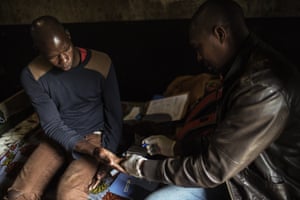
A sugar cane plantation farm worker gets tested for HIV by an health worker working with Doctors withour borders (MSF) at her house in Gwegwe on November 6, 2014 on the outskirt of Eshowe. The World Health Organization (WHO) says there were some 35 million people around the world living with HIV by the end of 2013, with some 2.1 million new infections during the course of that year. Sub-Saharan Africa is the most affected region, with almost 70 percent of new infections.


A sugar cane farmer gets tested for HIV by an MSF health worker in Gwegwe on the outskirts of Eshowe, 2014. Photograph: Gianluigi Guercia/AFP/Getty Images

In Eshowe, a town of 14,000 people set among rolling hills and sugar plantations, Médecins Sans Frontières has been pioneering testing by health workers who go door to door. MSF has also opened testing booths next to the butcher’s and by the taxi rank, where working men pass by on payday. They have found the same thing as the researchers in KwaZulu-Natal. They can get high proportions of people tested – but not to the clinic to get the drugs.


“We give them referral letters to the clinic. Then you find they don’t go,” says Babongile Luhlongwane, who walks miles every day on rough tracks with her kit in a backpack to reach those who live in this rural community. “Last Monday I had three men who tested positive. Two went to the clinic. The other said he didn’t have time.”


Dr Carlos Arias leads MSF’s initiative to set up monthly clinics on sugar plantations, testing workers for HIV and delivering medication. He says they see people with Aids who have virtually no immune system left.


Related: Village girls fight scourge of the ‘blessers’ – whose gifts ruin their lives


South African guidelines say people should be treated when their CD4 count – a measure of the strength of their immune system – drops below 500. “We see CD4 counts of less than 100 – CD4s of five or six,” he says. A serious infection would kill them. He tells of one man who arrived with a CD4 of 13 but did nothing about it. Two years later he was tested again and had a CD4 of 8. That means the virus in his body will be rampant and he will be highly infectious to a sexual partner. “HIV prevalence here is enormous,” he says. “In KwaZulu-Natal, among women aged 15 to 29, it is 56.8%.”


The Africa Centre trial in northern KwaZulu-Natal compared what happened in 22 clusters of 1,000 people: half were randomly allocated to test and treat, half told they would be given drugs when their CD4 count dropped below 350 (500 when government guidelines later changed). The trial set up a mobile clinic in each of the 22 clusters.


The trial investigated whether immediate treatment led to a drop in the numbers becoming infected. The answer, to their dismay, was no.


“Disappointingly, we found no difference in the number of new infections between these two randomised sets of clusters,” says Deenan Pillay, director of the Africa Centre and professor of virology at University College London.


Sex in the cities was an issue. People were travelling away from home into Durban and Johannesburg a lot more than expected, and having sex there. But more problematic are the social and cultural mores that have long beset HIV response in Africa. Far fewer men went to the clinics for treatment than women. “It is a hierarchical society. It is about being seen to be positive. There is stigma associated with it,” says Pillay.


He has been working with this community for more than 10 years, he says, and saw the huge change when people stopped dying. “Treatment was first used for people who were very ill and dying – and they lived. Now we talk about people who appear well and look well and you are asking them to medicalise themselves, to go to this government clinic where you have to queue up all day and you see other people you know there.”


People walk by a Doctors withour borders (MSF) HIV testing mobile clinic on November 6, 2014 in Ngudwini on the outskirts of Eshowe. The World Health Organization (WHO) says there were some 35 million people around the world living with HIV by the end of 2013, with some 2.1 million new infections during the course of that year. Sub-Saharan Africa is the most affected region, with almost 70 percent of new infections.


An MSF mobile clinic to test people for HIV in Ngudwini, on the outskirts of Eshowe, 2014. Photograph: Gianluigi Guercia/AFP/Getty Images

Pillay thinks more must be done to target the sugar daddies or “blessers” – the older, working men who give gifts and money to impoverished young girls in exchange for sex. About 60% of new cases are women. “It is horrendous. In our setting, a 15-year-old girl today has an 80% chance of being infected in her lifetime,” he says. At antenatal clinics where pregnant women are all tested for HIV, half are positive.


The government has launched a campaign telling young girls not to sleep with older men. But, says Pillay, “the real problem is the men who are not being tested and treated”.


“It is a complete crisis. The message of the conference is that there is all this hope – and it is not sustainable.”


Cost is a huge and growing issue. If test and treat worked, it would slash the bills by preventing new infections. But that assumption now seems premature and funding from donors has dropped for the first time. A report by the Kaiser Family Foundation and UNAids says they gave $ 7.5bn last year, compared with $ 8.6bn in 2014.


The drugs bill is going to rise dramatically, not just because of the increase in infections and the fact that everybody must take antiretroviral therapy for life, but also because resistance is spreading to the basic three-drug combination available in Africa for as little as $ 100 a year. Hospital beds are once more taken up by Aids patients whose treatment has failed. Africa cannot afford the newer drugs available in Europe and the US.


MSF has found resistance levels to the basic combination of 10% in its South Africa projects. There has been worse news in other parts of Africa. A study covering Kenya, Malawi and Mozambique found 30% of people on second-line treatment, which costs at least $ 300, were resistant. The lowest cost of a third-line drug regime – or salvage therapy – in Africa is $ 1,859 a person annually.


“I think we are seeing the tip of the iceberg,” says Dr Vivian Cox of MSF. “A lot of countries are not doing routine viral load monitoring in the first place. They are moving towards it and then you can imagine what they will find.”


Youth focus


Related: Under the shadow of ‘dirty’ HIV, South African children offered a refuge


Nobody at this year’s conference was talking about the end of Aids, as they were only four years ago when the conference was held in Washington DC. Bill Gates expressed real concern. If it is difficult now to treat and prevent HIV infections, he said, the demographic bulge could make things worse.


“If we only do as well as we have been doing, the number of people with HIV will go up even beyond its previous peak,” Gates said. “We have to do an incredible amount to reduce the incidence of the number of people getting the infection. To start writing the story of the end of Aids, new ways of thinking about treatment and prevention are essential.”


A vaccine is still a long way off. Pre-exposure prophylaxis works for the partners of people with HIV in the global north. Taking an antiretroviral drug guards them against infection. But that looks very hard to implement for young women in Africa who barely own their own bodies and could face accusations of either having HIV or being a prostitute.


There are brave attempts to change behaviour and the subservience of women and girls. Actor Charlize Theron is funding projects to educate, help and support young people. MTV’s Staying Alive Foundation is attempting to reach young people through its mass media campaign Shuga, sharing the sexual lives of more affluent young Africans. After two series in Kenya and two in Nigeria, the fifth will be filmed in South Africa.


Surveys carried out in South African schools to determine the issues facing 14- to 20-year-olds before the new series offer a glimpse of the dangers they face. A third of girls said a girl does not have the right to ask a boy to stop kissing her. A quarter of the boys said they had “sexually forced” someone. A fifth of the girls said they were sexually active and most of those had been forced into sexual activity at some point.


Charlize Theron visits a project to create youth ambassadors in KwaZulu-Natal, 2013


Charlize Theron visits a project to create youth ambassadors in KwaZulu-Natal in 2013. Photograph: Justin Barlow/Getty Images/The Global Fund

“The figures point to 86% of sexually active girls experiencing being sexually forced by their boyfriends,” say the researchers. “These figures … reflect a need to understand what is going on within heterosexual relationships and the experience and position of risk within those relationships. It also calls for HIV prevention efforts to help build safe and supportive norms within relationships.”


Of the girls among the 3,000 students surveyed in three provinces over two years, 15% said they had been pregnant – which equates to 70% saying they are sexually active. Nearly half the young people – 46% – said a young couple who went public about one of them becoming HIV positive would be openly judged and 4% thought they would be physically harmed. “This indicates the fear-filled environment South African young people are still growing up in when it comes to HIV,” says the report. “Fear keeps people silent and silence feeds everyone’s risk for HIV and for not getting the care and support they require to address HIV infection.”


Research is showing that Shuga does have an impact on young people’s behaviour. “Where we see behaviour change work really well is when the audience see their own lives reflected in the storylines,” says Georgia Arnold, executive director of the MTV Staying Alive Foundation, who says she wants to get a DVD to every one of the 6 million high school students in South Africa.


“We’ve had a recent World Bank study that was done on … series four in Nigeria. It was a random, cluster study of 5,000 young people and what it proved was that if you watched MTV Shuga you are twice as likely to get tested for HIV.”


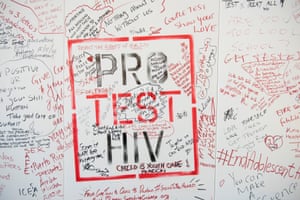
A slogan reading pro test hiv from the 2016 aids conference in Durban


The biggest challenge in fighting HIV is stopping people becoming infected. Photograph: Steve Forrest/International Aids Society

Behaviour change could stop the epidemic – although it is not doing so in Europe or the US – and initiatives could help improve young people’s lives. But it is difficult and slow. Aids will be with us for far longer than anybody used to imagine.


Professor Peter Piot, the first head of UNAids and director of the London School of Hygiene & Tropical Medicine, says the biggest challenge is keeping people from being infected. “It is as if we’re rowing in a boat with a big hole and we are just trying to take the water out. We’re in a big crisis with this continuing number of infections and that’s not a matter of just doing a few interventions.


“We will not end HIV as an epidemic just by medical means. People are not robots. Sex happens in a context. It is about power. Southern African girls and young women are infected by men who are much older than themselves. It’s about poverty. It’s also about a culture of machismo. There are also gay men all over the world who are discriminated against and underground, and there’s no way you can prevent infections if something is underground.”


He believes that it was a mistake to foresee the end of the epidemic a few years ago. “I don’t believe the slogan ‘the end of Aids by 2030’ is realistic and it could be counter-productive. It could suggest that it’s fine, it’s all over and we can move to something else. No. Aids is still one of the biggest killers in the world.”


Think the Aids epidemic is over? Far from it – it could be getting worse | Sarah Boseley