Bird etiketine sahip kayıtlar gösteriliyor. Tüm kayıtları göster

28 Ocak 2017 Cumartesi

Officials confirm second bird flu outbreak in Lancashire

A second outbreak of bird flu has been confirmed in Lancashire, the Department for Environment, Food and Rural Affairs has said.


The H5N8 avian flu strain was confirmed in a flock of about 1,000 pheasants at a premises in Pilling, Preston, by the UK’s deputy chief veterinary officer, Graeme Cooke.


Defra said there was a business link between the site and a nearby farm where the infection was found in a flock of about 10,000 pheasants earlier this week.


A 3km (1.8 mile) protection zone and a 10km (6.2 mile) surveillance zone had been put in place around both infected premises to limit the risk of the disease spreading.


A Defra spokesman said: “This case was proactively identified as part of a routine investigation of premises traced as a result of confirmation of the disease in Lancashire earlier this week. There is a business link between the two premises.”


A number of the birds in the latest case had died and the others would be culled humanely.


Public Health England has advised that the risk to public health from the virus is very low, and the Food Standards Agency made clear that bird flu did not pose a food safety risk for UK consumers.


On 16 January, Defra confirmed a case of bird flu in a flock of about 6,000 turkeys at a farm in East Lindsey, Lincolnshire.


Earlier in the month, the strain was discovered in two small backyard flocks of chickens and ducks on a premises near Settle, in North Yorkshire, and Carmarthenshire, south-west Wales.


An avian influenza prevention zone was declared on 6 December and would remain in place until February 28. It required owners to keep poultry and captive birds indoors or to take steps to separate them from wild birds.


Officials confirm second bird flu outbreak in Lancashire

25 Ocak 2017 Çarşamba

UK egg producers warn free range sector at risk due to bird flu controls

UK egg producers have warned that the future of the premium free range sector is at risk if the eggs lose their prized status because of the ongoing threat of bird flu.


Flocks of free range hens are being housed indoors because of the bird flu outbreak – and if they are unable to go back outside by the end of February the eggs would be downgraded to “barn produced”, the British Egg Industry Council (BEIC) has warned.


In early December last year the Department for Environment, Food and Rural Affairs (Defra) ordered that all free range hens – providing eggs or meat – should be housed to protect against the threat of the H5N8 influenza virus. At that time there were no cases in the UK but there were numerous reports of cases in other European countries. The so-called “housing order” was for 30 days.


Since then, cases of H5N8 have been found in the UK – on two turkey farms in Lincolnshire and in backyard flocks in Wales and North Yorkshire – as well as in a number of wild birds around the country. Chief veterinary officer Nigel Gibbens subsequently extended the housing order until the end of February. Bird flu has since been found in a flock of farmed pheasants in Lancashire, Gibbens confirmed this week.


Concern is now growing among free range producers because the extension will take the housing order to the end of the 12-week period – imposed by the European Union – beyond which free range birds will lose their status unless they are allowed outdoors. Mark Williams, chief executive of the BEIC, is calling for the 12-week cut-off to be extended.


“The egg industry is hoping that the risk of avian influenza from wild birds will dissipate to the level that free range hens can go back outside after that date, and are currently planning enhanced biosecurity measures to ensure that any risk to the hens’ health, particularly from contact with wild birds, is minimised,” Williams said.


“If the chief veterinary officer advises that free range hens need to continue to be housed for a further period (possibly one or two months) the industry is planning to put stickers on free range egg packs explaining that the birds are currently housed, accompanied by point-of-sale material in supermarkets and a website for further information, to ensure full transparency for consumers.”


Free range eggs currently represent 56% of UK retail egg sales – the highest proportion of any European country – whereas just 2% of eggs are from the barn system.


Williams said that if free range hens were unable to go back outside at the end of February, the viability of the free range sector would suffer if their eggs were to be downgraded to barn.


“There would not be sufficient barn packaging to enable a wholesale switch across the industry, particularly when it is unlikely to be required for more than a few weeks. There would also be a delay in the correct free range packaging being available again after the hens return outside.”


The BEIC said free range producers still incur the same costs for land and staff while birds are housed, and in some cases face increased costs to house their birds. Most free range production in the UK comes from small, independently-run family farms whose existence would be threatened by not being able to continue to sell their eggs as free range, with appropriate labelling, should the current housing order be extended.


Farmers’ leaders in other EU countries are pressing for the same extension, and the issue was raised by both Dutch and Belgian representatives at a meeting of the EU agriculture and fisheries council earlier in January.


Between October and January there were a total of 761 outbreaks of H5N8 in Europe – 51% in poultry and the rest in wild birds. Some 1.6m poultry birds were destroyed. As well as affecting 18 countries in Europe, H5N8 has also been found in Asia, Africa and the Middle East.


Public Health England advises that the threat to human health from avian flu remains low.


UK egg producers warn free range sector at risk due to bird flu controls

16 Ocak 2017 Pazartesi

Bird flu found in flock of 6,000 turkeys in Lincolnshire

Bird flu has been confirmed in a flock of about 6,000 turkeys at a farm in Lincolnshire, the Department for Environment, Food and Rural Affairs (Defra) has said. The H5N8 strain of avian flu – the same as that found in a flock of turkeys on a nearby farm on 16 December – was confirmed by the UK’s chief veterinary officer, Nigel Gibbens.


A number of birds at the farm in East Lindsey have died, and those remaining will be culled. The two cases are unlikely to be linked, but an investigation is under way, Defra said.


A 3km protection zone and 10km surveillance zone have been put in place around the affected farm to limit the risk of the disease spreading. It comes after H5N8 avian flu was found in flocks in Carmarthenshire, south west Wales, and Settle, North Yorkshire, earlier this month.


Bird flu found in flock of 6,000 turkeys in Lincolnshire

8 Ocak 2017 Pazar

Bird flu found in North Yorkshire back yard

Bird flu has been found in a small flock in a back yard in North Yorkshire, the UK’s chief veterinary officer said, warning that people who kept chickens and ducks in their gardens needed to be vigilant.


A 3km protection zone and a 10km surveillance zone have been put in place around the infected premises, near Settle, to limit the risk of the disease spreading. The remaining live birds in the small flock of chickens and ducks are being humanely culled, the department for Environment, Food and Rural Affairs (Defra) said.


The same H5N8 strain of avian flu has been confirmed at a poultry farm in Lincolnshire and at a premises in Carmarthenshire, Wales. It has also been found in wild birds in England, Scotland and Wales.


The advice from Public Health England is that the risk to public health from the virus is very low. The Food Standards Agency has made clear that bird flu does not pose a food safety risk for UK consumers.


The chief veterinary officer, Nigel Gibbens, said: “We have taken swift action to limit the risk of the disease spreading. Restrictions are now in place around the affected premises and a full investigation is under way to determine the source of the infection.


“This finding in a back yard flock shows how essential it is for all poultry owners, even those who just keep a few birds as pets, to do everything they can to keep them separate from wild birds and minimise the risk of them catching avian flu via the environment.


“This means keeping birds in a suitable building where possible, and taking precautions such as putting up netting, keeping food and water inside and disinfecting footwear and equipment after contact with birds.”


An avian influenza prevention zone that has been in place since 6 December will be extended until 28 February to help protect poultry and captive birds from avian flu, Gibbens said.


The zone requires keepers of poultry and other captive birds to continue to keep their birds indoors, or take appropriate practical steps to keep them separate from wild birds.


It covers England and similar declarations have been made in Scotland and Wales. There is also a Britain-wide ban on poultry shows and gatherings.


Bird flu found in North Yorkshire back yard

6 Ocak 2017 Cuma

French authorities gas thousands of ducks after bird flu outbreaks

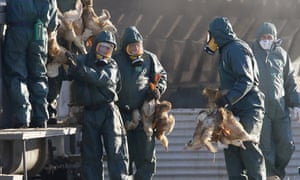
Workers wearing masks and protective clothes have gassed thousands of ducks in south-west France, in a massive cull that was ordered in an attempt to prevent a spread of the H5N8 bird flu virus.


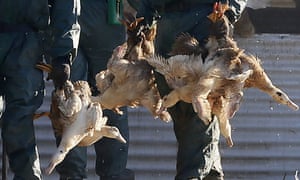
At one farm in the village of Latrille, in the heartland of duck and geese rearing country, 8,000 ducks were taken by hand and put in coloured metal containers where carbon dioxide was piped in to kill them, normally within seconds.


Workers clad in head-to-toe protective suits, face-visors and gas masks, finished the slaughter in the space of a few hours.


France, which has the largest poultry flock in the European Union, has reported 95 outbreaks of the virus.


Most of the cull is taking place in and around the Gers area of south-west France, where geese and ducks are reared in vast numbers to make foie gras.


About 800,000 birds out of a population of about 18m in the whole of the south-west are due to be killed in the coming week.


Workers carry ducks before placing them in a bin filled with carbon dioxide at a poultry farm in Latrille, south-west France.


Workers carry ducks before placing them in a bin filled with carbon dioxide at a poultry farm in Latrille, south-west France. Photograph: Bob Edme/AP


The operation is part of mass cull of poultry in France, which has reported 95 outbreaks of the H5N8 bird flu virus.


The operation is part of mass cull of poultry in France, which has reported 95 outbreaks of the H5N8 bird flu virus. Photograph: Bob Edme/AP


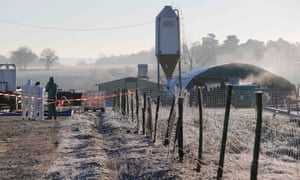
France, which has the largest poultry flock in the EU, has ordered the cull of ducks in its three most-affected regions.


France, which has the largest poultry flock in the EU, has ordered the cull of ducks in its three most-affected regions. Photograph: Regis Duvignau/Reuters


French authorities gas thousands of ducks after bird flu outbreaks

16 Aralık 2016 Cuma

Bird flu outbreak confirmed at turkey farm in Lincolnshire

A bird flu outbreak has been confirmed at a turkey farm housing more than 5,000 birds in Lincolnshire.


The Department for Environment, Food and Rural Affairs (Defra) said on Friday the H5N8 strain had been found at the farm near Louth. The virus has been circulating in mainland Europe.


All of the surviving animals will be culled and a protection zone has been placed around the facility. Officials said there was a low risk to the public and insisted there would be no impact on the Christmas turkey supply.


Most birds at the premises have died already, officials said, adding that a 3km (1.9 mile) protection zone and a 10km surveillance zone had been put in place around the farm to help stop the spread. Birds must be kept housed in the zones and the moving or gathering of them is banned.


An update on the Defra website said: “We are taking immediate and robust action and an investigation is under way to understand the origin of the disease and confirm that there are no further cases.”


Public Health England said the risk to public health from the virus was very low and the Food Standards Agency said bird flu did not pose a food safety risk. Thoroughly cooked poultry and poultry products, including eggs, were safe to eat, officials said.


The chief veterinary officer, Nigel Gibbens, said: “Avian flu has been confirmed on a turkey farm in Lincolnshire. This is the same strain that has been affecting poultry in Europe. Immediate steps have been taken to limit the risk of the disease spreading and all remaining poultry at the farm will be culled.


“Bird keepers should remain alert for any signs of disease, report suspected disease immediately and ensure they are maintaining good biosecurity on their premises. We are urgently looking for any evidence of disease spread associated with this farm to control and eliminate it.”


A PHE spokesperson said: “Avian flu (often called bird flu) is primarily a disease of birds. There have never been any recorded cases of H5N8 in humans and the risk to public health is considered very low. We continue to work closely with Defra throughout this investigation. Despite the risk being very low, we will offer health advice to those people who may have been exposed on the farm as a precaution.”


Defra said a detailed investigation was in progress to determine the most likely source of the outbreak, which is the first in the UK since January.


Since June, countries in Europe and Asia have detected A(H5N8) infections in wild birds and/or domestic poultry including Austria, Croatia, Denmark, Germany, Hungary, India, Israel, the Netherlands, Poland, Russia and Switzerland, according to the World Health Organisation, although most were associated with wild birds.


Bird flu outbreak confirmed at turkey farm in Lincolnshire

26 Kasım 2016 Cumartesi

190,000 ducks destroyed at six Dutch farms after bird flu outbreak

Some 190,000 ducks were destroyed on Saturday at six farms in the Netherlands following an avian flu outbreak, the country’s first cull in response to an epidemic sweeping northern Europe.


Outbreaks of avian flu, primarily the highly pathogenic H5N8 strain, have been reported in Denmark, Finland, Germany and Sweden over the past week.


Dutch authorities did not say what strain of the virus had been discovered at a poultry farm in the village of Biddinghuizen, 70km (43 miles) east of Amsterdam.


The cull was implemented at four other sites owned by the same company and at a sixth farm less than a kilometre from the site of the confirmed outbreak.


Officials said they were checking for bird flu at farms within three kilometres of the original site and imposed a ban on transporting poultry products within a 10km radius.


The world’s second largest agricultural exporter, the Netherlands has more than 100 million hens, pigs, cows and sheep on high-intensity farms. The density makes the animals more vulnerable to disease outbreaks.


Since 1997, 40 million hens, cows, goats, pigs and sheep have been slaughtered to contain outbreaks including swine flu, foot-and-mouth disease and BSE.


190,000 ducks destroyed at six Dutch farms after bird flu outbreak

18 Temmuz 2014 Cuma

From anthrax to bird flu the dangers of lax security in illness-management labs

For the danger they posed, the lapses have been appalling. They place lives at threat, that significantly is clear. But they had been surprising, too, due to in which they took place. The US government’s large-security disease-handle laboratories – which property samples of the most harmful germs in the globe – can not afford to screw up.


Very first came news of a single incident. Personnel functioning on deadly bioterrorism agents at the Centres for Condition Manage and Prevention (CDC) in Atlanta followed the incorrect method to “inactivate” batches of Bacillus anthracis, the bacterium that brings about anthrax. However probably nonetheless lethal, the bugs had been sent to one more CDC lab in which personnel have been not outfitted to deal with reside spores. A report into the lapse published last week exposed a worrying pattern of employees failures, and found that dozens had been potentially exposed. The CDC doled out antibiotics and anthrax vaccine. Impacted rooms had been sterilised. They had been fortunate: no one particular got the disease. But that is hardly the point.


It was not an isolated occasion. As CDC investigators finalised their report into June’s anthrax scare they unearthed a more alarming incident that had gone unreported. In March, lab workers sent samples of a pretty harmless strain of bird flu to scientists at the US Division of Agriculture. To the agricultural team’s alarm, every single chicken they contaminated with the virus died. It was only soon after 21 birds had succumbed that they discovered why: the CDC samples had been contaminated with a strain of highly lethal H5N1 bird flu. Organic outbreaks of the virus have killed hundreds of folks in Asia.


The director of the CDC, Tom Frieden, took swift action. He closed the CDC’s anthrax and influenza labs and imposed a ban on the shipment of biological material in or out of the CDC’s highest-protection labs even though safety procedures are revamped. At a press conference last week, Frieden mentioned the behaviour of some workers had been “completely unacceptable … Frankly, I’m angry about it.” On Wednesday, Frieden was referred to as ahead of a US Residence oversight committee to describe himself. The chairman, Tim Murphy, did not hold back. The incident was “troubling”, “totally unacceptable”, the CDC’s reputation “tarnished”. Frieden, he mentioned, had referred to as the anthrax scare a “wake-up phone”. But that was a “hazardous understatement”, Murphy warned. “It was a probably really dangerous failure,” he mentioned.


The incidents cast a lengthy shadow more than the organisation charged with defending the US public. But a third incident points to a broader failure in US biosecurity. In early July, 6 vials of smallpox have been identified in a storage area at an unguarded FDA lab in Maryland that after belonged to the US Nationwide Institutes of Wellness. Following the eradication of smallpox, a horrific disease that kills 30% of individuals it infects, official stocks are stored only at the CDC in Atlanta and at the Russian Vector lab in Novosibirsk. The samples located in the NIH lab probably date back to the 1950s, but tests at the CDC discovered that despite their age, smallpox in two of the 6 vials was even now alive and hazardous. (The last fatal situation of smallpox in the United kingdom took place in 1978, when the virus escaped from a laboratory at the University of Birmingham.) The bad news did not finish there. On Wednesday, federal investigators reported far more harmful materials from the very same room. In all, they found twelve boxes containing 327 vials labelled with a variety of unpleasant pathogens, from influenza and dengue fever to rickettsia and Q fever.


Center for Disease Control and Prevention (CDC) Director Tom Frieden CDC director Tom Frieden was named just before a US Property oversight committee to explain the current lapses, which he admitted had been ‘totally unacceptable’. Photograph: Mandel Ngan/AFP/Getty Pictures


It was the NIH’s turn to apologise. Its director, Francis Collins, stated that “overlooking such a sample collection for years is obviously unacceptable”. He ordered a total search of all fridges, freezers, cold rooms, storage shelves and cabinets, as properly as offices linked to laboratories, in case other unsafe agents had gone missing. To the outdoors globe, the most trusted keepers of lethal germs had proven themselves to be dangerously incompetent.


The failings will have direct consequences at the CDC and NIH, but the fallout from the lapses will be felt far past the US. There are main lessons to be discovered about human error that even the most vigilant high-safety labs in Europe, Asia and elsewhere must heed. But for some scientists, the incidents contact for a lot more drastic action. Some want the variety of laboratories holding lethal bugs to be slashed, to minimise the chance of a catastrophic accident. Other people want the highest-risk experiments curtailed, arguing that the fresh understanding they bring is not well worth the actual danger of an accidental outbreak.


“This is not just getting noticed as some thing across the Atlantic. There will be knock-on considerations, there have to be,” said John McCauley, director of the WHO influenza centre at the National Institute for Health-related Analysis in London. “These incidents remind us that accidents, even though incredibly uncommon, can take place, and we need to be conscious of how they occurred so we can minimise or even eliminate that kind of accident occurring elsewhere.”


Eight labs in the United kingdom are permitted to function with the most dangerous pathogens, and aside from two animal vaccine makers, all are government-sponsored. Some, which includes the military labs at Porton Down, are planet class, but other people, this kind of as the Institute for Animal health at Pirbright are reportedly much more run-down. The 2007 outbreak of foot-and-mouth disease practically certainly came from the Pirbright lab, in accordance to a Commons science committee report.


At Wednesday’s US hearing on the CDC anthrax scare, Richard Ebright, a biosafety specialist at Rutgers University, known as for a dramatic reduction in the quantity of labs permitted to perform on the bugs, from one,500 or so in the US to nearer 50, in order to minimise the risk of a severe accident. He urged the government to set up an independent federal company to regulate the operate, one particular with actual powers to shut down labs that operated dangerously.


The US government is unlikely to embrace Ebright’s plan. On Sunday evening, the NIH sacked half of its biosafety panel by e-mail. The move ousted 11 of the government’s authentic advisers, who in the previous had raised issues about experiments to produce hazardous new pathogens. Critics are now waiting to see who will exchange the fired advisers. A single advised the Guardian the replacements would be “yes guys”.


Anthrax bacteria Anthrax bacteria related to individuals transported among US CDC labs in violation of security protocol last month Photograph: EPA


Ron Fouchier, a virologist at Erasmus health care centre in Rotterdam, mentioned slashing the number of labs working with dangerous pathogens would be a huge blunder. “The cause so many labs are undertaking pathogen analysis is due to the fact there is so significantly to be investigated, in the curiosity of public and animal wellness,” he stated. The number of organisms that need to have higher-protection labs is growing. There are ongoing outbreaks of anthrax, various strains of bird flu, Ebola, and Middle East Respiratory Syndrome (MERS), which has killed hundreds in the Middle East, and a handful more in Africa, Asia, Britain, France and Germany. “I locate it difficult to believe theat Dr Frieden or Dr Ebright may well consider that some of the work is not necessary and can be hence be lowered,” Fouchier advised the Guardian. He mentioned his lab currently employed harmful pathogens only when there was no alterative. Working in large-safety labs “is not exciting, and is extremely high-priced”.


But the breaches in the US have fuelled concerns about some of the far more intense studies that scientists do. When the CDC declared its anthrax incident, Marc Lipsitch, professor of epidemiology at the Harvard College of Public Well being, explained we should be glad it was only anthrax. He fears that scientists, Fouchier incorporated, pose far greater dangers to the public by intentionally making harmful pathogens. In 2011, Fouchier announced that he had mutated bird flu to make it spread very easily in animals by way of coughs and sneezes. Advocates for these experiments, recognized as gain-of-function research, say they give scientists essential insights into the varieties of viruses to concern in nature. To Lipsitch and several other individuals, the irony is all as well clear. In striving to avoid the next pandemic, they say Fouchier and his colleagues make a disastrous outbreak more most likely.


Earlier this week, Lipsitch convened more than a dozen researchers who shared his considerations. The end result of their meeting was the Cambridge Working Group consensus statement calling on the US government to “curtail” experiments that produce probably pandemic pathogens, right up until proper danger assessments have been carried out. Even though Fouchier and other folks describe that they have previously been by means of numerous risk assessments, and operate underneath very tight protection, their critics are not reassured.


A single of the signatories of the Cambridge Operating Group statement is Sir Richard Roberts, a British scientist and Nobel prize winner, who now works at New England Biolabs in Massachusetts. Roberts hasn’t seen the risk assessments for Fouchier’s experiments, but notes that even the CDC labs, “which were typically regarded as to be the safest labs out there”, had had problems. “How can you believe in anyone? Humans are human. Men and women make problems.”


Lipsitch’s group desires to convene a meeting that brings together scientists and other professionals to debate the possible hazards of creating unsafe pathogens, and to draw up binding suggestions to ensure that potential experiments are safe. The program mirrors the landmark Asilomar conference in California in 1975, which was largely driven by younger scientists who had concerns over the unknown risks of swapping genes in and out of various organisms. The meeting set critical ground guidelines – like the introduction of biosafety containment levels all around the world – for genetic scientific studies to this day.


Vincent Racaniello, a virologist at Columbia University in New York, explained the Cambridge Operating Group was “infuriating” due to the fact it misled folks into believing that viruses created in laboratories were a serious risk to the public. But because the experiments are done in ferrets, he argues, it is not possible to know if the bugs would spread in men and women, and how unsafe they may possibly be. He added that determining which experiments went ahead on the basis of a risk-benefit analysis was “absurd”, since it was typically unattainable to know the positive aspects of an experiment beforehand.


McCauley largely supports the experiments at the centre of the controversy, arguing that they reveal how viruses in the wild transform from harmless strains to far more unsafe types. “I need to have to be in a position to advise folks,” he said. “And it tends to make me really feel a whole good deal happier being aware of a lot more.”


Roberts, however, is having none of it. “The dangers are massive and the positive aspects, to my mind, are non-existent,” he said. “If I recommended that you consider to make the most virulent and harmful virus that we can picture, some thing that could destroy a quarter of the world’s population if it received out, does that look a sensible factor to do? That strikes me as being definitely ridiculous.”


From anthrax to bird flu the dangers of lax security in illness-management labs

4 Şubat 2014 Salı

Bird flu: new strain claims initial victim

He explained: “It reveals that the H10N8 virus has continued to circulate and could result in far more human infections in long term.”


The dead girl had visited a dwell poultry market a couple of days prior to infection, suggesting an incubation time of about 4 days – similar to that of other bird flu strains.


Swab samples were taken from the woman victim’s windpipe and the benefits reporting the initial human death associated with H10N8, appear in The Lancet medical journal.


Dr Jeremy Farrar, director of the Wellcome Believe in, stated viruses that crossed the species barrier were constantly worrying because it was unlikely people would have prior immunity.


He said: “We should be especially anxious when individuals viruses display qualities that propose they have the capability to replicate very easily or to be virulent or resistant to drugs. This virus ticks many of these boxes and consequently is a result in for concern.”


But other people said that with no proof of the strain spreading from human to human, there was no trigger for main alarm.


Dr Ben Neuman, a virologist at the University of Reading, said: “The patient will have had get in touch with with tens or hundreds of friends, household, acquaintances and wellness care employees ahead of the severity of the condition was obvious.


“As however there are no reviews that the virus has spread to anyone else. H10N8 fits the profile of an avian flu virus in that the ailment is terrible, but the virus is not readily transmitted.”


Bird flu: new strain claims initial victim