refugee etiketine sahip kayıtlar gösteriliyor. Tüm kayıtları göster

9 Eylül 2016 Cuma

Small acts of kindness ... but it"s not enough for women in refugee camps

In a refugee camp near the Greek city of Thessaloniki, I treated a Kurdish woman in her early twenties for a throat infection. Before she left, the translator asked her if there was anything else we could help her with. She broke down in tears. She had four children who she was struggling to look after and keep clean. She showed us a photograph of her children, just one year ago, well dressed and smiling. This woman was not only tired and desperate, she was ashamed of her living conditions. The food was bad, toilets revolting and she could not properly look after her family.


This refugee crisis is the worst in living memory. The UNHCR currently estimates that there are 65.3 million people displaced from their homes by conflict and persecution globally. Many are women and 41% are children.


Women were deliberately not drinking water so they could avoid a trip to the revolting portable toilets


In times of crisis women bear the brunt. All refugees are marginalised, but the women are particularly vulnerable to exploitation and physical and sexual harm. Many are victims of unimaginable atrocities as they flee their home countries. Pregnant women and those with small children are uniquely vulnerable on the dangerous journey to Europe. Throughout these camps there are widespread reports of gender-based violence.


In the camps women are under extraordinary pressure. Many have young families to provide for. Living in small tents they need to look after their children, feed their families, keep them clean and try to retain some normality with dignity.


Women are hit hardest by poor access to sanitation and water. Washing clothes for large families in a refugee camp becomes an impossible task. Summertime Greece is hot, in the camp where I worked women felt they could not keep clean and were deliberately not drinking water so they could avoid a trip to the revolting portable toilets; just six for a camp housing 600. They were risking dehydration and kidney and urine infections. One woman cried as she described the shame she felt about having to urinate in a bucket inside a tent that she shared with her large family.
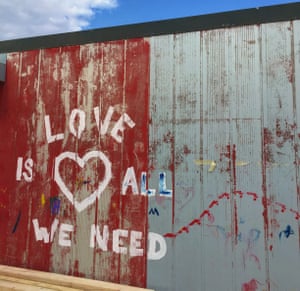


Graffiti at the camp


Small acts of kindness do not solve the problems but they do give some comfort and dignity. Photograph: Hannah Mitchell

Asides from the issue of sanitation, the toilet area was poorly lit and women felt afraid and unsafe going there at night, with reports of intimidation and fights.


In the rush to respond to the large numbers of refugees arriving, many of the camps have sprung up in previously abandoned warehouses. They were not designed for human habitation. However, provision of clean, well-lit sanitation facilities, which a large number of people can use is not a difficult task and something that could be easily addressed in the camps.


Another recurring theme was that women did not want to be intimate with their partners. Many felt pressured into having sexual relations and there were newly pregnant women in the camps. Women have distinct health needs that can easily be overlooked in the response to acute medical needs. Provision of good maternity care and being pragmatic about access to family planning should be prioritised.


Many of the women had previously assumed the role of carer in their family, and many were deeply upset by their inability to carry out that role in the camps. The UNHCR emphasises that women must be involved specifically with the management and distribution of resources. There was little evidence of this on the ground in the camps. Unfamiliar and unpalatable food was given out. Many of the women complained that by the time it arrived it was hardly edible.


We need to empower women in the camps


Central to the humanitarian response should be empowering these women who have lost everything. Many of the women felt they weren’t being listened to. Here simple, pragmatic things can make a huge difference; volunteers in one of the camps organised distribution of fresh fruit and vegetables, which were needed to cook traditional meals from back home. Another gave out cooking utensils. Many of the women were delighted by this. Another volunteer gave pillows to each of the tents. These small acts of kindness do not solve the problems but they do give some comfort and dignity.


These women see no solution to their problems … They wait with their children for their lives to start again


However, the painful reality is that these women see no solution to their problems within reach. They wait with their children for their lives to start again. They are terrified for their children’s future as they have no access to formal education. One said that a prison sentence would be better than being in the camps, because at least then they would know when they would get to leave.


The responses of local people in the towns hosting the refugees was mainly one of kindness and compassion. The volunteer response, though at times chaotic, shows some of the large amount of goodwill towards refugees in Europe. The response of some of the European countries to the refugees is shameful, especially the failure of the UK to provide a safe haven for the many unaccompanied child refugees.


The world has been slow in its response to the refugee crisis, but this is an issue that will affect us all for many generations. These women have faced the most appalling conditions with the utmost of resilience and dignity. As the refugee crisis slips down the news agenda and out of the public’s mind, these families are going nowhere. If Lebanon, a country with a population of under 5 million can host 1.5 million refugees, then surely the rest of the world can play its part too.


Translation by Nada Sarsour, Amer Sawaf, Mohamad Abou Ras, Mariam Saleh and Mohamad Namo.


Join our community of development professionals and humanitarians. Follow @GuardianGDP on Twitter. Join the conversation with the hashtag #SheMatters.


Small acts of kindness ... but it"s not enough for women in refugee camps

5 Ağustos 2016 Cuma

Refugee with growing breast lump has medical transfer from Nauru cancelled

A refugee on Nauru with a growing lump in her breast has had her medical flight for treatment postponed indefinitely but has not been told why.


The 39-year-old Lebanese mother of four has had several scans over the past eight months that indicate the lump is growing, and doctors have requested she undergo a biopsy.


This week, more than a dozen refugees and asylum seekers who were scheduled to be flown to Papua New Guinea for medical treatment say they were told their flight, and their treatment, had been postponed for at least three weeks.


Related: NT royal commission ‘should also include children in immigration detention’


They were not told why their flights had been postponed but it has been reported that uncertainty over the legality of Australia’s offshore detention regime in that country has caused the flights to be abandoned.


The PNG supreme court ruled in April the Manus Island detention centre was “illegal and unconstitutional” and a decision in a second court challenge is imminent, which may further undermine Australia’s offshore regime there.


The woman on Nauru, whom the Guardian has chosen not to name, arrived in Australia in July 2013.


She first noticed a lump in her left breast about three years ago, but has developed increasing breast pain while living on Nauru, and has experienced a yellow-green discharge from her breast.


She underwent her first breast ultrasound on Nauru in late 2015. A subsequent ultrasound found two irregular masses in the woman’s left breast and confirmed at least one is growing.


Dr Paddy McLisky from Doctors 4 Refugees said a biopsy should have been arranged with some urgency at the first available opportunity.


“This is a medical scenario in which a biopsy is necessary to obtain a diagnosis and most importantly to rule out malignancy.”


McLisky said the woman did not have confidence in the Republic of Nauru hospital (RONH) to perform the biopsy safely.


“We are aware of multiple accounts that the RONH facilities are quite basic by Australian standards, and that general hygiene is a concern for refugees and asylum seekers who have attended RONH. The obvious solution is to have … [the refugee] assessed and a biopsy carried out in an appropriately resourced hospital in Australia.”


He said the woman was receiving a level of care “completely unacceptable in rural or metropolitan Australia”.


“Unfortunately, this case is only one of a multitude in which our government is falling far short of providing timely and adequate care to refugees and asylum seekers, due to political agendas.”


In response to questions from the Guardian, the department would not comment on the woman’s case specifically, but said in a statement:


“Due to unforeseen circumstances a medical transfer flight to Port Moresby scheduled for 4 August 2016 did not occur.


“The governments of Nauru and Australia are working with the government of Papua New Guinea to reschedule the transfer to Port Moresby for medical treatment as soon as possible.


“Persons scheduled for medical transfer will continue to receive medical treatment from the health services provider in Nauru.”


The department has consistently maintained that refugees and asylum seekers on Nauru and Manus Island have access to healthcare services “broadly comparable to those available within the Australian community”.


Australia has dedicated $ 26m towards upgrading Nauru’s hospital.


Meanwhile, on Australia’s other offshore detention island, Manus, refugees and asylum seekers held a late-night vigil for Pakistani refugee Kamil*, who drowned while swimming this week.


But refugees have also protested against plans by PNG authorities to bury the man on Manus Island. The detained refugees have said the man should be returned to his native Pakistan for burial, in accordance with his family’s wishes. They have even offered to sell their clothes and personal effects to fund the repatriation.


PNG authorities, after initially saying the man’s body could not be repatriated because it would cost too much, have agreed to meet with representatives of the refugees on Friday morning.


Australia funded the repatriation of two Iranian asylum seekers who died from injuries sustained while in detention on Manus: Reza Barati who was murdered by guards, and Hamid Kehazaei who died in a Brisbane hospital after his infection on Manus was inadequately treated.


However, a spokesman for the Department of Immigration and Border Protection said “funerary arrangements for refugees and transferees dying in Papua New Guinea are matters for the PNG government”.


“The department is aware that the PNG government has made contact with the deceased person’s next of kin and that local arrangements are being made for his burial.”


Iranian refugee Behrouz Boochani told the Guardian from inside the detention centre: “The Pakistani guys talked with Kamil’s family today and they do not agree to bury Kamil in Manus island. They want him sent back to Pakistan.


Related: Peter Dutton urged to ‘open his heart’ to plight of Iranian asylum seeker


“This is incredible that immigration want to bury him by force and it is immoral and inhumane. The Australian government is responsible and must send his body to Pakistan.”


Uncertainty over the future of the Manus regime has led to unrest in the detention centre compounds.


A Rohingyan refugee currently held at East Lorengau was prevented from a second suicide attempt in as many days, when fellow refugees took petrol from him. It’s understood the man had requested to return home, but because Rohingya people are not recognised as citizens by his native Myanmar he is legally stateless and cannot be returned there.


• The Guardian has chosen to publish only the man’s first name, out of concern for his family in Pakistan.


Refugee with growing breast lump has medical transfer from Nauru cancelled

26 Haziran 2014 Perşembe

A bitter pill: Syrian refugee medical doctors share their stories

Syrian refugee

A medic requires care of a newborn Syrian refugee child in the Lebanese town of Arsal. Photograph: Joseph Eid/Getty Photos


Dr Muhammed Selim, 41, Kawergosk camp


Muhammed, a common surgeon from Qamishli, had worked in the Al-Safira district, in the Aleppo governorate, since 2006. He worked at a government hospital in the morning and at his private clinic in the evening.


“Prior to 2011, daily life was happy and function was good,” he says. “I would function hard and after function I would get pleasure from visiting friends all around Aleppo.”


But when conflict started out in rural Aleppo, Muhammed found himself and his clinic in the midst of battle. “My clinic was situated in the vicinity of 3 strategic positions which have been currently being fought more than by numerous groups. I was stuck for eight months, unable to leave my clinic for Aleppo or anyplace else, and there were snipers all close to.


With fighting continuing each and every day, there was an exodus of people leaving Al-Safira. Muhammed managed to escape with his lifestyle, underneath fire, in January 2014. He recalls a extended and perilous journey via Ar-Raqqah and Al-Hasakah, passing many checkpoints at which he had to hide his Kurdish identity, right up until he reached Qamishli. From there, he tried to cross the border to Iraq 3 instances, but it was closed. He then endured an eleven-hour journey on foot by means of mountains and valleys from Qamishli to another portion of the border, in which he was lastly able to leave Syria.


Soon after settling in the Darashakran refugee camp, Muhammed worked as a painter for two weeks. But a likelihood encounter with Médecins Sans Frontières expat staff would be a turning point for him.


Following a written check and interview, Muhammed began operate as a basic physician in the close by Kawergosk camp. “Function is very good,” he says. “I am really happy to be functioning in my area, with all my energy. The men and women here are satisfied with our support, specifically that I share their language and dialect. I know about their struggling and their way of contemplating. Often the only treatment they need to have is through phrases, not drugs.”


Muhammed nonetheless lives in the Darashakran camp, commuting every single day to Kawergosk, 10km away. Regardless of escaping with his life and continuing to offer health care care to his fellow Syrian refugees, Muhammed nonetheless struggles with his conscience. “Even to this moment I have feelings of guilt that I left Syria. Continuing to function here is some consolation, but sometimes I tell myself that I need to have served my individuals better and stayed even if I was killed. Perhaps I could have fulfilled my duty far better.”


Dr Media Rasheed, 28, Darashakran camp


Possessing graduated from Damascus University in 2009, Media was in her fourth 12 months of specialisation in haematology when she had to end and leave the country.


Media’s family had currently fled Damascus, although she had stayed behind, determined to comprehensive her training. But her household convinced her that there was significant danger to her daily life and safety if she stayed, and so she left for Erbil in June 2013.


Right after hunting for work for six months, Media commenced functioning for Médecins Sans Frontières as a standard physician, very first in Kawergosk camp and then in Darashakran, the place she sees all around 50 patients a day.


“As a Syrian medical doctor operating in a Syrian refugee camp my connection with the individuals is not restricted to being a doctor. Some sufferers just want to speak. I pay attention to their stories of struggling and truly feel their soreness, particularly individuals escaping the conflict in rural Damascus and Aleppo. 1 of the stories that affected me the most was of a Syrian lady who lost her husband following hefty shelling in Aleppo, and did not have the chance to say goodbye or bury him ahead of fleeing.


“I often come to feel guilty for leaving my country, as we physicians have pledged not to depart in times of war, but the security circumstance left us no decision. The day the war ends I will return to Syria.”


Read more stories like this:


• Globe in a week: much more refugees today than at the finish of World War II


• Five issues they inform you about refugees that are not correct


• ‘We urgently need a lot more information on internal migration’


Join the neighborhood of global growth specialists and professionals. Turn into a GDPN member to get a lot more stories like this direct to your inbox


A bitter pill: Syrian refugee medical doctors share their stories