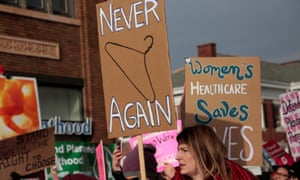
Planned Parenthood’s president, Cecile Richards, gave a damning verdict on the Republicans’ healthcare bill to repeal and replace the Affordable Care Act on Thursday, saying: “Being a woman is going to be now a pre-existing condition in this country.”
Speaking hours after the American Health Care Act was narrowly passed in the House of Representatives, the activist – who is a key figure in the campaign for American women’s health and reproductive rights – received a standing ovation as she arrived on stage to address a packed audience at the New School in New York as part of PEN America’s World Voices Festival.
Richards said the bill, which won by a margin of just four votes, was “jammed through” without proper scrutiny or debate, adding: “To say it’s unpopular is really an understatement.”
Opening the talk, Richards tried to strike an optimistic tone by saying to cheers and applause that the delay to the bill – which failed to win sufficient support in March – proved that “the resistance is working”.
However, she went on to describe the damage that the bill, which she described as “a vampire resurrected”, could go on to cause if it gets past the Senate. Preventing that outcome, she said, was now the key focus for campaigners’ energies.
She told the audience: “Today, of course, for those of you who have been blissfully off of Twitter, the House of Representatives jammed through a bill that really very few members of Congress, I think, had read. Certainly the Congressional Budget Office hadn’t even scored in terms of its impact – both fiscal impact and impact on folks.”
She added: “There’s a lot of things in the bill, we can talk about them, but of course one of the things that has been foremost on the mind of some of the leaders and Speaker [Paul] Ryan was ending access to Planned Parenthood for women on, patients on Medicaid.
“That means millions of folks who come to us for cancer screenings and for family planning, particularly in medically underserved areas, will no longer be able to go to Planned Parenthood for that care.”
She said based on the evidence she has seen in her home state, Texas – where more than half the abortion clinics have closed – the effects of the new healthcare plan would be “devastating”.
“The impact is immediate on women and particularly women on low income, women of color,” she added.
Citing figures that estimate 24 million people will lose their health insurance coverage under the bill, she talked about its other possible implications.
Richards said the equity “we fought for so hard under President Obama” had been “thrown out”, gender ratings enabling insurance companies to charge women more would return, and it would be more difficult for women to have access to maternity coverage and family planning.
“Supposedly the pro-family party just passed a bill that will basically make it harder to not get pregnant, harder to have a healthy pregnancy and harder to raise a child,” she added.
Although Richards said the Senate was “a place where cooler heads prevail”, where she claimed the bill is “wildly unpopular”, she feared the Senate majority leader, Mitch McConnell, would “try to get it through” regardless.
She urged opponents of the bill to “tell the story of what happened”, adding: “The more this gets out there, the more people hear about it, the less popular it is and the more people that, when these guys go back home, because of course they’re mainly guys, they go back home and they have to deal with a lot of women in pink pussy hats, Planned Parenthood signs and patients telling their stories, and they don’t like that.”
The event, which had been scheduled long before the bill’s outcome was known, featured a discussion between Richards and the PEN America executive director, Suzanne Nossel, about the body politic.
California prosecutors have charged two anti-abortion activists who made undercover videos of themselves trying to buy fetal tissue from Planned Parenthood with 15 felonies, saying they invaded the privacy of medical providers by filming without consent.
State attorney general Xavier Becerra announced the charges on Tuesday against David Daleiden of Davis, California, and Sandra Merritt of San Jose. The two operate the Irvine-based Center for Medical Progress.
The allegations say the pair filmed 14 people without permission between October 2013 and July 2015 in Los Angeles, San Francisco and El Dorado counties. One felony count was filed for each person. The 15th was for criminal conspiracy to invade privacy.
Becerra says they used a fictitious bioresearch company to meet with women’s healthcare providers and covertly record them.
Daleiden, in an email to the Associated Press, said the “bogus” charges were coming from “Planned Parenthood’s political cronies”.
“The public knows the real criminals are Planned Parenthood and their business partners,” Daleiden said.
Planned Parenthood – which has previously said the videos were “heavily edited to deceive the public” – welcomed the charges, saying they sent “a clear message: you can’t target women and healthcare providers without consequences”.
Planned Parenthood (@PPact)
CA Attorney General filing criminal charges sends a clear message — you can’t target women & health care providers without consequences. https://t.co/dFT42uZUyq
March 29, 2017
In April of last year, Daleiden said in a Facebook post that California department of justice agents had raided his home, seizing all of his video footage along with personal information.
Since then, the case had gone largely quiet, with virtually no revelations about the investigation and no indication that the charges were coming before they were filed on Tuesday in San Francisco superior court.
The prosecution got a new leader this year in Becerra, a longtime Congressional Democrat, who took over for Kamala Harris when she became a US senator.
Daleiden and Merritt had previously been indicted in Texas on similar charges in January 2016, but all of the charges were eventually dropped by July as prosecutors said a grand jury had overstepped its authority. The grand jury had originally been convened to investigate Planned Parenthood, but after finding no wrongdoing indicted Daleiden and Merritt instead.
Calvin Kasulke was living with his parents when he came out to them as a transgender man. All of a sudden, he recalled gingerly, “I was disinvited from living at home.”
He needed a new place to stay. And Ithaca, New York, where he had gone to college, was the obvious choice. He would have friends there, he figured, and a place to live.
“And also,” he said, “Planned Parenthood was there.”
Unbeknown to many, Planned Parenthood is one of the largest sources in the US of transgender healthcare. The embattled provider offers hormone replacement therapy, which helps a person’s body appear more masculine or feminine, at dozens of its locations, and a growing share of its staff are trained to perform routine sexual health exams for trans patients.
“They are one of the most important providers of trans healthcare in the country,” said Harper Jean Tobin, the director of policy for the National Center for Transgender Equality, adding that their clinics are some of the few transgender healthcare providers located outside major cities. “Many of their clinics are the only places for miles around that trans people can go to for hormone therapy, HIV tests, and pap smears, and not face discrimination.”
With Congress on the brink of attempting to defund Planned Parenthood because of its role as an abortion provider, those services could easily be caught in the crossfire. Each year, Planned Parenthood is reimbursed hundreds of millions of dollars for family planning services it provides at little or no cost to low-income Americans. If Congress were to freeze Planned Parenthood out of those funding streams, it could force an unknown number of health centers to close. Health providers have long warned that this would have a detrimental impact on women’s health. But, Tobin said, the cuts could be particularly “disastrous” for trans people.
“As it is getting more real, in the back of my head I said, ‘Oh shit. What am I going to do now?’” said Raven Green, a patient of Planned Parenthood of the Southern Finger Lakes. “I don’t know where else I would go.”
The state of transgender healthcare in the US is already a fragile one. In one survey after another, large numbers of transgender people report difficulty accessing both basic and specialized services because of biased providers or the distance to the nearest provider with adequate knowledge of trans health issues. Only about two-thirds of trans people who want hormone replacement therapy, a common treatment during gender transition, have actually received it, according to a major survey of transgender adults taken in 2015, and 23% have avoided getting essential care out of fear of harassment. Thirty-three percent have had a negative experience with a healthcare provider, like needing to teach their doctor the fundamentals of transgender care. And 29% reported having to travel at least 25 miles for transition-related care.
The result is that thousands go without care every year.
“Everything is stacked against trans people” in the healthcare system, said Casulke, who now volunteers with Planned Parenthood part-time. “There’s always an extra layer of, am I going to have to educate my own provider? Is it safe to come out to this person? You’re having to advocate for yourself in a really vulnerable situation.”
Planned Parenthood in recent years has sought to address that problem. And it has made its clinics a magnet for thousands with few other options. Starting with Planned Parenthood of the Southern Finger Lakes, in upstate New York, a growing number of its health centers have become places where trans people can begin to transition medically, as well as get basic reproductive services. Its centers use a newer model for gender transitioning that gives the patient input on whether to start their transition, rather than turning the decision over entirely to a psychiatrist. Some clinics have staff with detailed knowledge of how to update driver’s licenses, passports and social security cards to reflect someone’s name and gender.
“It’s this little oasis in the middle of nowhere,” said Luca Maurer, the program director for Ithaca College’s LGBT center. His center has a partnership with Planned Parenthood. Previously, he said, many trans students and locals would drive to Manhattan or Philadelphia, at least four hours each way, for prescriptions and the routine checkups that accompany gender transition. A handful even crossed the Canadian border for treatment in Toronto.
Luca Maurer, the program directors for Ithaca College’s LGBT center, which partners with Planned Parenthood. Photograph: Jenn Foy Photography
“If I didn’t have them available to me, I’m not sure what I would do,” said Maurer, who is trans. “It would be a crisis. And I’m saying this as a person whose job it is to help others navigate healthcare systems.”
Upstate New York is a microcosm of the hurdles facing transgender people when it comes to medical care. In 2015, LGBT healthcare providers surveyed local trans people and learned that 57% had run into barriers because there were not enough providers trained to address their needs. A full quarter had been turned away by one of their doctors. Without the Planned Parenthood in Ithaca, there would be limited places for several hundred trans patients to turn. The only local endocrinologist, who specializes in hormonal therapy, is not able to absorb so many new patients. And a local primary care doctor who offers transgender care is near capacity.
The need is not limited to transgender-specific care. Doctors and other healthcare providers frequently refuse to treat trans people for conditions having nothing to do with their gender identity – what trans rights activists have sardonically termed “trans broken arm syndrome”.
In Florida, where Planned Parenthood recently began to offer transgender care at about a dozen of its health centers, some of the group’s physicians are offering trans patients basic treatments for diabetes, high blood pressure and the common cold.
Gina Duncan, an advocate with Equality Florida, said Planned Parenthood’s affiliates in Florida have been instrumental in pushing other providers to acquire the knowledge to care for trans patients. “Where Planned Parenthood has filled such a huge gap, is it’s a known, reliable, quality source for healthcare,” Duncan said.
In that region, too, Planned Parenthood is the major provider to trans people of hormone replacement therapy and general care.
Dinah, a trans woman who did not want her real name printed, used to drive 120 miles round-trip every time she needed basic blood work before the Planned Parenthood in her city began to offer hormone therapy.
“We have patients who are grateful that they only have to drive two hours,” said Dr Suzie Prabhakaran, the vice-president of medical services for Planned Parenthood of south-west and central Florida. The 11 health centers Prabhakaran oversees began offering hormone replacement therapy in October and are now treating 80 patients and counting. Four out of every five are starting hormone therapy for the first time.
As Planned Parenthood comes under fire, the prospect of possibly losing those services is throwing patients into turmoil.
Dinah says the care she has received at Planned Parenthood has been lifesaving. Recently, she worked up the courage to schedule her first physical in years. It was her first such exam since her transition, and during the breast cancer screening, she began to cry.
“It’s another thing that makes it real,” she said. “It meant that I’m a woman and I have to be treated like one.”
The House on Thursday approved a resolution that would permit states to withhold federal family-planning funds from affiliates of Planned Parenthood and other healthcare providers that offer abortions. Abortion foes immediately hailed the measure, which is expected to pass the Senate, as a critical victory, while public health advocates worried that the cuts would blow a hole in the nation’s fragile family planning safety net.
The measure would overturn a rule, issued by Obama’s department of Health and Human Services, prohibiting states from withholding federal family-planning dollars from groups that provide abortions. States can only withhold those funds for reasons related to a provider’s ability to deliver family planning services, the rule says.
The Obama administration finalized the rule during his last weeks in office, and it took effect just two days before the inauguration of Donald Trump.
Planned Parenthood on Thursday seemed open to taking the issue to court. The group argues that because family planning grants are competitive – that is, they are supposed to be awarded based on a provider’s demonstrated abilities to distribute care – excluding Planned Parenthood is illegal under federal law.
“To date, every court to consider the issue on the merits has ruled that state politicians cannot block access to care at Planned Parenthood” through these types of cuts, a Planned Parenthood spokeswoman said.
The resolution targets Planned Parenthood’s participation in Title X, the federal program that allows medical providers to offer reproductive healthcare to millions of low-income Americans at little to no cost. States receive Title X funds as block grants and distribute the money on a periodic basis to the healthcare providers that are best qualified to provide family planning services.
Planned Parenthood receives more than $ 500m annually from the federal government, and about a quarter of that comes from Title X.
Planned Parenthood says it serves 1.5 million people through Title X, or more than one-third of the 4 million people who receive Title X services. Seventy-eight percent of those Planned Parenthood patients earn 150% or less of the federal poverty level, and about a third are black or Latina. The organization does not spend the funds it receives from states on abortion, but on services such as pap tests, HIV and STI screenings, breast exams and contraception.
What is the ‘global gag rule’, and why does Trump support it?
Title X is a popular target for conservative lawmakers looking to slash government budgets. Republican governors in several states have attempted or succeeded in cutting the state’s family planning budget to nearly zero. And in 2015, Republicans on a House appropriations subcommittee offered a budget that would have eliminated Title X funds completely.
Healthcare providers are prohibited from spending Title X funds on abortion by federal law. But by choosing to single out Planned Parenthood, Republicans on Thursday portrayed the resolution as a referendum on abortion. The resolution’s sponsors, congresswoman Diane Black of Tennessee and Senator Joni Ernst of Iowa, have both cited misleading videos, which were edited to look like Planned Parenthood sold fetal parts for a profit, as a reason to strip Planned Parenthood of its federal funding.
The resolution is based on a little-used law that allows Congress, on a fast-tracked timetable, to overturn a new federal rule. It requires only 51 votes to pass the Senate, where Republicans control 52 seats, and Donald Trump is expected to sign.
Supporters of the measure denied that it would impact people who rely on Title X, because the money Planned Parenthood received would be rerouted to “comprehensive healthcare clinics”.
But public health advocates are skeptical that other providers are primed to absorb Planned Parenthood’s millions of patients.
Supporters of Planned Parenthood rally outside a clinic in Detroit, Michigan. Photograph: Rebecca Cook/Reuters
Community health centers “have wait lists for the people they’re serving today, much less having to absorb all of Planned Parenthood’s patients as well,” Sara Rosenbaum, a professor of health policy at George Washington University, said recently. “The notion they can suddenly ramp up their capacity to absorb all of the services Planned Parenthood can offer … is absurd.”
A recent study of community health centers and similar clinics found that only about one in five large centers prescribe and dispense the full range of contraception. More often than not, these centers don’t stock common methods of contraception, such as birth control.
Healthcare providers are already prohibited by federal law from spending Title X funds on abortion. In 2000, under pressure from anti-abortion groups, the Clinton administration approved a rule requiring Planned Parenthood and other providers offering abortion to keep Title X funds “separate and distinct” from abortion activities.
Republicans have since then sought to cut Title X funding to Planned Parenthood altogether, arguing that organizations that provide abortions should not receive any material support from the government. Several proposals introduced to the House of Representatives under George W Bush failed. But those efforts gained steam under Obama, and in 2011, then-congressman Mike Pence attached a rider to defund Planned Parenthood to a critical spending bill and nearly triggered a government shutdown.
Many states controlled by Republicans have also taken action to strip Title X funds from Planned Parenthood.
The governors of Tennessee and New Hampshire, respectively, stripped $ 1.04m and $ 1.8m in Title X dollars from Planned Parenthood in 2011. The same year, the Kansas legislature blocked Title X dollars to the group.
Just as Republicans argued on Thursday, the governors in those states claimed that other healthcare providers would step up to care for Planned Parenthood’s patients. But those are questionable claims. A year after Kansas kicked Planned Parenthood of its Title X program, the number of Kansans receiving contraception, STI tests, and cancer screenings subsidized by Title X had fallen by more than 14,000.
Some efforts to kick Planned Parenthood out of Title X have proved vulnerable to challenges in court.
A federal judge ruled last summer that Florida could not block Title X funds to Planned Parenthood. Planned Parenthood’s Florida affiliates had been using the funds to provide healthcare screenings and finance a school dropout prevention program.
But others states have managed to make their cuts stick.
In Texas, eliminating Planned Parenthood from the public safety net had a particularly profound effect on rural communities. “I hate to say it, but I think an awful lot of women just opted to go without care,” said Mike Austin, the chief executive of Midland Community Healthcare Services. His clinic emerged as the only major alternative to Planned Parenthood in Midland-Odessa in west Texas after the cuts.
“We are seeing a subsequent rise in STDs and a subsequent rise in unplanned pregnancies,” Austin recently told the Guardian. “And I’m sitting here going, ‘See? I told you so. This is what happens.’”
In the remote western plains of Texas, the Midland-Odessa region is separated from the nearest major city by hours of open road. So when the Planned Parenthood clinic in Midland closed down in late 2013 – a casualty of legislative cuts that targeted Planned Parenthood directly – it served as an isolated experiment in what happens when the government defunds the largest women’s healthcare provider around.
“I hate to say it, but I think an awful lot of women just opted to go without care,” said Mike Austin.
Austin is chief executive of Midland Community Healthcare Services (MCHS), a federally-funded network of providers that has emerged as the only major alternative to Planned Parenthood in the area. His clinic offers all of the same services the Midland Planned Parenthood once did, including contraception, cancer screenings and STI tests, to the same kind of patients, low-income women who rely on the public safety net for their healthcare.
In fact, just before the Planned Parenthood clinic shut down, the two providers made a plan to minimize the fallout. Planned Parenthood sent nearly 5,000 patient medical records – up to 1,000 belonging to active patients – directly to MCHS.
But to Austin’s dismay, only about 100 former Planned Parenthood patients ever showed up at his door.
“We are seeing a subsequent rise in STDs and a subsequent rise in unplanned pregnancies,” Austin said. He believes they could be linked. “And I’m sitting here going, ‘See? I told you so. This is what happens.’”
In the weeks ahead, members of Congress will replicate Midland’s experiment on a grand scale by defunding Planned Parenthood across the country. They will do so in the form of a budget that blocks Planned Parenthood from accepting Medicaid, the government-funded insurance for low-income individuals.
It’s a move Republicans have long framed as a rebuke of Planned Parenthood’s role in providing abortions – even though Medicaid is prohibited from covering abortions by law, and only half of Planned Parenthood clinics even offer the procedure.
What Medicaid does do is allow Planned Parenthood to provide contraception, cancer screenings and STI tests to 1.5 million patients in the public safety net at some 650 health centers for no cost. About two-fifths of the organization’s $ 1.3 billion annual budget derives from public funding. Without the reimbursements Medicaid provides, a spokeswoman for the Planned Parenthood said, an unknown number of those centers will have to close.
House Speaker Paul Ryan of Wisconsin recently predicted that federally funded health centers – like the one in Midland – could pick up where Planned Parenthood left off. “They’re in virtually every community,” he said at a recent town hall, “providing the same kinds of services.”
But public health officials such as Austin, who work in states where Planned Parenthood’s presence is already in decline, are sounding the alarm. They say the loss of Planned Parenthood would imperil the health of thousands of women who already face high barriers for care.
And some of the strongest voices in opposition come from Ryan’s own backyard.
“They’ve never replaced the services of Planned Parenthood,” said Gail Scott, director of health in Jefferson County, Wisconsin. Her county, which lost the Johnson Creek Planned Parenthood in 2013, bumps up against Ryan’s congressional district. “I’m not pro-abortion or anything,” she said. “But I can tell you nothing ever replaced those services for uninsured people.”
The clinics in Johnson Creek closed because lawmakers in Wisconsin, as in Texas, approved a series of family planning cuts targeted directly at Planned Parenthood. Today, Scott said, when the Jefferson County health department gets calls from low-income women looking for a place to obtain contraception, staff recommend they travel to another county – where there’s still a Planned Parenthood.
Chippewa County, Wisconsin, also lost its Planned Parenthood clinic. Jean Durch, the county health director at the time who is now retired, recalled that after the closure, there was no place in Chippewa for women to receive STI tests, even though her department sought the funding to make it happen.
“We never were able, before I retired, to pick up the full complement of services” of Planned Parenthood, she said.
And Shawano County, Wisconsin, which is experiencing a flare-up in gonorrhea and which the state government recently designated a hot-spot for new chlamydia infections, is still feeling the pressure. After the Planned Parenthood there closed, former patients faced significant waiting lists to see a doctor at local community health clinics. The health department didn’t know where to send women for certain services.
“The clinic that closed in Shawano served the whole county,” said Jaime Bodden, the Shawano County health director. Not just women on Medicaid, she said, but women with stingy insurance and women with no insurance at all. Now, the county health department is virtually on its own as it combats the region’s rising STI rates.
“It’s something that we still often talk about,” she said. “We say, ‘Wouldn’t it be nice to have Planned Parenthood in town?’”
‘A national healthcare disaster’
Planned Parenthood officials say Wisconsin would continue to be hard-hit if Congress went through with its plans for defunding. A disproportionate number of its patients there are Medicaid beneficiaries and women of color – groups of people who already face barriers to accessing care.
Already, some of their patients are worried about gaps in their health care if Planned Parenthood were to disappear.
“I have to get that care,” said Courtney Kessler, 22, of Madison, Wisconsin, who has a family history of ovarian cancer and has gone to Planned Parenthood for cancer screenings and contraception for seven years. She is on a public safety net program that covers the costs. “I don’t know where else I would go. I would have to spend time finding somewhere else to go, and worry about, can I afford it? And worry about, am I getting the same quality of care I get with Planned Parenthood? It’s only making it more difficult for people already having struggles.”
Planned Parenthood operates 22 locations in 15 Wisconsin counties, with just two providing abortion services. A new survey conducted by Health Management Associates, a healthcare consulting firm, and paid for by Planned Parenthood, concluded that in seven of those counties there are no viable alternatives to Planned Parenthood for family planning services. In four other counties, there is only one viable alternative. Two counties that would have no alternative if Planned Parenthood were to close – Racine and Walworth – comprise part of speaker Ryan’s district.
The notion that overnight they can serve two million more people who need reproductive health services is absurd
The survey also concluded that many alternatives offer limited hours and do not stock all the most effective contraceptives – making it questionable that they are truly alternatives to Planned Parenthood.
Raegan McDonald-Mosley, Planned Parenthood’s chief medical officer, said this pattern holds across the country. In 332 of the 491 counties where it had locations in 2010, the latest year numbers were available, Planned Parenthood served at least half of the women obtaining contraception through the public safety net. In 103 of those counties, Planned Parenthood was the only safety net provider for family planning.
“We play a hugely important role in family planning safety net around the country,” said McDonald-Mosley. If those clinics were no longer options for many women, “It would truly be a national healthcare disaster.”
A woman has her blood pressure checked at a women’s clinic in San Juan, Texas. Photograph: Delcia Lopez/Reuters
Proponents of defunding Planned Parenthood have circulated their own surveys. In 2015, lawmakers and anti-abortion activists distributed maps and lists claiming there were thousands of government-funded health clinics able to take on Planned Parenthood patients. Several news outlets revealed that these lists included dentists, jails and food banks.
Still, many of the dots on such maps represent clinics that really do offer the same services as Planned Parenthood. The question is, can they take on potentially millions of new patients?
Many public health advocates are skeptical.
“Planned Parenthood treats about 2 million women on Medicaid and community health clinics in total serve about 25 million – everybody from infants to 90-year-olds,” said Sara Rosenbaum, a professor of health policy at George Washington University who has worked in the field of community health for several decades.
“They have wait lists for the people they’re serving today, much less having to absorb all of Planned Parenthood’s patients as well,” she continued. “The notion they can suddenly ramp up their capacity to absorb all of the services Planned Parenthood can offer, the notion that overnight they can serve two million more people who need reproductive health services is absurd. It displays, to my mind, an astounding ignorance of how the health system works.”
‘Texas illuminates what may happen’
Planned Parenthood hasn’t produced an estimate of how many of its clinics might close, and where if the group were defunded.
In Texas, though, a nascent body of research suggests that excluding Planned Parenthood from the safety net has negative consequences even when the cuts don’t force clinics to shut their doors.
These studies have measured what happens not when Planned Parenthood clinics closed, but when women enrolled in Texas’ Medicaid-like program can no longer use their insurance at Planned Parenthood. One study, from the Texas Policy Evaluation Project of the University of Texas-Austin, followed women in Midland (before the clinic shut down) and Houston who relied on Planned Parenthood for Depo Provera, an injectable contraceptive. They found that 20% of women who wanted to stay on Depo-Provera missed their next dose.
These women faced a small but real increase in their odds of getting pregnant. About 25% became pregnant – versus just 8% of the women who didn’t miss their next dose.
The other four out of five women in the survey who wanted another dose, got one. But it wasn’t always free, and it wasn’t always straightforward. Forty-three percent of these women reported that it cost them time or money to find a new provider. In Midland, because other providers were scarce, 65% of the women surveyed kept going to Planned Parenthood, even though it now meant paying out of pocket.
Republicans trade blows with Planned Parenthood president Cecile Richards, in a congressional hearing in September 2015.
Defunding Planned Parenthood, in other words, didn’t necessarily stop women from relying on Planned Parenthood for health care – it just forced them to replace the state’s money with their own.
“These results should be cautionary to states considering similar measures,” the study warned. “They contradict the claim that Planned Parenthood could be removed from a statewide program with little or no consequence.”
Another study found that after Texas kicked Planned Parenthood out of the Women’s Health Program, there were drops of more than 30% in reimbursement claims for some of the most effective methods of contraceptives (although not birth control pills). The drops were only observed in counties where women had previously used local Planned Parenthood affiliates. That study also measured a small but real uptick in births by women on Medicaid, although there are other explanations besides the loss of Planned Parenthood.
“Texas’s experience illuminates what may happen on a larger scale,” said Joe Potter, a UT Austin researcher. “Each person involved in the program had to go find a new provider. And whether or not the new providers have the training, experience, and bureaucratic set up so women can get care promptly is a big question mark.”
Austin, who runs the clinic in Midland, says the problem isn’t just that local health clinics might not have the capacity. In fact, he was one of few public health officials interviewed who felt that federally funded healthcare clinics really could provide for Planned Parenthood’s patients – eventually.
“Logistically, yes, it can happen,” he said. “But it can’t happen for free or overnight. In Dallas or Austin, you could be talking about 10,000 people being displaced into the community health system. I’m sure [local clinics] would do their best, but it would take a ramp-up to do it.”
A Texas health department survey of the state indicates that the capacity to absorb Planned Parenthood patients might exist. But the problem, as Austin’s experience attests, is getting all of the same patients that Planned Parenthood once served through the door. Clinics like his also have an extremely limited ability to advertise their existence. Women know what Planned Parenthood is and the services it offers. And MCHS doesn’t employ the same medical professionals as Planned Parenthood – people that patients have trusted for years with personal and sometimes embarrassing issues.
All these could be reasons why hundreds of Planned Parenthood patients, unless they moved or found other care, never transferred to Austin’s clinic.
Recently, MCHS moved most of the 5,000 records it inherited from Planned Parenthood into storage.
“It broke my heart,” Austin said. “Here’s 5,000 people who have basically been thrown out on the street. What happened to them? I can only account for about a hundred of them. What happened to the rest?”
Reproductive rights advocates announced a significant slate of challenges to anti-abortion laws on Wednesday, taking aim at major restrictions in three states which advocates say are unconstitutional.
Planned Parenthood, the American Civil Liberties Union, and the Center for Reproductive Rights, a legal advocacy group which argued a landmark abortion case earlier this year, filed three lawsuits in Alaska, Missouri and North Carolina. In Missouri, the groups will challenge a pair of abortion restrictions that have reduced the number of abortion providers to just one. They are taking aim at a similar clinic restriction in Alaska. In North Carolina, they will mount a challenge to a 20-week ban on abortion that has some of the nation’s strictest exceptions.
The two Missouri restrictions are highly similar to laws in Texas that the US supreme court struck down in June. They require abortions to be performed in expensive, hospital-like facilities and require abortion providers to have certain professional relationships with a local hospital.
The supreme court ruled that such restrictions served no medical purpose and were unconstitutional. But similar restrictions remain on the books in several states. In Missouri, where 1.2 million women of reproductive age live, the laws have forced two Planned Parenthood clinics, in Columbia and Kansas City, to stop providing abortions in recent years. The only remaining clinic is located in St Louis, forcing many Missouri women seeking an abortion to travel long distances.
“Because of laws like the ones we are challenging today, for too many women across our country the constitutional right to have an abortion is more theoretical than real,” said Jennifer Dalven, the director of the ACLU’s Reproductive Freedom Project.
But it is the North Carolina challenge that may have the bigger impact on abortion rights nationwide. This is only the second time reproductive rights advocates have challenged a 20-week ban on abortion in federal court – potentially setting the table for these restrictions to go before the supreme court.
North Carolina’s law bans abortions after 20 weeks except in a medical emergency where a woman’s condition is so grave that she requires an abortion immediately. That is stricter than other 20-week bans, which have health exceptions but don’t require there to be a medical emergency.
The bill defines medical emergency as a condition which “so complicates the medical condition of the pregnant woman as to necessitate the immediate abortion of her pregnancy to avert her death or for which a delay will create serious risk of substantial and irreversible physical impairment of a major bodily function” not including mental health.
In their lawsuit, the ACLU, Planned Parenthood and the Center for Reproductive Rights argue that the language essentially forces women having an abortion for health reasons to wait until she becomes gravely ill.
Laws banning abortion several weeks before a fetus is viable outside the womb are increasingly common. Across the country, more than a dozen states ban abortion two weeks before viability on the medically dubious grounds that the fetus can feel pain.
But despite the fact that Roe v Wade prohibits states from banning abortion before the point of viability, most of those laws have not faced a legal challenge. Only Arizona’s 20-week ban, passed in 2012 and struck down permanently over the next two years, was ever the subject of a legal battle in federal court.
The challenge is especially significant now that Donald Trump has been elected president. Trump, in a wholesale embrace of the anti-abortion movement’s top priorities, has promised to sign into law a nationwide ban on abortion at 20 weeks.
One reason is that very few abortion providers have standing for such a challenge. “To challenge these laws, you would have to be actually doing abortions after 20 weeks,” said Priscilla Smith, an abortion rights advocate and a senior fellow at Yale law school. “And there are just so few states where you can obtain abortions at that stage of pregnancy. Despite the anti-abortion world’s focus on post-20-week abortions, they’re very rare.”
But another reason may be that reproductive rights advocates have been hesitant to launch a lawsuit that could reach the supreme court. In the past several decades, many such legal challenges have resulted in the supreme court chipping away at abortion rights.
That changed this summer, when the court ruled 5-to-3 to strike down a set of harsh Texas abortion restrictions. The ruling prohibited states from enacting abortion restrictions based on medically questionable arguments about protecting women’s health. Justice Anthony Kennedy, who is often skeptical of abortion rights, joined the majority.
With Trump potentially empowered to shift the balance of the court rightward, Smith said, reproductive rights advocates are probably facing the friendliest bench possible under the new president.
Courts have struck down early bans on abortion before, including an Arkansas law banning abortion at 12 weeks and a North Dakota law banning abortion at six weeks – before many women realize they are pregnant. In defense of 20-week bans, abortion foes commonly argue that fetuses at that stage of development will feel pain during the procedure. But the evidence is slim. While select studies have found evidence for this, the most recent systematic review of studies on this topic concluded that the fetal nervous system is not developed enough to feel pain until the third trimester.
Still, bans on abortion at 20 weeks occupy fraught emotional territory. Public support for abortion restrictions grows with gestational age, and a substantial portion of Americans are ambivalent or opposed to abortion rights in the second trimester.
Anti-abortion activists place an emphasis on these cases, even though they account for only 1% to 2% of all abortions in the US. Abortion rights advocates argue that many women obtaining later abortions are doing so for health reasons or after discovering a severe or fatal fetal anomaly – although the evidence suggests these are not the majority of cases.
On Wednesday, representatives for Planned Parenthood, the ACLU and the Center for Reproductive Rights said the three lawsuits were the beginning of a spate of legal challenges the groups would mount jointly.
“We are going to fight back state by state and law by law until every person has the right to pursue the life they want,” said Dr Raegan McDonald-Mosley, Planned Parenthood’s chief medical officer.
My grandmother served a month in jail 100 years ago. Her crime? Opening the first birth control clinic in the US. Her name was Margaret Sanger, and she was the founder of Planned Parenthood. That first clinic was open for just 10 days in 1916 before the police shut it down; its very existence was considered a “public nuisance”. Today, Planned Parenthood is the single-largest provider of reproductive healthcare services in the country.
At 81, when she was very ill, I saw her give her last speech. “The law was wrong,” she said, standing in front of a crowd in the ballroom of the Waldorf Astoria hotel in New York City, “and I broke it.” She recounted her early struggles and the multiple arrests she endured, all to bring reproductive healthcare to women. I have never forgotten that day. Even into her 80s, my grandmother was always on the move. No sooner would she come to visit us in the suburbs than she would hop on a train to New York, an hour away, to attend a meeting, give a speech or lobby her supporters. She was indefatigable.
Her example led me to join her unfinished fight. As chair of the International Planned Parenthood Federation (IPPF) council for the past 15 years and president of Planned Parenthood of New York City for a decade before that, I have helped continue my grandmother’s legacy. However, she would be appalled that, a century after the founding of Planned Parenthood in Brownsville, Brooklyn, the fight for reproductive rights is far from over. When you live to be 100, you have either good genes or are doing something very right. For an organisation, it is both. Three million women a year, every year, need Planned Parenthood in the US. We have no national health service. Women are forced to rely on charities to fill the gaps that our federal, state, county and municipal clinics don’t cover. Its mission, to get birth control information to the poor and needy, should have been taken over by government health services, much like countries in western Europe. In the rare US cities where municipal clinics do offer birth control, like New York City, women still come to Planned Parenthood because they know they will get unbiased advice and full options.
It shouldn’t be this way. But Planned Parenthood is doing something right and the US government is doing something, if not exactly wrong, then certainly inadequately. This is made all the more plain by a recent report showing that Texas, a state in the richest country on Earth, has the highest maternal mortality rate in the developed world.
Let all women decide for themselves: that is Planned Parenthood’s mantra
Of course, the severe stigma surrounding women’s reproductive rights and health isn’t limited to the US. At least 47,000 women die every year from unsafe abortion, many in countries where it is legal. US political posturing around reproductive rights negatively impacts countless women beyond US borders.
The Helms amendment, passed in 1973, prohibits US foreign aid from going to organisations that provide safe abortion among their reproductive healthcare services – even if abortion is legal in the recipient country. The exportation of a policy inconsistent with US law means women suffer, whether in Syria, where rape is a weapon of war, or in Latin America, where the Zika virus threatens the health of women and babies. The US should prioritise policies that help to reduce, not exacerbate, the severe health challenges and unnecessary deaths caused by limited access to reproductive healthcare services – including safe abortions – in all countries.
My grandmother insisted that women could not call themselves free until they could decide whether or not to be a mother. That was her mantra. Born poor, Irish, Catholic, tubercular, with an 11th-grade education, my grandmother was a tough and determined woman. She witnessed injustice and was determined to fix it. As a nurse, she saw women having children they didn’t want or, all too often, dying from illegal abortions. “Enough,” she said. Her eye was on women and their babies.
When Planned Parenthood founder Margaret Sanger opened a family planning clinic in Brooklyn in 1916, it was promptly shut down. Photograph: Bettmann Archive
Let all women decide for themselves: that is Planned Parenthood’s mantra, and it transcends national borders. My grandmother was also one of the founders of International Planned Parenthood, launched in 1952. Just last week, I visited IPPF’s member association in Morocco, called the Association Marocaine de Planification Familiale. The association not only operates a reproductive health clinic, but also runs a community school for orphans and offers training facilities in hairdressing, dressmaking and cooking, providing career paths for underprivileged boys and girls. The Moroccan people trust and respect our organisation, as do people in 172 countries where IPPF operates.
To the poor and underserved, to the young and marginalised, to the minorities and immigrants that the US government doesn’t reach, my grandmother said: “We are here for you, all of you, no questions asked.”
A century ago, she was persecuted for this by the government, the churches, and many of her fellow citizens. She went to jail. When she got out, she continued the fight. At Planned Parenthood, we have fought the government, politicians, protestors and many anti-choice institutions, including churches and corporations. We have plenty more to do, nor least repealing the Hyde amendment, which prohibits Medicaid – social healthcare for US citizens of limited resources – from including abortion services, thereby depriving poor women of the right and means to decide on whether and when to have children.
Our international movement has never backed away from the fight to give women a choice. And we aren’t tired, even at 100 years old.
Women wearing black clothes and waving black flags are demonstrating across Poland, boycotting their jobs and classes as part of a nationwide strike in protest against a new law that would in effect ban abortion.
Many men also took part in demonstrations on the streets of Warsaw, Gdańsk and elsewhere across the largely Catholic nation.
Thousands of people protested on Saturday in front of the parliament in Warsaw. Women were wearing black in a sign of mourning for the feared loss of reproductive rights; they have also warned that some women will die if the proposal passes as it stands now.
Poland already has some of the most restrictive abortion laws in Europe, with terminations legally permitted only when there is severe foetal abnormality, when there is a grave threat to the health of the mother, or if the pregnancy resulted from rape or incest.
But the new law would criminalise all terminations, with women punishable with up to five years in prison. Doctors found to have assisted with a termination would also be liable for prosecution and a prison term.
Critics say that even a woman who suffers a miscarriage could be under criminal suspicion, and that doctors might be put off conducting routine procedures on pregnant women for fear of being accused of facilitating a termination.
Although a ban has received public support from elements within the Catholic church and Poland’s ruling rightwing Law and Justice party (PiS), neither initiated the proposals. They were drafted by hardline conservative advocacy group Ordo Iuris and submitted by the Stop Abortion coalition as a “citizens’ initiative” – a petition considered by parliament once it has received more than 100,000 signatures.
While it was difficult to gauge strike participation in small towns and rural areas, which tend to be more conservative, participation in the cities appeared to be significant on Monday morning.
A large crowd gathered in central Warsaw and people were also out on the streets in other cities.
The private news broadcaster TVN24, with some of its own presenters in black, showed images of establishments joining the strike, including a restaurant in Wrocław that closed to let female employees participate and a museum in Krakow where none of the women showed up to work.
In Częstochowa, perhaps the most Catholic city in the overwhelmingly Catholic nation, the city hall reported that 60% of female workers had not turned up to work.
Pro-choice activists called for the strike, or “national absence campaign”, after the Polish parliament voted on 23 September for Stop Abortion’s proposals to be scrutinised by a parliamentary committee. Women were encouraged to take a day off work and domestic tasks and gather for meetings or demonstrations, to donate blood or do charity work.
Many Polish women say they are sick of deals being cut over their fundamental reproductive and human rights, which they argue threaten both their safety and their dignity.
“A lot of women and girls in this country have felt that they don’t have any power, that they are not equal, that they don’t have the right to an opinion,” said Magda Staroszczyk, a strike coordinator, over the weekend. “This is a chance for us to be seen, and to be heard.”
Organisers cite an assault on women’s reproductive rights that goes beyond Stop Abortion’s proposed ban. A separate, PiS-sponsored bill restricting IVF, which would make it illegal to freeze embryos and allow women to fertilise only one embryo at a time, was also passed to the parliamentary committee stage in September.
Monday’s protest was inspired by an all-out strike more than 40 years ago by the women of Iceland, when 90% of women refused to work, cook, or look after their children for a day in October 1975.
The intensity of the so-called “black protests” has proved tricky for PiS, which presents itself as the guardian of traditional values in a country beset by liberal notions of multiculturalism, relaxed social mores and restrictive political correctness, but which remains mindful of the risks of alienating mainstream public opinion.
The party’s leader, Jarosław Kaczyński, has suggested that the government might accept a compromise whereby terminations carried out because of foetal abnormalities would be banned, but terminations of pregnancies as a result of rape or incest would still be permitted.
Tens of thousands of women are expected to go on strike across Poland in protest against a new law that would effectively ban abortion.
Poland already has some of the most restrictive abortion laws in Europe, with terminations legally permitted only when the life of the foetus is under threat, when there is a grave threat to the health of the mother, and in the instance that the pregnancy resulted from rape or incest.
Were the proposed ban to be enacted, all terminations would be criminalised, with women punishable with up to five years in prison. Doctors found to have assisted with a termination would also be liable for prosecution and a prison term.
Critics say that would mean that even a woman who suffers a miscarriage could be under criminal suspicion, and that doctors might be put off conducting even routine procedures on pregnant women for fear of being accused of facilitating a termination.
Although a ban has received public support from elements of the Catholic church and Poland’s ruling rightwing Law and Justice party (PiS), neither initiated the proposals. They were drafted by hardline conservative advocacy group Ordo Iuris and submitted by the Stop Abortion coalition as a “citizens’ initiative” – a petition considered by parliament once it has received more than 100,000 signatures.
When on 23 September the Polish parliament voted for Stop Abortion’s proposals to be scrutinised by a parliamentary committee, pro-choice activists responded by calling a nationwide strike, or “national absence campaign”, by women, encouraging them to take a day off work and domestic tasks and gather for meetings or demonstrations, to donate blood or do charity work.
Many Polish women say they are sick of deals being cut over their fundamental reproductive and human rights, which they argue threaten both their safety and their dignity.
“A lot of women and girls in this country have felt that they don’t have any power, that they are not equal, that they don’t have the right to an opinion,” said Magda Staroszczyk, a strike co-ordinator. “This is a chance for us to be seen, and to be heard.”
The protest was inspired by an all-out strike more than 40 years ago by the women of Iceland, when 90% of women refused to work, cook, or look after their children for a day in October 1975.
Organisers cite an assault on women’s reproductive rights that goes beyond the measures contained in Stop Abortion’s proposed ban. A separate, PiS-sponsored bill restricting IVF (in vitro fertilisation), which would make it illegal to freeze embryos and allow women to fertilise only one embryo at a time, was also passed to the parliamentary committee stage in September.
The Polish Federation of Pro-Life Movements, with the support of an MP from a rightwing parliamentary faction associated with Law and Justice, has called for a total ban of the morning-after pill. Under the proposals, anyone caught selling or distributing emergency contraception could be imprisoned for up to two years.
But it is the perceived cruelty of the proposed abortion ban that has united what has long been a relatively marginal feminist movement with many self-identified Roman Catholics who support the existing “compromise” – shorthand for the legislation passed in 1993 that regulates abortion to this day.
“One thing that I think really radicalised women is when they understood that this could lead to incarceration for women who had miscarriages,” says Agnieszka Graff, a commentator, activist, and author of World without Women: Gender in Polish Public Life.
According to a poll for Newsweek Polska, 74% of Poles support the retention of the existing legislation, while research by polling company Ipsos indicates 50% of Poles support the strike, with 15% saying they would like to take part. A further 15% expressed opposition.
“My mother is very Catholic, goes to church every Sunday, and is against abortion just because you might not want the child,” says Malgorzata Lodyga, a junior doctor who supports the strike. “But she is against this law, because if a woman is raped, she will be treated worse than the man who raped her.”
The intensity of the so-called “black protests” has proved tricky for Law and Justice, which presents itself as the guardian of traditional values in a country beset by liberal notions of multiculturalism, relaxed social mores and restrictive political correctness, but which remains mindful of the risks of alienating mainstream public opinion.
The party’s leader, Jaroslaw Kaczyński, has suggested that the government might accept a compromise whereby terminations carried out because of a congenital disorder of the foetus would be banned, but terminations of pregnancies as a result of rape or incest would still be permitted.
Junior doctors have called off the first of their planned series of five-day strikes after growing alarm from senior doctors and NHS leaders that the action could endanger patients.
In a statement on Monday afternoon, Dr Ellen McCourt, the chair of the British Medical association’s junior doctors committee, said that the doctors’ union was “suspending the industrial action planned for the week of 12 September”.
McCourt told Jeremy hunt, the health secretary, that he now had a month to stop the imposition of the new contract that has sparked such anger among trainee medics in England over the last year. It is due to start being implemented from early October.
However, the BMA is still planning to stage three other five-day- walkouts, in October, November and December, if Hunt does not respond positively.
However, it is unclear what will happen next after the Department of Health’s initial reaction to the call-off did not indicate if Hunt would do what the BMA are urging him to do and suspend the planned imposition of the contract.
A DoH spokesman said only that: “The public will be relieved that the BMA has decided to call off the first phase of these unprecedented strikes, so this is welcome news. But if the BMA were really serious about patient safety, they would immediately cancel their remaining plans for industrial action which, as the GMC says, will only cause patients to suffer.”
Hunt may clarify his position later on Monday, though, when he makes a statement in the Commons on the long-running dispute.
Mc Court added that the BMA decided to call off next week’s planned action, which saw the BMA being heavily criticised by many medical groups including the Academy of Medical Royal Colleges, to ensure that safety of care was maintained.
“Patient safety remains doctors’ primary concern. For the first time in this dispute NHS England have told us that a service under such pressure cannot cope with the notice period for industrial action given,” she said. “We have also listened to the concerns of working doctors, patient groups and the public.”
It comes hours after the General Medical Council, which regulates doctors, warned that “harm and suffering to patients” would inevitably result from the action.
The walkouts were due to include even life-or-death areas of care in hospitals such as A&E, surgery, intensive care and maternity services. An estimated 125,000 planned operations were set to be cancelled as another consequence, leading to fears that patients would suffer pain and distress as hospitals would take months to clear the backlog.
The BMA’s move may be a belated attempt to maintain the profession’s year-long unity over the new junior doctors’ contract, which shattered last week with many leading doctors criticising the intended strikes as disproportionate and likely to threaten patient safety. Junior doctors may also be hoping to keep the public on their side in their bitter dispute with Hunt.
They continued to enjoy around 60% public backing despite the eight days of strikes they staged between January and May in pursuit of their claim that the new contract for England’s 54,000 doctors below the level of consultant was unsafe and unfair.
The NHS funding crisis could lead to closures of hospitals and various services across England, with secretive plans being currently developed to “transform” care.
The moves are being made to tackle huge funding gaps, and an investigation by the Guardian and campaign organisation, 38 Degrees has revealed some of the details. The NHS plans, called Sustainability and Transformation Plans (STPs) cover 44 geographical areas of England, and the majority of them have not been published.
What has been uncovered so far
According to the investigation:
Council leaders have refused to sign up to a plan to “transform” NHS services amid fears two major London hospitals, Ealing and Charing Cross, are to be downgraded and will lose their A&E units and other acute services, the Guardian can reveal.
In The Black Country, there are plans for major changes to frontline services at Midland Metropolitan Hospital including the closure of the hospital’s A&E. The plans also propose to close one of two District General Hospitals as part of a planned merger.
In Leicester, Leicestershire and Rutland, there are plans to reduce the number of hospitals in the area from three to two. There are also plans to put GP surgeries under “review” because of a shortage of funding.
In Suffolk and North East Essex, the plan refers to “reconfiguration of acute services within our local hospital, Colchester Hospital University Trust”. Historically, “reconfiguration” in the NHS has meant cuts. There are also plans to close GP practices.
In Dorset, hospital beds are at risk and a funding shortage of £158 million is predicted in five years. Consideration is being given for ‘consolidation’ of hospitals and acute services;
In West, North and East Cumbria, the public plan refers to “reconfiguration of all of the services… including for acute and community hospital services, maternity services and mental health services.”
A leaked draft plan circulating amongst NHS Managers in West Yorkshire reveals proposals to close the equivalent of 5 wards in the Leeds Teaching Hospitals Trust. It also proposes a “major reconfiguration” of frontline NHS services in Wakefield and North Kirklees and Calderdale and Huddersfield.
How you can help
The investigation has found that the plans to close services, appear to have had little input from patients and the public. Despite being due to be signed off in October this year, many draft plans are still secret.
So that we can report on this more fully, we would like you to help us find out more about NHS services in England that are under threat. Do you know of any planned cuts in your area or more about the ones included in this article? We also want to hear what the impact will be on people if these cuts go ahead.
If you have any information for our journalists or want to tell us how you may be affected, please fill in the form below, anonymously if you wish. We will contact you before publishing.