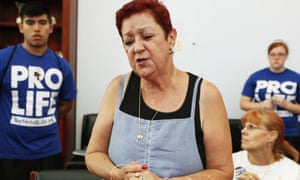
Jane Roe, the anonymous plaintiff in the Roe v Wade case by which the US supreme court legalised abortion, became an icon for feminism. But the real Jane Roe, Norma McCorvey, who has died aged 69 of heart failure, was an unlikely heroine, unwilling to take the spotlight and uncomfortable with it when she finally did. Then she underwent a Damascene conversion and became an equally iconic anti-abortion campaigner.
McCorvey was 22 and pregnant for the third time when in 1969 she sought an abortion, then illegal under Texas law except when necessary to save the mother’s life. Born Norma Nelson in Simmesport, Louisiana, she had a difficult childhood. Her father, Olin, a TV repairman, abandoned the family. Her mother, Mildred, known as Mary, an alcoholic, moved Norma and her brother, James, to Houston, Texas. At the age of 10, Norma robbed the till at a gas station and ran away with a girlfriend. They took a motel room in Oklahoma City, but were caught when a maid walked in on the two girls kissing and reported them to the police.
Norma was made a ward of the court and sent to state institutions. She described this as the happiest time of her life. At 15 she was sent to live with a cousin who abused her sexually. At 16 she left school and was working as a waitress when she met and married a sheet-metal worker, Woody McCorvey. He beat her, before and after she became pregnant. She left him and gave birth to a daughter, Melissa, in 1965. She began drinking heavily and came out as a lesbian. When she left her baby with her mother, to take a weekend trip, Mary charged her with abandonment, and soon afterwards made her sign what Norma thought were insurance papers; she had in fact agreed to let her mother adopt Melissa, and was then barred from the family home.
At 18, working in a series of menial jobs, she had a second child, whom she gave up for adoption. She became pregnant again in 1969. After first claiming she had been gang-raped, thinking that might get her a legal abortion, and seeking an illegal one as well, she visited the Dallas lawyers Sarah Weddington and Linda Coffee. She was already five months pregnant. They wished to challenge the law; McCorvey wanted an abortion quickly. She later claimed she had again signed papers that she had not read, not understanding what the case would entail. She was given a pseudonym, Jane Roe, a variation of the John/Jane Doe used for unknowns, and the case was filed against the Dallas County district attorney Henry Wade, previously best-known as the DA in charge of the case against Lee Harvey Oswald.
McCorvey’s baby was born and given up for adoption. The supreme court’s decision, by a 7-2 majority, did not come until January 1973. Justice Harry Blackmun’s opinion, giving women the right of choice, while protecting the state’s interest in preserving life in the later stages of pregnancy, in effect overturned anti-abortion laws in almost all of the 50 states. The landmark decision marked a milestone in women’s rights. McCorvey was living quietly in Dallas with her partner, Connie Gonzalez at the time. McCorvey stepped out of the shadows in the 1980s to counsel women at pregnancy clinics, and in 1987 became a cause celebre when she admitted in a TV interview that she had lied when she claimed to have been raped, though that played no part in the case that went to the supreme court. She was decried as a “baby-killer” and faced death-threats, but she still spoke at a massive pro-choice Washington rally in 1989, the same year Holly Hunter won an Emmy playing her in a television film.
But by the time her autobiography, I Am Roe, written with Andy Meisner, was published in 1994, McCorvey had become a born-again Christian, baptised by the evangelical minister Flip Benham, the head of Operation Rescue, a leading anti-abortion campaigner. She began campaigning fiercely against abortion, claiming she had been a pawn of her Roe v Wade lawyers. “They could have been nice to me instead of treating me like an idiot,” she said.
She also renounced her lesbianism, and, after the publication of her second book, Won By Love, written with Gary Thomas, in 1998, converted once again, this time to Roman Catholicism, under the auspices of Father Frank Pavone, director of Priests for Life.
Testifying before the Senate in 1998, she said: “I am dedicated to spending the rest of my life undoing the law that bears my name.” She petitioned the supreme court to undo the Roe v Wade decision, but it rejected her appeal. She protested when Barack Obama spoke at the Roman Catholic University of Notre Dame in 2009, and was arrested at Senate hearings while protesting against the appointment of the pro-choice Sonia Sotomayor to the supreme court. She also made TV ads against Obama in 2012, saying: “He murders babies.”
She was the subject of a 1998 documentary, Roe vs Roe: Baptism by Fire, and featured in Lake of Fire (2006), a pro-choice film. She also played a small role in an independent feature film, Doonby (2013). McCorvey said in her first biography: “I wasn’t the wrong person to become Jane Roe, I wasn’t the right person to become Jane Roe. I was just the person who became Jane Roe.”
She is survived by Melissa; she does not appear to have had any contact with her other two childrne after their adoption.
• Norma Leah McCorvey, campaigner, born 22 September 1947; died 18 February 2017
Norma McCorvey obituary