Massive etiketine sahip kayıtlar gösteriliyor. Tüm kayıtları göster

31 Mart 2017 Cuma

Young people and mental health: "Since diagnosis, I have taken massive strides"

Holly, 22, Sydney, Australia
I have suffered from depression and suicidal ideation since I was about 12. If my parents did not have private healthcare, I would probably be dead.


Vulnerable young people shouldn’t have to wait for months to see a psychiatrist, or to compensate for the lack of communication between specialists. Help-seeking behaviour should be supported and encouraged.


Young people in distress presenting to emergency rooms and hospitals should not be viewed as a problem. You don’t want us to kill ourselves, well, here we are. Mentally ill kids are often really intelligent. We can sense when you feel we are being a burden. Saying there are not enough beds, putting us in wards with elderly dementia patients or adults with drug-induced psychosis will ensure we do not ask for help again.


Malcolm Turnbull and Theresa May have the chance to make a real difference in the lives of vulnerable young people, who have a lot to offer the world in return. Don’t let us down.


Lindsay, London, 24
I am currently detained under section three of the Mental Health Act, and have been in hospital since 22 July 2016. Before this, I had a full-time job and always managed to keep my mental distress under control. I never imagined I would become a person to whom the psychiatric ward was home.


Amy-Hannah Charman, Cheltenham, studying A-levels
This poem was written in 2014 between two stints in psychiatric hospital with psychosis.


I want you to cry, I want you do die,


I don’t want to get hurt, I want to fight’


You need to hurt yourself so you can be free,


You need to ignore him, or in sin you will be,


If you don’t do what I say, I’ll make life hell,


You don’t want to slip; you’re doing so well,


Do this do that, you will be happier then,


Please just draw on yourself in a sharpie pen,


Arggg! Arrg! Cry cry cry,


Please! Please! I want to live life!


You’re a failure; this is not very hard,


Think of your friends, remember Mum’s card,


Cut cut cut, harm harm harm,


Relax relax, calm calm calm,


You need to scratch, you stupid cow,


Just go and find Mum she can save you now,


Cover your evidence, you must be sly,


Don’t do what he says, just look to the sky,


Listen to me, let me take over you now,


No I can’t, I need help, but how?


I hate you and you must hate yourself,


No I don’t want to get help,


You have nothing, nothing at all,


Actually I do like friends and all,


You don’t deserve to be happy like this,


Yes I do, think of that Taylor Swift gig,


You deserve everything I’ve done to you,


I don’t want this, I won’t listen to you,


I want to squish everything out of you,


Little, innocent me please shine through,


I will scar you and hurt you, I will do what I like,


I won’t let you win, I will always fight.


Caitlin Kitchener, 22, PhD student, York
It took an attempted suicide to gain access to therapy. I had been taking antidepressants for a few months, but they weren’t particularly working. It happened during the first year of my undergraduate degree and I remember being picked up in an ambulance outside the halls of residence, with people having a peek to see what was occurring.


Things worked out OK for me, but they didn’t for one of my best friends. She was utterly wonderful, witty, sassy, an absolute star of a woman. After my suicide attempt, she didn’t let me sleep alone for a week and made sure I looked after myself. She even helped arrange a surprise birthday party just four days after my attempt. Underneath all this charisma and humour and kindness was someone who was dreadfully sad. In the third year, she killed herself. She had attempted before, gone to hospital, had a review with a therapist, but faced excruciating waiting times. During her four-month wait for therapy, while she was also waiting for access to university services, she killed herself.


No one from the university or the NHS should be blamed. Maybe reduced waiting times wouldn’t have stopped her. But I can’t help it when I sit on her beautiful memorial bench to feel anger towards Tories whose actions are having real-life implications.


Anonymous, 19
I’ve had depression on and off since I was 11. Over the years, I’ve tried various coping mechanisms: self-harm, restrictive eating, bulimia – you name an unhealthy coping mechanism, and I’ve tried it.


The one that’s been the most constant is alcohol. It’s now got to the point where I’m drinking a small bottle of vodka pretty much every day, sometimes as early as 9am. Needless to say, this doesn’t help my depression, but I’m too dependent on it to give it up. I know I’m in desperate need of professional help, but it terrifies me thinking of my friends and family knowing I’m depressed. I worry that people will be awkward around me, feel guilty for not being able to help me or utter the dreaded phrase: “What have you got to be depressed about?”


I hope that one day the stigma surrounding mental health issues will be non-existent and I will have the courage to deal with my problems in a healthy way.


Anonymous, 17
At secondary school I was taught about religious education, maths, science, English and a plethora of other subjects. But there was one thing missing. After countless sleepless nights, and episodes of self harm, depressive thoughts and suicidal ideation, I had no idea what was wrong with me. I went to the top of a car park and watched the people walk past below like nobody in the world cared.


A woman spoke to me and saved me. After that, I got a correct diagnosis. Learning about mental health and that it is OK to ask for help is important.


Anonymous, 23
Over the years my depression and anxiety has come and gone in waves. After a friend who was having similar problems was diagnosed with Asperger syndrome, I visited a doctor and told him my symptoms. He laughed at me and said I simply had social anxiety, and put me on beta blockers.


When I was at university, a different doctor suggested I see a counsellor. After the first session the counsellor said she’d follow up and make a second appointment, which never happened. My confidence was shook, and I tried a second service. The session went well, and she said she’d make a second appointment for me. She never did. I was convinced that they didn’t think I was worth their time.


I called a mental health charity, when my depression got particularly bad. They arranged a time for them to call back and do a full assessment. They never called back.


I have a great family, and got a first in my degree, and a distinction in my postgraduate degree. Still, I constantly feel numb and almost completely emotionless. My few friends have all cut ties with me for unknown reasons.


Dolly Z, New Jersey
As a young adult, I wanted to share my life’s journey with mental illness in verse.
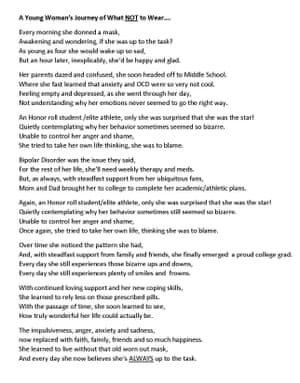


Dolly Z reflects on her mental illness.


Dolly Z reflects on her mental illness.

Laura Vale, 18, student on a gap year
“I’m so OCD about that, I have to have everything straight.” Or, “I’m such a clean freak, I’m so OCD.”


People don’t say these things maliciously, however, they do cause upset to actual sufferers of obsessive compulsive disorder. There are four main categories of OCD: checking; contamination/mental contamination; hoarding; ruminations/intrusive thoughts.


My OCD falls into the category of contamination/mental contamination. I cannot eat cold savoury food, and without medication I could not even be in a room with cold savoury food without having a panic attack. This is the main feature of my OCD, but I also can’t deal with foods touching, or sharing food and drink.


When it’s really bad, I cannot eat because I feel as though I am contaminating myself with food. I have to feel mentally clean, too, which kind of means mentally organised. This can be with relentlessly cleaning myself or tidying or harming myself because I was not clean enough.


Once (while taking Prozac, which really messed with me), I had to empty my room and paint it white. I knew this was illogical, I was crying because I felt insane, and yet I felt that this was the only way for me to be safe and comfortable. Intrusive thoughts control my life. From basic anxieties to more obscure ones, such as my absolute terror of ever having a child and then starving the child through my OCD. But it can be manageable and, for those who know me, since diagnosis I have taken massive strides.


The main issue with OCD is the lack of understanding in mainstream society. By making statements such as: “I am so OCD about that,” you are trivialising a mental illness that is so controlling, manipulative and horrible, and making the sufferer feel as though their struggle is not real and their feelings are irrelevant. Education is key.


In the UK, the Samaritans can be contacted on 116 123.
In the US, the National Suicide Prevention Hotline is 1-800-273-8255.
In Australia, the crisis support service Lifeline is on 13 11 14.


Young people and mental health: "Since diagnosis, I have taken massive strides"

24 Ağustos 2015 Pazartesi

Cargill"s Massive Bet On Fish--and the Industry"s Difficulties Ahead

[unable to retrieve complete-text content material]


The organization of aquaculture doesn’t typically make headlines&nbsp unless of course a firm like Cargill treads into the sector, which is precisely what was recently reported when it announced it was buying Norwegian salmon feed supplier, EWOS &nbspfor an estimated $ one.5 billion. The company produces and distributes feed in Norway, Chile, Scotland, [...]


Cargill"s Massive Bet On Fish--and the Industry"s Difficulties Ahead

16 Ağustos 2015 Pazar

Scientists Say The Unique Paleo Diet program Had A Massive Dose Of Carbs

[unable to retrieve complete-text content]


It&rsquos weirdly ironic that the paleo diet is one particular of the great dietary fads of the minute, embraced most notably by Jeb Bush. Simply because fads come and go, but the real Paleolithic time period&nbspstarted about 3 million many years in the past and ended about ten,000 many years in the past. And a great deal occurred in that [...]


Scientists Say The Unique Paleo Diet program Had A Massive Dose Of Carbs

2 Temmuz 2014 Çarşamba

Some States Are Prescribing Massive Quantities Of Painkillers [Infographic]

Health-related situations involving pain might not fluctuate a lot from state to state, but the frequency with which painkillers are prescribed does – and widely, a new CDC study finds. Alabama tops the record of painkiller prescriptions, with 143 prescriptions for every one hundred folks. This startlingly higher number is 3 occasions the sum in the lowest prescribing state, Hawaii. (See the infographic below for the rates in all states.) The numbers don’t look so encouraging, particularly given that overdose from prescription drugs continues to be a massive problem in the nation. Thankfully, however, when prescribing rules tighten as they have in Florida, the death price does seem to be to react in variety.


In total, the CDC located that in 2012, doctors and other healthcare companies wrote 259 million prescriptions for opioids and other narcotic painkillers, Vicodin, OxyContin, Opana, and methadone. “That’s adequate for every American grownup to have their very own bottle of capsules,” said CDC Director Thomas Frieden. Of program, each and every American doesn’t have his or her very own bottle of drugs: The complete prescriptions shake down so that some individuals – presumably those struggling from a soreness-associated condition– are filling several prescriptions per 12 months.


Bad Drugs

(Photograph credit score: derekGavey)


The greater concern is that prescription drug addiction and linked mortality is an ongoing difficulty in the U.S. The CDC factors out that 46 individuals die each and every day in the U.S. from prescription painkiller overdose.


The new research discovered that the Southern states, specifically Tennessee, West Virginia, and Alabama, had the highest prescription costs in the country. Some Northeast states – Maine and New Hampshire – had the highest prescription costs of long-acting and higher-dose medications.


The CDC says that prescription rates are skewed not due to the fact soreness situations vary across states or have risen current years, but because doctors from diverse parts of the country apparently disagree about when a prescription is warranted. Furthermore, “pill mills,” or for-revenue discomfort clinics, are yet another element of the problem, and a single of the targets in Florida’s selection to tighten prescription rules.


Plainly there is no straightforward reply to the prescription problem, and some attempts to discourage abuse of painkillers have backfired. Creating OxyContin capsules tougher to grind up, for illustration, has had at least a partial effect of sending some people in excess of to heroin as an substitute.


On the brighter side, an additional CDC report finds that after Florida tightened its prescription tips in 2010, drug-relevant deaths fell by 23% in the many years following the crackdown. And this is including a consistent rise in heroin-related deaths. “Florida exhibits that policy and enforcement matter. When you get critical action, you get encouraging final results,” Frieden said.


The CDC recommends that state governments think about tightening rules, including those for discomfort clinics, who might play a big component in the problem. Physicians need to be more conscious of their prescription habits, and display for psychological health ailments, keep away from specified combinations of drugs, and prescribe the lowest attainable amount.


And sufferers can use some common sense of their own. Monitor oneself as considerably as you can, and don’t hold further painkillers about for “just in case” use, the CDC says.


“They are hazardous prescription drugs,” Frieden explained. “Patients given just a single program might turn out to be addicted for life.”


Stick to me @alicewalton or discover me on Facebook.


Courtesy CDC

Courtesy CDC


Some States Are Prescribing Massive Quantities Of Painkillers [Infographic]

1 Temmuz 2014 Salı

Psychological sickness treatment method requirements massive investment. The case is overpowering | Richard Layard

mental health nhs

‘Nearly forty% of all illness in this nation is mental illness, but most of it is untreated.’


What is the greatest supply of misery in our society – poverty, unemployment or psychological illness? As surveys show, the reply is mental illness. But underneath a third of people with these troubles are in treatment method. If you break a bone, you obtain care instantly, but if your spirit is broken, you do not.


Almost 40% of all sickness in this nation is psychological sickness, but most of it is untreated. It is the biggest injustice in our society and every single party’s manifesto requirements a program to redress it. The good information is that both depression and chronic anxiousness situations are hugely treatable by contemporary proof-primarily based psychological therapies such as cognitive behavioural treatment (CBT). Half of the people taken care of recover entirely, and numerous other individuals improve considerably. After recovery, the probabilities of relapse are considerably decreased numerous patients say they feel reborn.


The National Institute for Well being and Care Excellence (Wonderful) has recommended that these therapies be made available to all people with depression or anxiousness issues, but at existing they are supplied to only 13%. That is substantially far better than the one% in 2008, just before the government instituted Improving Accessibility to Psychological Therapies under this programme 1000′s of therapists have been educated, and new standards for speaking therapies have been set. The scheme has accomplished well and the journal Nature has known as it “world-beating”. But it needs to double in dimension during the next parliament and each and every party need to include that dedication in its election manifesto.


Can we afford the expense of it? Effectively, really, it would price us practically nothing simply because it would conserve more than it costs. The gross value of remedy is only £650 on common, and set towards this there are massive financial savings – on positive aspects, misplaced taxes and even bodily healthcare.


Due to the fact depression and anxiety are also poor for your bodily health. Between men and women with a provided physical illness, people who also have a mental illness cost the NHS £2,000 a 12 months a lot more – they go more typically to A&ampE, and have a lot more hospital appointments. The complete price of this to the NHS is £10bn a year. It follows that if we make psychological treatment far more readily offered, there would be large cost savings.


As is properly identified, many NHS commissioners, when brief of income, minimize mental healthcare. Final week Sue Bailey, the retiring president of the Royal University of Psychiatrists, named the circumstance a “vehicle crash”, alluding to the truth that cuts in psychological therapy trigger far much more problems than they solve.


One-third of all households in Britain contains somebody who is mentally unwell. It is a everyday fret for millions of families, and out of shame it is minor mentioned. But individuals know about it all also properly, and they will cheer any political party that shows it is aware of, too.


This letter that I obtained not too long ago is normal of numerous other individuals: “Dear Lord Layard, my husband was referred for CBT in April final 12 months. Four months later on he had a telephone assessment and was put on a waiting listing. 5 months right after that his psychological well being truly deteriorated. We begged for support because we had been frightened of him dropping his job and us our residence. 3 months later that happened.”


What is necessary in the manifestos is fairly basic. Will every party please undertake to double the psychological therapy obtainable in the NHS by 2020?


Psychological sickness treatment method requirements massive investment. The case is overpowering | Richard Layard

28 Haziran 2014 Cumartesi

The good results of the NHS lies in the strength of its values | The massive problem

Blood donation

The altruism of blood donors is what aids to drive the NHS. Photograph: Martin Argles for the Guardian


As a committed NHS advisor (element retired) dealing with leukaemias amid other haematological issues, I read through Will Hutton’s column with wonderful fulfillment (“The NHS is loved and effective, so why the obsession with reform?”, Comment). Not due to the fact I want a pat on the back, but due to the fact his position on the NHS and condemnation of the present government’s systematic and determined undermining of the organisation resonate with my own and numerous others’ attitudes. He is right to assess that its power lies in the underlying “value driven” ethos. His reference to the “drive to cure” uniting the teams, such as the altruistic blood and marrow donors, is, in my mind, what it is all about and why I function in it.


It was the freedom from getting to be commercial that permitted me and my colleagues to location the patients’ interests as our paramount concern. By no means getting to query how a patient was to spend for their remedy has been a great privilege.


Susan J Kelly


Kidlington


Oxon


It’s genuinely good to know that Will Hutton has seasoned very first-class leukaemia companies with the NHS at the superb UCL, but he will know the problems that other sufferers expertise due to the fact of the variability of individuals companies across the NHS. He will also recognise the issues of concerns of late diagnosis of cancer highlighted by Macmillan cancer care. Most major patient groups, as nicely as the NHS Confederation, are arguing strongly for new models of well being and social care that are much better co-ordinated about patients’ lives and not overall health providers’ organisational requirements.


We believe in the ethos of the NHS and that it is powerful adequate to go with these adjustments demanded by sufferers. The last factor the NHS requirements as it faces the challenges of better demand is complacency.


Professor Paul Corrigan


and Mike Parish, chief executive, Care Uk


c/o Reform


London SW1


It is a shame that politicians are not as candid in public as they are in private about the problems dealing with the NHS. Increasing patient demand, falling resources, workforce shortages: the image sadly is the exact same during the NHS. However, politicians in public seem to ignore this reality and instead meddle in the NHS in a way that ends up contributing to the problem rather than solving it.


The Health and Social Care Act wasted enormous amounts of time and assets on an experiment that is already fragmenting the delivery of care by introducing needless competition. It is not surprising in this climate that a BMA poll located that three-quarters of the public thought politicians designed their polices to win votes rather than improve care.


We require our policymakers to be transparent about the state of the NHS and to end inflicting sick considered-out policies on a overall health services that is already struggling. Most importantly, politicians need to have this conversation in public rather than hiding their remarks behind close doors.


Dr Mark Porter


Chair of BMA Council


London WC1


Toby Helm reminds us that the pointless £3bn shake-up of the NHS caused by Andrew Lansley was not voted for and not spelled out in the 2010 election manifesto (“Minister: NHS is out of our management”, Information). Actually, it is far worse than that. He had informed us clearly that it was not going to happen. At the British Pharmaceutical conference in 2009, in front of a number of hundred pharmacy and scientific colleagues, Mr Lansley informed me, in response to a direct query, that no main NHS reorganisation was planned. His reply was, for a politician, surprisingly clear and unequivocal. So was the palpable sigh of relief between my 700 or so colleagues at this welcome information. I will not forgive Mr Lansley or his celebration for getting so very cost-effective with the truth.


Brian Curwain


Christchurch, Dorset


Dorset


The good results of the NHS lies in the strength of its values | The massive problem

17 Haziran 2014 Salı

NSW budget: Labor says schooling, health massive losers in "document of spin"

The New South Wales opposition leader has accused the Baird government of underspending in the crucial locations of health and education in its 2014-15 price range.


John Robertson mentioned the premier had failed to stand up to Tony Abbott’s budget cuts and stated the budget was a document of spin which fell $ 500m quick on wellness paying.


“Today we identified there will be half a billion bucks much less in our hospitals,” he said.


“That signifies much more strain on everyone who works at our hospitals, due to the fact the funds is not there because Mike Baird has rolled out Tony Abbott’s cuts.”


The treasurer, Andrew Constance, announced on Tuesday $ one.3bn for creating and redevelopment of health amenities including Westmead, Sutherland, St George and Gosford hospitals.


He also announced $ 220m to retain patient providers previously funded by the Commonwealth and $ 24m for five new ambulance stations.


But the Australian Health care Association (AMA) says the money will not be sufficient.


The NSW president, Saxon Smith, says the cuts to health in the federal budget have flowed by way of to the NSW budget.


“This has resulted in a reduced than necessary degree of growth funding for overall health,” he stated.


“While the 5.two% improve is in line with past many years, the NSW government has had to soak up funding for packages previously funded by the Commonwealth government.”


The AMA says overall health growth funding needs to boost by approximately 7% a 12 months to keep ranges of companies.


The secretary of Unions NSW, Mark Lennon, mentioned the price range failed in the places of jobs for the young, injured employees and stress on public service jobs.


He believed two,500 jobs have been set to go from the public services.


“It will place further stress on public sector employees to provide solutions that the NSW government requirements,” he explained.


The NSW Greens explained manage of the price range had been passed to the organization sector, which will reap $ 780m in advantages from the abolition of transfer and duty taxes.


Greens spokesman John Kaye said taxes on poker machines could give the price range an $ 800m increase to fund growth in education spending that the federal government had deserted.


NSW budget: Labor says schooling, health massive losers in "document of spin"

2 Haziran 2014 Pazartesi

Cos your feet"s as well massive


If guys are from Mars and women from Venus (an unlikely proposition), then women are Cinderella and guys Rumpelstiltskin. We’re speaking feet, here. Cinderella won the Prince since her titchy tootsie fitted the glass slipper. Rumpelstiltskin stamped so tough with his huge foot that he drove himself into the ground with fatal benefits. But now feet are receiving bigger, according to the School of Podiatry (which ought to know). Not only are youngsters taller, with larger feet, but our feet splay underneath growing weight. So no much more glass slippers for princesses, and all the more purpose for guys, especially those with implausibly odd names, to steering clear of uncontrolled stamping. As for podiatrists, they rue the growth of shoe acquire on the internet. Striving on a shoe that will be broad sufficient is essential, they say. And no doubt each and every mattress need to be experimented with with a pea hidden beneath it.


Cos your feet"s as well massive

30 Mayıs 2014 Cuma

A Massive Quest For Good Genes That Shield Us From Undesirable Ones Begins

Stephen Friend (seated) and Eric Schadt (onscreen).

Stephen Pal (seated) and Eric Schadt (onscreen).


What if the very best clues to curing genetic illness are not in the ailment genes themselves, but in the resilient genes of those who who somehow really don’t turn into unwell?


That’s the idea of a new research examine launched yesterday by open science advocate Stephen Good friend president of Risk-free Bionetworks, along with an article in Science, the analysis journal, and a TED talk explaining the venture. Friend and his colleagues hope to hunt via far more than a million men and women in buy to uncover a few who have genetic variants that ought to have killed them in childhood, but who have made it to age forty or older.


“Maybe we’ve been hunting as well lengthy at those who are sick,” says Pal, “and the better way to do it would be to assume that if you wished to create a therapy for prevention, shouldn’t you appear at people who should have gotten sick and did not.”


Friend, who has had profitable turns as a cancer researcher, a biotech CEO, and the head of cancer research at Merck, calls the hard work, referred to as The Resilience Undertaking, a single of the most thrilling he has ever been concerned with.


The thought dates back to the operate of Nobel laureate Lee Hartwell, with whom Buddy commenced a biotech company in the 1990s. In February 2001 Hartwell wrote an report in Science proposing that researchers need to be concerned far more about what he called “buffering.”


Just possessing a gene variant, even for a terrible disease like cystic fibrosis, which fills the lungs with mucus, leads to digestive difficulties, infertility, and early death, may not usually suggest you get sick. Geneticists call this “penetrance” – the trait a gene codes for might not penetrate into the physical signs and symptoms of a person. This, Hartwell argues, is because there are most likely other gene variants in the body that are trying to keep the undesirable gene from doing harm.


Great theory. But why does Pal think discovering these genes is even plausible? Simply because he did a check run. He teamed up with Eric Schadt, who worked for Pal at Merck and now directs the Icahn Institute for Genomics and Multiscale Biology at the Mount Sinai School of Medication. They have been in a position to get anonymized samples from a lot more than half a million individuals from databases which includes the 1 kept by genetics startup 23andMe, and from them they identified ten people who look to carry genes that lead to 12 illnesses, which includes unusual but deadly illnesses cystic fibrosis, Gaucher’s disease, and MPS II. Friend calls them “unexpected heroes:” men and women whose genomes might hold hints at how to


The problem: due to the fact of the way the information had been collected, they can not simply go back to those people to study them. So they want to commence the search anew. “All we need is info,” Good friend says in his TED talk. “We need to have a swab of DNA and a willingness to say, what’s inside me? I’m prepared to be re-contacted.” Patients can indicator up through the project’s web web site.


Even once individuals folks are discovered, the energy will not be more than. “It’s a massive challenge,” says Daniel Macarthur, a genomics researcher at Massachusetts Basic Hospital. The unexpected heroes will be so small in quantity that conventional genetics will not be able to locate the protective genes. Instead, Good friend and Schadt say, they will place people people’s genes in model organisms like mice. They will generate induced pluripotent stem cells of the heroes’ DNA, and review those. Other groups will study their cells making use of new tactics like CRISPR, which enables scientists to do targeted genetic editing to figure out what transpires when distinct alterations are produced to a cell’s DNA.


If the effort comes up dry on obtaining protective genes, MacArthur says, just studying a lot more about how frequently disease genes actually cause ailment will be hugely useful for scientists.


But genes are not destiny not only simply because of other genes, but due to the fact of environmental factors, also. Pal and Schadt have tied up with the National Institute of Environmental Wellness Sciences. Lisa S. Birnbaum, the Institute’s director, says that the effort could be “a treasure-trove for geneticists, epidemiologists, biostatisticians, and possibly all biomedical researchers.”


“Most folks believe of your genes, heredity, and setting as hazards,” Friend says. “There’s this concern among the public that you would by no means want to know what is going on, that the genes are all bad. What we’re trying to say is we would never ever be right here if there weren’t for this point of energy we deliver with us: Not the poor mutations but the great that actually allow us to survive.”


A Massive Quest For Good Genes That Shield Us From Undesirable Ones Begins

8 Mayıs 2014 Perşembe

Syphilis Produced A Massive Comeback In 2013, CDC Warns

By the year 2000, syphilis was regarded all but eradicated in the U.S. But with new data from 2005-1013 released today, the CDC created a shocking announcement: Syphilis is back, with the fee of new cases far more than doubling given that 2005.


“After getting on the verge of elimination in 2000 in the United States, syphilis circumstances have rebounded,” announced Dr. Monica Patton and colleagues in this week’s Morbidity and Mortality Report, launched these days.


Based on very current data (reported as of April 28, 2014), the yearly complete of main and secondary syphilis situations much more than doubled, from 8,724 to 16,663.


The overall per population charge much more than doubled to 5.three cases per one hundred,000 men and women in 2013 from 2.one circumstances of syphilis per one hundred,000 in 2000, when syphilis was at its lowest rate.


A poster from the UK warns of the syphilis comeback there as well. (Photo: wiki media)

A poster from the United kingdom warns of the syphilis comeback there as well. (Photograph: wiki media)


And the numbers are fairly clear about gender it’s practically solely guys acquiring syphilis. The proportion of new syphilis cases that had been in men grew with each yr studied, and in 2013, a whopping 91 percent of all new syphilis instances have been in men. And almost all of individuals were amid guys who recognized themselves as gay or bisexual.


There are also massive racial and ethnic variations among individuals receiving syphilis, the CDC mentioned, with black guys five instances as very likely to contract the ailment as white men, and black girls 13 times far more at threat than white girls. Secrecy close to gay and bisexual intercourse is a significant contributing issue to the spread of the disease, the CDC warned.


Syphilis is not a ailment you can consider lightly. As some of you might bear in mind from 1960s- 70s and 80s-era public well being warnings, syphilis can trigger dementia, blindness, and death if undetected and untreated.


Ladies are especially at danger since syphilis can be mild or even asymptomatic in females. Another issue is that syphilis’s most widespread early signs, such as fever or rash, can be simply confused with other conditions. The sores most folks image as happening with syphilis can be painless and mistaken for an ingrown hair, says the CDC in its education resources.


Ladies who don’t know they have syphilis and get pregnant can seriously endanger their babies syphilis can cause lower birth fat, prematurity, and even stillbirth.


The takeaway: We want to commence screening for syphilis again, at least amongst gay and bisexual males, explained CDC officials. These who have multiple partners should be screened each 3 to 6 months.


For more overall health news, follow me right here on Forbes.com, on Twitter, @MelanieHaiken, and subscribe to my posts on Facebook.


Syphilis Produced A Massive Comeback In 2013, CDC Warns

28 Nisan 2014 Pazartesi

Massive pharma"s ransom for new medicines | @guardianletters

Watchdog blocks breast cancer drug

Kadcyla, a new drug for breast cancer, is to be blocked from program NHS access beneath draft advice issued by the National Institute for Wellness and Care Excellence (Good). Photograph: Rui Vieira/PA


In a statement issued by Roche and cited in your post (Nice rejects new breast cancer drug as also costly, 23 April), Professor Paul Ellis attempts to justify the £90,000-per-patient price of the cancer drug Kadcyla, insisting that it gives sufferers with useful additional time with their loved ones – “time that you are not able to put a price tag on”. I agree that you can’t put a value tag on a terminally ill person’s remaining months. But with Kadcyla’s £90,000 value tag, has not Roche completed just that?


New medicines can lessen patients’ side effects and prolong their lives. Indeed, considering the toxic regimens that medical doctors still have to use to deal with conditions like cancer and tuberculosis, it is clear that we require new treatment options. But what use is innovation if individuals can not entry these new medication because they are as well pricey? This has been a recognised problem in reduced- and middle-cash flow countries for some time. But increasingly individuals in countries like the United kingdom are locating they or their wellness programs can’t afford these charges both.


We’re told that if we don’t permit firms to charge enormous sums for medicines, then they can’t fund the research and advancement (R&ampD) essential to produce much more new medicines. But retail prices do not reflect the price of manufacturing – in truth, the price of producing a drug will be just a tiny fraction of what it goes for on the marketplace. Retail prices are set in accordance to the highest amount a industry will bear in the absence of price tag-reducing competitors.


Why do we proceed to accept a method the place, with no transparency on the expense of R&ampD, firms are allowed to promote new drugs under monopoly conditions and set their personal pricing, effectively holding governments and individuals to ransom? Eventually, we require to find a way to pay out for the growth of new medicines that isn’t going to put all the bargaining chips in pharma companies’ hands. It’s achievable, but to get there we need to have our governments to look at option organization versions that reward the development of new drugs without having conferring monopolies.


The system is broken and we require to resolve it, urgently. Time is passing and, clearly, it comes at a price.
Katy Athersuch
Access campaign, Médecins Sans Frontières/Doctors Without having Borders (MSF)


Massive pharma"s ransom for new medicines | @guardianletters

6 Mart 2014 Perşembe

IBS – No Remedy or No Massive Pharma Cure?

IMAGINE HAVING A CONDITION with symptoms so severe that you can’t leave the house, yet your doctor calls it a “functional,” or “psychosomatic,” disease — meaning that it’s all in your head.


But it’s a very real problem for the 60 million people — that’s 20 percent of Americans — who have irritable bowel syndrome (IBS). These people are plagued by uncomfortable and often disabling symptoms like bloating, cramps, diarrhea, constipation, and pain.  We have been told that there is no way to stop the pain.


That is NOT the answer.  Big Pharma just doesn’t have a pill they can sell you yet. 


Some doctors believe food allergies may be a trigger of IBS for some people. The most common food allergens are dairy products, wheat, soy, eggs and fish.


Your health care provider may recommend an elimination diet, where foods that are suspected of causing an allergic reaction are eliminated from your diet, then gradually added back to see which food trigger symptoms.


Eating a healthy diet that includes mainly fruits, vegetables, and whole grains may help. If gas is a problem, you may want to avoid beans, cabbage, broccoli, cauliflower, apple juice, grape juice, bananas, nuts, and raisins. These tips may also help:


  • Avoid refined foods such as white breads, pastas, and sugar.

  • Eat fewer red meats and more lean meats

  • Use healthy cooking oils, such as olive oil or vegetable oil.

  • Take fiber supplements to help reduce pain, cramping, and gas.

  • Drink 6 – 8 glasses of filtered water daily.

  • Exercise 30 minutes daily, 5 days a week.


Eliminating dairy and wheat from your diet is not a major concern.  However, fish contain omega-3’s that are essential for maintaining a healthy lipid profile and reducing overall inflammation.  This means a fish allergen could be a double whammy!  Not only could you be in gut wrenching pain, but your body needs the Essential Fatty Acids (EFA’s) that come with fish, like the omega-3 EPA.  Omega-3’s have shown amazing reductions in inflammation throughout the body.


We suggest trying the only proven alternative to fish oil, PhytOriginal.  PhytOriginal is made of the plant-like phytoplankton that fish eat to build up their omega-3 reserves.  It is produced from cradle to grave in the United States with only the highest grade ingredients.


IBS – No Remedy or No Massive Pharma Cure?

IBS – No Remedy or No Massive Pharma Cure?

IMAGINE HAVING A CONDITION with symptoms so severe that you can’t leave the house, yet your doctor calls it a “functional,” or “psychosomatic,” disease — meaning that it’s all in your head.


But it’s a very real problem for the 60 million people — that’s 20 percent of Americans — who have irritable bowel syndrome (IBS). These people are plagued by uncomfortable and often disabling symptoms like bloating, cramps, diarrhea, constipation, and pain.  We have been told that there is no way to stop the pain.


That is NOT the answer.  Big Pharma just doesn’t have a pill they can sell you yet. 


Some doctors believe food allergies may be a trigger of IBS for some people. The most common food allergens are dairy products, wheat, soy, eggs and fish.


Your health care provider may recommend an elimination diet, where foods that are suspected of causing an allergic reaction are eliminated from your diet, then gradually added back to see which food trigger symptoms.


Eating a healthy diet that includes mainly fruits, vegetables, and whole grains may help. If gas is a problem, you may want to avoid beans, cabbage, broccoli, cauliflower, apple juice, grape juice, bananas, nuts, and raisins. These tips may also help:


  • Avoid refined foods such as white breads, pastas, and sugar.

  • Eat fewer red meats and more lean meats

  • Use healthy cooking oils, such as olive oil or vegetable oil.

  • Take fiber supplements to help reduce pain, cramping, and gas.

  • Drink 6 – 8 glasses of filtered water daily.

  • Exercise 30 minutes daily, 5 days a week.


Eliminating dairy and wheat from your diet is not a major concern.  However, fish contain omega-3’s that are essential for maintaining a healthy lipid profile and reducing overall inflammation.  This means a fish allergen could be a double whammy!  Not only could you be in gut wrenching pain, but your body needs the Essential Fatty Acids (EFA’s) that come with fish, like the omega-3 EPA.  Omega-3’s have shown amazing reductions in inflammation throughout the body.


We suggest trying the only proven alternative to fish oil, PhytOriginal.  PhytOriginal is made of the plant-like phytoplankton that fish eat to build up their omega-3 reserves.  It is produced from cradle to grave in the United States with only the highest grade ingredients.


IBS – No Remedy or No Massive Pharma Cure?

25 Şubat 2014 Salı

What"s So Poor About Massive Information In Tiny Classrooms?

When I was a kid we utilised to have ‘book fairs’ at school. After or twice a year, a room in the school would be transformed into a bookstore. Folding tables have been covered in paperbacks. I remember glossy biographies of celebrities, film novelizations, and Television show themed graphic novels.


Children loved purchasing. Standard books, advised by our teachers, completely suited to our reading ranges, have been so considerably shinier and more exciting than the effectively-worn books in the library. Other than the awkward socio-financial realities it forced us to face–some little ones had fundamentally a blank check out from their parents on guide honest days–it was awesome.


I presume that in exchange for internet hosting the publishers, the college acquired a kick back. Some percentage of every sale most likely went to the operating budget and youngsters had been exposed to much more ‘literacy.’ It sounds like a excellent deal. Everyone wins. But those were diverse times: back prior to the world wide web, prolonged prior to we misplaced trust in corporate ethics, and phrases like “data-mining” had been not even in our vernacular.


These old-college book sales weren’t the only factor that occupied my thoughts as I sat subsequent to Joel Klein and Jim Steyer at The Pupil Privacy Zone Summit in Washington, DC. I also imagined about other third celebration vendors with income versions that historically gave them front line accessibility to mothers and fathers and college students due to the fact of inventive contracts that they had negotiated with colleges. Consider people pictures my mom purchased for all my family members on picture day. Contemplate the plethora of companies that manufacture yearbooks, class rings, and letter jackets.


Of course, we reside in a different planet now. At The Student Privacy Zone Summit, hosted by Frequent Sense Media and The Annenberg Retreat at Sunnylands, U.S. Secretary of Schooling Arne Duncan explained that “personal information in education need to be used only for educational purposes, not to sell snacks or video video games.”Senator Edward J. Markey stated it is our job to “ensure we animate tech with the human values we’ve inherited.”


I couldn’t aid but think about the slippery slope we’re sledding on when we start producing value judgments about items that are allowed into our college districts because they’re “educational” and the one’s that are not. The line among for-profit snack chips and for-profit publishing would seem rather arbitrary to me.


That specific arbitrary line is one of the tight ropes that edtech walks. It is a stress amongst two big fears we have about implementing modern edtech in all of our nation’s colleges. One worry resides in some misguided fantasy about the purity of our recent system–the concept that we really do not presently have and undoubtedly do not want–companies offering to our kids although they are at school. The other is a worry of large information and the Orwellian police state.


What’s especially intriguing about edtech is that it conflates these two fears into a jumbled narrative. Put merely, we fret that the data mined by the corporate oligarchy may possibly be utilised as targeted marketing that’s delivered in this kind of a way that it gets to be indistinguishable from class instruction. Believe of the college scene in Pixar’s optimistic dystopian film Wall-E, the place box retailers handle every little thing and college kids find out that “B is for Buy ’n’ Big, your really greatest good friend.”


To see that this particular fear is not irrational, you need to have to understand just how significantly data is becoming collected.


Ordinarily, the phrase “student data” brings transcripts, grades, and attendance records to mind. But more and more, Frequent Sense Media explains, “through on the web platforms, mobile applications, and cloud computing, schools and edtech suppliers acquire massive amounts of sensitive data about students.”


Bus scheduling information offers addresses, athletics information gives shoe size, right after college action information provides a list of hobbies. When you cross reference data about all the college students in a certain college you can interpolate who a particular student’s friends are likely to be. Add the books they purchased at the book honest and their digital class photos and you have got a ton of details that Frequent Sense Media believes “needs to be kept out of the hands of non-educational, industrial interests and other third events.”


But is that actually what scares us? Following all, do these third events genuinely require that data? They currently get metadata from our children’s Netflix Netflix queues. They can see purchase histories on Amazon. They can mine the spreadsheets, presentations, and essays students generate through cloud based office apps. And social profiling can be taken to a complete new degree thanks to public accounts on Facebook, Twitter, Tumblr, WhatsApp, and Google Google. Do school information genuinely provide so considerably far more? I doubt it. So what scares us?


Some men and women are afraid that the purpose is to generate the college-day equivalent of check out-out line candy bars merchandised at kids’ eye level. It might sound paranoid. But it’s a logical deduction to be made in an age when companies that mostly promote marketing (Google, NewsCorp) are implementing a single-to-1 pupil-to-gadget ratios in the name of ‘digital literacy’ and better content material delivery.


No wonder a bunch of politicians, business individuals, and lobbyists received collectively at the The Pupil Privacy Zone Summit to speak about how we require to do anything to make positive kids’ data is limited to educational use only.


The factor is, we all agree with the thought of guarding kids, but the definition of educational use can be fuzzy. After all, reliance on information is increasingly creating it attainable to carry mind-blowing adaptive learning technologies to much more various populations. Personalized studying is dependent upon collecting and assessing data in order to contextualize learning in a way that tends to make it more effective and much more precise.


Think about how a lot far more engaged a pupil would be if the word issues in their math workbooks have been based mostly on statistics from the ball game they streamed on the tablet last night? Think about if school work integrated contemplating how a twenty% off coupon would affect the ultimate price of an item put in an on the web buying cart last night but never truly purchased. Envision if essay prompts could be customized to this kind of a degree that they consider into consideration the books and movies that individuals have been viewing. Picture if your background textbook could automatically modify in this kind of a way that it requires into account your nationality and teaches particularly how your ancestors played a component in world background.


I know that sounds scary to some people. But consider what it would do for knowledge retention. This is exactly the variety of point that great teachers have constantly completed in their classrooms. They gather data.


In my classroom at Temple University, I start every single semester by discovering out who the personal students in my classroom are: what are their majors, in which are they from, what do they care about? Those goofy ice breakers are not just about creating a learning neighborhood, they also enable me to tailor my instruction to the men and women in the area. I adapt and personalize during the semester employing the items I find out in individual essays, the jokes college students tell in class, every tidbit of individual information they offer.


What frightens me most about large information legislation is that from the standpoint of advocacy we over regulate. I worry that, in the name of safeguarding individuals, we will recreate the exact same two courses of schooling that currently exist: the elite who acquire private schooling, the other individuals who get public training for cost-free.


Those who can afford to circumvent privacy legislation so that their young children can reap the benefits of information driven training get shockingly precise adaptive technologies. People who cannot afford it…well they get what they’ve often had: lowest typical denominator content material and testing that is not personalized and doesn’t consider cultural and socioeconomic distinctions into account.  Either way, the firms will carry on to target advertising wherever they’re permitted.


At the The Student Privacy Zone Summit, Arne Duncan mentioned, “Privacy rules may possibly nicely be the seat belts of this generation.” And that might be real. We’re at quite interesting time in background. The Orwellian police state has presently arrived and it is not all undesirable. We now see the benefits and the atrocities.


Large data is sort of like an overbearing mother. In some approaches it can embrace and nurture us. In other approaches it can restrain and constrict us. Being watched can be the two comforting and imprisoning.


Of program, this has always been the question for educators, the tension of our craft. Is it our job to mold men and women into great citizens that abide by collective social conventions? Or to free of charge men and women so they can think for themselves?


Jordan Shapiro is author of  FREEPLAY: A Video Game Manual to Highest Euphoric Bliss. For info on his upcoming books and events click here.


What"s So Poor About Massive Information In Tiny Classrooms?

18 Şubat 2014 Salı

Massive Deal: $25 Billion Forest Sale Cements A Turnaround Artist"s Reputation

There’s a stream of internet jokes from a few years back that lauded the mythical – and impossible – achievements of martial arts star Chuck Norris. “Chuck Norris can cut via a sizzling knife with butter,” one particular mentioned. “Chuck Norris counted to infinity – twice. Chuck Norris is the reason Waldo is hiding.”


Huge pharma M&ampA just got its Chuck Norris.


I’m commencing to wonder if you could give Brent Saunders, who has now rebuilt and sold off two legendary health care brand names, just about any distressed drug firm and see it purchased a quick time later for a big, juicy premium. Practically 5 many years in the past, he took more than eye care business Bausch &amp Lomb, which had been taken personal soon after some of its goods led to deadly eye infections. “By the time we offered the business to Valiant three and a half many years later, B&ampL had the best late-stage pipeline it had ever had in its 160 many years at that point,” Saunders stated at the Forbes Healthcare Summit last 12 months. Valeant paid $ 9 billion.


Now the larger fish: 9 months ago Saunders took in excess of Forest Laboratories, the legendary drug organization that, beneath chief executive Howard Solomon in the 1990s, had pioneered a new organization model. Instead of inventing its very own medicines, Forest purchased medicines that had been laying fallow someplace else. Inspired by his son’s struggles with depression, Solomon launched two of the hottest antidepressants ever, Celexa and Lexapro, and manufactured Forest into one of the industry’s electrical power players.


Also on Forbes: When It is Time To Sell Your Organization


But patents on these drugs expired, and the patent on Namenda, a blockbuster Alzheimer’s condition therapy, would go soon. In an extra insult, U.S. officials even threatened to ban Solomon from selling to Medicare and Medicaid in connection with false claims act allegations, including that Forest had pushed Celexa on children. Carl Icahn had taken a stake in the business, and was pushing for new management.


Saunders, currently a Forest board member, took the reins and quickly received Wall Street fired up again. Saunders purchased the rights to Saphris, an antipsychotic that Saunders knew from his time at Schering-Plough, from Merck Merck for $ 240 million. He worked to create successors to Namenda, which includes a delayed release version, to sustain market share.  And he spent $ two.9 billion to get Aptalis, which tends to make drugs to ease the digestive troubles connected to cystic fibrosis and would add $ 700 million in income.


In a note to investors on January 31, Leerink pharmaceutical analyst Seamus Fernandez praised Saunders’ “tireless enthusiasm for the sector and prospects for [Forest],” crowing that an early closure of the Aptalis deal could add 5 or ten cents per share to earnings for 2014 and advised investors to buy the stock. Vamil Divan at Credit Suisse, was equally bullish, telling consumers that Forest was “in the early innings of a multi-12 months rejuvenation story.” On February four, Chris Schott, the pharmaceuticals analyst at J.P. Morgan J.P. Morgan, initiated coverage on the stock with a acquire rating, pointing in portion to Saunders’ experience at Bausch &amp Lomb and his capacity to leverage money flow to pursue much more acquistions.


This morning, Forest announced that it is getting bought by generic drug maker Aptavis for $ 25 billion. The supply involves $ 26.04 in funds and .3306 Actavis Actavis shares for every share of Forest that functions out to $ 89.48 per share for the organization, or a 105% return for traders who purchased the stock when Saunders was named as CEO on September 10 of final 12 months.


“I venture to say that as a CEO you really don’t target on promoting the organization, even if you’re personal and that’s portion of what you want to do,” Saunders said at the Forbes summit back in December. “You target on developing the strongest, ideal organization you can and if some thing comes out of left field, or by way of a method, or whatever it might be, that is the correct factor for your shareholders than you do it.”


This time it only took 9 months. Analysts who cover Forest are – huge surprise – saying that the deal need to make fiscal sense for Actavis. I believe that investors need to want to kick the tires a bit on that. Just as Chuck Norris didn’t actually do any of individuals cool issues at the best of the story, there’s a bit of myth-making concerned in firm turnarounds. Bausch really did require a great deal of work, and Saunders essential to obtain and launch merchandise. The turnaround and Forest has been more quickly and much more subtle, and it is worth pondering if swings in investor sentiment have as considerably to do with the buy price as changes in the company’s fundamental enterprise. AstraZeneca is rumored to have entertained a $ 15 billion bid surely that would have been a far better deal from the buyer’s viewpoint, even without having Saunders’ handiwork?


But the actuality is that most turnarounds are a bit of a psychological trick. That was correct, also, for Saunders’ mentor, Fred Hassan, who turned close to Pharmacia and Schering-Plough. You really do not hear doubts about Inspra, the supposed blockbuster heart drug Pfizer received with Pharmacia that then fizzled, or queries about vorapaxar, Schering’s supposedly fantastic blood thinner, attached to him a lot these days. People bear in mind the offers. And the very same will be true here.


Wall Street will bear in mind the tremendous returns Saunders delivered. That’s why he will not be out of the CEO seat for very long – and why, when he pops up once again, you must take into account acquiring the stock.


Adhere to me on Twitter @matthewherper.


Also on Forbes: Anatomy Of A Turnaround


Massive Deal: $25 Billion Forest Sale Cements A Turnaround Artist"s Reputation

13 Şubat 2014 Perşembe

Study: Feasible Tie Between Massive Climate Modifications And Stroke Risk

Considerable modifications in temperature, higher than regular moisture in the air, and decrease temperatures could be tied to a rise in stroke hospitalizations and deaths, Yale researchers say.


Judith H. Lichtman, Associate Professor of Epidemiology at the Yale College of Public Health, presented the study results yesterday at the Worldwide Stroke Conference held by the American Stroke Association.


Lichtman and her colleagues analyzed the healthcare data of 134,500 people who had strokes among 2009 and 2011 employing Medicare, Medicaid, and private insurance coverage data from hospitals all above the U.S. They then cross-referenced the health care information with weather information at the county level for the exact same time period. What they discovered:


  1. Bigger every day temperature alterations and larger humidity – as indicated by dew stage – were related with an enhance in stroke hospitalizations, but not with an increased death threat.

  2. Reduce typical annual temperatures were linked the two with a lot more stroke hospitalizations and with greater stroke death charges.

  3. With each and every average  temperature improve of one degree Fahrenheit, the likelihood of becoming hospitalized for stroke dropped by .86 percent and the likelihood of dying from stroke dropped by one.one %.


The blizzards of February 2014 - could dramatic weather changes be tied to stroke risk? (photo: google)

The blizzards of February 2014 – could dramatic climate alterations be tied to stroke danger? (photo: Google weather)


The stroke sufferers studied have been 18 or older and had ischemic strokes, which are induced by blood clots that reduce off blood flow to the brain.


“This is a really timely and intriguing paper provided the varieties of changes in temperature that we’re seeing,” commented American Stroke Association representative and epidemiologist Daniel Lackland, incorporating that the analysis is “very, very preliminary.”


“They have some extremely, quite good numbers – this was a national survey that went over the United States and there appeared to be a constant pattern that individuals places that had large alterations in temperature seemed to be associated with larger stroke hospitalization.”


Preceding study has shown that reduce temperatures are connected with better hospitalizations for angina, said Lackland, who is Professor and Director of Graduate Instruction at the Health-related University of South Carolina.


“Is the connection worthy of even more investigation? Certainly,” mentioned Lackland, who said far more study is required to confirm the findings and determine a cause-and-result mechanism.


According to Lichtman, “This research suggests that meteorological variables such as every day fluctuations in temperature and enhanced humidity may be stressors that improve stroke risk. People at chance for stroke could want to steer clear of being exposed to substantial temperature alterations and substantial dew point and, as constantly, be ready to act swiftly if they or a person they know experiences stroke indications and signs.”


People indicators of stroke to observe for are:


  • Drooping face

  • Arm weakness

  • Speech difficulty

  • Serious headache

  • Sudden numbness in legs, arms, encounter

  • Sudden confusion

  • Issues comprehending speech

  • Difficulty seeing out of a single eye


Just as crucial a get-away, says the American Heart Association, is to lessen your threat factors for stroke by:


  • Controling your blood strain

  • Lowering your cholesterol

  • Controlling diabetes

  • Shedding fat

  • Exercising often

  • Not smoking


Lastly, you can check out out the stroke risk of your state on Weather.com’s state-by-state stroke chance slideshow.


For far more wellness news, follow me here on Forbes.com, on Twitter, @MelanieHaiken, and subscribe to my posts on Facebook.


Study: Feasible Tie Between Massive Climate Modifications And Stroke Risk

27 Ocak 2014 Pazartesi

The Massive Enterprise Of Celebrity Rehab

The list of celebs who checked themselves into rehab in 2013—and let the public know about it—isn’t a quick a single, among them Josh Brolin, Zac Efron, and maybe most famously Lindsay Lohan. Illustrating there is no specific “type,” others included ABC News co-anchor Elizabeth Vargas, who entered treatment for alcohol addiction in October Hairspray director Adam Shankman actor Philip Seymour Hoffman and former child star Amanda Bynes. In the final handful of weeks, singer Ke$ ha announced she’d be coming into a center for support with an eating disorder.


Utilized to be that individuals battling addictions—famous or not—might keep their need for support underneath wraps, quietly coming into and exiting centers with out anyone knowing. But as the chronicling of celebrity lives turns into ever far more vigilant, their adventures in recovery have grown more public. This could be a very good factor: Enhanced publicity and conversation could aid get rid of the lingering stigma surrounding addiction, and therapy of this kind of, helping much more individuals comprehend that addiction is a significant concern that doesn’t discriminate based mostly on income, social standing, seems, or anything else. Definitely, celebrities increase the profile not only of the certain institution they attend but the notion of recovery in general.


On the other hand, the Hollywood promotion of addiction remedy could serve to normalize, potentially even glamorize, the idea of living to excess, and maybe excuse the reckless habits that typically lands celebrities in rehab in the 1st spot. Rehab can be employed as a mea culpa, for the well-known and the non-popular: a way to make amends or smooth over a predicament while also, handily, earning praise for “dealing with their demons.” Efron reportedly admitted himself right after failing to show up for perform filming his upcoming film, Neighbors. R&ampB singer Chris Brown entered rehab for anger management in October following reportedly punching a guy in the face. Going to rehab can perform to take a bit of the heat off. And with the notable exception of some, there frequently would seem to be couple of lasting consequences—nothing, genuinely, to lose—for individuals who overuse alcohol and medicines, or mismanage anger, in their skilled lives: this kind of recovering addicts as Robert Downey Jr., Drew Barrymore, and Robin Williams have maintained glorious careers, and, well, men and women hold buying Chris Brown’s music. That’s not always the case—the second possibility (or third, or fourth)—for typical folks. But it can be effortless to believe otherwise.


In fact, how seriously celebrities consider rehab might impact how critically “regular” men and women do as well. Celebrities who flit in and out of rehab might be struggling privately, but the message the public receives in those cases—enough information to know that a celebrity is back in a system, but not ample to know why—is too frequently that rehab is a place to go each time you feel the need to have to get away for a bit. Brown, for example, stayed only two weeks. For those celebrities who are not dealing with real addictions or looking to make true change—but as an alternative in search of a fast and straightforward way to apologize, or possibly a spike in media attention—the message will get muddled.


Undoubtedly, for a lot of celebrities, revealing a journey to recovery is far more of a necessity than a want to be “open and honest” with the rest of the world. It is usually much better to be the one particular to tell the story than have it told for you. Still, the motivation for telling the story, and for getting into recovery, matters, as does proof of a actual drive to get nicely, and much more openness and honesty would go a prolonged way in the direction of making sure that their influence over how the rest of view rehab stays optimistic. The PR reps who often announce a celebrity’s admission into a program typically ask the public to afford the star privacy (even individuals who may well have been dancing on tabletops just weeks before). It is challenging to see actual soul-seeking in that.


Comply with Peggy on Twitter and Facebook and understand much more about Peggy at www.peggydrexler.com


The Massive Enterprise Of Celebrity Rehab

22 Ocak 2014 Çarşamba

Surviving A Heart Attack: Spot And Time Make A Massive Distinction

Two studies published this week offer fresh proof that your life could rely on exactly where and when you have a heart attack.


one. Heart assault individuals in the United Kingdom are far more most likely to die than heart assault patients in Sweden, in accordance to a research published in the Lancet. Researchers in Sweden and the Uk analyzed information from practically 120,000 Swedish sufferers and 400,000 United kingdom individuals who had heart attacks in between 2004 and 2010. The thirty day charge of death was considerably greater in the United kingdom than in Sweden: ten.5% vs 7.6%. The researchers then took into account variations amongst the patient groups in every country by adjusting for 17 variables identified to effect on mortality and found that patients in the Uk still had an increased danger of death (standardized mortality ratio: 1.37, CI 1.30-one.45). This enhanced chance, they calculated, might have resulted in eleven,263 excess deaths more than the 7 many years of the study.


Amid numerous variations between Sweden and the Uk, the researchers focused on two differences in treatment method that may aid account for the big difference. Major PCI (the fast insertion of a stent to open the blocked artery) was utilized in 59% of individuals in Sweden but only 22% in the United kingdom and beta-blockers had been utilized in 89% of sufferers in Sweden versus 78% in the United kingdom.


“Our findings are a trigger for concern,” said a single of the authors, Harry Hemingway, of University College London in the Uk, in a Lancet press release. ”The uptake and use of new technologies and efficient treatments advised in suggestions has been far faster in Sweden. This has contributed to large differences in the management and outcomes of patients.”


2. Heart attack individuals are far more likely to die if they attain the hospital at evening or on the weekends, according to a research published in the BMJ. Mayo Clinic Mayo Clinic researchers analyzed information from 1.9 million heart attack individuals and found that short phrase mortality was six% greater when patients arrived at the hospital in the course of off hours. Individuals with huge STEMI heart attacks were 60% significantly less very likely to undergo PCI inside 90 minutes if they arrived during off hours.


The authors compose that these differences are very likely linked to the shifting availability at various instances of cardiologists and cardiac catheterization laboratory assistance employees, since several hospitals do not run a 24-hour service and may need to activate the catheterization lab throughout off hrs. In an accompanying editorial, Lauren Lapointe-Shaw and Chaim Bell compose that “managers searching for to improve their hospital’s functionality for patients with acute myocardial infarction need to focus on improving their off-hour care, with the purpose of providing consistently substantial quality care 24 hours a day and 7 days a week.”


Surviving A Heart Attack: Spot And Time Make A Massive Distinction