1 Eylül 2016 Perşembe

India rolls out world"s first leprosy vaccine as fight goes on "war footing"

The first lesions appeared on teenager Rammurat’s feet. To those in his village near Gorakhpur, in the vast Indian state of Uttar Pradesh, the cause of the pale sores was clear.


“Some said it was black magic. Some said it was the spirit of the dead catching us,” he recalls.


“What will people think? What will the neighbours think?” he wondered when finally diagnosed at a nearby mission hospital – too late to entirely save his feet. “People used to hate looking at a leprosy patient. You see a lady [with symptoms] coming into the village, they will run away.”


India is officially leprosy free, meaning the disease afflicts fewer than one in 10,000 people. But specialists understand the true infection rate to be far higher, and the disease is still endemic in some of the country’s poorest districts.


Today India accounts for more than 60% of the world’s new leprosy cases and health officials have quietly moved to a “war footing” against it, one senior researcher says.


This week the government announced a major step: the world’s first leprosy vaccine, developed in-country but tied up for years in testing, will be rolled out in Gujarat and Bihar, two states where the problem is sharpest.


Among the oldest recorded references to leprosy – the ulcers, the gnawing away of a fingers, eyes and noses – appear in 4,000-year-old Hindu epics, the disease christened kustha, Sanksrit for “eating away”.


Long associated with sin and contagion, one Vedic legend holds that even a king was banished after developing the telltale sores. Rammurat, a 14-year-old when his symptoms appeared, sought treatment, but stood no chance against the stigma.
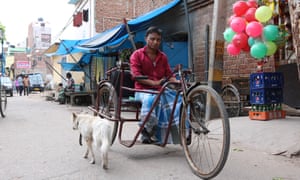


The government has provided residents of Tahir Pur who have leprosy with hand-operated rickshaws. Some have lost tissue in their feet due to leprosy-related injuries.


The government has provided residents of Tahir Pur who have leprosy with hand-operated rickshaws. Some have lost tissue in their feet due to leprosy-related injuries. Photograph: Michael Safi for the Guardian

Older now, Rammurat lives in a 30-hectare slum on Delhi’s north-eastern fringes. Rubbish collects in open sewers along the tight lanes of the neighbourhood and children mingle with tethered goats and chickens in the midday heat. It could be any poor community in the capital, but for the preponderance of wounds: missing toes, fingers, or entire limbs wrapped in white gauze.


Allotted to people with the disease a half-century ago, these blocks in Tahir Pur have grown into Asia’s largest leprosy colonies, home to 2,000 patients and their families, and a remnant of centuries of official policy to segregate them from the world. Rammurat arrived 25 years ago, seeking acceptance and access to treatment. “I moved here to save myself,” he says.


A few hundred metres away is the Leprosy Mission’s Delhi hospital, one of 14 specialist care centres the Christian group runs in India. Inside, hundreds crowd around waiting rooms and dispensary windows awaiting medicine, among them up to 150 leprosy patients each day.


It diagnoses on average one new case of the disease per day. “That’s alarming,” says Stephen Levi, the hospital’s superintendent. “And when we ask them to bring their other family members in, they don’t.”


Beside psalms and lists of symptoms on the hospital’s tiled walls there are, less congruously, pictures of the nine-banded armadillo: the north American mammal the only other species to naturally host leprosy, and a boon for researchers, who are still unable to grow the disease in labs.


For all the fear it conjures, leprosy, caused by the pathogen Mycobacterium leprae, has been effectively treatable since the 1940s. It isn’t particularly contagious either, its spread requiring regular contact with an untreated sufferer, and an immune system already compromised by genetics or poverty. Nor is it “flesh-eating” – limbs more likely to rot away because of injuries sustained by repeated use after the sensation of pain is lost.


“The real problem is the level of stigma,” says Dr Sunil Anand, the executive director of the Leprosy Mission. “Those who get leprosy tend to be ostracised and stigmatised by the community, they tend to hide away.”
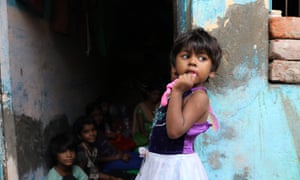


Children work packing balloons in Tahir Pur, home to the largest leprosy colonies in Asia


Children work packing balloons in Tahir Pur, home to the largest leprosy colonies in Asia Photograph: Michael Safi for the Guardian

That makes containing the disease, or treating it before disfigurement sets in, harder. “Discriminatory practices then come into play. Like schools not giving admission to children with leprosy, or from a leprosy family. It’s the same in jobs, even healthcare,” he says.


About 16 national Indian laws still discriminate against people with leprosy, he says, a legacy of the ancient aversion to the disease, but also an 1898 colonial law that segregated patients and prevented them having children, passed in response to British panic an epidemic would spread back home.


A eight-year treatment drive by the Indian government shrunk the number of new cases four-fold by 2005. That year the government celebrated the official elimination of the disease, meaning a rate of fewer than one in 10,000 new cases a year. “Maybe that’s possible,” Levi, the hospital superintendent, says of the official rate. “But only because India has such a huge population.”


One of India’s leading leprosy researchers, Dr Uptal Sengupta, is more sceptical. The elimination figure trumpeted by the government and World Health Organisation was produced “in a hurry”, the 75-year-old says from his office, a bobble-headed armadillo on the desk.


More recent leprosy surveys produced by the Indian Council of Medical Research (ICMR) have a much greater prevalence, he says, but the Indian government has declined to release the exact estimate. (A source with access to the research told the Guardian the research showed a national rate of “roughly five to six cases per 10,000”.)


Battling high rates, health officials are also racing against time: leprosy strains are slowly becoming resistant to the multi-drug therapy that so successfully brought the Indian infection rate crashing down.


“When there was a monotherapy, it took only 30 years for the disease to develop resistance,” Sengupta says. “And we are already seeing resistance cases [for the multi-drug therapy].”



An aerial view of one of Tahir Pur’s 29 leprosy colonies in east Delhi. Spanning 74 acres, the colonies make up the largest leprosy complex in the world.


An aerial view of one of Tahir Pur’s 29 leprosy colonies in east Delhi. Spanning 74 acres, the colonies make up the largest leprosy complex in the world. Photograph: Michael Safi for the Guardian

The rollout of the vaccine, announced earlier this month, is part of a return to a “war footing” against the disease, he says. “The vaccine is the most important thing for elimination. It’s the best answer.”


Beginning in five hotspot districts in Bihar and Gujarat, the vaccine will be administered both to people with leprosy and those in close and regular contact with them, in combination with the antibiotic Rifampicin. Trials of the vaccine have shown it could bring existing rates down by 65% over three years, according to Dr Soumya Swaminathan, the director-general of the ICMR.


The rollout is accompanied by a new round of “active case detection” – health workers going house-to-house “to hopefully detect new leprosy cases which were undiagnosed in the community”. Fifty districts have already been swept, turning up 5,000 previously undetected cases.


“It’s a multi-pronged attack on leprosy, we’re looking to eliminate it” – a second time – “in the next five to 10 years,” Dr Swaminathan says.


That the vaccine is Indian-developed is also a source of pride. “It shows exactly how Indian research and development can solve our own problems,” she says.


In Delhi at least, efforts to remove the stigma around one of the world’s oldest diseases are also paying off – but not without cost.


As the capital expands, the giant leprosy colonies of Tahir Pur suddenly find themselves on prized land. Businesses are illegally setting up shop and developers are eyeing an area society once spurned. “Now, the non-leprosy people are trying to move in,” Levi says.


India rolls out world"s first leprosy vaccine as fight goes on "war footing"

Bioengineered animal-free dairy coming to a grocer near you

Synthetic biology start-up company Perfect Day, formerly Muufri, is close to introducing a new kind of dairy to the food industry, sans cows. You read right; Perfect Day has created a genetically modified (GMO) strain of yeast called “Buttercup,” which turns plant-based sugars and fats into real milk proteins. Founders of Perfect Day have been working to provide a humane and ultra-sustainable dairy alternative since 2014 and anticipate having their products in stores towards the end of 2017.


Perfect Day co-founder Perumal Gandhi said, “We’re trying to make a ‘Goldilocks product’ that is better than anything out there: something that has the best of dairy products, but also the best of the alternatives.” While the company has started with cow milk, they plan to engineer goat milk, buffalo milk, and more. “We were hungry for a solution that empowered you to help make the world a kinder, greener place without giving up the delicious dairy foods you love.”


The company’s website totes claim that their crafting process is “cleaner, greener, and kinder” than the factory farming methods used to produce milk and dairy products. Preliminary studies suggest that their engineering process will use 98% less water, 91% less land, 65% less energy, and produce 84% less greenhouse gas emissions than industrial dairy production.


The company is citing superior nutrition, greater versatility, and better taste and texture as reasons consumers might choose their products instead of vegan dairy alternatives. However, it appears that their primary target market includes lacto-vegetarians who have not found the flavor and texture of vegan alternatives suitable and those who are lactose intolerant. They expect pricing to be comparable to organic dairy products.


“There will certainly be a “yuck factor” to the first food products created with industrial biotech and tissue-engineering platforms, but a steel fermentation vessel is a heck of a lot more sterile than a dirty cow or dairy farm,” said Maxx Charski of the Motley Fool. “You don’t drink milk because it comes from cows; you drink milk because you want milk. In other words, the milk is the product, not the cow. So why should the production system come into play in your purchasing decision? If you truly care about the impacts of your food, then you’ll consider the benefits of each on a case-by-case basis, not because one is labeled organic.” Obviously, the products will not be organic as USDA organic certification prohibits the use of genetically modified organisms in any aspect of production.


Perfect Day founders have vowed to practice transparency and to create products people will want to eat. They invite customers to submit product suggestions on their website and to stop by their Berkeley, California brewery for samples. Despite promises of transparency, the company fails to address concerning research against genetically modified (GMO) foods, GMO labeling, or global efforts to ban GMO foods.


The Perfect Day website states, “Our products are 100% free of genetically-modified organisms. However, we relied on genetic engineering to create a type of yeast that produces milk proteins. This is how vegetarian rennet, ethical vanilla, insulin, and many other everyday products are made. We then carefully filter and purify our milk proteins to ensure they’re 100% free of any yeast before adding them to our food products — this is why we can be sure they’re totally non-GMO.”


There are a lot of unanswered questions here, but the consumer will be the final judge.


Source for this article include:


http://www.fool.com/investing/general/2014/08/10/why-vegan-cow-free-dairy-milk-presents-a-major-pro.aspx


http://www.sciencealert.com/this-new-dairy-alternative-is-made-from-real-milk-proteins-but-with-no-cows-required


http://www.perfectdayfoods.com/faq/


https://www.fastcoexist.com/3062905/these-vegan-dairy-products-are-made-from-milk-there-just-arent-any-cows-involved


http://www.sciencemag.org/news/2016/07/us-senate-passes-gm-food-labeling-bill


Bioengineered animal-free dairy coming to a grocer near you

A mother"s world was transformed – and so was my career – all by a baby"s birth

Under my hands were the hands of a midwife with years of experience, and under hers the head of a baby about to be born.


I had never met the woman lying in the bed in the delivery room before, but she gave me the opportunity as a student nurse to experience childbirth with her.


I was in my mid-twenties and had worked in hospital administration for a number of years. At this point I had completed the first year of my general nurse training: modules in care of elderly people, acute medical and surgical, and time in the operating theatre.


It should have been nerve-racking but I knew my hands would be shadowing the midwife’s, and fear turned to astonishment. I could sense through her hands the movement of the advancing baby. The midwife enabled this progress using just the right amount of guiding control. I had no fear, only anticipation.


The labour was at an advanced stage – a small tuft of dark hair was visible. There was no time to discuss anything other than that this was her second pregnancy and her labour had been quick.


The birth seemed more of a spiritual experience than anything I expected. The midwife gently encouraged the woman, with no sense of urgency but calmly and knowledgeably. You only heard a slight change in her tone and saw a hint of a nod to the labouring mother when effort was required.


The midwife cradled the head of the child as he was born, while I stood at her side. It was a defining moment for me to feel the baby part from his mother and take that first gasp. It was as if I had delivered him myself, a moment forever etched in my heart and mind. Nothing else I could do would match the privilege of helping bring another human being into the world.


It would be a number of years after this experience before I would deliver a baby by myself. I’ve never forgotten how much this gentle birth helped influence my career path. That experience in a small rural midwifery-led unit was when I decided to become a midwife. The first day there sealed my future, and not only because I witnessed the birth of a baby. It was because the delivering midwife asked me to step forward. I had no idea what she was going to ask me to do. Having done my theatre experience I knew how to scrub up at least and that was all she asked of me. She was a natural mentor.


Once the baby was born I was allowed to hand the infant to his mother. We were left in awe in the hushed silence of the room. She gently felt him all over counting along with the midwifery sister the tiny toes and fingers. It was as if nothing else in the world existed other than mother and child. The mother cradled her son in her arms as he took his first feed from her. It was a scene of completeness and contentment.


The usual depiction of a baby crying out was not so. The mother murmuring sweet words to her newborn son were calming and no one wanted to break the sense of wonder.


Such hands-on experience changed my world as much as it did that mother’s. Some 30 years on, she is likely to be a grandmother and that baby, a parent himself. To have been a part of that is profound.


I went on to become a midwife in more clinical, acute hospital settings in bustling towns and larger cities. Yet I endeavoured to keep that gentle birth at the forefront of my practice. For in all we do, in our administering to the sick or healthy, there is no greater honour than stepping into another’s life.


If you would like to contribute to our Blood, sweat and tears series which is about memorable moments in a healthcare career, please read our guidelines and get in touch by emailing sarah.johnson@theguardian.com.


Join the Healthcare Professionals Network to read more pieces like this. And follow us on Twitter (@GdnHealthcare) to keep up with the latest healthcare news and views.


A mother"s world was transformed – and so was my career – all by a baby"s birth

How We Control Our Genetic Expression

Genetics and Epigenetics


There are certain genes that have been passed on from previous generations that we cannot change no matter how hard we try.  These may include eye colour, skin colour, height, etc.  They are ingrained in our DNA.   DNA is made out of two long strands that contain genetic information.   A gene is a part of DNA that is passed down from your parents. To be more specific, genes are grouped into units called chromosomes.  As you may recall from your high school science class, humans have 23 pairs of chromosomes. One set of chromosomes for each pair comes from a person’s mother, and the other set of chromosomes comes from the father.  Genetics can be defined as “The study of genes, heredity, and genetic variation in living organisms.”   1   It must be noted that while you have inherited your genes, many factors play a role in determining how your genes are expressed.  Although we may have the gene that could trigger a disease, lifestyle, diet and environmental factors play a much greater role in that issue actually coming to fruition.   This is what is known as “epigenetics”.  This emerging field has garnered the attention of cell biologists, doctors, scientists, and nutritionists.  What many people referred to as a life sentence for unfavourable gene formation is now being modified and altered by the way in which you live your life.  This puts the onus and accountability back in the hands of the individual and the decisions they make each and every day.


In my practice, I tend to hear and see people who blame their lack of progress on their parents, siblings, genetic makeup, etc.  They say they are big boned, hot tempered, impatient, or moody.  As I have just described, this may be true for some people but the typical ratio I see is 10 percent to 20 percent of your results are genetic while 80 percent to 90 percent are lifestyle, environmental and nutrition based.  This means that you can control around 80 percent of what happens to you.   “Modern genetics has expanded beyond inheritance to studying the function and behavior of genes. Gene structure and function, variation, and distribution are studied within the context of the cell, the organism (e.g. dominance) and within the context of a population. Genetics has given rise to a number of sub-fields including epigenetics and population genetics. Organisms studied within the broad field span the domain of life, including bacteria, plants, animals, and humans.”  2


We must take a step back and first look at how your parent’s and even your grandparent’s lifestyle and nutrition decisions affected your DNA.  The science is just starting to show that their decisions on type of food, living environment, etc. played a significant role in forming your DNA sequence.  Professor Mark Hanson, University of Southampton, says, “Aspects of our early lives stay with us for the rest of our lives and set the control mechanisms of our body processes such as appetite and our predisposition to lay down fat or exercise. These are set early and are affected by a mother’s diet, physical composition and even aspects of a father’s lifestyle.  The environment during development affects gene expression and thereby the setting of physiological control systems that stay with us for the rest of our lives. They affect the way the genes we have inherited from our parents actually operate and can be influenced by aspects of mother’s and father’s diet and lifestyle.” 3 Now that we can thank our parents for setting the genes in motion with their decisions, we will also review how our own lifestyle actually expresses them.


Responsibility and ownership of your own life will invariably fall back on you and that is exactly how it should be.  We control our destiny and I am going to explain how our own decisions actually alter our genes and the subsequent results.  “In terms of heart disease, we were able to show, for the first time, that it could be reversed by changing lifestyle, and these improvements occurred much more quickly than had once been thought possible. Usually within hours, and almost always within days to weeks, your heart can receive more blood flow. As a result, we found over a 90 percent reduction in the frequency of angina or chest pain.  People not only felt better but also, in most cases, they were better in every way we could measure. Their hearts received more blood flow and pumped more normally. The arteries that feed the heart became measurably less clogged in one year and showed even more improvement after five years. Using cardiac positron emission tomography (PET) scans, we found that 99 percent of the patients in our research were able to stop or reverse the progression of heart disease simply by changing lifestyle, without drugs or surgery. These findings may capture people’s imagination—so often, people think there is not much they can do, what I call genetic nihilism: “Oh, it’s all in my genes, what can I do?” Well, it turns out you can do a lot, more quickly than we had once realized and to a much greater degree than had been thought possible.“ 4  This research is revolutionary and confirms the suspicions that your daily decisions affect the chances of activating specific genes and consequently serious illness.


Mike, FDN, PT


www.mikedaciuk.com


info@mikedaciuk.com


About the Author:


After completing his Degree at Ryerson University and spending 15 years in Corporate, he graduated from the Functional Diagnostic Nutrition program in California and is now the CEO of Interactive Body Balance where he oversees a vibrant functional medicine health practice. Transitioning from Corporate to the entrepreneurial paradigm has involved seeing patients and clients via the conventional method but also virtually. He has authored the popular self-help book titled “The Transformation From Within” and the Functional Medicine Book ” How To Restore Your Health”, hosts the highly ranked ITunes Podcast called Interactive Body Balance, is creating multiple online health courses while also presenting to audiences around the world.


Sources for Article


  1. Griffiths, Anthony J. F.; Miller, Jeffrey H.; Suzuki, David T.; Lewontin, Richard C.; Gelbart, eds. (2000).“Genetics and the Organism: Introduction”.An Introduction to Genetic Analysis(7th ed.). New York: W. H. Freeman. ISBN 0-7167-3520-2.

  2. Hartl D, Jones E (2005)

  3. http://www.physoc.org/press-release/2013/your-children-could-inherit-your-lifestyle-their-genes

  4. https://edge.org/conversation/dean_ornish-changing-lifestyle-changes-gene-expression


How We Control Our Genetic Expression

6 Essential Vitamins We All Need After 40

The sourness of sugar

With the food industry, it all comes down to greed and various conspiracies to make you eat and spend more. As their profits go through the roof, every time we use more of their products, we need to realize that they are already producing enough food for every American to eat 3,900 calories a day – which is almost double what we actually need.


So, how do they get us to eat more girth enlarging calories? Sugar!


Sugar and corn sweetener, aside from largely being a GMO crop, are cheap to produce and let you eat until the cows come home without feeling full. To scarf down 1,000 via a 7-11 Big Gulp is not only effortless, but it leaves plenty of room for dinner.


The effect that this type of consumption has is that you eat more calories than your body needs, you easily gain weight, and it’s easier to become the President than to lose weight.


We, the “tricks”, are eating what amounts to about 31 teaspoons of added sugar a day, which equates to about 500 extra calories a day, or 25% of your daily caloric intake each and every day.


How do they trick us into doing that?


The “hooker” (the U.S. Government) requires that the “pimp” (the food industry) disclose the amount of sugar contained in a given product. Sounds great on paper, doesn’t it?


What if sugar is given a different name, one that you may not be aware of? Having somewhat of a brain, you would assume that molasses and honey must contain sugar. But what about sorghum or corn syrup or high fructose corn syrup or turbinado or fructose or amazake or lactose or dextrose or sucrose, or galactose, or maltose? Jeez, it’s enough to make you comatose!


The average person wouldn’t associate these scientific-sounding names with sugar. But that’s what they are.


These sugar aliases allow a food manufacturer to list these euphemisms on the same label without telling you it’s all sugar.


The next trick they use is to list the information in grams. Why grams? Because you don’t know squat about grams.


When you see that a 12-ounce can of soda contains 40 grams of sugar, you could care less. But what if you saw that that same can of soda contained 10 teaspoons of sugar?


What would you think if you were sitting next to a guy in Starbucks and you watched him put 10 teaspoons of sugar in his coffee? You would think the guy was lolo (Hawaiian for crazy), wouldn’t you?
So, allow me to make it easy for you. Four grams equals one teaspoon. You divide the total grams by four and you will know how many teaspoons you are about to ingest.
In dealing with the “sugar conspiracy” thrust upon us, we left off with the using of grams to describe sugar content. But, it doesn’t end there.


One very, very important thing to remember is that you must read labels, because many “non-sweet” products contain sugar as well.


A half cup of store-bought spaghetti sauce can contain as much as three teaspoons of sugar.


Ketchup can have a 20% sugar content.


When the “pimps” take the fat out of a product, like cookies or salad dressing, guess what they replace it with? Yep, sugar and extra salt. High blood pressure anyone? Calorie wise they are not much less than the “fattier” version.


Bread is another one. It’s sugar and eggs (the whites, by the way, are used in aircraft paint because they don’t crack under extreme temperatures.) that gives bread its nice, golden crust.


We know that potato chips are salty, but they can contain sugar as one. They don’t say, “betcha can’t eat one”, for nothing.


And let’s not forget the popular high protein energy bars. These guys can contain up to 300 calories and are loaded with sugar.


There was a study done at the American College of Neuropsycopharmacology ( say it three times fast and you’ll own it) that found that sugar gives the same brain reaction like morphine, cocaine and nicotine. To put it another way, sugar is addictive!


The reality is that the food industry knows full well that sugar is addictive, so it shouldn’t come as surprise to you that they will put as much as they can in as many products as they can to get you to eat more and more and more. You eat more, you get fat, you get sick, they get rich. They see that as a win-win situation. How do you see it?


But sugar just doesn’t make you waddle down the street. It does a number on your insulin levels and leads you to becoming a diabetic. Did you know that just consuming one can of soda a day increases your risk of diabetes by 85% and can cut 11 to 20 years off your life? No s – – t!


Trust me, it’s not a walk in the park to break a sugar habit, but you have to give it your best shot.


You can keep your blood sugar stable by including protein with every meal. If you know about quinoa, the incredible grain from Peru which is a complete protein, you can eat that and get plenty of fiber as well. Remember, if it had a face or a mother it has no fiber.


If you use fruit as a substitute for sugar it will help curtail your sugar cravings.
Under no circumstances substitute fake sugar and think it’s the answer.


Aspartame (Equal, NutraSweet, etc) will turn you into a zombie because the methanol in aspartame converts to formaldehyde at 84 degrees F (the body’s temperature is 98.6 degrees F)


Splenda is derived from chlorine and is best used in your swimming pool.


The reality is that these fake sugars do not eliminate sugar cravings, they actually increase them. A study proved that a person’s risk for obesity went up 41% for each daily can of diet soda.


So, do the best you can and take it one day at a time. When you see your weight come down and your mood swings level out and you have more sustained energy, you’ll know you’re on the right road.


Just stay as sweet as you are.


Aloha!
To learn more about Hesh, listen to and read hundreds of health related radio shows and articles, and learn about how to stay healthy and reverse degenerative diseases through the use of organic sulfur crystals and the most incredible bee pollen ever, please visit www.healthtalkhawaii.com, or email me at heshgoldstein@gmail.com or call me at (808) 258-1177. Since going on the radio in 1981 these are the only products I began to sell because they work.
Oh yeah, going to www.asanediet.com will allow you to read various parts of my book – “A Sane Diet For An Insane World”, containing a wonderful comment by Mike Adams.
In Hawaii, the TV stations interview local authors about the books they write and the newspapers all do book reviews. Not one would touch “A Sane Diet For An Insane World”. Why? Because it goes against their advertising dollars.


The sourness of sugar

Organ donation rates for transplants still too low in UK, says NHS

A record number of organs were donated and transplanted in the UK in 2015-16 but the consent rate is still one of the lowest in Europe, with a worrying shortfall of donors from black or Asian communities.


In the 12 months to the end of March, 1,364 people became organ donors when they died and their donations resulted in 3,519 transplants taking place, figures published on Thursday show.


The consent rate stood at 62%, slightly up on 2012-13 when it was 57%, but well short of the target of 80% by 2020 with the biggest obstacle being family refusal, mostly when they were unaware of their deceased relative’s intentions.


The consent rate was much lower (34%) among potential black, Asian and minority ethnic (BAME) donors, which is of particular concern as 26% of the current waiting list are BAME.


Sally Johnson, NHS Blood and Transplant director of organ donation and transplantation, said: “Think about what we would want others to do for us if we ever need a transplant and be prepared to donate. Talking to your relatives about what you want is crucial as it is much more difficult to agree to donation when you don’t know what the patient would have wanted. There are about 6,500 people waiting for a transplant now and they need people to agree to donate for them to get the organ transplant they so desperately need.


“It is especially important for people from our black and Asian communities to talk about organ donation. I realise that this is a very difficult subject but there are many black and Asian people who need a transplant. While some are able to receive an organ from a white donor, others will die if there is no donor from their own community.”


Last year, 466 patients died in need of an organ and a further 881 were removed from the transplant waiting list, many whom would also have died shortly afterwards.


NHS Blood and Transplant estimates that if 80% of families approached to donate a relative’s organs said yes, more than 1,000 additional transplants would take place across the UK each year.


People from black and Asian communities have a higher incidence of conditions such as diabetes and certain forms of hepatitis, making them more likely to need a transplant, and make up a third of the active kidney transplant waiting list. But in 2015-16 only 67 (5%) of all deceased organ donors were from black and Asian backgrounds.


Lloyd Dalton-Brown, 65, who lives in Exeter, agreed to donate his half-sister Jane’s organs when she died aged 29 after being hit by a truck in 2000. Their father was from Trinidad. “Because of that gift [of organs] five people had transplants, which is utterly fantastic. One of them was a mother of children of three and four; she got one of Jane’s kidneys and because of that ended up with quality of life and was able to bring up her children.


“A lot of people from Caribbean backgrounds are quite susceptible to kidney disease. Her organs were going to be really beneficial to someone in that category. There’s a positive outcome after a very sad ending.”


The Welsh government, which on 1 December became the first part of the UK to introduce a “soft opt-out” system, expressed satisfaction at a 24% rise in the number of its citizens whose lives have been saved or improved by organ transplants, compared with a 4% increase in the UK as a whole. The effect of the change in system was relatively small in the period analysed, during which there were nine cases where consent was deemed.


Charities including Live Life Give Life and the British Heart Foundation urged people to join the organ donor register and communicate their decision to their loved ones.


To join the NHS Organ Donor Register visit www.organdonation.nhs.uk or call 0300 123 2323.


Organ donation rates for transplants still too low in UK, says NHS