1 Eylül 2016 Perşembe

Time to take laughter seriously?

“We don’t laugh because we’re happy, we’re happy because we laugh” – William James


Do we laugh enough or should we learn to laugh more?
Joyful, good-natured, ‘mirthful’ laughter is a tonic for our body, mind, emotions, and spirit. Whether we use it as a distraction, to cheer ourselves up, or as a practice to energise and enthuse us, laughing impacts every part of us. In many ways it is the ultimate drug, with no harmful side-effects.


It activates our zest for life.


On a physical level, laughter stimulates our cardiovascular and pulmonary systems by giving our hearts and lungs a vigorous workout. It stimulates blood flow, oxygenates our blood and energises our whole physical system even if we’re hospitalised. The US doctor Patch Adams has been using it professionally for years.


Its endorphin-triggering effect makes laughter a strong painkiller for emotional and mental pain, as well as physical. It has been proven that higher levels of pain can be readily tolerated and the healing process is speeded up. Both the Norman Cousins experience, described in his classic best seller ‘Anatomy of an Illness’, and the current RX Laughter project with children in UCLA hospital in Los Angeles provide the evidence.


Psychologically, laughter is the antithesis of depression. If we’re feeling any anxiety, it is an excellent antidote. In fact, in 2002 in Austria Dr Koutek started using the sound of spontaneous group laughter as part of his treatment for patients with depression. In our Bristol laughter club (www.bristollaughterclub.com) there are countless examples of people whose lives have benefited from the ‘lightness’ that laughter induces. People’s faces change, their body language and posture become more open and relaxed, their communication becomes more playful and spontaneous. Even the simple smiling exercise based on the 1988 F. Strack, L.L. Martin and S. Stepper’s pencil exercise produces lasting results. All you need do is smile genuinely three times a day for at least 10-15 seconds and some people find it transforms their lives.


Laughter and playfulness, in turn, unlock our natural creativity. “You can learn more about a person in an hour of play than a year of conversation” said Plato. Creativity is an essential part of a fun-filled life and helps neuroplasticity, our brain’s learning ability, by strengthening mental flexibility and resilience. Because of this – as we see in Martin Seligman’s Positive Psychology – optimism, positivity and happiness become learnable skills. In short, we learn to become happier. Learn more about this here.


On the self-development path, the practice of laughter is the practice of joyfulness. Ancient traditions as well as new ones encourage us to practice laughing – with a sense of willingness. What ancient traditions intuited and experienced, and neuroplasticity shows, is a practice is learning new skills until they become second nature. Current thinking is that it might be only 21 days, as in the Chopra 21-day meditation challenge.
The key ingredients are
single-mindedness,
perseverance and
tenacity to keep going until you become aware of the differences in your life.


There are numerous recent psychological studies which show the beneficial impact of smiling especially when this is the genuine ‘Duchenne’ smile which uses the involuntary orbicularis oculi muscles. This genuine smile encourages an empathetic response and consequently stimulates sociability.


This is also the theme in the book ‘Awakening the Laughing Buddha within’.


4 top tips to laugh more:


1. Look for laughter and laughter will find you. Look for as many opportunities to smile and laugh in your day, and importantly, communicate them. Not only will you feel better, you will also be encouraging a positive ripple in others too.
2. If it will be funny later, it’s funny now. Often we look back and laugh at things. Can we laugh at them now instead?
3. Start your day with a laugh. This is both a Zen and a Hawaiian practice. No matter what yesterday delivered, start today with a chuckle, a kinaesthetic version of a positive affirmation. Why? We get the endorphins. We may then feel more upbeat and better equipped for your day ahead. Its worth remembering, when we’re feeling really rough, that’s the time we need our endorphins most.
4. Fake it till you make it. Feeling grumpy? Sluggish? Irritable? When you’re ready to change your mood, smile and laugh, even if you don’t yet feel like it. Your system will release endorphins anyway because it can’t tell the difference between the real joyful laugh and a fake one. The key is your willingness.


For more information, please visit www.joehoare.co.uk


Time to take laughter seriously?

Young children copy parents" sugary drinks habits, study suggests

Children aged four to eight whose parents regularly consume fizzy drinks are almost three times as likely to drink them as other children their age whose parents don’t, research suggests.


The Drink as I Do report suggests that young children copy the drinking behaviour of their parents, whatever they are consuming, but that the effect is most worrying when it comes to consumption of beverages linked to health problems.


Four- to eight-year-olds whose parents drank fizzy drinks were 192% more likely to consume them than other children their age. They were more than twice as likely (115%) to drink fruit juices if their parents consumed those and more than six times as likely (529%) to have smoothies if their parents indulged.


The report was compiled by Emma Derbyshire, children’s nutrition adviser to the Natural Hydration Council, a not-for-profit organisation backed by producers of bottled water.


She said:“Clearly children emulate their parents. With water, children were only drinking about three cups a day when they should be drinking between five and eight glasses. They’re under-consuming water in favour of calorific drinks. It’s a concern given problems with obesity and tooth decay. The thing is [for parents] not just to tell children to drink water but to do it themselves and ideally be seen to enjoy it.”


The report, based on responses from 1,000 parents and, in each case, one of their children, found that 37% of children do not drink water on any given day but this fell to13% when their parents drank water often.


Where parents drank squash, their children were 1.4 times more likely to drink them than other children and the “copycat” effect was even more pronounced for sports drinks (11 times more likely), although for the latter the small sample size means it should be treated with caution.


Children in the UK consume three times more sugar than is recommended, and soft drinks are the biggest source, accounting for 29% of the sugar intake of 11- to 18-year-olds and 16% for younger children. After concerns about the impact this is having on children’s health, a two-tier sugary drinks tax is to come into force next year based on the level of sugar per 100ml in a soft beverage.


Public Health England’s Eatwell guide, which was published earlier this year, advises that intakes of fruit juice and/or smoothies should be limited to a total of 150ml a day as they are a source of excess sugars.


Psychologist Emma Kenny, who is backing the report, said: “It’s that ‘do as I say not do as I do culture’. If you’re giving children water and drinking fizzy drinks, it’s natural for them to want to taste your drink and the moment the child can get their hands on a fizzy drink they will do so. You’re not going to stop them having other drinks but the tastes they form early on are compelling.”


Young children copy parents" sugary drinks habits, study suggests

Poisonous Algae Blooms Threaten Ecosystems and People in U.S.

Serious outbreaks of poisonous algae blooms have hit 20 states in the United States this summer.  Many of these dangerous occurrences are in surprising places like mountain lakes and streams.


Though algae blooms are a normal part of summer, the toxicity, size, and frequency are worse than ever this year.


Scientists, water managers, and public health officials continue to scramble for a solution to this increasing public health concern.


Poisonous Algae Bloom Outbreaks


Poisonous algae blooms are showing up in lakes and big reservoirs — like Lake Oroville and Shasta Lake, in California.  The outbreaks are also taking place along the Atlantic Coast, and in Florida, Rhode Island, Alabama, Utah, and Ohio, to name a few.


This summer’s massive algae bloom, that closed Utah Lake, made people sick and left farmers scrambling for clean water during some of the hottest days of the year.  In some places, the algae is spreading so bad, it looks like a huge can of green paint was spilled into the water.  And the poisonous algae blooms have a foul odor.


The poisonous algae outbreaks are forcing public health officials to shut down beaches in Florida.  The outbreaks are threatening ecosystems in California and other locations within the U.S., as well.


Bev Anderson, an algae expert and scientist with the California Water Resources Control Board, told NPR that water managers are anxious to find a solution — and they’re quite nervous.  She says, “Everyone’s on edge with the cyanobacteria.”


Every morning Anderson receives emails about outbreaks of cyanobacteria — or blue-green algae. She says California has posted danger signs in a minimum of 30 reservoirs and lakes.


Toxin Levels Are Alarming


Algae blooms can be caused by storm water runoff.  They could make bodies of water turn bright green — as if the water had paint spilled in it.


And if the algae has cyanobacteria, people become at risk of developing a variety of adverse health conditions — from skin rashes to symptoms of Alzheimer’s and more.


For instance, in Discovery Bay, a community about 60 miles east of San Francisco, resident Wade Hensley ended up in the hospital after diving in the water that contained poisonous algae.  His body went numb from the waist down.  It’s still numb.


Hensley voices his concern.


“And, it was about three days of swimming.  Not constant, but in and out. And they can’t pinpoint exactly what it is.”


County health officials did find microcystin in Discovery Bay.  Microcystin is one of several toxins produced by algae. Symptoms that are more typical are fever, rashes, vomiting, and dizziness.


Scientists looking into the poisonous algae outbreaks are finding most alarming toxin levels in water throughout North America.  For example, toxin levels of twenty micrograms per liter would cause concern.  However, the current readings are much higher — as high as 150,000 micrograms per liter.


Precautionary Advice


Bev Anderson says a changing climate is partly responsible for the poisonous algae bloom outbreaks.


“We’re getting higher temperatures than we’ve seen ever in the past.  California had an unprecedented drought for the last five years which [has left] the water levels very low in a lot of areas.”


And when water is shallow, that means warmer water.  Additionally, fertilizer in water runoff from lawns, golf courses, and farms helps the algae spread.  Chemicals that kill algae can help.  But chemicals are only a temporary solution.  In addition, chemicals can also backfire by promoting other toxins.


In the mean time, Anderson offers some simple advice to swimmers and anyone with pets near water with algae blooms.


“If in doubt, stay out!  Don’t go in; don’t let your dogs in.”


How to Alert Environmentalists of Harmful Algae Blooms


Though water districts carefully screen for toxins, poisonous algae outbreaks pose public health dangers to our drinking water, as well.  And, scientists expect the problem to escalate.


Aware citizens can help environmentalists in tracking poisonous algae blooms.


For example, Hilary Snook, a senior scientist with the Environmental Protection Agency (EPA) who works in a lab in Chelmsford, Mass., told a gathering of people in Rhode Island about a new mobile application people can download free on Android and IPhones.  It’s called, bloomWatch.


The bloomWatch app is the easiest way to participate in the Northeast Regional Cyanobacteria Monitoring Program.  If you want to be more involved, they highly recommend trying your hand at cyanoScope or their cyanomonitoring program.  They’re always looking for new recruits.


The way the app works is people can take photos of possible poisonous algae blooms and upload them to the app. Then they will add the name of the pond or lake where they took the photo, and additional information — like the current weather condition.


The uploaded information shared through the app will help public health officials, water managers, and scientists, who are engaged in tracking the poisonous algae blooms.


In the meantime, other than gathering information — the way it stands now — unless someone comes up with a solution there’s nothing to do but wait for the poisonous algae to hopefully disappear during the cold, winter months.


Poisonous Algae Blooms Threaten Ecosystems and People in U.S.

Team GB"s cycling heroes call for "legacy of everyday cycling"

A group of Britain’s medal-winning cyclists from the Rio Olympics have written to Theresa May to tell her the best way to honour their achievements would be for the government to invest heavily in everyday bike-riding.


The signatories, including Laura Trott, Jason Kenny, Mark Cavendish, Joanna Rowsell Shand and Becky James, as well as Sir Chris Hoy, jointly with Kenny the country’s most successful Olympian, told May: “You were widely reported in the media as saying that there will be ‘no limits’ on the honours that could be bestowed on our medal winners.”


They continued: “But the best way to honour the achievements of our athletes would be a legacy of everyday cycling in this country – a place where cycling is the choice form of transport for people to get around in their daily lives.”


The letter was organised by British Cycling, which as well as being a sporting body also campaigns for better everyday bike provision. It pointed out the disparity between Britain’s vast success in sports cycling and the relatively tiny numbers who use bikes for transport, arguing cycling should be treated as consistently and seriously by government as the roads, rail or aviation.


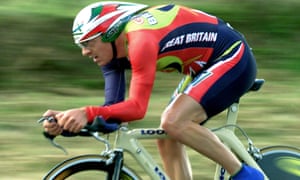
Chris Boardman at the Cycling World Championships in France, 2000.


Chris Boardman at the Cycling World Championships in France, 2000. He has asked to meet Theresa May. Photograph: Franck Prevel/AP

Britain won six golds and 12 medals overall at cycling in Rio, topping the medals table in the sport for the third successive Olympics. Yet the proportion of trips made by bike has remained constant at about 2%, with relatively little investment in bike lanes outside London and a handful of other places.


While David Cameron famously said he hoped to see a “cycling revolution”, an eventual walking and cycling strategy, released earlier this year, was written off by cycle campaigners as worthless, with the money committed around £1 per person per year, against a figure of about £28 in the Netherlands.


The Olympians’ letter urged May to “set out a timeline to address the chronic underfunding and lack of leadership which is keeping cycling for transport in the slow lane”. It added: “Only networks of segregated cycle lanes in towns and cities across the country can achieve and influence growth.”


With a chronically sedentary nation and around one in three children overweight or obese, investment in cycling would pay enormous health dividends, the letter argued, as well as boosting businesses along the routes, and making towns and cities less congested and more liveable.


“There is huge latent demand for cycling,” they wrote. “Two thirds of people would cycle more if they felt safer on the roads.” The letter asks the government to commit 5% of its transport spend to cycling, and to improve law enforcement to better protect cyclists.


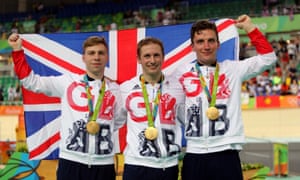
Philip Hindes, Jason Kenny and Callum Skinner with their gold medals following the Rio 2016 men’s team sprint final.


Philip Hindes, Jason Kenny and Callum Skinner with their gold medals following the Rio 2016 men’s team sprint final. Photograph: David Davies/PA

“Investment in cycling as a form of transport isn’t purely an investment in cycle lanes,” the letter concluded. “It is an investment that will pay off for the nation’s health, wealth, transport infrastructure and the vibrancy of our towns and cities. It has the added benefit of just making it easier for ordinary families to get to work and get to school.


“Our athletes have inspired the country and now we urge the government to take cycling seriously as a transport option for everyone.”


The signatories are asking May to meet Chris Boardman, whose cycling gold at the 1992 Olympics heralded Britain’s success in the sport, and who is now British Cycling’s policy adviser.


Boardman said he hoped for a fresh start after the lack of action from Cameron’s “cycling revolution” and the cycling and walking investment strategy.


“It was quite a step, so we were all pretty gutted when we saw it will amount over this parliament to less than a pound a head, which just beggars belief,” he said.


Boardman said he hoped the letter would “put some moral pressure on the prime minister to have to say either what we’re going to do, or why we’re not going to do it”.


He said: “Even in these austere times it’s such a good economic investment, it’s such an efficient spend of cash. It’s exactly what they should be doing. So what we deserve is an answer.”


At the moment, Boardman said, the government was officially committed to doubling the numbers of cyclists by 2025, but had no real means to achieve this. He said: “The question I would like to ask is, you want to double the amount of cycling, to get from 2% to 4%. Do you think less than £1 a head will achieve that target? I don’t think anybody could look you in the eye and say, yes.”


A cycle left as a protest by Bikes Alive at King’s Cross, London.


A cycle left as a protest by Bikes Alive at King’s Cross, London. Photograph: Sarah Lee for the Guardian

A Department for Transport spokesman said government investment in cycling had tripled since 2010. He said: “We are spending £300m on cycling funding and a further £500m for infrastructure in local communities which will include benefits for cyclists.


“The number of people choosing to get about by bike has grown over recent years and, following the success of our Rio Olympians, we want to see this trend continue.”


The letter to Theresa May


Dear Prime Minister,


The Great Britain cycling team athletes topped the cycling medal table for the third Olympic Games in a row at Rio 2016. It was a truly outstanding performance and enhances Britain’s status as the world’s leading elite cycling nation.


You were widely reported in the media as saying that there will be “no limits” on the honours that could be bestowed on our medal winners. But the best way to honour the achievements of our athletes would be a legacy of every-day cycling in this country – a place where cycling is the choice form of transport for people to get around in their daily lives.


Your predecessor called for a “cycling revolution” and your government’s manifesto sets out a target to “double” the number of journeys cycled. While some steps have been made, cycling is still a transport mode which does not enjoy the government investment or political leadership given to roads, rail or aviation.


The government is now considering feedback on the draft Cycling and Walking Investment Strategy (CWIS). We urge the government to publish this and set out a timeline to address the chronic underfunding and lack of leadership which is keeping cycling for transport in the slow lane. Only networks of segregated cycle lanes in towns and cities across the country can achieve and influence growth.


The success of the CWIS will be felt not only across government but in all areas of the nation’s life.


The government’s sports strategy seeks to extend the number of people living physically active lives and could be truly transformative. Active travel – walking and cycling – is the easiest way for people of all ages to fit physical activity into their lives. Currently, only one in five people achieve the recommended levels of physical activity.


Around one in three children is overweight or obese. The government’s childhood obesity strategy recognises the value of physical activity and the importance of walking and cycling to school. I am sure you know that this will seem a fanciful idea for most parents without the convenient walking and cycling routes which would give them the confidence that their children will be safe getting to school. Yet we know it can be achieved – in the Netherlands, 50% of education-age children cycle to school.


As cities like Copenhagen and New York have shown, cycling also creates better places to live and work. More cycling cuts congestion, reduces noise pollution and fuels local economies. Small businesses in New York have seen a 49% increase in business where cycle lanes have been installed.


There is huge latent demand for cycling. Two thirds of people would cycle more if they felt safer on the roads. The government’s road safety statement reiterates the manifesto commitment to reduce the number of cyclists killed or injured. The CWIS needs to set targets to improve road maintenance, enhance enforcement of the laws, and update the rules of the road to better consider the needs of cyclists.


To make this happen, we need 5% of the government’s transport spend allocated to cycling. This is the only way that cycling will be integrated into transport strategy and given the priority it deserves.


Investment in cycling as a form of transport isn’t purely an investment in cycle lanes. It is an investment that will pay off for the nation’s health, wealth, transport infrastructure and the vibrancy of our towns and cities. It has the added benefit of just making it easier for ordinary families to get to work and get to school.


Our athletes have inspired the country and now we urge the government to take cycling seriously as a transport option for everyone.


British Cycling’s policy adviser Chris Boardman would welcome a meeting to discuss this further. We look forward to hearing from you.


Yours sincerely,


Chris Boardman, policy adviser, British Cycling and Olympic gold medalist


Sir Chris Hoy, six-time Olympic gold medallist, joint most successful British Olympian


Laura Trott, four-time Olympic gold medallist and Britain’s most successful female Olympian


Jason Kenny, six-time Olympic gold medallist, joint most successful British Olympian


Mark Cavendish, Olympic silver medallist


Joanna Rowsell Shand, double Olympic gold medallist


Elinor Barker, Olympic gold medallist


Owain Doull, Olympic gold medallist


Becky James, double Olympic silver medallist


Katy Marchant, bronze medallist


Team GB"s cycling heroes call for "legacy of everyday cycling"

Survival in a Pill Bottle

Survival in a Pill Bottle


Believe it or not basic survival tools can be arranged and stored within the small confines of an average pill bottle.  As long as you do not intend on surviving multiple days out in the wilderness with just a survival kit stored in a pill bottle.  The survival kit in a pill bottle is intended to get you either through the day or through the night with some basic tools that will keep you warm, fed and hopefully dry until safety can be reached or until you can be found.  The greatest factor of keeping a survival kit in a pill bottle is that you can keep the pill bottle just about anywhere.  From your vehicle glove box to your backpack or even pants pockets, the survival in a pill bottle is designed to keep you alive.


Matches


Matches can come in handy especially if you are forced to spend overnight in the wilderness.  Matches can provide basic fire starting abilities so that a campfire can be made to keep you warm and keep predators away as well as to even cook your food.  Be sure to carry, if possible, waterproof matches, windproof matches or matches that can ultimately maintain resistance to extreme weather conditions.


Fishing Line and Hooks


Fishing line and hooks will come in handy when food is needed to be found.  More often than not small streams, lakes and even rivers are found all throughout the wilderness and with a little bit of time a fish can be eventually caught.  Many fishing hooks come with fishing line already tied for your convenience.  Take advantage of these fishing hooks and lines by storing them in your survival in a pill bottle.


Band Aids


It’s better to be safe than sorry by storing additional band aids.  As well as they really do not take up much space. The average pill bottle can store almost any amount of band aids.  Having roughly three or four band aids however will be plenty if only an overnight in the wilderness is anticipated.  Band aids will go a long way as to prevent any further infections from open wounds or sores if stumbling around in the wilderness especially if in the dark.


Wooden Clothespin


A wooden clothespin can surprisingly come in handy for all sorts of activities.  Whether it is for ensuring the fishing line and hooks are secured for catching small fish or for simply holding back pieces of clothing in order to make a tourniquet for extreme cuts or wounds.  It is better to have a wooden clothespin and not need it than to need it and not have one.


Sanitary Wipe


Ensure the prevention of infection from cuts, scrapes and small wounds by packing a sanitary wipe in your survival in a pill bottle.  This will help to clean out wounds that might occur from an emergency situation that forces you to stay overnight in the wilderness.  Sanitary wipes will also come in handy for small rashes if various plants are accidentally on your path to safety.


Twisty Ties


Believe it or not twisty ties can go a long way in the game of survival.  They are durable and usually will hold small amounts of weight.  For example, using twisty ties as a part of your fishing line and hooks to catch small fish will ensure that your line and hook doesn’t get away from you.  Also, twisty ties can be used as small markers around trees and bushes if you need to find your way back to a specific location.  Twisty ties are great and large quantities can be stored in small areas making them an excellent choice for a survival tool in a survival in a pill bottle.


 Watch a short video here: Survival Kit in a Pill Bottle


Survival in a Pill Bottle

31 Ağustos 2016 Çarşamba

MPs say cuts are "false economy" in drive to improve poor people"s health

MPs are calling on the prime minister to fulfil her pledge to end the “burning injustice” of shorter lifespans for the poor by boosting public health, after the missed opportunity of the childhood obesity strategy.


But the health select committee is saying in a hard-hitting report that cuts to public health funding since responsibility was handed to local authorities in 2013 will make this more difficult. Cuts are “a false economy”, because keeping people healthy in their communities protects the NHS from the expensive consequences of treating diabetes, heart disease and other chronic illnesses in times to come.


Dr Sarah Wollaston, Tory chair of the committee, said people were rightly scathing about the government’s recent watered-down childhood obesity strategy, which “demonstrates the gap in joined-up evidence-based policy to improve health and wellbeing”.


“Government must match the rhetoric on reducing health inequality with a resolve to take on big industry interests and will need to be prepared to go further if it is serious about achieving its stated aims.”


Speaking to the Guardian, she said people were “hugely disappointed because it was the opportunity to signal intent that this wasn’t going to be business as usual”.


Wollaston added: “People were hugely encouraged by Theresa May’s words and determination. I don’t doubt her intent. What I feel is now at risk is that the people who are going to be tasked with making a difference won’t have the tools to do the job, and at a time of shrinking health budgets it’s even more difficult for them to narrow health inequality.”


Although the childhood obesity figures appear to be levelling off – with about a third of kids overweight or obese by the time they leave primary school – the truth is that the change is in the children of affluent families. The gap between rich and poor children is widening.


“Childhood obesity is this huge future growing disaster not only for these individual children but for the NHS in terms of costs from managing type 2 diabetes,” Wollaston said.


She urged the government to listen to the criticism and act. Linking public health to planning and licensing applications, thereby allowing local authorities to say no to more fast food outlets and off-licences, “would send a very strong signal”, Wollaston said.


She believes the government should also rethink the absence of restrictions on advertising and marketing junk food to children. “There’s nothing there about advergames – the deliberate targeting of children where they think they are playing a game when they are actually having stuff flogged to them. And [it’s] particularly disappointing that there was nothing about the saturation advertising to children and the use of cartoon characters,” she said.


“There was very clear evidence that Public Health England presented about impulse purchases and pester power and end of aisle displays and checkout displays. Everyone recognised that it wasn’t just a single hit here. You had to look at it across the board, yet whole tranches of public health messaging are going to be undermined by the fact that advertising hasn’t been touched at all.”


Funds to local authorities for public health were slashed by £200m last year and more cuts are to come. The report says this is short-sighted and talks of “a growing mismatch” between spending on public health and the significance attached to prevention in NHS chief executive Simon Stevens’s plan. Keeping people well and out of hospital is fundamental to the sustainability of the NHS in his plan.


The report calls for a Cabinet Office minister to be given responsibility for embedding the interests of health in every government department, a proposal welcomed by the Royal Society for Public Health. “A ‘health in all policies’ approach is key to addressing wider determinants of health and health inequalities, such as housing, education and employment, and enhanced cross-departmental working at a national level will help enable this,” said Shirley Cramer, its chief executive.


The Kings Fund agreed. “The government’s weak plan on childhood obesity underlines the need for a minister at the centre of government to coordinate public health policy across departments but, more importantly, to hold departments strongly to account for their actions. Funding reductions are already resulting in significant cuts to key services such as sexual health services and support for people who want to stop smoking,” said David Buck, senior fellow, public health and health inequalities.


Prof John Middleton, president of the Faculty of Public Health, said the report “demonstrates the false economy of cutting local authority public health budgets because of the added pressures this puts on NHS resources. Councils in England have worked extremely hard for many years to maintain the services they offer their communities with reduced funding. Nevertheless, sexual health services, drug treatment clinics and other health services funded by councils have been hit hard by these cuts.”


MPs say cuts are "false economy" in drive to improve poor people"s health

Brains and bone saws: a day with the chief medical examiner of New York City

The smell in the autopsy room is indescribable. It lingers on your clothes and in your hair long after you leave. Staff are constantly cleaning the linoleum floors and wiping down every surface with harsh disinfectants. But if anything, it adds to the uniquely acrid odor.


You never get used to the smell, says Jennifer Hammers, deputy chief medical examiner for Kings County, New York – but you do get beyond it.


I’ve been allowed a privileged glimpse at a regular Wednesday in the Brooklyn office of the Chief Medical Examiner of New York City. The office is one of the busiest of its kind in the country.


Around 70,000 people die in New York City each year, and about 8,000-9,000 of them end up at the medical examiner, requiring further investigation. Of those, 5,000 are autopsied.


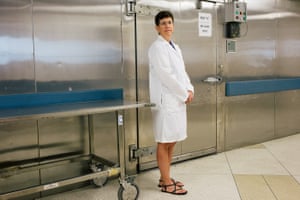
Barbara Sampson, Chief Medical Examiner of New York City


Barbara Sampson, Chief Medical Examiner of New York City Photograph: Ben Zucker for the Guardian

Only the lonely


In the basement, the staff are hard at work in the autopsy suite, carefully examining the bodies and photographing relevant organs for their reports.


Most cases brought to the medical examiner are not crime related. In a city of over 8 million people, with many immigrants and transplants from other parts of the country, there is no shortage of the lonely.


Of the seven bodies brought in today, three have died alone in their apartments. In the summer, without air conditioning, it can take as little as two days before the smell of a body causes neighbors to make a call.


One gentleman found alone in his home is now lying before me on a steel gurney. James Daniels, a lead forensic mortuary technician, is carefully removing the scalp before cutting the skull with a bone saw so the brain can be examined for any signs of aneurysm, stroke or other potential causes of death.


An examination table in the “decomposition room” of the Office of the Chief Medical Examiner of New York.


An examination table in the “decomposition room” Photograph: Ben Zucker for the Guardian

Over 60 forensic mortuary technicians like Daniels work in New York City. While the 31 medical examiners in New York City are all highly trained physicians who completed special fellowships, technicians don’t have any educational requirements.


Typically, technicians join when they are young and only have a high school education. They learn the intricacies of their job on site. Without them, the office would cease to function. They are the ones dispatched to collect the bodies for autopsy. They are often the first people from the office a family encounters when grieving.


Being the doctor’s doctor


In addition to the medical examiners, there are x-ray technicians who scan for bullets and broken bones; DNA and toxicology laboratory staff; consulting dentists for matching dental records for identification; anthropologists who specialize in discovering the race, age and height of skeletal remains and figuring out what tools caused blunt force traumas; mortuary technicians who assist with autopsies; a variety of administrators; death scene investigators; and professional photographers who take careful photos of every autopsy for detailed record keeping.


One of the photographers on staff also takes professional photos of food, Hammers tells me with a smile.


While the doctors examine the body and determine the cause of death, the technicians do a lot of careful and very skilled cutting to assist them. They also clean the bodies after the autopsy is completed, making sure that it is in a pristine state when handed over to a funeral director.


For Daniels, who started with the Office of the Chief Medical Examiner as a young man in 1989, it was an unexpected career choice, as he hated the idea of being around dead bodies and avoided funerals entirely.


Most of the medical examiners, on the other hand, said they always loved the idea of solving a mystery, of being “the doctor’s doctor”. They wanted to be the ones to determine the real cause of a death or diagnose a pathology.


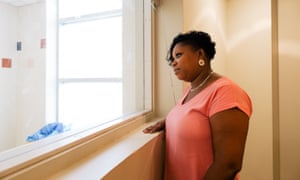
Nadia Bissette-Dolor, who works in the Office of the Chief Medical Examiner of New York City, stands by a window used by families to identify bodies of the deceased. She says family members rarely ask to view the body, but a small number do.


Nadia Bissette-Dolor, who works in the Office of the Chief Medical Examiner of New York City, stands by a window used by families to identify bodies of the deceased. She says family members rarely ask to view the body, but a small number do. Photograph: Ben Zucker for the Guardian

Daniels had a more pragmatic reason for joining the office: he needed a job, and working for the city meant stable employment. When he first started, he dreaded touching bodies and entering strangers’ homes. It was fear of the unknown, he explains. But these days, working as a lead technician, there is little left unknown when it comes to the dead.


Daniels was on the job during 9/11. He also responded to Flight 587, which crashed in Queens in November 2011, killing everyone on board. That time created his worst memories of the job. But it also gave him the greatest sense of the work’s importance: none of those families would otherwise have had closure. He now “loves the job”, he says.


The case that hits home


No matter how long they have been working at the Office of the Chief Medical Examiner, and how many bodies they have seen, everyone has a case that hits home.


For Barbara Sampson, the chief medical examiner for New York City, it was a 9/11 case. The terror attack on 9/11, which Sampson refers to as the biggest homicide in US history, was a difficult time for all of the staff at the office. They worked round the clock to identify bodies, and the images they saw still haunt most of them fifteen years later.


Identification often had to be done from DNA analysis of fragments of remains and is still ongoing as new DNA techniques are discovered.


One particular case sticks out for Sampson: a Belgian man who died during the collapse of the World Trade Center towers. His parents were elderly, and while they knew that he had died, without official scientific confirmation, they could not get closure. His remains had not been identified. They were afraid they would pass away never having his death confirmed.


Two years ago, Sampson’s office was able to identify the Belgian man’s remains through DNA analysis. “I had the honor of telling them we had found their son. That was one of the most incredible experiences of my life,” she says. Thirteen years after 9/11, the parents could finally put their son to rest.


Office work station in the Brooklyn office of Chief Medical Examiner of New York


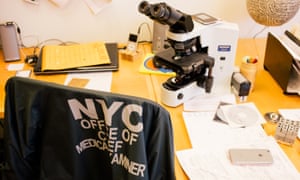
The desk of the Deputy Chief Medical Examiner Photograph: Ben Zucker for the Guardian

For Aglae Charlot, an elegant senior medical examiner with a pronounced French accent who has worked at the office since 1987, it was a teenage girl who came in a few years back. The girl died in the hospital of an unusual illness, from which her mother also suffered. The illness can be idiopathic or caused by Aids. The hospital had assumed it was idiopathic since the mother had the same illness.


When Charlot investigated, she found the teenager did actually have Aids, which she must have been suffering from for five or six years.


Upon further investigation, she discovered the mother’s boyfriend had died of Aids.


Infecting a child and causing her death is murder, she explains to me, her jaw tensing. Charlot knew she could probably trace the particular strain of Aids back to the boyfriend, but what would it change? He was dead, so could not be charged, and it would only cause more pain for the living. She put Aids as the cause of death on the certificate, and left it at that.


Seeing the lighter side


“We all have an odd sense of humor,” says Christopher Brock, a bearded young medical examiner sitting in front of a file cabinet covered by photos of his wife and two young children. “We are often smiling, and I think you have to when you are surrounded by this every day.”


In Hammers’s office, her crooked playfulness is on display in a framed, fake blood-spattered sign above her desk that reads: “Braainns.”


Humor can provide a release in an environment that is fraught with stress. “One of the things a lot of people don’t realize is that we deal with the living just as much as we deal with the dead,” says Brock. “We provide answers to families.”


Check out station at Morgue in the office of Chief Medical Examiner of New York in Brooklyn, NY


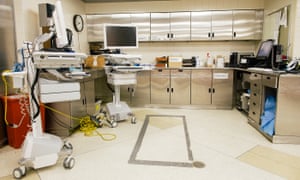
Check out station at the morgue Photograph: Ben Zucker for the Guardian

Much of the week is spent performing autopsies, and the rest of it filling out paperwork, testifying in court and speaking with the families of the dead.


At a time when primary care physicians rarely have more than two minutes to speak with a living patient, it’s strange somehow that the medical examiners can spend hours explaining their findings to the families, comforting them and helping them deal with their grief.


“Every family really wants to know what happened to their loved one and have their questions answered in order to have closure,” says Hammers. “Even if it is a hard answer like in the case of a suicide, it wouldn’t be what they prefer to hear but it allows them to have an answer and then work their grief around that and move through it.”


As Brock puts it, when it comes to the deceased: “We are their last physicians.”


Brains and bone saws: a day with the chief medical examiner of New York City