cycling etiketine sahip kayıtlar gösteriliyor. Tüm kayıtları göster

20 Nisan 2017 Perşembe

It"s good to hear cycling to work reduces your risk of dying. But that"s not why I do it | Laura Laker

It may not be a surprise to see another study suggesting that cycling to work can drastically reduce your chances of getting cancer and heart disease – those who ride bikes for transport already know how good it makes them feel. However, it’s perhaps yet another motivation for those who don’t, to dust off their bikes – and remember some other reasons cycling to work is so great.


In a five-year study of 263,450 UK commuters, published in the BMJ, researchers at Glasgow University found regular cycling cut the risk of death from any cause by 41%, and the incidence of cancer and heart disease by 45% and 46% respectively.


The cyclists in the study were riding an average of 30 miles per week; that’s three miles each way, five days per week. Cycling at a leisurely 10mph, that would take about 20 minutes each way – a manageable distance for most people.


At present only 3% of the UK population commute by bike, while 36% use a car. If we increased cycling in this country to German levels by 2025, we would save £1.8bn in health benefits and £284m thanks to less congestion.


Ask anyone who cycles to work why they do it, and they’ll have a story to tell, whether it’s about how good it makes them feel, how they saved money, lost weight, or won a battle with depression. Most people will tell you how enjoyable it is.


My commuting story began at university. I remember being astonished one morning when I realised my friend Szilvia had cycled from Finsbury Park in the rain. Getting on a bike and riding five miles in such conditions sounded miserable, but she looked happy and bright, and told me how great it was.


We lived fairly close to one another and she offered to ride with me one day. As I pedalled frantically to keep up with her through Regent’s Park, and Camden, it was like I’d grown wings. Before long, like her, nothing short of a gale force wind with pigeon-sized hailstones was going to stop me from experiencing this feeling every day.


For the first time in my life I started getting fit. I arrived at university feeling awake, alert, and generally in a good mood. I continued to cycle to various temp jobs around London after graduation, carrying my work clothes in a pannier and getting changed in the loos.


On crisp, sunny mornings, I’d cycle through the city feeling like it had rolled out the red carpet just for me. I’d levelled up on urban living: I’d whizz past the stationary traffic and queues for buses and try not to look too smug.


I’d chat to others at the traffic lights. Often I’d get to places quicker than public transport could carry me. Often it was the best part of the day.


Fitting exercise into your daily routine is infinitely easier than trying to carve out a slice of it to go to the gym. Without even trying, you get fitter if you cycle. It is no surprise that levels of physical activity are declining as fewer people cycle or walk to work.


In the cities of cycle friendly countries, such as the Netherlands and Denmark, up to 41% of people commute by bike because it’s easy to do and it feels safe. Decades of investment in cycling infrastructure have made it that way. These countries have learned that most people prefer protected, direct routes on main roads, and low-traffic neighbourhood streets. This means people of any age can cycle, from the very young to the elderly. In the Netherlands, for example, 20% of 80-84 year olds regularly cycle.


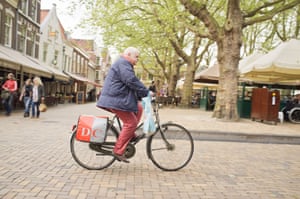
Imagine if the UK was like the Netherlands, where 20% of 80-84 year olds regularly cycle


Imagine if the UK was like the Netherlands, where 20% of 80-84 year olds regularly cycle. Photograph: Rory Buckland L/Alamy Stock Photo

In the UK, meanwhile, we’ve had decades of car-centric planning, and minuscule levels of funding for cycling. Even though cycling is statistically safe, it doesn’t always feel it, and this fear of sharing road space with motor traffic is the key reason people don’t cycle or stop after trying it.


The government knows that every £1 spent on cycling brings £5.50 of benefits, but at present it spends just 72p per person per year on cycling, compared with £86 per person per year for roads. There is huge potential for more journeys to be cycled if that were to change.


Increased levels of cycling can bring benefits for everyone, whether they cycle or not. Bicycles take up far less road space than cars and emit no toxic fumes. They’re good for our high streets: on New York streets where cycle lanes were introduced average trade rose by a quarter. What’s more, bicycles are great social levellers – according to research, mass cycling could increase mobility of the nation’s poorest families by 25%.


If a magic pill were invented that could generate all of these benefits, we would be falling over ourselves to buy it. As it is, no magic is required, just steady, long-term planning and investment, and a commitment to the humble bicycle, so that more of us can enjoy the simple, life-giving joy of cycling from A to B.


It"s good to hear cycling to work reduces your risk of dying. But that"s not why I do it | Laura Laker

1 Eylül 2016 Perşembe

Team GB"s cycling heroes call for "legacy of everyday cycling"

A group of Britain’s medal-winning cyclists from the Rio Olympics have written to Theresa May to tell her the best way to honour their achievements would be for the government to invest heavily in everyday bike-riding.


The signatories, including Laura Trott, Jason Kenny, Mark Cavendish, Joanna Rowsell Shand and Becky James, as well as Sir Chris Hoy, jointly with Kenny the country’s most successful Olympian, told May: “You were widely reported in the media as saying that there will be ‘no limits’ on the honours that could be bestowed on our medal winners.”


They continued: “But the best way to honour the achievements of our athletes would be a legacy of everyday cycling in this country – a place where cycling is the choice form of transport for people to get around in their daily lives.”


The letter was organised by British Cycling, which as well as being a sporting body also campaigns for better everyday bike provision. It pointed out the disparity between Britain’s vast success in sports cycling and the relatively tiny numbers who use bikes for transport, arguing cycling should be treated as consistently and seriously by government as the roads, rail or aviation.


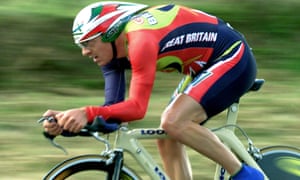
Chris Boardman at the Cycling World Championships in France, 2000.


Chris Boardman at the Cycling World Championships in France, 2000. He has asked to meet Theresa May. Photograph: Franck Prevel/AP

Britain won six golds and 12 medals overall at cycling in Rio, topping the medals table in the sport for the third successive Olympics. Yet the proportion of trips made by bike has remained constant at about 2%, with relatively little investment in bike lanes outside London and a handful of other places.


While David Cameron famously said he hoped to see a “cycling revolution”, an eventual walking and cycling strategy, released earlier this year, was written off by cycle campaigners as worthless, with the money committed around £1 per person per year, against a figure of about £28 in the Netherlands.


The Olympians’ letter urged May to “set out a timeline to address the chronic underfunding and lack of leadership which is keeping cycling for transport in the slow lane”. It added: “Only networks of segregated cycle lanes in towns and cities across the country can achieve and influence growth.”


With a chronically sedentary nation and around one in three children overweight or obese, investment in cycling would pay enormous health dividends, the letter argued, as well as boosting businesses along the routes, and making towns and cities less congested and more liveable.


“There is huge latent demand for cycling,” they wrote. “Two thirds of people would cycle more if they felt safer on the roads.” The letter asks the government to commit 5% of its transport spend to cycling, and to improve law enforcement to better protect cyclists.


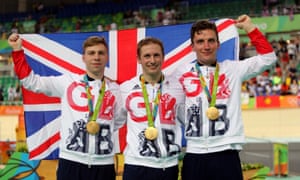
Philip Hindes, Jason Kenny and Callum Skinner with their gold medals following the Rio 2016 men’s team sprint final.


Philip Hindes, Jason Kenny and Callum Skinner with their gold medals following the Rio 2016 men’s team sprint final. Photograph: David Davies/PA

“Investment in cycling as a form of transport isn’t purely an investment in cycle lanes,” the letter concluded. “It is an investment that will pay off for the nation’s health, wealth, transport infrastructure and the vibrancy of our towns and cities. It has the added benefit of just making it easier for ordinary families to get to work and get to school.


“Our athletes have inspired the country and now we urge the government to take cycling seriously as a transport option for everyone.”


The signatories are asking May to meet Chris Boardman, whose cycling gold at the 1992 Olympics heralded Britain’s success in the sport, and who is now British Cycling’s policy adviser.


Boardman said he hoped for a fresh start after the lack of action from Cameron’s “cycling revolution” and the cycling and walking investment strategy.


“It was quite a step, so we were all pretty gutted when we saw it will amount over this parliament to less than a pound a head, which just beggars belief,” he said.


Boardman said he hoped the letter would “put some moral pressure on the prime minister to have to say either what we’re going to do, or why we’re not going to do it”.


He said: “Even in these austere times it’s such a good economic investment, it’s such an efficient spend of cash. It’s exactly what they should be doing. So what we deserve is an answer.”


At the moment, Boardman said, the government was officially committed to doubling the numbers of cyclists by 2025, but had no real means to achieve this. He said: “The question I would like to ask is, you want to double the amount of cycling, to get from 2% to 4%. Do you think less than £1 a head will achieve that target? I don’t think anybody could look you in the eye and say, yes.”


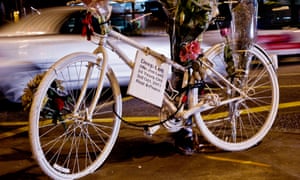
A cycle left as a protest by Bikes Alive at King’s Cross, London.


A cycle left as a protest by Bikes Alive at King’s Cross, London. Photograph: Sarah Lee for the Guardian

A Department for Transport spokesman said government investment in cycling had tripled since 2010. He said: “We are spending £300m on cycling funding and a further £500m for infrastructure in local communities which will include benefits for cyclists.


“The number of people choosing to get about by bike has grown over recent years and, following the success of our Rio Olympians, we want to see this trend continue.”


The letter to Theresa May


Dear Prime Minister,


The Great Britain cycling team athletes topped the cycling medal table for the third Olympic Games in a row at Rio 2016. It was a truly outstanding performance and enhances Britain’s status as the world’s leading elite cycling nation.


You were widely reported in the media as saying that there will be “no limits” on the honours that could be bestowed on our medal winners. But the best way to honour the achievements of our athletes would be a legacy of every-day cycling in this country – a place where cycling is the choice form of transport for people to get around in their daily lives.


Your predecessor called for a “cycling revolution” and your government’s manifesto sets out a target to “double” the number of journeys cycled. While some steps have been made, cycling is still a transport mode which does not enjoy the government investment or political leadership given to roads, rail or aviation.


The government is now considering feedback on the draft Cycling and Walking Investment Strategy (CWIS). We urge the government to publish this and set out a timeline to address the chronic underfunding and lack of leadership which is keeping cycling for transport in the slow lane. Only networks of segregated cycle lanes in towns and cities across the country can achieve and influence growth.


The success of the CWIS will be felt not only across government but in all areas of the nation’s life.


The government’s sports strategy seeks to extend the number of people living physically active lives and could be truly transformative. Active travel – walking and cycling – is the easiest way for people of all ages to fit physical activity into their lives. Currently, only one in five people achieve the recommended levels of physical activity.


Around one in three children is overweight or obese. The government’s childhood obesity strategy recognises the value of physical activity and the importance of walking and cycling to school. I am sure you know that this will seem a fanciful idea for most parents without the convenient walking and cycling routes which would give them the confidence that their children will be safe getting to school. Yet we know it can be achieved – in the Netherlands, 50% of education-age children cycle to school.


As cities like Copenhagen and New York have shown, cycling also creates better places to live and work. More cycling cuts congestion, reduces noise pollution and fuels local economies. Small businesses in New York have seen a 49% increase in business where cycle lanes have been installed.


There is huge latent demand for cycling. Two thirds of people would cycle more if they felt safer on the roads. The government’s road safety statement reiterates the manifesto commitment to reduce the number of cyclists killed or injured. The CWIS needs to set targets to improve road maintenance, enhance enforcement of the laws, and update the rules of the road to better consider the needs of cyclists.


To make this happen, we need 5% of the government’s transport spend allocated to cycling. This is the only way that cycling will be integrated into transport strategy and given the priority it deserves.


Investment in cycling as a form of transport isn’t purely an investment in cycle lanes. It is an investment that will pay off for the nation’s health, wealth, transport infrastructure and the vibrancy of our towns and cities. It has the added benefit of just making it easier for ordinary families to get to work and get to school.


Our athletes have inspired the country and now we urge the government to take cycling seriously as a transport option for everyone.


British Cycling’s policy adviser Chris Boardman would welcome a meeting to discuss this further. We look forward to hearing from you.


Yours sincerely,


Chris Boardman, policy adviser, British Cycling and Olympic gold medalist


Sir Chris Hoy, six-time Olympic gold medallist, joint most successful British Olympian


Laura Trott, four-time Olympic gold medallist and Britain’s most successful female Olympian


Jason Kenny, six-time Olympic gold medallist, joint most successful British Olympian


Mark Cavendish, Olympic silver medallist


Joanna Rowsell Shand, double Olympic gold medallist


Elinor Barker, Olympic gold medallist


Owain Doull, Olympic gold medallist


Becky James, double Olympic silver medallist


Katy Marchant, bronze medallist


Team GB"s cycling heroes call for "legacy of everyday cycling"

30 Nisan 2014 Çarşamba

Cycling levels in England fall slightly

A new release from the Department for Transport (DfT) shows the percentage of England’s population who cycle at least once a month has dropped from 15.3% to 14.7% in the year to October 2013.


The DfT report states:


Although the change is small, the size of the sample means that we can be confident that this decrease exists in the whole of the English population


The local area walking and cycling in England report, which presents data on cycling and walking among adults in England, uses statistics based on the results from the Active People survey, an annual telephone survey run by Sport England.


A larger proportion of people cycle recreationally than do for utility purposes (for example commuting, shopping or visiting friends) according to the report, whereas the proportions of people walking for pleasure and utility purposes do not differ significantly.


Combined the proportion of people who cycle recreationally and the proportion who cycle for utility purposes is more than those who cycle for all purposes because some people do both. However, a considerably greater proportion walk for both purposes than cycle for both purposes.


The chart below shows the prevalence of people walking and cycling. Click on the tab to see the data for ‘at least once a week’ and for ‘at least five times a week’.


The areas that boast the highest percentage of cyclists for utility purposes are, predictably, the places considered to have better cycling infrastructure and with cycling communities such as Cambridge, Oxford and the Isles of Scilly.


The table below shows the top eight local authorities for those cycling for utility and for those cycling recreationally. It is worth noting that the survey records cycling in the authority where people reside, not where they cycle.


The proportion of male cyclists compared to female cyclists is considerably higher across all age groups – unlike walking, where both genders have similar numbers.


Download the data


• SOURCE: DfT


More open data


Data journalism and data visualisations from the Guardian


Development and aid data


• Search the world’s global development data with our gateway


Can you do more with this data?


• Contact us at data@theguardian.com
• Follow us on Twitter
• Like us on Facebook


Cycling levels in England fall slightly

25 Mart 2014 Salı

Cycling Trends & Upgrades 2014, Part 2

This is direct continuation of a feature that began yesterday and I urge you to start there or this may possibly not make as significantly sense to you.


Wheels &amp Tires &amp (No) Tubes (Upgrade) – Continued: Yesterday I talked about the large trend of road bike wheels moving to a wider standard, up to 22 or 23mm from the longtime norm of 19mm. That is hardly the only large modify going on in road bike wheels and tires.


For as long as most of us have ridden bikes, inner tubes have been a part of life. But tubeless tires are spreading like wildfire and have presently converted most severe off-road enthusiasts. If you are an avid mountain biker reading this, there is a great likelihood you already have tubeless, or at least have imagined about switching, and the idea is broadly accepted. Even so, it is still novel in street riding.


“Tubeless technological innovation has already taken over mountain biking, and is speedily spreading to street riding,” mentioned Mike McCormack, a longtime race and bike event organizer. Skilled road racers and some tough-core amateurs have extended ridden street bikes with tubulars, which are a tube and tire in one particular, glued to the rim and challenging ample to alter that the huge bulk of the road biking community has eschewed them, in spite of their overall performance advantages. But the new choice is a tubeless edition of the identical street tire (aka clincher) most of us are used to, with the extra bonus that in the occasion of a flat, rather than changing and re-gluing the tire roadside, you basically stick a tube in just like you always did – and previously know how to do.


Road bike wheel

Most top quality new street wheels are now tubeless compatible, like Shimano’s common RS81.


“Road tubeless is the middle ground amongst a standard clincher and a tubular,” said cycling sector consultant Eric Doyne. “Tubular is the bomb, with lighter wheels and better dealing with, but they are a soreness, not at all consumer pleasant, really expensive, and you have to glue them on. Road tubeless offers much of the same managing advantages, and they are supple and far more flat resistant. In mountain biking I wouldn’t ride anything but tubeless, it’s the biggest advent because suspension. I also trip road tubeless, but in road biking it is nevertheless new school stuff.”


Most good quality wheels now come tubeless compatible, which means you can select to use both a classic clincher or tubeless tire. Far more than the wheel, it is the tires that make the distinction, and tubeless supply pros and cons, which are nevertheless becoming debated inside of the industry. On the plus side, they are much more flat resistant than regular clinchers, and since they also have a liquid sealant within, are to a degree self-healing on smaller punctures. They demand much less air strain, which has several benefits: better comfort and trip good quality, far better cornering and better braking. People are the big positive aspects, whilst on the other hand, negatives have little to do with overall performance: the tires are appreciably much more costly (I ride Hutchinson tires now and the two of this company’s much more common tubeless tires are a hundred bucks each or much more, double what I’ve paid for clinchers) and there are far fewer alternatives on the marketplace. They usually want to be installed with messy sealant and a compressor, as a common pump can’t get air into them rapidly ample to develop a seal, which means many recreational cyclists have to go to a shop to have tires mounted. On the other hand, in the typical season many street riders really don’t get a single flat, flats are even less typical with tubeless, and as a cease gap tires can basically be ridden with a tube till you make a decision to make the effort to go to a store and replace the tire.


Not every person agrees the advantages are notable enough to be really worth the extra price and headache, and at this stage street tubeless stays an early adopter’s technological innovation, but given that most new wheels accept it anyway, it’s 1 of the easiest upgrades, and one you can choose at any time. “Road tubeless has been ‘the subsequent large thing’ for the past seven-10 years, and men and women are carrying out it, but it’s absolutely nothing like in mountain biking,” said Rolf Prima’s Brian Roddy. “Tubeless is an intriguing technology and there are advantages, but they aren’t nearly as excellent as in mountain biking – if it is a trend, it is a slow expanding trend.”


Bike disc brake

Disc brakes on road bikes are a scorching trend, but mostly on new bikes as they are hard or extremely hard to retrofit onto most present models.


Street Bike Disc Brakes (TREND): Just last year when I rounded up bike trends, this was futuristic – now it is coming standard on a lot much more bikes straight off the showroom floor and adoption is more quickly than several in the market anticipated. For example, Specialized, a single of the largest producers, is now offering disc brakes on numerous street bikes from its entry-degree Secteur ($ one,400) to the leading tier S-Functions Roubaix SL4, the very same model that won the 2012 Paris-Roubaix classic ($ eight,500). The major big difference here is that significantly less costly bikes are using mechanical disc brakes, whilst pricier ones use the much better hydraulic programs, however across the market most street bikes nevertheless use conventional caliper brakes.


For years disc brakes have been standard problem for mountain bikes, since they supply tremendously enhanced stopping electrical power and also since they work a lot much better in moist or muddy problems. For this same cause (plus critical changes in competitors rules) disc brakes have flooded the cyclocross marketplace. But the argument for disc brakes on road bikes, similar to tubeless tires, is a lot more tenuous, simply because most individuals really don’t ride road bikes in mud, snow or downpours.


“Do road bikes need disc brakes? No. Are they far better? Hell yes,” stated Doyne, who works with Shimano, the industry’s top supplier of high quality components. It is uncommon to get a comprehensive bike from any significant firm that does not use some Shimano components, and the firm just introduced the higher-finish R785 hydraulic disc system for road bikes in its leading DuraAce and Ultegra lines, in which the brake levers are coupled with its Di2 electronic shifting. “The disadvantage has always been bodyweight, but now Shimano has manufactured a lighter, much better hydraulic disc brake and it is the scorching point. The R785 has swiftly turn into the common for off the shelf road bikes from foremost companies including Trek and Colnago. Disc is far better, specifically for wet climate riding and commuting or education in snow or rain. For a lot more significant riders one more benefit is that you can brake later in the turn and optimize performance. There are a limited variety of bikes available with disc brakes, but riders who attempt them tend to be instantaneously converted.”


Like the new 27.5 inch wheel normal for mountain bikes I mentioned yesterday, this is not an improve but rather element of a new bike acquire or a new frame create-up, given that almost everything including the wheels and frame wants to be redesigned to accommodate disc brakes and quite number of bikes that aren’t very latest can be retrofitted to disc. Nonetheless, this is one particular of the hottest trends in cycling right now. “A great deal of people have asked ‘why do not we have this yet?’ due to the fact the engineering is verified, cheap and trustworthy,” stated McCormack. “I consider a lot more and a lot more bikes will have them standard, and some currently do.”


Rolf Prima’s Roddy confirms the rapid adoption: “We are an after-industry company, and all of our wheels are hand built in Eugene, Oregon, even though virtually all bikes are produced in Asia, so we are not unique products on any of these bikes. We are an improve, and as this kind of, we do not typically see new trends until 6-eight months later on, when men and women start upgrading their factory parts. It took us a whilst to see the demand for 27.five inch mountain bike wheels, but with street disc we saw it proper away.” His firm presently provides its most popular road wheels in disc compatible versions.


But you do not want to go to disc brakes to get greater stopping power on road bikes. Shimano has launched a new design of classic (caliper) brakes with dual pivots across its top two element groups, DuraAce and Ultegra, that while not fairly as potent as discs are significantly far better than earlier caliper brakes. “The degree of braking electrical power is so very good that for most riders it enough,” stated Doyne. “Braking is the new business frontier, not just for disc brakes but across the board.” Unlike disc brakes, the new Ultegra and DuraAce dual pivot caliper elements can be retrofitted as an improve to your current road bike. This particularly make sense if you are presently considering final year’s hottest upgrade, electronic shifting, given that it is far more price productive to do them with each other.


Most cyclists, which includes myself, really don’t go for a street trip and come house wishing we had better brakes. Like the adjust from common to energy brakes in automobiles decades ago, you really don’t comprehend how great it is right up until you try it. It has only been when I have ridden street bikes with greater brakes than my bike has that I’ve observed, and that is when I wish mine had been better. For any individual who has ever imagined far more stopping power would be greater, this is a banner 12 months in cycling.


Cycling Trends & Upgrades 2014, Part 2
9 Şubat 2014 Pazar

Cycling development could save NHS £250m, says report

Cycling in UK

Cycling stress group Bikes Alive protest towards road security policies at King’s Cross, London. Photograph: Sarah Lee for the Guardian


The NHS would conserve £250m a yr if a single in 10 journeys have been manufactured by bicycle, according to a review commissioned for a campaign for government to deal with cycling far more significantly.


Cambridge University researchers concluded that if cycling produced up ten% of all journeys, as towards the present figure of about two%, the nation would also achieve the mixed equivalent of far more than 1m years of healthy residing more than a decade due to reduced costs of inactivity-connected illnesses.


The review, by the university’s centre for diet plan and action study, was undertaken for British Cycling, launching a ten-point manifesto to boost cycling levels.


British Cycling is largely the governing entire body for cycling sport in the United kingdom, and has delivered the nation a lot of dozens of Olympic and planet titles over the past decade or so. Nevertheless, it has lately begun to campaign on each day cycling, a move led by its policy adviser, former Olympic champion Chris Boardman.


Boardman, who will give proof to the Commons transport choose committee right now, mentioned Britain had a distinct option more than what path it took in terms of transport choices and the outcome on the nation’s well being.


He mentioned: “Britain is now 1 of the most profitable cycling nations in the world. How can we be obtaining it so appropriate in terms of elite good results but still be failing to truly embed cycling as an every day portion of British culture? This research demonstrates that the affect of more cycling would have constructive effects for every person.


“In the 1970s, the Netherlands produced a aware option to put folks very first and make cycling and walking their preferred indicates of transport. It is no coincidence that they are also a single of the healthiest and happiest nations in the globe. Regional and nationwide government needs to wake up and realise that cycling is the answer to so many of the significant issues Britain is now dealing with.”


The Cambridge investigation signifies even comparatively small behaviour modifications would bring massive wellness dividends. It concluded that if just 5 minutes of the regular 36 minutes a day men and women invest in cars was utilised for cycling the NHS would see a 5% fall in inactivity-relevant illnesses this kind of as heart condition, diabetes and strokes.


The manifesto, Time to Select Cycling, notes that while cycling stays objectively incredibly secure several Britons are place off by poor cycle infrastructure and possessing to share the road with fast-moving targeted traffic, especially lorries.


Chief among the 10 recommendations is that cycle safety is designed into all roads and junctions, paid for by guaranteed lengthy-term investing of at least £10 per individual per year. This is a lot higher than the recent figure of £2, the report notes, but nevertheless practically nothing like the £75 committed to roads.


Cycling development could save NHS £250m, says report

4 Ocak 2014 Cumartesi

Pippa Middleton: how I finally joined the cycling brigade

As anticipated, Jonathan looked every inch the seasoned professional. Black Lycra? Examine. Balaclava and gloves? Verify. Clear glasses? Verify. He was also sporting a pair of neoprene shoe covers to protect his clip-in shoes. Did I genuinely want all this hi-tech kit, I wondered, or is it as significantly about searching the element? “It depends on price range,” Jonathan told me, “but a small investment in a handful of important items will mean you get the most out of your cycling.” His suggestions are: a great-good quality helmet, glasses to guard the eyes from filth and gravel flicked up on the street, cycling trousers or shorts that should be padded (for comfort) and skin-tight (for warmth and an aerodynamic profile), and a windproof, “breathable’’ shell prime. Little, fitted saddle bags are far better than a rucksack, in his view.


I’d borrowed a snazzy Hoy Sa Calobra bike, a gleaming white machine from a selection designed by Olympic multi-medallist Sir Chris Hoy himself. It claimed to offer a “fast, nimble trip with a confident and reassured character” – but only if you can get going in the initial place, I believed, eyeing people scary clip-in shoes.


The major advantage of clip-in (or “clipless”, their proper and complicated identify) bikes, according to Jonathan, is that simply because the shoe is attached to the pedal you can pull up as effectively as push down. This helps make a massive distinction to power and efficiency and goes some way to explaining the warp velocity of numerous urban cyclists.


You do require to spend a small time comprehending how to use them, however, to steer clear of monumental embarrassment.


With assistance from a cricket pavilion wall I practised clipping in, by pushing the pad of my special bike shoe on prime of the pedal, and clipping out, by twisting the heel outwards. Jonathan and I then superior to the soggy cricket pitch, which offered a soft landing in case it was necessary. It was a bit like learning to ride a bike all above once again, but following a handful of laughs and wobbles I got the hang of it, reassured by Jonathan’s suggestions that “as prolonged as you can clip 1 foot in and out, the other foot can remain in most of the time”.


I set off somewhat timidly on tarmac, trying to maintain civilised conversation even though steering clear of pedestrians, potholes and puddles and uncertain I’d ever be ready to cease.


As we tackled the cycle path that runs previous Battersea’s Peace Pagoda, heads into the wind, Jonathan advised me that he was established to get much more men and women of every single age cycling. In his hometown of Newcastle he understands 70- and 80-12 months-olds who head out on their bikes most weekends. “It has a lower impact on the knees, so is considerably greater for the joints than working,” he explained. This tends to make sense – on a bike the frame takes 70 per cent of your excess weight, which means you can cycle much more intensely although avoiding affect injuries (providing you really don’t fall off). “You also cover longer distances than runners, so it is a much better way to see the countryside,” he additional. 1 of his favourite spots to cycle is the Lake District, the place he’ll trip for miles and scarcely notice time passing.


The bodily benefits are apparent: typical cycling strengthens the heart and lungs, meaning oxygen is transported much more efficiently about the physique. This contributes to a lessen in blood strain and boosts excess fat burning, while enhancing muscle tone in the legs, thighs and buttocks. Which is nicely and excellent, but how do you steer clear of developing massive thighs like several of the Tour de France chaps? “If you do extended distance – anything more than an hour – on reduced resistance, you should tone your legs rather than bulk them so too with your arms and back,” Jonathan mentioned.


We’d completed two laps of Battersea Park at what felt like lightning pace (I was a clip-in convert by this stage) and Jonathan was expanding on his personalized cycle regime. It did not sound a single for novices: he employs a bicycle roller at house, which requires cycling on a stationary bike perched over spinning tubes.


This demands fantastic balancing abilities that you do not get to practise on ordinary ‘turbo trainer’ bikes (the ones utilized in standard spinning courses), which have their back wheel clamped into a frame, and he says it significantly improves his overall performance in the saddle outdoors. If you don’t have accessibility to a spinning bike or roller, he suggests paying 45 minutes to an hour a week performing leg presses, squats, lunges and arm and back strengthening workout routines to get fitter for the bike.


As we moved more into professional territory – heart monitors and bike computers (these track distance and velocity and are fantastic for fitness education: the greatest brand is Garmin, apparently) – I was starting to drop feeling in my feet as well as my fingers. By now Jonathan was suggesting a carbohydrate drink such as Gatorade or a supply of power gel packs as the greatest way to keep going on prolonged rides.


Fortunately, given the bitter wind, this wasn’t a prolonged trip and after a handful of much more laps, Jonathan indicated we should clip out. I shall surely be much less intimidated by urban cyclists (at least people with manners) in the potential following my short initiation into their methods, and a street bike is now on my sporting equipment wish record. But right then, the only carbohydrate drink I was thinking about was a piping scorching chocolate, perhaps with a shot of rum. I’m not entirely positive Jonathan would have accredited.


Pippa’s picks: five items to try out


one. Best Read through: Fifty Shades of Kale by Drew Ramsey and Jennifer Iserloh. I received this in my stocking and it is packed with 50 delicious, wellness-aware recipes.


2. Snug Snood: The Buff unique snoods are truly warm wind-protectors for prolonged bike excursions.


3. The Wiggle Web site: Wiggle.com has all the on-line biking kit you will ever need to have, at a variety of charges.


4. One To Observe: The promo video is up – start obtaining thrilled for this year’s Tour de France, which commences in Yorkshire in July.


five. Inspiration: The British explorer Maria Leijerstam has, last month, become the initial man or woman ever to cycle to the South Pole, beating her two male rivals.


Pippa Middleton: how I finally joined the cycling brigade