revolutionise etiketine sahip kayıtlar gösteriliyor. Tüm kayıtları göster

28 Kasım 2016 Pazartesi

Hemosep: the machine set to revolutionise blood transfusions

The idea of being able to recover a patient’s own blood and put it back into their body is not new. But until now it has been expensive and largely unworkable. Autotransfusion, as it is known, has typically used large, complex, centrifugal devices that require skilled operators, take a lot of time and are very expensive. The cumbersome machines used in many hospitals return just the red blood cells, eliminating the platelets needed for clotting and the white cells required to fight infection. That can lead to complications.


But a new machine, devised by Strathclyde University’s biomedical engineering department, may change all that. Hemosep, as it is known, is designed for use during major surgery. It removes blood from the surgical site, takes out the plasma and returns the vital blood cells to the patient, all through a single lightweight device.


The key is a special plastic bag into which the recovered blood is poured. This acts as a chemical “sponge”, soaking up plasma that has diluted the blood during the operation, so that the resulting transfusion is rich in the vital blood cells needed by the patient.


In 2014-15, NHS Blood and Transplant issued 1.7m units of red blood cells, 275,000 units of platelets, 215,000 units of fresh frozen plasma and 165,000 units of cryoprecipitate (frozen blood plasma) to hospitals in England and North Wales. Hemosep’s makers say the device could save the NHS £2.6m a year.


Although transfusion is generally a safe procedure, it can carry risks of infection and, in some countries, disease. So outside hospitals – in a war zone or natural disaster – the possible benefits are obvious. The device is now in clinical use in 50 countries, and there are already reports of a reduction in blood transfusions in patients who have benefited from its use. Because patients receive their own blood, it also allows patients whose religion or culture prevent them having donor blood transfusions to have surgery.
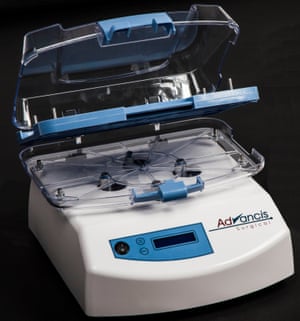


Hemosep … already used all over the world – but not in the NHS.


Hemosep … already used all over the world – but not in the NHS. Photograph: Advancis Surgical

Professor Terry Gourlay, head of biomedical engineering at Strathclyde University, remembers the “Eureka!” moment in the Hemosep’s creation – and it really was in the bath. “It has been a source of fascination to me for years,” he says. “I decided to look at a completely different approach, with a control membrane through which no cells could pass. That way, we would be left with all cells concentrated on the outside, ready for collection.”


He experimented with this idea at home, using different membranes and duct tape to see if the concept was feasible. He quickly became convinced that he was on to something revolutionary. “A funding call from the military looking at ways of reducing blood loss also inspired me,” says Gourlay. “I continued my research at the university, with the focus on developing a super-absorbent membrane. You could almost describe it as being similar to babies’ nappies – though much more efficient and aggressive.”


It took two years from concept to licence, and the current version satisfies even Gourlay, who admits he has a constant urge to tweak. “I do tend to think we can always do better, and that is probably reflected in how we developed it, but I am delighted now.”


Stephen Cotton, managing director of Brightwake, which helped to develop and manufacture the membrane, says that interest is so intense that the company is looking for a new site to scale up manufacture. “It’s an amazing device, which you can train someone to use in 15 minutes. It is saving lives as well as money, and we have orders pouring in from across the world – China, India, Canada, the States, France, the Middle East – but, oddly, not from the UK, although it was conceived, developed and manufactured here.”


The problem, he explains, is to do with the way the NHS does its purchasing. “When hospitals are buying equipment from big companies, they are locked into agreements for three or five years. Hemosep is completely different from all the traditional blood salvage devices, so there’s currently no point in us bidding for the tenders, as we’re offering something so innovative that it falls outside the criteria. It would be good to see Hemosep used in the UK, but with such massive interest worldwide we can’t worry about that.”


While the NHS might be missing out, the military isn’t. Recently, a military and civil disaster version of the Hemosep has been developed by the Strathclyde team. This new version is portable and hand-operated, and has the advantage of being able to return salvaged blood directly back to the patient, without the concentration process – vital when rapid transfusion might be the difference between life and death.


Neal Smith, capability adviser for medical science at the Defence Science and Technology Laboratory, part of the UK Ministry of Defence, is leading trials on this version. “We began funding the research in 2014, and believe Hemosep has the potential to transform battlefield care,” he says “Devices such as this, which is lightweight, robust and relatively easy to use on the battlefield, can provide enormous benefits and save lives.” Uncontrolled blood loss is still the major cause of death on the battlefield, and Hemosep’s ability to allow blood lost to be directly returned to the bloodstream, long before patients reach a field hospital, is undoubtedly a breakthrough.


Hemosep: the machine set to revolutionise blood transfusions

29 Eylül 2016 Perşembe

How 3D printing can revolutionise the medical profession

Before the vehicle that she was travelling in flipped over and trapped her right leg, Leakhena Laing was a happy teenager who enjoyed climbing trees and playing football with friends. After her limb was amputated, she could only sit and watch.


“It was difficult to even get a glass of water. I felt hopeless, very sad and embarrassed to be around other people,” says Laing, who was forced to abandon school after the accident nearly four years ago.


She used crutches for two years, before receiving a below-knee (transtibial) prosthetic plaster limb, which improved the quality of her life, although it meant regular visits to a clinic in Phnom Penh, Cambodia’s capital, nearly 30 miles away from her home in Borset district, for refittings.


Today, aged 18, Laing’s part of a ground-breaking trial by the Canadian non-profit social enterprise Nia Technologies, aiming to produce high quality mobility devices for children and young people more quickly than the conventionally produced plaster cast method – using a 3D printer and other 3D technology.


The World Health Organisation estimates that 30 million people in low-income countries need prosthetic limbs. There is hope that 3D scanning and printing may be able to help.


Pioneering techniques


“Our project leap frogs current developed world fabrication techniques by using 3D printing to produce devices that are actually being used by patients,” says Dr Matt Rotto, Nia’s chief science officer. In the trial that 30 Cambodian children and young people, including Laing, are participating in, Nia is testing “3D PrintAbility”, which combines scanning, modelling and printing technologies to produce two types of mobility devices: transibial (below-the-knee) sockets and ankle foot orthoses (AFOs or leg braces).


The computer process enables medical staff to save work (digital files), share them with colleagues for review and keep a digital record of a patient’s history of devices. As Rotto describes, “what that literally looks like is a Google docs for prosthetists, where they upload the digital model they made. They can then send a request to someone saying ‘hey can you take a look at this thing that I just made?’”


Nia’s clinical study of 3D technologies for the production of lower-limb mobility devices, being conducted in three developing countries, is the first of its kind and scale anywhere, with others in other parts of the world still in an exploratory phase or not working with clinical partners or patients yet.


“We’re trying to give clinicians tools to make them more efficient because there’s a tremendous shortage of prosthetists and orthotists in the world,” says Nia president and CEO Jerry Evans, stressing the technology was not designed to replace them.


Speeding up the process


In the developed world, a quarter of prosthetics and orthotics clinics which once used conventional plaster casts – which usually take between one to two weeks to deliver – have replaced them with computer-aided design and computer-aided manufacturing (Cad/Cam) equipment for custom-made devices that can be delivered within two days, say Vorum.


The company, which pioneered Cad/Cam equipment for custom-made prosthetics, orthotics and footwear nearly three decades ago, predicts 3D technology will be used in combination by almost all of these areas within a decade.


London-based startup Andiamo was founded by Naveed Parvez and wife Samiya Parvez in 2014, after a harrowing and frustrating experience acquiring orthotics for their late son, Diamo. Andiamo are producing and trialling their hand splits, AFOs and Ground Reaction Ankle Foot Orthotics (Grafos) using 3D printing technologies, and aim to offer their services to the public early next year. Down the track Andiamo have global expansion in their sights, but warn there are risks considering the temperature and humidity of materials that are “still quite poor”, among other concerns.


“By making sure (the technology) works in the UK first we know that it will have a solid foundation to be used elsewhere,” says Naveed Parvez.


Revolutionising the industry


3D printing is having a “transformational effect on the medical industry”, especially the prosthetics and orthotics sector, but also in orthodontics, says Joe Kempton, an analyst from global technology market firm Canalys. He estimates total spending on 3D printing, including printers, materials and services, will reache around USD $ 947m in 2016, and jump to $ 1.6bn by 2018.


“3D printed prosthetics development is being used more and more in hospitals and clinics worldwide,” says Kempton. “It is becoming more common than not for orthodontist clinics to make use of 3D printing, and this will only continue to grow in the future.”


“The ability to quickly repair and adapt any part of the prosthetics is incredibly useful, especially as the body changes.”


In Cambodia, Laing is hoping new technology could build upon what a plaster cast has already given her, that is the ability to “cook for myself, fetch water for my family, walk and do other things”.


“I am very happy to be part of this study,” says Laing.


She still dreams of what she intended before her accident, to become a beautician.


“I want to continue my education and open a salon,” she says.


To get weekly news analysis, job alerts and event notifications direct to your inbox, sign up free for Media & Tech Network membership.


All Guardian Media & Tech Network content is editorially independent except for pieces labelled “Paid for by” – find out more here.


How 3D printing can revolutionise the medical profession

23 Haziran 2014 Pazartesi

Next generation pacemaker will "revolutionise" patients" lives, scientists say

The new pacemaker employs synthetic neural technology to restore this normal variation of heart charge with lung inflation – modulating its pulses to matching breathing prices.


Researchers say the device operates by saving the heart energy, strengthening its pumping efficiency and enhancing blood movement to the heart muscle itself.


Pre-clinical trials recommend the gadget gives a 25% enhance in the pumping capability, which is expected to lengthen the lives of individuals with heart failure.


The venture, which is currently being awarded funding by the British Heart Foundation, aims to miniaturise the gadget to the size of a postage stamp.


Dr Alain Nogaret, senior lecturer in physics at the University of Bath, mentioned the team aim to build an implant that can be used within people inside of five years.


“Our operate to produce a new kind of pacemaker will considerably improve the lives of sufferers struggling with heart failure, both in the Uk and internationally,” Dr Nogaret said.


“Making use of state of the artwork nanotechnology, the new pacemaker will reply to patients’ breathing rate to improve the pumping efficiency of the diseased heart.


“This is a distinctive therapy for heart failure which will complement current therapies for cardiac arrhythmias and cardiac resynchronisation which are addressed by present pacemakers.”


Dr Nogaret stated the pacemaker delivered remedy “not presently addressed by mainstream cardiac rhythm management units.”


The study staff has patented the technology and is doing work with NHS consultants at the Bristol Heart Institute, the University of California at San Diego and the University of Auckland.


Professor Jeremy Pearson, associate healthcare director at the British Heart Foundation, explained: “This examine is a novel and thrilling first stage towards a new generation of smarter pacemakers. Far more and more men and women are residing with heart failure so our funding in this area is vital.


“The perform from this progressive research group could have a true influence on heart failure patients’ lives in the potential.”


It is hoped the technologies can also be applied to other locations of brain research, which includes prosthetics and potentially to stimulate the rebuilding of nerves following a stroke.


The findings of the analysis have been published in the Journal of Neuroscience Methods.


Next generation pacemaker will "revolutionise" patients" lives, scientists say

9 Nisan 2014 Çarşamba

Google Glass might revolutionise healthcare treatment

Providing medical professionals x-ray vision


Since the starting of the 12 months The Beth Israel Hospital in Boston has place QR codes outside patient’s rooms so that doctors sporting Google Glass can quickly entry health care information and x-rays.


Standford University surgeon Dr Homero Rivas and his crew have also been trialling a new augmented actuality tool to support with operations.


In the course of a procedure Google Glass is educated on an area of skin. The surgeons can see the method illustrated stage by phase with pictures superimposed over the skin of the model.


Coaching medical students


Operations, observed as if through the eyes of a surgeon, can also be reside-streamed to medical college students.


Last September Madrid-primarily based Dr. Pedro Guillén, dwell-streamed a surgical process to medical doctors found at 300 universities and hospitals in five continents.


This was the very first time an operation was recorded dwell through Google Glass.


Google Glass is also operating with Phillips to produce a programme which permits surgeons to check patient’s essential indicators without taking their eyes away from the working table.


And eye tests in the long term are also probably to get area via Google Glass rather than classic eye charts.


Google Glass might revolutionise healthcare treatment