The idea of being able to recover a patient’s own blood and put it back into their body is not new. But until now it has been expensive and largely unworkable. Autotransfusion, as it is known, has typically used large, complex, centrifugal devices that require skilled operators, take a lot of time and are very expensive. The cumbersome machines used in many hospitals return just the red blood cells, eliminating the platelets needed for clotting and the white cells required to fight infection. That can lead to complications.
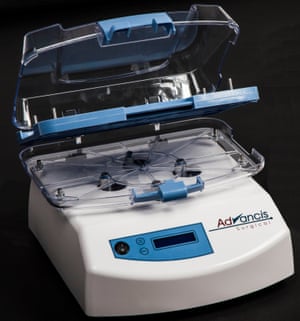
But a new machine, devised by Strathclyde University’s biomedical engineering department, may change all that. Hemosep, as it is known, is designed for use during major surgery. It removes blood from the surgical site, takes out the plasma and returns the vital blood cells to the patient, all through a single lightweight device.
The key is a special plastic bag into which the recovered blood is poured. This acts as a chemical “sponge”, soaking up plasma that has diluted the blood during the operation, so that the resulting transfusion is rich in the vital blood cells needed by the patient.
In 2014-15, NHS Blood and Transplant issued 1.7m units of red blood cells, 275,000 units of platelets, 215,000 units of fresh frozen plasma and 165,000 units of cryoprecipitate (frozen blood plasma) to hospitals in England and North Wales. Hemosep’s makers say the device could save the NHS £2.6m a year.
Although transfusion is generally a safe procedure, it can carry risks of infection and, in some countries, disease. So outside hospitals – in a war zone or natural disaster – the possible benefits are obvious. The device is now in clinical use in 50 countries, and there are already reports of a reduction in blood transfusions in patients who have benefited from its use. Because patients receive their own blood, it also allows patients whose religion or culture prevent them having donor blood transfusions to have surgery.
Professor Terry Gourlay, head of biomedical engineering at Strathclyde University, remembers the “Eureka!” moment in the Hemosep’s creation – and it really was in the bath. “It has been a source of fascination to me for years,” he says. “I decided to look at a completely different approach, with a control membrane through which no cells could pass. That way, we would be left with all cells concentrated on the outside, ready for collection.”
He experimented with this idea at home, using different membranes and duct tape to see if the concept was feasible. He quickly became convinced that he was on to something revolutionary. “A funding call from the military looking at ways of reducing blood loss also inspired me,” says Gourlay. “I continued my research at the university, with the focus on developing a super-absorbent membrane. You could almost describe it as being similar to babies’ nappies – though much more efficient and aggressive.”
It took two years from concept to licence, and the current version satisfies even Gourlay, who admits he has a constant urge to tweak. “I do tend to think we can always do better, and that is probably reflected in how we developed it, but I am delighted now.”
Stephen Cotton, managing director of Brightwake, which helped to develop and manufacture the membrane, says that interest is so intense that the company is looking for a new site to scale up manufacture. “It’s an amazing device, which you can train someone to use in 15 minutes. It is saving lives as well as money, and we have orders pouring in from across the world – China, India, Canada, the States, France, the Middle East – but, oddly, not from the UK, although it was conceived, developed and manufactured here.”
The problem, he explains, is to do with the way the NHS does its purchasing. “When hospitals are buying equipment from big companies, they are locked into agreements for three or five years. Hemosep is completely different from all the traditional blood salvage devices, so there’s currently no point in us bidding for the tenders, as we’re offering something so innovative that it falls outside the criteria. It would be good to see Hemosep used in the UK, but with such massive interest worldwide we can’t worry about that.”
While the NHS might be missing out, the military isn’t. Recently, a military and civil disaster version of the Hemosep has been developed by the Strathclyde team. This new version is portable and hand-operated, and has the advantage of being able to return salvaged blood directly back to the patient, without the concentration process – vital when rapid transfusion might be the difference between life and death.
Neal Smith, capability adviser for medical science at the Defence Science and Technology Laboratory, part of the UK Ministry of Defence, is leading trials on this version. “We began funding the research in 2014, and believe Hemosep has the potential to transform battlefield care,” he says “Devices such as this, which is lightweight, robust and relatively easy to use on the battlefield, can provide enormous benefits and save lives.” Uncontrolled blood loss is still the major cause of death on the battlefield, and Hemosep’s ability to allow blood lost to be directly returned to the bloodstream, long before patients reach a field hospital, is undoubtedly a breakthrough.
Hemosep: the machine set to revolutionise blood transfusions
