hairdressers etiketine sahip kayıtlar gösteriliyor. Tüm kayıtları göster

5 Mart 2017 Pazar

Hairdressers of the world unite against hidden dangers of the salon

Hairdressing is not an obviously dangerous occupation. Yet working in a hair salon or a barber’s shop can provoke skin conditions, musculoskeletal diseases such as arthritis and tendonitis and work-related asthma.


Now Usdaw, the shopworkers’ union which represents many of Britain’s estimated 140,000 hairdressers, is calling for a “new deal” to protect them. Paddy Lillis, the union’s deputy general secretary, said the government needed to give “proper protection” to barbers and hairdressers, the majority of whom are female and younger than 40.


A Europe-wide agreement on health and safety standards for the industry has been blocked by the European commission, under pressure from successive British governments. “It’s time we had a new deal for hairdressers,” Lillis said. “All too often the safety of shopworkers is overlooked in the mistaken belief they work in low-risk environments.


“This is a mistake the UK government made when they scaled back Health and Safety Executive inspections and slashed inspections by local authorities who enforce safety in shops, warehouses and offices. It is time that the government and the European commission took these risks to the health and safety of hairdressers seriously and gave them proper protection.”


Research indicates that hairdressers are at risk from seemingly innocuous activities such as washing hair, cutting hair and using hairspray. Repeatedly washing hands can lead to dermatitis, a non-contagious sensitivity to chemicals that causes painful cracked skin and bleeding, and research has shown that 70% of hairdressers have suffered from skin conditions.


Breathing in hairspray and other chemicals may be linked to asthma, according to some studies. Using scissors day in, day out can provoke arthritis and tendonitis in the hands and thumb, through loss of cartilage.


And hair dye has been blamed for a link between hairdressing and bladder cancer, although Cancer Research UK believes this is more likely to be the result of older hair dye ingredients which have been discontinued. Most of these issues could be solved by wearing appropriate gloves and taking regular breaks.


Rebecca Walker had been a hairdresser for nearly 10 years when she developed arthritis. The first signs were a “really stiff shoulder”. “I thought that maybe I’d been overworking it, but it didn’t go away and the pain moved to my elbow,” she said.


Within two months she had resigned because she was taking too much time off because of the pain in her wrists and hands. “I suppose I’m quite a determined person so I didn’t want to give up,” she said. So in 2011 Walker opened her own salon, quirkydo in Macclesfield, and now employs several other people.


“There have been times I’m not sure how I’m going to get through the day, but if I give myself a break for half an hour between clients, it’s OK,” she said.


The picture is different on the continent where hairdressers are more likely to be employees. Regina Richter has been a hairdresser in Leipzig for 51 years, but for the last 30 years she has suffered major back problems due to standing up for eight hours a day. “It seems to be affecting my younger colleagues more now,” she said. “After four or five years they are starting to experience pain. I think it is because the pressure has increased – now everyone has to cut hair as quickly as possible to get as many clients as possible.”


She believes that sometimes being able to sit down while cutting hair, and using ergonomic scissors and lighter hair dryers, would have prevented or delayed her condition.


In 2012, the union that represents about one million hairdressers across the EU, Uni Europa, was involved in drawing up an agreement for EU member states to sign up to shared health and safety standards for hairdressers. But since Jean-Claude Juncker became president of the European commission, the agreement has been blocked, under pressure led by Britain and some other parts of the EU, according to Oliver Roethig, regional secretary of Uni Europa.


“When we look at hairdressing, it’s the tip of the iceberg,” he said. “Social legislation by the EU has been completely taken off the agenda by the Juncker commission. He said the EU must not be big on the smaller things. But we don’t think that hairdressers having to give up work is a small thing.”


In the UK, where nearly half of all hairdressers are self-employed, it can be difficult for individual stylists to raise health and safety issues in their salon, and given the role of Britain in obstructing progress at a European level, life after Brexit is unlikely to get any easier.


In 2009, the Health and Safety Executive handed over responsibility for its campaign on dermatitis to the Hairdressing and Beauty Industry Authority (Habia) and the National Hairdressers’ Federation.


However, Habia’s website refers to health and safety only from an employers’ perspective and does not offer guidance to hairdressers.


Hilary Hall, chief executive of the National Hairdressers’ Federation, said it did offer guidance to employers on contracting dermatitis and advised staff to wear vinyl gloves when washing hair.


“The directive pretty well captures what is available in the UK,” she said. “The difference is enforcement. The individual is responsible and they could be subject to inspections. We feel it is better to let people choose.”


THE DANGERS


Dermatitis


A study in 2004 revealed that 70% of hairdressers in Britain had suffered from work-related dermatitis, in the form of red, sore and sometimes itchy skin, mainly to the hands and fingers but also to the arms, face and neck.


Asthma


In France, a paper published in 2003 showed that 20% of women affected by work-related asthma were hairdressers, compared with 1% for the general population.


Arthritis


According to the European Agency for Safety and Health at Work, musculoskeletal disorders are five times more prevalent among hairdressers than in the general population. Research published in the journal Work in 2009 showed that in a study of 145 hairdressers, 41% experienced ‘work-related upper limb disorders’.


Cancer


An analysis of 42 bladder cancer studies in 2010 showed that hairdressers faced a risk 30 to 35% higher than the general public. However, Cancer Research UK says that because cancer can take many years to develop, this may be due to exposure to older chemicals that are no longer used.


Hairdressers of the world unite against hidden dangers of the salon

12 Ağustos 2016 Cuma

Conakry hairdressers dispense cut-and-dried contraceptive advice to women | Ruth Maclean

Fatoumatah Bah is cornered. Sitting in front of a tinsel-ringed mirror in Miskaa Salon, her head is bent forward, two women at work braiding twists into her hair. She will be stuck in the chair for at least three hours.


It is a good moment to pounce. Fatoumatah Kamara, 20, an apprentice hairdresser in a matching skirt and blouse and glinting cherry earrings, sidles up to Bah. She starts to make conversation.


At first, it is the usual hairdresser chatter. What rain we’ve been having, eh? Where are you from? What are you up to this weekend? This is the 20-year-old accountancy student’s second visit to the salon in Guinea’s capital, Conakry.


Soon Kamara’s questions become more personal. Does Bah have a husband? A boyfriend? Then she goes in for the kill. Does she know there are ways of avoiding getting pregnant?


With every manicure, pedicure and hairdo at the Miskaa Salon, clients receive a free treatment: a great deal of contraceptive advice.


Related: Contraception and family planning around the world – interactive


Five salons across Conakry have been dispensing family planning advice since 2012, and they have been so successful that the project – the brainchild of Jhpiego, a health organisation associated with Johns Hopkins University in the US – is about to be extended to salons in Guinea’s seven major cities.


In Guinea, which has one of the lowest rates of modern contraceptive use in the world, women have an average of five children. According to UN figures, in 2015 only 7.5% of married or cohabiting women use some form of contraception.


A lot of effort has gone into teaching women in rural Guinea about family planning, but not so much in urban areas. A salon is an excellent place to reach them, so long as it is the right kind of salon.


“It’s better to go where they do braids because that’s what women traditionally want,” says Yolande Hyjazi, Jhpiego’s director in Guinea. “A woman who’s straightening or washing her hair has more money and more access to information.”


Across town from Miskaa, Jumelle Coiffure is trying to turn around clients as fast as possible, largely because the room is impossibly cramped. Jumelle is owned by 32-year-old twins Tata Sylla, wearing a short black and bright green wig, and her sister Mbalia, with long, heavy braids.


“There were a lot of young women getting pregnant around here when they didn’t want to, with lots of kids running after them, and I thought it would be good to teach them how to avoid that. Even my apprentices were getting pregnant,” says Mbalia, making up Aminata Kouma’s face just inside the salon door. Outside, a dozen girls huddle under the dripping overhang of the salon’s tin roof, filing fingernails and tugging at each other’s hair.


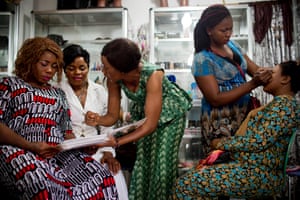
An apprentice hairdresser at the Jumelle salon in Conakry shows a client different family planning methods


An apprentice hairdresser at the Jumelle salon in Conakry shows a client different family planning methods. Photograph: Kate Holt

Kouma, 35, says she first heard about family planning at Jumelle.


“I never knew about this before coming here – they taught me how,” she said. “I got the injection, and since then I’ve been able to control the number of children I have. I already have four and I don’t want any more. My husband can’t afford it, school fees are so high. There’s too much suffering here. I’m a housemaid, but I’m out of work.”


Each salon has an army of apprentices, some of whom have worked in them for years, to cope with the intensity of the work and the number of clients. Jhpiego deliberately chose very popular salons to reach as many people as possible, and trained some of their apprentices as community health workers, to explain how to use exclusive breastfeeding to prevent pregnancy, talk about implants, sell pills and write referrals. They earn half the sale price for any pills and condoms they sell.


The trial started in 2013, but everything had to stop for the Ebola outbreak. Like all health organisations, Jhpiego had to turn its efforts to fighting Ebola. In any case, women were not going to the salon.


It is now back in full swing, though, and tailors’ shops are the next target. “There are women that wait around all day for their dresses, trying them on,” Hyjazi said. “People are being social, hanging around. But in the tailors’ shops we also have a lot of young men. Reaching men is important.”


The idea is that clients of both establishments will talk to their friends, and word will spread.


At Miskaa, a large wedding party is getting ready.


Apprentice hairdressers cluster around each client, carefully painting on long, black eyebrows, blow-drying hair straight, and making minute adjustments to towering, shiny headwraps.


Kamara, pointing at her laminated booklet, has just finished explaining how to use a string of beads to track fertility. But it isn’t new to Bah.


“I go on Google, I go on YouTube, I find information,” she says. “But not everybody is a student like me.”


She knew about condoms and pills, but not the other methods Kamara talks about. Young people have far more access to information than previous generations, and sex is slowly becoming something that is more talked about.


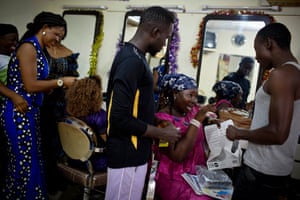
Young men who have come to Conakry’s Miskaa Salon for cut price condoms are shown how to use them correctly by apprentice hairdresser Nene Diakité.


Young men who have come to Miskaa Salon for cut price condoms are shown how to use them correctly by apprentice hairdresser Nene Diakité. Photograph: Kate Holt

Traditionally, a Guinean woman would space out her children by leaving her husband and going back to her mother’s house for a few years, every time she had a baby.


“Now no one is using abstinence, so everyone is using contraceptives, but no one is talking about it,” Hyjazi says. “Many people think that if a women is using contraceptives, it’s because she has another partner. There’s not a lot of open communication – even between a husband and wife using them. Many women will use the pill without telling their husbands.”


One thing is unlikely to change, though, and according to Hyjazi, it is skewing the statistics, because people doing surveys do not always do them in private. “If a woman is asked if she’s using contraceptives and her mother or mother-in-law is there, she’ll never say yes.”


The wedding party is almost ready. Kamara looks over each woman carefully before opening the door for them. In a few hours, they have become more glamorous and, thanks to Kamara, more contraceptive-savvy.


“I like making women beautiful – that’s why I work here,” says Kamara, already looking around for her next quarry.


Conakry hairdressers dispense cut-and-dried contraceptive advice to women | Ruth Maclean