eradication etiketine sahip kayıtlar gösteriliyor. Tüm kayıtları göster

21 Kasım 2016 Pazartesi

Jakarta"s Rat Eradication Movement: public offered cash reward for live rats

Samin climbed down into the darkness of the sewer, homemade catapult in hand. He wasn’t using stones this time, concerned they might kill his prey. Instead he formed small balls from damp mud, just enough to stun the rats and get them into a rusty wire cage. The plan was to smoke them out. He threw a fistful of lit rags down the tunnel and waited.


That night, despite an evening thunder storm, the square outside Cakung district administrative office in East Jakarta was packed with street cleaners carrying an assortment of old birdcages and traps made from wire or discarded water dispenser bottles. A good haul for one afternoon – 650 live rats – many of them more than two feet long.


Civil servants in khaki uniforms gathered round to record the scene on smartphones as workers in protective suits and masks vigorously shook the squealing contents of each cage into a pair of steel drums to be gassed with sulphur. Shouts and screams went up whenever a rat escaped, zigzagging through the crowd of legs to get back to the sewer. A few made it. Most were stamped to death.
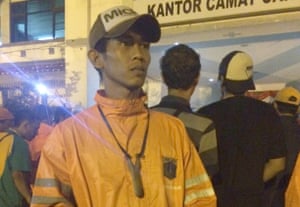


Samin with the homemade catapult he used to stun and catch six rats.


Samin with the homemade catapult he used to stun and catch six rats

Welcome to the Rat Eradication Movement, a fledgling city programme to rid the Indonesian capital of its rodent problem. It’s the idea of deputy governor Djarot Saiful Hidayat, who has offered the public a bounty of 20,000 rupiahs (£1.20) for each live rat – a generous incentive in a country where 40% of the population live on less than $ 2 a day. Collecting the rats alive stops people claiming rewards for dead rodents found in the street, and allows officials to ensure none have been poisoned or shot, which they fear could be dangerous to the public.


Cats used to catch them but now the rats are bigger than them


Murad Husein


Jakarta recorded 40 cases last year of Leptospirosis – a bacterial infection from rat urine which can be deadly to humans – with the situation made worse by the city’s frequent floods. While rodent populations are highest near markets and their ready supply of waste food, they can be seen almost anywhere in the city. Rats have been spotted in courthouses and government offices, exclusive apartment blocks and expensive restaurants. Wander the streets at 3am and rats can be seen scurrying in and out of drains. They don’t seem too scared of people.


The rats gnaw through plastic drainage pipes and electrical wires. It is both a fire hazard and an expensive problem to fix as a broken pipe or chewed through wire could be anywhere – outside, inside or under – that a rat can get.



A resident shows off the 200,000 rupiahs he earned for catching 10 live rats during a pilot programme in Kemayoran, Jakarta, last month.


A resident shows off the 200,000 rupiahs he earned for catching 10 live rats during a pilot programme in Kemayoran, Jakarta, last month. Photograph: Alez Kurniawan

Funding for the programme currently comes from Djarot’s own budget, and full operation will not start until after city elections in February. He is standing on a ticket with Jakarta governor Basuki ‘Ahok’ Tjahaja Purnama, who was last week named as a suspect in a blasphemy investigation.


A similar pilot evening two weeks ago in the sub-district of Kemayoran yielded 200 live rats. Djarot, who was there to supervise the operation and distribute money to the moonlighting cleaners and ojek motorcycle-taxi drivers who caught the rats, said the city’s rodent population had until now been “uncontrollable”. Ojek driver Sutikno earned 100,000 rupiah after catching five rats with fishing nets and traps. “It’s good money. I’ll do it again,” he said.


Some, though, worry the programme could backfire in a phenomenon economists call the Cobra Effect, where cash rewards lead to unintended consequences.
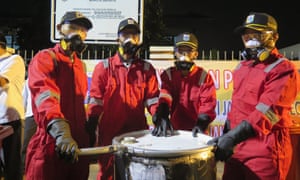


City workers in protective clothing and masks gassed the rats with sulphur.


Workers in protective clothing gassed the rats with sulphur. Photograph: Alez Kurniawan

The term was coined by German economist Horst Siebert, whose book of the same name contained an anecdote about attempts by colonial authorities in India to rid Delhi of cobras. When the British official in charge placed a bounty on the snakes, some enterprising locals started farming them. The scheme proved ineffective and was eventually cancelled. At that point the cobra farmers, faced with an unwanted stock of snakes, released them into the countryside around the city. The supposed solution had made the problem worse.


A similar situation has been documented by historian Michael Vann. His account of “the Great Hanoi Rat Massacre” tells of attempts by French colonial rulers to control rat populations in the Vietnamese city. New sewers in the wealthy European section unwittingly created a secret underground transportation network for the rats, where they were protected from predators, and the dark tubes provided an ideal breeding ground. They could make their way across the city, with flushable toilets in the poshest homes acting as a convenient entry point.


Authorities offered a cash reward to the public, paying out on production of a rat tail to make administration of the scheme easier. Soon residents were turning in tails in huge numbers – tens of thousands a day – but it wasn’t long before tail-less rats became an increasingly common sight.


“[Officials realised residents] were catching rats, but merely cutting off the tails and letting the still-living pests go free – perhaps to breed and produce more valuable tails,” Vann said. “Later, things became even more serious as health inspectors discovered a disturbing development in the suburbs of Hanoi. These officials found … individuals were actually raising rats to collect the bounty.” The scheme was declared a failure and scrapped.


Could Jakarta’s Rat Eradication Movement end up creating similar unintended consequences? Currently the scheme is nowhere near the scale of Hanoi’s Great Rat Massacre and there seems no shortage of genuine sewer rats, but Benvika, head of wildlife at the Jakarta Animal Aid Network, is not convinced by the project.


He advocates a return to a more natural balance, with predators such as snakes and owls used to control rodent populations. “The sulphur gas is not immediately lethal and causes unnecessary suffering,” he added. “The people of Jakarta must return to living healthily, and maintain their environment.”


Overseeing the Cakung operation was the vice-mayor of East Jakarta, Murad Husein. “Cats used to catch them but now the rats are bigger than them,” he said. “Without any predators the rat population has got bigger, and so have the rats themselves. We’ve no idea how many there are but you can see them almost anywhere, night or day.”


Additional reporting by Linda Hairani


Jakarta"s Rat Eradication Movement: public offered cash reward for live rats

17 Mart 2014 Pazartesi

The Eradication of Schizophrenia in Western Lapland review – "A startling piece of work"

The Eradication of Schizophrenia in Western Lapland by Ridiculusmus

Funny, fragile, unsettling … The Eradication of Schizophrenia in Western Lapland by Ridiculusmus. Photograph: Tristram Kenton for the Guardian


Earlier this yr, Jon Haynes, co-artistic director of Ridiculusmus, listed on his website several things that “may have contributed” to the company’s new show. A single was reading a guide by the psychiatrist RD Laing as an undergraduate and “discovering the notion of madness fairly attractive” one more, currently being sectioned and discovering that “madness wasn’t so eye-catching after all”. The four characters in The Eradication of Schizophrenia in Western Lapland are all going through or assimilating psychological illness in approaches that are funny, fragile, unsettling and touching to witness. Madness seems to be perplexing, agonizing, exhausting. It also appears a good deal like ordinary daily life.


  1. The Eradication of Schizophrenia in Western Lapland

  2. Stephen Joseph Theatre,

  3. Scarborough


  1. Starts 19 March

  2. Until twenty March, then touring


  3. Box workplace:
    01723 370541

  4. Theatre web site


Which is down to the ingenuity of the staging: the audience are divided on both side of two rooms linked by net-curtained windows. In a single, a mom is exhibiting signs of psychosis, to the bemusement of her sons in the other, the eldest son is speaking to his psychologist from his personal state of psychosis, perhaps triggered by his parents’ divorce. Sound bleeds from 1 area to the other, blurring the stories. Even when the audience swaps sides and the action replays, it’s a struggle to place the pieces collectively. If the eldest son – played with deadpan concision by Haynes – is “mad” in 1 area and “sane” in the other, what’s the variation? Is his psychologist – a deliciously distracted overall performance by the other half of Ridiculusmus, David Woods – also hearing voices? There’s something electrifying however oddly reassuring about this expertise: what does it matter if nothing at all tends to make sense?


Embedded right here is an argument for a diverse remedy for psychological sickness, practised in Finland, that embraces dialogue with a community, not just a patient. There is area for the present to produce, but previously it truly is a startling piece of perform that issues how you pay attention and fathom what you hear.


• Did you catch this show – or any other not too long ago? Inform us about it using #gdnreview


The Eradication of Schizophrenia in Western Lapland review – "A startling piece of work"

21 Şubat 2014 Cuma

Yaws eradication will require hundreds of thousands of donated antibiotics, says WHO

mdg : Tanna children showing a stained fingernail as proof of yaws treatment

Tanna youngsters showing a stained fingernail as proof of yaws treatment, in Vanuatu. Photograph: World Health Organisation


The Planet Wellness Organisation has stepped up efforts to eradicate yaws, described as the “forgotten condition”, following the discovery of a single-dose oral antibiotic that can remedy it.


Wiping out the bacterial skin ailment that leads to weeping ulcers would, even so, rely on whether drug firms were ready to donate millions of tablets, the WHO stated.


Untreated, the condition progresses to the bones, causing significant disfigurement and disability. It largely has an effect on beneath-15s in poor, remote populations.


Only 12 countries – 3 Pacific islands, eight African countries and Indonesia – are affected by yaws. A global vaccination programme in the 1950s treated more than 300 million men and women and rid 90 endemic countries of the infectious bacteria.


In the remaining endemic nations, up to ten% of kids suffer skin ulcers, which suggests that among forty% and 60% have the infection in their bloodstream. These latent instances can turn into sources of reinfection, stated Oriol Mitjà, a technical adviser for the WHO’s neglected tropical conditions division who works on the yaws remedy programme in Papua New Guinea.


“How can we morally justify not using such a straightforward and inexpensive tool to rid the young children of these communities of an infection that causes years of struggling?” he said.


The WHO set 2020 as the deadline for the eradication of yaws, and has effectively carried out therapy campaigns employing the new antibiotic in Congo-Brazzaville, Ghana, Papua New Guinea and Vanuatu. With a single dose provided to everyone, the illness can speedily be eliminated from the neighborhood, said Mitjà.


“We had been very content to see that about 95% of the population residing in the 4 nations took a single dose of the drug. And we are encouraged by the benefits, that after a single round of treatment the ailment goes down dramatically,” stated Kingsley Asiedu, responsible for yaws in the WHO’s neglected tropical conditions department.


In Lihir in Papua New Guinea, the variety of new cases dropped by 90% just 6 months after the antibiotic was administered, Asiedu explained.


But the air of optimism is tinged with uncertainty about where funding for the antibiotic will come from.


The up coming phase, according to Asiedu, is to broaden the remedy into other countries, but this will require a lot more resources, notably the drug azithromycin.


“If we depart it to a country’s capability to acquire the drug, it is going to truly delay the speed at which we can attain the target. Our basic goal is now to secure the donation of azithromycin. We’re trying to discuss with Pfizer no matter whether it will be interested to aid in yaw eradication efforts,” he mentioned.


“It’s up to the pharmaceutical organizations to make the donation of 200m tablets. There are presently forty million people who are at risk from the condition and we need to deal with them all,” Mitjà stated.


As the treatment method requires only a single round, Asiedu is sure that if they get the funding yaws can be wiped out inside of six years. The ability to reach remote areas would not be a dilemma, he mentioned, since preceding vaccination programmes had efficiently reached them.


Matthew Coldiron, a medical professional who took part in a Médecins Sans Frontières campaign to eradicate yaws in the remote northern areas of Congo-Brazzaville, stated, nonetheless, that treating Aka pygmy communities in the most inaccessible areas of the tropical rainforest was “an immense logistical burden”.


“1 of the significant places the place yaws is present is in the central African rainforest. Logistic access and insecurity is going to make it a true struggle to eradicate the condition,” he said.


There is also concern that the bacteria that causes yaws will turn out to be resistant to azithromycin, in accordance to Michael Marks, a Wellcome Trust clinical research fellow at the London School of Hygiene and Tropical Medicine. Resistance to the drug has occurred in the bacteria that brings about syphilis, which is closely relevant to the yaws bacteria, he explained.


“Monitoring for the development of resistance in the yaws bacteria will be really crucial in the course of the yaws eradication programme,” he stated. “Despite the fact that there are problems to overcome, if we can sustain the momentum we have, then throughout the world elimination is a sensible purpose.”


Wellness authorities see the yaws eradication hard work as an indicator of related worldwide drives to wipe out other diseases. “If we can not eradicate anything like yaws, why are we so concerned about eradication of other ailments. This is the easiest ailment to eradicate, medically speaking,” Coldiron said.


“Yaws is going to be the second ailment to be eradicated from the world right after smallpox. This will most likely inspire other public well being officials to pursue eradication of other conditions, this kind of as malaria and tuberculosis,” Mitjà explained.


Yaws eradication will require hundreds of thousands of donated antibiotics, says WHO