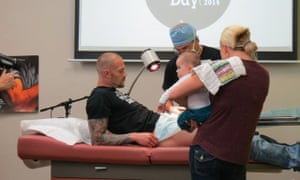
Vasectomies etiketine sahip kayıtlar gösteriliyor. Tüm kayıtları göster

24 Ekim 2016 Pazartesi

Solder on: we need men to keep getting vasectomies

Vasectomies are much less popular than they used to be, “down 64% in the past 10 years”. What a pity. It would be such a relief for women not to have all the bother, fiddling about and responsibility. But apparently “worrying myths” about pain and the end of sex as they know it frightens men, as does the word “snip”. That sounds a bit weedy. It isn’t even a snip. It’s just a bit of soldering “with a red-hot implement”, under anaesthetic, and probably two or three days swelling and resting.


A breeze compared with common proceedures for women: think episiotomy – ripping, cutting and sewing, lumps of rubber regularly stuffed up and pulled out, internal examinations, pokings and grovellings about for this that and the other, hormonal implants, with possible nasty side-effects and bleeding. Or coils – mine went through to my stomach. Not pleasant. The removal was also pretty grim.


Mavis’s didn’t work and she got pregnant again, so she had an abortion, which was no fun either. And then there’s childbirth – usually much tougher than a quick bit of soldering.


There are other cuts probably putting the dampeners on vasectomies – government cuts, because they cost £400 each. But to reassure anyone contemplating a vasectomy and egg them on: it only takes 15 minutes, it’s 99.9% effective, it’s reversible (sometimes), and afterwards you can be at it like the clappers, just as you always were. All right, you may meet a new partner and long for more children, but you could regard the vasectomy as your own voluntary biological clock. Just like women, but ourrs is mandatory, inescapable, panic-inducing and irreversible.


Fielding still doesn’t fancy one. Ever. Because he still has his dreams. What if he’s in Paris one day, goes into Scarlett Johanssonn’s gourmet popcorn shop for some truffle parmesan popcorn, and she’s actually in there herself, serving; she falls in love with him and longs for a baby. Then what? Pigs will fly. But we can all have our mad fantasies. Like mine: one day all men, worldwide, will take on the burden of contraception.


Solder on: we need men to keep getting vasectomies

21 Ekim 2016 Cuma

Number of vasectomies in England falls 64% in 10 years

Vasectomies appear to have gone dramatically out of fashion, with a decline of 64% in the number of men undergoing the procedure within the last 10 years, leaving women once more shouldering the responsibility for contraception.


But the reasons for the apparent shift are complex, say experts. Part of it is bad publicity, with many men seemingly put off by scare stories about pain and unfounded worries about the implications for their sex lives, but there are also concerns that NHS funding for the procedure may be slipping away.


In 2004-5, there were 31,216 vasectomies carried out in England, but in 2014-15, that fell to just 11,113 according to NHS Digital. Image is definitely an issue, according to Genevieve Edwards of Marie Stopes, who says “the snip” is an offputting misnomer. “That is not what happens. If you were going to launch vasectomy as a product, you wouldn’t start there,” she said.


“People worry massively and have lots of misconceptions about it – how painful it is, the impact on their sex life, whether they will still have orgasms. People are really confused about it.”


The perceptions lag behind the reality, Edwards said. “There is no snipping at all. It is a 15-minute procedure with lots of anaesthetic and Bob’s your uncle.”


But the later age of having children is also a factor, she believes. In the past, a couple may have had several children before they were 30. “If you and your partner had another 20 years of fertility ahead, another two decades of the pill, you might pack him off to the doctor,” she said. But if a woman will be facing the menopause in just a couple of years, they might carry on with contraception rather than opting for a vasectomy.


Suggestions that men no longer want a vasectomy in case their marriage breaks up and they have a second partner who wants children are wide of the mark, she believes.


Marie Stopes is a leading provider of vasectomies for the NHS as well as privately and has been trying to boost interest among men. It ran a campaign this spring on websites and at football grounds called “Have you got the balls?” inviting men to think about it. It appeared to have some effect, because 200 more men came along for the procedure last month than in September the year before.


If awareness and interest is dropping in England, that is not the case elsewhere. Marie Stopes clinics get quite a lot of male clients from France and the Middle East. In the Middle East, the procedure is rarely done, so men head for clinics where it is routine and they feel in safe hands. In France, vasectomy was illegal until relatively recently, under the Napoleonic code that banned self-harm. Although it is legal now, it is not easy to access and men who ask for it must go through counselling and a cooling-off period. Many jump on the Eurostar instead.


But cost in England may be becoming an issue. At a time of increasing financial pressure on the NHS, some clinical commissioning groups are considering reducing the number of vasectomies they will pay for, or dropping them altogether. The North East Essex clinical commissioning group (CCG) will no longer fund it. Its website states: “The community vasectomy and female sterilisation services are considered as one of many forms of contraception and are deemed to have no or limited clinical value.” It will be available, however, “in cases of complex health needs”.


The procedure costs £400, but arguably saves money on other forms of contraception over the long term. It also allows men to take over responsibility from women, who have had to worry about their fertility and the possible side-effects of hormonal contraception for much of their lives.


While vasectomy has declined, the use by women of long-acting reversible contraceptives, known as LARCs – such as implants and intra-uterine devices (the coil) – has risen.


“There has been a huge push on getting women to use long-acting reversible methods,” said Katherine O’Brien, a spokesperson for BPAS, the British pregnancy advisory service. “It is cheaper for doctors to be providing these things. We know that if you speak to women and their partners, if they have discussed the possibility of a vasectomy with their GP, the doctor often says to them, why don’t you just have the coil or an implant?”


The attraction of LARCs is that they can be left for several years but the contraceptive effect is reversible – and a vasectomy often is not. But implants are hormonal, which some women do not want, and sometimes there is bleeding. “When women go back to the GP, they are told to go back on the pill to cope with the bleeding,” said O’Brien. “It is really extraordinary. They chose the LARC because they didn’t want to take the pill.”


The Family Planning Association says it advocates “as much choice as possible”. It too is worried about the decline of the vasectomy and fears there will be a postcode lottery as some CCGs decide to pay for it, while others will not. “We are worried that if men aren’t able to access vasectomy, it does put more of a burden onto women,” said a spokesperson. The conversation heard in the clinic is of the woman in a partnership saying that contraception was her responsibility until the couple had completed their family – and now it is the man’s turn.


The vasectomy is a simple procedure, carried out under local anaesthetic. It involves a small incision on each side of the scrotum, allowing the doctor to access the tubes that carry sperm out of the testicles. These are cut and sealed. It can also be done with keyhole surgery. Ejaculation is as normal afterwards, but the semen contains no sperm.


Number of vasectomies in England falls 64% in 10 years

Number of vasectomies in England falls 64% in 10 years

Vasectomies appear to have gone dramatically out of fashion, with a decline of 64% in the number of men undergoing the procedure within the last 10 years, leaving women once more shouldering the responsibility for contraception.


But the reasons for the apparent shift are complex, say experts. Part of it is bad publicity, with many men seemingly put off by scare stories about pain and unfounded worries about the implications for their sex lives, but there are also concerns that NHS funding for the procedure may be slipping away.


In 2004-5, there were 31,216 vasectomies carried out in England, but in 2014-15, that fell to just 11,113 according to NHS Digital. Image is definitely an issue, according to Genevieve Edwards of Marie Stopes, who says “the snip” is an offputting misnomer. “That is not what happens. If you were going to launch vasectomy as a product, you wouldn’t start there,” she said.


“People worry massively and have lots of misconceptions about it – how painful it is, the impact on their sex life, whether they will still have orgasms. People are really confused about it.”


The perceptions lag behind the reality, Edwards said. “There is no snipping at all. It is a 15-minute procedure with lots of anaesthetic and Bob’s your uncle.”


But the later age of having children is also a factor, she believes. In the past, a couple may have had several children before they were 30. “If you and your partner had another 20 years of fertility ahead, another two decades of the pill, you might pack him off to the doctor,” she said. But if a woman will be facing the menopause in just a couple of years, they might carry on with contraception rather than opting for a vasectomy.


Suggestions that men no longer want a vasectomy in case their marriage breaks up and they have a second partner who wants children are wide of the mark, she believes.


Marie Stopes is a leading provider of vasectomies for the NHS as well as privately and has been trying to boost interest among men. It ran a campaign this spring on websites and at football grounds called “Have you got the balls?” inviting men to think about it. It appeared to have some effect, because 200 more men came along for the procedure last month than in September the year before.


If awareness and interest is dropping in England, that is not the case elsewhere. Marie Stopes clinics get quite a lot of male clients from France and the Middle East. In the Middle East, the procedure is rarely done, so men head for clinics where it is routine and they feel in safe hands. In France, vasectomy was illegal until relatively recently, under the Napoleonic code that banned self-harm. Although it is legal now, it is not easy to access and men who ask for it must go through counselling and a cooling-off period. Many jump on the Eurostar instead.


But cost in England may be becoming an issue. At a time of increasing financial pressure on the NHS, some clinical commissioning groups are considering reducing the number of vasectomies they will pay for, or dropping them altogether. The North East Essex clinical commissioning group (CCG) will no longer fund it. Its website states: “The community vasectomy and female sterilisation services are considered as one of many forms of contraception and are deemed to have no or limited clinical value.” It will be available, however, “in cases of complex health needs”.


The procedure costs £400, but arguably saves money on other forms of contraception over the long term. It also allows men to take over responsibility from women, who have had to worry about their fertility and the possible side-effects of hormonal contraception for much of their lives.


While vasectomy has declined, the use by women of long-acting reversible contraceptives, known as LARCs – such as implants and intra-uterine devices (the coil) – has risen.


“There has been a huge push on getting women to use long-acting reversible methods,” said Katherine O’Brien, a spokesperson for BPAS, the British pregnancy advisory service. “It is cheaper for doctors to be providing these things. We know that if you speak to women and their partners, if they have discussed the possibility of a vasectomy with their GP, the doctor often says to them, why don’t you just have the coil or an implant?”


The attraction of LARCs is that they can be left for several years but the contraceptive effect is reversible – and a vasectomy often is not. But implants are hormonal, which some women do not want, and sometimes there is bleeding. “When women go back to the GP, they are told to go back on the pill to cope with the bleeding,” said O’Brien. “It is really extraordinary. They chose the LARC because they didn’t want to take the pill.”


The Family Planning Association says it advocates “as much choice as possible”. It too is worried about the decline of the vasectomy and fears there will be a postcode lottery as some CCGs decide to pay for it, while others will not. “We are worried that if men aren’t able to access vasectomy, it does put more of a burden onto women,” said a spokesperson. The conversation heard in the clinic is of the woman in a partnership saying that contraception was her responsibility until the couple had completed their family – and now it is the man’s turn.


The vasectomy is a simple procedure, carried out under local anaesthetic. It involves a small incision on each side of the scrotum, allowing the doctor to access the tubes that carry sperm out of the testicles. These are cut and sealed. It can also be done with keyhole surgery. Ejaculation is as normal afterwards, but the semen contains no sperm.


Number of vasectomies in England falls 64% in 10 years

22 Eylül 2016 Perşembe

Vasectomies: turning an "act of love" into a global movement

“How do we celebrate the best in men when the news is full of stories about their frustration, humiliation, and destructiveness?” That was the question that film-maker Jonathan Stack was pondering back in 2011. The answer, he concluded, was to point out to men that there is a simple and pragmatic way they can personally make a difference to some of the most complex problems of our time – a vasectomy.


“I saw it as a creative challenge,” he says now. “How do we counter that narrative?” In vasectomies Stack saw an opportunity to transform an “act of love” into a global movement – a means “to engage men in the conversation”.


stack


Vasectomies are an act of love, argues Jonathan Stack. Photograph: World Vasectomy Day

Expanding access to vasectomies in developing countries has now become Stack’s life mission. In 2012, he created World Vasectomy Day while working on a documentary about his journey through fatherhood and decision to have a vasectomy. “The plan was to have 100 doctors in 20 countries do 1,000 vasectomies in 24 hours,” he says. “And we came very close to that.”


Men need to share the burden of birth control


Studies indicate that reducing fertility can result in far-reaching benefits – from improvements to maternal and child health to poverty reduction and long-term environmental sustainability. In 2012, the Bill and Melinda Gates Foundation and the UK government’s Department for International Development co-hosted a summit on family planning and outlined an ambitious new goal: to make affordable contraception available to an additional 120 million women and girls in the world’s poorest countries by 2020.


Four years on, important gains have been made: more than half of the 69 countries have delivered on their commitments, and an additional 24.4 million women and girls now have access to modern contraceptive methods. But some experts say progress has been slower than expected because efforts have overlooked a key population: men.


Vwfamily fl


“We need to engage more men to support their partners and spouses,” says Monica Kerrigan. Photograph: World Vasectomy Day

“We’re falling behind,” says Monica Kerrigan, former deputy director of family planning with the Gates Foundation and a senior adviser to FP2020, the global partnership formed after the summit to carry out its objectives. “I think a missing component is the need to engage more men to support their partners and spouses.” Among the many ways they can do that, she says, is by shouldering some of the burden of birth control, including, for those who no longer want to have children, voluntary sterilisation, or vasectomy.


Stack agrees. As it is, he says, men are largely left out. Most family planning programmes target women and girls, and with good reason: globally, the biggest barrier to reducing birth rates is gender inequality – population growth is fastest where female literacy is low, violence against women is common and reproductive rights are not protected.


Still, the reality remains that men tend to dominate decision making about family size and birth control. At the same time, they tend to be detached from or opposed to family planning, and the result is often that their partners discontinue using birth control or never start at all. In fact, of the unmarried women who say they don’t want to get pregnant within the next two years, close to a quarter don’t use contraception because someone close to them opposes it – one reason for the 74m million unintended pregnancies that occur annually.


“We’re now realising that while it’s important to focus on women and girls, we can’t continue with business as usual,” says Kerrigan. “We have to positively disrupt the status quo.” World Vasectomy Day, she says, is just that – an effort to secure men’s engagement, using modern innovations that can accelerate progress.


No scalpels


One of those innovations is the no-scalpel vasectomy. First performed in China in the 1970s, the technique made what was already a safe, simple procedure – a pair of small incisions to sever the duct that delivers sperm from the testicles (the vas deferens) – even more so. Using the no-scalpel approach, a provider need only locate the vas deferens under the skin and make a single needle puncture through which to cut it, minimising the risk of bleeding.


Men equate vasectomy with castration, or believe it will cause them to be impotent


Ricky Lu


“That modification really facilitated the spread of vasectomy across the globe,” says Carmela Cordero, a reproductive health expert with EngenderHealth. “Before, it was only the urologist who could perform a vasectomy. Now, we’re training nurses, midwives, clinical officers. You don’t need sophisticated equipment, you don’t need an operating room. It’s inexpensive, and it takes less than 15 minutes.”


And yet, for all its virtues, vasectomy is still an uncommon practice in the developing world and the least known modern method of contraception in poorer countries. In sub-Saharan Africa, where the unmet need for family planning is greatest, fewer than 100,000 men have had the operation. By comparison, female sterilisation, which is costlier , more time consuming, must be performed in a hospital and can result in serious complications, is among the most widely used methods of contraception worldwide.


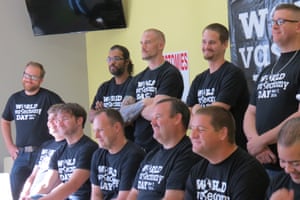
Some of the volunteers for WVS 2014.


Some of the volunteers for WVS 2014. Photograph: World Vasectomy Day

One reason for that, says Ricky Lu, director of family planning and reproductive health at non-profit Jhpiego, is that vasectomy has long been mired in misconception. “Many men equate vasectomy with castration, or believe it will cause them to be impotent,” he says. Where accurate information is lacking, he says, demand for the procedure is very low, and “there are few trained providers offering the service” as a result.


Jhpiego is trying to change that through programmes like Tupange (“let’s plan” in Kiswahili) in Kenya, which aims to make modern contraceptive methods available to the urban poor and to educate men about the benefits of voluntary male sterilisation. The country is one of a long list that will celebrate the fourth annual World Vasectomy Day on 18 November, 2016. Now a global movement, the event is supported by the International Planned Parenthood Federation, Marie Stopes International, FHI 360, and the ministries of health of India, Indonesia, and Kenya.


WVS is celebrated all over the world, including Indonesia.


WVS is celebrated all over the world, including Indonesia. Photograph: World Vasectomy Day

As before, the day will feature an 18-hour “vasectomy-thon” with medical professionals from around the world performing the procedure, as well as a training session for would-be providers in Kenya. “We’ll also have a wellness centre where men can get a general check-up, as well as counselling and testing for HIV and hypertension,” Stack says. “We think that part of being a responsible partner is taking care of one’s health.”


Kerrigan says vasectomy is part of catalysing men to support contraception. “If the majority of men supported their partners in using the contraceptive method that they want, we could go a long way toward preventing the 74m unintended pregnancies that happen every year,” she adds. “We need to change the way we think about men and boys in this space.”


Join our community of development professionals and humanitarians. Follow @GuardianGDP on Twitter. Join the conversation with the hashtag #SheMatters.


Vasectomies: turning an "act of love" into a global movement