Screen etiketine sahip kayıtlar gösteriliyor. Tüm kayıtları göster

5 Nisan 2017 Çarşamba

Big screen baddies and their skin conditions unpicked by dermatologists

Bulbous noses, warts and dark circles under the eyes are among the skin conditions commonly used by filmmakers to indicate villains, researchers have found.


A study by a team of US dermatologists has highlighted that while heroes of the silver screen typically have barely a mark on their features, characters with dubious morals are often depicted with all manner of skin traits – an association that, the researchers say, is damaging.


“It something that has been perpetuated in film, sometimes maybe even unintentionally, but it is something that has become more and more prevalent over the years,” said Julie Amthor Croley, co-author of the research from the University of Texas.


“It is not only perpetuating this tendency towards discrimination towards people with skin disease but it also does affect the person on an individual basis,” she added.


For the research, published in the journal JAMA Dermatology, Amthor Croley and colleagues began by scrutinising the appearance of the top ten heroes and villains as rated by the American Film Institute.


Top of the list of ne’er-do-wells was Hannibal Lecter, from The Silence of the Lambs, followed by Norman Bates of Psycho, Darth Vader of Star Wars, and the Wicked Witch of the West from the Wizard of Oz. The virtuous list, meanwhile, was topped by Atticus Finch from To Kill a Mockingbird and included, among others, James Bond, TE Lawrence, and Rocky Balboa.
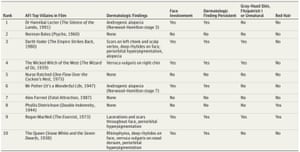


American Film Institute all-time top 10 villains and associated dermatologic findings.


American Film Institute all-time top 10 villains and associated dermatologic findings. Photograph: American Film Institute/Julie Amthor Croley et al

The team found that while skin features or conditions were common among the villains, cropping up in six of the ten cases, they were largely absent among the heroes – only Indiana Jones from Raiders of the Lost Ark and Rick Blaine from Casablanca were found to have scars, and then only single marks. What’s more, these scars belonged to the actors rather than being the handiwork of makeup artists, and were subtler and shorter than those of villains.


Baddies, however, had a host of skin problems ranging from warts, as found on the chin of the Wicked Witch of the West, to a condition known as rhinophyma which can cause a bulbous, red nose – such as that of the Queen in Snow White who, when in her hag-like disguise, was also found to sport deep wrinkles.


Regan MacNeil of The Exorcist also appeared on the top ten list of evil characters. The dark circles under her eyes and scars on her face are features also seen – together with deep wrinkles, grey skin and alopecia – in Darth Vader when he takes off his mask. The result, according to the authors, is that Vader “manifests sheer evil and incites apprehension and fear of the unfamiliar.”


“All these associations of skin findings with film villains date back to the silent film age in a time when all filmmakers had to communicate [with] was visual cues, they didn’t have spoken word,” said Amthor Croley, adding that one villain often sported multiple skin conditions, designed to hint at a nefarious character. “With specific reference to scars, filmmakers may use them to illustrate a sort of a stormy past filled with violence,” she added.


Beyond the top ten lists, the team point to other features which have frequently been linked to movie villains, including albinism – a condition seen in killers in the Da Vinci Code and Cold Mountain, among other films.
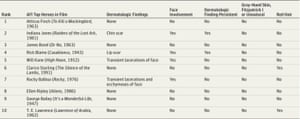


American Film Institute all-time top 10 heroes and associated dermatologic findings.


American Film Institute all-time top 10 heroes and associated dermatologic findings. Photograph: American Film Institute/Julie Amthor Croley et al

While the study does not consider whether many features such as hair loss were intended, prosthetic or just a natural feature of the actor, and only considers a small range of characters, experts say the research highlights an important issue.


“Skin disease is often trivialised as being nothing more than cosmetic disfigurement, but as this study shows, society holds deep-seated stereotypes about the association between skin appearance and personality,” said Kim Thomas, professor of applied dermatology research at the University of Nottingham, who was not involved in the research.


“Such stereotyping can be psychologically devastating for people suffering from common skin condition such as vitiligo, warts, acne and hair loss,” she added. “At a time when cash-strapped health services are talking of limiting medical treatment for cosmetic conditions, it is timely to be reminded of the wider impact that visible disfigurement can have on those affected.”


James Partridge, chief executive of the charity Changing Faces, said that findings of the study were not surprising. “For years, facial differences, such as dermatological conditions, scars or alopecia, have been used to indicate a villainous character. What concerns us is that this type of visual shorthand is used without any thought as to how it might affect the lives of real people with a visible difference,” he said.


“We want the film industry to take a more balanced approach,” he added. “Why can someone with a disfigurement not play the kind parent, the supportive teacher, the famous actor or even the president?”


Big screen baddies and their skin conditions unpicked by dermatologists

17 Mayıs 2014 Cumartesi

Heart professionals: screen for HCM muscle thickening ailment

Fabrice Muamba

Fabrice Muamba sheds a tear as he returns to Bolton on two May possibly 2012, much less than seven weeks right after suffering a cardiac arrest. Photograph: Rex Attributes/Offside


Mike Dodd has an abiding memory of the day he discovered of his susceptibility to serious heart sickness. When he was a teenager a decade ago, he was advised one afternoon that he was banned from taking portion in cross-nation running. “I was stunned but delighted,” he recalled. “I hated operating.”


Then he identified the explanation. His father, Ian, who had been suffering from chest pains and palpitations, had been diagnosed that day as obtaining hypertrophic cardiomyopathy, or HCM.


An inherited thickening of heart muscle, HCM has an effect on more than 100,000 men and women in the Uk. Males and females are affected equally by the issue, which is induced by a mutation in a gene that controls the manufacture of proteins concerned in heart muscle contraction. Thickened heart muscle leaves individuals at danger of struggling cardiac arrest.


In its mildest form, the condition has only a small impact on life-style. But at its severest level, physical action – in particular intense get in touch with sports – can set off cardiac arrest and death. Fabrice Muamba, a expert footballer enjoying for Bolton suffered a cardiac arrest, aged 23, during an FA cup game against Tottenham Hotspurs two many years in the past. He was identified to have HCM and only narrowly survived after getting without having a heartbeat for 78 minutes.


Dodd said: “When my dad was diagnosed, it was imagined I may well have picked up the HCM gene from him and so would be in danger from taking extreme physical exercise. So medical doctors phoned my college and asked that I be stopped from working.”


Gene exams later on confirmed Dodd – along with his brother Chris – had inherited the HCM gene. The impact on his existence has been anything at all but damaging, nonetheless. Certainly it has been constructive – for Dodd’s curiosity in the condition led him to become a biochemist. “I was always interested in science, but finding HCM in our family members made me specialise on the heart.”


Nowadays Dodd, 27, is a researcher doing work on hypertrophic cardiomyopathy at the Oxford laboratory of Professor Hugh Watkins, a foremost HCM skilled who was concerned in the diagnosis of the Dodd household problem. “I cannot don’t forget now whether or not I initial met Mike as a patient or as a single of my college students,” said Watkins. “That doesn’t happen really frequently.”


Dodd’s work in Watkins’s laboratory is focused on the growth of medicines that could counter HCM in those with its severest types.


“The difficulty with HCM is that, if it has not but been detected in your household, you may well not know that you have it. That is when you are at chance of triggering a cardiac arrest by taking portion in sport,” said Watkins, who is primarily based at the John Radcliffe Hospital in Oxford. “Each 12 months there are tragic headlines about college young children or students dropping dead of heart attacks on the football or rugby pitch. HCM is generally the lead to.”


In a bid to increase awareness about HCM and other inherited heart illnesses, and to raise research money to examine these conditions, the British Heart Foundation last week launched its Fight for Every single Heartbeat campaign. “We can generally spot HCM when it is known to have run in a family members for numerous generations,” stated Watkins.


“When that happens, and it is clear a patient is at threat of an attack, we can advise them not to perform extreme sports. We can also fit individuals with defibrillators that will restart their hearts if they have an attack.


“The problem is that the mutations that trigger the problem arise sporadically, and so a patient and their doctors will occasionally be unaware of their issue. In addition, defibrillators can sometimes go off at the wrong time and the effect is pretty debilitating for the patient.”


Watkins believes that there needs to be a considerable improvement in pinpointing households that are affected but who have not been detected. Then these men and women can be closely monitored.


However, Watkins also believes it is essential that medicines be developed to deal with sufferers so that their situation does not develop to a lifestyle-threatening degree – and that job is now becoming undertaken by Dodd.


“Heart muscle gets about 70% of its energy from fats in the physique and about thirty% from sugars,” he explained. “One particular theory suggests that the HCM mutation triggers adjustments in these levels, and that these can lead to the thickening of heart muscle and in the end, in some circumstances, to cardiac attacks.


“The crucial point is that there are medicines previously in existence – for example, therapies for diabetes – that adjust the way the heart uses fuel. We could give versions of these to HCM sufferers so that their heart muscle does not thicken in later existence, and that is what we are doing work on here.


“It is early days, of course. On the other hand, it is a actual privilege to do research that has direct implications for your very own health.”


Heart professionals: screen for HCM muscle thickening ailment

6 Mayıs 2014 Salı

Do Touch Screen Devices Have An Adverse Effect On Cognitive Improvement In Toddlers?

With the widespread use of touch display devices such as smartphones in our every day lives, the issue has been raised no matter whether introducing these devices to infants and toddlers at a youthful age will lead to any early measurable educational advantage, and can they enhance studying or language capability.


Pediatricians from Cohen Children’s Healthcare Center of New York, element of the NSLIJ network, evaluated infants and toddlers -three many years outdated supplied with touch-screen devices to greater comprehend if there may possibly be any educational advantage. Final results of the investigation demonstrated that young children who played non-educational video games employing touch-screen products really had lower verbal scores on testing.


Although there was no statistical distinction in developmental scores in young children who played educational video games versus non-educational games,the vast majority of parents interviewed for the review felt that their children would derive educational advantages by employing wise phones, computer tablets, and e-readers.


English: Front of black iPad 2. English: Front of black iPad 2. (Photograph credit score: Wikipedia)


“We have observed in our neonatal clinic that the number 1 ‘toy’ mother and father are providing their toddlers are sensible phones,” described Dr. Ruth Milanaik, lead author of the study and an attending developmental and behavioral physician at the Cohen Children’s Health care Center of New York in New Hyde Park.  “It was striking to see that mothers and fathers were substituting books and general little one toys for smart phones.  Several parents did not look to deliver any other distraction for their young children except the touch display units.”


It turns out that the 2011 American Academy of Pediatrics (AAP) policy relating to use of electronic media was place with each other prior to widespread use and adoption of sensible phones and tablets and actually advisable against the use of electronic media in toddlers beneath two years of age, warning towards achievable unfavorable results on cognitive growth, due to  absence of proof to promote educational growth.


Meanwhile, the new 2013 AAP guideline, although describing optimistic educational and socially integrative benefits of media use, does not handle young children -three. In accordance to Dr. Milanaik, the results of touch-display units on cognitive growth of these young children had by no means been evaluated.


97 %, or 63 of 65 households evaluated in this examine, owned a touch screen device.  11 months was the common age of a child to begin use of a touch-screen device, based mostly on the examine information. The regular use was about 36 minutes a day.


According to the review, examples of touch screen gadget utilization included viewing children’s “educational shows” (thirty percent), playing educational applications (26 percent),  randomly pressing buttons on a display (28 %), and enjoying non-educational video games (14 %).


Although 60 percent of mothers and fathers described “educational benefits” of their child employing a touch screen device, the research overall demonstrated that there was no significant distinction in testing scores in between kids who utilized touch-screen gadgets compared with young children who did not use these units.


In accordance to the review, young children who played non-educational games (ie. Angry Birds, Fruit Ninja, and so forth.) had a decrease verbal score on developmental tests. This was reflected in lower receptive &amp expressive language scores in contrast to children who engaged in other sorts of touch display gadget video games.


Human interaction is crucial for the duration of early childhood growth and aids to generate robust emotional and social bonds in between dad and mom and kids. Whilst technology might aid to reinforce ideas and suggestions to market understanding, it is essential to keep in mind that human interaction is sacred as kids grow and build.


“Technology can never replace a parent’s interaction with their kid.  Just talking to your child is the very best way to motivate understanding,” added Milanaik.


Do Touch Screen Devices Have An Adverse Effect On Cognitive Improvement In Toddlers?

24 Ocak 2014 Cuma

eight Surprising Information About How Children Understand From Screen Time

Most of the mother and father I communicate with fret about display time.


I’m a so-called ‘expert,’ so they ask me for guidance. How several hours a day of television is healthful? How numerous hours of video games must they permit after college? Is my child enjoying also significantly Minecraft? In individual, their concern seems to outweigh their faith in digital media.


But what parents say to one one more for the duration of playdates and what they do in the privacy of their very own homes is not always the exact same. The Joan Ganz Cooney Center just launched a nationwide survey of far more than 1500 parents of children ages 2-ten. The research is entitled Understanding at Home: Families’ Educational Media Use in America.


It turns out that 57 percent of mothers and fathers feel that their kids have discovered “a lot” from “educational media.” Nonetheless, they’re also clear that “learning from mobile gadgets falls quick compared to other platforms.”


The review “is intended to give the initial-ever extensive analysis of parental reports on the use of educational media in the house and the manner in which mothers and fathers jointly engage with their young children in media viewing and interactive play,” wrote Dr. Michael H. Levine, executive director of the Joan Ganz Cooney Center.


One of the exciting issues that the study reveals is “an alarming drop in educational media use soon after the quite earliest years.  As display media use goes up, the proportion devoted to educational content goes down.” Michael Levine explains, “While young children are spending much of their media time with educational content material in the course of their preschool many years, their finding out opportunities drop significantly as they get older and invest much more time on mobile platforms.”


“This is the 1st review to quantify the portion of display time that is educational,” explained Vicky Rideout, a national specialist in children’s media use and president of VJR Consulting. “Right now, mobile media are not residing up to their likely as a supply of learning for little ones, at least in accordance to parents’ reports.”


Levine concurs, “As we operate to increase education requirements and improve students’ good results, we have to give increased quality media options—especially on mobile—that will help engage and educate today’s older young children.”


In our sound-bite saturated media culture, it is normally the media–journalists and so-named experts and specialists–that we hear from most frequently. They tell us what’s great for our little ones, what they must be learning. Both that, or we just see children’s media that is labeled “educational” by the people that make it. The trouble is, a lot of dad and mom feel that when this media doesn’t perform as advertised there should be anything wrong with their children.


This report is special and laudable in that “it is mother and father who assess no matter whether the media their youngsters use at residence is educational or not.” Approaching from this viewpoint provides surprising benefits that are constant with other national reports in some techniques, and inconsistent in other individuals.


For illustration the examine raises “key concerns about whether our nation is centered clearly on manufacturing of media for minimal-income households, particularly these from Hispanic-Latino heritage, and how ideal to get vital family members engagement in the quick transition from print books to digital studying technologies. It also casts realistic doubt on some journalistic and academic accounts that children are isolated from their families although using media.”


Right here are eight important findings from The Joan Ganz Cooney Center study: Learning at House: Families’ Educational Media Use in America..


  1. Educational Media Is Well-liked.
    “80 % of youngsters use educational media weekly (which includes 34 % who do so everyday). Mothers and fathers say that their children’s learning expertise goes beyond the screen, with numerous weekly users talking about (87 percent), asking inquiries about (77 percent), engaging in imaginative perform (78 percent), and wanting to do projects (61 percent) based on something they have discovered from educational media.”


  2. Older Kids Are Much more Very likely To Be Couch Potatoes.
    “Two- to four-12 months olds devote a lot more time per day on educational media than any other age group: one hour 16 minutes for ages two-4, 50 minutes for ages 5-seven and 42 minutes for ages eight-10.”


  3. My Boob Tube Is Bigger Than Your Tablet.
    “Television continues to dominate, according to parents, with children spending an average of 42 minutes a day with educational Tv in contrast to five minutes with educational content material on mobile units and computer systems and three minutes with educational video games.”


  4. Sesame Street Is Still Far better Than An App.
    “Even between individuals who use educational content material on each and every platform weekly, finding out from mobile lags behind Television: 39 percent say their child has realized “a lot” about any topic from mobile in contrast to 52 percent for Tv.”


  5. Youngsters Even now Read…Paper &amp Print Dominates.
    “Children are reading an regular of forty minutes per day, like 29 minutes with print, eight minutes on personal computers, and five minutes employing e-platforms. The bulk (62 %) has access to e-readers or tablets, but less than a third (31 %) use them, typically simply because their mother and father desire printed books to the digital kind.”


  6. Occasionally, It’s A Racial Thing.
    “There are considerable distinctions amid racial groups: across virtually every topic spot and platform, Black mothers and fathers had been most most likely to say their young children had discovered from educational media, with Hispanic dad and mom least probably to believe so. For illustration, 91 percent of Black parents said their youngsters had realized a whole lot or some about math from computer systems in contrast to 79 % of Whites and 63 percent of Hispanic-Latinos (among individuals whose youngsters are weekly customers of educational content on computer systems).”


  7. Black, Hispanic-Latino, And White Parents See Educational Media Possibilities In a different way.
    “Both Black (60 percent) and Hispanic-Latino (52 %) dad and mom are much more probably than White (37 percent) ones to think about interactive media a really or relatively important supply for the lessons their youngsters most need to have to discover, and they are far more likely to say they want much more details about how to locate good quality educational media for their kids, specially Hispanic-Latino parents (74 percent, in contrast to 57 % for Blacks and 46 percent for Whites).”


  8. Not Enough Science In Digital Media.
    “There are variations in what mother and father say their children are understanding from educational media. More dad and mom report that their children have discovered a great deal about reading through (37 percent) and math (28 %) from educational media than science (19 percent) or the arts (15 percent). ‘Parents are telling us we need to have to do a greater occupation in generating science-based mostly educational media,’ said Levine.”


Jordan Shapiro is author of  FREEPLAY: A Video Game Guide to Highest Euphoric Bliss. For information on his upcoming books and events click right here.


eight Surprising Information About How Children Understand From Screen Time