robot etiketine sahip kayıtlar gösteriliyor. Tüm kayıtları göster

2 Şubat 2017 Perşembe

Leaked DARPA Robot. Can You H.A.N.D.L.E. the Truth?

Boston Dynamics founder Marc Raibert recently showed off an impressive robot called H.A.N.D.L.E. Marc Raibert himself even calling the creation nightmarish. Someone in the crowd had a cell phone and recorded a rough video. Feeling like something out of the movie Iron Man when Tony Stark revealed video of his competitors Iron Man suits to a hostile Senate the footage is dramatic. So is the robot. No doubt the audience in the video was very enthusiastic about one of the new robots called H.A.N.D.L.E.  A rolling humanoid bot designed to carry very heavy loads, maneuver in and out, over and under various obstacles. All at a very high rate of speed. Just begging for a belt fed mini gun and two huge ammo boxes placed at it’s hips. Scary indeed and this is just what is being shown to the public.
[embedded content]
Boston Dynamics came out of M.I.T. with funding from D.A.R.P.A. in 1992 and is a defense contractor. They make weapons. H.A.N.D.L.E wasn’t made to brew a latte or vacuum the rug. Boston Dynamics is a Google/Alphabet-owned robot company that specializes in making it’s product for the military market.


Looking at the video it is clear what capabilities these products are designed to have. Every time one of these robots is demonstrated it is either working at a big box store or factory. Then chasing “something” through rough terrain or getting up after a human has knocked it over. Please look at all the videos put out by Boston Dynamics and notice this common theme. Some cute scenarios are presented but there is the plain fact. These are weapons. It’s actually a bit of dark humor when looking at it from this perspective. Not the “Gee Whiz” and “Isn’t this Great” reaction from the crowd in the leaked video. One guy at the end sounded a little too excited.


The dangers these type of weapons will have in the not so distant future are obvious but an arms race will ensue. First militaries will use these type of weapons. Then almost all jobs will be automated by one robot or another. Law enforcement will of course follow suit then it will be deployed against the people. The temptations of authoritarian regimes to deploy these systems will be irresistible. Using history as a guide it’s not hard to see where this is all going. Needless to say H.A.N.D.L.E won’t be buttering your toast in the morning.


Visit RaptormanReports for news, science, and history.


Sources:


http://www.bostondynamics.com/


http://www.ai.mit.edu/projects/leglab/old-leglab/people/mxr.html


https://www.youtube.com/user/BostonDynamics


Leaked DARPA Robot. Can You H.A.N.D.L.E. the Truth?

10 Eylül 2016 Cumartesi

Surgeons use robot to operate inside eye in world first

British surgeons have successfully performed the world’s first robotic operation inside the eye, potentially revolutionising the way such conditions are treated.


The procedure was carried out at John Radcliffe hospital in Oxford, where surgeons welcomed its success.


On completing the operation, Professor Robert MacLaren said: “There is no doubt in my mind that we have just witnessed a vision of eye surgery in the future.


“Current technology with laser scanners and microscopes allows us to monitor retinal diseases at the microscopic level, but the things we see are beyond the physiological limit of what the human hand can operate on.


“With a robotic system, we open up a whole new chapter of eye operations that currently cannot be performed.”


Patient Father William Beaver, 70, an associate priest at St Mary the Virgin church in Oxford, said his eyesight was returning following the procedure, having previously experienced distorted vision similar to “looking in a hall of mirrors at a fairground”.


The procedure was necessary because the patient had a membrane growing on the surface of his retina, which had contracted and pulled it into an uneven shape. The membrane is about 100th of a millimetre thick and needed to be dissected off the retina without damaging it.


Surgeons normally attempt this by slowing their pulse and timing movements between heart beats, but the robot could make it much easier. Experts said the robot could enable new, high-precision procedures that are beyond the abilities of the human hand.


The surgeons used a joystick and touchscreen outside the eye to control the robot while monitoring its progress through the operating microscope. This gave medics a notable advantage as significant movements of the joystick resulted in tiny movements of the robot.


This is the first time a device has been available that achieves the three-dimensional precision required to operate inside the human eye.


Speaking at his follow-up visit at the Oxford eye hospital, Father Beaver said: “My sight is coming back.


“I am delighted that my surgery went so well and I feel honoured to be part of this pioneering research project.”


MacLaren said: “This will help to develop novel surgical treatments for blindness, such as gene therapy and stem cells, which need to be inserted under the retina with a high degree of precision.”


The robotic eye surgery trial involves 12 patients undergoing operations with increasing complexity. In the first part of the trial, the robot is used to peel membranes off the delicate retina without damaging it.


If this part is successful, as has been the case so far, the second phase of the trial will assess how the robot can place a fine needle under the retina and inject fluid through it.


Experts said this could lead to use of the robot in retinal gene therapy, a new treatment for blindness which is currently being trialled in a number of centres around the world.


Surgeons use robot to operate inside eye in world first

24 Temmuz 2016 Pazar

Why your NHS surgeon could be a robot in the future

Long waiting times, staff shortages, exorbitant agency fees, doctors’ working hours: it’s no secret that the NHS is facing a labour crisis. Post-Brexit it could very well get worse, with the NHS Confederation now warning of a reluctance by EU doctors and nurses to come and work in the UK.


Difficult times call for radical measures. So, with an estimated staff shortfall of 50,000 for the NHS in England, is it time to start thinking seriously about the mass adoption of robotics and other automated technologies in the health service?


So-called “collaborative robots”, or “cobots”, are already being used extensively in the life sciences industry, where their ability to undertake repetitive tasks with near-perfect consistency is helping to accelerate large-scale tests in the lab.


In the health sector, such technologies have tended to be limited to back-office operations. The idea is that if time-consuming, low-skilled tasks can be taken up by automated machines, then nurses and admin staff can then be reassigned to more value-added roles.


So argued the University Hospitals Bristol NHS Foundation Trust when it proposed introducing automated speech recognition and digital transcription services about three years ago.


Working with automated technology can improve efficiency and thus allow personnel to use their skills to greater effect


Historically, the trust’s secretarial staff spend the bulk of their time transcribing letters read into a dictaphone by the hospital’s clinicians. With the automated technology, they receive the letter already transcribed on their desktop, requiring them to simply proofread and tweak as necessary.


“A one-minute dictation takes a secretary around four and a half minutes to transcribe. The automated system takes around two and a half minutes. That frees them up to prioritise other tasks and to support other areas of the trust where their skills are needed,” says Michael Milton, project manager of the initiative.


Since the system’s phased introduction in late 2013, Milton credits it with reducing dependency on agency staff, cutting administrative backlogs and speeding up the average turnaround time for a letter from 15 days on average to five days.


Doctors and clinical nurse specialists have also seen their admin burden reduce. The speech recognition software, which is implemented by UK-based firm BigHand, offers them a selection of letter templates to choose from and automatically uploads the patient’s personal details.


Even so, Milton admits that medical staff were “slightly sceptical” about losing their secretarial support, while the secretaries themselves were downright hostile to what they saw as a direct threat to their jobs.


“Upfront, we gave assurances that this wasn’t about reducing jobs. There will always be a need for human interaction in this line of work. What working with automated technology can do is improve efficiency and thus allow personnel to use their skills to greater effect,” says Milton.


A hospital robot


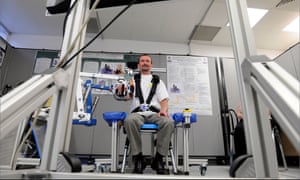
Stroke rehabilitation patient Neil Russell uses the iPAM (intelligent pneumatic arm movement) robot at Leeds General Infirmary. The robot is being developed to help people who have had strokes. Photograph: Christopher Thomond for the Guardian

Robots and surgery


The prospect of automated technologies replacing frontline surgical staff is less immediate, but it is happening. In the private sector, a company in the US, for example, has developed a non-invasive CyberKnife to use in tumour treatments. Instead of cutting out a tumour, the CyberKnife eliminates it by targeting it with a precise beam of high-dose radiation. Where such cobots are used, however, the surgeon is almost always on hand.


Among the early adopters of robotic methods in the UK is Dr Christopher D’Souza, a hair transplant specialist at the London-based clinic Ziering Medical. D’Souza uses ARTAS, an outpatient procedure developed in the US that extracts individual hair follicles from the back of a patient’s head and then implants them towards the front.


“FUE [follicular unit extraction] involves anything up to 2,500 grafts, which, when done manually, can take three or four hours. That’s tough on my eyes and neck. With the robotic method, there’s absolutely no surgeon fatigue,” says D’Souza.


Using this automated system enables him to focus more on patient care, communication and team management, while also allowing him to redeploy one of his two assistants, he says. Not all clinicians are as comfortable with the robotic method, he admits, with many arguing that it “takes away the impression that the surgeon knows best”.


Related: How air pollution affects your health – infographic


It may only be a matter of time before we see greater use of such robotics in the NHS. However, the nascent nature of the field means that it remains a tough argument to sell clinical robotics on the basis of comprehensive cost-benefit analysis, says Mike Ouren, a cobot expert at US-based robotics firm Precise Automation. The results data simply doesn’t exist yet to compare patient outcomes for robotic surgeries with traditional methods.


“There’s a financial question around how effective is a robot in terms of the amount of money it costs and the support staff required versus whether or not we’re getting more surgeries through the hospital and so forth,” he says.


For James Kippenberger, head of market development for BigHand, the efficacy of automated tech has less to do with the tech itself and more to do with how health professionals interact with it. “These projects rarely if ever fail because of the software or hardware,” he argues. “The key determinant of success invariably relates to human behaviour.”


As a new generation of tech-savvy professionals enter the health service, he is confident that co-working – the day-to-day interaction between man and machine, individual and automaton – will become more commonplace. Until then, it’s imperative that automated systems are implemented with clear directions, full communications and appropriate training.


In the case of University Hospitals Bristol NHS Foundation Trust, the initial resistance of secretaries more or less vanished once they saw their workload reduce, according to Michael Milton. Over time, resistance among frontline surgical staff to automated equipment will likely reduce, too. That leaves just one critical audience to be convinced: patients themselves.


Why your NHS surgeon could be a robot in the future

8 Temmuz 2014 Salı

How Paro the robot seal is being utilized to help United kingdom dementia individuals | Andrew Griffiths

Ron Abbott, 85, is sitting on a bench in the courtyard backyard of a Sheffield hospital with what looks like a baby seal on his knee. He is searching into its eyes, lost in a world, then he brushes its whiskers and tickles its nose with a slow finger. “Itchy-itchy-itchy-coo,” he says. The seal wriggles, gazes back at him and tends to make little, seal-like noises. Abbott’s smile exhibits his pleasure.


Beside him is Claire Jepson, an occcupational therapist at The Grange, an NHS specialist assessment unit for dementia sufferers.


A single of the most significant issues employees encounter during the four- to eight-week evaluation time period is managing distressed and disturbed behaviour. Medication is one particular recourse. Paro is an additional.


Paro is a robot seal, modelled unashamedly on a little one harp seal, both in terms of seems to be and the plaintive cry that it tends to make. Its Japanese creater, Takanori Shibata, chose it because folks are unlikely to have unhelpful memories of actual seals. It also mitigates towards the charge that vulnerable individuals are getting deceived into believing that this is a actual animal, that this cute cartoon of a creature is anything at all other than synthetics and circuitry, and not flesh and blood.


Paro has some artificial intelligence. It has the ability to “find out” and bear in mind its own identify, and it can learn the behaviour that final results in a pleasing stroking response and repeat it. Paro is not new – the robot has been all around since 2004, which in terms of robotics helps make it ancient background. But clinically, that is what tends to make it so interesting – Paro has been about prolonged enough to give some thought of whether or not it really functions. Which is why the effectiveness of the robotic seal in a dementia care setting is now currently being evaluated in a joint venture involving Sheffield Overall health and Social Care NHS Foundation Trust and the University of Sheffield.


“My perspective is that something that makes folks come to feel comforted and far more at ease with the world is really worth it when individuals are in the later on phases of dementia,” says Gail Mountain, professor of overall health service analysis at the university of Sheffield.


With dementia affecting 800,000 men and women in the United kingdom and numbers set to double more than twenty years, the Grange introduced Paro final 12 months. There are some 3,000 Paro seals globally, the vast majority in Japan exactly where they have even been employed to befriend earthquake survivors. There are about 10 in the United kingdom two of which are at the Grange.


“When I very first noticed Paro on YouTube I thought it was extremely twee,” says Jepson, as she prepares to give me a demonstration. We are in a quiet rest spot of the ward and the seal sits on the table among us, inanimate, eyes closed, looking like a child’s cuddly toy. But once it is switched on, it is obviously not a toy. Its eyes are remarkably affecting, and as it moves and responds to your touch there is a musculature apparent in its face that conspires to give it a genuine “residing” come to feel.


Select it up and it is a surprisingly hefty bit of kit. On your knee you know it is there, and weighing 3kg it feels comparable to a canine of a comparable dimension. This fat gives it a gravitas, and as it waddles and flaps its flippers as you stroke it, the total thing vibrates.


Jepson employs Paro to inspire social behaviour, she explains. “There is a good deal of humour with Paro. A lot of of the sufferers anthropomorphise the seal, enjoy pretending that it is a true, residing creature, with all the related foibles. As well as the nurturing: ‘Let’s look after it and stop it crying’, a whole lot of people refer to its bodily functions,” says Jepson. “They will say [as a joke]: ‘Oh it’s farted on me!’ or ‘Don’t you go peeing on my leg!’ and then people will laugh, and the jokes will come in, and it creates a good social interaction.” Encouraging social interaction and calming distressed individuals are proving to be two of Paro’s most promising utilizes.


Jepson uses it in structured therapeutic sessions and admits that she has “fallen for this fabulous bit of kit”.


“It is a robot companion. It is about empowerment,” she says. “It enables individuals to even now truly feel a sense of achievement, a sense of identity. They grow to be the carer alternatively of the cared for.”


The use of companion robots and assistive technology in care for older individuals is in its infancy. Toyota, for example, is experimenting with assistive robots that can lift and carry patients to alleviate risks for carers. But they are not with no controversy. Two concerns are that users are deceived, believing that the robot is genuine, and that it infantalises them, demeaning patients’ dignity.


At the Grange, Abbott appeared convinced that the seal was real, but Pam, yet another dementia patient enjoying with the robot, was clearly mindful that as seals go, it was a fraud.


With the government unveiling the UK’s first official robotics method final week, which could lead to an enhanced use of robots in our every day lives, Amanda Sharkey, a senior lecturer in Sheffield University’s division of laptop science, warns: “I believe we require to be a bit mindful about human interactions with robots, so we do not finish up with previous men and women becoming looked soon after by robots and nothing else. So I think you could misuse Paro in the sense of: we have given this previous lady the seal to search right after and now we don’t have to go and talk to her.”


Initial outcomes of the study are due out subsequent month. Mountain would like to area Paros in a lot more dementia care environments. But as each and every Paro fees £4,000, like a day’s coaching, funding is crucial.


Abbott’s daughter, Sarah O’Neill, 43, believes that if tools such as Paro can assist individuals with dementia to find some peace then they should be utilised.


“Some folks could think, ‘Oh, he is enjoying with a doll and that isn’t truly what an adult should do’, but they have misplaced so considerably of the core of what can make them a ‘grown-up’ adult, I do not truly think that should be utilized,” says O’Neill.


“Basically, when you see somebody in such a distressing state, it is horrible for you and it is horrible for them. Who knows what is taking place in Dad’s brain chemistry? But if something can just stop that for a minute and make him smile, or laugh, then brilliant.”


How Paro the robot seal is being utilized to help United kingdom dementia individuals | Andrew Griffiths

19 Haziran 2014 Perşembe

Meet your new colleague Bob - the robot

He is then capable to “learn” what an workplace generally seems to be like, like specifics on a desk, and he is meant to be ready to both alert a safety guard if some thing is awry, or be ready to track down certain objects.


On his three-week stint at the offices of G4S, a security business, in Tewksbury, he roamed the corridors and monitored no matter whether fire doors were closed and no matter whether fire extinguishers had been in their correct spot. He ought to, in theory, be in a position to monitor a Whitehall division, for instance, which has a stringent policy in not leaving delicate paperwork on desks overnight.


Robots, or undoubtedly programmed machines, have been in use in British workplaces given that the Industrial Revolution. But what they have been really great at is repeatable tasks. They have only produced modest steps at reacting to unpredictable events.


Nick Hawes, senior lecturer in intelligent robotics at the University of Birmingham, stated: “Humans are genuinely very good at subtlety and intuition. But they are not always systematic. The positive aspects of robotic automation in protection, for instance, are the very same as you get with automobile manufacturing. You get repeatability and predictability. You really don’t get enhanced skills. But in security they will not skip a space.


“Robots replacing people is not the way to look at this. Because humans have a massive variety of abilities that you cannot automate. We believe, nonetheless, robots could augment a group of people. In terms of security you get a more dependable observation of a room to a specific degree of detail and a roving camera, but you really don’t get human choice making and intuition.”


Meet your new colleague Bob - the robot

15 Haziran 2014 Pazar

Robot physicians, on the web attorneys and automated architects: the future of the professions?

Final 12 months, reporters for the Associated Press attempted to figure out which jobs had been currently being misplaced to new technology. They analysed employment information from 20 nations and interviewed experts, computer software developers and CEOs. They located that almost all the jobs that had disappeared in the previous 4 many years have been not lower-skilled, minimal-paid roles, but fairly effectively-paid positions in historically middle-class careers. Application was changing administrators and travel agents, bookkeepers and secretaries, and at alarming rates.


Economists and futurists know it is not all doom and gloom, but it is all change. Oxford academics Carl Benedikt Frey and Michael A Osborne have predicted computerisation could make nearly half of jobs redundant inside 10 to twenty many years. Office function and support roles, they wrote, were notably at risk. But nearly nothing at all is impervious to automation. It has swept via shop floors and factories, transformed businesses big and little, and is starting to revolutionise the professions.


Expertise-based mostly jobs have been supposed to be secure job alternatives, the years of study it requires to become a lawyer, say, or an architect or accountant, in concept guaranteeing a lifetime of rewarding employment. That is no longer the case. Now even medical professionals face the looming risk of possible obsolescence. Professional radiologists are routinely outperformed by pattern-recognition software, diagnosticians by simple personal computer questionnaires. In 2012, Silicon Valley investor Vinod Khosla predicted that algorithms and machines would exchange 80% of medical doctors inside a generation.


In their considerably-debated guide The 2nd Machine Age, Erik Brynjolfsson and Andrew McAfee argued that we now face an intense time period of innovative destruction. “Technological progress,” they warned, “is going to leave behind some men and women, perhaps even a great deal of folks, as it races ahead … there is never been a worse time to be a worker with only ‘ordinary’ abilities and skills to offer, simply because personal computers, robots and other digital technologies are obtaining these expertise and capabilities at an extraordinary rate.”


So exactly where does that depart the professions, whose difficult-won knowledge is beginning to fall within the power of computers and artificial intelligence to emulate? The efficiency of computerisation appears probably to spell the finish of the task security previous generations sought in this kind of careers. For numerous, what had been after extraordinary skillsets will soon be rendered ordinary by the advance of the machines. What will it suggest to be a professional then?


“We’ll see what I contact decomposition, the breaking down of professional work into its element parts,” says major legal futurist professor Richard Susskind. Susskind’s forthcoming book Past the Professions, co-authored with his son Daniel Susskind, examines the transformations currently underway across the sectors that when offered jobs for life. He predicts a process not unlike the division of labour that wiped out experienced artisans and craftsmen in the past: the dissolution of experience into a dozen or much more streamlined processes.


“Some of these elements will still need specialist trusted advisers acting in standard approaches,” he says. “But several other components will be standardised or systematised or manufactured accessible with online services.” In a earlier book Tomorrow’s Lawyers, he predicts the creation of eight new legal roles at the intersection of application and law. Many of the job titles sound at residence in IT companies: legal expertise engineer, legal technologist, venture manager, threat manager, approach analyst.


“A lot of conventional lawyers will appear at that and believe: ‘Yes, they may possibly be jobs, but which is not what I went to law college for. And that is not what my parents’ generation did as lawyers.’” That, says Susskind, is not his concern: whether we get in touch with these new positions attorneys or not, the legal sector will survive.


“What I frequently say is that the potential of law is not Rumpole of the Bailey, and it really is not John Grisham,” explains Susskind. “It’s not a model of what we have these days somewhat tweaked. It will be people functioning in the legal sector but offering legal solutions and legal aid in new ways.” It might be the end of the profession as immortalised in courtroom dramas, but as computer software eats the previous jobs it will have to create new ones too.


“Individuals professions that do not alter will render themselves obsolete,” says Dr Frank Shaw, foresight director at the Centre for Future Scientific studies. “Individuals that are able to transform themselves – and I indicate ‘transform’ – will thrive and prosper.”


No 1 understands for sure what the careers of the future will search like. But the people at the cutting edge are currently viewing outdated jobs disappear – and experimenting with the technology that has begun to produce new ones. Here’s how three of the professions – medication, architecture and the law – could be transformed, in accordance to the individuals assisting to reinvent them.


THE LAW


Law ‘The future of the legal profession is not Rumpole of the Bailey and it’s not John Grisham.’ Photograph: Alexander Kozachok/Getty Pictures


5 many years in the past, entrepreneur Charley Moore founded on-line legal services provider Rocket Lawyer. It now boasts 30 million users. Subscribers spend a regular monthly fee for quick access to pre‑prepared paperwork and tutorials, as properly as on the web legal guidance from authorities at participating companies. The perform lawyers on the network do has previously begun to resemble the streamlined, a single-to-numerous roles Susskind predicted.


Moore is optimistic about the revolution computerisation has unleashed in his sector. “I do not consider of [software program] as consuming the sector, as a lot as I consider of it as supporting the sector. So with application, definitely there are mundane, routine tasks that will turn out to be more effective, but by producing people duties far more productive, lawyers will be capable to move up in the meals chain and serve millions more legal transactions than they currently can.”


Even judges, he says, will want to move online. “I think we have to have virtual courts. Australia has been experimenting with them. New York has been experimenting with online parking ticket adjudication. I mean, give me a break, who the heck thinks you ought to have to go to some government creating when you get a targeted traffic ticket? It truly is incredibly inefficient.”


Such adjustments would imply fewer lawyers were required to meet present clients’ requirements. But there is an upside: as fees fall and lawyers serve far more clientele, little businesses and personal men and women will suddenly be ready to afford legal tips. This is the “latent legal market”, a disenfranchised horde of potential buyers estimated to be worth as a lot as £27bn. “There is genuinely an unmet demand for legal services,” says Moore. “We require more lawyers, not fewer.”


ARCHITECTURE


Architecture ‘The cloud implies a a single-man designer can access the exact same computing electrical power as huge multinationals.’ Photograph: Alamy


Computer software company Autodesk, founded in 1982, produces virtual style equipment utilised by hundreds of thousands of architects and designers each day. Last 12 months alone, the organization produced revenues of $ two.3bn. British vice president Pete Baxter is responsible for its architecture, engineering and building operations in Europe, Asia and the Middle East.


He believes architects have minor to worry from artificial intelligence. “Yes, you can automate. But what does a style seem like that’s totally automated and entirely rationalised by a personal computer plan? Possibly not the most fascinating piece of architecture you have ever witnessed.”


Technological innovation will not destroy the profession, but it will, he says, democratise it. “There’s a paradigm shift now: the one particular-man architect working from home with a bright thought now has accessibility to an infinite amount of computing power in the cloud. That indicates a one particular-man designer, a graduate designer, can get access to the very same volume of computing power as these large multinational organizations. So suddenly there’s a distinct competitive landscape.”


Baxter is keen to highlight the a lot of new options computer software generates for the savvy architect. Collaboration across continents is growing ever easier, opening up projects all in excess of the world. This, in turn, has paved the way for better specialisation: the expert in the most minute factor of layout can apply their insight in numerous nations in the area of a single doing work day.


“The architectural occupation absolutely will nonetheless exist,” he says. “I feel what is occurring is we’re obtaining a much more collaborative approach. But in the end somebody even now makes the decision.”


Medication


Medicine ‘Where this is going is that, sooner or later, robots will end up doing surgeries on their own.’ Photograph: Alamy


Dr Pete Diamandis is the chairman and CEO of XPRIZE, a series of competitions that supply $ 10m awards for inventors who handle to resolve some of technology’s most vexing problems. One such prize will be awarded to the first crew to make a working “tricorder” – the handheld device employed by the healthcare officers in Star Trek – capable of diagnosing a set of 15 conditions with out the presence of a healthcare specialist.


He expects a person to do well in the subsequent 5 years. Right after which, it will only be a matter of time ahead of diagnosis is anything accomplished mostly by machines. “It really is a matter of delivering the personal computer with the information. When it has the information, it really is able to contemplate thousands or millions of times far more parameters than a human can hold in their head.” We will nevertheless require health-related specialists to guide us and give the human touch – but physicians will have to accept that computer systems are much better at elements of the occupation than they are.


It’s not just computer software and diagnosis, both: surgeons will have to make way for smarter machines. “I consider we’re going to see the function of the physician shifting substantially via the use of robotics,” says Diamandis. He cites the function of Silicon Valley company Intuitive Surgical, which has developed a “surgical program” named Da Vinci, which an skilled surgeon can manage online from anyplace in the world. Just as in architecture, such developments will enable experts to reach wider markets – but not like with architecture there is no reason to presume they will end there.


“Sooner or later, exactly where this is going,” says Diamandis, “is that the robot will finish up performing the surgeries on its own. I can think about a day in the future where the patient walks into the hospital and the patient demands, say, cardiac surgery, and the conversation goes some thing like this: ‘No, no, no, I do not want that human touching me. I want the robot which is completed it one,000 instances flawlessly.’”


Yet, in spite of the massive components of the part that technological innovation will consider from them, he does not count on a collapse in our demand for doctors any time soon – largely due to the fact we already need to have so several far more than we have. In the US alone, for example, professionals predict a shortage of up to 91,500 physicians by 2020. “And that’s minimal compared to the rest of the world,” he says. “Africa, which has 25% of the illness burden, has one.three% of the overall health employees. There is no way to ever build sufficient healthcare colleges or educate ample physicians for the demand that exists even these days.”


“It is about the economics,” explains Diamandis. The application and robots are currently here – or well on their way – but this unmet demand will continue to be right up until the tech is not only far more efficient but less expensive than the equivalent doctor. “I contact this approach the ‘dematerialisation of technology’. You utilised to buy a GPS, you utilized to get a camera, you utilized to acquire information. These items which were bodily have dematerialised on to your phone, and de-monetised, turning into effectively free of charge. And last but not least they democratise. Healthcare is undergoing the identical approach: dematerialisation and democratisation.”


Robot physicians, on the web attorneys and automated architects: the future of the professions?

2 Haziran 2014 Pazartesi

Surgical "robot hands" could execute operations on unborn infants with defects

Professor Sebastien Ourselin who is major the analysis stated: “Working on infants in the womb is not undertaken lightly and is reserved for just a handful of the most significant defects. Really few procedures can be done safely in the fetus making use of keyhole surgical treatment, and more complicated ones need opening the uterus, which puts both the mother and unborn child at chance. Less than one,000 procedures a yr have been attempted at various specialised clinics all around the globe.


“Our aim is to combine less invasive surgical technologies with stem cell and gene therapies to deal with a wide range of ailments in the womb, with significantly significantly less danger to both mother and infant.”


At present surgery in unborn infants can only be carried out when the foetus is 26 weeks previous. According to the Observer the task will aim to make it achievable to operate on foetuses at a significantly earlier stage of growth.


It is envisaged that the ‘robot hand’ will involve a thin, flexible probe that would be inserted into the womb. The probe’s head would have a single strand fitted with a small camera that would produce a 3D photograph within the womb. The photographs could then be utilized to guidebook the probe to its target.


In the case of a foetus with spina bifida, the probe’s other arms would be fitted with instruments which would carry a piece of gel or patch that would then be inserted in excess of the gap in the baby’s spine.


In addition to working on surgical imaging techniques, the analysis will create new instruments to increase surgical procedure on unborn babies, as properly as producing adaptations to the delivery of stem cell therapies to unborn infants.


Surgical "robot hands" could execute operations on unborn infants with defects

31 Mayıs 2014 Cumartesi

£10m venture to produce small robot hand could transform spina bifida surgery

Scientists have launched a £10m undertaking to create a small surgical robot hand that could transform the remedy of youngsters with spina bifida and other congenital situations.


The aim of the study, which is getting carried out by engineers at University University London (UCL) and KU Leuven in Belgium, is to generate a minuscule gadget that would provide 3D images of a foetus even though it is nonetheless in the womb which will also act as an automated robot hand. This could carry out delicate surgery or provide stem cells to an unborn child’s damaged organs.


“The aim is to develop significantly less invasive surgical technologies to deal with a broad assortment of illnesses in the womb, with substantially much less risk to both mom and infant,” mentioned the project leader, Professor Sebastien Ourselin, from the UCL centre for health-related image computing.


A prime priority for the undertaking, which is currently being funded by the Wellcome Trust and the Engineering and Physical Science Analysis Council, is to revolutionise the treatment of youngsters with spina bifida. About a single in 1,000 babies are born with myelomeningocele spina bifida, the most significant type of the problem. This is brought on when the spine of an unborn infant does not form appropriately and amniotic fluid leaks into it. Germs in the fluid can then spread up the spinal column until it reaches the brain and inhibits its development. As a consequence, infants born with spina bifida typically endure serious neurological problems. The solution, medical professionals have concluded, is to try out to patch the gap once it has appeared in the baby’s spine.


Such surgery requires opening the mother’s abdomen and uterus and incurs a important threat of triggering premature birth, however. As a end result, operations like these are seldom carried out. “They are really harmful,” explained project manager Jenny Nery. “There is a quite significant threat to the mother’s well being.”


In addition, surgical treatment on the unborn can only be carried out when the foetus is at least 26 weeks outdated. By that time, significant harm may possibly currently have been carried out to the child’s increasing brain. “We want to discover a way to block up the gap in the baby’s spine at a considerably earlier stage in the foetus’s growth,” added Ourselin. “Ideally, it ought to be completed around sixteen weeks. The earlier the treatment, the more efficient it will be.”


At present, such operations are impossible. The goal of the Wellcome-funded project is to produce instruments – based on the most recent developments in optics and robotics – that will make them achievable.


The engineers and doctors concerned in the venture envisage creating a very thin, hugely versatile probe that would be inserted into the womb of a woman carrying a youngster with spina bifida. The head of the probe would have one particular strand fitted with a tiny camera that would use laser pulses and ultrasound detection – a combination acknowledged as photo-acoustic imaging – to produce a 3D photograph within the womb. These photos would then be used by the surgeons to guidebook the probe to its target: the gap in the foetus’s spine.


The probe’s other arms would also be fitted with tiny instruments which would carry a piece of gel or patch that would then be inserted over the gap in the baby’s spine. “It will be like a plaster,” added Ourselin. “If we can do that, there will enormous achieve for the foetus while there will be little chance to the mom.”


At present, most patterns for the robot foetal surgeon envisage a 3-pronged gadget that has one arm fitted with a camera and two that are fitted with pincers or other instruments.


“We are still in the design stage, so we could end up with a device with 4 or 5 arms in the finish,” additional Ourselin. “Nor would it be utilised simply to place in patches. It could carry out delicate surgery or provide stem cells to damaged organs.”


In addition to the spina bifida cases, the device could also aid in the treatment method of many other foetal circumstances, this kind of as twin-to-twin-transfusion-syndrome (TTTS) in which there is an unequal, life-threatening provide of blood twins within the womb.


“Working on babies in the womb should not be undertaken lightly,” extra Ourselin. “We need to have the quite ideal surgical tools to do one thing like this, and this project will make certain we have them in the subsequent handful of years.”


£10m venture to produce small robot hand could transform spina bifida surgery

20 Mayıs 2014 Salı

Robot skeleton helps wheelchair-end users walk again


Sophie Morgan was 18 when she broke her back in a automobile crash. The accident left her confined to a wheelchair, unable to move or feel from her breastbone to her feet.


Now, with the assist of Rex Individual, a robotic exoskeleton, Sophie is ready to stand and stroll yet again.


Rex is built to help the body in an upright position and can stroll and climb stairs safely without having the help of crutches.


Miss Morgan stated: “I haven’t stood in 10 years. Now that the exoskeleton is right here, I’m possessing to reimagine myself and my daily life in a standing place.”


Among the advantages, Miss Morgan lists being capable to attain items on higher shelves, sleeping better and getting ready to hug folks even though standing near them.


The Rex Individual exoskeleton is offered for £89,073 topic to a healthcare check.


Robot skeleton helps wheelchair-end users walk again

8 Mayıs 2014 Perşembe

Newcastle hospital"s £2m robot transforms medical operations

Staff using the Da Vinci robot at Freeman hospital

Employees use the Da Vinci robot to carry out surgical procedure at Freeman hospital. Photograph: ncjMedia Ltd


Beneath the glare of an operating theatre lamp, Paul Renforth at the Freeman hospital in Newcastle demonstrates the £2m Da Vinci robot that has transformed surgical treatment on individuals. The four-armed robot is operated by a surgeon from a booth utilizing two finger grips that move the arms and manage the instruments on the finish of every single.


All in, the robot is about two metres substantial and one.5m across. Its arms go inside the patient however modest incisions in the skin. Seeking via a 3D viewfinder hooked up to a camera on the robot, the surgeon can magnify, grasp, reduce and cauterise tissue inside.


The dexterity of the robot indicates surgeons can operate with far more precision. They can locate and get rid of cancerous tissue almost unattainable to attain otherwise.


The robot is previously utilised for heart bypass operations and to remove cancers throughout the entire body, which includes people in the lungs, throat, prostate, bladder, spleen and colon. The following specialty to adopt the robot surgeon will be gynaecology later on this year.


“You can rotate the instruments 360 degrees, so they are more dextrous than the human hand,” explained Renforth, Da Vinci co-ordinator at the hospital. “We are going into locations now that we could not get into just before.”


“We deal with laryngeal tumours at the back of the tongue, in which we can down and underneath and entry and cut away the tumours. Generally that would be carried out by splitting the decrease jaw and going in from the side,” he stated.


At the end of each and every operation the instruments on each and every arm are taken off, sterilised and autoclaved, and reused on the next patient. Most equipment can be utilised up to 10 occasions just before they are discarded.


It is early days for robotic surgical procedure, but at the Freeman cancer operations seem to be to be more productive, simply because surgeons can see tumours much better and take away tissue a lot more effortlessly. Surgeons find out to operate the robot by practising on cadavers.


Newcastle hospital"s £2m robot transforms medical operations

12 Nisan 2014 Cumartesi

NHS sufferers are missing out on existence-saving robot surgical procedure

Gynaecology roboto

A gynaecologist uses a robot. Photograph: Jean-Paul Chasse/Alamy


New life-saving surgical techniques are not being adopted quickly enough in British hospitals. That is the stark conclusion of a report by the Royal College of Surgeons (RCS) which warns this week that patients are missing out on new procedures because the NHS is failing to set up programmes to promote their use in the UK.


The report, Innovation to Adoption: Successfully Spreading Surgical Innovation, stresses the need to find ways to introduce new surgical techniques as quickly as possible, thus saving lives and helping the NHS to save money.


New surgical techniques – involving robotics, 3D-imaging and lasers – have been developed in recent years, but in many cases have only been introduced in a haphazard manner in British hospitals. This failure to act coherently is now causing concern among surgeons.


“Many patients are not benefiting from ground-breaking procedures, even when surgeons firmly believe that they can save or extend lives. This cannot continue,” said Professor Norman Williams, the RCS president. “We cannot afford to neglect the kind of surgical innovation that has made such a difference to survival and recovery, such as keyhole surgery and advancements in transplant surgery.” He added that the NHS, the government and doctors had to understand how to accelerate innovative surgical practices in the UK.


The point was backed by David Neal, professor of surgical oncology at Cambridge University. “The NHS is the perfect place to test new technologies,” he said. “It covers the whole country and gives us an ideal platform for showing the worth of a new surgical technique. Unfortunately, this is not being done. The NHS does not seem to be able to tackle this sort of thing. Instead, we are relying, in many cases, on tests being done in the US, where there are commercial pressures involved.”


Neal has been involved in using a semi-automated technique known as robot-assisted radical prostatectomy (Rarp) to treat prostate cancer in the UK. “The technique greatly improves a human surgeon’s performance,” said Neal. “Using current methods, a patient is typically in hospital for around five days, while around 20% of them need blood transfusions. With Rarp, they can leave the next day and only about 1% of patients need a transfusion.”


About 200 prostate cancer patients are now being treated every year using the new technique. “That is far to low a figure,” Neal added. “We need to introduce the technique to enough hospitals to treat around 10,000 patients a year, but that is not happening.” He added that the UK needed a network of about 10-15 hospitals where new medical techniques would be taught to surgeons.


The need to promote robots in medicine is seen as being particularly important in future. The first robot procedure was offered to NHS patients in 2004, but the NHS has yet to fund the purchase of a single surgical robot and has relied instead on charities and endowments to provide cash to buy them.


A programme to help surgeons learn keyhole colorectal surgery for patients with bowel cancer and other conditions was set up in 2007. Mark Coleman, a consultant at Plymouth Hospital involved in creating the programme, said: “In 2008, 10% of operations on the colon involved keyhole surgery. Now that figure has reached 50% and the saving for the NHS over that period has been calculated as being around £11m.”


NHS sufferers are missing out on existence-saving robot surgical procedure

NHS individuals are missing out on life-saving robot surgical treatment

Gynaecology roboto

A gynaecologist uses a robot. Photograph: Jean-Paul Chasse/Alamy


New life-saving surgical techniques are not being adopted quickly enough in British hospitals. That is the stark conclusion of a report by the Royal College of Surgeons (RCS) which warns this week that patients are missing out on new procedures because the NHS is failing to set up programmes to promote their use in the UK.


The report, Innovation to Adoption: Successfully Spreading Surgical Innovation, stresses the need to find ways to introduce new surgical techniques as quickly as possible, thus saving lives and helping the NHS to save money.


New surgical techniques – involving robotics, 3D-imaging and lasers – have been developed in recent years, but in many cases have only been introduced in a haphazard manner in British hospitals. This failure to act coherently is now causing concern among surgeons.


“Many patients are not benefiting from ground-breaking procedures, even when surgeons firmly believe that they can save or extend lives. This cannot continue,” said Professor Norman Williams, the RCS president. “We cannot afford to neglect the kind of surgical innovation that has made such a difference to survival and recovery, such as keyhole surgery and advancements in transplant surgery.” He added that the NHS, the government and doctors had to understand how to accelerate innovative surgical practices in the UK.


The point was backed by David Neal, professor of surgical oncology at Cambridge University. “The NHS is the perfect place to test new technologies,” he said. “It covers the whole country and gives us an ideal platform for showing the worth of a new surgical technique. Unfortunately, this is not being done. The NHS does not seem to be able to tackle this sort of thing. Instead, we are relying, in many cases, on tests being done in the US, where there are commercial pressures involved.”


Neal has been involved in using a semi-automated technique known as robot-assisted radical prostatectomy (Rarp) to treat prostate cancer in the UK. “The technique greatly improves a human surgeon’s performance,” said Neal. “Using current methods, a patient is typically in hospital for around five days, while around 20% of them need blood transfusions. With Rarp, they can leave the next day and only about 1% of patients need a transfusion.”


About 200 prostate cancer patients are now being treated every year using the new technique. “That is far to low a figure,” Neal added. “We need to introduce the technique to enough hospitals to treat around 10,000 patients a year, but that is not happening.” He added that the UK needed a network of about 10-15 hospitals where new medical techniques would be taught to surgeons.


The need to promote robots in medicine is seen as being particularly important in future. The first robot procedure was offered to NHS patients in 2004, but the NHS has yet to fund the purchase of a single surgical robot and has relied instead on charities and endowments to provide cash to buy them.


A programme to help surgeons learn keyhole colorectal surgery for patients with bowel cancer and other conditions was set up in 2007. Mark Coleman, a consultant at Plymouth Hospital involved in creating the programme, said: “In 2008, 10% of operations on the colon involved keyhole surgery. Now that figure has reached 50% and the saving for the NHS over that period has been calculated as being around £11m.”


NHS individuals are missing out on life-saving robot surgical treatment