return etiketine sahip kayıtlar gösteriliyor. Tüm kayıtları göster

18 Şubat 2017 Cumartesi

The return of the MMR charlatan fits with our times | Nick Cohen

If you are unlucky, and all of us are unlucky in the end, you will visit a doctor in the confident expectation that they can fix any illness as a mechanic fixes a car and learn of the vast areas of ignorance on the map of medical science. If you are very unlucky, you will take an autistic child to a doctor and learn that “autism” is a vague and flabby label. There isn’t even agreement on what causes it, let alone on what, if anything, might alleviate or cure it.


Into the gap, between inexplicable suffering and the inability to relieve it, pour the conmen. Last week, Andrew Wakefield, the most contemptible of the charlatans, arrived in Britain to exploit the false hopes and fill the nightmares of his native land.


That he is a fraud has been established beyond reasonable doubt. The General Medical Council struck him off in 2010 after, in a superb example of journalism at its best, Brian Deer showed how Wakefield had manipulated research to make a non-existent link between the measles, mumps and rubella vaccine and autism.


Not content with lying, Wakefield exploited his voodoo science for financial gain. The money was not the worst of it. The MMR conspiracy theory sent vaccination rates below the level of herd immunity. As unvaccinated children become teenagers, we are yet to see whether they will pay a price in blood for Wakefield’s fraudulence. Given the threat to public health, the personal enrichment and the neglected fact that Wakefield’s malign fantasy has led parents who vaccinated autistic children needlessly blaming themselves, in my eyes he appears to be a criminal.


If you want to know what is wrong with a country, look at the criminals its courts cannot punish. Just as it was impossible to prosecute bankers after the crash of 2008, so it is impossible now to arrest Wakefield. Rob an old lady of her savings and you go to prison. Rob millions of children of protection against preventable illness and you are endorsed by the Trump administration, which has, inevitably, made its support for the MMR con explicit.


The one good thing Andrew Wakefield has done in his worthless life is show that sick societies are like sick people. They, too, face suffering without relief or prospect of a cure. They, too, are open to exploitation by every variety of crank and fanatic. Nowhere more so than in Trump’s America. At a personal level, Trump’s wife, Melania, promises to sue anyone who says their son, Barron, may be autistic. Her threat suggests the couple have feared, however fleetingly, that they might learn of the pain of the parents of autistic children and of autistic people themselves.


Whatever twinge of sympathy I felt, vanished, however, when I saw that at the political level Trump had said that “doctors lied” about vaccination and has given every indication of pursuing the Wakefield conspiracy theory in office. If he does, it will be a disaster for autistic people. In America, as in the UK, they fall over a cliff edge when they move from child to adulthood. So bad are the services, the US does not know how many autistic adults live in its borders.


Hillary Clinton, who actually talked to autistic people, something vaccination conspirators neglect to do, promised a census. She lost. And now, as Steve Silberman, the author of the magnificent Neurotribes tells me, the Trump administration can indulge in junk science, safe in the knowledge that its billionaire friends will never need public assistance to provide for their autistic children.


The “doctors lied” is the first link between MMR and so many other modern manias. Climate change deniers have to maintain that 97% or more of the world’s scientists are lying. It is easier to believe an unbelievable fiction than contemplate the vast and wrenching changes manmade climate change must bring to our lives. Rather than face them, say Trump and the Anglo-Saxon right, we can retreat into a surprisingly comfortable state of paranoid delusion.


Second, and this point needs emphasising when elements on the right claims to be the champions of the working class (and let us see how long that lasts) and elements on the left blame it for Trump’s victory: conspiracy theories always begin with pseudo-intellectuals.


Anyone who has looked at the work of Holocaust, 9/11 or climate change deniers, will see that it is stuffed with footnotes. It was not a tabloid catering for the “left behind” that began the MMR lie, but the learned medical journal, the Lancet. Its editors did not know they were victims of a fraud. But they ought to have seen that Wakefield’s original 1998 paper was “badly written and had no clear statement of its hypothesis or indeed of its conclusions”, as Ben Goldacre, the debunker of scientific fraud, put it.


Last week, Wakefield did not speak at a working men’s club, but at the supposedly reputable Regent’s University in London. To top that, he was invited to the European parliament, not by a neofascist know-nothing, but by an MEP from a Green party, which readers who have not been paying attention may think is filled with decent people.


Third, the MMR scandal rebuts the myth that we are living in a uniquely mendacious era of web-driven “fake news”. Mainstream national newspaper journalists (including here at the Observer, I am afraid) and BBC and Channel 4 broadcasters amplified Wakefield’s message in the last decade without making the most basic checks. There can be no “post-truth age” for the autistic, for they never had an age of truth to begin with. To put the disgrace of my trade as mildly as I can, if Wakefield were put on trial, there would be hundreds of journalists alongside him in the dock.


Finally, ask yourself why Andrew Wakefield does not recant, when every study of autism and vaccination has shown his original claim to be false. Asking that is like asking why Donald Trump does not cut his links with climate change deniers or Jeremy Corbyn cut his links with the Socialist Workers party. Wakefield would lose his support base. More to the point, as I suspect he, Trump and Corbyn know, the very fools he has encouraged would throw the accusations of corruption he has thrown at others back at him.


Whether you are dealing with climate change or MMR, the final lesson is this: you cannot rely on charlatans to expose themselves. You have tune up your bullshit detector and do the exposing yourself.


The return of the MMR charlatan fits with our times | Nick Cohen

16 Şubat 2017 Perşembe

Black bones, gangrene and weeping: the unwelcome return of scurvy

When doctors and patients realised that scurvy had reappeared, in separate outbreaks in Zimbabwe and Sydney recently, they were stunned. “I couldn’t believe it,” Penelope Jackson, one of the Sydney victims, recalled, “I thought, ‘Hang on a minute, scurvy hasn’t been around for centuries’.”


Shame followed, as it often does with scurvy. “Does scurvy just affect developing countries?” asked Newsweek 24 of the Bulawayo emergency in Zimbabwe. “I couldn’t believe you could be obese and malnourished,” said Jackson. “We have sent a team to attend to it,” the Bulawayo city council curtly announced, by way of a plenary reply to such questions about the disease.


We forget about scurvy – deliberately perhaps. And we seem to forget as well just how simple it is to cure and prevent. As Jenny Gunton, the clinician at the Westmead Institute in Sydney, pointed out, scurvy is prevented if we don’t boil vegetables to a paste, and as for the cure: “It’s so easily treated with one vitamin tablet a day” or by fresh vegetables and fruit. When the rules for eating properly are neglected by a significant sector of the population, and their forgetfulness is allied with government cutbacks for social services, the outlook for outbreaks gets a lot grimmer.


The recent sieges in Aleppo and Mount Sinjar have doubtless been accompanied by unreported scorbutic outbreaks. Over the last few years there have been a steady trickle of stories of individual cases in Europe and the US – an eight-year-old in Wales died of cardiac arrest brought on by severe scurvy in 2011, and a toddler in Michigan who couldn’t walk and was successively tested for Guillain-Barré syndrome, osteomyelitis and cancer until physicians finally diagnosed scurvy.


But now that multiple cases are appearing in a single place, it suggests that either bad choices of diet are becoming more common, or that institutional food programmes are failing. Or that both are occurring simultaneously.


Vitamin C – the life sustainer


Human beings have, in common with a few other species (apes, fish, fruit bats and guinea pigs), an inability to synthesise vitamin C out of their own bodies. Although it contributes nothing to body mass, vitamin C is vital to life: without it death is inevitable. For centuries this was not really a problem, but once the western powers started sailing the great oceans of the earth in search of riches and territory, scurvy became a serious issue for sailors such as Bligh and his mutinous crew on the Bounty. Commanders and administrators who understood the benefit of frequent stops for refreshment, especially oranges, lemons and limes, could alleviate it. But no one discovered the secret of an entirely reliable preventive at sea because it was hard to preserve juice without destroying the crucial vitamin it carried.


Limes


Commanders who understood the benefit of frequent stops for refreshment, especially oranges, lemons and limes, could alleviate scurvy. Photograph: Getty/iStockphoto

The illness itself is actually a fairly simple progression. Once the content of vitamin C in blood plasma falls from 40 micromoles to 10, as it did in among diabetics at the Sydney Westmead Clinic, then the body stops producing collagen, the protein that glues us together and ensures our hydraulic systems operate smoothly. Cartilage disappears, hair and teeth fall out, bones weaken, skin bruises as the capillaries rupture, and soon it ulcerates: old wounds and fractures unknit, tendons stiffen and artery walls collapse.


Mucus tissue begins to rot, and come away from bone that is blackened by leaking blood. At the same time brain function is compromised. Vitamin C is an extremely efficient antioxidant that is the first line of defence against potentially damaging waste products generated by normal metabolic activity. It has a number of further functions, such as supporting the production of neurotransmitters such as serotonin and dopamine, the chemical messengers of the brain. Without them, neuronal signalling – feeling and thinking – can be compromised. And so the deficit of the vitamin contributes to the powerful and obsessive fantasies of scorbutic patients (usually of food) that alternate with profound lassitude, likened by one specialist to “a falling down of the whole soul”.


The illness brought on odd effects in the imaginations of victims, as historical accounts show. Tears were very common, even among rugged old tars. The Scottish naval physician Thomas Trotter remarked: “In dreams they are tantalised by the favourite idea; and on waking, the mortifying disappointment is expressed with the utmost regret, with groans, and weeping, altogether childish.” (Observations on the Scurvy, 1792, 44).


This soul hath been/ Alone on a wide wide sea:/ So lonely ‘twas, that God himself/ Scarce seemed there to be


Coleridge’s ​The​ Rime of the Ancient Mariner


“Our mental sufferings were such as defy description,” wrote Thomas Beale, author of the Natural History of the Sperm Whale and a favourite of Herman Melville, “and nothing but being placed within the same situation could convince those who have not the power to imagine its monotonous dreariness.” The repulsion felt by the eyewitness and the abjection endured by the victim of scurvy combined to make even this narrow band of sympathy uninhabitable. The great ballad of scurvy, Coleridge’s Rime of the Ancient Mariner, explores the radical loneliness of the scorbutic seaman and the impossibility of its story ever being fully told: “O Wedding-Guest! This soul hath been/ Alone on a wide wide sea:/ So lonely ‘twas, that God himself/ Scarce seemed there to be.”


Outbreaks of scurvy on a ship were, according to Captain William Bligh, disgraceful, a sign of bad management, so when his surgeon diagnosed scurvy on the Bounty he promptly had it re-diagnosed as rheumatism. On his 3,000 mile journey from Tahiti to Kupang he could not bear to look at the sick among his crew, whose leaden pallor and sunken eyes made them look like the walking dead.


And when Robert Scott’s company became scorbutic in Antarctica on his first expedition, he was furious with Ernest Shackleton for getting it so badly, and was glad to pack him off home. On the second expedition, when scurvy re-appeared, he said: “The great thing is to pretend that there is nothing to be alarmed at.” He even thought of suppressing any mention of it in his log. On whaleships Herman Melville noticed that scorbutic sailors would hide their symptoms as long as they could, for “sickness at sea is so heartily detested”.


The cause, and the cure, eluded scientists for years. It didn’t help that scurvy was often innocently confused with other nutritional illnesses. The blindness sometimes ascribed to scurvy was owing to lack of vitamin A.


It was not until 1933 that ascorbic acid was finally isolated. Up until that point nobody had been absolutely sure what it was in food that prevented or cured scurvy. Before that date the theories fell into two schools: that scurvy was caused by toxic food, which was false but not possible to disprove; or that there was some virtue present in food independent of its nutrient value – a sap, latex, or nitrous salt – which was true but not provable.


James Lind’s magnificent feat of clinical observation in 1747, when he proved that citrus fruit cured scurvy, was hindered from a full application by his belief that tainted food was indeed the cause of scurvy, and therefore while oranges and lemons definitely operated as a remedy, they could not (according to him) prevent the onset.


This caused Trotter the frustration shared by many historians of this malady when hindsight offers them an unobstructed view of important people making mistakes about its origin and cure. In his Observations on the Scurvy (1792) he cited the paragraph in Lind’s postscript (“I am fully confirmed … that whatever weakens the constitution, and especially the organs of digestion, may serve without any other cause to introduce this disease … even among such as live on fresh vegetables, greens, or the most wholesome diet, and in the purest air”), and added, “This paragraph . . . is one of the most unaccountable that has ever crept into the records of medicine”.


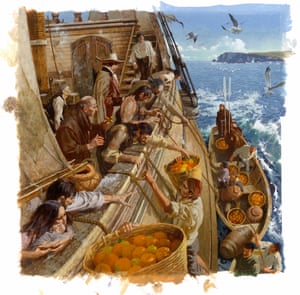
A painting depicting passengers and crew from Manila reaching for oranges and lemons, some antidotes to scurvy.


A painting depicting passengers and crew from Manila reaching for oranges and lemons, some antidotes to scurvy. Photograph: Robert E McGinnis/Getty/National Geographic Creative

But even though we have known how to prevent scurvy with absolute certainty for nearly a century, still it recurs and resurfaces because of the ever present trickery of the fact that, as Gunton puts it of November’s outbreak, “It highlights a danger that you can consume plenty of calories yet not receive enough nutrients.” If people feel full, then they believe they are well nourished. This was the very same mistake the brilliant medical men of the 17th century were trying to correct. Very simply; sufficient body mass and malnutrition can co-exist.


If people feel full, then they believe they are well nourished


And still, populations throughout the world are proclaiming their ignorance of this truth. A survey of North American students discovered that 14% of those tested had concentrations in the blood below the medically accepted minimum level for normal health. An average person needs to consume up to 300 milligrams of vitamin C a day to maintain maximal circulating levels and preserve the estimated whole body pool of 1,500mg.


The reality is that we can be scorbutic even before we get bruising and stiff legs. The brain survives longer than any other organ, owing to the additional protection afforded the transport of vitamin C into the cerebrospinal fluid in which it bathes and from which the major brain cells are supplied with the antioxidants they need. But even that citadel will succumb when the level of the vitamin falls low enough.


More work is being done now on conditions such as sepsis, chronic fatigue syndrome, and symptoms of diabetes. But this research pales in comparison with the rise in the consumption of sugar, especially by young people, and the enforcement of recent policies of austerity by western governments. Figures quoted in the Guardian at the same time as the Sydney outbreak revealed that diagnoses of malnutrition in Britain have increased by 44% in the five years to 2015. Ignorance about food among individuals and misguided state policies concerning diets of the young and the elderly: these are the nurseries of scurvy, and always have been.


Jonathan Lamb is Mellon Professor of the Humanities at Vanderbilt University and author of Scurvy, The Disease of Discovery.


With thanks to Professor James May and Professor Fiona Harrison, Vanderbilt University Medical Centre, who helped with the medical aspects of scurvy.


Join our community of development professionals and humanitarians. Follow @GuardianGDP on Twitter.


Black bones, gangrene and weeping: the unwelcome return of scurvy

27 Ocak 2017 Cuma

The return of the global gag rule stinks of neocolonialism | Lola Okolosie

Here’s a question I’d like somebody to ask President Trump: “What’s a woman’s life worth?” I’d hazard a guess that his response would attempt to sound reasonable.


Since the word “woman” tends to evoke a particular type, much in the same way the colour nude is taken as beige with whispers of peach, I’d like to ask another: “Mr Trump, what worth do you see in the lives of women in the developing world?”


The answer to that is revealed in Trump’s decision to reimpose the global gag rule. For women in poorer countries reliant on American aid, their lives have been deemed a fair compromise in service of politicking and moralising. It is a brutal use of these women’s bodies in order to mount an ideological assault on the idea that a woman can have bodily autonomy. Women of developing nations have become expendable collateral damage in a war far closer to home. Who isn’t reminded of colonialism and the hierarchy of bodies that matter?


Some 22,000 women will die this year because of unsafe abortions, and 8.4 million will suffer serious illness or injury


The global gag rule, also known as the Mexico City Policy, stops any foreign NGO receiving US government aid for family planning from using their own funds to provide safe abortion services, if legal in that country. Not only that, the rule stops funding NGOs if they are: known to have referred women elsewhere to receive terminations; lobbying their own governments to liberalise restrictions on abortion law; campaigning against governments wanting to restrict abortions; and even educating the public on the fact that they can ask for safe legal abortions.


The rule has been brought in and out of existence by Ronald Reagan in 1984, Bill Clinton nine years later, then George W Bush in 2001, and Obama in 2009, before Trump re-imposed it this week. Trump is in fact expanding the rule’s powers so that it no longer applies solely to family planning assistance given by the US government, but also to funding given to NGOs focusing on disease control.


Some 22,000 women will die this year because of unsafe abortions, and 8.4 million more will suffer serious illness or injury. Millions more will lose access to contraceptives and condoms because the NGOs who once provided them with such services will no longer exist. All because of the moral ideals of a powerful anti-choice lobby is intent on winning something, anything. How easy it is to play political football with the lives of people from the developing world.


[embedded content]

It is the same contingent that calls NGOs working to make abortion part of family planning initiatives “cultural imperialists”. Cultural relativism and the pretence that they are making a charitable intervention is supposed to mask a commitment to enforcing their sense of morality elsewhere. They assume that using the argument of salvaging “traditional” cultures will protect against an essential truth: it is a woman’s right to decide what happens to her body and when. Never mind that women in the developing world are not a homogenous lump with identikit views on abortion. Like colonial missionaries of old, it’s all for the moral good of the natives, apparently.


An American friend recently pointed out the paradox in Trump’s promise to put Americans first, (with its implication of isolationism) and yet make America great again, a sentiment that is nothing if not outward-looking and colonial in spirit. What better way to neatly combine the two than to withdraw billions in funding to poorer nations while making them understand the almighty power of the US dollar?


During Trump’s inauguration speech, the language of moral virtuosity was barely contained, lest it sound too imperialistic for the moment. It has nevertheless been let loose. American religious values, by way of the global gag rule, will be imposed on countries as far flung as Kenya and Peru, Ethiopia and Nepal.


Last year Trump stated that in the event of abortion being criminalised, women who went on to have a termination would have to face “some form of punishment”. Asked by MSNBC’s host Chris Matthews about how you actually ban abortion, Trump said: “Well, you know, you will go back to a position like they had where people will perhaps go to illegal places.”


The casual “you know” seems all the more perverse appearing as it does before an acknowledgement that it would mean putting women’s lives at risk. It seems that the lives of women from the developing world have been taken as a good starting point.


The return of the global gag rule stinks of neocolonialism | Lola Okolosie

4 Haziran 2014 Çarşamba

The coalition"s attacks on the NHS will return us to the age of the workhouse

A midwife with a penchant for gin delivered me into the arms of my exhausted mom on a cold, blustery day in February 1923. I slept that evening in my new crib, a dresser drawer beside her bed, unaware of the troubles that surrounded me. Simply because my dad was a coal miner, we lived rough and prepared in the hardscrabble Yorkshire town of Barnsley. Cash and happiness did not come simply for the likes of us.


Considering the hunger, the turmoil and the squalor in Britain during the early many years of the 20th century, it was miraculous that I lived to see my third birthday. That I survived colic, flu, infection, scrapes and bangs without the positive aspects of modern day sanitation, hygiene or wellness care, I have to give thanks to my sturdy peasant genes. As a infant, I was ignorant of the wonderful sorrow that enveloped England and Europe like a damp, grey fog. The nation was still in mourning for her dead from the world’s first Wonderful War. It had ended only 5 short years prior to my arrival. Practically a million British soldiers had been killed in that conflict. It had begun in farce in 1914 and ended in bloody tragedy in 1918. In four years, that war killed much more than 37 million males, women and kids around the globe.


Even when the guns across the battlefields had been created dumb by peace, the killing didn’t quit. Death refused to get a holiday and a pestilence stormed across the globe. It was named the Spanish flu. The pandemic lasted until finally 1921 and erased a hundred million individuals from the ledger guide of the living.


Like most individuals in Barnsley, my loved ones occupied a terraced residence. They were created back-to-back and in a row of ten units. There was minor area, privacy or comfort for us or any of the other occupants. It was just a place to rest your head soon after investing 10 hours hacking coal from the side of a rock encounter hundreds of feet below ground. 3 walls out of 4 had been linked to another home.


Barnsley covered in snow, 1930. Barnsley covered in snow, 1930. Photograph: Fox Photographs


The floors were created of difficult slate rock and have been sparsely covered with previous rags that had been hand-woven into coarse mats. The interior walls have been comprised of moist limestone coated in a gruel-thin whitewash that never seemed to search clean.


In summer our house was hot, in autumn damp, and in winter bitterly cold, while spring was as moist as autumn yet again. The residence had no electricity and only the parlour and scullery possessed a gaslight fixture. Right after sunset, it sputtered and hissed a gloomy yellow light that illuminated our poverty. I shared a room with my older sister, Alberta. We slept together on a straw mattress that was host to several insects and reeked of time and other people’s piss. Its covering was created from a rough materials that was as unpleasant to me as the events when my father tickled my encounter with his moustache. Dependent on the season, I slept in my undershirt or remained totally clothed. During the cold months, Alberta and I nestled collectively and shared our entire body heat to stave off the chilling frost beating towards the windowpane. Our parlour had no furnishings except a stool and an upright piano that had come as portion of my dad’s legacy from his father. But it stood mute towards the wall due to the fact the room was occupied by my infirm and dying eldest sister, Marion.


At the age of 4 she had contracted tuberculosis, which was a frequent illness among our class. Her ailment was induced since my mothers and fathers were compelled to live in a condition-ridden mining slum at the finish of the Fantastic War. Ultimately my parents were ready to leave the slum but by then the damage had previously been carried out to my sister’s overall health, and the TB spread into her spine. It left her a paraplegic with a hunchback. For the last twelve months of her daily life, Marion was absolutely dependent on my mom to be fed, bathed and clothed. In these days, there was no national overall health support you both had the dosh to spend for your medication or you did with no. Your only hope for some health care care was the council poorhouse that accepted indigent patients.


Miners leasving a Yorkshire pit after an explosion, 1930. Miners leaving a Yorkshire pit after an explosion, 1930. Photograph: Linked Newspapers/Rex


As a younger lad, I was encouraged by my mothers and fathers to invest time with my ailing sister. I believe it was since they knew that she was dying and they needed me to keep in mind her for the rest of my life. I didn’t comprehend sickness or death because I was only three, so I contented myself with enjoying close to her sick bed. On some events, I advised her nonsense stories, but my sister couldn’t respond to my kindness since the illness had destroyed her vocal cords.


Even although she was in excessive discomfort although the TB ate away at her spine and invaded her vital organs, she was silent. My sister often seemed to be hunting previous me with her big expressive eyes. Possibly she was waiting for death, or probably she discovered the gaslight casting shadows on the opposite wall an interesting distraction from the monotony of the ache that consumed her ten-year-outdated entire body.


TB was identified in the 19th century as the poet’s ailment, but I saw no lyricism in the way it killed Marion. As the autumn days grew shorter in 1926, so did the time my sister had to dwell. Her last weeks have been unbearable but she nevertheless fought death. She thrashed her arms about in defiance against the coming end to her daily life. My dad and mom tried to calm her by stroking her hair or singing to her, but she was not pacified. As an alternative, Marion wept silent tears and continued to struggle with so significantly ferocity that in the end my dad reluctantly restrained her to her bed with a rope.


My dad and mom made a decision that there was absolutely nothing far more that could be accomplished for Marion in their care, so they organized for her to be positioned in our nearby workhouse infirmary. It was the last stop for a lot of men and women who have been as well poor to pay for a medical professional or appropriate hospital care. The workhouse in our neighborhood was a forbidding creating that had been constructed during the age of Dickens. In the century just before I was born it was employed to imprison debtors, property orphans and provide primitive health care to the indigent. By the time Marion was sent there, it was no longer employed as a prison. Nonetheless, orphans, the sick and these with communicable conditions were nonetheless incarcerated behind its thick, towering black walls.


Spanish flu victims. Spanish flu victims. Photograph: Everett Assortment Inc/Alamy


On a single of the last days in September my mother pawned her ideal dress and my father’s Sunday suit and hired a man with an outdated dray horse and cart to come to our residence and acquire Marion. When he arrived, my dad carried Marion outdoors and carefully positioned her into the delivery carriage exactly where my mom was waiting for her.


Alberta and I stood on the side of the street and waved goodbye to Marion. I asked my dad the place my sister was going and he mournfully replied: “She’s going to a greater location than here.” Afterwards, he place his arms about me and Alberta and we watched the horse-drawn carriage slowly plod down our street in the direction of the workhouse infirmary.


That was the last time I noticed my sister alive.


Marion died a month later on in the arms of my mom. There was no wake, no funeral support and even considerably later there was no headstone erected to mark her short passage in existence. My household, like the rest of our local community, was just as well bad to afford the accoutrements of mourning. We relied on my dad’s minuscule salary just to maintain us with a roof more than our heads and dry in the perpetual hard luck rain of Yorkshire. Even my dead sister’s landau was quickly dispatched to the pawnbroker’s shop the place it was swapped for a number of coins to help feed her hungry living siblings.


My sister’s entire body was committed to a pauper’s pit and interned in an unmarked grave along with a dozen other forgotten victims of penury. My parents didn’t even have a image to don’t forget their daughter’s lifestyle. To the outdoors world, it was as if she was never there, but for our loved ones her existence and her finish profoundly affected us. My father never ever mentioned Marion’s title once again. It was not out of callousness or disrespect, but since her death festered in his soul like a wound that by no means healed. For the rest of his existence my dad carried with him an unwarranted guilt that he was responsible for Marion’s tuberculosis, and it lower him deep. As for my mother, she frequently talked about Marion. As my family stumbled from misery to calamity, via the pitch dark of the Excellent Depression, my mother invoked my dead sister’s name as a warning that the workhouse awaited every of us, unless of course the globe and our situations modified.


It would be virtually 20 many years ahead of, in 1948, the NHS was formed, and for the 1st time in my civilian lifestyle I went to a doctor’s surgical procedure and was treated for bronchitis with antibiotics that assured me a speedy and safe recovery. The expense to me was nothing, and I was grateful simply because I was skint, obtaining just started out back in the civilian working planet.


An NHS immunization van in the 50s. An NHS immunization van in the 50s. Photograph: Popperfoto


As I convalesced, I was gobsmacked at the wonderful consequences of free of charge wellness care and the possible it provided to enhance our society. It was a transformational shift in how we as a country viewed our fellow citizens. The creation of the NHS manufactured us recognize that we were in reality our brother’s keeper, and that taxation rewards everybody through sustaining not just our roads and sewers but the health of our young children, staff and elderly.


To me, the introduction of totally free overall health care was the 1st brick laid on the street to the social welfare state. So it has always been challenging for me to pay attention to politicians, proud possessors of health insurance coverage and shares in private overall health care businesses, when they speak about how the wellness services that we fought so challenging to create should change. The coalition government’s Well being and Social Care Act will generate a two-tier well being care program. This act will see the NHS stripped down like a derelict home is by criminals for copper wiring.


Ukip has even proposed that A&ampE sufferers should have the proper to get their way to the front of the queue, although in Merseyside a personal for-revenue cancer clinic has set up store below the NHS umbrella. In which will all of this end? What will be given the biggest priority in a new health care technique that sends every services, from blood work to chemotherapy, out to the lowest bid tender?


It ends in which I began my life – in a Britain that believed health care depended on your social status. So if you had been rich and insured you received timely medical remedy, whilst the rest of the nation acquired the drippings. A single-fifth of the lords who voted in the controversial act – which offers a gateway to privatise our well being care program – were found to have connections to private health care firms. If that isn’t going to make you angry, nothing will.


Often I try out to think how I may possibly clarify to Marion how we constructed these beautiful structures in our society – which protected the poor, which kept them protected at operate, healthy in their lives, supported them when they had been down on their luck – only to view them be destroyed inside a couple of short generations. But I are not able to locate the phrases.


Harry’s Final Stand by Harry Leslie Smith is published by Icon Books at £12.99. To buy a copy for £9.99, go to theguardian.com/bookshop or phone 0330 333 6846.


The coalition"s attacks on the NHS will return us to the age of the workhouse

24 Mayıs 2014 Cumartesi

Return to Victorian-design hospitals to fight superbugs, professionals urge

Hospital in 1914.

Nurses and individuals at King’s University Hospital in 1914. Photograph: Hulton Archive/Getty Images


Wards in British hospitals need to have to be redesigned to give defences towards the spread of deadly, antibiotic-resistant superbugs. That is the stark warning of scientists, who mentioned final week that the danger now posed by drug-resistant infections had reached crisis degree.


In the long phrase, governments need to motivate the pharmaceuticals sector to develop new generations of antibiotics, said a group of British experts. Even so, these new medication will consider so prolonged to attain the market that brief-phrase measures must also be introduced to hold back resistant ailments that now threatens to overwhelm overall health professionals.


A group of senior scientists – including Dame Sally Davies, the chief healthcare officer, and Professor Jeremy Farrar, director of the Wellcome Believe in – told the Royal Society final week that the planet faced the prospect of individuals dying from schedule infections since efficient antibiotics no longer existed.


Changes to be produced to hospital wards should, they explained, incorporate greater distances among beds, reduce bed occupancy rates, enhanced staff-patient ratios and massive, openable windows.


“We are speaking about returning hospital wards to the type we had 100 years in the past,” stated microbiologist Professor Kevin Kerr, of Hull York Medical College.


The critical level of such “outdated school” measures is to purchase time, extra fellow microbiologist Professor Mark Fielder, of Kingston University in Surrey: “We want to hold back the spread of resistant bacteria while discovering approaches to persuade pharmaceuticals [businesses] to boost their output of new generations of antibiotics – for we are facing a potential in which there may be no powerful antibiotics left on the planet.”


Kerr stated: “In the close to long term it is possible that a scratch from a rose thorn could turn out to be septic. With out efficient antibiotics, septicaemia could effortlessly set in and result in death. It is a horrible prospect, but a very real 1. We are facing a return to the state of affairs that existed prior to antibiotics had been identified.”


Resistance to antibiotics arises as a consequence of the processes of all-natural choice. In a population of bacteria, some are more resistant to medicines than others. Sometimes these resilient strains survive, multiply and become a lot more resistant to antibiotics. This is how superbugs this kind of as MRSA have evolved.


Scientists estimate there are 5,000 deaths a year in the Uk due to strains of bacteria that have evolved resistance to antibiotics. In future, the continuing rise in resistance could have wider repercussions. Surgical procedure, and remedy for illnesses this kind of as leukaemia, would be hard to carry out if there had been no implies to kill off random infections in sufferers.


Nevertheless only a handful of new antibiotics are in development. “In the 1960s, there had been plenty of new versions appearing,” additional Fielder. “But that has stopped. Basically we took our eye of the ball.”


The issue for medication is that antibiotics do not offer very good returns to shareholders in pharmaceuticals companies. Medicines that can tackle diabetes or higher blood pressure offer a a lot greater prospect of very good earnings.


“If you build a continual issue like higher blood pressure, you will have to get medicines for it for the rest of your daily life,” Fielder said. “By contrast, you usually only get antibiotics for a week at most, when you are struggling from an acute situation. That represents a poor monetary return for the pharmaceuticals companies that make the drug.”


The urgent problem of persuading drug companies to develop new antibiotics must be tackled by the healthcare equivalent of a physique like the Intergovernmental Panel on Climate Adjust, Davies and Farrar said. Possible steps could include offering companies tax breaks for making new antibiotics or lengthening the period for which a new drug is protected by patent.


Other approaches could also be promoted to produce different ways of killing bacteria, extra molecular geneticist Professor Chris Thomas of Birmingham University. “An additional very promising strategy requires the use of bacterial phages, viruses that assault certain bacteria. If you know the bacterium that is causing an individual’s sickness and you know a phage virus that attacks that bacterium, you could inject your patient with individuals viruses and so deal with their situation. The critical point is that we need to have to create a range of different approaches to this crisis. Primarily this is a race against time.”


Return to Victorian-design hospitals to fight superbugs, professionals urge

10 Mayıs 2014 Cumartesi

#Shake4Mike: "I needed to be his rock in return"

“He was nevertheless waiting to hear back from a task interview, so I assumed it was about that and I got truly thrilled,” she says. “I experimented with to ring a number of instances, and ultimately I acquired by means of over fairly a patchy line. He mentioned, ‘I consider I’ve got leukaemia.’ When you hear those words, you know how significant it is. I just advised him, ‘I’m going to get home as rapidly as I can.’ ”


The information that followed was devastating. Mike, 29, was diagnosed with acute lymphoblastic leukaemia and is at present undergoing intense chemotherapy six occasions a week at Bristol Royal Infirmary. Such is the severity of his situation that medical professionals have stated he requirements a stem-cell transplant to save his lifestyle – and time is working out.


As has been widely reported this week, his family, who live in Somerset, have only until finally the start of July, when his chemotherapy program ends, to find a ideal donor. Normally a third of folks requiring the operation are able to find a sibling match. All of his 3 brothers have presently been examined, but none has been productive.


He and his loved ones are now browsing the Anthony Nolan stem‑cell donor register for a match with a stranger inclined to assist. The charity warns, nonetheless, that it can generally locate a ideal donor for only close to half the individuals who need to have a existence-saving stem-cell transplant.


Kate, as a end result, has taken issues into her personal hands. This week, she launched a public campaign for men and women to signal up to the register, urging social media end users to submit silly movies of themselves shaking their faces from side to side – some thing the couple employed to movie each other carrying out – to encourage the campaign she has called #Shake4Mike.


Her hope, of course, is that much more signatories to the register will enhance her fiancé’s chances of locating a donor – and she has been inundated with responses. “Some have been so funny they’ve produced me laugh out loud.”


Indeed, in conversation, the Nottingham University graduate is strikingly upbeat and resilient. But optimism in the encounter of tragedy is a skill she has previously been forced to master. In 2005, her 59-year-previous father, David, died all of a sudden at the household home in Aylesbury, Buckinghamshire, following building a blood clot following an operation on a hip he had broken skiing. “He had just eaten his Sunday roast and walked on his crutches to the residing area and died.”


A number of weeks later on, her grandparents followed him. In 2008 her mom, Ali, invited her ideal pal, Simon Blackett, to move in to assist support the family members. Within two months, the 38-year-old suffered a fatal brain haemorrhage.


It was a 12 months soon after this most recent loss that the couple first met. Kate says her fiancé has aided flip her existence about and that, ever since she acquired that mobile phone contact in Burma, she has been established to be his “rock” in return.


Nonetheless, the journey home was in itself adequate to test her emotional strength. She remembers a “horrendous” 48-hour blur of buses and planes. “Mum picked me up straight from Heathrow and drove me to the hospital. I considered when I noticed her I’d break down, but she’s actually strong and that assisted so significantly. When I received to the hospital and noticed him he looked pale, but other than that it was just a relief to be with him,” says Kate.


By then, Mike had previously been in Bristol Royal Infirmary for 3 days, having suffered fatigue and evening sweats in the weeks leading up to his admission. When he at some point visited a medical professional for blood exams, he was told – just 4 hours later – that he had leukaemia.


Mike is now undergoing his 2nd of three phases of chemotherapy. The total course finishes at the end of subsequent month, which is when the stem-cell transplant will be required.


The Anthony Nolan register will not be capable to verify till subsequent week how many men and women have signed up to donate given that Kate launched her on the web campaign. But presently her Facebook web page has attracted one,500 “likes” in just four days – and more will surely follow. Tomorrow, she has been invited into the Tottenham Hotspur stadium in north London to indicator up donors prior to the final match of the season.


She is evangelical about her result in. “People are often fearful of donating, but the approach, if you are matched with someone, is not dissimilar from offering blood,” she tells me. “It’s incomparable to what Mike’s entire body has to go by means of as the recipient: 3 huge regimes of chemotherapy that ruin all the bone marrow, his immune method, all the cancer cells, plus I don’t know how numerous other cells in his body.”


That undergoing this kind of a process is the greatest case scenario demonstrates what a hard path lies ahead for Mike and his household. None the much less, in accordance to his fiancée, he is in an “amazing” condition. “He’s producing continuous jokes and is in actually excellent spirits. That makes everybody truly feel stronger.”


A new occupation Mike had been provided in March and not but commenced, functioning as an ecology assistant in Banbury, Oxford, is being held for him while he undergoes treatment. The only element of the future he is not speaking about is his wedding ceremony following summer time, the reception for which is to be held in the Robertsons’ backyard.


“Pre-diagnosis he did not get also thrilled speaking about wedding plans anyway,” his fiancée says, “you know what boys are like. I’ve told him that right up until we get previous the transplant, we do not have to mention it.”


Nowadays, significantly less than 60 days continue to be till that transplant is required. Kate chooses not to focus on what that “deadline” could signify, nevertheless.


“I haven’t asked what will take place if he does not get the transplant. My understanding is that if they do give him the transplant they can remedy him. If they do not, the likelihood of relapse is enormous.”


For now, she says, they are just focusing on remaining good – a single day at a time.


To donate to the Anthony Nolan register, go to www.anthonynolan.org


#Shake4Mike: "I needed to be his rock in return"

6 Şubat 2014 Perşembe

DNP: the return of a deadly excess weight-reduction drug | Philip Strange

4 deaths in the United kingdom and up to 60 worldwide have recently been attributed to the substance two,4 – dinitrophenol (DNP). DNP is an industrial chemical but has grow to be common amongst men and women wanting to drop weight, such as bodybuilders and folks with consuming ailments.


The dangers of DNP were even raised in the Property of Commons where David Cameron agreed to see what actions could be taken to shield people. DNP is not, even so, a new substance and its deadly results have been identified for nearly a century. Its background need to convince any individual considering taking the drug that this is a very risky company.


DNP emerges as a bodyweight-reduction drug


DNP was first used on an industrial scale in French munitions factories for the duration of the Initial Globe War when it was mixed with picric acid to make explosives. The experiences of workers exposed to DNP highlighted each its likely and its risks. They misplaced bodyweight, they felt fatigue, sweated excessively and exhibited elevated entire body temperature. Several deaths occurred prior to security measures were introduced.


These observations led Tainter and Cutting at Stanford University to review the effects of DNP and in 1933, they reported that, in individuals taking the chemical, metabolic process was stimulated by 50%. Fat and carbohydrate stores have been broken down leading to weight loss of up to one.five kg per week without having dietary restriction. Though they noticed the potential of DNP therapy for fat reduction, they warned of the unknown dangers of prolonged use and the potential for fatal overheating with substantial doses.


Dropping excess weight with no dieting is, nonetheless, the slimmer’s (and the physician’s) dream. Tainter and Cutting’s observations had been embraced enthusiastically and inside a 12 months up to 20 wholesale drug companies have been marketing DNP and as a lot of as one hundred,000 folks had taken DNP in the US alone. Numerous of the revenue occurred by means of drug stores with no prescription or supervision.


At initial it seemed that the drug was relatively safe but as much more individuals took DNP and for longer periods, a lot of side results had been reported like skin lesions and an epidemic of “dinitrophenol cataracts”. Some deaths occurred such as one particular man who overdosed and “literally cooked to death” with a temperature of 43.3o C. In 1938, DNP was designated as “extremely hazardous and not match for human consumption” and its use ceased.


How does DNP function?


In 1948, Harvard biochemists, Loomis and Lipmann, showed that DNP disrupted vitality generation in cells. Typically, the vitality necessary for driving the multitude of processes that occurs in cells comes from the oxidation of meals (unwanted fat and carbohydrate). In the presence of DNP, unwanted fat and carbohydrate in meals are broken down but manufacturing of helpful energy for cells is impaired and is as an alternative released as heat. As a consequence, entire body reserves of unwanted fat and carbohydrate are mobilised and fat is lost.


DNP rears its deadly head again


In the 1960s, Russian-born doctor, Nicholas Bachynsky, learnt of the effects of DNP while translating Russian health-related journals for the US government. The Russians had utilized DNP to preserve soldiers warm in winter with the main side effect being fat loss. In the early 1980s Bachynsky utilized this knowledge to set up clinics across the southern US marketing a bodyweight reduction treatment underpinned by DNP. Bodyweight loss of up to 7 kg a week was claimed with the only side impact getting elevated physique temperature. About 14,000 individuals enrolled on the programme and Bachynsky became very rich.


Complaints about the side effects of the treatment method commenced to accumulate at the FDA. Legal action was begun towards Bachynsky on the basis that he was employing a drug that had not been accredited and in 1986, an injunction was issued preventing him from employing DNP. In spite of this, he continued treating patients and it was only when he was convicted of insurance coverage fraud that he ended up in prison.


A fateful prison meeting


Prison ought to have witnessed the finish of Bachynsky’s influence but when he was incarcerated he met Dan Duchaine. Duchaine, dubbed the “steroid guru”, was notorious as a promoter of steroids for bodybuilding. He had been jailed for illegally offering these medication and was fascinated to hear Bachynsky’s story of DNP. In the late 1990s, now out of prison, Duchaine promoted DNP to the bodybuilding neighborhood as “the king of the body fat-loss drugs” and a new era of DNP use began.


DNP is now accessible via the web and is being utilised without supervision or regulation. This has some parallels with the circumstance in the 1930s and we are witnessing the very same sorts of problems with reports of overheating and some deaths. The allure of a drug promising fat-reduction without having dieting indicates that sadly, historical past is repeating itself.


DNP: the return of a deadly excess weight-reduction drug | Philip Strange

16 Ocak 2014 Perşembe

Specialists get in touch with for new medicines and return of sanitoriums to halt TB in South Africa

Patients with drug-resistant TB in South Africa are being systematically discharged into the neighborhood when their treatment method fails, exactly where they carry on to spread the ailment, medical professionals warn. The situation in South Africa, which does not have the innovative remedies that gives individuals the greatest opportunity of survival, is dire and a warning of the risk this type of tuberculosis poses to the globe, say specialists.


Professor Keertan Dheda of the department of medicine in Cape Town, leader of a new examine published in the Lancet, said that analysis into new medicines to treat drug-resistant TB was urgently needed and that modern day versions of the previous sanatoriums must be introduced, to offer voluntary seclusion and care to sufferers.


“In the old days there were no TB drugs also, so they shipped you off to sanatoria the place you had a lot of fresh vegetables and sunlight,” he explained.


Patients who are untreatable but infectious and might live for a 12 months or much more are at present discharged from hospital in South Africa since there are no beds, he explained. Modern-day sanatoriums would offer long-phrase care and physiotherapy but also activities and help for those chronically sick but still lively and in danger of infecting other folks.


The Lancet paper investigates what happened to some of the individuals in a cluster of extremely drug-resistant (XDR) TB instances in Tugela Ferry, KwaZulu-Natal province, identified in 2005-06.


Far more than 500 circumstances have been diagnosed. Of these, Dheda and colleagues followed up 107. They located that regardless of intensive treatment with an typical of eight various medication, three-quarters (74%) of them have been dead 5 years later on. One particular patient had TB that was resistant to all 10 medicines that have been attempted. Just twelve individuals (eleven% of the complete) had good outcomes.


But the most worrying locating, the authors say, is that just beneath half (42%) of the patients who were sent house from hospital still had transmissible drug-resistant TB, which they would be likely to pass to their families. Exams showed that had without a doubt took place. “In many situations they came from really disadvantaged backgrounds,” mentioned Dheda. “Their houses were a single single informal space shared by youngsters and adults. Is it wise to send men and women back to this setting and not anticipate the disease to spread?”


A co-ordinated global method to avert the spread of disease from patients who are not able to be cared for above a single or a lot more years in hospital was essential, Dheda said. Multidrug-resistant (MDR) TB is now located all in excess of the planet. What was occurring in South Africa would also be happening in eastern Europe and other parts of the globe, in which drug-resistant TB is also developing quick.


In a linked commentary, Max O’Donnell, from the Albert Einstein College of Medication and Neil Schluger, from Columbia University University of Physicians and Surgeons, both in New York, USA, warned that the research sounded “an urgent alarm” for global TB handle.


“MDR illness in all its types is an out-of-management issue with probably huge and devastating repercussions for global public overall health,” they say.


“Drug-resistant tuberculosis is an acute international wellness crisis. Nationwide manage programmes have to urgently build methods to use present public health instruments for manage of tuberculosis in all its types.


“Significant new investments in drug growth, diagnostics, and operational research are required. Regrettably, as a report from Treatment Action Group indicates, worldwide tuberculosis study budgets are shrinking, not expanding. The situation regarding MDR and XDR tuberculosis is bleak.”


Specialists get in touch with for new medicines and return of sanitoriums to halt TB in South Africa