precious etiketine sahip kayıtlar gösteriliyor. Tüm kayıtları göster

24 Ekim 2016 Pazartesi

Our precious allotments are being destroyed – it’s time to get our hands dirty | Rose George

In 2014, there was a protest outside the Royal Courts of Justice. The protesters were colourful: with flowery dresses, a bee costume and balloons. They had clever signs such as: “Give Peas a Chance” and “Don’t Lose the Plot”. The protest was described as a “turf war” by newspaper headline writers, because they love a pun, and because it was about allotments. Last Friday, the protesters were back, this time with wheelbarrows, pumpkins and produce, because once again Watford council had applied to close Farm Terrace allotments, and once again some of the people of Watford refused and fought back.


On paper, Watford council’s rationale for closing Farm Terrace may sound reasonable, even though the plots have been there since 1896 and have statutory protection. The council wants to build a “health campus”, an Orwellian-sounding scheme that incorporates a new hospital, green spaces and that dreaded phrase beloved of planners, a “community hub”. Watford’s elected mayor, Dorothy Thornhill, interviewed the last time the turf war got to court, said that it would bring “up to 1,300 new jobs, much-needed homes, green open spaces which can be enjoyed by all and community facilities, including a community hub with shops”. She also said Farm Terrace plots were “a really hideous, derelict site”.
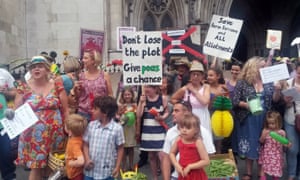


The Watford campaigners in 2014


‘The Farm Terrace case matters because it is a fight about what is of value.’ The campaigners in 2014. Photograph: Cathy Gordon/PA Archive/PA Images

It’s difficult to object to a new hospital or 1,300 new jobs. But anything that uses the expression “green spaces” raises my hackles, because it means that the rest of the project is hard spaces and concrete. The council’s “master plan” is actually unclear: even the hospital doesn’t know what it will use the site for yet (Sara Jane Trebar, a Farm Terrace campaigner, thinks it will become 68 houses and a car park for Watford football club). But if it were to be built without allotments, as the mayor’s comments imply, it would be an own goal. Gardening, as a Social Care Institute for Excellence review of evidence showed in 2013, reaps “a range of benefits across emotional, social, vocational, physical and spiritual domains”. Allotments are as good for the people of Watford as that community hub with shops (which Watford presumably already has plenty of).
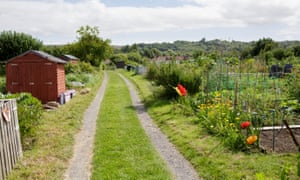


The Alderman Moore allotments in Bristol.


‘Five minutes at my allotment, kneeling to weed, putting my hands into soil, and my spirit lifts.’ Photograph: Sam Frost for the Guardian

I support the Farm Terrace fighters because I’d fight for my plot, even though I’m a haphazard gardener. Slugs have eaten more this year than I’ve managed to grow. But when I’ve struggled with depression, when even getting out of the house seemed like the hardest thing in the world, I still sometimes walked five minutes to my plot, past the neat and flourishing allotments that shame me; past the scruffy ones that comfort me, to my higgledy-piggledy plot with its rose bed, sturdy greenhouse and pathetic tomato plants, my glorious collard greens and magnificent roses.


Five minutes there, kneeling to weed, putting my hands into soil, and my spirits lift. There are other riches there too: the businessman who arrives stressed and leaves less so; the young families who leave with children clutching sweetcorn or potatoes, now knowing that not all fruit and vegetables come wrapped in plastic; the old boys who offer advice, wanted or unwanted. Growing your own isn’t always cheaper, but it’s always better. It is one of the best counter-balances that remains to our cult of lonely, commerce-driven individualism.


In law, allotments are apparently well protected, from the 1908 Small Holdings and Allotments Act that instructed councils to supply allotments to meet demand, to further strengthened legislation in 1925. Allotments on statutory land, such as Farm Terrace, can’t be disposed of without ministerial consent. But pressure groups such as Save All Allotments and Don’t Lose the Plot think the Localism Act of 2011 and recent 2014 guidelines that supposedly simplified the law only made it simpler for plot land to be turned into building sites. In a freedom of information request, Save All Allotments found that between 2007 and 2014, 194 of 198 applications to close allotments were granted by the secretary of state. The National Allotment Society is more sanguine, pointing out that of the 65 of 87 applications for disposal that were granted between 2010 and 2013, most were for small bits of land for access or flood alleviation, or land that had long been disused.


But Farm Terrace isn’t disused, nor derelict, nor hideous. The case matters because it is a fight about what is of value. Of course hospitals and houses are needed. The problem with Farm Terrace is that Watford council can’t see the worth of the plots, nor that a proper health scheme can be more than a community hub, shops and a bit of green space. The judicial review adjourned on Friday with no decision reached, but my grubby allotmenting fingers are crossed that peas will be given a chance. I hope that there is room, still, in our era of cat-calling, spite and profound uncertainty, for the simple, humble act that is putting your fingers into the earth, and reaping what you sow.


Our precious allotments are being destroyed – it’s time to get our hands dirty | Rose George

4 Ağustos 2016 Perşembe

Where precious cash is wasted in the NHS | Letters

I used to be involved in decision-making for funding high-cost drugs in the NHS, a process I strived to undertake systematically, transparently and justly. I was passionate about minimising waste. I recall once being forced to give up a perfectly good chair to make way for new ones bought to ensure our budget was spent, at the same time as turning down funding requests for cost reasons. This was galling. Fortunately, I left the NHS before the reorganisation – the abhorrent waste of resources in redundancy and rebranding would have broken me. The fiasco around PrEP (NHS can fund ‘game-changing’ HIV prevention drug, court rules, 3 August) has brought it all back. How much precious money will be spent on court cases, legal advice and appeals? Why does the NHS make everything so complicated, expensive and conflict ridden? And why are healthcare interventions subject to rigorous economic evaluations when other sources of expenditure are not?
Lesley Graham
Toronto, Canada


Join the debate – email guardian.letters@theguardian.com


Where precious cash is wasted in the NHS | Letters

13 Temmuz 2014 Pazar

Existence is also precious for lawmakers to aid its ending


When someone is in discomfort and says they want to die, it is hard to search on and say: “No.” The ideal argument that the lobby for doctor-assisted dying has is the raw, emotional 1, and a lot of will truly feel sympathy for it. Among their quantity can now be counted Lord Carey, the former archbishop of Canterbury, who has stated that he believes it is concomitant with “Jesus’s mission” to assist end the struggling of the terminally sick.


Theologians could well argue that he is wrong. The Most Rev Justin Welby, the recent Archbishop of Canterbury, has asserted in equally moving terms that the Christian cause is often to market a culture of existence. Even so, Lord Carey is brave to consider a place that is so contrary to that of his own Church, and we have no doubt that his motivations are honourable and charitable, for he is a guy of considerable integrity. We do, nonetheless, respectfully disagree.


This week, a Bill authored by Lord Falconer will be debated in the Lords to legalise assisted dying for the terminally sick. It would apply only to those imagined to have significantly less than 6 months left to reside and who had been deemed mentally capable to make a selection and their condition need to be independently assessed by two physicians. This may look realistic in a tiny minority of situations, but this kind of a modify in the law could have considerable consequences for wider society.


Medical professionals can’t often reliably predict someone’s lifespan, and pointless action may well be taken. It might also be really difficult certainly to discern the distinction amongst currently being mentally capable and currently being in the correct frame of mind to make such a profound decision. And the concept of pure “choice” – that no terminal patient could ever come beneath strain to “choose” death – is specifically naive. Individuals will usually perceive, hopefully wrongly, that they have grow to be a “burden” on the people about them. As Lord Carlile writes right now, “The threat is that these who uncover themselves in this position could request support with suicide, not since it is a heartfelt wish, but because they see no alternative.” Do we genuinely want to produce a legal framework that confirms this kind of nihilistic pessimism?


Any person who thinks that opponents of assisted dying depend as well heavily on a “thin end of the wedge” argument need to have only seem to the Netherlands or Belgium to see where this can end up. In the Netherlands, the place voluntary euthanasia has been legal given that 2002, the variety of deaths by euthanasia has doubled in just 6 many years mobile units now make “house calls” to support men and women to die. This yr in Belgium, its parliament passed a bill making it possible for euthanasia for terminally ill young children, with no age limit. The probability is that if legalised assisted dying is made feasible for one particular group in the United kingdom, its use will increase above time and the strain will develop to make it accessible for other people.


Rather than resorting to assisting individuals commit suicide, it would be far far better to invest appropriately in palliative care and to motivate a culture in which no one is left to encounter an uncertain potential alone. We ought to construct a society that more than just acknowledges the ache of other people, and rather seeks to bear their suffering alongside them – in recognition that lifestyle is frequently challenging but, ultimately, valuable.


Existence is also precious for lawmakers to aid its ending