The number of children seeking help for anxiety has risen sharply in the last year, a leading charity has said, with increased exposure to global affairs on social media suggested as a possible cause.
The NSPCC’s Childline service handled 11,706 counselling sessions for anxiety over the past year, a 35% increase on 2014-15. The charity said: “Worryingly the problem appears to be getting worse.” It dealt with 6,500 contacts in the last six months where anxiety was cited the main issue – an average of 1,000 a month or 36 a day.
Research showed an increasing number of children and young people were concerned about world affairs such as the EU referendum, the US election and the conflict in Syria.
Childline figures
The rise is said to be down to a combination of personal and political issues, with some young people talking to counsellors about problems in their day-to-day life, while others cited disturbing events seen in the media and on social media as being the source of their worries, the charity said.
As Childline marks its 30th anniversary, it has created a webpage, launched in September, called Worries about the world, which has already received almost 5,000 visits.
Childline’s president, Esther Rantzen, said: “Seeing pictures of crying and bewildered toddlers being pulled from bomb-damaged homes upsets all of us. Often we fail to notice the impact these stories are having on young people.”
She said the fact they turned to Childline enabled them to express their anxiety. “Sometimes these stories also reveal related concerns in their own lives, such as being subjected to racist bullying.”
Being listened to and reassured, she said, meant if they suffer from other problems, “such as abuse or neglect, self-harm or cyberbullying, they will also turn to us for help”.
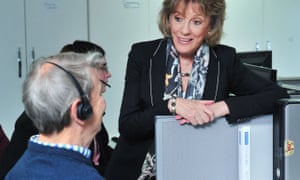
Esther Rantzen meeting volunteers at the NSPCC’s Glasgow office. Photograph: Julie Howden/PA
Peter Wanless, the chief executive of the NSPCC, said: “The world can be a worrying place but we need to ensure our children are reassured rather than left overwhelmed and frightened.
“It’s only natural for children and young people to feel worried sometimes, but when they are plagued by constant fears that are resulting in panic attacks and making them not want to leave the house then they need support.”
Children as young as eight have contacted Childline to talk about their fears, with girls seven times more likely to get in touch for help with anxiety than boys.
There has been a marked shift in how the service is used. More than two-thirds of users now communicate with counsellors online.
Children and young people can contact Childline for free, confidential support and advice, 24 hours a day on 0800 1111 or at childline.org.uk.
As a relatively young oncologist I saw a patient scheduled for surgery that morning. I didn’t know him but he was on my list because he needed chemotherapy. The story seemed routine enough but when I walked in, I found that the relatively young man looked terrible.
Since his overnight admission, he had been in considerable pain. His lips were parched and his skin sagged. He groaned from the work of making a few minutes of conversation and my gut instinct was that he must be terminally ill. But the difficulty was that I had only known him for the last minutes while the surgeon presumably knew him better and had thought him fit for the procedure he was about to have.
Related: Nauru files: widespread condemnation of Australian government by UN and others
But even when we crossed paths in the corridor, I didn’t reveal to the surgeon the depth of my concern. I felt both foolish and relieved when the patient did just fine. But days later, when he failed to wake up in intensive care, and the ventilator was turned off, there was no end to my self-reproach and moral distress, which grew worse when the thoughtful surgeon said he would never have gone ahead if I’d flagged the problem.
“Why didn’t you tell me?” he rued.
I later wrote about the experience in the New England Journal of Medicine and something interesting happened when the piece was published. Doctors wrote in from all over the world, sharing their own stories, and thanking me for “courageously” illuminating an issue that also nagged at them. But since the essay was widely circulated, many non-doctors read it too and their response could be summarised by the excoriating words of one correspondent: “You were gutless to not speak up for your patient and I would never, ever want someone like you as my doctor.”
This stinging (and I thought, deserved) rebuke highlighted the extraordinary gap between how doctors and patients perceive the same set of events. And I couldn’t help but think of this as I read the damning reports of errors that recently came to light within the New South Wales public hospital system.
One baby died and another suffered serious brain damage when nitrous oxide, instead of oxygen, was administered at birth. A hospital engineer has been stood down while the inquiry continues. Two oncologists stand accused of under-dosing chemotherapy patients. They maintain that they acted in good faith and indeed, chemotherapy dosing is both science and art. It’s difficult to know if patients’ survival was impacted but nonetheless astonishing to discover that the practice continued in plain sight, and apparently troubled others, for 11 whole years before someone spoke up. The health minister asserts that the public was lied to but the question hospital executives were debating was, “Do patients need to be informed?”
Spare a thought for the sick patients and hapless families caught up in this maze, not knowing where to turn and whose word to trust. From arrival to discharge, the average patient encounters a march-past of doctors, each responsible for a tiny fraction of care. How to tell the difference between honesty and evasion? How to gauge if one is receiving adequate care?
Most hospitalised patients have no idea whose care they are under; frustratingly, their doctors may not know either. Increasingly, in modern medicine, there is no such thing as the patient’s doctor – it’s the patient’s pulmonologist, oncologist, thoracic surgeon, psychiatrist and cardiologist. This fragmentation of care has deep consequences for decision-making and healthcare spending but there is another growing problem – the diffusion of accountability.
If you are one of five doctors tending a patient, it can be tricky to specify your personal responsibility.
If the person’s cancer is in remission but she has persistent abdominal pain, how much should you intervene? None, according to the gastroenterologist who told me to mind my own business until I could see a cancer on the scan. Imagine you are the infectious diseases consultant called to give an opinion on a last-ditch antibiotic for a transplant patient and the patient’s son correctly fears that his father is dying but no one will tell him. What should you do? Counsel the son, find the transplant physician, or just chart the drug, when past experience tells you that your role is viewed as antibiotic selection, not patient prognostication?
Hospitals … should celebrate doctors who model outstanding behaviour and demonstrate personal integrity
There is by now a familiar array of reasons given for the mismatch between what the public expects and what doctors deliver. It appears that in New South Wales, like in other places, bullying is endemic, hierarchies persist, and those who speak up risk losing not just their sleep but possibly their livelihood.
Witnessing such incidents disheartens doctors who feel that their diligent work is undone by poor institutional culture. They are particularly detrimental to medical students and young doctors who imbibe the message that their ethical actions won’t budge the status quo.
We drill into all doctors the idea of professional integrity – behaving in accordance with the norms of a hallowed profession. At corporate-style workshops held at enormous cost, institutions love to posit, “What kind of doctor do we want you to be?”
Implicit in this question is the message that a doctor’s conduct can be shaped by institutional expectation. So being a certain kind of doctor, say the kind that is a “team player”, or a “consensus builder”, you might avoid the bumps. But as countless unfortunate incidents show, a smooth, uncontroversial career for a doctor has little bearing on patient outcomes. Doctors whose highest aim is to keep the executive happy have different goals to the ones whose duty is to patients.
So, while professional integrity is necessary, I think the question we ought to periodically ask all doctors is actually a far simpler one. “What kind of a person do you want to be?”
Implied in this question is an appeal to our better selves, a reminder to care about our patients as people and treat them with respect, compassion and understanding. If you see yourself as an upright, fair and considerate individual then you will treat the patient in a manner consistent with this and more importantly, do it fearlessly. After all, personal integrity does not need the imprimatur of the institution.
Related: Doctors as an arm of border protection? That’s a step too far | Ranjana Srivastava
At its heart, medicine is a moral enterprise. For all the cynicism, the majority of doctors still enter medicine to make a difference. Along the way, we grapple with fundamental beliefs about what it means to be a doctor and how we will live up to many of our own high expectations.
In the same way as hospitals flaunt their most innovative researchers, adept surgeons and grant-winning physicians, they should celebrate doctors who model outstanding behaviour and demonstrate personal integrity because their impact is enduring.
The imbalance of information and power in the doctor-patient relationship is enormous and the temptation to take shortcuts is human and ever-present. This is why it helps to stop and ask, “What kind of a person do I want to be?”
Doctors lose count of the exhortations about how to be a better doctor because the institutional guidance regrettably seems like corporate advice. Patients are not clients, consumers or customers – they are people. People who are sick and afraid and vulnerable, who need doctors armed not only with skills but a sense of our shared humanity.
Someone once told me that personal integrity is how you behave when no one else is looking. The definition stuck with me. It’s simple enough to repeat and a powerful enough reminder about the importance of being a good person before being a good doctor.