One is a hipster meeting place in the middle of east London, the other overlooks the Menengai crater in Kenya and is staffed by orphans. But these two bakeries, E5 Bakehouse and Ujima Bakehouse, seemingly worlds apart, have come together over a sourdough starter and a shared passion for healthy bread.
Situated in the Nakuru region, a four-hour drive from the Kenyan capital, Nairobi, Ujima is the brainchild of Andrew and Madeline Bastawrous, British doctors who were overwhelmed by the demand for eye operations to treat blindness in the region and wanted to find a sustainable way to fund them.
Madeleine Bastawrous, a keen baker who trained at E5 in Hackney, had the idea to sell bread to support checkups for the patients, provide local employment and extol the virtues of healthy eating.
The couple had noticed rising rates of diabetes – which can cause blindness – and high blood pressure, which made them determined that the bakery would make and sell a healthy product. They turned to sourdough.
Sourdough loaves, popular among British foodies, contain no fat, oil or sugar, unlike many mass-produced breads. Also, making sourdough requires a period of fermentation before baking, which is said to make the bread healthier and easier to digest.
The couple asked E5 to provide strategic guidance and the Kenya-based Ujima Foundation, which trains orphans for employment, to provide the staff.
The story of head baker Jastan Kimani is typical of those supported by the foundation. He was orphaned at an early age and left with the responsibility of supporting nine siblings.
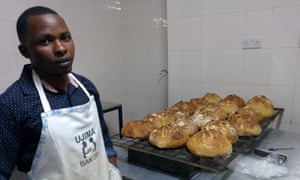
After discovering a flair for kneading, Kimani became the site’s master baker. He was recently invited to carry the flame, in the form of a sourdough starter, to Rio as part of an initiative to teach cooking skills and feed people for free during the Olympic Games.
Acclaimed chefs David Hertz and Massimo Bottura, whose social kitchens have previously attracted some of the world’s best chefs to Brazil’s favelas, or slums, invited Kimani after being inspired by the story of the bakery. He is due to travel at the end of the week.
Social enterprise
Profits from the Kenyan bakery are divided between the local eye hospital and the foundation. Some of those involved, such as Kimani, work at the bakery, while others work in hotels and shops nearby.
According to Andrew Bastawrous, eight out of 10 people who go blind do so due to entirely preventable causes. In Kenya, the biggest problem is a lack of access to treatment.
“The figures would be the same in the UK if you removed 99% of eye care,” adds the doctor, who also invented Peek, a smartphone app that offers a low-cost alternative for detecting vision problems.
Since the Kenyan bakery opened, the Bastawrouses have raised enough money to restore the sight of 60 people – a figure they hope will increase if they can start selling more bread.
They have also raised enough for 60 orphans to take a six-month employment-training programme through the foundation, which says it has an 80% success rate in getting its trainees placed in full-time employment.
The journey of the starter
The founder of E5 Bakehouse, Ben Mackinnon, has made three trips to Kenya – one with E5’s 200-year-old starter yeast – to support the bakery.
There was almost a disaster when air pressure on the plane forced open the jar carrying the starter – a fermented mixture of water and wild yeast that is used to help the bread rise. Almost all of it escaped, “but there was enough left in the pot to get going. They are remarkably resilient cultures”, Mackinnon says.
Related: How to make sourdough bread starter | Make your own
Mackinnon says that Ujima’s bakes easily passed the taste test. “There is a farmer a few miles from the bakery growing wheat and milling it in an Austrian stone mill, which is almost identical to ours here at E5,” he added.
Ujima has to use a special technique for “proving” the dough – letting it rest so the yeast can make it rise – to help preserve the loaves in Kenya’s heat, but otherwise the bread-making process is the same.
Back in the UK, E5’s special loaf is the ”Hackney Wild”. In Kenya, it’s the Afya, which is Swahili for healthy. The team are encouraged to promote the health benefits of sourdough to their customers.
Some of the customers have taken a bit of time to adjust to the taste, which is very different from the processed white loaves available on the supermarket shelves, said Andrew Bastawrous.
The average loaf at E5 costs between £3.50 and £5, and Ujima’s loaves are also at the higher end of their market, priced at about 200 Kenyan shillings (£1.50). “We are targeting people with a disposable income … like Robin Hood without actually stealing,” he says.
Next, the bakery wants to tackle diseases such as diabetes by creating an affordable product that can be sold by street vendors.
Not just for Hackney hipsters: the Kenyan sourdough bakery tackling blindness
