Mouse etiketine sahip kayıtlar gösteriliyor. Tüm kayıtları göster

26 Eylül 2016 Pazartesi

‘Mouse droppings were everywhere’: a day in the life of a food inspector

When you’ve been a food safety inspector for as long as Sharon Nkansah, you know how to smell a rat.


“Last month, there was a place I inspected [where] I walked in and you could smell it,” she says. “You can smell mouse activity. They had droppings in fridges, where they have their sauces, where they have their cutlery; the droppings were everywhere. So I just said: ‘Pull the shutters down’.”


You also learn tricks to catch out wily business owners. The best time to inspect a suspect business is in the morning, she says, before staff have had a chance to sweep up anything nasty deposited overnight.


Nkansah has worked as a food safety inspector for Newham borough council in east London for 10 years. As we move between businesses throughout the day, she is fun and chatty, talking about her children and her recent holiday, but as soon as she’s in a kitchen, her bright patterned dress is covered with a white coat and her braids are tucked under a hairnet. She becomes brisk, businesslike, at times tough.


Her repeated refrain, delivered to staff at the takeaways she inspects who ask her for food hygiene advice, is: “I am not here to train you, I am here to enforce.”


A firm approach is needed in Newham. A Guardian analysis of Food Standards Agency data found that the borough has the lowest food hygiene scores in the country: 26% of its food businesses fail inspections, rising to 50.4% for takeaways. Far from being embarrassed by these numbers, Matthew Collins, a principal environmental health officer at the council, and Nkansah’s boss, sees them as a point of pride.


“I think it’s an indication that we’re out doing our jobs,” he says.


What food safety ratings mean


How to read food safety ratings

Nkansah began her career as a chef, but wanted a job with more child-friendly hours after having children, so did a one-year degree in food hygiene and began working as an inspector in Newham.


Cuts to local government funding have meant the number of food inspectors has declined in recent years. The ratio of food safety inspectors to businesses has dropped from 4.2 full-time inspectors per 1,000 food businesses in 2012-13, to 3.7 per 1,000 in 2014-15. This figure is dragged down considerably by England, where there are only 3.2 officers per 1,000 businesses, compared with 5.7 per 1,000 in Scotland, Wales and Northern Ireland.


The job, says Nkansah, is satisfying, but it comes at a cost: she has seen what goes on in the back rooms of takeaways, cafes and restaurants.


Before going to a new restaurant, Nkansah says she always looks up its food safety rating. When asked if she would eat somewhere that scored zero, one or two, Nkansah is appalled. “Absolutely not,” she says.


On a good day, Nkansah can inspect three establishments. On a bad day, if she visits businesses where standards are very poor and the management is either belligerent or impossible to track down, she can spend half a day trying to evaluate one.


KFC: High Street North, East Ham


Nkansah starts at KFC on the high street. She is expecting big things here: large chains often do well with food safety and at its previous inspection in March 2014, this KFC branch was given the highest possible score of five.


Inside the KFC kitchen, the first thing Nkansah does is wash her hands. “It’s a way of testing if they have adequate hand-washing facilities. If they don’t, that’s not a good start,” she says.


KFC’s hand-washing station passes muster and Nkansah then works her way through the kitchen, starting at the entry point for deliveries, before moving on to the tills.


Nkansah is happy with everything – the general cleanliness of the kitchen, the way food is stored and the waste management system. The temperature of the freezer and fridges are good, and she is pleased to see a designated raw chicken preparation area.
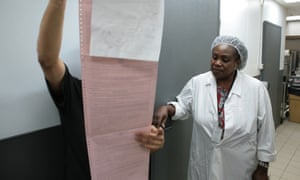


Sharon Nkansah looks at food safety paperwork at a branch of KFC


Nkansah casts her eye over paperwork at a branch of KFC. Large food chains often do well in inspections. Photograph: Martin Godwin for the Guardian

“They’ve got good separation,” Nkansah says approvingly of the way the fridges are organised: raw chicken is stored on the left, while other products, such as milk, salad and Pepsi, are on the right.


“They will maintain their five stars as long as their paperwork is in order,” she tells me as we wind up.


When we leave the kitchen, two customers sitting down to chicken wraps and a large serving of chips look up at us, with our white coats and hairnets, in a concerned manner.


“Is it all right in there?” one man asks, voice lowered.


“Yes,” we assure him. “Looks good.” They nod and tuck into their meal.


King’s Peri Peri Chicken: High Street South, East Ham


Next is a visit to King’s Peri Peri Chicken. The inspection is a follow-up after the shop was given a score of zero, the lowest possible, in March. Nkansah is back to see if it has made improvements.


What were the issues at the last visit? “Oh, everything,” she says.


Most significantly, there was no hand-washing station, meaning that employees were either washing their hands in the large washing-up sink or not at all. Today, Nkansah is pleased to see that a hand-washing sink has been installed.


The manager is not in, so a staff member shows us around the property, starting with the food preparation area, which is in a basement below the shop. It is small and dark, and the floor is slippery with oil, but quite cool, which Nkansah says is a point in the restaurant’s favour. On the bench is a large plastic crate full of flour in which the raw chicken is tossed before being taken upstairs to be fried.


There are two other containers on shelves below the work surface, each holding flour, bits of which are stuck to the sides of the container with, Nkansah assumes, chicken juice. She worries that the same flour is used to coat chicken day in and day out.


The chef, who has been working at the shop for two weeks, struggles to understand Nkansah’s questions about how often they are cleaned, first saying they were cleaned every week, then every day and then every two days. It is unclear how much of this is a language barrier and how much is his uncertainty about the details of the cleaning schedule.


“I’ve been in this business for a long time,” says Nkansah, gesturing to the crates. “This is not today’s flour.”
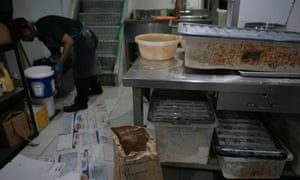


Food preparation area at King’s Peri Peri Chicken


A view of the food preparation area at King’s Peri Peri Chicken. The business was given a score of zero in March. Photograph: Martin Godwin for the Guardian

Storage is also a problem: food should be kept on shelves off the ground. But a bag of rice and a sack of chicken breading mix, both open, and a bag of bread rolls, are on the floor. A large rice cooker sits in the corner of the kitchen next to cleaning chemicals.


Nkansah looks into the fridge, which she says is kept at a good temperature, and pulls out large open tins of jalapeños and olives, as well as a large uncovered saucepan of sticky sauce meant to go on rice.


“This is one of my pet hates,” says Nkansah. “I wouldn’t even do this at home, putting the whole pot in the fridge.”


She orders the staff to throw out the contents of the saucepan and both tins.


Nkansah revisits the shop a week later when the manager is in. He shows her the food safety paperwork. Because the shop had taken some measures to improve standards since the March inspection, it is rated up from a zero, meaning “urgent improvement necessary”, to a two, signifying “improvement necessary”.


As we leave the shop, we pass a long queue of people waiting to buy chicken and I wonder whether they would keep standing in line if they knew the store’s food safety rating. There is evidence that forcing businesses to display their food hygiene scores improves quality. When Wales made it mandatory for businesses to publicly display their ratings in November 2013, the proportion of places with a zero rating fell from 0.6% to the current rate of 0.2%. Northern Ireland will introduce a similar mandatory display policy on 7 October, but publicly displaying ratings is not mandatory in England or Scotland.


Agraba Grill: Barking Road, East Ham


The final visit for the day is supposed to be to a chicken shop, Peri Peri de Griller, which Nkansah shut down in July. She is back to see if it has improved conditions and can be allowed to reopen.


Instead, we find that the shop has been sold and a new store, Agraba Grill, has opened in the same location. It is in its second week of operation. The business is a Turkish takeaway, advertising kofta, kebabs and falafel wraps, but it still seems to sell a lot of fried chicken.


Again, the manager is not in, so someone who says he is a friend of the manager shows Nkansah the premises. Walking through the kitchen, the problems are immediately evident. The food preparation area, covering half of the kitchen, has no lights.


“Can I tell you one thing?” Nkansah says. “You cannot be running this food business in this darkness, it will not help you.”


She moves on to the other problems, among them the ceiling, which has a large hole, and an open drain. “You see, all these holes is where you can get cockroaches,” she says.


There are large piles of junk in the back of the kitchen – an old cooker, bags of rubbish and stacks of boxes. “If pests come in, they’re going to live in there and breed, so all the boxes and things you don’t need, they need to go,” Nkansah says.


There are other problems. There is no basin in the staff toilet – “So where do you think they’re washing their hands?” Nkansah asks, with a raised eyebrow – and she is unimpressed to find an ashtray in the kitchen.


“If someone is smoking back here, they need to stop, it’s illegal,” she says. Nkansah is immediately reassured that no one does.


Food safety checker interactive

Mostly, she is frustrated that conditions have not improved since the previous business was shut down. Places that are closed down cannot be reopened without being reinspected, but they can be sold on.


Owners of a new food business are required to register it with the council 28 days before they start operating, which leads to a food safety inspection, often within a month of operation. But this direction is frequently ignored and Collins says he knows of just one instance of a successful prosecution of a business for failing to register with the council.


Nkansah and Collins are adamant that the way to combat this problem is to introduce licences for food businesses, which would require owners to show proof of food safety training before they start serving customers.


Checking back with the council two weeks later, Collins tells me that the business has been sold again – the shop now has its fifth owner in nine months. The new proprietor is working with the council on improving standards at the premises before opening.


Back in the office, inspections done for the day, the food safety team are deciding where to go for a late lunch. But with the morning’s inspections playing on their minds, they opt for a safe bet: McDonald’s on the high street, food safety rating five.


‘Mouse droppings were everywhere’: a day in the life of a food inspector

28 Temmuz 2016 Perşembe

Getting an emotional support animal is as simple as clicking a mouse

Everyone seems to have a story about seeing an emotional support animal out and about these days. That pig inexplicably sitting next to you on your flight. That little dog, yipping away at a restaurant. Once rare, emotional support animals now show up everywhere, including apartments with strict no-pet policies.


Unlike service animals – those well trained fuzzy companions that assist the blind or turn on light switches for people with cerebral palsy – emotional support animals aren’t trained for any specific tasks. The job of an emotional support animal is simply to be present for their owner’s wellbeing.


There are very few rules governing emotional support animals, and there is no official registry, so it’s hard to establish how many there are. To present a pet – whether a dog, a ferret or a snake – as an emotional support animal, all one has to do is provide a letter written by a licensed mental health practitioner attesting to the psychological benefit of that pet’s presence. Though emotional support animals sometimes show up at restaurants and other public places, unlike service dogs, the Fair Housing Act and the Air Carrier Access Act limit them to housing and air travel only.


While the spirit of the law may have been intended to allow mental health professionals to better serve the needs of their patients, it has also enabled a whole new business to flourish. Multiple online companies now provide these official letters without ever seeing anyone in person.


Related: The day I met Arthur, the dog who walked through the jungle to stay by me


Simply pay them a fee in the $ 150 – $ 200 range, fill out an open-ended questionnaire online and within 24 hours, your ferret could be sitting on your lap during that Thanksgiving flight home, with no extra airline fee.


Since these services provide an emotional support letter without meeting the patient, it is relatively easy for anyone to obtain one.


One of the most popular online companies, CertaPet, bills itself as top rated among online emotional support animal certification services. It lists skipping an animal fee when flying with your pet and avoiding a pet surcharge in your apartment building as two of the top three reasons to get an emotional support animal prescription.


In addition to websites offering a therapist’s letter, there are now a number of websites offering to register your emotional support animal with their company. The official sounding National Service Dog Registry, which allows you to register your furry companion as an emotional support animal for the low price of $ 64.99, sends you a certificate of registration and some tags to identify your dog in exchange for the fee. There is no such thing as a support animal registry, however, and the National Service Dog Registry even states in small print that such registration is not needed. Emotional support animal dog tags are also offered by many sites, but ID tags are not required by law.


While there are laws in a few states against misrepresenting a pet as an emotional support or service animal, there are no federal laws against it.


Presently this area is a free-for-all


“Presently this area is a free-for-all,” says Rebecca Johnson, director of the Research Center for Human-Animal Interaction at the University of Missouri College of Veterinary Medicine. She suggests this lack of regulation may eventually hurt those who actually need support animals to function.


“It makes it difficult for people who truly need an emotional support animal to travel,” says Rebecca Huss, an animal law expert and law professor at Valparaiso University. “Everyone looks at them as a fraudster.”


I decided to see just how easy it is to be a fraudster and get approved for an emotional support letter by applying to a few of these online services.


First, I needed justification for my emotional support animal. The list of disorders that are approved for an emotional support animal are broad. Everything from depression, anxiety, PTSD – and, according to some websites, even stress – can qualify.


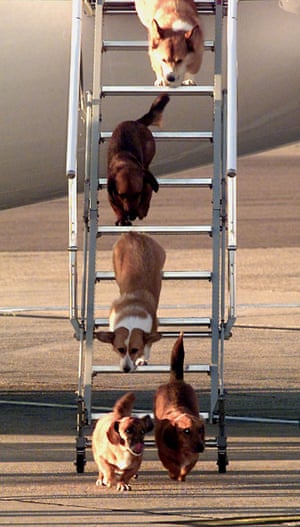
The Queen of England’s dogs leave an aircraft at Heathrow Airport after flying from Balmoral

The Queen of England’s dogs leave an aircraft at Heathrow Airport after flying from Balmoral Photograph: Tim Ockenden/PA

I chose to highlight symptoms most of us living in a big city experience: anxiety and trouble sleeping. On top of that, I added the true story of a close family member’s death.


The portrait I painted was of an anxious woman, tired from lack of sleep, who avoids parties where she does not know everyone but still functions in her everyday life, with family, friends and a spouse to support her. She gets a little depressed on some days but not others, and recently had a tragic family death.


The websites allow you to choose different plans – a letter just for flying or a letter for housing and flying – for different fee structures. I chose the flight letter option simply because it was the cheapest, and if I was going to waste the Guardian’s money on an imaginary dog, I figured it was best to go with the bare bones package.


The process for getting an ESA online is remarkably similar from company to company. I chose two of the most popular companies: The Dogtor and CertaPet.


The Dogtor requires no human interaction, but the form, which the company says takes 30 minutes to fill out, took me over an hour. Almost all the questions are open-ended and you are given a lot of space to write in detail about your mental health issues. If you are not approved, the company will refund your fee.


Related: Falling in love with Pete: there’s never been a better time to rescue a dog | Steph Harmon


At CertaPet, I was required to fill out the form for a specific animal and explain how it helps me. (I used the family dog, Roscoe, as a proxy for my non-existent pet.) The form CertaPet had me fill out online was half open-ended questions and half survey, with questions that focused on everything from schizophrenia to manic episodes to the standard issues of depression, anxiety and PTSD. Like The Dogtor, if you are not approved, they will refund you.


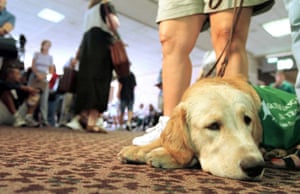
Seven-month-old golden retriever “Tim” waits patiently for his flight to Las Vegas


Seven-month-old golden retriever “Tim” waits patiently for his flight to Las Vegas Photograph: Toru Kawana/AP

Unlike The Dogtor, CertaPet had a remarkably kind sounding social worker call me within two hours of filing the form. We chatted for about three minutes, after which she kindly told me she would approve my letter. She also told me to save her phone number and call or email her if I needed anything, which I found oddly moving.


The Dogtor simply sent me an email from a therapist about 8 hours after I had filed the form. In the email, the therapist focused on the family death, saying a few kind words of sympathy and advised me to see a psychiatrist.


Just like that, in less than 12 hours, I had two emotional support animal letters in my inbox. According to the letters, I was also now the patient of each of the therapists who had signed off on my letters.


A proper emotional support animal prescription should come from someone who is treating the patient and knows their mental health condition, according to Philip Tedeschi, executive director of the Institute for Human-Animal Connection at the University of Denver. It should also take into consideration the living circumstances of the animal. If the emotional support animal is living in circumstances it is not suited for – like a dog that is left alone all day – it can become a health issue for the animal and a source of stress for both the animal and patient.


The way the system is set up presents a challenge for businesses. No one wants to get sued for mistaking a pet for an emotional support animal or a service.


Related: Doggy delights: delivering bespoke meals for hungry hounds


Businesses that don’t want to accommodate animals have little recourse at the moment, says William Goren, an attorney specializing in disability law. Though, if an animal eats a table leg or poops on the carpet, businesses can still ask them to leave.


So far, the government has not pushed back against these online services and the proliferation of fuzzy companions skipping over housing and airline restrictions. Awareness of how easily people obtain these pet prescriptions online, however, is rising. When emailing me my letter, The Dogtor noted that United Airlines and American Airlines require extra forms to be completed by a mental health professional in addition to the emotional support animal letter. Businesses can’t question a prescription, but they can make it a little harder to cheat the system.


Changes to the rules around what constitutes a proper prescription are not likely to come anytime soon, so the online emotional support animal prescription services are here to stay for now. While that might lead to some people gaming the system, imposing more hurdles can be an issue too, leading to a delicate balancing act. When it comes to those with real disability, “we want to encourage access, not discourage it,” says Huss. Even if that means someone without disability getting a free flight for their ferret.


Getting an emotional support animal is as simple as clicking a mouse

20 Mart 2014 Perşembe

Too Minor Rest Kills Brain Cells, Mouse Research Demonstrates

If you’re burning the midnight oil, you may possibly be burning out brain cells, also, new analysis displays. A research published this week in the Journal of Neuroscience discovered that staying awake as well extended destroys brain cells in mice, and may possibly do the very same in people.


It is the 1st study to demonstrate (if only in animals) that rest loss can lead to irreversible brain cell damage.


Researchers from the Center for Rest and Circadian Neurobiology at the University of Pennsylvania found that prolonging wakefulness damages a certain sort of brain cell called locus ceruleus (LC) neurons, which play an important position in maintaining us alert and awake.


“We now have evidence that rest loss can lead to irreversible injury,” says lead writer Sigrid Veasey, MD, associate professor of Medicine at the University of Pennsylvania’s Perelman College of Medicine. ”This may well be in a basic animal but this suggests to us that we are going to have to seem quite carefully in people.”


Burning the midnight oil has become the norm for Americans, but are we causing irreversible brain damage as a result? (Photo: wikimedia)

Burning the midnight oil has become the norm for Americans, but are we triggering irreversible brain damage as a consequence? (Photo: wikimedia)


In collaboration with colleagues at Peking University, the researchers looked at the brains of mice subjected to rest problems comparable to late evening or shift perform and discovered that disrupted circadian rhythms resulted in degeneration of LC brain cells and eventually apoptosis, or cell death.


The researchers limited the test mice to four to five hours of rest above every 24-hour time time period. Soon after just 3 days of rest deprivation the mice seasoned a 25% loss of LCs in a distinct segment of the brain stem.


The study was completed in mice, so further study is necessary just before we’ll know if similar cell death occurs in people. Nonetheless, the researchers said, they planned to extend the benefits to humans by conducting autopsies to examine the brain cells of shift employees.


Concern about brain changes from lack of rest has mounted in current months with the publication of several other crucial scientific studies. In January, sleep researchers at the University of Surrey linked rest loss with disruptions in gene perform that could influence metabolic process, irritation, and longterm condition threat to physique and brain.


And in October a groundbreaking research showed how sleep may “detox” the brain, flushing out waste merchandise linked to Alzheimer’s and dementia.


A Nation at Chance for Sleep Deprivation


But Americans really do not seem to be to be listening. No matter whether its school students in libraries, truck drivers on the interstates, or cubicle- and office-dwellers in higher-rises, we truly feel increasing stress to show our commitment – and ideal the competitors – with longer and longer hours.


As a result, the Centers for Illness Manage (CDC) recently announced that insufficient rest is now “epidemic” in America.


According to a CDC survey of almost 75,000 grownups, far more than a third (35 percent) explained they got on common less than seven hrs of sleep a evening, and 38 % explained they had been tired adequate to unintentionally drop off to sleep for the duration of the day at least after in the past month.


In addition, a startling 48 % explained they snored, a characteristic often connected with bad sleep, even though four.7% admitted to nodding off or falling asleep at the wheel at least as soon as in the previous month.


Even now, there is excellent news as properly. A optimistic get-away from the examine was the discovery that a protein called SirT3 (full title sirtuin kind 3) protects LCs from the harm caused by lack of rest. This factors the way in the direction of the development of future treatments to enhance SirT3 production and as a result defend brain cells from damage due to lack of sleep.


For more overall health news, follow me right here on Forbes.com, on Twitter, @MelanieHaiken, and subscribe to my posts on Facebook.


Too Minor Rest Kills Brain Cells, Mouse Research Demonstrates