Matters etiketine sahip kayıtlar gösteriliyor. Tüm kayıtları göster

18 Nisan 2017 Salı

The stiff upper lip: why the royal health warning matters

It was Diana, of course, who opened the floodgates of tears that swept away the notion of the British “stiff upper lip”. The public mourning at her death was seen as a turning point for a nation where emotional repression had been a point of pride. So it seems fitting that this week it is her sons, William and Harry, who are warning us that our emotional journey is not yet over.


Last week, Prince Harry described how he went for counselling after repressing his own grief over the loss of his mother led to a two-year period of anxiety, anger and “total chaos”. This week, his brother, the Duke of Cambridge, has gone on to warn in an interview that keeping “a stiff upper lip” should not be at “the expense of your health”.


More than 25 years since Paul Gascoigne’s famous tears during the 1990 World Cup made him a national hero, haven’t we moved on from this buttoned-up stereotype? From Barack Obama crying over the death of children at Sandy Hook to Vladimir Putin shedding tears at a victory rally, these days even world leaders are unafraid to show their emotions. Yet, as consultant clinical psychologist Sally Austen points out, such public weeping invariably takes the form of “tidy tears”. The emotion we accept, or even encourage, in public figures is still controlled. “To be with someone who is crying snot and choking on their sadness takes a level of courage for which we might not yet be ready,” she says.


For individuals, the terror that strong emotions will overwhelm us remains deep-seated. “The fears are underpinned by negative automatic thoughts; powerful, often unexamined thoughts that affect the choices we make, often without us even noticing. This leads us to worry that, ‘If I start crying I will never stop’ or, ‘If I cry my colleagues will lose all respect for me’, and even, ‘I can’t cry because I need to look after everyone else’.”


This can come at a cost. “People who might be classed as emotionally ‘strong’ – the stiff upper lipped – are more likely to end up with depression or PTSD than those who recognise their need to express their feelings,” she says.


It’s not hard to find pockets of nostalgia for the idea of a stiff upper lip in the UK, fuelled in part by a hankering for a time when boarding school-bred army officers were moulded to take charge of the empire. A recent Sky News article, for example, railed against “thin-skinned millennials” as it mourned the loss of the days when tough “ploughmen and labourers” were “led by youth from the middle and upper classes tempered and toughened in the forges of public school”.


The journalist Alex Renton, whose book about the dark side of boarding schools is titled Stiff Upper Lip: Secrets, Crimes and the Schooling of a Ruling Class, says this is what makes William’s words “stunning”. “Those three words are understood across the world to sum up a sense of British reserve and resilience and qualities that, to many people, are what made Britain great. It’s the core creed of the empire. The notion that the British were exceptional and the best rulers the world has known through the training of being tough and taking things on the chin is very strong. So it’s pretty revolutionary to have one of the titular heads of a nation say it’s not always a good thing and that speaking up might be better.”
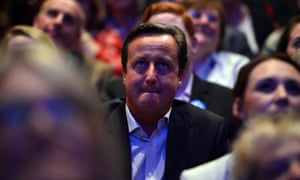


David Cameron fights back the tears listening to William Hague’s final speech as an MP in 2014


Keep calm and carry on: David Cameron fights back the tears listening to William Hague’s final speech as an MP in 2014. Photograph: Carl Court/AFP/Getty Images

Psychotherapist Philippa Perry says an old French and Saunders sketch neatly sums up the problem with the stiff upper lip. In it, a caricature of a “hunting, shooting and fishing” woman accidentally chops off her finger and, rather than crying, throws it to her nearby dog. When another dog starts barking for a similar treat, she cuts off another finger. This, says Perry, illustrates “how ridiculous it is not to listen to your feelings”.


“The stiff upper lip type thinks there are only two options,” she says. “Either you try to put [your emotions] in a box” or you “allow them to be the horses to your chariot – you are led around by them. Of course, there is a middle way – when you hear and listen to your feelings, and are guided, but not led by them.” This, she says, is the difference between allowing your emotions to “spill out everywhere”, and containing them.


By refusing to acknowledge our own emotions, Perry argues, we risk losing our ability to empathise with others. The long-term effects can be detrimental. Counselling psychologist Victoria Galbraith says: “There is still this idea that men need to ‘keep it together’. Suicide is much greater among younger men, which might be down to them feeling they have to keep these things to themselves. Having the opportunity to talk to people … I can’t overemphasise how positive that is.


“If we keep our emotions in, they come out somehow. That can be through poor physical health in time, or anger outbursts or taking things out on other people. It’s almost impossible for it not to have an impact – it’s about how soon we choose to engage with the emotions we experience.”


Linda Blair says she has noticed a change in the UK’s attitude in the near 40 years she has been a psychologist. UK patients were much more likely to be ashamed or defensive about seeking help, and saw it as being a “bother”. And, she says, there was a lingering feeling that men should not ask for help; where once only one in six of her patients were male, this is now around one in three.


But Blair does have a word of warning about letting everything hang out: we should think about who we are releasing our emotions on to. “We need to be sensitive. If someone is very stressed, dumping your problems on to them is not a favour. If you are meeting your best friend, say: ‘I know we are meeting for a fun lunch but I need to talk about a problem.’ We can’t lose our sense of community as we start being able to feel.”


Ultimately, however, she thinks the princes should be thanked for their intervention in reducing the stigma around showing your emotions. As she puts it: “Ugly feelings left unattended just fester.”



Captain Lawrence Oates


Captain Lawrence Oates: the epitome of British stiff upper lip. Photograph: Scott Polar Research Institute, University of Cambridge/Getty Images

‘I decided to give up crying’: Tim Dowling on his emotional journey


When I was a small boy growing up in the US, I was what was technically known as a cry baby. I cried over everything including, on many occasions, spilt milk. So prodigious was my ability to produce tears that other children used to take things away from me, just to see me cry.


Eventually, I realised this was putting me at a social disadvantage, so I decided to give up crying. It took years to learn how to choke off this particular emotional outlet, but I managed it. I figured, good riddance.


I suppose this was my version of the stiff upper lip – at the time, I thought I had invented it. It didn’t quite turn me into the confident, fearless person I hoped it might. I remained self-conscious, awkward and anxious. I just didn’t cry. There was only one thing left to do: I found an island nation over the sea where all the men were like me, and I moved there.


The earliest citations for the expression “keep a stiff upper lip” are actually from the US, but I won’t pretend I have ever considered it an American trait. I have never even really thought much about what it means. As an admonition, it seems a little wrongheaded; when you are on the cusp of betraying emotion, the lower lip is usually the first to go. It also seems to imply the presence of an enemy – perhaps somebody standing on the deck of a nearby frigate with binoculars trained on your face – who might take comfort from your weakness.


There is nothing wrong with prizing resolve, but the most famous examples of the stiff upper lip in action – think of Antarctic explorer Captain Oates leaving the tent and walking into the blizzard with the words, “I may be some time” – often seem more like evocations of futility. To remain calm in the face of a situation that warrants considerable panic is generally a sign that you are mentally unwell, or in shock, or both. Over the years, I have learned to avoid people who would have me maintain a stiff upper lip on their behalf.


I have also learned that most British traits come with a competing countertrait: they are the uncomplaining people who complain all the time; they have an intimate relationship with their weather, but they never, ever dress for it; the men aspire to stiff upper lips, but they are also happy to admit to deep insecurities; everybody spurns help in the first instance, but nobody likes to be thought of as well-adjusted. I love it here, I really do.


I do sometimes worry about raising three sons in a nation where the myth of the stiff upper lip still holds sway. I was conscious of trying not to dissuade them from crying when they were little, but of course one ends up doing it anyway. A crying child triggers a strong emotional reaction in a parent; it’s exhausting. Somewhere along the line, children have to learn the lesson about spilt milk.


What I can never do is create an emotionally appropriate world for my children to live in. It is how it is out there, and they learn more about how a young British man is supposed to comport himself from a one-hour bus ride than they ever will from me. We all figure out where and when we can let our guard down. There is a kind of resilience in just possessing that information.


That said, there are two lessons we can take away from the publicity created by William and Harry speaking out. The first is that if people habitually avoid displaying emotions, they can get into terrible mental distress without anyone else knowing about it, and that’s dangerous. The second is that if you don’t actually engage with your own emotions, like I stopped doing decades ago, you end up hauling them about with you like an overfull bucket. It’s time to stand up and be British: face your scary emotions squarely, with a stiff upper lip.


• Samaritans is available around the clock, every single day of the year, to listen and offer confidential support. Phone 08457 90 90 90 or visit samaritans.org


The stiff upper lip: why the royal health warning matters

13 Ocak 2017 Cuma

Your Home and Professional Environment Matters

Living in a world where at most times you are unable to dare I say, “stop and smell the roses,” or even enjoy the view that the earth has given you, we can become so bombarded with environmental distractions. From the foods you eat, to what you see, to the air you breathe we live in a spiritual and physical toxic society that shapes our perspectives. At times such distractions can allow us to neglect our personal space that can lead to unhealthy habits. So, how can we avoid this detrimental chaos? It’s simple, clean your space!!!


The dark-side in keeping an unorganized and unclean environment


Now, if you are an environmental conscience person like I am then you have a working understanding of why having a clean space is so important. So why are so many people able to live in disarray? Do people not realize what this does to their mental health? Acting-Editorial Director of Sonima has much to say about a tidy environment and overall mental health:


She stated that “Studies show that people find living in a home space that is in disarray creates a sense of overload, ambiguity, confusion, and over-stimulation in one’s everyday life,” confirms Saxbe, who studies the stress hormone cortisol. “If clutter and house projects are stressful to you, then streamlining your surroundings may be restorative and relaxing,” she even indicated that being this way does not give you the permission to have your mental health overworked.


Now, I get it, we live in a society where we are overworked and often can’t find the time to be organized, clean and stay that way. Well, I am here to tell you there are no excuses. Think of how much more productive you would be if your home or professional space were more organized. To many people, this is a daunting task that involves more work, stress and time.


My question ism wouldn’t you rather put in the work for the less stress in your life? The last thing you would ever want is to be so unclean and unorganized that it lands you in an emergency room. Zbestlimo states that “workplace illness is one of the leading causes of inefficiency and falling behind in your tasks. And the lack of cleanliness might be the culprit behind every a runny nose you’ve gotten and a sick day you’ve taken.” Sad to say this can even be said true for homes. So, what are the solutions?


Solutions to keep your environment organized and clean


Prepare a plan of action that gives you accountability and easy to follow. Having this plan will force you into following through with being organized. Make out a list of cleaning supplies, organized folders, or labeled boxes to assist you in this plan.


Make a budget when purchasing cleaning supplies or, organizational aids. Try to use products that are chemical-free. Setting a budget within your plan also gives you greater awareness of what environmental chores need to be taken care of. This also will keep you in a constant routine that will help you along the way.


Make a chart to pick out days during the week that you can begin to execute your plan. Find a space of time during the day that you can dedicate to staying true to your plan. Remember timing is everything, and if weekdays are bad for you, there are always weekends.


Once you have all the necessary components in place, stick to the plan. By sticking to this plan, you will garner success in what you are seeking. Now, this is not going to be easy by a long shot, so if need be asked someone to assist you in your endeavors. This will give you more accountability in the long-run.


Conclusion


So, whatever spectrum you fall in on being clean and organized just understand that it is important. If you utilize these tips, I guarantee that some success will be achieved. Just remember to research and find a solution that will benefit you in the long-run because timing is everything.


Your Home and Professional Environment Matters

28 Ekim 2016 Cuma

A male pill matters because both partners can share the side-effects | Deborah Orr

An experimental male contraceptive jab has proved just as effective as the pill is for women. Trials were abandoned, however, because side-effects included depression, raised libido and acne. Which is weird, because the pill has similar side-effects – although sometimes it can cure acne. The pill’s other common side-effects include nausea, headaches, breast tenderness, anxiety, weight gain and, sometimes, decreased libido. However, suggesting that the pill isn’t an almost perfect form of birth control tends not to go down very well.


This is understandable. The pill has given women agency over their own lives like nothing else. And women don’t want that great freedom to be tarnished. The advantages of an equally reliable male contraceptive, of course, are much less direct. If anything, the pill freed men from worry about contraception or “getting a girl pregnant” to the extent that an unwanted pregnancy is often looked on as something that’s entirely the fault of the fool who’s enceinte. It’s hard not to look on all those anti-abortionists and morning-after pill killjoys as people determined that foolish women should pay for their own singular mistakes.


Yet a male contraceptive is simply more sensible, in biological terms, than a female one. In her book, Sweetening the Pill, and in numerous articles, Holly Grigg-Spall points out that men have no fertility cycle, while women are only fertile for six days every month. Women take a lot of responsibility for those six days, while the constant risk is not from their ova but from ever-ready sperm.


Grigg-Spall, who is a passionate advocate of raised awareness about the pill’s risks to women, believes that its side-effects are minimised not just because of feminism, which cannot help but see the pill’s advantages as outweighing its disadvantages, because they do, but also because of sexism, which tends to dismiss female problems as trivial and male advantages as important. It’s hard not to agree with her, when comparing this latest research, in which side-effects were given such emphasis, with Danish research published last month that linked the pill to depression and gained little more than shrugs.


Packets of pills


‘Shared responsibility for reproductive freedom still seems so far away.’ Photograph: Garo/Phanie/Rex/Shutterstock

Yet it’s precisely because hormonal contraceptives have side-effects, and that these vary from person to person, that a decent male contraceptive would be such a good thing. If one partner finds the side-effects unbearable, then the other can take up the mantle. If one partner has been on contraceptive hormones for a long time, he can give his body a rest and ask his partner to take her turn. A male pill would promote the idea of shared responsibility. Which in matters of sex and reproduction still needs a lot of promoting.


The pill unleashed sexual freedom on a grateful world. It took a while for feminism to realise that this was not by any means always to the advantage of women. Ever since that time, discussion about the male pill has tended to focus on casual sex – whether a woman would trust a man who said he was on the male pill, since a lie wouldn’t leave him up the duff. But the truth is that barrier methods remain necessary for casual sex, to protect against sexually transmitted diseases, whether other contraception is being used or not. Hormonal contraception for both sexes is at its most positive as a goal in stable relationships, where it is so important for responsibility and risk to be shared.


Yet shared responsibility for reproductive freedom still seems so far away. One reason why the development of an effective male contraceptive has been painfully slow is lack of enthusiasm for the idea. Money for research isn’t there because big pharma doesn’t think men will be keen enough. The prospect of more equality, empathy and understanding between the sexes just doesn’t thrill the market.


Unlike Grigg-Spall, who had a terrible time when she was on the pill, and suffered major side-effects such as panic attacks, I’m not against hormonal contraceptives, even if they are risky. I stayed on the pill for a long time, maybe too long, and eventually I couldn’t face it any more. I’d have very much liked it if my partner could have taken his turn too. That alternative wasn’t available. But that isn’t just scientific and pharmaceutical happenstance. I’m troubled by the idea that risks women are routinely encouraged to take are risks that men are not willing also to take. There are related risks that men won’t take either. Vasectomies are at a historically low level. Addressing this particular inequality is a huge step towards addressing many others.


With double as many people willing to take a contraceptive pill, fewer women would have to suffer in silence for the sake of worry-free sex. I’m sure that some men would be happy to take a hormonal contraceptive. But the market tells us that not nearly enough are interested, while research tells us that even when they are, they’re too risk-averse for the idea to be driven forward with enough urgency.


Reliable contraception is a Great Thing for humanity. It’s about time that half of humanity stopped shirking and joined women in engaging in the physical challenges that are undertaken in embracing it.


A male pill matters because both partners can share the side-effects | Deborah Orr

5 Haziran 2014 Perşembe

Why Disney"s "Maleficent" Matters

Disney’s Maleficent brought in $ 70 Million at the box office in the course of its opening weekend. The actual significance of the movie, nonetheless, has nothing at all to do with income. Rather, it represents a cultural shift that can probably have profound implications for our youngsters.


In fact, what’s remarkable is that, with the exception of a couple of banal narrative devices that are presumable meant to hit us more than the head with explicit proof that the filmmakers are cognizant of basic vital gender concept, Maleficent is not a film about princesses, evil queens, femininity, nor girlhood. Don’t believe the buzz there’s quite tiny about gender right here. Rather, Maleficent is a film about stories. It is a fairy tale of redemption in which some of the crucial vulnerabilities of human knowledge are freed from their habitual narrative dichotomies.


Considering that the beginning of the 20th Century, Disney has been the principal cinematic storyteller in the fairy tale genre. Maleficent matters because they spent $ 170 Million creating a film that is different and then positioned it as a massive summertime blockbuster.


The Disney Firm has not only dominated a marketplace sector it has also, to some degree, defined modern cultural iterations of traditional narrative tropes. This is not just due to the fact Disney has grow to be this kind of a media powerhouse that it can control what we see (even though this is also correct), it is also a end result of Walt’s legacy: a outstanding intuitive capacity to realize the kinds of stories that greatest capture the imagination of the collective.


When I write the phrases “capture the imagination,” I imply them literally, as if a Disney film were a screenshot of the collective unconscious–like a photograph that captures a second in time. The Walt Disney Organization continues to existing our dynamic psychic desktop back to us like a reflection of our collective imagination.


The factor about fairy tales is that they are much more than just superficial stories. The great Jungian analysts Marie Louise Von Franz stated that “fairy tales are the purest and easiest expression of collective unconscious psychic processes.”


Maleficent01


Surely we’ve all read myriad criticisms of Disney narrative conventions. Brilliant feminist thinkers, for illustration, have shown us the misogynistic implications of what is colloquially referred to as “The Disney Princess Rescue Fantasy.” But we’d do effectively to keep in mind not to scapegoat the storyteller. Massive media organizations really don’t colonize our imaginations all by themselves. Don’t forget the lessons learned from Frantz Fanon, who wrote, “Zombies, think me, are much more terrifying than colonists.”


Every single individual–both oppressor and oppressed–bears some of the burden for the continued reinforcement of princess tropes and patriarchal evils. We will in no way conclusively fix the paradox of which comes 1st, the storytelling chicken or the collective psychic egg. Influence runs in each instructions, from Disney to the buyer and then back once more. Regardless of the Industrial Age’s insistence on describing the planet in terms of simple mechanical causality, we all know that the partnership in between a culture and its narratives is too complex for simple who-caused-what and what-impacts-who explanations.


Still, who can deny that we’ve invested a century in a consumerist kingdom where great, evil, black, white, male, female, and a lot of far more have been codified and catalogued into clear oppositions? With Maleficent, issues shift.


Spoiler alert: as much as I’d like to compose this without offering away particulars, Maleficent just has also several surprises–narrative, aesthetic, emotional, and so on. I couldn’t make my point without revealing them. Bookmark this webpage. See the film. Then come back and read the rest of this post.


The cultural shift that Maleficent endeavors to catalyze is clear from the commence of the movie. The castle of the ubiquitous Disney brand is absent. A new castle stands in its location behind Walt’s signature. I know this would seem like a basic cinematic gimmick, but it is considerable. In the planet of fairy tales, ‘the kingdom’ is not just the setting, it is also the symbolic representation of a existing psychic state–a way of getting in the planet that is in need to have of attention.


All fairy tales start off with a neurotic kingdom, one that’s desperate for psychological alignment. The tale itself is usually a type of instruction guide on how make things appropriate, how to restore stability. And this is why we frequently speak about “the moral of the story.” The lesson is often one of transformation: how to move from a current state of being into a much better one particular. Disney’s familiar Cinderella’s castle brand finally appears following the last credits, as if to tells us that Maleficent puts the Magical Kingdom back in order.


Immediately, Maleficent’s opening narration tells us that business and ambition are out of control in the kingdom. Hierarchy and inequality create an imperialist greed that’s often threatening the borders of the Mores (the land in which the fairies live). All the grownups in the audience should wonder at this level if, beneath all the fantasy and pixie dust, we’re in for an moral allegory about politics and wealth distribution in the present international economic system? Yes, we are.


On the most standard level, economics and governance will perform a main position in Maleficent. But it goes significantly deeper. There is also an environmental message, and a philosophical one. The film operates in a way that helps make eco-feminist author Susan Griffin’s phrases ring real, “One can’t separate a culture’s way of ordering reality, its cosmology, its epistemology, from the social structures it is made up of.” In Maleficent, we see two competing social structures, the monarchy of the human kingdom and the utopian Democracy of the Mores. The humans order the universe into assets for business. The fairies care for a sustainable planet.


The fairies live in the Mores: a magical land exactly where all beings are pleased, empowered, and seen for their person strengths. The Mores is a swamp–a classic image of the unconscious imagination: fertile, moist, and scary in its unfamiliarity. Aesthetics are flipped upside down. There are unusual flying shrimp-like creatures, tall wood-ogre guards, and mushroom critters with big noses covered in warts. They are all pleasant, playful, and just normally living a great lifestyle. That is, they are residing a very good daily life right up until Stefan arrives.


Stefan is an orphan boy from the human kingdom and in his initial scene with Maleficent (nevertheless a little woman at this level) a superficial puppy-enjoy story blossoms. Though Stefan would seem sweet, he actually never does something good. He enters the Mores to steal a jewel, not due to the fact he’s hungry, but due to the fact he desires riches. He sees the wonders of the Mores as a source of extractable assets. Even in the montage of their blossoming adore, he is by no means carrying out anything for Maleficent. She carries him, ready and fired up to let her wings bear the burden of his weight. She’s naive, innocent, and too trusting.


Ultimately, Stefan gets to be each the king and the villain of the story. There is nothing revolutionary here. Greediness, engineering, and industry are usually poor in our well-known stories. Believe of Star Wars’ empire. Believe of Pinocchio’s Trustworthy John. When it comes to our narrative conventions, we have a tendency to maintain Puritan values. Challenging work and ambition are pure when motivated by really like and passion, but not funds and materialism.


Still, there is some thing striking about Stefan: he’s an orphan that is prepared to do what it requires to get ahead in the world. And just like that, in 3D IMAX, Disney just criminalized the rags to riches story. The most common American protagonist is the typical Joe that climbs the ladder to a place of energy. All of a sudden, here, residing the American dream just turned Stefan into the enemy.


Readers are almost certainly objecting that what can make Stefan evil is not his ambition, but rather that he drugged Maleficent and stole her wings to get ahead. A lot of writers have currently pointed out that the theft of the wings is a symbolic date rape scene, roofies and all. I agree. But I think most writers are stuck on the gender implications and, as a result, missing the genuine stage.


The scene is not about rape. It is a social commentary arguing that any hierarchical rise to electrical power inherently occurs via the exploitation of other folks and is consequently tantamount to rape. This is why, with no her wings, Maleficent also becomes an oppressive ruler of the Mores. She’s been robbed of her ability to fly. Tethered to the ground, she cannot soar. Almost everything she represents, believes, and stands for has been grounded. Like most victims of oppression, she responds in type. She takes it out on people who are smaller sized and weaker than she.


English: Portrait of Walt Disney, 1 January 19...


Had Walt created this movie for the duration of the cold war, he would’ve been blacklisted. I suspect this is why there is an sappy platitude about the energy of motherhood masking the actual message: real adore is not about residing happily ever after in an out-dated institutionalized legal arrangement the place one particular man or woman is virtually always exploited. The princess (Sleeping Beauty a.k.a Aurora) is not a prize and she doesn’t need to be rescued. This story does not finish with a wedding ceremony. The kiss of a handsome prince is a comedic gag in this movie. The kingdom is transformed, and balance restored, when Aurora frees Maleficent’s wings, defeating the patriarchy, and permitting the magic of the Mores to flourish once again.


What is it about the Mores? Things are different there. It seems to be like a socialist democracy. Correct really like, consequently, is not only between a guy and woman, but rather, about valuing other individuals: local community, sustainability, caretaking, and social equality.


Since I’m writing in Forbes, most readers will probably get this as a criticism. Don’t error my explication for a condemnation of a movie with an anti-capitalist message. I loved Maleficent. I noticed it twice. There’s no criticism here, no judgment, just observation and interpretation.


I see the movie as a reflection of where our collective psyche is inevitably headed. We’d be smart to heed its message. Let’s totally free the fairy’s wings from patriarchy’s prison. The boring dichotomy amongst socialism and capitalism is like barbed wire between two kingdoms that require to be united.


The movie’s final narration reminds us that Maleficent is each hero and villain. It is time to leave the kingdom of acquainted partisan oppositions: let’s substitute the either/or with neither/nor or each/and.


Jordan Shapiro is writer of FREEPLAY: A Video Game Guidebook to Maximum Euphoric Bliss, and MindShift’s Manual To Games And Learning For data on Jordan’s upcoming books and events click right here.


Why Disney"s "Maleficent" Matters