Haiti etiketine sahip kayıtlar gösteriliyor. Tüm kayıtları göster

25 Ekim 2016 Salı

UN"s own expert calls its actions over Haiti cholera outbreak "a disgrace"

The United Nations’ refusal to accept responsibility for the devastating cholera outbreak that has claimed more than 9,000 lives in Haiti has been branded a “disgrace” by the organisation’s own human rights special rapporteur.


Human rights groups working with victims had reacted with jubilation earlier this year following the UN’s first tacit admission that it was to blame for the outbreak after doggedly refusing to address how its peacekeepers brought the disease to Haiti in 2010.


However, in a scathing report (pdf) to the UN general assembly, the organisation’s special rapporteur on extreme poverty and human rights, Philip Alston, said that flawed and unfounded legal advice provided by the UN lawyers was preventing it from accepting responsibility for the outbreak.


“The UN’s explicit and unqualified denial of anything other than a moral responsibility is a disgrace,” Alston said. “If the United Nations bluntly refuses to hold itself accountable for human rights violations, it makes a mockery of its efforts to hold governments and others to account.”


Alston accused the UN’s Office of Legal Affairs (OLA) for coming up with a “patently artificial and wholly unfounded legal pretence for insisting that the organisation must not take legal responsibility for what it has done”.


The criticism comes as the administration of the outgoing UN secretary general, Ban Ki-moon, is moving to provide compensation for the first time to victims of the outbreak. The UN plans to make cash payments from a proposed $ 400m (£328m) cholera response package, the New York Times reported.


Alston added that the OLA’s approach “has been cloaked in secrecy: there has been no satisfactory official explanation of the policy, no public attempt to justify it, and no known assessment of its consequences for future cases. This goes directly against the principles of accountability, transparency and the rule of law that the UN itself promotes globally.”


Peacekeepers who were relocated from Nepal to Haiti in 2010 in the wake of a major earthquake imported the deadly cholera bacterium with them. Studies have found that the UN troops could have been screened for the illness, and the disaster averted, for as little as $ 2,000.


Alston said the UN’s legal position appears to be largely explained by the approach of the US, the main contributor to the UN’s peacekeeping budget.
“Despite numerous requests to do so, the United States itself has never publicly stated its legal position on the responsibility of the UN for causing cholera in Haiti,” he added.


“Instead, it seems to have pressed the UN to adopt the position frequently taken by lawyers in the US that responsibility should never be accepted voluntarily, since it could complicate future litigation. But this rationale is completely inapplicable to the UN, which enjoys absolute immunity from suit in national courts and whose reputation depends almost entirely on being seen to act with integrity.”


The special rapporteur said that the current stance of the UN’s lawyers ensures that it would never admit its responsibility for introducing cholera. “And avoiding legal responsibility hinders the UN from learning lessons and making sure that the fatal mistakes made in Haiti are not repeated elsewhere.”


Ban’s office said in a statement earlier this year that the organisation had decided to step up its efforts to fight cholera in one of the world’s poorest countries. A reference to the UN’s “involvement in the initial outbreak” was greeted as a breakthrough by groups working with cholera victims.


Ban appeared to have been bounced into making a clearer recognition of responsibility than ever before by the advent of a draft report by Alston into how the UN handled the crisis. Alston had also been one of five experts working for the UN who earlier this year wrote a heavily critical letter to Ban in which the secretary general’s resistance to accepting any responsibility was torn apart.


UN"s own expert calls its actions over Haiti cholera outbreak "a disgrace"

Midwife in Haiti tells of delivering babies knee-deep in water by torchlight

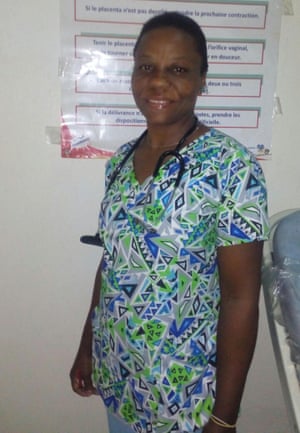
A midwife in Jérémie, Grand’Anse, one of the worst-hit towns in Haiti during Hurricane Matthew, has told how she delivered six babies, two boys and four girls, in a blackout during the night of the storm.


Marie-Lyrette Casimir, a midwife at St Antoine hospital, worked by flashlight as the fiercest Caribbean storm in almost a decade ripped though the south-west tip of the country, killing more than 500 people and causing widespread devastation.


Casimir, who was trapped in the hospital with her patients for hours after the storm, due to rising floodwater, said: “During the deliveries, the mothers were saying: ‘Miss Casimir, please save us. You’re going to save us.’ I was worried a lot, but I tried to calm them down, to be reassuring. I said to them: ‘Even in this desperate situation, you have to play your role, in the interests of the baby.’”


In a town where 80% of the buildings have reportedly been destroyed, St Antoine’s maternity unit, housed in one of three buildings that make up the hospital, emerged relatively unscathed. One of the hospital’s adjacent buildings was flattened by winds of up to 145mph, the other suffered extensive damage.


Casimir, who works for the United Nations Population Fund (UNFPA), described how windows were shattered and doors wrenched off their hinges during the storm and, amid fears the building itself would collapse, mothers were screaming and crying. There were two nurses in the ward that night, but she was the only midwife, she told the Guardian.


“I was very sad and worried … At first, the wind wasn’t very strong but the hurricane became really strong around midnight.”


When a power cut plunged the hospital into total darkness, she carried on using a rechargeable lamp and a flashlight, she said. “I was afraid, there was a lot of noise and I was worried I could be injured. But I had to stay – my work was to help women give life.”


Casimir, 46, said that by dawn the floodwater in the hospital had reached her knees. At one point she had to raise the bed in the delivery room, which was becoming contaminated with floodwater.


But her fears that falling debris or, worse, the collapse of the building, could risk all their lives, went unrealised. “I’m very proud of what I achieved that night. There were no deaths. The deliveries went well and none of the babies needed to go to paediatric care. Everything was great.”


Casimir’s story emerged after an assessment by the UNFPA and Haiti’s ministry of women’s affairs revealed the scale of devastation in Grand’Anse and Nippes, two of the country’s hardest-hit departments. It found most of the population affected were living in appalling conditions, with 176,000 in temporary shelters. Almost 100% of crops were destroyed in what is one of this impoverished country’s most fertile areas.


Up to 1.4 million people, 40% of them children, are in need of humanitarian assistance, according to a report (pdf) by the Office for the Coordination of Humanitarian Affairs (Ocha), with 806,000 people being at what it described as at “extreme-impact level” of food security (near-famine conditions), mainly in Grand’Anse and Sud. A further million people were at a “very high” or “high” level, it said.


Marie-Lyrette Casimir, a midwife at St Antoine hospital


Marie-Lyrette Casimir, a midwife at St Antoine hospital. Photograph: Courtesy UNFPA

Maternal health facilities were badly hit, particularly St Antoine and the City Med hospital in Beaumont. All seven of the main health facilities in the area were flooded and remain without power, water, equipment and short of staff. The directorate of civil protection of the Haitian government has reported 11 of the 33 hospitals in Grand’Anse, Nippes and Sud were damaged.


Along with the unmet basic needs of food and shelter for thousands, an estimated 13,650 women – among the most affected people – are due to give birth in the next three months, according to Ocha.


Vavita Leblanc, reproductive health programme manager of UNFPA in Haiti, said the agency has sent two teams of six midwives into the affected areas.


“In Grand’Anse, we found none of the health facilities have power [or] water, and all are flooded,” said Leblanc. “They have problems with medical supplies. Human resources have also been affected as nurses and doctors are facing their own problems, with their houses and with food.”


Leblanc said the devastation caused by the hurricane would severely affect the country’s maternal mortality rate – it is already the worst in the Americas but had been falling due to more hospital births.


“People will now stay in their communities to give birth,” said Leblanc. “It will set us back a decade.”


Two-thirds of babies in Haiti are delivered without qualified help. The country’s maternal mortality rate stands at 359 per 100,000 births in 2105. Cuba has a maternal mortality rate of 39 per 100,000.


Amid warnings by aid agencies of the risk of a fresh cholera outbreak, the storm also damaged most of the cholera treatment centres of Grand’Anse, according to the Ocha report. The country’s cholera epidemic began in 2010, when UN peacekeepers unwittingly introduced the disease shortly after a devastating 7.0 magnitude earthquake. The disease, previously unknown in the country, went on to kill more than 9,000 people.


This week, a UN official said he was concerned the scale of the cholera outbreak may be under-reported because remote areas are cut off. He also warned that protests, by desperate people angry about the slow pace and uneven distribution of aid, were impeding progress.


A spokesman for the World Food Programme’s Haiti operation told the Guardian it had so far managed to get food assistance to just 10% of the 800,000 estimated to urgently need it. “Initially, the response took time,” the WFP spokesman said. “We started distributing on 8 October and so far, 80,000 people have received assistance.”


He said the damage to infrastructure and roads delayed trucks going to the peninsula until 7 October, four days after the hurricane. It is now sending out between two and four trucks a day to the hardest-hit areas, as well as helicopters, he said. They plan to use boats to get out to the coastal areas.


There have been a few security issues, he said, but they represent a small proportion of the response. “People are really suffering, they are desperate and hungry, but we expect safe passage so that we can get to the communities that need it.”


To support the government-led response, the humanitarian community in Haiti launched an appeal for $ 120m, only $ 15.1m of which, according to the latest Ocha report, has been raised.


Paul Brockman, MSF head of mission in Haiti, speaking from Baradères, around 50km from Jérémie, said that while cholera is not as bad as they feared, significant risks remain. Brockman said: “There is a great need for shelter and drinkable water everywhere. Cholera could be a very substantial risk. It’s important to remember, that, as a small country, Haiti was very affected by the rain in the hurricane, even in the areas where the wind did not devastate – and with cholera still present everywhere, it increases the risk when treatment centres [have been] flooded.


“In every coastal area we’ve been in, there has been partial or total destruction of the cholera treatment centres.”


Midwife in Haiti tells of delivering babies knee-deep in water by torchlight

7 Ekim 2016 Cuma

Hurricane Matthew: Haiti needs vaccines to stop deadly cholera spreading | Dr Anita Zaidi and Helen Matzger

[unable to retrieve full-text content]


9,000 people died in Haiti’s last cholera outbreak. We must act fast in disaster-affected hotspots to help prevent history repeating itself


Six years ago, as the country attempted to rebuild following a massive earthquake, cholera began spreading in Haiti. And it didn’t stop.


Adults and children – many of whom contracted cholera by drinking untreated water from familiar rivers and streams – lay listless in hospitals packed to capacity with emergency cases. The death toll mounted. The months passed. The cases continued. Stories of pregnant women and tough little girls and boys struggling to survive became the norm and were well recorded by partners on the ground, who were bearing witness to what is now considered the worst cholera outbreak in recent history.


Related: Hurricane Matthew: preparations and aftermath – in pictures


Related: UN makes first public admission of blame for Haiti cholera outbreak


Continue reading…


Hurricane Matthew: Haiti needs vaccines to stop deadly cholera spreading | Dr Anita Zaidi and Helen Matzger

16 Temmuz 2014 Çarşamba

UN chief methods up fight against Haiti cholera epidemic

MDG : UN chief Ban Ki-moon visits a cholera-afflicted village in Haiti

UN chief Ban Ki-moon leaves a home he visited throughout a journey to the cholera-afflicted rural village of Los Palmas in Haiti. Photograph: Marie Arago/Reuters


The UN secretary common has flown to Haiti on a “essential pilgrimage” to help the fight against cholera, a condition that many Haitians blame UN peacekeepers for introducing to the Caribbean country.


Ban Ki-moon is looking for assistance for a $ 2.2bn, ten-yr cholera elimination campaign that he launched in December 2012 with the presidents of Haiti and the neighbouring Dominican Republic.


“I know that the epidemic has brought on significantly anger and dread. I know that the illness continues to have an effect on an unacceptable quantity of people,” he informed parishioners at a church support in Los Palmas. “My wife and I have come right here to grieve with you. As a father and grandfather, and as a mom and grandmother, we feel incredible anguish at the discomfort you have had to endure.”


The UN has not accepted accountability for the cholera epidemic that has killed eight,500 people and contaminated much more than 700,000 considering that October 2010, regardless of proof that suggests it was brought to Haiti by Nepalese peacekeepers stationed near a significant river.


Ban’s check out was criticised by some in Haiti who mentioned the UN should accept duty for introducing the ailment and supply compensation to families. “It is an insult to all Haitians for the secretary standard to come to Haiti for a photo possibility when he refuses to take obligation for the 1000′s of Haitians killed and the hundreds of 1000′s sickened by the UN cholera epidemic,” mentioned Mario Joseph, a Haitian human rights lawyer.


Cholera, which had not been documented in Haiti in almost a hundred years prior to the outbreak, is an infection that leads to significant diarrhoea that can lead to dehydration and death, and is triggered by poor sanitation.


Donors had been slow to react to the initial cholera elimination campaign, Ban advised the Miami Herald newspaper, including that the UN had struggled to raise an initial $ 400m essential in the very first two many years.


Attorneys have filed three lawsuits towards the UN seeking compensation for Haitian victims of the epidemic. The Nepalese troops were stationed near a tributary of the Artibonite river and discharged raw sewage that carried a strain of cholera, sparking the outbreak, the lawsuit explained.


An independent panel appointed by Ban to examine the epidemic issued a report in 2011 that did not figure out conclusively how the cholera was launched to Haiti. The US Centres for Illness Management and Prevention said proof strongly recommended UN peacekeepers from Nepal were the supply.


Some senior UN officials, which includes the human rights chief Navi Pillay, have said Haiti’s cholera victims need to be compensated.


Together with Haiti’s prime minister, Laurent Lamothe, Ban also launched a sanitation campaign, noting that one in two Haitians lack entry to satisfactory sanitation systems.


The scheme seeks to train folks to build latrines, as effectively as installing water filter methods in colleges, well being centres and markets. The UN and the World Financial institution are targeting 55 communities worst affected by cholera, covering three.8 million individuals inside the up coming five years.


UN chief methods up fight against Haiti cholera epidemic