surgeon etiketine sahip kayıtlar gösteriliyor. Tüm kayıtları göster

29 Nisan 2017 Cumartesi

The surgeon who cruelly betrayed his patients’ trust | Barbara Ellen

Breast surgeon Ian Paterson has been convicted of 17 counts of “wounding with intent” and three counts of “unlawful wounding” and is now bailed, awaiting sentencing.


Many women have come forward to claim compensation, which sounds richly deserved. For years, Paterson performed hundreds of unnecessary or inadequate surgeries, for mainly female patients at the Heart of England NHS Foundation in Birmingham and private clinics run by Spire Healthcare.


As the case unfolded, there was a recurring theme of Paterson’s charming bedside manner, but also of his arrogance-cum-“God complex”, which was allowed to go unchecked, despite many concerns and complaints. Sometimes, Paterson would perform unnecessary disfiguring operations. At other times, his signature “cleavage-sparing mastectomy” procedure left patients in greater danger of developing secondary cancers.


Reading this, one feels sickened for the patients. There’s a nightmarish feel, almost reminiscent of the 1988 David Cronenberg film Dead Ringers, in which an insane surgeon performed gruesome gynaecological operations. Paterson’s patients were at their most vulnerable and in such a specifically female way. For women, breasts are not just another body part but can be bound up in maternal and sexual identity. Paterson’s patients trusted him, not only with their bodies and lives, but also with their identity and he violated them in the cruellest possible way.


Paterson has also undermined general trust in surgeons, not least with this recurring theme of arrogance and “God complex”. These are all too familiar complaints when it comes to surgeons. However, is it always a case of the surgeon being arrogant or could it sometimes be about the solid confidence that you need to do the job? My partner is a surgeon and, from what I’ve gleaned from him and other surgeons, a high level of confidence, in their decisions, in their ability, is crucial. They’re cutting people’s bodies open; they need to be in charge, to make the tough calls. The last thing anyone wants is an unconfident, self-doubting surgeon.


This doesn’t mean that surgeons think they know it all. Far from it. Good surgeons not only welcome second opinions, they continue to train, learn new techniques, question and push themselves, like the driven type-A personalities so many of them seem to be. It sounds as though Paterson had stopped all that, if he ever started, instead letting himself slide into a state of self–serving toxicity and, from the sounds of it, lucrative complacency.


In someone like Paterson, the “God complex” would emanate not from innate belief, but the self-conviction that, ultimately, their wrongful behaviour is justified. Certain details spring out: the endless operating, the fact that Paterson kept himself apart from colleagues. Not only is performing unnecessary operations simply not done, able surgeons are much more likely to confer over diagnoses, to want to share knowledge and expertise. When someone shies away from doing this, it suggests not so much arrogance as a fear of exposure or a mask for incompetence.


None of this excuses how Paterson was allowed to continue mutilating patients or placing them in danger, unhindered, for so long. The culture of secrecy and protection around high-ranking medical professionals must be stamped out. Moreover, I’m sure that some surgeons are just arrogant sods who bully patients. No one is defending that, however good they may be at their jobs.


However, this case shouldn’t lead to people automatically distrusting or fearing confident surgeons. While Paterson’s actions are the stuff of nightmares, they also feed straight into a paranoid, 1950s-style narrative of haughty surgeons badgering patients into doing as they’re told. In truth, whatever Paterson was (incompetent? greedy? psychotic?), his crimes clearly demonstrate that he wasn’t on the normal surgeon spectrum, not even at the arrogant end. What Paterson did was criminal and pathological.


The surgeon who cruelly betrayed his patients’ trust | Barbara Ellen

Hundreds of private patients seek compensation from rogue surgeon

Hundreds of private patients of a surgeon convicted of carrying out needless breast operations are seeking compensation after nearly £18m worth of claims were made against the NHS.


Ian Paterson, 59, was convicted on Friday of 17 counts of wounding with intent and three counts of unlawful wounding against 10 patients, upon whom he conducted “extensive, life-changing operations for no medically justifiable reason”.


More than 250 NHS patients have received payouts after being treated by the surgeon and it has now emerged that around 350 patients who underwent treatment privately at clinics owned by Spire Healthcare in the West Midlands are also taking civil action against Paterson and the firm.


Paterson, described in court by one victim as being “like God”, lied to patients and exaggerated or invented the risk of cancer to convince them to go under his knife.


Thompsons Solicitors, a firm representing the private patients, said the Spire Healthcare’s treatment of those who complained was “shabby”.


“We are determined to secure appropriate compensation for every single one of our clients, some of whom found the courage to come forward only as recently as four weeks ago,” said Linda Millband, lead national lawyer at the firm.


“Spire needs to face up to its responsibilities, because they let him operate well after he was suspended by the NHS.”


A freedom of information request revealed the NHS has resolved 256 cases, paying out £9.5m in compensation and £8.2m in costs, while a further 25 cases are still to be heard.


Paterson, who was suspended by the General Medical Council in 2012, lied to patients and exaggerated or invented the risk of cancer in order to convince them to go under the knife.


He sobbed as the jury returned the guilty verdicts on Friday at Nottingham crown court. The surgeon was released on conditional bail ahead of sentencing in May, when he faces a custodial sentence.


One patient who gave evidence in the trial had 27 biopsy cores taken from her healthy right breast and had “absolutely not” received medical best practice.


A Spire Healthcare spokesman said: “What Mr Paterson did in our hospitals, in other private hospitals and in the NHS, absolutely should not have happened and today justice has been done.


“We would like to reiterate how truly sorry we are for the distress experienced by any patients affected by this case. We can say unequivocally that we have learned the lessons from these events.


“We commissioned a thorough independent investigation and have fully implemented all of the recommendations.”


Hundreds of private patients seek compensation from rogue surgeon

28 Nisan 2017 Cuma

NHS pays out millions to patients of surgeon convicted of needless breast operations

The NHS has been forced to pay out almost £10m in compensation to more than 250 patients of a rogue surgeon found guilty of carrying out needless breast operations on patients who were left traumatised and scarred.


Consultant surgeon Ian Stuart Paterson, 59, was convicted on 20 counts of wounding with intent and unlawful wounding against nine women and one man on Friday. But he could have more than 1,000 more victims, among them hundreds of private patients who may never be compensated for botched and needless operations.


Paterson had denied the charges, which related to procedures he carried out between 1997 and 2011. The jury at Nottingham crown court had heard claims that the surgeon – who saw hundreds of patients a year – carried out the operations for “obscure motives”, which may have included a desire to “earn extra money”.


He denied misrepresenting patients’ test results to dupe insurers into paying for surgery, but other former patients have told the Guardian that the surgeon exaggerated or simply invented the risk of cancer and – in some cases – claimed payments for more expensive procedures that those he had carried out.


Paterson was employed by Heart of England NHS trust in 1998 – despite having been previously suspended from the Good Hope hospital in Birmingham – and also practised at privately run Spire Healthcare hospitals in the Midlands over a 13-year period.


The NHS has so far paid out around £9.5m, settling 256 cases, with 25 outstanding, the Guardian has learned. But hundreds of Paterson’s private patients may never see a penny after Paterson’s insurance company – the Medical Defence Union (MDU) – said their cover was “discretionary” and had been withdrawn. Paterson had a limited separate insurance policy of £10m, which solicitors say will not nearly cover the compensation and costs of all private patients.


Spire Healthcare, which runs the Parkway and Little Aston hospitals where Paterson treated private patients, have settled some cases but argue that as Paterson was not technically their employee, they are not responsible for his actions. The company would not divulge any details about compensation.


Sarah Jane Downing, who set up a petition, demanding compensation for Paterson’s private victims, said she had been left “shocked and appalled” at the lack of redress.


Sarah Jane Downing.


Sarah Jane Downing. Photograph: Teri Pengilley for the Guardian

“Many of these people chose private healthcare because they bought into those promises in the glossy brochures. And now we have realised that those promises are not worth the paper they are printed on. It’s utterly devastating.”


At a recent coffee morning for former Paterson patients, many described the consultant’s “brilliant” bedside manner. “He was so lovely, I thought I was so lucky – I thought I was being looked after,” said Elaine Diskin, who had eight operations by Paterson over as many years.


Her husband, Mike, also had a deep respect for the surgeon – so much so that when he had a pain in his chest, he went to him and did not hesitate when the surgeon said he suspected lipoma and that they “had to get it out”.


“Sinister was the word he used,” Diskin said. “I had no reason to doubt him because he was looking after Elaine so well.”


They trusted Paterson so much they also recommended his care to a friend, who went on to have a lump removed. “We used to joke that we’d paid for his skiing holidays,” said Elaine Diskin.


After the Diskins were recalled for a review of their treatment in 2012 they discovered that at least seven of the eight operations Paterson had done on Elaine – along with both performed on her husband and their friend – were unnecessary.


A civil case with seven “test” cases – which will determine to what extent Spire can be held liable for Paterson’s work in their hospitals – is scheduled to be heard in October, but looks likely to be delayed. The outcome will affect all the private patients who have brought civil claims – and who fear they may get nothing.


Solicitors familiar with the case say Spire has made a handful of payments – the largest about £150,000 – to former patients in the private sector which include unnecessary removal of lumps and the received“cleavage-sparing mastectomies”, a controversial operation that left breast tissue behind after the removal of cancerous cells.


Concerns about Paterson were raised as far back as 2003. But despite several internal and external investigations and complaints from patients, GPs and other surgeons he was only suspended by the General Medical Council in 2011. “In every profession you get rogue operators – but there are checks and balances to stop terrible things happening,” said Mike Diskin. “Why were there not in this case, or why were they ignored?”


Timeline


1998: Paterson is hired as a consultant surgeon at the Heart of England NHS trust, despite being previously suspended from the Good Hope hospital, and also sees private patients at Spire Healthcare hospitals Little Aston and Parkway.


2003: Paterson is investigated because of concerns about “cleavage-sparing mastectomies”. Recommendations are not followed through.


2007: Breast surgeon Hemant Ingle is appointed and with others raises concerns. Further investigations are carried out and Paterson is told to stop performing “cleavage-sparing mastectomies”. Mark Goldman, chief executive of the Heart of England NHS trust, informs Spire that the trust is investigating Paterson.


2008: Two GPs complain about Paterson’s treatment of a patient, saying he gave misleading information about pathology reports, over-treated patients and disregarded the multidisciplinary team meeting process. Another report is critical.


2009: A Spire Parkway patient makes a formal complaint about Paterson. No action is taken. Heart of England NHS trust recalls 12 patients who have had “cleavage-sparing mastectomies”. West Midlands Cancer Intelligence Unit submits two further reports.


2010: The General Medical Council (GMC) tells Spire Parkway executives about a complaint from an NHS patient. .


2011: Parkway were informed Paterson had carried out a “cleavage-sparing mastectomy” in 2009 after being told to stop in January 2008. A month later the GMC informed Spire about another patient complaint. A total recall of all Paterson’s patients begins.


Paterson is suspended by the NHS in May 2011 but continues to perform breast surgery for Spire until 31 May and general surgery until 8 June 2011. He is paid until November 2012.


NHS pays out millions to patients of surgeon convicted of needless breast operations

22 Nisan 2017 Cumartesi

Trump administration removes Obama surgeon general pick Vivek Murthy

The Trump administration has removed Dr Vivek Murthy as US surgeon general, leading one Democratic senator to accuse the president of “politicising the position”.


Murthy was appointed by Barack Obama and confirmed by the Senate in December 2014 after a long delay. Murthy had incurred the wrath of the National Rifle Association by saying gun control was a “healthcare issue”.


During his tenure, he helped produce a White House report that said climate change had become a public health crisis, and launched Facing Addiction, the first surgeon general’s report on alcohol, drugs and health.


A spokeswoman for the Department of Health and Human Services said Murthy was asked to resign after “assisting in a smooth transition”. His deputy, rear admiral Sylvia Trent-Adams, will serve as acting surgeon general and leader the US Public Health Service Commissioned Corps, of which Murthy will remain a member.


Chris Murphy, a Democratic senator who has campaigned for new gun laws since the 2012 massacre of 20 children in Newtown, issued a statement on Saturday in which he praised Murthy’s handling of gun control, addiction and outbreaks of Ebola and Zika. The Connecticut senator called the doctor “another in a long list of political targets by the Trump administration”.


“Surgeons general are not supposed to be fired mid-term,” Murphy said. “They have served administrations of both political parties because keeping Americans safe and healthy isn’t a partisan issue.


“By firing Dr Murthy, President Trump is politicizing the position of surgeon general and risking the credibility of our nation’s top public health official.”


In a statement posted to Facebook, Murthy said: “Two years and four months ago, I was honored to be sworn in as the 19th surgeon general of the United States. For the grandson of a poor farmer from India to be asked by the president to look out for the health of an entire nation was a humbling and uniquely American story.”


He also summarised some of his achievements, which included educational initiatives on addiction, the opioid epidemic, vaccines and food insecurity.


Murthy added: “We worked with thousands of Commissioned Corps officers to protect our nation from Ebola and Zika and to respond to the Flint water crisis, major hurricanes, and frequent healthcare shortages in rural communities.


“I am exceedingly proud of what our team and our officers have done to bring help and hope to people all across America.”


The president has also dismissed several other high-profile appointees who he had either promised would stay on or left without replacements. In January he fired Sally Yates, then the acting attorney general, for her refusal to defend an order banning travel from seven Muslim majority nations, which was later halted in courts. Then in March he fired Preet Bharara, the powerful prosecutor in the southern district of Manhattan and the justice department dismissed dozens of US attorneys without new appointees. Scores of positions in the state department and other agencies also remain vacant.


Trump administration removes Obama surgeon general pick Vivek Murthy

6 Nisan 2017 Perşembe

UK"s first double hand transplant patient delights in writing letter to thank surgeon

The first person in the UK to have a double hand transplant has said writing a letter to thank his surgeon has been one the highlights of his first nine months since the operation, as well as being able to clap for his favourite rugby league team.


Chris King, 57, described how he has got his life back since the surgery last July, when he became the second person to have a hand transplant at the UK’s specialist centre for the operation at Leeds General Infirmary (LGI) and the first to have both hands replaced.


King,from Rossington near Doncaster, said he can now do a range of tasks, including writing, making tea and gardening as he progresses even faster than his surgeon anticipated. He said he was improving every week and his next aims are to tie his shoelaces and button up his shirt – he said he had already cracked undoing them.


Looking at his hands, King said: “They are my boys, they really are.


“It’s been going fantastically. I can make a fist, I can hold a pen, I can do more or less the same functions as I could with my original hands. There are still limitations but I’m getting back to the full Chris again.”


King has his hands examined by Prof Simon Kay, the surgeon who performed the transplant.


King has his hands examined by Prof Simon Kay, the surgeon who performed the transplant. Photograph: Danny Lawson/PA

King has also discovered he is now ambidextrous. “When I picked a pen up first time was with my right hand,” he said. “The next time I picked it up it was left. I might be able to write with both hands now.” He said: “I think it will be the icing on the cake when I can do my laces, and I don’t think that’s far off.”


King lost both his hands, except the thumbs, in an accident involving a metal-pressing machine at his workplace in Doncaster four years ago.


Consultant plastic surgeon Prof Simon Kay, who carried out the operation and two other hand transplants, believes the operation could become as routine as a kidney transplant.


Kay said he was amazed to receive a handwritten Christmas card and thank you letter from King.


Mark Cahill, 55, was the first hand transplant patient in 2012 at LGI, and a third man, who has not been named, became Kay’s third successful transplant patient earlier this year when he was given two new hands and a new forearm.


Two female patients are scheduled for surgery at the LGI as soon as donors become available.


Kay said: “The programme is now well-established. It’s now become mature. We understand the indications, the process. We now have three transplant patients completed and another two to go.”


“We would like hand transplantation to be as routine and unremarkable as kidney transplantation,” he said.


King with a cup of tea


King with a cup of tea. He lost both his hands in an industrial accident four years ago. Photograph: Danny Lawson/PA

Last year, NHS England awarded Leeds Teaching Hospitals NHS Trust the contract to become the UK’s specialist centre for hand transplants.


Referring to King, Kay said: “He’s proved to be, as he proved right at the beginning, a very robust, resilient patient, very enthusiastic about his hands, and I think he’s absolutely delighted.”


“When you bear in mind he will go on improving for another two years, he’s really remarkable – a real vindication for the surgery he’s had.”


“He’s doing more, sooner than we expected. He’s well ahead of our expectations.”


Cahill, a former pub landlord from Greetland, near Halifax, West Yorkshire, has since gained almost complete use of his transplanted hand. He reportedly used it to save his wife’s life last year after she had a heart attack.


Kay urged people to consider the need for future donors. Donating a hands is not yet an option on the organ donor card, but it can be discussed with potential donors if the opportunity arises, a spokeswoman for the NHS’s organ donor register said.


UK"s first double hand transplant patient delights in writing letter to thank surgeon

12 Aralık 2016 Pazartesi

UK university launches inquiry into links to work of controversial surgeon

It was the case of the superstar surgeon, the prestigious Swedish institute and the ill-fated windpipe transplants that escalated into allegations of misconduct, dismissal and a criminal investigation.


Now, a leading British university has launched an inquiry into its own links with the endeavours of Paolo Macchiarini, the surgeon at the centre of the trachea operations following which six patients died.


The surgery, pioneered five years ago with the world’s first synthetic windpipe transplant at Stockholm’s prestigious Karolinska Institute, appeared to mark the beginning of an era in which artificial organs could be created from scratch by scientists and seamlessly integrated into the human body.


However, the remarkable success story began to unravel. In March, the Italian surgeon was dismissed from the Karolinska Institute amid an unfolding medical scandal and Swedish prosecutors are conducting a criminal investigation.


Now, in a case that has sent ripples across the scientific world, University College London has launched an inquiry into links with the controversial surgeon.


The latest investigation will probe its relationship with regenerative medicine research that may have taken place at Karolinska. Several of its senior scientists contributed to the procedures pioneered by Macchiarini, in which donor or synthetic tracheas were seeded with the patient’s own stem cells with the aim of creating new, functioning organs.


There is no suggestion that the UCL academics are implicated in any misconduct.


The regenerative surgery initially appeared to have gone well, and was described as successful in high profile journal articles, but it later emerged that six of the eight patients to receive synthetic tracheas had died, while another remains in intensive care. Karolinska’s vice chancellor resigned and its entire board were sacked earlier this year after they continued to back the Italian surgeon despite warnings of clinical and scientific misconduct.


Karl-Henrik Grinnemo, a surgeon who worked alongside Macchiarini at Karolinska, said of his former colleague that there was always a sense of emergency that led to him bypassing standard ethical safeguards in international collaborations.


“It was ‘They’re severely ill and they will die very soon and … we can’t wait to get the permissions from the regulators’,” he said. “Everything was always in a hurry when it came to Paolo Macchiarini.”


Alexander Seifalian, a former UCL professor of biomaterials, created the first synthetic trachea to be transplanted into a patient. The 36-year old Eritrean man, Andemariam Beyene, had been suffering from advanced tracheal cancer and died two-and-a-half years after the transplant. Seifalian was dismissed from UCL in July, after a tribunal in an unrelated case found that he had dishonestly obtained £24,000 from an overseas student.


Seifalian, who had developed a polymer material to make artificial ears and noses, said he agreed to produce a synthetic trachea in just 10 days after being approached by Macchiarini, who told him his patient had only two weeks to live. In a 2013 TED talk, Seifalian recalled asking his PhD student to obtain sheep and pig tracheas from the butchers, because they did not know what the organ looked like.


“I said ‘Go on Google and type in trachea’,” he recalled in the talk.


According to Grinnemo, who assisted in the operation, “none of the [Stockholm] patients needed an operation that urgently. They would have survived even years. You could have waited for the regulators to look at the material and the cells.”


Grinnemo later concluded that the entire synthetic trachea concept was doomed to fail because the plastic would inevitably become infected as it was exposed to bacteria and viruses with each breath, adding that he now views the synthetic transplant as a “death tube”.


While the material was approved as safe for clinical use, the actual trachea was never formally assessed as a new medical device, meaning this risk was not fully considered.


Seifalian told the Guardian: “At the time he came to our laboratory and he said this is the only chance of survival for this patient … Yes if we had a longer time, we would have made a better scaffold. Everything was in a rush.”


Seifalian later made a synthetic trachea for a 20-year-old British woman, Keziah Shorten, who was treated at University College Hospital London in 2011.


Martin Birchall, a UCL professor of laryngology who coordinated the surgery, said that on the back of positive reports from Karolinska, the team were given approval to perform a synthetic trachea transplant under compassionate use rules. The surgery allowed Shorten, who had been in a critical condition in intensive care following cancer treatment, to return home for a brief period, but she died three months later.


“At the time it was the rational thing to do,” said Birchall. “We wouldn’t do it again now.”


Birchall had collaborated with Macchiarini on a transplant carried out in a Spanish clinic in 2008.


He too recalls a sense of urgency when helping to prepare the donor trachea that had been stripped of its cells and re-populated with stem cells taken from the bone marrow of the 30-year-old patient, Claudia Castillo.


Birchall, then at Bristol University, was given permission by the Human Tissue Authority to prepare the cells in a veterinary laboratory, that was not licensed for clinical applications. In a 2008 letter the HTA said it would not stand in the way of what “could in this particular case be life-saving therapy” for a “carcinoma patient”.


The surgery was required because one branch of Castillo’s windpipe (the bronchus) had been damaged by a TB infection. Her left lung was at risk of being surgically removed, but she was not at immediate risk of dying, according to the Barcelona clinic where she was treated.


Birchall told the Guardian that he believed the additional risk this carried was justified because “my firm belief was her life was in danger and we needed to move quickly”, adding that even so he would not have carried out the work without HTA approval.


There is no suggestion that the cells caused any health problems, but Castillo suffered extensive complications and ultimately had her lung removed earlier this year, raising questions about whether the risk was warranted.


In a statement, UCL said: “Following recent events at the Karolinska Institute in Sweden relating to some aspects of regenerative medicine research, UCL’s Vice Provost (Research) has instigated a special inquiry in order to establish the nature and scope of regenerative medicine research at UCL and to establish the nature of UCL’s relationship with regenerative medicine research that may have taken place at the Karolinska Institute.”


Macchiarini rejected claims that he misrepresented the clinical condition of patients to collaborators. Of the first synthetic transplant, he said: “All of us involved in Andemariam Beyene’s care wanted to give him the very best chance possible, and he and his family expressed their gratitude for the extra years we gave him.”


UK university launches inquiry into links to work of controversial surgeon

15 Kasım 2016 Salı

Surgeon jailed over patient"s death wins appeal against conviction

A surgeon who served a jail sentence over the death of a patient at a private hospital has won an appeal against his conviction.


David Sellu, 69, was convicted of gross negligence manslaughter in November 2013 and handed a two and a half year prison term at the Old Bailey.


On Tuesday, three court of appeal judges in London allowed his challenge against the conviction relating to the death of James Hughes, a father of six from Northern Ireland.


Hughes, 66, died at the Clementine Churchill hospital in Harrow, north-west London, after falling unexpectedly ill after surgery on his left knee.


The retired builder had a planned knee replacement on 5 February 2010. The operation went well, but he developed abdominal pain during his recovery and was transferred to Sellu’s care.


It was the standard of the doctor’s care of Hughes over a period of about 25 hours that formed the basis of the case against him.


At a recent hearing the appeal judges heard that the “essence” of the prosecution case was that the doctor, a “respected consultant colorectal surgeon”, should have performed an operation to repair a perforated bowel “at a much earlier time”.


But a QC argued on behalf of Sellu, who served 15 months before being released in February last year, that his conviction for gross negligence manslaughter was “unsafe” on a number of grounds.


Sellu, of Hillingdon, west London, was present in court to hear Sir Brian Leveson, who heard the case with Lord Justice Irwin and Mr Justice Globe, announce that the conviction should be quashed.


Leveson gave the prosecution 24 hours to make an application if they wished to seek a retrial.


Surgeon jailed over patient"s death wins appeal against conviction

24 Temmuz 2016 Pazar

Why your NHS surgeon could be a robot in the future

Long waiting times, staff shortages, exorbitant agency fees, doctors’ working hours: it’s no secret that the NHS is facing a labour crisis. Post-Brexit it could very well get worse, with the NHS Confederation now warning of a reluctance by EU doctors and nurses to come and work in the UK.


Difficult times call for radical measures. So, with an estimated staff shortfall of 50,000 for the NHS in England, is it time to start thinking seriously about the mass adoption of robotics and other automated technologies in the health service?


So-called “collaborative robots”, or “cobots”, are already being used extensively in the life sciences industry, where their ability to undertake repetitive tasks with near-perfect consistency is helping to accelerate large-scale tests in the lab.


In the health sector, such technologies have tended to be limited to back-office operations. The idea is that if time-consuming, low-skilled tasks can be taken up by automated machines, then nurses and admin staff can then be reassigned to more value-added roles.


So argued the University Hospitals Bristol NHS Foundation Trust when it proposed introducing automated speech recognition and digital transcription services about three years ago.


Working with automated technology can improve efficiency and thus allow personnel to use their skills to greater effect


Historically, the trust’s secretarial staff spend the bulk of their time transcribing letters read into a dictaphone by the hospital’s clinicians. With the automated technology, they receive the letter already transcribed on their desktop, requiring them to simply proofread and tweak as necessary.


“A one-minute dictation takes a secretary around four and a half minutes to transcribe. The automated system takes around two and a half minutes. That frees them up to prioritise other tasks and to support other areas of the trust where their skills are needed,” says Michael Milton, project manager of the initiative.


Since the system’s phased introduction in late 2013, Milton credits it with reducing dependency on agency staff, cutting administrative backlogs and speeding up the average turnaround time for a letter from 15 days on average to five days.


Doctors and clinical nurse specialists have also seen their admin burden reduce. The speech recognition software, which is implemented by UK-based firm BigHand, offers them a selection of letter templates to choose from and automatically uploads the patient’s personal details.


Even so, Milton admits that medical staff were “slightly sceptical” about losing their secretarial support, while the secretaries themselves were downright hostile to what they saw as a direct threat to their jobs.


“Upfront, we gave assurances that this wasn’t about reducing jobs. There will always be a need for human interaction in this line of work. What working with automated technology can do is improve efficiency and thus allow personnel to use their skills to greater effect,” says Milton.


A hospital robot


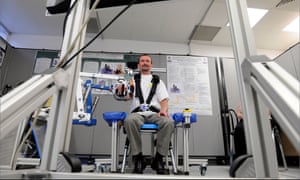
Stroke rehabilitation patient Neil Russell uses the iPAM (intelligent pneumatic arm movement) robot at Leeds General Infirmary. The robot is being developed to help people who have had strokes. Photograph: Christopher Thomond for the Guardian

Robots and surgery


The prospect of automated technologies replacing frontline surgical staff is less immediate, but it is happening. In the private sector, a company in the US, for example, has developed a non-invasive CyberKnife to use in tumour treatments. Instead of cutting out a tumour, the CyberKnife eliminates it by targeting it with a precise beam of high-dose radiation. Where such cobots are used, however, the surgeon is almost always on hand.


Among the early adopters of robotic methods in the UK is Dr Christopher D’Souza, a hair transplant specialist at the London-based clinic Ziering Medical. D’Souza uses ARTAS, an outpatient procedure developed in the US that extracts individual hair follicles from the back of a patient’s head and then implants them towards the front.


“FUE [follicular unit extraction] involves anything up to 2,500 grafts, which, when done manually, can take three or four hours. That’s tough on my eyes and neck. With the robotic method, there’s absolutely no surgeon fatigue,” says D’Souza.


Using this automated system enables him to focus more on patient care, communication and team management, while also allowing him to redeploy one of his two assistants, he says. Not all clinicians are as comfortable with the robotic method, he admits, with many arguing that it “takes away the impression that the surgeon knows best”.


Related: How air pollution affects your health – infographic


It may only be a matter of time before we see greater use of such robotics in the NHS. However, the nascent nature of the field means that it remains a tough argument to sell clinical robotics on the basis of comprehensive cost-benefit analysis, says Mike Ouren, a cobot expert at US-based robotics firm Precise Automation. The results data simply doesn’t exist yet to compare patient outcomes for robotic surgeries with traditional methods.


“There’s a financial question around how effective is a robot in terms of the amount of money it costs and the support staff required versus whether or not we’re getting more surgeries through the hospital and so forth,” he says.


For James Kippenberger, head of market development for BigHand, the efficacy of automated tech has less to do with the tech itself and more to do with how health professionals interact with it. “These projects rarely if ever fail because of the software or hardware,” he argues. “The key determinant of success invariably relates to human behaviour.”


As a new generation of tech-savvy professionals enter the health service, he is confident that co-working – the day-to-day interaction between man and machine, individual and automaton – will become more commonplace. Until then, it’s imperative that automated systems are implemented with clear directions, full communications and appropriate training.


In the case of University Hospitals Bristol NHS Foundation Trust, the initial resistance of secretaries more or less vanished once they saw their workload reduce, according to Michael Milton. Over time, resistance among frontline surgical staff to automated equipment will likely reduce, too. That leaves just one critical audience to be convinced: patients themselves.


Why your NHS surgeon could be a robot in the future

6 Temmuz 2014 Pazar

EU working time rules a "mistake" that prevents junior medics obtaining adequate experience, says top surgeon

He has now written a guide about his career as a neurosurgeon, entitled Do No Harm, and earlier this yr disclosed he had made the decision to retire from the NHS soon after management banned him from sporting his wristwatch.


When asked no matter whether younger doctors had been offered sufficient expertise in coaching right now, Mr Marsh informed an audience said: “No, they’re not.


“It is a fear. What is indicates is the new generation of young consultants are a lot less skilled.


“At the minute I’m fairly positive junior medical professionals are not working enough. The European operating time directive is a blunder.”


He additional: “The difficulty is now my students face is that they operate 48 hours a week and are significantly, significantly much less experienced than I was at their stage.


“They don’t have continuity of care, they don’t comply with individuals via in the way we used to. I believe that’s all very undesirable.


“But they invest the entire night on the phone. My juniors are used as a brain scan reporting services for the whole location, so they get no sleep at all.


“Most of their time is spent handing out very simple health-related advice to quite inexperienced casualty physicians.”


Mr Marsh, who plans to continue educating around the globe when he retires, stated he also believed physicians improved in their later career, gaining empathy and insight into the patients’ own maladies as they aged.


“I like to think they’re like a good red wine,” he added. “They get far better with age.”


His memoir, Do No Harm: Tales of Daily life, Death and Brain Surgery, is out now.


EU working time rules a "mistake" that prevents junior medics obtaining adequate experience, says top surgeon

3 Haziran 2014 Salı

Best surgeon sacked right after allegedly harassing two female trainee medical professionals, tribunal hears

“I feel the claimant had sought to engage in inappropriate conversations of a personalized nature with (the medical doctors) and had tried to persuade them to meet privately with him. In addition, he had, I believed, told them each to maintain these matters amongst them secret,” Dr Thomson said.


She added: “Worst of all, the claimant had sought to influence the junior physicians by implying that their careers may be affected if they did not comply with his requests to meet, or would be enhanced if they complied with the requests to meet outside of function hours and at his residence.


“As junior doctors, they have been in a vulnerable position in relation to the claimant and their careers would have been hard won and very dear to them. To try to exploit this was wholly wrong.”


Dr Thomson stated the ladies, who are not able to be named, “felt intimidated by the advances created by the claimant”, and that his conduct had been “unwanted and had triggered them anxiousness and distress”.


One of the females alleged the unmarried surgeon touched her inappropriately on the leg in a failed sexual advance in his office, whilst the other explained he sent her “persistent” text messages asking her to come over to his house soon after perform.


Dr Thomson said: “The two medical doctors explained how the claimant’s position and influence with the Yearly Assessment of Competence Progression approach had been referred to on numerous occasions and that they had understood that their ARCP would endure if they did not agree to devote social time with the claimant.”


The ARCP is a formal assessment used to determine how well a trainee doctor is progressing in their coaching, the tribunal heard.


Dr Thomson stated the accused advisor had referred to as one particular of the ladies “a liar” and claimed the two had colluded to destroy his profession when he was hauled just before the disciplinary hearing.


“In essence, the claimant denied he had behaved in the way alleged by (the physicians) and he said the incidents they described had basically not happened,” explained Dr Thomson, director of children and women’s services at the hospital Believe in.


She continued: “I in the end concluded that each (doctors) were credible witnesses. I discovered no evidence to substantiate the claimant’s argument that the junior physicians had colluded with every single other.


“I believed (the doctors) and I believed the claimant had behaved in the way they described. I identified the claimant’s perform, aside from getting intimidating and upsetting, amounted to sexual harassment.”


The advisor was located guilty of gross misconduct and sacked with instant impact in December 2012.


Now, he is suing the NHS Believe in for unfair dismissal, breach of contract, racial discrimination, sexual discrimination, and loss of wages at Reading through Tribunal Centre, Studying, Berkshire.


The advisor claims the allegations were fabricated as portion of a cynical move by the Trust managers to force him out of his occupation amid budget cuts.


Nonetheless, Dr Thomson mentioned she was unaware of the planned restructuring of his department at the time she sacked him, and pointed out that his dismissal induced “quick-phrase troubles” at the hospital in which he worked.


The 3-week tribunal continues ahead of Employment Judge Andrew Gumbiti-Zimuto. The tribunal manufactured an buy precluding the naming of the claimant or anything at all which may possibly identify him for the length of the proceedings.


Best surgeon sacked right after allegedly harassing two female trainee medical professionals, tribunal hears

30 Mayıs 2014 Cuma

The pioneering surgeon who healed guys scarred by war, a new monument created in his honour - and the impressive twist of fate that hyperlinks them

In the finish McIndoe and his team in West Sussex “fixed up” 649 servicemen – men who underwent such revolutionary treatment method that they rakishly dubbed themselves The Guinea Pig Club.


Their disfigurement meant the chance of getting shunned by sweethearts and buddies, their lives blighted. So McIndoe not only treated them, he also stood up for them. “He had enormous battles with the authorities,” says Montfort Bebb, now 86. “He stated, ‘You treat my boys effectively.’ He even had a keg of beer for them in the ward. He had to give them the odd dressing-down, they were young men – they did misbehave – but they loved him.”


Such devotion suggests that handful of guys more richly deserve being immortalised in bronze than Sir Archibald McIndoe. But by the time, two years in the past, that Jacquie Pinney, chief executive of the health care analysis charity Blond McIndoe, began a campaign to erect a statue to McIndoe, his name and popularity had faded from the public eye.


The charity was founded in 1961 by the industrialist Neville Blond, who lived close to East Grinstead and noticed McIndoe’s operate there first-hand. He admired how McIndoe had taken present, primitive, plastic-surgical treatment tactics and pioneered new techniques that transformed not only the lives of his sufferers, but also the total area of reconstructive surgery.


But despite McIndoe’s achievements, there have been no statues or monuments to his honour, even in his native New Zealand. “There was practically nothing,” says Pinney. “I felt it was long overdue.”


Hence when she known as Martin Jennings, the acclaimed sculptor of the considerably-loved John Betjeman statue in St Pancras station, she was worried that he would not know who McIndoe was: “I assumed he would consider, ‘Who are these weird folks calling from East Grinstead?’”


When she got by way of to him, he went quiet on the line, apparently confirming her worst fears. She require not have anxious. “It was incredible,” says Jennings now. “She imagined that I would by no means have heard of McIndoe. But in truth I knew all about him.”


Above the program of the ensuing conversation, Martin Jennings relevant how his father, Michael, had been a tank commander in the war. On the afternoon of October 17 1944, with the Allies bearing down on the Maas canal, he was leading a troop of four tanks from the 15/19 King’s Royal Hussars on a push by means of heavily fortified German positions east of Eindhoven, in the Netherlands.


All of a sudden his Cromwell tank was hit by a shell. The driver was wounded but, determined to press on, an undaunted Jennings switched to another tank and continued the advance. He was significantly less lucky second time round. The shell that hit his commandeered tank killed its driver. As the armoured automobile erupted into flames, Jennings himself was badly burned. He had small time to reflect on his issue.


“In his diary he recorded that the Germans have been ‘coming on a bit’,” says his son. “I consider that’s a euphemism for massive numbers of them trying to kill him.”


Below hefty machine-gun fire, he produced it back to his personal lines. From there he was evacuated to the Queen Elizabeth Hospital in Birmingham, where his head and his hands were completely bound in bandages. He was 23.


His sisters visited and fed him grapes by way of a mouth‑hole in the wrappings. But he also acquired one more visitor – Archie McIndoe, who was on one of his typical excursions of the nation to see if there had been sufferers that he may well be capable to assist.


Michael Jennings was unusual for a Guinea Pig, in that he was not an airman. None the much less, he was transferred to East Grinstead and, over the course of the next two many years, underwent a host of skin grafts and reconstructive procedures at the hands of McIndoe and his fellow surgeon, Percy Jayes.


At the outset, Michael Jennings’s morale could hardly have been reduce. His sisters found him staring into a mirror, repeating: “I’m burned to a crisp. I’m burned to a crisp.”


But, as his son notes, “McIndoe had this outstanding capacity to transfer his self confidence to his patients.”


Jack Perry can don’t forget that golden touch: “He sat on my bed and kindly spoke to me. He explained: ‘I see you play a whole lot of sport. Properly, you are going to perform once again. Perhaps not as well, but you definitely will play.’”


That ability to lift spirits was an important component of the McIndoe treatment. “His sufferers, like my father, have been such younger males,” says Martin Jennings. “They have been hoping to get married, have young children and a normal daily life. Out of the blue they have been plunged into the prospect of a existence of passivity and victimhood. But McIndoe was so upbeat. His ethos was that these horrible injuries did not mean that their lives have been over.”


Michael Jennings was 1 of individuals who, with McIndoe’s support, refused to accept that his daily life was more than. In 1952, he received married, and he and his wife had 11 young children.


These days, Martin Jennings describes his loved ones connection and the call from Jacquie Pinney as “an astonishing coincidence”. She had discovered in the sculptor a man who had lengthy nursed the concept of producing a monument to the guy who had cared for his father and overseen “significant improvement to the decrease half of his encounter – to his nose, mouth, lips”.


Certainly it is a hardly a stretch to recommend that with out McIndoe, Michael Jennings may in no way have married, and his sculptor son may possibly never have been born.


It has taken two years considering that that 2012 telephone contact for the project to come to fruition. On one particular research journey to East Grinstead, Jennings asked for data from the war. There he turned up a file featuring a familiar face. For 10 many years right after he was burned, Michael Jennings refused to be photographed. But there, in the hospital files, have been photos from that lost decade that McIndoe had taken to plan and perform his operations.


“That was really moving,” says Jennings. “I was seeking at photos of my father, and he was the exact same age in the pictures as my very own sons have been in true lifestyle. I discovered myself feeling a sense of paternal protectiveness to my own father. That was very much McIndoe’s spirit. He was a father to these guys. This is a story of fathers and sons.”


With that exact same protective spirit, McIndoe would send the men below his care into East Grinstead, to stroll the town, drink in the pubs, attend events – just like other younger guys. And the folks of East Grinstead, to their immense credit, learned to welcome these disfigured males in uniform. Now it is identified as “the town that did not stare”.


Jennings’s McIndoe memorial is, as a consequence, an arrangement of two somewhat bigger than life-size figures. Seated is a airman, his burned hands clawed collectively, his scarred encounter turned to 1 side. Standing behind him, resting a reassuring hand on every single shoulder, is the figure of McIndoe.


They are framed by a stone bench. “When the nearby individuals sit on that lengthy curved seat, they comprehensive the monument,” says Jennings. “This is a tribute to Archie McIndoe and the Guinea Pigs, but it is also a tribute to the individuals of East Grinstead.”


Michael Jennings, like numerous of the Guinea Pigs, went on to outlive by far the man who had so helped him. He died in 2002, aged 82, after a lengthy submit-war profession as a instructor. He too, will live on in the memorial. Though the figure of the airman is not based on any a single guy, Martin Jennings modelled the burned hands on individuals of his father.


The result, says Montfort Bebb, would have enormously pleased her very own father, Archie McIndoe. Not that he subscribed to theories of “greatness”.


“He mentioned that greatness is just challenging work – attention to detail and a lot of hard perform. He possibly worked himself to death. But he by no means talked about his very own health. He was just devoted to medicine and patching up these poor boys.”


Go to mcindoememorial.com to make a donation


The pioneering surgeon who healed guys scarred by war, a new monument created in his honour - and the impressive twist of fate that hyperlinks them
Cycle helmets are useless, says brain surgeon

“I see lots of men and women in bike accidents and these flimsy small helmets do not aid.”


Mr Marsh stated that he had been riding his bike for forty many years, sporting a cowboy hat, and had only fallen off after.


“I have been cycling for forty many years and have only been knocked off after. I put on a cowboy hat and cowboy boots. I seem totally mad.”


Marsh, who retires in March, also admitted jumping red lights to get ahead of the targeted traffic.


“It’s my life at threat,” he said, ‘So I routinely cross over red lights.”


Cyclists travel all around three.1 billion miles each and every 12 months in Britain. Lights and reflectors are a legal obligation after dark, and reflective jackets an more and more common sight.


But helmets are not compulsory in the Uk, in contrast to in Australia and components of the US, yet the government encourages cyclists to wear one particular.


Study carried out by Dr Ian Walker, a professor of targeted traffic psychology at the University of Bath, showed that motorists drove close to 8cm closer when overtaking cyclists with helmets.


He advised that drivers think helmeted cyclists are much more wise, predicable and seasoned, so consequently the driver isn’t going to need to have to give them significantly space when overtaking.


Non-helmeted cyclists, specially non helmeted “women” are significantly less predictable and seasoned, in accordance to this review and so motorists give them much more room.


Nevertheless, Mr Marsh’s remarks are most likely to anger cycling safety campaigners, who believe that helmets give crucial protection on Britain’s hectic and narrow roads.


James Cracknell, the Olympic rowing gold medalist, was virtually killed whilst cycling in 2010 following he was hit by a petrol tanker.


He has said that he only survived the accident because he had been wearing a helmet and has described individuals who do not wear one particular as “selfish” as their actions can effect their loved ones.


“From a personal point of see I would be dead if I hadn’t worn a helmet,” he mentioned. “A wing mirror smashed into my skull at 70mph.


“There is no downside to wearing a helmet except possessing messy hair. And you have to keep in mind that eight out of 10 children who have cycling accidents are not on the road.


“Even if you will not care enough about yourself to wear a helmet other people care about you.”


A Division of Transport examine has shown that helmets could prevent ten-sixteen per cent of cyclist fatalities, though this was also an estimate primarily based on a small study.


Angie Lee, Chief Executive of the Bicycle Helmet Initiative Believe in said: “I hope he is going to consider obligation for the cyclist who will get injured since they get their helmet off following his comments.


“This might be his opinion but there are a great deal far more neurosurgeons and surgeons who would counter that argument.


“My suggestions would be the identical as the Division of Transport’s which is that helmets have a spot in safeguarding the head.”


Marsh, who retires in March, also admitted jumping red lights to get ahead of the site visitors.


“It’s my life at danger,” he explained, ‘So I regularly cross in excess of red lights.”


Cycle helmets are useless, says brain surgeon

23 Mayıs 2014 Cuma

Surgeon utilizes Google Glass throughout cancer operation


Mr Shafi Ahmed, Colorectal Cancer Lead at Barts Health NHS Trust, wore the glasses which allowed his view to be broadcast live to 13,000 surgical students around the globe who were able can interact and put their questions directly to him as he performed the operation.


The students typed their questions online as they watched, and their queries appeared on the bottom left-hand side of Mr Ahmed’s Google Glasses who answered them verbally, transmitted via the online feed.


The questions appear to the side of the Google Glass so it does not restrict the surgeon’s view.


In an online questionnaire, 90 per cent of students who watched the live broadcast said that they wanted this type of learning to be part of the curriculum.


Surgeon utilizes Google Glass throughout cancer operation

Surgeon makes use of Google Glass throughout cancer operation


Mr Shafi Ahmed, Colorectal Cancer Lead at Barts Health NHS Trust, wore the glasses which allowed his view to be broadcast live to 13,000 surgical students around the globe who were able can interact and put their questions directly to him as he performed the operation.


The students typed their questions online as they watched, and their queries appeared on the bottom left-hand side of Mr Ahmed’s Google Glasses who answered them verbally, transmitted via the online feed.


The questions appear to the side of the Google Glass so it does not restrict the surgeon’s view.


In an online questionnaire, 90 per cent of students who watched the live broadcast said that they wanted this type of learning to be part of the curriculum.


Surgeon makes use of Google Glass throughout cancer operation

First operation streamed dwell with surgeon sporting Google glass

As the concerns seem to the side of the Google Glass there is no risk to the patient as it isn’t going to restrict the surgeon’s view.


Mr Shafi Ahmed, Colorectal Cancer Lead at Barts Wellness NHS Believe in and Associate Dean at Queen Mary University of London, Barts and The London College of Medication and Dentistry performed the operation.


He said: “I am delighted that by making use of Google Glass technologies we are transporting our future surgeons directly into the working theatre. Making use of this technologies will assistance us to supply high-top quality and protected care now and in to the future.”


Professor Richard Trembath, Vice-Principal for Overall health at Queen Mary University of London, said: “We are thrilled to be involved in the initial live-streamed surgical process taking spot in the Uk.


“This is a pioneering piece of function, enabling us to broaden our reach around the globe. We feel harnessing technologies in this way will eventually turn out to be a core component to the cutting-edge undergraduate and postgraduate teaching we supply our students and trainees.”


The Google Glass provides viewers a surgeon’s-eye see of the process from starting to end, as effectively as providing insight into how an operating theatre operates. People viewing had been also capable to observe medical college students from Queen Mary University of London as they assisted in the procedure.


In an on the internet questionnaire, 90 per cent of students who watched the live broadcast mentioned that they desired this variety of finding out to be portion of the curriculum.


Hemant Kocher, Advisor Liver Surgeon at Barts Wellness NHS Believe in and Reader in Liver and Pancreas Surgery at Queen Mary University of London, eliminated the cancerous tissue in the patient’s liver which had spread from the bowel.


Hemant added: “I am very enthusiastic about this new way of teaching. We are now capable to demonstrate this expert mixed operation of liver and bowel which is only achievable in a specialist hospital this kind of as The Royal London due to our professional crew operating with each other.”


Roy Pulfer, 78, from Chadwell St Mary, near Tilbury, agreed to have his operation broadcast around the globe.


He mentioned: I’m content that it will support educate youthful men and women. They like employing engineering so it’s excellent for them. The employees have been wonderful to me all the way and explained each and every step of the operation so plainly.”


Professor Norman Williams, President of the Royal School of Surgeons mentioned: “Today we received a glimpse of what technologies can do for the future of surgical training.


“The unique and unparalleled view of an operation means trainee surgeons know much better what to assume when they go in to the working theatre. There is prospective for trainee surgeons from close to the planet to watch and learn from leading surgeons in their fields of skills.”


First operation streamed dwell with surgeon sporting Google glass

11 Nisan 2014 Cuma

A day in the existence of ... a children"s orthopaedic surgeon

Jim Huntley

‘The operating theatre is a stunning spot – the epicentre of exercise,’ says Jim Huntley.


Children’s orthopaedic surgery, paediatric orthopaedics, is a tiny sub-speciality concerned with surgery for musculoskeletal trauma, soreness and deformity. Children are not just small grownups – and they deserve the very best that humankind has to give. I function in 1 of the hubs, at the royal hospital for sick kids in Glasgow, where 6 consultants share the on-call (one week in 6), serving a massive population.


The alarm is set for 6.29am and placed far out of attain, so that to flip it off I in fact have to get up. I snatch some cereal and hopefully a quick second with my very own kids ahead of driving to function, listening to the Nowadays programme. I arrive at 7.30am, as the canteen opens, and pick up my very first coffee of a caffeine–fuelled day. I have three-quarters of an hour administration ahead of the 8.15-eight.30am trauma meeting – the place the on-call registrar presents the earlier 24 hours’ admissions, mostly sufferers with fractures.


This is a management and organizing meeting but also important for learning and instruction. The trainee registrars are lightly grilled deficiencies in knowledge are probed and the on-call day is planned. The meeting has to be incredibly centered. We would begin it at 8am but this would render us non-compliant with the European Operating Time Directive/New Deal – an example of a poorly imagined-out leading-down directive having unforeseen consequences compromising coaching and care. Most frustrations in our support stem from well-meant directives that are inappropriate or unworkable – this generates a huge quantity of time and hard work in bureaucratic fire-fighting.


My working week is split into 10 half-day sessions: 3 working, four clinic, two administrative, one particular supervisory/educating/analysis. Soon after a ward-round of inpatients eight.30-9am, my favourite morning clinic is the plaster clinic – for patients (specifically these with clubfeet, developmental dysplasia of the hip (DDH) and cerebral palsy) whose treatment method involves serial changes of casts, harnesses or splints. It is intensely practical, so I am lucky to operate with a wonderful crew of plaster nurses, a group whose technical expertise are typically taken for granted.


Packed lunch is in front of a computer, catching up on paperwork and emails. From 1pm, I see patients (and parents) just before their operations. There is the pre-operative brief with the anaesthetist and theatre staff at 1.30pm. The operating-theatre is a lovely location, the epicentre of action, yet again staffed by a highly skilled and minor shifting group. An afternoon record usually entails two tiny situations and one particular longer a single, finishing at 5pm.


Our theatre has a excellent see across the river: Glasgow University, in front of which, barely 400m away, is the statue of Joseph Lister, professor of surgical treatment. With a modest patient series of open fractures Lister launched the world to antisepsis, opening the age of present day surgical procedure.


Following a submit-operative ward round of patients, there is usually time to overview the focused piles of investigations and scans, organised by a amazing secretary. I depart function at about 7pm, a great time to miss most of the visitors.


Sport has often been a necessity for me, and I will do half an hour on the rowing machine at least every single other evening. At the weekend I actually appreciate taking part in squash with my kids. I wish I was a lark, but I am in truth an owl, and do most of my written perform in the little hours – it truly is a very good time to target. Everybody else is asleep.


Are you a member of our on-line community? Join the Healthcare Professionals Network to acquire normal emails and unique provides.


A day in the existence of ... a children"s orthopaedic surgeon

13 Şubat 2014 Perşembe

Surgeon struck off in Britain banned from practising and fined in New Jersey

A doctor who fled to the US from Britain after becoming convicted of manslaughter has once more been banned from practising and fined almost $ 500,000, for injuring patients with surgeries he was not competent to execute.


Dr Richard Kaul was stripped of his American licence at a meeting of New Jersey’s board of health-related examiners, which also ordered him to pay $ 300,000 in civil penalties and $ 175,422 to reimburse the state for legal charges and investigation expenses.


John Hoffman, the acting New Jersey lawyer common, explained the board’s selection would defend the public “from a person who place sufferers in harm’s way, and very candidly had no qualms or remorse about repeatedly performing so”.


“Dr Kaul’s sufferers in truth did sustain extra maladies as effectively as uncorrected health-related problems, as a direct end result of Dr Kaul’s improper procedures,” Hoffman mentioned in a statement after the verdict, which confirmed a 3-month skilled prosecution of Kaul last 12 months.


Kaul, 49, became a multimillionaire right after arriving in the US and reinventing himself as a pioneering keyhole spine surgeon, in spite of his only hands-on education getting a two-week course in South Korea. He manufactured errors that left numerous sufferers unable to walk or work.


He had been advised by a London judge in 2001 that his profession was “in ruins”, when he was discovered guilty of creating the death of Isatu Bangura, who suffered a cardiac arrest after he injected her with sedatives and failed to keep track of her issue while she had dental function accomplished.


New Jersey state prosecutors argued that Kaul had performed complicated surgical treatment with “flagrant disregard” for his inadequate qualifications, citing the circumstances of 11 individuals who claimed to have suffered mistreatment at his hands amongst 2005 and 2012.


Judge Howard Solomon agreed in his determination in December that Kaul “never need to have performed any spinal surgeries,” and had engaged in “gross negligence, gross malpractice and gross incompetence” by operating on individuals “without enough training, expertise and competence”.


The case raised fresh considerations about the safety of ambulatory surgical centres (ASCs) like Kaul’s, which supply quicker and much less expensive operations than classic hospitals but are not topic to the identical inspections and checks, and have been criticised by patient watchdogs.


In 2012 New Jersey governor Chris Christie vetoed a bill passed by state legislators that would have ensured all ASCs had been regulated, partly on the grounds that it would value as well a lot for his administration to inspect them.


Kaul presently owed a former patient practically $ 1m following a profitable lawsuit, as properly as hefty unpaid tax payments. He is also becoming sued by Geico, a major insurance coverage organization, which claims he improperly billed it for surgeries. Kaul denies the allegation.


“The state proved its allegations and we’re pleased the Board has enacted the Court’s recommendation of licence revocation,” stated Eric Kanefsky, the director of the New Jersey lawyer general’s division of buyer affairs, said of the board’s selection.


“Dr Kaul’s actions are an affront to medical professionals who commit many years learning and education so they can effectively care for their sufferers.”


Surgeon struck off in Britain banned from practising and fined in New Jersey

12 Şubat 2014 Çarşamba

New Jersey regulators move to bar British surgeon struck off in Uk

A physician who was banned from practising in Britain following becoming convicted of the manslaughter of a patient fled to the US, reinvented himself as a pioneering spine surgeon and severely injured a quantity of individuals, in accordance to a damning report commissioned by state authorities in New Jersey.


Dr Richard Kaul was advised by a judge in London in 2001 that his profession was “in ruins” when he was identified guilty of causing the death of Isatu Bangura, who suffered cardiac arrest following he injected her with sedatives and failed to keep track of her condition.


Yet he moved to the United States and became a multi-millionaire by restyling himself as an skilled in rewarding keyhole back surgical treatment, regardless of his only hands-on coaching in the specialism being a two-week course in South Korea.


Kaul, 49, was due to be stripped of his licence at a meeting of New Jersey health care regulators on Wednesday following becoming ruled a “danger to the public” by a judge as part of a 3-month specialist prosecution by state authorities.


“He never should have performed any spinal surgeries,” Judge Howard Solomon wrote in a 105-webpage determination, concluding that Kaul engaged in “gross negligence, gross malpractice and gross incompetence” by working on sufferers “without enough instruction, abilities and competence”.


Kaul’s repeated violations of the laws and laws governing physicians in the state “warrant absolutely nothing much less than the revocation of his medical licence”, the judge concluded.


The situation has raised considerations about the security of ambulatory surgical centers (ASCs) like Kaul’s, which provide very same-day procedures that are quicker and significantly less costly than in conventional hospitals, but are not topic to the identical regime of inspections and checks.


In 2012, New Jersey governor Chris Christie vetoed a bill accredited by state legislators that would have ensured all such surgeries in the state were regulated, partly on the grounds that it would cost too considerably for his administration to inspect them.


David Knowlton, president of the New Jersey Wellness Care Quality Institute (NJHCQI), a non-revenue watchdog group, said that harmful medical doctors such as Kaul “probably would have been caught” under the vetoed regulation regime.


A dossier for the prosecution presented by one particular of Christie’s deputy lawyer generals argued that Kaul had performed complicated surgical treatment with “flagrant disregard” for his inadequate qualifications.


It thorough the instances of 11 individuals who claimed to have suffered mistreatment at his hands among 2005 and 2012. Numerous of them limped to the witness stand to testify towards Kaul and fought back tears during hearings at the office of administrative law in Newark last 12 months.


Kaul had charged them tens of thousands of dollars for operations such as the fusing with each other of troublesome vertebrae. Some did not even need to have the surgeries, the judge ruled, even though other individuals suffered botched procedures that had to be redone right after they caused excruciating soreness.


James Jarrell, a 62-yr-old former development employee at Ground Zero, mentioned he felt “crippled” right after a fusion by Kaul – which was later declared pointless – left him struggling to stroll and unable to operate. “He was terrible,” mentioned Jarrell. “I can barely carry myself to phone him a doctor”.


Study compiled in 2011 by the NJHCQI discovered that a single in 4 ambulatory surgical centers in the state had been cited by the department of wellness for “immediate jeopardy”, meaning that their failure to comply with regulations had induced, or was most likely to trigger, “serious injury, harm, impairment or death to a patient”.


Surgeries had been inadequately sanitised, workers were recorded “walking through the sterile working room in street clothes”, data were not appropriately finished, and single-use healthcare products was utilised “more than as soon as, on far more than one particular patient”, according to the investigation.


“I would not advise any of my close friends or family members to have surgical treatment or procedures accomplished at any unlicensed surgical practice,” Knowlton stated at the time. An energy to tighten the regulations on ASCs collapsed in the state assembly last 12 months.


Kaul was also left free of charge to practise in spite of New Jersey authorities suspending him for 6 months and fining him $ 10,000 in 2003 when they discovered by way of a tipoff that he had failed to declare his English manslaughter case on his application to renew his American health-related licence.


Kaul mounted an elaborate PR campaign to fight off the allegations, claiming to be the victim of a political conspiracy co-ordinated by Christie and mainstream spine surgeons who, he stated, were resentful after shedding enterprise to him. “This just goes to demonstrate that in New Jersey you can not get a fair shake if you are on the wrong side of the political establishment,” he mentioned shortly following the judge’s verdict was published.


Kaul published glossy pamphlets and petitions that purported to show signatures of pleased customers. He wrote a string of information articles or blog posts defending himself, and posted publicity movies, like 1 exhibiting an obvious former patient happily skiing.


He published secret surveillance footage of an additional patient, attempting to demonstrate that her injuries had been faked, in spite of the clip displaying she was bent double. His publicist even posed as a journalist and interviewed a state health-related official in an energy to expose the supposed conspiracy.


In the end, nevertheless, he failed to rebut the allegations. “It has been confirmed, properly past a preponderance of the credible proof, that [Kaul] not only poses a danger to the public, but has violated numerous statutes and regulations governing the practice of medication and surgical treatment in this state,” wrote Solomon.


Now owing hundreds of thousands of dollars in legal fees, damages and unpaid taxes, and with his surgery in New Jersey bankrupted, a defiant Kaul stated that he planned to concentrate on treating poverty-stricken people in Congo, as portion of The Spine Africa Project, a charity he founded. “I do not see why it must cease me assisting people with my capabilities,” he explained of the judge’s determination.


New Jersey regulators move to bar British surgeon struck off in Uk

10 Şubat 2014 Pazartesi

Surgeon generates pelvis using 3D printer


Craig Gerrand, a consultant orthopaedic surgeon at Newcastle Upon Tyne Hospitals NHS Believe in, used the procedure on a patient in his 60s who had to have half his pelvis eliminated to end the spread of bone cancer.


Scans permitted his group to measure specifically how significantly bone would be removed. A bespoke replacement to fill the gap was then created on a 3D printer by laying down successive layers of titanium powder fused together with laser. The titanium pelvis was coated with a mineral into which the remaining bone could expand and a normal hip substitute was fitted into the new socket.


The patient suffered from a rare bone cancer referred to as chondrosarcoma.


“Considering that this cancer does not reply to medicines or radiotherapy, the only selection was to get rid of half of the pelvis,” stated Mr Gerrand.


Standard implants do not constantly match properly – and in this situation so a lot bone essential getting rid of that practically nothing would have been left to which an implant could have been connected, the surgeon explained.


Surgeon generates pelvis using 3D printer

14 Ocak 2014 Salı

MPs should measure themselves to check if they are obese a Lord and major surgeon has said

He stated that there had been rather too a lot of portly bellies observed all around the halls of Westminster and that measuring thier waistline and towards their height was a basic way to check no matter whether they were a healthier dimension.


“At the end of the day you are not able to be obese unless of course you are consuming too significantly – and it seems to be negative if MPs are telling men and women what to do and are obese themselves.


“It is an essential issue and we notice fairly a bit of weight problems in the ranks and, they are eating too a lot of the gross nationwide merchandise. .


“It is killing hundreds of thousands of people, its costing billions and the price is cost-free – consume less and consume more healthily. I hereby empower folks – all they have to do is place significantly less meals in their mouths.”


This week the Nationwide Weight problems Forum warned that Britain’s obesity crisis could be worse that feared with a report suggesting that predictions that half the British population will be obese by 2050 ”underestimate” the scale of the crisis.


In the same debate Lord Tebbit blamed people’s “personal stupid actions” in eating “rubbish” food items for the rise in weight problems. The former Conservative Cabinet minister lashed out at those who “stuff themselves silly” at question time in the Lords.


He advised peers: “Individuals ought to know that if they stuff themselves silly with high calorie rubbish foods they will get body fat.”


“It is their accountability and all the forums and other nonsenses are just making an attempt to divorce men and women from the consequences of their very own stupid actions.”


MPs should measure themselves to check if they are obese a Lord and major surgeon has said