Seek etiketine sahip kayıtlar gösteriliyor. Tüm kayıtları göster

29 Nisan 2017 Cumartesi

Hundreds of private patients seek compensation from rogue surgeon

Hundreds of private patients of a surgeon convicted of carrying out needless breast operations are seeking compensation after nearly £18m worth of claims were made against the NHS.


Ian Paterson, 59, was convicted on Friday of 17 counts of wounding with intent and three counts of unlawful wounding against 10 patients, upon whom he conducted “extensive, life-changing operations for no medically justifiable reason”.


More than 250 NHS patients have received payouts after being treated by the surgeon and it has now emerged that around 350 patients who underwent treatment privately at clinics owned by Spire Healthcare in the West Midlands are also taking civil action against Paterson and the firm.


Paterson, described in court by one victim as being “like God”, lied to patients and exaggerated or invented the risk of cancer to convince them to go under his knife.


Thompsons Solicitors, a firm representing the private patients, said the Spire Healthcare’s treatment of those who complained was “shabby”.


“We are determined to secure appropriate compensation for every single one of our clients, some of whom found the courage to come forward only as recently as four weeks ago,” said Linda Millband, lead national lawyer at the firm.


“Spire needs to face up to its responsibilities, because they let him operate well after he was suspended by the NHS.”


A freedom of information request revealed the NHS has resolved 256 cases, paying out £9.5m in compensation and £8.2m in costs, while a further 25 cases are still to be heard.


Paterson, who was suspended by the General Medical Council in 2012, lied to patients and exaggerated or invented the risk of cancer in order to convince them to go under the knife.


He sobbed as the jury returned the guilty verdicts on Friday at Nottingham crown court. The surgeon was released on conditional bail ahead of sentencing in May, when he faces a custodial sentence.


One patient who gave evidence in the trial had 27 biopsy cores taken from her healthy right breast and had “absolutely not” received medical best practice.


A Spire Healthcare spokesman said: “What Mr Paterson did in our hospitals, in other private hospitals and in the NHS, absolutely should not have happened and today justice has been done.


“We would like to reiterate how truly sorry we are for the distress experienced by any patients affected by this case. We can say unequivocally that we have learned the lessons from these events.


“We commissioned a thorough independent investigation and have fully implemented all of the recommendations.”


Hundreds of private patients seek compensation from rogue surgeon

20 Mart 2017 Pazartesi

Pregnant women without legal status "too afraid to seek NHS care"

Hundreds of pregnant women without legal status are avoiding seeking NHS antenatal care because of growing fears that they will be reported to the Home Office or face high medical bills, according to charities that work with vulnerable migrant women.


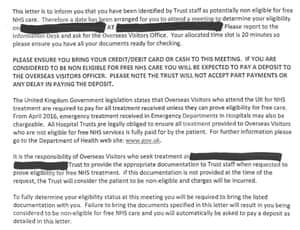
The Guardian has seen letters from one NHS trust sent to women with complex asylum claims warning they will have their antenatal care cancelled if they fail to bring credit cards to pay fees of more than £5,000 for maternity care. These letters contravene NHS guidelines, which state that maternity care should never be denied.


Doctors of the World, which runs clinics for trafficked women, undocumented migrants and asylum seekers whose claims have been rejected, is seeing increasing numbers of women seeking medical help at its clinic in east London in the late stages of pregnancy, who say they are too scared to go to the NHS for fear of high bills or of being reported to the Home Office.


In January, a woman came to the charity’s east London clinic already in labour, having received no antenatal care. “She was very fatigued, she was pale. She had been too frightened to go to hospital because of her immigration status,” said Deman Le Déaut, who runs the women’s and children’s clinic in Bethnal Green.


She was the second woman in four months who had come to the clinic for the first time, at the end of the pregnancy, who had not sought mainstream healthcare. “We are seeing a lot of women six months’ pregnant onwards not accessing medical care. That is incredibly dangerous,” Le Déaut said.


One patient, an asylum seeker from Eritrea, was homeless and living in a bus shelter when she visited the clinic in early pregnancy, having been wrongly turned away from a GP because she had no proof of address.


A number of women have visited the clinic, alarmed by debt-collection letters they have been sent by NHS trusts that instruct them to come to their antenatal appointments with money to make deposit payments of several thousand pounds for maternity care.


An extract from a letter sent out by the NHS.


An extract from a letter sent out by the NHS.

“Please ensure you bring your credit/debit card or cash to this meeting. Please note the trust will not accept part payments or any delay in paying the deposit,” one letter sent by Barking, Havering and Redbridge University Hospitals NHS trust states. “Failure to pay a deposit for treatment may result in your future appointments being cancelled. In addition, overseas visitors who incur costs for treatment and do not pay will be reported by the trust to the Home Office and debt collecting agencies. The Home Office will review all records of bad debt and this could be detrimental to any future applications to visit the UK.”


NHS rules stipulate that it is legitimate to ask for payment from those who are not eligible for free care (because they are not ordinarily resident in the UK or because they are living here illegally), but emergency treatment cannot be withheld if a patient cannot pay.


A Department of Health spokesperson said staff should be “especially careful to inform pregnant patients that further maternity healthcare will not be withheld, regardless of their ability to pay … our guidance specifically says that maternity care should never be denied or delayed while a patient’s eligibility is established”.


The Barking, Havering and Redbridge University Hospitals NHS trust said that it had recently “updated” the standard letter to make “it clearer that maternity care would never be withdrawn or appointments cancelled”.


Le Déaut said: “It is bad practice to send these letters demanding credit cards. You are not supposed to threaten pregnant women – documented or undocumented – that you are going to withhold services. We are seeing this kind of letter quite often now. These people have no means whatsoever to pay this debt.”


One patient was telephoned weekly by a debt collection agency, which had a negative effect on her mental health, according to staff at the charity.


The pregnancy discrimination charity Maternity Action runs a helpline for women in this situation and has also noted a rise in demand for its services. “We regularly hear from women who are very distressed about receiving large bills from the NHS for their maternity care. It is pointless sending letters of demand to women who can’t afford to pay for their food and housing,” said its director, Ros Bragg.


The Department of Health spokesperson said no one should be denied urgent treatment and “vulnerable people, including those seeking asylum and refugees, are not charged for NHS care they receive”.


The case of a Nigerian woman who gave birth to quadruplets at London’s Queen Charlotte’s and Chelsea Hospital and incurred a bill of several hundred thousand pounds triggered popular hostility earlier this year, but the charity stressed that its patients had not travelled to the UK in search of free medical treatment.


Sarah Pillai, a volunteer GP who works at the east London clinic, said: “This is not health tourism by any stretch of the imagination. These are people at the outer reaches of society, cleaning, cash in hand jobs, providing the infrastructure for society, but unable to access healthcare.


“The women I’ve seen tend to be very anxious and nervous. A lot of these have been women in hiding until now. Lots of these women present late in pregnancy, which has an adverse effect on their pregnancy because delayed antenatal care can create problems for the mother and baby.”


Staff said there was growing awareness among patients of a controversial memorandum of understanding jointly published by the Home Office and NHS Digital that came into effect on 1 January and set out how the Home Office could request information on immigration offenders from the NHS.


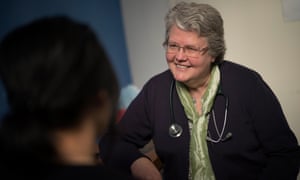
Dr Sarah Pillai


Dr Sarah Pillai, a volunteer at the east London clinic: ‘A lot of these have been women in hiding until now.’ Photograph: Sarah Lee for the Guardian

“When they hear if you go to the doctors, the Home Office might be knocking on your door, they choose to stay away,” Le Déaut said. “The results have serious implications; we see women who are nine months’ pregnant coming to our clinic. We assume that some people are giving birth at home”


She said she understood the need to ensure health tourists paid “but a trafficked woman or an undocumented migrant, who has no way of paying bills should be refused care when she is at her most vulnerable?”


Binta, a pharmacist from Sudan, arrived in 2010 to visit her husband, a doctor from Sudan who had a British passport and who had fled Sudan for political reasons. While she was trying to organise permanent residencyshe became pregnant. She was told by the Home Office that she needed to return home to apply for a new visa but did not feel able to travel because she was in the late stages of pregnancy. She was given leave to remain on appeal, but the papers did not come through immediately so she found herself ineligible for NHS treatment.


When the GP referred her for a scan, she was sent a bill for £2,669. “I was very frightened. I thought that they would deport us or that I would be sent to jail,” she said.


Her husband, who has now requalified and is working as an NHS doctor, was unemployed while he studied for UK medical exams and was receiving only £65 a week. “They kept resending the invoice; we received many letters. We couldn’t afford to pay. It distracted me from that beautiful moment of giving birth – all the time I was thinking about the money, are they going to take me to court? It is a part of my life I don’t want to remember again.”


Li arrived in the UK in 2012 after fleeing China because she was being targeted for promoting Christianity. She paid traffickers to get her out of China and arrived in the UK on a false passport. She spent more than a year locked in a house, forced to work for her traffickers, who produced illegal DVDs, to pay back some of her debts. Later she was freed and moved to live with a boyfriend. During her pregnancy, she was wrongly turned away by a GP when she tried to register because she had no papers.


“They asked me to pay £5,000 before I delivered the child. At one of my antenatal appointments, they brought me to a small room and explained I would have to pay more if I needed a caesarean. I felt very scared. There’s no way I can pay that much. I thought about not going to hospital, but I knew I couldn’t deliver a child by myself. I couldn’t cut the umbilical cord.


“When I was in the little room, explaining about the payment plan, I had to fill in a form with my immigration status, my names and address. They said they would hand that to the Home Office. I didn’t know what the Home Office would do – if they could deport me back to China. When I was in labour I was thinking about money all the time.”


She has subsequently begun the process of applying for asylum. She is not working because she is looking after a baby, so is not yet able to begin paying back her debts to the NHS.


Pregnant women without legal status "too afraid to seek NHS care"

14 Aralık 2016 Çarşamba

Theresa May pledges to seek long-term solution to social care squeeze

Theresa May has pledged to seek a “long-term solution” to the challenge of funding social care for older people, as she confirmed that local authorities would be allowed to bring forward increases in council tax to ease the pressures on the creaking system.


Challenged by Jeremy Corbyn on what he called the crisis in social care, May said her government would give councils more flexibility to raise more money in the short term – but would also seek a sustainable funding model.


“You cannot look at this question as simply being about money in the short term. If we’re going to give people the reassurance they need in the long term, it’s about finding a way forward that will give a sustainable solution for the future,” she said.


Sajid Javid, the communities secretary, is expected to announce on Thursday that local authorities will be allowed to increase council tax by up to 3% next year and the year after, with the money ringfenced to pay for social care.


The maximum increase had been 2% over each of the next three years, but councils will now be able to make upfront rises of 3% in each of the next two years.


Government sources were keen to stress that no further rises would be permitted – so the total increase in council tax over the three-year period would remain the same, at 6%.


Pressure has been mounting on Downing Street to tackle the demands on social care, since the chancellor, Philip Hammond, triggered a Tory revolt by failing to make more funding available at his autumn statement last month.


In a spirited performance at the final PMQs of 2016, Corbyn said older people were being left to live a “horrible, isolated life, when they should be cared for by all of us, through a properly funded social care system”.


He urged the prime minister to cancel planned cuts to corporation tax, which were confirmed by Hammond, and ringfence the money to fund elderly care.


Corbyn pointed out that increases in council tax raised more in wealthy parts of the country. “Raising council tax has a different outcome in different parts of the country,” he said, adding: “Is she saying that older people – frail, elderly, vulnerable older people – are less valuable in our cities than in other parts of the country?”


May insisted money was not the only answer to the problem, pointing to what she said were poorly performing councils, singling out Ealing council as an example of poor practice for failing to integrate social care with the wider NHS.


“There are also some councils across the country – some Labour councils – who have not taken that opportunity, and where we see a worse performance,” she said, pointing to a “twentyfold” difference in delayed discharges, where hospitals cannot send a patient home because there is no social care in place.


“We recognise that there are indeed pressures on social care, but we also recognise that this is not just about money; it is about delivery,” she said.


New research by the Nuffield Trust health thinktank shows that increasing the council tax precept for social care produces least benefit in the poorer parts of England where need is greatest.


Their analysis has found that this year the local councils in the ten most affluent places in England will raise almost 50% more per head of local population from applying the 2% precept this year than those covering the ten least well-off areas.


Local authorities, which are responsible for social care, have repeatedly said cuts to their funding from central government have put provision at risk.


Sarah Wollaston, the Totnes MP and chair of the health select committee, called for cross-party talks to come up with a long-term solution to the problem.


Hammond has also been considering whether to allow Javid to further boost social care by bringing forward to 2017-18 some of the £1.5bn the government has already pledged to put into the Better Care Fund in phased increases starting next April. That is the £4bn-a-year scheme, co-funded by the NHS and Whitehall and launched by the coalition government, to help keep older people healthier and reduce their risk of ending up in hospital.


However, sources close to the Whitehall discussions about that proposal, which the Local Government Association and NHS bodies have been arguing for, said it was unlikely Javid would increase the £105m injection already planned for the fund next April. One source said: “Theresa May isn’t keen on the Better Care Fund because she sees it as just more money for the NHS through the back door and more money going into the NHS black hole, even though it’s intended to relieve the pressure on overcrowded hospitals.”


Theresa May pledges to seek long-term solution to social care squeeze

5 Kasım 2016 Cumartesi

Men much less likely to seek mental health help than women

Men are far less likely to seek medical support for a mental health problem than women, new figures reveal.


A survey commissioned by the Mental Health Foundation found that not only are men far less likely than women to seek professional support, they are also less likely to disclose a mental health problem to friends and family.


The YouGov survey, the largest of its kind, polling more than 2,500 people who have had mental health problems, showed 28% of men admitted that they had not sought medical help, compared with 19% of women.


The survey found that a third of women, compared with a quarter of men, had told friends or family about their mental health problem within a month of it arising. More than a third of men, compared with a quarter of women, either waited more than two years or chose never to tell friends or family about their problem.


Mark Rowland, director at the Mental Health Foundation, said the findings showed that there needed to be a cultural shift in the approach to the issue. “Mental health is so central to our experience of being alive that if we’re ever to rise to the challenge of preventing mental health problems, it will be because men feel more able to share when they are vulnerable,” Rowland said.


“This is not about being more of a man but being more in touch with our humanity.


“It takes courage to be open and honest about mental health, but when suicide is the leading cause of death for young men, we all have a responsibility to push for cultural change.”


Dave Chawner, 27, a comedian who lived with anorexia and depression for 10 years before seeking support, backed the findings.


“It’s important to talk about gender when we talk about mental health. It is more accepted for men to deal with stress, emotions and situations with anger. Anything else is interpreted as vulnerability and shut down.”


In the past year a number of campaigns have been launched to encourage men to talk about their mental health problems. Documentaries by the rapper Professor Green, Stephen Fry and the Bafta-award-winning actor Adam Deacon have all helped to draw attention to the issue as have the #RUOKM8 and #BoysDoCry social media campaigns.


Men much less likely to seek mental health help than women

4 Ağustos 2016 Perşembe

Thousands of Lawsuits Seek to Keep Up Momentum in Talcum Powder Cases

Natural News has been reporting on the dangers of talcum powder for almost a decade. The federal government has also known that this popular product could cause cancer since at least 1973. Yet somehow, companies such as Johnson & Johnson were permitted to legally continue selling a carcinogenic substance without being forced to disclose the risk involved with using it on a regular basis.


All of this began to come to an end when a $ 72 million talcum powder lawsuit was settled in favor of the plaintiff. In this particular case, a Missouri woman passed away from ovarian cancer. Her family was able to provide compelling evidence that this was linked directly to her usage of multiple Johnson & Johnson products that contain talc, including Shower to Shower and Baby Powder.


According to a study published by Cancer Prevention Research, women who use products that contain talc as part of their personal hygiene routine have a shocking 20 to 30 percent increased risk of developing ovarian cancer. This alone makes it clear that talcum powder is highly dangerous and should not be sold or used as a personal hygiene product.


After the completion of the first successful lawsuit, a jury awarded a South Dakota ovarian cancer survivor $ 55 million in damages. Assuming that neither of these awards ends up being whittled away by the appeals process, Johnson & Johnson now owes $ 127 million for two cases. This may not make much of a dent in the company’s estimated net worth of $ 65.03 billion, but the one thousand new cases that loom on the horizon in Missouri alone have to be enough to make the CEO lose some sleep each night.


After all, if all of these women were to win their case for the $ 55 million that was awarded in the second trial, this would equal another $ 55 billion that must be paid out. When you consider the fact that thousands of women could still file from other states, it becomes easy to see how quickly this scandal could put Johnson & Johnson out of business.


The momentum is definitely on each victim’s side, which makes this the perfect time for other injured parties to come forward. It is also vital to be aware that Johnson & Johnson attempted to settle the very first talcum powder lawsuit by offering what was basically a bribe: $ 1.3 million in an out of court settlement that would have required the plaintiff to sign a confidentially agreement. In other words, they offered her hush money. Fortunately, the victim in this case did not accept the company’s attempt at sweeping her case under the rug.


It remains to be seen exactly what will happen with all of the pending lawsuits, but one thing is certain: Johnson & Johnson is in big trouble. Even if many of these cases are dismissed or settled for a nominal amount, the company’s reputation has been severely tarnished. Additionally, it’s going to be very difficult to get consumers to continue to purchase enough cancer causing products for them to keep making a profit. The good news is that this means women’s lives will be saved instead of willfully put in harm’s way in exchange for money.


SOURCES:


DrugLawsuitSource.com


CancerPreventionResearch.AACRJournals.org


StLouis.CBSLocal.com


CelebrityNetWorth.com


DigitalJournal.com


Author Bio


Jade Rich currently works as an LPN at a Skilled Nursing Facility and Inpatient Rehabilitation Center. As a woman, mother and healthcare provider, Jade enjoys staying updated about the latest medical news. She is also saddened by the damage that talcum powder has allegedly caused individuals and their loved ones and is keeping a careful eye on news about any pending developments.


Thousands of Lawsuits Seek to Keep Up Momentum in Talcum Powder Cases

26 Temmuz 2016 Salı

Clinton leads way on abortion rights as Democrats seek end to decades-old rule

On a biting day in January, Hillary Clinton climbed the stage at a New Hampshire rally and accepted an endorsement from Planned Parenthood.


It was a day of unusual events. The country’s largest reproductive healthcare provider had never before made an endorsement in a presidential primary. But it was the Democratic presidential candidate who made the truly surprising announcement: a call for the repeal of the Hyde amendment, which bans the use of federal Medicaid dollars to pay for abortions.


Related: Abortion access still strained even after landmark US supreme court ruling


“Any right that requires you to take extraordinary measures to access it is no right at all,” Clinton said. “And not as long as we have laws on the book like the Hyde amendment making it harder for low-income women to exercise their full rights.” She supported repealing the amendment, she said the next day, “and actually I have for a very long time”.


The announcement made Clinton one of the only modern presidential candidates to oppose the nearly 40-year-old ban on federal abortion coverage. And this week, the rest of her party will follow suit. In what is the first significant shift to the party line on abortion in decades, Democrats will approve a platform at the Democratic national convention in Philadelphia that explicitly calls for elected officials to overturn Hyde.


But in a sharp departure from how abortion issues normally percolate, the loudest calls for the repeal of Hyde did not originate with groups such as Planned Parenthood or Naral Pro-Choice America – groups that have set the agenda for abortion rights supporters for decades. Instead, the calls originated with groups such as the National Asian Pacific Women’s Forum, the National Latina Institute for Reproductive Health and SisterSong.


“Women of color leaders have been calling for the repeal of Hyde for decades when most mainstream reproductive rights groups did not prioritize this issue,” said Jessica González-Rojas, director of the National Latina Institute and an All Above All co-chair.


The result is a movement that overtly fuses one of the modern Democratic party’s most established positions – support for abortion rights – with the interests of the activists who increasingly represent the demographic future of the party.


Hyde is one of the biggest barriers to abortion left standing, after the supreme court in June struck down health restrictions with no basis in evidence.


It is not a law, but a rider that has been attached to every one of Congress’ annual appropriations bills since 1976, when it was first introduced by the congressman Henry Hyde of Illinois. Today, the amendment prevents abortion coverage for some seven million women, about half of whom live below the federal poverty line. The only exceptions to the ban are when a woman’s health or life is in danger or the pregnancy is the result of rape.


“I would argue that it’s the harshest abortion restriction still on the books today,” said Destiny Lopez, who is co-director of All Above All, a network of reproductive rights advocates that is leading the first serious push to repeal the Hyde amendment in decades.


An All Above All letter addressed to the Democratic platform drafting committee read, “Coverage bans represent a deeply entrenched injustice, where issues of economic injustice, racism, and gender inequity come together.”


Democrats’ platform first outlined a position on abortion in 1976, three years after the supreme court case Roe v Wade established a right to the procedure. Acknowledging that some Americans had “religious and ethical concerns” about abortion, the party nevertheless said it was supportive of the justices’ ruling. In 1988, without specifically mentioning abortion, the platform declared, “The right of reproductive choice should be guaranteed regardless of ability to pay.”


But for 28 years, Democratic conventions were silent on how to actually guarantee that poor women had access to abortion. In Congress, even when the party firmly controlled the legislature, Democrats continued to approach the Hyde amendment as a forgone conclusion.


“This was really the third rail of abortion politics for a long time, even for folks who supported access to abortion,” said Destiny Lopez, the co-director of All Above All. “It involved both poor women and government funding, and that made people very nervous to talk about it.”


What changed, said Lopez, was more women of color forming their own reproductive rights groups and Democrats realizing their reliance had increased on nonwhite voters, young voters and women. Such is the makeup of most of the groups All Above All has organized to oppose the Hyde amendment. “It’s not a coincidence,” said Lopez, that this year those groups are succeeding in altering the Democratic platform.


All Above All was forged out of a frustration many activists felt after politics embroiled abortion coverage in the Affordable Care Act. It notched its first victory in 2015 when the California representative Barbara Lee, a longtime abortion rights supporter, led the introduction of a bill to guarantee abortion access for women on Medicaid. The bill also covered women insured by the government through the military, Peace Corps and veterans affairs.


This spring, Lee wrote the demand to repeal Hyde into the Democratic platform, as well as a call to overturn the Helms amendment. Many presidential administrations have interpreted the amendment, named for the former North Carolina senator Jesse Helms, as prohibiting US foreign aid from covering abortions. (Clinton has also promised to seek the repeal of Helms.)


It is a sharp reversal from the 90s, when the Democratic platform called for “less necessary, more rare” and “safe, legal, and rare” abortions. The latter was Clinton’s stated position on abortion for years on end.


Hyde still has stalwarts within her party. Senator Joe Manchin of West Virginia has said that for the party to oppose the Hyde amendment is “crazy”.


But the most high-profile supporter within the Democratic party may be Tim Kaine, the Virginia senator Clinton selected last week as her running mate for president.


Related: How Mike Pence wrote the Republican Planned Parenthood attack playbook


Although Kaine has a 100% rating from Planned Parenthood, he has said he opposes public funds for abortion. “I have traditionally been a supporter of the Hyde amendment,” Kaine told the conservative magazine the Weekly Standard in July. He added he wasn’t aware of a call to repeal Hyde in the platform, “but I’ll check it out”. Neither Kaine nor the Clinton campaign has said if he now supports Clinton’s position.


Anti-abortion groups immediately denounced the Democrats’ position when a draft of the platform was released.


“The platform Democrats are expected to ratify in Philadelphia is unrecognizable compared to twenty years ago, when the party claimed to ‘respect the individual conscience of each American’ on the abortion,” said Marjorie Dannenfelser, the president of Susan B Anthony List, an anti-abortion political action committee. “This is a gross violation of conscience rights.”


But proponents of repealing Hyde cite polls which show that public opinion is creeping in their favor.


“The pressure has been put on us by this electorate, by 18- to 30-year-olds, and women of color,” said Lee, the congresswoman. “I give them credit for insisting on it and holding us to it. It’s long overdue, but there’s finally a critical mass.”


Clinton leads way on abortion rights as Democrats seek end to decades-old rule

17 Haziran 2014 Salı

Medical doctors ought to seek advice from dying patients in "Do Not Resuscitate" choices, court guidelines

As a lot of as 80 per cent of individuals who die in hospital do so with instructions to medical professionals in area not to try resuscitation, he stated.


Mrs Tracey, who had been diagnosed with terminal cancer, died on March seven, 2011 two weeks soon after breaking her neck in a auto crash.


A former care home manager, she was described as “medically minded” and had expressed a “clear wish” to be involved in choices about her care, the court heard.


Despite the fact that barely in a position to communicate and unable to move, she routinely questioned medical doctors and nurses about medicine and products by creating on a notepad or whispering.


When a single doctor mentioned the probability of “tough decisions”, she replied “I will do my damdest” incorporating: “Please do not exclude me.”


A so-called DNACPR (Do Not Try Cardio-Pulmonary Resuscitation) order – at times identified as a DNR – was positioned in Mrs Tracey’s notes at the finish of February but removed a couple of days later right after her “horrified” daughter, Alison, objected, the judgment explains.


A couple of days later, when Mrs Tracey’s well being deteriorated once more, a fresh buy was place in spot, this time with the agreement of the family.


But following her death, Mrs Tracey’s husband, David, was given permission to deliver judicial assessment proceedings challenging the legality of the original DNR notice on her behalf, because of the relevance of the issue.


Lord Dyson, sitting with Lord Justice Longmore and Lord Justice Ryder ruled the hospital had violated Mrs Ryder’s right to “private and household life”.


But they rejected a separate attempt to force the Overall health Secretary, Jeremy Hunt to situation national suggestions to hospitals to clarify the principles.


Lord Dyson said the court must be “slow to give common guidance” about the exact situations essential to situation this kind of notices simply because of the complexity of person situations.


“But I feel it is appropriate to say that, considering that a DNACPR selection is one which will probably deprive the patient of daily life-saving therapy, there ought to be a presumption in favour of patient involvement,” he additional.


“There want to be convincing factors not to involve the patient.”


He mentioned even though there was small doubt it would be inappropriate to involve patients if performing so would clearly cause them physical or psychological harm, just wishing to keep away from distress did not come below this category.


“In my see, medical doctors ought to be wary of being too prepared to exclude sufferers from the process on the grounds that their involvement is probably to distress them,” he explained.


He also rejected the argument that it was inappropriate to involve a patient if the doctor was sure CPR would be futile.


But he additional that the courts should also be “slow” to rule that decisions not to seek the advice of sufferers violated their rights,”if conscientiously taken.”


In Mrs Tracey’s situation, he mentioned the reality that a later observe was agreed with the household did not justify the earlier decision.


Mr Tracey mentioned afterwards: “Patient care has acquired to come initial, and this will deliver more care to people.”


Dr Keith McNeil, chief executive of Cambridge University Hospitals trust, said: “Today’s ruling hinges on a distinct stage of law. There was no criticism of our clinical care.


“It is a truth of life that each day men and women die in hospitals. From my own expertise as a professional hospital medical doctor, the most essential thing is that these individuals are treated with the utmost respect and dignity.


“End of life scenarios involve physicians and nurses obtaining emotionally demanding but needed conversations, with patients and their families about what happens in the ultimate phases of their care. Medical staff use a blend of their compassion, experience and judgment at these hard times, to try out and discover the right pathway for each person patient, and supply the assistance necessary for everyone involved.”


A spokeswoman for the Division of Overall health stated: “Selections on whether an individual should be subject to Do Not Try Cardio Pulmonary Resuscitation (DNACPR) Notices are extremely delicate and tough, as the court recognised.
“It is important that medical professionals stick to the extremely greatest practice so requirements of care in this in area can be improved. We will carry on to operate with professional bodies to make confident advice is understood by health specialists.”


Medical doctors ought to seek advice from dying patients in "Do Not Resuscitate" choices, court guidelines

13 Mayıs 2014 Salı

Update: Arkansas" Private Choice Medicaid Expansion Much more Politically Toxic Than Ever As Supporters Seek Federal Bailout

This post is co-authored with Jonathan Ingram.


Arkansas’ “Private Option” Medicaid growth has produced considerable interest between red-state policymakers and the national press. And now that a lot more data on the potential price tag tag is coming to light, Razorback taxpayers are taking discover also. Price overruns are racking up and Arkansas officials are now considering asking for a Washington D.C. bailout, forcing all federal taxpayers to select up the tab for a poorly-created system. The state’s Medicaid director has abruptly resigned, and the political winds are gusting strongly against the system in Arkansas, at least among Republicans.


State Set To Pay Expense Overruns


As portion of its waiver negotiations with the federal government, Arkansas agreed to a cap on federal Personal Option paying. In accordance to the terms of the waiver, Arkansas “will be at danger for the per capita cost” of the Medicaid growth that exceeds the federal cap. At the end of the 3-year waiver period, the federal government will calculate how considerably was spent on the Personal Choice and assess it to the annual budget caps agreed to in the waiver. Any amounts above individuals caps have to then be repaid to the federal government from state tax dollars.


Remember, the objective of this provision is to safeguard federal taxpayers if waiver applications finish up costing far more than anticipated. How probably is it the Personal Alternative will cost a lot more than expected? It is already happening.


Image and video hosting by TinyPic A single of the major architects of Arkansas’ Private Alternative Medicaid Director Andy Allison has abruptly resigned. (Photograph Credit score: Arkansas On the web)



ObamaCare Growth Value Overruns Are Worse Than Previously Believed


We’ve previously highlighted the truth that Arkansas’ Personal Alternative had begun exceeded these federal spending budget caps following just a number of months into the plan. Much more recent data demonstrates that value overruns were even worse than previously anticipated. When we initial reported on Arkansas’ value overruns, the information offered by the Arkansas Division of Human Solutions included only the money sent immediately to insurers.


The terms of the waiver, nonetheless, need the state to provide further services through the classic Medicaid system. These additional advantages — which incorporate non-emergency health care transportation, out-of-network family planning services and early and periodic screening and diagnostic therapy companies — were not included in the earlier estimates. The state expects these charges to include an additional $ eight to $ 9 per member, per month to the total.
Image and video hosting by TinyPic


Note: These totals include projected expenses of wraparound advantages as provided by the Arkansas Department of Human Providers. Real wraparound expenses have not however been validated.


The price overruns would depend on how a lot of people eventually enroll and what occurs to these fees in the future. The state has previously spent $ 7.7 million a lot more than the terms of the waiver allows. If charges stay stable for the remainder of the 12 months, complete value overruns for the complete yr could reach amongst $ thirty million to $ 45 million, based on real enrollment. If the charges do not come down significantly, Arkansas taxpayers could finish up on the hook for hundreds of hundreds of thousands of dollars in price overruns accumulated over the subsequent three years.


Image and video hosting by TinyPic


Arkansas Floats Idea Of Federal Bailout For Failed ObamaCare Expansion


Soon after months of assuring lawmakers and the public that expenses have been under control, Arkansas bureaucrats are now signaling their intent to go hat in hand to Washington, D.C., searching for a federal bailout of their failed ObamaCare growth.


The state’s Medicaid director just lately mentioned that Arkansas will ask the federal government to raise the paying caps agreed to in the waiver, despite a poor record of fiscal projections and spending budget neutrality. If the Obama administration approves the bailout, taxpayers in Arkansas might be spared some of the burden, but only at the cost of hardworking Americans in 49 other states. No wonder the Washington Occasions recently labeled the system a “national nightmare.”


Regardless of what transpires with the bailout request, 1 thing is indisputably correct: state taxpayers will soon be on the hook for a considerable share of the charges, which are increasing larger by the month. That’s when the true fiscal pain will begin as money devoted to vital state services—education, infrastructure, public safety—will be siphoned away to pay out for the state’s ObamaCare growth.


Update: Arkansas" Private Choice Medicaid Expansion Much more Politically Toxic Than Ever As Supporters Seek Federal Bailout

31 Ocak 2014 Cuma

Tech companies seek "healthy" returns

Whilst it could seem strange for a video games console business to be obtaining concerned in healthcare, Iwata claims that Nintendo’s knowledge of trying to keep shoppers engaged and entertained means it is nicely-positioned to motivate folks to keep targeted for the duration of physical exercise.


“When we use ‘health’ as the keyword, some may inevitably consider about Wii Match,” he mentioned. “However, we are thinking about themes that we have not incorporated in games for our current platforms.


“This is the place our strength as an enjoyment business comes into play, assisted by the non-wearable function, which is the greatest differentiator of this new company discipline,” stated Iwata.


Nintendo is not the only large technologies business to be exploring possibilities in healthcare. Earlier this month, Apple hired two health-related technology professionals, fuelling rumours that the company’s forthcoming iWatch could have a well being emphasis.


In September 2013, Google announced a new healthcare venture with Apple’s chairman Arthur Levinson, with the aim of utilizing biotechnology to tackle significant illnesses and ageing. Google also not too long ago unveiled a contact lens that helps diabetics to control their issue by monitoring glucose levels in tears.


Wearable products have been a prominent characteristic of this year’s Consumer Electronics Present, allowing customers to track bodily action, analyse heart rate, rest patterns, skin temperature, oxygen consumption and a lot much more. Deloitte predicts that all around 10m wearable units will be sold in 2014.


“Technology firms see enormous potential in healthcare, in decreasing burgeoning healthcare costs, managing good quality of care, assisting clinical choice-creating and involving the patient in the decision-producing,” explained Anurag Gupta, analysis director at analyst firm Gartner.


With curiosity in wearable devices and fitness and nutrition apps on the rise, it looks that healthcare could become the next battleground for technological innovation companies.


Tech companies seek "healthy" returns

17 Ocak 2014 Cuma

Seek out treatment faster to keep out of hospital, individuals told

Ambulance

An ambulance outside A&ampE. Photograph: Bethany Clarke/Getty Pictures


The NHS is urging patients to help alleviate the expanding strain on hospitals by getting quicker treatment for minor ailments and not “soldiering on” with an sickness that may possibly then worsen.


It is launching a new £3m marketing campaign to persuade sufferers to look for advice or treatment method as soon as symptoms seem, so they do not finish up in A&ampE or having to keep in hospital.


Professor Keith Willett, NHS England’s director for acute care, said: “We see in our hospitals so numerous people who have not had or sought the aid they want early sufficient. We have to do much better at assisting people keep effectively, not just choosing up the pieces when they fall critically ill.”


Advertisements for the NHS’s “the earlier, the greater” campaign will appear on billboards, in nationwide newspapers and on radio stations and web sites.


It is aimed in distinct at frail, older men and women and individuals with extended-phrase circumstances such as heart trouble and diabetes, who take up a disproportionate volume of hospital beds and doctors’ time.


NHS bosses want sufferers to go to their local chemist for tips, check out the NHS Options website or ring the 111 guidance services, then see their GP if necessary, and only turn up at A&ampE if medically necessary.


The University of Emergency Medicine, which represents A&ampE physicians, welcomed the move as “a phase in the proper direction”, but additional that additional action was required.


A higher use of self-care would also relieve strain on GP surgeries, the British Health care Association explained.


“If a patient feels they want to access NHS solutions they ought to do so, but it is usually the case exactly where an individual can safely deal with their personal small conditions or ailments, for instance by going to a pharmacist for non-prescription medicine, rather than possessing the inconvenience of creating an pointless GP appointment and then sitting in a waiting space with other sick individuals”, explained Dr Chaand Nagpaul, chair of the BMA’s GP committee.


Seek out treatment faster to keep out of hospital, individuals told