Letter etiketine sahip kayıtlar gösteriliyor. Tüm kayıtları göster

6 Nisan 2017 Perşembe

UK"s first double hand transplant patient delights in writing letter to thank surgeon

The first person in the UK to have a double hand transplant has said writing a letter to thank his surgeon has been one the highlights of his first nine months since the operation, as well as being able to clap for his favourite rugby league team.


Chris King, 57, described how he has got his life back since the surgery last July, when he became the second person to have a hand transplant at the UK’s specialist centre for the operation at Leeds General Infirmary (LGI) and the first to have both hands replaced.


King,from Rossington near Doncaster, said he can now do a range of tasks, including writing, making tea and gardening as he progresses even faster than his surgeon anticipated. He said he was improving every week and his next aims are to tie his shoelaces and button up his shirt – he said he had already cracked undoing them.


Looking at his hands, King said: “They are my boys, they really are.


“It’s been going fantastically. I can make a fist, I can hold a pen, I can do more or less the same functions as I could with my original hands. There are still limitations but I’m getting back to the full Chris again.”
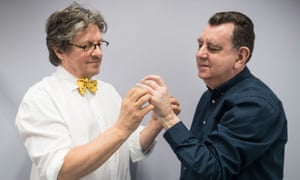


King has his hands examined by Prof Simon Kay, the surgeon who performed the transplant.


King has his hands examined by Prof Simon Kay, the surgeon who performed the transplant. Photograph: Danny Lawson/PA

King has also discovered he is now ambidextrous. “When I picked a pen up first time was with my right hand,” he said. “The next time I picked it up it was left. I might be able to write with both hands now.” He said: “I think it will be the icing on the cake when I can do my laces, and I don’t think that’s far off.”


King lost both his hands, except the thumbs, in an accident involving a metal-pressing machine at his workplace in Doncaster four years ago.


Consultant plastic surgeon Prof Simon Kay, who carried out the operation and two other hand transplants, believes the operation could become as routine as a kidney transplant.


Kay said he was amazed to receive a handwritten Christmas card and thank you letter from King.


Mark Cahill, 55, was the first hand transplant patient in 2012 at LGI, and a third man, who has not been named, became Kay’s third successful transplant patient earlier this year when he was given two new hands and a new forearm.


Two female patients are scheduled for surgery at the LGI as soon as donors become available.


Kay said: “The programme is now well-established. It’s now become mature. We understand the indications, the process. We now have three transplant patients completed and another two to go.”


“We would like hand transplantation to be as routine and unremarkable as kidney transplantation,” he said.
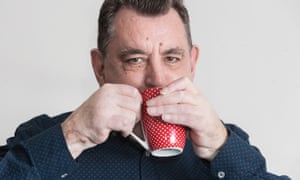


King with a cup of tea


King with a cup of tea. He lost both his hands in an industrial accident four years ago. Photograph: Danny Lawson/PA

Last year, NHS England awarded Leeds Teaching Hospitals NHS Trust the contract to become the UK’s specialist centre for hand transplants.


Referring to King, Kay said: “He’s proved to be, as he proved right at the beginning, a very robust, resilient patient, very enthusiastic about his hands, and I think he’s absolutely delighted.”


“When you bear in mind he will go on improving for another two years, he’s really remarkable – a real vindication for the surgery he’s had.”


“He’s doing more, sooner than we expected. He’s well ahead of our expectations.”


Cahill, a former pub landlord from Greetland, near Halifax, West Yorkshire, has since gained almost complete use of his transplanted hand. He reportedly used it to save his wife’s life last year after she had a heart attack.


Kay urged people to consider the need for future donors. Donating a hands is not yet an option on the organ donor card, but it can be discussed with potential donors if the opportunity arises, a spokeswoman for the NHS’s organ donor register said.


UK"s first double hand transplant patient delights in writing letter to thank surgeon

1 Nisan 2017 Cumartesi

A letter to … My brother, who doesn’t know that I’m a heroin addict

You came to visit me last year. Together we planned your trip. You were to stay at my house – I didn’t even realise that your grown-up form (so much taller and broader now) would be far too long for my short couch.


I came to meet you at the airport. I woke up early so that I could be there, ready and waiting. I imagined standing in arrivals, watching for you to emerge from the crowd. I knew that I would recognise you, even though I hadn’t seen you for many years.


I was late, of course. I’m late for everything now. I used to be so obsessively punctual, anxiously arriving at least half an hour early for appointments, studiously mapping journeys and carefully estimating travel times. But I overslept and then, at the airport, I spent a good 20 minutes in the first bathroom I could find, nervously at first and then gradually becoming less nervous, smoking heroin off the tin foil that I carry with me everywhere I go.


I came out of the bathroom and was calmer and happier and a little bit dozy. I saw you right away. Everything was great. You smiled so wide and hugged me. And everything was comfortably numbed and blurry.


I love heroin. I love it more than I love anything else in this world – more than I ever have loved or will ever let myself love anything or anyone else. My heart is beating so fast as I write this, and my palms are prickling damp with sweat. I’m eight hours without heroin and two hours after methadone.


I love heroin because it numbs me. It gave me just what I needed the first time I tried it, which was the ability to remove myself from my life at last, to remove myself from the self that I loathe so deeply and without reason. When I am high – which is all of the time, now – I can negate everything. Nothing else matters any more. I have chosen to reject prevailing lifestyle norms and the desires, both material and emotional, that come with these norms. I never thought that I could achieve anything anyway, so it is really just me in my 20s, mumbling a neat, easy and lazy “fuck this” as I remove myself from the world and sink into an opiate haze to hide.


Keeping my drug use from you is exhausting and you deserve my honesty, not the lie I present to the world


I meant to tell you, of course. I mean to do a lot of things. A lot of these things are simply forgotten – heroin is very good for forgetting, for removing from conscious thought anything that is not about how much heroin I have right now, or how badly I need it and how much I can buy as soon as possible – but some things, like this, are things that I just cannot bring myself to do.


I wanted to be honest with you. I wanted to start your visit off right, to make you breakfast after your flight and then, when the time was proper, to try my very best to explain to you that, yes, I am a junkie. I’ve got zero money and I’m only just hanging on to a job and I’ve just started on an opiate replacement for the first time. Some days, I do want to stop using heroin; most days, I don’t.


I really wanted to tell you everything. Keeping my drug use from you is exhausting and, more than anyone else, you deserve my honesty, not the duplicitous, multi-natured lie that I present to the rest of the world. I really wanted to tell you, but you’re my little brother. And for some reason you didn’t see the person I have become since we last met; you still saw me as your big sister.


Anonymous


We’d love to hear your stories


We will pay £25 for every Letter to (please write about 600-700 words), Playlist, Snapshot or We Love to Eat we publish. Write to Family Life, The Guardian, Kings Place, 90 York Way, London N1 9GU or email family@theguardian.com. Please include your address and phone number. We are only able to reply to those whose contributions we are going to use


A letter to … My brother, who doesn’t know that I’m a heroin addict

11 Mart 2017 Cumartesi

A letter to … My wonderful mother, who drank herself to death

I hate it when people who didn’t know you ask me how you died. As soon as I tell them you were an alcoholic, I know exactly the kinds of thoughts running through their heads. That one word conjures a vivid, stereotypical picture. You were violent. You were neglectful. You weren’t a good mother. I had a horrible childhood. You damaged me.


But that’s not how it was. You were a wonderful mother and I had a golden childhood. You gave me everything a child needs and more. You loved me, supported me, invested your time and money in me and cultivated a deep mother-daughter bond between us. I miss waking up in the middle of the night to find you kneeling by my bed and stroking my hair. I miss the way you took care of me when I was ill. I miss your cuddles and kisses and the strong, heady scent of your expensive perfume.


You really did lead a charmed life. You were married to a good man who provided for you and took care of you. You were never short of money, attention or love. You were the life and soul of the party and people flocked around you. You were strikingly beautiful and unfailingly kind. From the outside, you had it all.


When you were drunk you became nasty and spat out horrible, unforgivable words. It wasn’t like you at all


Yet appearances can be deceptive. You weren’t happy and it’s taken a long time for me to understand why. You always said you loved me more than I could ever understand and you would die for me. But then you did die and it wasn’t for me.


When you started drinking, it was a bit funny. “Oh, Mum’s drunk again,” we would giggle at parties, as you stumbled around talking nonsense. As the years rolled on, it became increasingly less funny. You changed beyond recognition and when you were drunk you became nasty and spat out horrible, unforgivable words. It wasn’t like you at all. I became accustomed to compartmentalising my feelings – the love and respect I had for my mum and the fear and loathing I had of this drunken stranger.


Things progressed badly and the drunken stranger took the steering wheel. My beloved mum gave up the fight. Your marriage fell apart and you lost your home. You were irreparably broken. I was young and selfish and, more importantly, I understood nothing of life or loss.


I’ve spent many years feeling guilty because I didn’t do more to help you. If this happened today, things would be very different. I’m a mother now and used to putting others before myself. I know what I should have done to understand you and help you. If only I could turn back time and be the daughter I should have been, perhaps you would still be alive today. At the time, I did nothing except feel sorry for myself. I blamed you. I was at a loss to understand what you had to be so deeply unhappy about. You had a perfect life and you chucked it all away.


Today, I see you with the compassion of a fellow mother and wife. Life experience has provided me with valuable perspective as to how you really felt. I am able to piece together all the little clues you subconsciously gave me until I can see the whole picture. I have suffered some heart-breaking losses, the first of which was you.


I used to be angry with you for hurting me and then leaving me. I then spent many years feeling guilty and blaming myself for your demise. Finally, I am now able to disentangle myself from all these feelings and treat everyone involved in your story with compassion. If I could have just two minutes with you today, I would take both your hands in mine and say: “I love you and I understand.” Anonymous


We’d love to hear your stories


We will pay £25 for every Letter to (please write about 600-700 words), Playlist, Snapshot or We Love to Eat we publish. Write to Family Life, The Guardian, Kings Place, 90 York Way, London N1 9GU or email family@theguardian.com. Please include your address and phone number. We are only able to reply to those whose contributions we are going to use


A letter to … My wonderful mother, who drank herself to death

5 Mart 2017 Pazar

‘Face-down restraint must end’: an open letter to Jeremy Hunt

Dear Jeremy Hunt


New figures released by Agenda, the alliance for women and girls at risk, have highlighted the routine use of physical and face-down restraint against women and girls in mental health settings. Although government guidance is clear that physical restraint should only be used as a last resort, this research shows that in many trusts it is widespread.


Given that more than half of women who have mental health problems have experienced abuse, restraint not only risks physical harm and can be frightening and humiliating, but being restrained, particularly face-down, can also re-traumatise those with a history of violence and abuse.


Mental health units are meant to be caring, therapeutic environments, for people feeling at their most vulnerable, not places where physical force is routine. That is why we believe face-down restraint must end and other forms of restraint should only be used as a last resort.


Instead, women and girls’ particular needs and experiences, including their histories of trauma, must be taken into account by mental health services and support given to tackle the underlying issues they face.


Katharine Sacks-Jones director, Agenda


Paul Farmer CEO, Mind


Mark Winstanley chief executive, Rethink Mental Illness


Sarah Hughes chief executive, Centre for Mental Health


Kathy Roberts chief executive, Mental Health Providers Forum


Liz Felton chief executive, Together for Mental Wellbeing


Professor Joy Duxbury chair, Restraint Reduction Network


Sarah Brennan chief executive, YoungMinds


‘Face-down restraint must end’: an open letter to Jeremy Hunt

20 Şubat 2017 Pazartesi

Vitamin D is not just beneficial, it’s a necessity | Letter

Great to see vitamin D on your front page at last (Vitamin D ‘proved to cut risk of colds and flu’, 16 February). Those of us in the British Society for Ecological Medicine, a group of doctors who take the nutritional aspects of our patients’ treatment very seriously, have been banging on about the benefits, and indeed the necessity, of vitamin D for decades. Indeed, the society’s president, Dr Damien Downing, published a book about it back in 1988 entitled Day Light Robbery – The Importance of Sunlight to Health.


I would just like to add two points: first, vitamin D is vital not only to the health of the immune system, thereby in fact reducing the likelihood of cancer as well as of infections, it is also essential for mental health. In young people with depression and in older people with onset of dementia, we find desperately low levels of vitamin D. Vegans are particularly at risk, because in the British climate they have virtually no source of vitamin D at all.


Second, with regard to the proposal to add vitamin D to our food: it is crucial that this be the real thing, vitamin D3, cholecalciferol. Too often, what is added to foods and cheap multivitamins is vitamin D2, ergocalciferol, which is synthetic and far less useful.


Thank you again for publicising this excellent research.
Dr Jenny Goodman
Barnet, Hertfordshire


Join the debate – email guardian.letters@theguardian.com


Read more Guardian letters – click here to visit gu.com/letters


Vitamin D is not just beneficial, it’s a necessity | Letter

15 Aralık 2016 Perşembe

Open Letter For Aging Adults From An Aging Adult

Aging And Your Body


You and I have probably never met.


I have worked in healthcare for over 30 years, many of them right here in southern Arizona. I have learned a few things that I want to share with you. Hopefully, you can relate to them.


As an older adult myself, and as a child who has cared for aging relatives, I have been frustrated both to see and to experience the limitations that becoming older brings. We tend to be more fragile, less resilient; things take more effort but we have less endurance. Simple, everyday tasks bring new challenges and risks we never considered 20 years ago.


One of the most bewildering things you may notice about becoming older is the difficulty you begin to experience when attempting tasks that used to take little, if any, effort. The distant possibility of no longer being able to live independently begins to look closer every day to you. You may find it hard to ask for help and consider that we are dependent on others after an entire life of being self-reliant. It can be disheartening, to say the least.


There are steps you can take (and some of you have taken these steps already) to stay more independent for longer. You can feel safer and more capable at home.  Rehabilitation and physical science has shown this to be true.


http://biomedgerontology.oxfordjournals.org/content/64A/1/61.short


Our physical therapists are uniquely qualified to help with the difficult business of getting older and more fragile. They have years of experience and they know how to work with you to improve your function.


Our bodies are complex organisms that rely on movement and circulation for strength and balance. If you aren’t using your muscles and joints, over time they become less flexible and more easily fatigued. If you have been injured or ill,  you may become discouraged and believe that physical activity is not possible for you.


It is. Physical therapists work with your personal limitations and consider carefully your injuries or illness.They will provide you with a program that can result in improved balance, more strength, and confidence in your ability to be more independent for longer.


physicaltherapytucson.com


You can take charge – no referral is required – and start today to work a program to improve how you feel.


Sincerely,


Amy


Open Letter For Aging Adults From An Aging Adult

30 Kasım 2016 Çarşamba

People with Alzheimer’s who enjoy singing songs from their youth | Letter

I read the heartwarming letter (29 November) in which Dennis Ruston said that even when his late wife had advanced Alzheimer’s she loved to join in the hymns on TV’s Songs of Praise and was word-perfect. Singing for the Brain groups, organised by the Alzheimer’s Society, allow people with dementia to join in songs from their youth. They normally each have a carer with them to support and encourage them to sing. Researchers have found that the brain’s musical pathways remain relatively unscathed by the illnesses that affect normal speech, and people who have lost their speech because of dementia, stroke and other conditions can often still access the words of songs. In such cases, singing is one of the few remaining activities that a dementia patient and their spouse can enjoy equally together.
Ann Wills
Ruislip, Middlesex


Join the debate – email guardian.letters@theguardian.com


Read more Guardian letters – click here to visit gu.com/letters


People with Alzheimer’s who enjoy singing songs from their youth | Letter

20 Kasım 2016 Pazar

My migraine relief | Letter

I was sorry to read of Anna Altman’s distressing symptoms (The long read, 17 November), which I recognised only too well. I spent 40 years of my life suffering incapacitating pain, nausea, dizziness and hallucinations in spite of trying every possible conventional and unconventional treatment.


I was permanently cured by a simple surgical procedure and 10 years later am migraine-free. I had to pay for this private operation in Germany. I took out a bank loan and it’s the best money I ever spent. My life was transformed. I subsequently advised other intending patients. The success rate is 85%. It’s not available on the NHS and my GP had never heard of it. He counselled against it, preferring to prescribe me increasing doses of increasingly expensive “migraine medications”, none of which worked.
Jacqueline Kaye
London


My migraine relief | Letter

15 Eylül 2016 Perşembe

The evidence of an NHS weekend effect is shaky | Letter from Neena Modi, David Owen, Robert Winston, Stephen Hawking and others

We call on Theresa May to act in the public’s interest and take immediate action over freshly disputed evidence surrounding a “weekend effect”. Department of Health documents leaked to the Guardian and Channel 4 News revealed NHS policy concerns from Jeremy Hunt’s own civil servants. His repeated claim about thousands of patients dying unnecessarily because of poor weekend hospital care “has not been helpful” in justifying new seven-day services. The internal briefing document proposed other means to vindicate his policy, but repeats the assertion that “eight independent studies have set out the evidence for a ‘weekend effect’ – unacceptable variation in care across the week”.


The evidence for these claims is not supported by reliable research. Of the eight “studies” cited by Hunt, only four are independently peer-reviewed, yet peer-review is essential. Three use data from the same population and are not independent, with just two from the last decade. The remainder are not peer-reviewed medical literature, being opinion pieces, the lowest form of clinical evidence. Critically, when his claims began, at least 13 independent, peer-reviewed papers were available to the secretary of state that refute his definition of a weekend effect.


Hunt has cherrypicked research, causing a devastating breakdown of trust between government and the medical profession. In making these claims without faithfully representing the evidence, he has obstructed fact and misled parliament and the public.


We call on Theresa May to commission an independent inquiry into the process behind these policies. It is wrong to waste precious resources, or lives, because of bad evidence. Like NHS treatments, health policy should be evidence-based to demonstrate clinical and cost-effectiveness. Additionally, we call for a pause on any policies or contractual reform driven by this evidence until it can be examined objectively and with rigour.


Dr Taha Nasser
Dr Ben White
Dr Hugo Farne
Dr Antonio De Marvao
Dr Rachel Clarke
Dr Margaret McCartney
Dr Philippa Whitford MP
Dr Phil Hammond Vice-president, Patients’ Association
Professor Alistair Hall Epidemiologist
Professor Trisha Greenhalgh Evidence-based practice
Professor Neena Modi President RCPCH
David Owen House of Lords
Professor Robert Winston House of Lords
Professor Stephen Hawking


Join the debate – email guardian.letters@theguardian.com


The evidence of an NHS weekend effect is shaky | Letter from Neena Modi, David Owen, Robert Winston, Stephen Hawking and others

1 Ağustos 2016 Pazartesi

Family planning is a key development goal that needs greater investment | Letter

Family planning is much more than a vital health and human rights intervention (Critical moment for family planning as funds come under pressure, 28 July). Investments in voluntary family planning are also investments in sustainable development, and therefore should be of as much of concern to ministers of finance as to ministers of health.


In the developing world, about 190 million pregnancies occur each year, of which 73 million (39%) are unintended. These unintended pregnancies often end in abortions (49% of the time, and many unsafe), unintended births (38%) or miscarriages (13%), with detrimental health and economic effects for many women and their families. Behind these statistics are untold stories of human suffering and lives taken off track, underscoring the urgent need for greater investments in family planning.


Related: Critical moment for family planning as funds come under pressure


However, only 1% of all overseas development assistance is allocated to family planning. Funding from local governments is typically even lower. In too many countries, programmes remain weak and political commitment is lacking. Family planning is assigned a low national priority, relegated to the health budgets of donors and the portfolios of health ministers, who are often battling a range of other health issues.


From a broader perspective, this low priority is a mistake, because family planning programmes have a wide array of development benefits that often are under-appreciated. In addition to the improved health and empowerment of women and girls, fewer births lead to a boost in the growth of GDP per capita; reduced pressure on the need to build schools, clinics and infrastructure; reduced environmental degradation; and greater political and social stability, as youth unemployment declines. A dollar invested in family planning returns multiple dollars in savings in other development sectors.


Family planning must therefore be reclassified as a development intervention. If we’re truly serious about meeting the sustainable development goals, we must embrace the rare investment opportunities that drive progress on many different development fronts – family planning chief among them.
John Bongaarts
Vice-president and distinguished scholar, Population Council


Join the debate – email guardian.letters@theguardian.com


Family planning is a key development goal that needs greater investment | Letter

6 Ağustos 2014 Çarşamba

The Two Letter Word That Can Ward Off Stress -- And How To Use It

As an entrepreneur, wife, mom of two, and a human who wants foods and rest, I know the difficulties of an endlessly occupied life. When you’re driven by massive goals and massive ideas, that busyness would seem downright all-natural. If I want so considerably, the considered goes, then I’m going to be operating all the time.


Even though I do have considerable ambitions, I also have a basic disagreement with the thought of 24/seven busyness. As I shared just lately on Fox Business’s The Willis Report, you, as a human being in a human physique, just can not sustain continual action. Eventually you will be slamming on the fuel pedal with the emergency brake on. Your tires may well spin, but your engine will break.


The crucial to staying sane, healthful, and productive under continual pressure is understanding how to prioritize your numerous responsibilities and say “no” when needed.


Here are three causes to draw the line.


one. Your overall health is at stake


Your body is your very best guidebook when it comes to owning up to your limits. It can not lie. When you have gone with just a number of hours of sleep for weeks on finish, one thing in your physique will hurt or break. If you neglect to drink adequate water in a day, you’ll get a headache. Believe of your emotions as an additional variety of physique, too. When you’re irritable, unmotivated, and dragging yourself by means of each day, that’s a red flag that you are near to burning out. (A lot more indicators you’re on the brink of burnout).


By the way, the identical thought holds when you want to understand your employees’ limits. Rather of a bodily entire body, you’re hunting at productivity, overall performance, absenteeism, and other benchmarks of continual busyness and anxiety to see exactly where things are breaking down.


Regardless of whether you are focused on your self or your enterprise, you need to recognize the existing, genuine capability of the physique in play. Once you know the limits, you can consider the methods to push them appropriately, such as blocking downtime into your calendar so you are charged up for a lot more action, or teaching resiliency skills to a workforce.


Say no when: Saying yes would compromise your wellness, your sleep, or your ability to cope with the stressors that abound every day. It does not imply you can’t take other stuff on, but you have to apply the 1 in, one particular out program: For every one issue you consider on, you should hand off, delegate, or drop something else.


2. You commence to play the “who’s busier” game


The cultural stress to equate busyness with success is immense. It’s trendy to be busy it is a tangible way for you to prove to colleagues, family, and by yourself that you are producing it.


But busyness is just a shadow of success. Its only value comes from comparison: becoming busier than a competitor in your field, a colleague, a neighbor, a fellow PTA member.  So you win at currently being occupied. Who truly cares? What’s far more worthwhile (and extraordinary) is choosing for oneself what it means to be a wonderful leader or a great mom and then reaching that objective, however numerous hrs it requires. That is success you can construct on.


Say no when: Saying yes wouldn’t add value to your existence in a meaningful way or assist you progress personally or professionally.  What do you wish for your self to attain and to expertise? This may consist of tackling a massive, time-consuming project, as long as its serves more than an itch to maintain up with the Joneses.


 3. You say “yes” out of guilt


When you are clear on your limits and on your objectives, then you can request two concerns of every new chance for busyness: Can you do this? And if you do, will it serve your objectives?


When you begin to draw boundaries close to your time, guilt typically comes up. Negative reactions like this deserve cautious consideration, since possibilities are great that a set of thoughts and beliefs is driving them, not the fact of saying “no.” If you really do not investigate the deeper causes for the guilt, the emotion will run you ragged.


Say no when: Guilt is the sole explanation for complying. This is when you need to have to stage back, observe your thoughts and question them. Are you genuinely letting a person down? Or is it all in your head? What’s truly pushing you to take on more and much more? Clarity right here will support you respect your personal limits and ambitions. (Read through far more on handling adverse feelings and ideas.)


As a leader at perform and a role model at residence, it’s your occupation to demonstrate how ambition and health can co-exist. Maintaining occupied is not the point for your business, loved ones, or self. Present them how to keep going although maintaining nicely.


The Two Letter Word That Can Ward Off Stress -- And How To Use It

18 Haziran 2014 Çarşamba

Letter: Charles Farthing helped deliver Aids out of the shadows

Charles Farthing

Charles Farthing’s crew at St Stephen’s hospital, Chelsea, handled folks with Aids as human beings


My pal Alastair MacInnes was 1 of the people taken care of by Charles Farthing in the early 1980s, in what was rightly described as a climate of fear about this mysterious illness that was killing previously wholesome, predominately gay youthful males.


Alastair was initially taken care of at a hospital where food on paper plates was pushed by means of a slot into his isolation space. No 1 knew what was incorrect with him and couple of men and women came near him. This contrasted with his following expertise as an inpatient at St Stephen’s hospital. Alastair and his companion had absolute faith in Dr Farthing and his team. On one particular memorable evening many of the inpatients held a Bet Lynch earrings party on their ward. Against a backdrop of media hysteria about the “gay plague”, folks with Aids were handled as human beings there, not lepers. I believe that this was down to Charles Farthing.


Alastair ultimately succumbed to the opportunistic HIV virus but in his last months he was able to turn out to be involved with the campaign to raise money for research into the ailment. He was specifically enthused about being a VIP guest at a fundraising musical gala. Large credit goes to Charles Farthing for bringing Aids out of the shadows and enriching the lives of so numerous youthful guys, their partners, family members and pals.


Letter: Charles Farthing helped deliver Aids out of the shadows

31 Mayıs 2014 Cumartesi

A letter to Steve, a helpline Samaritan

I have been which means to write to you for a prolonged time. In reality, for much more than twelve many years. Way back in September 2001 my son somehow managed to get you on a helpline in the Uk. Not effortless, as you know, due to the fact I dwell in Hong Kong. My son spoke to you about my out-of-manage alcoholism and drug addiction and asked if you could support. You said you would attempt.


When you phoned me later on that day I was in my workplace, stoned out of my mind with a heap of white powder and a bottle of booze on my desk. It was late in the evening and I was alone. Your call came out of the blue.


You might not have realised it (I anticipate you did, though) but I was significantly considering of ending it all. I just could not cease my self-destruction. I could not deal with my shame, my fears, my resentments against family and colleagues and I saw no way out. When you explained: “Peter, you don’t know me, but I have just spoken to your son. Are you Ok? How are you?” I had to cease myself from weeping.


In that moment (I didn’t know at the time why) I knew you were the 1st person I would spoken to who understood my pain and helplessness.


You then telling me that you were a recovering addict/alcoholic and had when gone through the identical horrors registered with me like nothing at all else had ahead of. I know today that, rather than supply me sympathy, you have been giving me empathy: a single of the most essential factors recovered addicts can provide every single other. With out it my recovery might have been extremely hard.


At the time, I was amazed that you had known as me from 6,000 miles away and that you did not reverse the costs that you did not request me to get in touch with you back on my very own dime.


Following listening to you, speaking to you, identifying with you in excess of people 50 or so minutes, I knew I had to do something about my existence of addiction. I knew I had to quit the carnage the discomfort I was leading to my family members, my pals, myself. I also believed you when you stated it was attainable to end “employing” and drinking and remain stopped. But that I had to take action and have some faith and trust and courage for the first time for many years.


In quick you “reached out” and I received the message – if I took action (by way of a twelve-step fellowship) and had an sincere want to get “clean and sober”, my daily life would modify so positively that I would be totally surprised.


You have been correct. You did not exaggerate. As you mentioned, addiction is the only illness in the planet exactly where, when you are in recovery, you come to feel greater than you did just before you acquired the sickness.


Inside 10 days of our conversation, and with my son’s assist, I was in rehab. I have to admit I did not end using in the course of individuals ten days and I turned up at the remedy facility totally drunk. But because I checked into the clinic that day, I have not had a drink or a drug and my life has modified beyond my wildest dreams.


I believe in a increased power. I realized (as you informed me), that I was the difficulty, that the booze and the medication have been the signs and symptoms that abstinence was the answer but to obtain this my contemplating had to alter in a lot of techniques. So I did what I necessary to do. I worked tough. I received truthful. I started out to care.


Each and every year brought me a lot more stability and happiness and significantly less self-centred, obsessive behaviour. My need to use thoughts-altering substances has been removed. I’ve grown up. I have faced my demons. I have after far more a loved ones that loves me. In brief, I have a “daily life”.


I did phone the helpline variety on which my son had spoken to you on but you had been no longer there. I did not consider to track you down. Maybe I need to have, but I did not think which is what you necessarily wanted. You were “carrying the message” to me as you must have to a lot of other people. By this letter, I want you to know my gratitude to you for reaching out to me – a stranger – and, by undertaking so, affecting my existence so considerably for the much better.


I will be 13 years sober in a number of months. To you, and all individuals who have helped me on my journey, thank you sincerely.


Ideal wishes, Anonymous


A letter to Steve, a helpline Samaritan

2 Mayıs 2014 Cuma

Letter: Louis Smidt obituary

Louis Smidt

Louis Smidt had an entrepreneurial touch and loved cutting-edge suggestions


Louis Smidt was that uncommon NHS manager, one who listened to and explored new tips and facilitated them.


Our capacity to create a leading support for HIV/Aids and sexually transmitted illnesses at the Middlesex hospital at the outset of the epidemic was produced feasible by Louis. He had an entrepreneurial touch and loved cutting-edge suggestions. We tried things that today’s rigid and constrained NHS would never ever entertain.


Louis understood the relevance of academic medication and the contribution it could make to the growth of new tips and companies for the advantage of patients.


Letter: Louis Smidt obituary