Work etiketine sahip kayıtlar gösteriliyor. Tüm kayıtları göster

7 Mayıs 2017 Pazar

NHS staff "quitting to work in supermarkets because of poor pay"

NHS staff are quitting to stack shelves in supermarkets instead of caring for patients because they are so demoralised by years of getting pay rises of only 1% or nothing, hospital bosses have warned.


The health service is now so understaffed that patient safety is being put at risk and people with mental health problems are experiencing delays and setbacks as a result, NHS leaders say.


The intervention in the general election campaign comes from NHS Providers, which represents almost all of England’s 240 NHS hospital, mental health and ambulance trusts. They told ministers bluntly on Monday that the government’s longstanding policy of holding down NHS staff pay is wrong and is damaging the service by deepening its already severe staff shortages.


“Years of pay restraint and stressful working conditions are taking their toll,” said Chris Hopson, NHS Providers’ chief executive. “Pay is becoming uncompetitive. Significant numbers of trusts say lower paid staff are leaving to stack shelves in supermarkets rather than carry on with the NHS.”


He urged Theresa May to abandon her plan to limit NHS staff’s pay increases to 1% a year until 2020 and not pursue it during the next parliament as a way of making the NHS’s books balance.


He added: “Trust leaders tell us that seven years of NHS pay restraint is now preventing them from recruiting and retaining the staff they need to provide safe, high-quality patient care. The NHS can’t carry on failing to reflect the contribution of our staff through fair and competitive pay for five more years.


“Pay restraint must end and politicians must therefore be clear about when during the lifetime of the next parliament it will happen and how.” He repeated the organisation’s demand for £25bn in extra funding to help the NHS in England get through until 2020 and warned that staff are also leaving because they are exhausted from having to work so constantly to keep up with the unprecedented demand for care.


Hopson added: “We are getting consistent reports of retention problems because of working pressures in the health service causing stress and burnout.”


Medical royal colleges, health trade unions and health charities such as Cancer Research UK have been highlighting in recent months the damaging effects on patient care of widespread shortages of doctors, nurses, GPs, paramedics and many other NHS staff groups.


Norman Lamb, a former coalition government health minister, said NHS pay restraint – which had operated since 2010 – was “stupid” and had gone on so long that it was proving counterproductive.


“The Conservatives expect NHS staff to take year-on-year real-terms pay cuts in order to try to stave off financial disaster in the NHS,” said the Liberal Democrat health spokesman. “You can’t possibly justify this over such a long period. It is also stupid because great staff will vote with their feet and leave.” s


He contrasted his party’s plan for a 1p increase in income tax to generate extra funds for health and social care with May’s refusal to commit to any tax increases for that purpose. With the Tory majority set to increase, “this guarantees a bleak future for the NHS and for its staff under the Conservatives”, claimed Lamb.


Jeremy Hunt, the health secretary, repeated his pledge of more money for the NHS if the Tories are re-elected and said that nurses’ pay should go up. Responding to a question from the BBC interviewer Andrew Marr about some nurses going to food banks, Hunt replied that average nurse’s pay is £31,000.


“Is that enough considering the brilliant work that they do? I think many people would say they want to pay them more. I think they do an incredible job. If you want more money to go into the NHS – and this government recognises we will need to put more money into the NHS and the social care system because of the pressures we face – then the question is how you get there,” said Hunt.


He also insisted that key NHS waiting time standards, such as the four-hour target in A&E and 18-week wait for planned hospital care, were not particularly useful measures of true NHS performance. Lives saved from cancer and heart disease as a result of better care showed the service was doing well, he added.


Jonathan Ashworth, Labour’s health spokesman, said Hunt’s agreement that it was unacceptable that the A&E target had not been met in England for more than two years was “an admission of failure straight from the horse’s mouth: the Tory-made A&E crisis is simply ‘not acceptable’”.


Responding to Hopson’s comments on NHS pay, Ashworth added: “This is a stark warning from NHS Providers about the Conservatives’ catastrophic management of the NHS workforce. It is incredible and disgraceful that NHS staff are leaving to work in supermarkets instead because NHS pay has been squeezed so far. The country’s shortage of paramedics, nurses and consultants now threatens a raft of NHS strategies to provide better services for patients.”


NHS Providers are also warning that understaffing is so serious in mental health services that patients are now suffering delays in receiving treatment, taking longer to recover and having a bad experience of NHS care. “We are particularly worried about the pressures in the mental health workforce,” said Hopson. “These are resulting in delays in treatment, people are taking longer to recover, and as a result their care is more expensive and their experience is worse.”


A Conservative spokesman declined to respond directly to Hopson’s warning. He said only that: “As NHS England say, outcomes for every major disease in this country are now better than they’ve ever been. But the truth is that in order to continue to invest in the NHS, grow staff numbers and pay, and improve patient care, we need to secure the economic progress we’ve made and get a good Brexit deal. That is only on offer at this election with the strong and stable leadership of Theresa May.”


NHS staff "quitting to work in supermarkets because of poor pay"

5 Mayıs 2017 Cuma

Fact check: how well does your birth control work?

Hello, how are you today? If you’ve got a uterus, maybe the answer is “not so great” – especially if you’ve heard reports about Donald Trump’s latest appointee. The woman tipped for a key family planning role, Teresa Manning, has previously worked with an anti-abortion group as well as an anti-LGBT rights lobbying group.


If Manning is appointed as deputy assistant secretary for population affairs at the Department of Health and Human Services, she would have oversight of the federal program that provides contraceptive services to low-income and uninsured women and men.


Manning, who is a law professor, has said “family planning is something that occurs between a husband and a wife and God, and it doesn’t really involve the federal government”. I won’t be fact-checking that statement (because it’s tricky to prove who does and who does not have a direct line to chat to God), but rather Manning’s claim that contraception doesn’t work well.


Here’s Manning’s statement in full which she gave in full during a radio interview:


Its efficacy is very low, especially when you consider over years – which, a lot of contraception health advocates want to start women in their adolescent years, when they’re extremely fertile, incidentally, and continue for 10, 20, 30 years. The prospect that contraception would always prevent the conception of a child is preposterous.


Let’s fact-check this.


Step 1: Do an internet search for “contraception efficacy rates”. You’ll very quickly land at this summary published by the Centers for Disease Control and Prevention (CDC). It shows that the effectiveness of contraception varies depending on which method is being used.


They range from spermicide (which is the least effective, with about 28 out of every 100 women who use it becoming pregnant on average within the first year of typical use) to the hormonal implant (which is the most effective, with one out of every 200 women becoming pregnant in the first year of typical use).


Step 2: Check the reliability of your source. While Wikipedia is certainly not the most accurate site on the internet, the thousands of editors who regularly work there can be more inclined to dig up criticism than the standard “about” page on a website.


The Wikipedia page on the CDC offers few leads about a corrupt, biased organization – rather, the CDC is simply described as a federal agency whose “main goal is to protect public health and safety through the control and prevention of disease, injury, and disability in the US and internationally”. The organization doesn’t seem to have an interest in overstating the effectiveness of contraception.


Step 3: Understand the terms used. The CDC talks about “typical use” and that seems kind of important, so I repeat the same internet search but this time with those two words added in there.


I land at this New York Times page, which has been built using data compiled by James Trussell from the Office of Population Research at Princeton University and also the Brookings Institution. Here’s how they define typical use:


“This is the norm, reflecting the effectiveness of each method for the average couple who do not always use it correctly or consistently.”


That makes sense. It is part of the reason why methods that require planning (eg “Babe, do you have the spermicide?”) or some other action before or during sex (“Don’t worry, I’ll pull out in time”) are much less effective than those that don’t (hormonal implants, intra-uterine devices and sterilization require much less upkeep).


Perfect use, by the way, is defined as:


“A measure of the technical effectiveness of each method, but only when used exactly as specified and consistently followed. Few couples, if any, achieve flawless contraceptive use, especially over long time periods.”


If 100 women were to use the pull-out or withdrawal method “perfectly”, 34 of them would wind up pregnant within 10 years (yep, that’s the 10-year use period Manning mentioned). But even with perfect use, there’s still a significant gap between different contraceptive methods. If those same women were to use a hormonal implant, chances are only one would be pregnant at the end of 10 years.


By appointing Manning, an opponent of Planned Parenthood, Trump takes another step towards his goal: defunding it. As a result, the availability of contraception such as the hormonal implant will be curtailed.


Step 4: Find a sexually active woman and listen to what she has to say. Ask her whether she wants to have the freedom to choose.


Would you like to see something fact-checked? Send me your questions! mona.chalabi@theguardian.com / @MonaChalabi


Fact check: how well does your birth control work?

24 Nisan 2017 Pazartesi

Drugs didn’t work for my brother. Electroconvulsive therapy did | Andrew Mayers

The death certificate said heart attack. But anyone familiar with what my brother had been through over the last decade of his life knew the real cause of death: depression. A self-depleting torment that knew no rock bottom; a psychological tumour that consumed his personality.


Now, looking back after several months on an end that Stephen had said was all he prayed for, I think there was something missing on the certificate: not a cause of death, but a “cause of hope”. That cause was a procedure once derided as the Frankenstein treatment: ECT, or electroconvulsive therapy. Last week it was reported that ECT is on the rise again, with more than 22,000 individual treatments carried out in England in 2015-16.


For some people, this new research will have reawoken old fears of the therapy, and it has certainly brought forth a welter of images of Randle McMurphy, Jack Nicholson’s character in One Flew Over the Cuckoo’s Nest, who was laid impossibly low by the treatment. It’s a context in which my brother’s story needs to be heard.


My brother’s case of depression may well have been “severe”, or “psychotic” or “neurochemical”, or any of the labels used in the struggle to understand his condition. But for me the definitive label was “treatment-resistant”.


Antidepressants, tranqs, sleepers, hypnotics, anxiety meds, CBT, visualisation strategies, talking therapies – my brother, bless him, tried every regime, and stuck to them doggedly even as his symptoms escalated. The efforts of the NHS doctors to find the magic formula, the right balance of millilitres and microgrammes, could not be faulted.


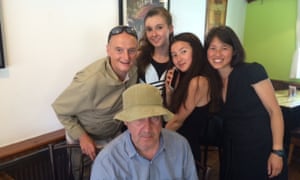
Stephen Mayers, front, a month before he died, with brother Andrew, niece Lola, daughter Sienna and wife Yasmin.


Stephen Mayers, front, a month before he died, with brother Andrew, niece Lola, daughter Sienna and wife Yasmin. Photograph: Andrew Mayers

With every regimen change there would be new flickerings of hope. Patience, the psychiatrists always cautioned – there is never a quick fix. If these drugs do work, it might be weeks, months, before the first inkling. But the lesson of the passing years was that the drugs didn’t work. The darkness engulfing Stephen became a tomb. And it engulfed us all – his wife, his daughters, his brothers, his parents.


So it seemed little short of a miracle when a “last resort” treatment penetrated that malign murk – indeed, blew it away. According to data collected by the Guardian, about 2,000 patients were given ECT in 2011. Thank God Stephen was one of them. A life that had been little more than an extended stupor, enlivened only by the gobbling of stodge, was transformed. The principled, generous, engaged soul re-emerged, as if from hibernation.


The addiction to discomfort eating, which brought only self-hatred, was ousted by a renewed passion for cycling. The old Stephen was reborn. As the writer and professor of clinical psychology Andrew Solomon has sagely noted, the opposite of depression is not happiness, but vitality.


My brother ended up getting four amazing, unexpected years of vitality: not a bad result from a seizure lasting less than a minute, triggered by an electrical current applied for up to eight seconds. All under general anaesthetic. No thrashing, no writhing. Perhaps a little toe-curling.


So if there is anything “crude and controversial” about ECT it’s the reaction, from some corners, to the revelation that these treatments are on the rise again. The portrayals that put this procedure on a par with lobotomy belong to a wholly different mental health era. We all know what happened to McMurphy at the hands of Nurse Ratched, but that was a fictional depiction, decades ago. When the Ramones sang Gimme Gimme Shock Treatment they made it sound like something only the truly twisted would consider. The experiences of Sylvia Plath – who described ECT as “a great jolt [that] drubbed me till I thought my bones would break and the sap fly out of me like a split plant” – or Janet Frame, the New Zealand poet incarcerated in asylums and subjected to 200 treatments by sadistic nurses, are brutal. But if anything they demonstrate how far mental healthcare has come.


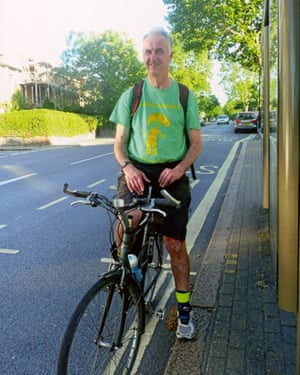
steve mayers


‘At his funeral one of his fellow cyclists gave an oration. ‘Steve Mayers, what a guy. Steve Mayers, what a guy. Steve Mayers what a guy.’’ Photograph: Yasmin Mayers

Last week the mental health charity Mind warned that the side-effects of ECT could include memory loss, difficulty concentrating and dizziness. In my brother’s case, these were the side-effects of not having ECT. But I still suspect that the ultimate side-effect of not having the procedure was his death last October.


The procedure had given him four precious years of vitality. In the middle of a cycle ride from Land’s End to John O’Groats – to raise money for the Maudsley hospital, in south London, where his treatment was carried out – his illness returned. The doctors knew – we all knew – that his best chance, perhaps his only chance, was another ECT course. But good medical practice meant that first they had to go through the rigmarole of drug regimes they knew would probably fail.


ECT time came agonisingly closer. His depression raged out of control – worse he said, than ever. And on top of this, even grimmer news: a persistent tremor was incipient Parkinson’s. The catastrophic thinking that was the hallmark of his depression now played a terminal role: the ECT miracle, those four years of vitality? A fluke, a trick, a story. Go under general anaesthetic? What happens if it leaves me conscious but paralysed? And anyway, what’s the point in being liberated from depression into a life ravaged by Parkinson’s?


The years of vitality were not to be repeated. But without ECT they would not have happened. At his funeral one of his fellow cyclists gave an oration. “Steve Mayers, what a guy. Steve Mayers, what a guy. Steve Mayers what a guy,” he intoned in broad Wolverhampton.


At the same time pictures flashed up on a big screen of Stephen on a bike. Forget Jack Nicholson, I thought. My big brother’s the positive face of ECT.


Drugs didn’t work for my brother. Electroconvulsive therapy did | Andrew Mayers

20 Nisan 2017 Perşembe

It"s good to hear cycling to work reduces your risk of dying. But that"s not why I do it | Laura Laker

It may not be a surprise to see another study suggesting that cycling to work can drastically reduce your chances of getting cancer and heart disease – those who ride bikes for transport already know how good it makes them feel. However, it’s perhaps yet another motivation for those who don’t, to dust off their bikes – and remember some other reasons cycling to work is so great.


In a five-year study of 263,450 UK commuters, published in the BMJ, researchers at Glasgow University found regular cycling cut the risk of death from any cause by 41%, and the incidence of cancer and heart disease by 45% and 46% respectively.


The cyclists in the study were riding an average of 30 miles per week; that’s three miles each way, five days per week. Cycling at a leisurely 10mph, that would take about 20 minutes each way – a manageable distance for most people.


At present only 3% of the UK population commute by bike, while 36% use a car. If we increased cycling in this country to German levels by 2025, we would save £1.8bn in health benefits and £284m thanks to less congestion.


Ask anyone who cycles to work why they do it, and they’ll have a story to tell, whether it’s about how good it makes them feel, how they saved money, lost weight, or won a battle with depression. Most people will tell you how enjoyable it is.


My commuting story began at university. I remember being astonished one morning when I realised my friend Szilvia had cycled from Finsbury Park in the rain. Getting on a bike and riding five miles in such conditions sounded miserable, but she looked happy and bright, and told me how great it was.


We lived fairly close to one another and she offered to ride with me one day. As I pedalled frantically to keep up with her through Regent’s Park, and Camden, it was like I’d grown wings. Before long, like her, nothing short of a gale force wind with pigeon-sized hailstones was going to stop me from experiencing this feeling every day.


For the first time in my life I started getting fit. I arrived at university feeling awake, alert, and generally in a good mood. I continued to cycle to various temp jobs around London after graduation, carrying my work clothes in a pannier and getting changed in the loos.


On crisp, sunny mornings, I’d cycle through the city feeling like it had rolled out the red carpet just for me. I’d levelled up on urban living: I’d whizz past the stationary traffic and queues for buses and try not to look too smug.


I’d chat to others at the traffic lights. Often I’d get to places quicker than public transport could carry me. Often it was the best part of the day.


Fitting exercise into your daily routine is infinitely easier than trying to carve out a slice of it to go to the gym. Without even trying, you get fitter if you cycle. It is no surprise that levels of physical activity are declining as fewer people cycle or walk to work.


In the cities of cycle friendly countries, such as the Netherlands and Denmark, up to 41% of people commute by bike because it’s easy to do and it feels safe. Decades of investment in cycling infrastructure have made it that way. These countries have learned that most people prefer protected, direct routes on main roads, and low-traffic neighbourhood streets. This means people of any age can cycle, from the very young to the elderly. In the Netherlands, for example, 20% of 80-84 year olds regularly cycle.


Imagine if the UK was like the Netherlands, where 20% of 80-84 year olds regularly cycle


Imagine if the UK was like the Netherlands, where 20% of 80-84 year olds regularly cycle. Photograph: Rory Buckland L/Alamy Stock Photo

In the UK, meanwhile, we’ve had decades of car-centric planning, and minuscule levels of funding for cycling. Even though cycling is statistically safe, it doesn’t always feel it, and this fear of sharing road space with motor traffic is the key reason people don’t cycle or stop after trying it.


The government knows that every £1 spent on cycling brings £5.50 of benefits, but at present it spends just 72p per person per year on cycling, compared with £86 per person per year for roads. There is huge potential for more journeys to be cycled if that were to change.


Increased levels of cycling can bring benefits for everyone, whether they cycle or not. Bicycles take up far less road space than cars and emit no toxic fumes. They’re good for our high streets: on New York streets where cycle lanes were introduced average trade rose by a quarter. What’s more, bicycles are great social levellers – according to research, mass cycling could increase mobility of the nation’s poorest families by 25%.


If a magic pill were invented that could generate all of these benefits, we would be falling over ourselves to buy it. As it is, no magic is required, just steady, long-term planning and investment, and a commitment to the humble bicycle, so that more of us can enjoy the simple, life-giving joy of cycling from A to B.


It"s good to hear cycling to work reduces your risk of dying. But that"s not why I do it | Laura Laker

17 Nisan 2017 Pazartesi

What is ECT and how does it work?

[unable to retrieve full-text content]


One Flew Over the Cuckoo’s Nest has coloured perceptions of electroconvulsive therapy, but the modern reality is different


The public perception of electroconvulsive therapy (ECT) is rooted in cultural depictions, not least the dramatic scene in the film One Flew Over the Cuckoo’s Nest in which Jack Nicholson is held down as the treatment is carried out.


Sylvia Plath’s account in The Bell Jar is hardly less brutal. Describing ECT, administered without general anesthetic, the protagonist says: “With each flash a great jolt drubbed me till I thought my bones would break and the sap fly out of me like a split plant.”


Related: Electroconvulsive therapy on the rise again in England


Related: What is ECT and how does it work?


Related: Tea, biscuits and classical music: inside an ECT clinic


Continue reading…


What is ECT and how does it work?

11 Nisan 2017 Salı

Could a new approach to kill cancer at nanoscale work?

In a small laboratory, not far from southern California’s Pacific coastline, Dmitri Lapotko is using lasers to conduct on-demand explosions on a scale almost infinitely small. These explosions are carefully designed to obliterate cancer cells at a nanoscale, with a level of efficiency and safety which far outmatches the current treatments of choice. The technology, pioneered by the company Masimo, is about to undergo clinical trials for both the diagnosis and treatment of cancer in the next few years. But the story of how the idea was first conceived originates from one of most defining moments of the 20th century.


In the late 1980s, Lapotko was a laser weapons physicist for the Soviet Union, living and working in what is now Belarus. His particular expertise was in using airborn ultrasound to steer the laser beam of a weapon in the upper atmosphere, as the Soviets tried to match the threat of Ronald Reagan’s Strategic Defense Initiative, nicknamed ‘Star Wars.’


But with the end of the Berlin Wall and the subsequent disintegration of the Soviet Union, many weapons scientists found themselves left out in the cold, surplus to requirements and with few career prospects.


“This was a bitter time for many Soviet physicists,” Lapotko remembers. “We realised our work was not about science or the future, but politics.”


However just as many of the scientists involved in the Manhattan Project 40 years earlier subsequently turned to biomedical research, Lapotko decided to try and apply his knowledge of lasers to treat diseases at the cell level, and the biggest challenge of all, developing a novel means of detecting and treating cancer, initially in Belarus and then in the US.


“One of the biggest problems in cancer treatment is that we cannot detect micro tumours at the earliest stage and we often would not be able to remove them surgically without damaging nearby important cells and organs,” Lapotko says. “Currently, the minimal detectable tumours are already several millimetres big and by then the disease has developed.”


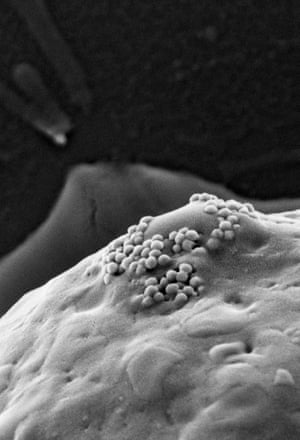
Nanoparticles: cancer cell surface


Nanoparticles: cancer cell surface. Photograph: Dmitri Lapotko

Chemotherapy and radiation therapy are not always effective because cancer cells continuously mutate and so rapidly develop resistance, requiring therapeutic doses which harm the patient in order to destroy them. “You can have an excellent drug today, but tomorrow it doesn’t work,” Lapotko says. “So I decided to base my approach on a way to detect and explode the cancer cell mechanically, something it cannot resist through its biological tricks. If you do this, there’s no biological way it can reassemble, revive or metastasise.”


Over the past two decades, researchers have sought to use nanoparticles, of sizes a thousand times smaller than a cancer cell, to deliver chemotherapy drugs specifically to the rogue cells themselves. This is done by exploiting some of the natural properties of tumours. Nanoparticles are injected into the bloodstream, attached with antibodies to recognise the cancer cell. Because aggressive cancer cells actively “eat” nanoparticles through the mechanism known as endocytosis, they end up self-assembling internal clusters of nanoparticles. This improves the toxicity problems of chemotherapy because large quantities of a drug can be delivered directly to the cancer without much harm to the surrounding healthy tissue. Gold nanoparticles are being used in this way in several ongoing clinical trials. However, even these therapeutic strategies still come up against the inevitable problem of cancers developing biological resistance to drugs.


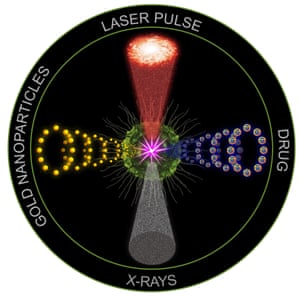
Instead, Lapotko’s idea has been to combine biology and physics in an entirely new way. Once gold nanoparticle clusters are inside a cancer cell, they are exposed to a short laser pulse which the nanoparticles convert to heat, forming a vapour bubble which expands and collapses in nanoseconds, called a ‘plasmonic nanobubble.’ The mechanical impact of this nanobubble tears the cancer cell apart in an instantaneous explosion.


“The nature of this explosion is intracellular so the surrounding healthy cells or important organs are not damaged,” Lapotko says. “A cell residue is left but this cannot reassemble into new cancer cells. It’s very safe as the energy of the laser pulse required is a million times lower than the laser energy used in some surgeries.”


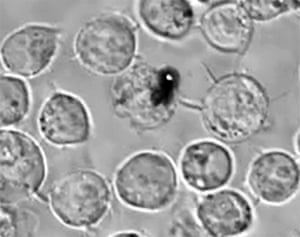
Cancer cell explosion.


Cancer cell explosion. Photograph: Dmitri Lapotko

One of the common problems in cancer treatment is that when surgeons remove a tumour, they may leave residual tumours behind. “In many instances the cancer is in a part of the body where doctors are afraid to remove more than they think that have to,” says Masimo’s chief executive and founder Joe Kiani who is looking to bring Lapotko’s technology from academia to the clinic. “And when you leave some behind it metastasises. Recurrence and metastases are the main causes of death.”


But Lapotko’s technology can also be used to diagnose and eliminate before such remaining cells can grow into a far more dangerous and resistant recurrent tumour.


“We can administer nanoparticles one day prior to the surgery and after the surgeon removes the tumour, we apply the endoscope to the surgical bed,” Lapotko says. “If there are even single cancer cells left in the surgical margins, plasmonic nanobubbles are generated which produce a pressure pulse or acoustic pop which we can detect immediately in real-time with an ultrasound detector. And then we can use the mechanical impact of the same nanobubbles to destroy them.”


So far the technology has been tested on tumours in mice in a series of studies published by Nature Medicine and Nature Nanotechnology, with a dramatic improvement in survival rate and safety compared to existing treatments. The only limitation is for cancers deeper in the body where it is difficult to generate lethal plasmonic nanobubbles due to poor laser penetration into the deep tissue.


In these cases, Lapotko believes he can use the technology to improve the efficacy of the mainstream cancer therapy techniques. Radiotherapy works by disrupting the DNA helix in cancer cells, but by creating even small nanobubbles inside these cells beforehand, the DNA structure is already weakened, presensitising them so a far lower radiation dose can be administered to achieve the desired effect.


The first preclinical study of the anti-cancer technology ‘quadrapeutics’ found it to be 17 times more efficient than conventional chemoradiation therapy against aggressive, drug-resistant head and neck tumors.


The first preclinical study of the anti-cancer technology ‘quadrapeutics’ found it to be 17 times more efficient than conventional chemoradiation therapy against aggressive, drug-resistant head and neck tumors. Photograph: Dimitri Lapotko/Rice University

Lapotko is well aware of some of the disappointment among clinicians regarding nanomedicine after many years of promise, but still no broadly available treatments for patients. “There are two main reasons why not much has reached the clinic yet,” he says. “A lot of the time nanoparticles are initially developed for non-medical use, for example the energy industry or the oil industry and then people start thinking about medical applications. So perhaps they’re not so effective as they’re not initially designed with cancer in mind. And then within nanomedicine, the mainstream ideas aim to improve drugs, either by making nanoparticles which are drugs by themselves or making nanoparticles to carry drugs. So in cancer, nanomedicine did not replace chemotherapy, it has just created an additional chemotherapy, and because of that it faces the same regulatory challenges as any other drug.”


It typically takes 10-25 years and a lot of investment for anything to pass from academic research to drug use in the clinic, a passage referred to by scientists as the ‘Valley of Death.’ But with no pharmaceutical involved, Masimo are hoping to fast-track the process. They have obtained a grant from the National Institute of Health for further testing and intend to pursue phase I and II clinical trials within the next few years, likely to be held in Europe.


“A lot of the time what is done in the world of medicine on a mouse, doesn’t work on a monkey never mind a human but the early results look great,” Kiani says. “If it all works, we’re probably four years away from a product. But if it all works, it could be a game changer.”


Could a new approach to kill cancer at nanoscale work?

6 Nisan 2017 Perşembe

I was ready to quit nursing until I went to work in a Laos hospital

I didn’t go into nursing ignorant of the challenges ahead. I’d witnessed the enormous toll it can take emotionally and physically, and was exposed to the seemingly constant negative press surrounding the NHS about overworked staff and a broken system. Yet I wanted to be a nurse. And I wasn’t going to let the NHS break me.


After three years of training, I started my first job as a children’s nurse on a busy surgical ward. I sat in my first handover, listening to the nurses complain about not getting breaks until, eventually, one turned to me and said dryly, “Welcome to the NHS!” These weren’t bad people. They were exhausted from giving so much to a system that relies on the good nature of its staff. But I was still optimistic. I wanted to be a good nurse. I wasn’t bitter. Yet.


My enthusiasm very quickly waned. My optimism and energy were worn down by the patient load, 14-hour days with just a cup of coffee to see me through, and the crushing responsibility of being a newly-qualified nurse. I made an agreement with myself: I’d get through one full year before I quit, just to prove to people I’d tried.


As the months passed I found myself actually enjoying the job. Yes, I still worked long days without a real break. And yes, I did still worry about my patients on my days off. But I’d somehow adapted to the gruelling schedule of a nurse. And so I continued.


But gradually, over the years, my list of grievances with nursing grew. It started to affect my home life and I noticed that I was getting sick more often. My resilience had been weakened and I felt like I was running on empty.


My partner and I had been talking about living abroad for a while and we came to the conclusion that now was as good a time as any. We were both ready for a break. Many of our friends were buying houses and climbing career ladders, and would often comment that we were brave to quit it all. But for me taking a break seemed selfish and indulgent rather than brave. I didn’t even consider whether it would harm my career progression. At that point I yearned for less, rather than more responsibility.


And so we packed our bags and headed for Asia. On long bus journeys or during quiet moments I would sometimes question whether I could go back to nursing. With the luxury of distance and time I saw myself as the bitter, overworked nurse I’d been sure I wouldn’t become. I was ashamed. I’d lost sight of why I wanted to be nurse.


After six months away from nursing, I heard that the Lao friends hospital for children in Luang Prabang was looking for nursing volunteers. Re-energised by our time away so far, I felt ready for a new challenge and so, with a mixture of apprehension and excitement, we headed to Laos.


The hospital is well equipped thanks to the generosity of the charity that funds and runs it. Yet compared with NHS hospitals it lacks the equipment, medicines and expertise that we take for granted. In the UK I never saw a child go without a blood transfusion because the blood bank was empty, or watched a terminally ill child be discharged home with only an apology that we could do no more. It reminds me how lucky we are to have the NHS. The limitations we worked with in Laos encouraged innovation and teamwork, which can sometimes be lacking or forgotten about in the vastness of the NHS.


Being part of a team that responds innovatively and tirelessly to the challenges these limitations provide, combined with spending my days (and nights) with children and their families and the joy of seeing these children get better, has reignited my enthusiasm for nursing.


I’m extending my stay here in Luang Prabang. Hopefully when I return to the UK, I’ll be a better nurse for my time spent here. But I certainly wouldn’t rule out another career break. It’s been difficult financially, and yes, it’s a luxury, but a break from my normal has made me remember why I’m proud to be a nurse.


If you would like to contribute to our Blood, sweat and tears series about memorable moments in a healthcare career, read our guidelines and get in touch by emailing sarah.johnson@theguardian.com.


Join the Healthcare Professionals Network to read more pieces like this. And follow us on Twitter (@GdnHealthcare) to keep up with the latest healthcare news and views.


I was ready to quit nursing until I went to work in a Laos hospital

3 Nisan 2017 Pazartesi

Talking about death is a part of my work – I worry I say the wrong thing

I am a NHS hospital consultant and work in a healthcare team that specialises in the care of adults with cystic fibrosis (CF). This is a genetic condition that affects various organs, but primarily the lungs. It results in recurrent and severe chest infections that ultimately cause the lungs to fail. There have been considerable advancements in new therapies that we are hopeful will change the natural history of the disease. Nevertheless, it remains a life-shortening illness and coping with the death of young adults brings many challenges to the team that I work in.


Patients move to our CF centre when they are 18 years old. The doctor-patient relationship is a dichotomous and delicate balance of professional distance and empathy. But it does not fully guard against emotion when we see those we look after approach death. Over the years we develop bonds with our patients and their families and witness many life events. We share in their laughter and tears. Occasionally I am the focus, a patient recently said to me: “You’ve lost weight … you need to look after yourself better.” That made me chuckle.


Clinical care satisfies the needs of today, but research brings the hope for tomorrow


Patients strive to lead normal lives and I am frequently in awe of their achievements. Some of their journeys are truly Homeric in stature. But years of infections and damage to the lungs take their toll. The hope of a better tomorrow is a powerful support but the reality of declining health can dismantle the scaffold. Broaching these end-of-life conversations is often difficult as the words uttered can confirm patients’ fears.


It is so important to choose those words carefully as they can linger in the family’s memory. I remember one young 22-year-old woman who was not responding to treatment in hospital; her death was imminent. It was important for her to have some sort of control. I asked her: “You are in the driving seat now, what would you like us to do with your treatment?” She wanted to stop it, and I did. Some months after her death her mum called into the hospital and said: “Thank you for putting my daughter in the driving seat”. I’ve cherished those words.


Many patients now have young families of their own and the death of a parent is a traumatic experience. We arrange for our patients to engage with a specially trained counsellor to express their thoughts in words and pictures. A personalised memory book is produced, which includes advice for the future without them.


I’ll always remember the young girl, after losing a parent, who put her thoughts down in a letter. It was a remarkable achievement for one so young. She said the book helped her and reminded her of the parent she had lost. The presence and tactility of a book is tangible. A father whose son died wrote to me: “It is impossible to balance the awfulness of our heartbreak with the comfort that this book provides, but what is paramount is that it provides amazing comfort to us all.” Their letters are the most powerful I have ever read.


In the liminal transition from life to death a peace descends in the half light. I reflect on what I could have done differently. Should I have changed the treatment plan? Could I have phrased things a little better? Some parents have lost all their children to this disease and they have been made to endure grief that is simply unendurable. So when I go home at night my family are hugged that little bit tighter, as nobody is immune to loss. Death casts light on my own mortality and the impermanence of life comes sharply into focus.


In the following days and weeks we redouble our efforts. Clinical care satisfies the needs of today, but research brings the hope for tomorrow. It is so important to be part of that hope. I walk into the hospital ward to hear new stories and guide as best I can. It is an enormous privilege to do what I do.


If you would like to write a blogpost for Views from the NHS frontline, read our guidelines and get in touch by emailing sarah.johnson@theguardian.com.


Join the Healthcare Professionals Network to read more pieces like this. And follow us on Twitter (@GdnHealthcare) to keep up with the latest healthcare news and views.


Talking about death is a part of my work – I worry I say the wrong thing

27 Mart 2017 Pazartesi

EU nurses no longer want to work in Britain. Brexit is poisoning the NHS | Suzanne Moore

How will Brexit impact the NHS? It already has. Nurses from the EU are much less keen to come and work here. Today the Times reported that in the last four months of 2015, an average of 797 EU nurses per month signed up to work in the UK; over the same period last year, that number fell to 194 a month. We currently have a huge shortage of nurses, with 24,000 jobs unfilled in England alone.


You can see this shortfall any time you go into a hospital. There is pressure on beds, on doctors and on nurses. Often there just aren’t enough of them, and they are overstretched. Some A&E departments that used to have 20 nurses are now down to half that number, and staff feel at breaking point. The five Cs that nurses are taught in their training – commitment, conscience, competence, compassion and confidence – are impossible to practise properly in the circumstances many are working in.


There have long been warnings of these shortages but a complete lack of long-term planning, now combined with Brexit, is bringing the situation to a head. We have an ageing population with complex needs. One in three nurses is set to retire in the next decade. The introduction of loans instead of bursaries for training means a 23% drop in applications for nursing and midwifery. Anyone could have predicted that taking away bursaries would prompt this result. No one goes into nursing for the money, so why did George Osborne decide to make it even harder? Why, when we need more nurses, are we not reinvesting in training?


This shortage had been plugged by about 7% of our nurses coming from the EU. If we fail to train nurses that’s how it has to be. This is where so much Brexit rhetoric falls apart. While Theresa May talks tough, refusing to guarantee EU nationals a right to stay, these nurses feel neither wanted nor welcome and will understandably go elsewhere. As Janet Davies, chief executive and general secretary of the Royal College of Nursing, has said: “The government is turning off the supply of qualified nurses from around the world at the very moment the health service is in a staffing crisis like never before.”


When in hospital we are at our most dependent. There may be those who complain about immigration but most people have experience of being cared for by someone who has come here to work. Our NHS could not function otherwise. Is May going to further exacerbate the nursing shortage by making the UK so hostile and unwelcoming to EU nurses they will go elsewhere? Well, this is already happening; people won’t take jobs here in such uncertain times. Yet we continue not to train enough nurses and have made it more financially difficult for them. Where is the joined-up thinking on this? The toxic discourse about “foreigners” stealing jobs may not have been intended for the nurse who washes you after your operation, but that’s how it pans out. We can choose to make people feel welcome or not, but it turns out we need them more than they need us.


EU nurses no longer want to work in Britain. Brexit is poisoning the NHS | Suzanne Moore

21 Mart 2017 Salı

Why do clinicians and managers struggle to work together?

With an army of more than 1.5 million staff, a £116bn budget and millions of patients to look after, it’s crucial that the NHS is well managed. But three years ago the landmark Francis report warned of serious problems. “Clinicians must be engaged to a far greater degree of engagement in leadership and management roles,” it said. “The gulf between clinicians and management needs to be closed.”


Has the relationship between clinical and managerial staff improved since then? Last year, research by the Nuffield Trust suggested financial pressure was compounding the problem, with many staff worried that “relationships are likely to deteriorate over the coming year”. The report concluded: “There is a long way to go.” We asked clinicians and managers to share their personal experiences of this fragile relationship.


Manager: ‘When I first started it was hard to get clinical staff to work with people like me, but things are changing’


I find it quite rare that clinicians and managers don’t get on. There’s not really a big difference. It’s just that they’re being pushed in very different ways.


National targets cause quite a lot of trouble, because you end up having a really tricky middle-management layer. They’re getting shouted at from above, from the senior director level, to meet their key performance indicators (KPIs). They’re also getting shouted at from clinicians, who see the KPIs as dehumanising.


For me, the sort of issue that I come up against is trying to release staff to do improvement work. I end up being the middle man; I want to get clinical staff out of their workplace for a few days, but I can also see from a management perspective that taking people out for that much time is not an option.


You get really weird setups, where consultants are managed by somebody who’s paid maybe half their salary. They think: “I know you’re my manager, but I also know you can’t tell me what to do, and I’ll do whatever the hell I want.” It becomes difficult for managers to change things and implement new ways of working. They’ve got to be skilled in the art of emotional intelligence. It’s almost manipulation – they need to impart ideas into people’s brains without a direct command.


When I first started, it was hard to get clinical staff to work with people like me – and to want to engage with change and improvement. But recently, we’re finding that staff are coming to us and saying: “We’re struggling, can you come and help us?”


My manager was about to risk my patient’s life for the sake of a government-inflicted target


A&E nurse: ‘One manager risked a patient’s life for the sake of a target’


We have managers who you rarely see in person. They are simply a barking voice on the other end of the phone. They harass you endlessly when a patient is coming close to breaching the four-hour target in A&E. I get relentless phone calls; if they actually let me get off the phone and do my job I could focus on managing and preventing breaches.


It’s rare that they ever come down as a supporting presence in the department. Some of them have a clinical background, but you rarely see them rolling their sleeves up and digging in to help us out. I feel alienated from managers.


Once, I was working with critically unwell people and a patient was coming up to a four-hour breach. We’re fined for each breach. Someone in a suit approached, took the brakes off the patient’s trolley, and started to push them out. He said: “This patient is about to breach, we need to get him to the ward.” The response was: “This man’s blood pressure is dangerously high. You won’t make it to the ward.” This manager was about to risk the patient’s life for the sake of a government-inflicted target.


Clinical manager: I’ve got a very responsive senior management team


I’m fairly lucky, I don’t have a heavy-handed senior management team and they’re very responsive. If I go along and say I have an issue, they listen. I didn’t set out to be a clinical manager, but managerial responsibilities come with the grade. The advantage is I know what the job is; I’ve had to do it.


I work in a small health board so it’s reasonably easy to communicate with each other. People are around and we’ve got good face-to-face relationships. I think when you’ve got a much bigger organisation, it’s harder to do that.


NHS manager: ‘The health service runs because managers and clinicians get on’


Running the NHS is an incredibly complicated operation, so I guess it’s not surprising if there’s a lack of understanding about what managers are doing all day. But most of the time, the NHS runs because managers and clinicians get on – not despite the fact that they don’t.


Sometimes it’s the managers who are seen as making the tough decisions and implementing the policies no one likes. But actually, in the parts of the NHS that are really succeeding, those decisions will always be made in partnership with clinical colleagues and leaders. And they’ll always have what’s right for patients and their families at the heart of it.


Managers share an awful lot of the same motivations as doctors, nurses, therapists and scientists. They have a lot more in common with clinical staff than we’re given credit for.


Junior doctor: ‘I don’t know who my manager is’


I’ve worked with some managers who are diabolically awful, and it makes it really hard to get your work done. As a junior doctor, it’s difficult to interact with senior management. We’re not invited to any of their meetings; we’re not consulted on anything.


Recently, I worked in a hospital where they sacked all the phlebotomists because they needed to save money, and said: “Well, the junior doctors can take those bloods anyway.” We can, but there’s only so many things you can do at a time. So they get done sporadically through the day, when you’ve got two minutes to spare. It means that if your results don’t get back until 8pm, then a lot of older people won’t be able to get home afterwards, so they’re stuck in hospital for another night, wasting money. If any junior doctor had been invited to the meeting where they decided that, we could have warned them. But there’s no relationship with management, and there’s no consequences if they get things wrong.


Consultant: ‘Managers see things from a very different angle: it’s all numbers and targets’


At the moment, it’s very much: “Here’s your list of patients, get on with it.” People start to resent that after a while. The fundamental change that needs to happen is that managers have more exposure to patients, and doctors have more exposure to management.


Managers see things from a very different angle: it’s all numbers and targets. Operations might get cancelled because somebody in the booking office has put together an operating list without knowing the details of the case, the complexities of it, and how fast or slow that particular surgeon is. It would make sense if doctors had a lot more input into how every day is run, what equipment is procured, and so on. People do try to engage, but it’s incredibly difficult to make those changes.


Join the Healthcare Professionals Network to read more pieces like this. And follow us on Twitter (@GdnHealthcare) to keep up with the latest healthcare news and views.


Why do clinicians and managers struggle to work together?

17 Mart 2017 Cuma

How can I ever work again after the trauma of whistleblowing?

Twice a week we publish problems that will feature in a forthcoming Dear Jeremy advice column in the Saturday Guardian so that readers can offer their own advice and suggestions. We then print the best of your comments alongside Jeremy’s own insights.


Six years ago I was a whistleblower at my workplace. I worked there for three years, but from my first day I noticed daily cover-ups, misuse of position and daily cash fraud.


This was my dream job, at a firm I had looked up to. I was shocked to see what was happening and, for a long time, blamed myself for being too sensitive and thought I was just being paranoid.


At one point the fraud became so serious, and the cover-up so intricate, that I was left with no choice but to report it internally.


I was 100% sure they would find out, correct the situation and give out warnings, and we would move on. But my first report was not taken seriously: they checked out the paperwork I mentioned but overlooked the obvious fraud. They simply dismissed any claims, and the case was closed.


Nothing changed and I decided I would quit as soon as I could. When I made that decision I also decided to become a whistleblower. I thought I had nothing more to lose.


I was very wrong. During the whole whistleblowing experience, I was bullied, snubbed by management as a disgruntled employee and accused of being a “disrespectful colleague”.


I have lost all my hope in humanity. I know it sounds severe, but I really feel this way. I am scared to be employed again, and have been working from home and living off my savings.


How will I ever gain any confidence in the world or in any company? The people I looked up to, those whom I had aspired to be like, have let me down beyond belief. I am a traumatised human who had no other choice but become a whistleblower.


Do you need advice on a work issue? For Jeremy’s and readers’ help, send a brief email to dear.jeremy@theguardian.com. Please note that he is unable to answer questions of a legal nature or to reply personally.


How can I ever work again after the trauma of whistleblowing?

8 Mart 2017 Çarşamba

Over half of NHS staff work unpaid overtime every week, survey finds

This past year has sent shockwaves through an already challenging working environment in the NHS. From the withdrawal of nursing bursaries and junior doctors’ strikes to the uncertain impact of Brexit on 58,000 EU nationals currently working in the health service, workforce pressures continued to build for an already overstretched service.


So what do the findings of the latest NHS staff survey, released on Tuesday, tell us about how staff are coping? Covering 316 participating NHS organisations, the survey is the biggest in the world, capturing the experiences of more than 423,000 healthcare professionals across the country.


The good news is that despite the tremendous pressures the NHS faces, nearly three quarters of staff remain enthusiastic about their job, while 70% said they would be happy with the standard of care provided by their organisation if a friend or relative needed treatment. The proportion of staff who reported feeling unwell due to work-related stress is at its lowest since 2012, down to 37%.


Responses addressing another key aspect of staff motivation – feeling empowered to contribute suggestions for improving work practices – also signalled positives. More than 70% of staff said that there are frequent opportunities to show initiative in their role, and 75% reported making suggestions to improve the work of their team or department. The survey did indicate room for improvement, however. Only a small majority of staff (56%) stated that these suggestions were actually acted upon – staff feedback does not appear to always translate into tangible change.


As is to be expected in such a pressured working environment, the survey does highlight some challenges for the NHS. More than half of staff (56%) report having attended work in the last three months despite feeling unwell, due to pressure from either their manager, colleagues or themselves. This is, however, a significant improvement since 2012, when 64% attended work despite illness. Most of this pressure comes from staff themselves (92%), rather than from managers (26%) or other colleagues (20%).


Generally, staff report feeling that managers are invested in their health and wellbeing. Most say that their immediate manager takes an interest in their health and wellbeing (67%) and that their organisation more broadly takes positive action on the health and wellbeing of staff (90%). These figures are on a par with those from last year’s survey and describe a workforce committed to working together and supporting one another to deliver high quality care – one that struggles more with heavy workloads and external pressures.


A key aspect of wellbeing is maintaining a healthy work-life balance and this is another area that contains some worrying figures. Staff report being satisfied with the opportunities to work flexibly – but 59% are, on average, working additional unpaid hours each week. Overall, the proportion of staff working additional hours is 72%, indicating that not enough has been done to alleviate workloads in light of similar results in recent years. The steady increase in both paid and unpaid overtime since 2012 is concerning as research repeatedly suggests that relying on tired and over-worked staff can lead to poorer standards of care.


The results of the 2016 staff survey suggest NHS staff are showing remarkable resilience despite the huge pressures that have been placed on the system. However, with external pressures such as Brexit likely to exacerbate existing problems in future years, a concerted effort is required from the government and NHS England to ensure that the positives to be found in staff motivation and engagement this year are not lost. NHS staff are subject to immense pressures that are unlikely to ease without significant support.


  • Rory Corbett is a senior research associate at Picker, a charity that co-ordinates the NHS staff survey on behalf of NHS England

Join the Healthcare Professionals Network to read more pieces like this. And follow us on Twitter (@GdnHealthcare) to keep up with the latest healthcare news and views.


Over half of NHS staff work unpaid overtime every week, survey finds

25 Ocak 2017 Çarşamba

NGOs: How will the "global gag rule" affect your work?

In one of his first acts as president – and two days after millions of people marched for women’s rights – Donald Trump has reinstated the “global gag rule”.


The policy will cut US aid funding to international NGOs which offer family planning programmes associated with abortion. Also known as the Mexico City Policy, it was first introduced by Ronald Reagan in 1984 and has since become a political ping pong – reinstated by Republican presidents and rescinded by Democrats.


Building on the 44-year-old Helms amendment which prohibits the use of US aid money for abortions, the new policy will prevent NGOs from using private funds to offer abortions, from referring women to groups that provide abortions, and even from offering information on services.


What is the ‘global gag rule’, and why does Trump support it?

Some $ 600m of US foreign aid goes towards family planning assistance, but organisations will now have to choose between no longer offering these services, or losing funding from the US.


Two major beneficiaries of US funding for family planning programmes, the International Planned Parenthood Federation (IPPF) and Marie Stopes International have indicated that they would not comply with the gag rule. Marie Stopes estimates that without alternative funding the loss of its services will cause more than 6 million unintended pregnancies during Trump’s first term. The IPPF could lose up to $ 100m of funding, which could lead to cuts to sexual health services in at least 30 countries where its partner organisations work.


The policy could put millions of women’s lives at risk: one in 10 maternal deaths in developing countries are caused by unsafe abortions an estimated 20 million take place each year.


“This blocks access to sexual and reproductive health services in the poorest and hardest to reach communities where we are currently changing lives,” Tewodros Melesse, director general of IPPF, told the Guardian. “We can’t support something which tries to restrict people’s choices or take them away.”


We want to hear from you


Do you work for a global health organisation funded by US aid? We want to know how the global gag rule will affect your work. Tell us your stories, thoughts and concerns using the form below.


NGOs: How will the "global gag rule" affect your work?

20 Ocak 2017 Cuma

One Home Remedy for Allergies That Just Doesn't Work


Can drinking cayenne tea help with my allergies?


The essential ingredient in cayenne pepper is capsaicin, which is used for many things, from rubs that treat sore muscles to pepper sprays used for self-defense. It is also found in certain nasal sprays to alleviate congestion in people with sinus issues. But, sadly, there is no research to support the claim that drinking it in hot tea will help with your allergies.


At the very least, if the tea is spicy enough, it may trigger a runny nose in the same way that eating spicy foods can, and this might bring some minor relief if your allergies are stuffing you up. People who’ve tried it say that it’s like a “clearing-out.”


But I don’t recommend following their lead. Aside from being only a temporary solution, the spiciness of the tea can upset your stomach. Plus, if it’s making your nose run, there’s the possibility that it will backfire by adding more mucus. What you really want is prevention. If you haven’t already, see an allergist to determine exactly what your triggers are so you can avoid them. And, if needed, take an antihistamine or use a steroid nasal spray daily to get ahead of stuffiness.


Health‘s medical editor, Roshini Rajapaksa, MD, is assistant professor of medicine at the NYU School of Medicine and co-founder of Tula Skincare.RELATED: 24 Ways to Allergy-Proof Your Home

20 Ways to Stop Allergies


11 Unexpected Allergy Triggers


One Home Remedy for Allergies That Just Doesn"t Work

10 Ocak 2017 Salı

‘Care work is tough. We should not be paying minimum wages’

Whether or not you agree with reports at the weekend that the NHS is facing a “humanitarian crisis”, caused by delayed discharge and unprecedented demand for services, it is abundantly clear that when it comes to health and social care, the status quo is not an option.


As calls grow for the government to do more to tackle the funding gap in social care – predicted to reach £2.3bn by 2020, David Miles, chief executive of Mears Group, agrees that the social care sector’s position is precarious.


The funding gap has become so severe that Housing and Care 21, Mitie and Saga have all decided to stop providing domiciliary care services. And as one of the UK’s biggest providers of homecare for elderly and vulnerable people, Mears has certainly been feeling the pinch. In 2014, its care business made a loss of £400,000. The following year, losses had spiralled to £5.1m, with no sign of this slowing in 2017.


But Miles dismisses any suggestion that Mears could walk away from its care business altogether. “That won’t happen, categorically not,” he says. “But we have given up 20% of our homecare contracts in revenue terms, where we believe the gap between the national living wage and the rate we enjoy from our clients is not enough to continue delivering services.”


The problem is that, reeling from austerity cuts, some local authorities have been slashing the rates they pay for homecare. Across Britain, providers receive just under £15 an hour, but a number of councils have cut these fees to £12-£13 an hour, which the UK Homecare Association, which represents domiciliary care providers, says barely covers a care worker’s salary, travel time, travel costs, statutory holiday pay, sickness and pension entitlements and does not cover the cost of providing the service or regulatory costs. At the same time, payroll costs have risen following the introduction of the “national living wage” of £7.20. According to the UKHCA, the total funding gap for homecare is £513m.


Mears has already handed back its contracts with Sefton, Liverpool and Wirral councils because they were no longer viable, publicly condemning the authorities for offering new rates that were “nothing short of encouragement to providers to breach the national living wage”. It has also refused to bid for new contracts with Solihull for the same reasons. And unless local authorities change how they contract with domiciliary care providers, Mears could decide to hand back more contracts.


Miles agrees that the government needs to do much more. Part of the solution to the funding crisis is integrated health and social care budgets, he says. “Better homecare, with better-trained care staff, would actually reduce the need for hospital beds and other NHS services. It is a vicious circle at present and someone needs to own both budgets and go for it.”


“The Manchester Devo could be the right solution, however, it needs to happen now, because the situation needs a long-term fix, not more short-term, knee-jerk funding solutions.”


But he also wants more scrutiny of how existing funding is spent.


“If I were Theresa May, I would work out what the cost of care is and where the money goes,” he says. “As a taxpayer, we pay around £24 for an hour of [state-funded] care. How does £24 become £7.20 an hour for a care worker?”


“Care work is really tough, when you think what these people are expected to do,” he says. “We shouldn’t be paying them minimum wages.” Miles advocates making care a more skilled job, with pay rates to match – he suggests around £11 an hour – and argues that this would actually save money in the long run. “Let’s make sure more of the money goes to paying care workers, making sure they’re properly trained. And then maybe they wouldn’t need as much supervision and management as currently.”


Paying more would also help to address the perniciously high turnover rates of care staff, leading to better services and reducing recruitment costs.


But Miles believes councils could stretch their social care budgets much further if they had fewer, larger, long-term contracts, instead of multiple providers on 18- to 24-month deals. “If you have lots of contractors as many councils do, that’s a lot more costly to administer than managing one or two.”


While Mears has won a handful of long-term contracts – Wiltshire and Richmond being the most notable examples – it is extremely unusual. Yet in housing, single-provider, five- to 10-year contracts are common, even though the recipients of the services are often the same.


“How is it possible that the same local authority chief exec allows the housing department to come up with a long-term single-provider model, but allows social services departments to use lots of providers working on a cascade system on short-term contracts, with no qualitative scores? I don’t get it.”


Miles argues that longer-term contracts provide certainty of revenue and allow staff to be paid more, so recruitment and retention costs are lower due to less churn, and the quality of services improves. In addition to providing homecare services to 25,000 people, Mears also repairs and maintains more than 700,000 social homes in the UK, accounting for 85% of the company’s turnover. In recent years, it has also expanded beyond maintenance into housing management and building new homes.


Miles welcomes last week’s announcement of a £7bn “affordable homes fund” as a “great opportunity” as long as it happens quickly – so many housing initiatives have come and gone “with little impact”, he says. What about the garden village proposal?


“The principle is a good one, but waiting lists for affordable housing normally are at their highest in already densely populated areas, with little to no affordable land available, therefore it will be very difficult to build new homes to the quantity required.”


Miles does not really believe that housebuilding will solve the lack of affordable homes. “Personally I’m not sure building’s the right way to go. The UK’s got lots of space in certain areas to build, but that’s not necessarily where people want to live.”


He thinks councils would be better off buying back homes, pointing out that many of the 3 million people on the waiting list for social housing are in private rental accommodation. “I don’t understand how the private landlord can make that work and why a local authority can’t make it work. Is there not a way to convert people on the waiting list into more properties for the local authority?”


So far, Mears has not spoken out much about housing policy or social care. But as council budgets continue to be squeezed, that looks likely to change.


For Miles, 20 years after he joined the company, it’s all about helping to improve people’s lives. “I am very boring,” he says – “I like trying to make a difference.”


Curriculum vitae


Age 49
Lives London
Education West Hatch high school, Chigwell, Essex. Professionally qualified electrical engineer (IEE)
Career 1985-1992: senior engineer, Cairn Electrical Engineers; 1992-1996: senior manager, Mitie; 1996-present: chief executive, Mears Group
​Interests The environment​


‘Care work is tough. We should not be paying minimum wages’