Hundreds of private patients of a surgeon convicted of carrying out needless breast operations are seeking compensation after nearly £18m worth of claims were made against the NHS.
Ian Paterson, 59, was convicted on Friday of 17 counts of wounding with intent and three counts of unlawful wounding against 10 patients, upon whom he conducted “extensive, life-changing operations for no medically justifiable reason”.
More than 250 NHS patients have received payouts after being treated by the surgeon and it has now emerged that around 350 patients who underwent treatment privately at clinics owned by Spire Healthcare in the West Midlands are also taking civil action against Paterson and the firm.
Paterson, described in court by one victim as being “like God”, lied to patients and exaggerated or invented the risk of cancer to convince them to go under his knife.
Thompsons Solicitors, a firm representing the private patients, said the Spire Healthcare’s treatment of those who complained was “shabby”.
“We are determined to secure appropriate compensation for every single one of our clients, some of whom found the courage to come forward only as recently as four weeks ago,” said Linda Millband, lead national lawyer at the firm.
“Spire needs to face up to its responsibilities, because they let him operate well after he was suspended by the NHS.”
A freedom of information request revealed the NHS has resolved 256 cases, paying out £9.5m in compensation and £8.2m in costs, while a further 25 cases are still to be heard.
Paterson, who was suspended by the General Medical Council in 2012, lied to patients and exaggerated or invented the risk of cancer in order to convince them to go under the knife.
He sobbed as the jury returned the guilty verdicts on Friday at Nottingham crown court. The surgeon was released on conditional bail ahead of sentencing in May, when he faces a custodial sentence.
One patient who gave evidence in the trial had 27 biopsy cores taken from her healthy right breast and had “absolutely not” received medical best practice.
A Spire Healthcare spokesman said: “What Mr Paterson did in our hospitals, in other private hospitals and in the NHS, absolutely should not have happened and today justice has been done.
“We would like to reiterate how truly sorry we are for the distress experienced by any patients affected by this case. We can say unequivocally that we have learned the lessons from these events.
“We commissioned a thorough independent investigation and have fully implemented all of the recommendations.”
Hundreds of children’s playgrounds have been closed or are being closed by cost-cutting local authorities across England, with councils blaming “unprecedented budget constraints” for the decision to get rid of parks and sports facilities.
A series of freedom of information requests to local authorities found that 112 playgrounds were closed in the 2014-15 financial year, and a further 102 in 2015-16.
Councils also revealed that they had 80 more closures in 2016-17, followed by plans for 103 in the current budget period and at least 51 closures planned for 2018.
But the more recent figures most likely understate the number of closures, because around a third of councils said they had not yet finalised their plans, according to the Association of Play Industries, which submitted the FOI requests.
Mark Hardy, chair of the API, said that government investment of around £100m would be required to reverse the trend in closures.
“With increasing childhood obesity and the health benefits of activity and play well known, now is not the time for community playgrounds to be closing. This action goes against the government’s clear intention to get children more active and needs to be stopped as quickly as possible,” Hardy said.
Gary Porter, the Conservative chair of the Local Government Association, said councils “want to do everything they can keep our parks and playgrounds intact but are doing this in the face of unprecedented budget constraints.
“Given ongoing funding reductions, many councils continue to have to make difficult decisions about which services are scaled back or stopped altogether. Decisions like this are never taken lightly and councils are exploring new ways to fund and maintain these facilities.”
A spokesperson for the Department for Communities and Local Government said: “Our historic four-year funding settlement means that councils have almost £200bn to spend over the course of this parliament – allowing them to prioritise the services that communities and local people value.”
Hundreds of hotels in Britain have failed their food hygiene inspections, including establishments with five- and four-star ratings and one with two AA rosettes.
In total, 652 hotels, guesthouses and B&Bs failed their latest food safety inspections for reasons including inspectors discovering seafood past its expiry date, raw meat stored next to sauces and high-risk food stored without temperature controls, according to a survey conducted by Which? Travel.
Included in this number were 19 hotels that were given a zero rating, the lowest possible score.
Among those with failing food hygiene scores was the five-star Royal Horseguards hotel in London and the four-star Novotel hotel in Birmingham, which were both given scores of two. The Novotel received the score for storing “high risk food … out of temperature control”.
The four-star Imperial Hotel in Norfolk, which in 2015 was awarded the Visit England Rose, recognising excellent service, and the Visit England breakfast award, was given a score of zero in October 2016, due to inspectors’ concerns relating to the production of liver paté on the site and lack of paperwork. The owner of the hotel, Nick Mobbs, said the hotel was due to be reinspected next month and he anticipated an improved score.
Other hotels with failing grades include the four-star Copthorne Hotel in Birmingham, which was given a score of one after inspectors found raw meat stored next to sauces and out-of-date seafood. Best Western’s Dean Court Hotel in York, which has two AA rosettes, was was given a food hygiene rating of one.
In England, Wales and Northern Ireland, the Food Standards Agency (FSA) ranks all food providers with a score of zero to five after an inspection conducted by officers from local authorities. Food safety officers consider the condition and structure of the building and record-keeping as well as how hygienically food is handled by staff.
A zero rating signifies that the establishment “urgently requires improvement”. Between zero and two is considered a failing grade, and three to five is satisfactory. In Scotland, businesses are given a score of either “pass” or “improvement required”.
Businesses are not required to display their food hygiene scores in England and Scotland. In November 2013, Wales made it mandatory for food establishments to publicly display their ratings, which led to a significant improvement in safety. This mandatory display policy was introduced in Northern Ireland on 7 October.
There were calls for the introduction of legislation requiring businesses to display their hygiene scores in England in September last year after a Guardian investigation found that one in seven takeaways had failed their most recent hygiene inspection.
“I’m certainly very supportive of introducing [a policy of mandatory display],” Clive Betts, Labour MP for Sheffield South East and chair of the community and local government select committee, said at the time. “What drives businesses is improving their profits and bad scores are going to turn customers away, so there will be a real incentive for businesses to improve their score.”
There is strong public support for a system by which businesses would be forced to display their food hygiene ratings. According to an NFU Mutual report into food hygiene ratings, 88% of people are in favour of a law that required the compulsory display of rating stickers and 73% of people would turn away and eat somewhere else if they saw that a business had a score of two or below.
“All food businesses, including hotels, should be able to achieve a the top food hygiene rating of five,” said a spokesman for the FSA. “The FSA remains committed to seeing the mandatory display of food hygiene ratings introduced in England. As the Which? study illustrates, mandatory display will be an added incentive for businesses with poorer standards to improve.”
Best Western said the Dean Court Hotel’s score of one out of five was due to “administrative oversight and clerical error”.
A spokeswoman said: “We are absolutely confident that the result had nothing to with the food hygiene standards of the hotel, of which they have always proudly scored the maximum of five out of five. The hotel is currently waiting for another inspection and has actively encouraged the York environmental health officer team to expedite this as soon as their resources allow.”
A spokeswoman for the Royal Horseguards Hotel said: “When the Food Safety Department of the City of Westminster City Council visited the hotel in March 2016 we took its findings very seriously. A new senior management team immediately took action to improve standards to the level our staff and customers expect. We also commissioned NSF, a global leader in health and safety, to conduct additional inspections in July and November 2016.
“These independent reports found significant improvements had been made by the new hotel team and described the kitchen as being ‘exceptionally clean and well-maintained’ during an unannounced audit.”
A spokesman for the Birmingham Copthorne said: “The safety of our guests, which naturally includes food safety, is our primary concern. A five food safety rating, which is what all Copthorne hotels aim to achieve, had been in place at Birmingham Copthorne for several years prior to a routine, unannounced environmental health inspection of the hotel’s kitchen on June 8 last year.
“The visit occurred at a time when standard processes had been disrupted temporarily by a change in the kitchen team. The general manager took immediate action to remedy the faults identified and requested a return visit by environmental health inspectors at the earliest opportunity, permissible under the food hygiene rating scheme rules, which would have been September 7, 2016. At the time of writing this, a formal visit has not yet been made.”
A spokesman for the Novotel Birmingham Centre hotel said: “We took immediate action to correct the issues raised from the inspection. We are currently in the process of applying for re-certification.”
Hundreds more women’s lives could be saved every year if every woman invited to come for NHS cervical cancer screening turned up at their appointment, experts in the disease have revealed.
New research has found that screening for cervical cancer is so effective that it prevents an estimated 1,827 deaths a year from it in England alone.
However, if all women aged between 25 and 64 who were invited for screening attended, an extra 347 deaths a year there – almost half the 2014 total of 726 in England – could be avoided, researchers said.
The study, published in the British Journal of Cancer, is the first of its kind to establish the impact that screening has had on deaths from the disease by examining screening information from women who have been diagnosed with it.
“Thousands of women in the UK are alive and healthy today thanks to cervical screening,” said Prof Peter Sasieni, the lead researcher, who is based at Queen Mary University of London.
“The cervical screening programme already prevents thousands of cancers each year and as it continues to improve, by testing all samples for the human papilloma virus, even more women are likely to avoid this disease,” he added.
Sasieni and his team reached their conclusions after studying the records of more than 11,000 women in England who had been diagnosed with the disease.
Women aged 50 to 64 who come for screening, usually at a GP’s surgery, benefit the most. There would be five times more women of that age dying from cervical cancer if screening did not exist.
Screening for cervical cancer was introduced across the UK in 1988. Women aged 25-49 are invited to come every three years and those aged 50 to 64 every five years, though in Scotland it is offered to females aged between 20 and 60.
But there is concern that the falling numbers of women attending screening appointments may leave some at risk. Overall, between 70% and 73% of all eligible women turn up and the numbers have been falling since the surge in attendance sparked by the death of the reality-TV star Jade Goody from the disease in 2009.
Dr Anne Mackie, Public Health England’s director of screening, said: “It is of concern that a smaller proportion of women are being screened. This is particularly evident in younger women, with 63.5% of women under 30 being screened every three years.
“We are working hard to address this with academics and local services to investigate and use new ways of improving screening uptake among younger women,.”
The latest data for England showed that 73.5% of eligible women came to cervical screening appointments in 2014-15, down from the 74.2% seen the year before, added Mackie.
Nicola Smith, a senior health information officer at Cancer Research UK, said discomfort and embarrassment deterred some women from attending.
“Most women who are invited for cervical screening do take up the offer but it is a personal choice. Cervical screening saves many lives but no test is perfect and treatment for abnormal cells can have risks.
“If you have concerns about the procedure, for example you find it uncomfortable, it’s a good idea to speak to the practice nurse as there may be things they can do to make you more comfortable.
“Some women may be embarrassed by the test but nurses do tests like this all the time so there’s no need to be worried and you can ask to see a female doctor if you’d prefer,” said Smith.
Older women may not see the point of coming, Smith added. “Older women may not think this type of screening is relevant to them, but while cervical cancer is unusual in that it affects women at younger ages than most cancers, older women also develop the disease”, she said.
Pharmaceutical organizations are mentioned to be the only winners from classifying huge numbers of folks with pre-diabetes. Photograph: Andrew Matthews/PA
Millions of individuals are getting unnecessarily labelled pre-diabetic, growing their likelihood of getting prescribed drugs which will at greatest briefly delay the onset of the sickness, say specialists.
Writing in the British Health-related Journal, scientists argue that the diagnosis is of tiny benefit and carries huge health care and social fees. What is needed is a public wellness method to tackle the issues in the food, overall health and educational surroundings which have led to widespread weight problems and inactivity – the major leads to of the rapidly escalating variety of cases of variety 2 diabetes.
The only winners from classifying vast numbers of people with pre-diabetes are the pharmaceutical firms, say the authors from University College London and the Mayo Clinic, Minnesota, US. A latest study recommended that a third of the grownup population of the United kingdom has pre-diabetes and half the population of China – a vast marketplace for medicines.
Emeritus professor of medication at UCL, John Yudkin, said pre-diabetes “is an artificial class with almost zero clinical relevance .… There is no established advantage of offering diabetes therapy medication to folks in this class prior to they develop diabetes, particularly since numerous of them would not go on to create diabetes anyway.”
He says the numbers labelled as pre-diabetic have been considerably boosted by a new definition adopted by the Amertican Diabetes Association. Kind 2 diabetes can be confirmed by a blood check to measure average levels of haemoglobin A1c in the final three months. An A1c in excess of six.5% indicates kind two diabetes. The association now considers any person with an A1c of five.7% to 6.4% to have pre-diabetes.
The ADA guidelines had been those utilized by the current study published in BMJ Open, which was carried out by the University of Florida in collaboration with the University of Leicester in the Uk. There are 3.two million people in the Uk at present diagnosed with type 2 diabetes, but sixteen million would be labelled pre-diabetic and potentially be given drugs beneath the ADA suggestions.
At the second, neither the World Well being Organisation nor the National Institute for Well being and Care Excellence (Wonderful) endorse the ADA suggestions. Great says we must “move away from describing pre-diabetes as a separate issue”.
Yudkin mentioned: “I am concerned about the increasing influence of the phrase. It has been utilized in several scientific papers across the planet, and has been applied to a third of grownups in the Uk and half of these in China. We require to stop searching at this as a clinical difficulty with pharmaceutical solutions and emphasis on improving public wellness. The complete population would benefit from a much more healthier diet and a lot more physical activity, so it can make no sense to single out so a lot of individuals and tell them that they have a disease.”
A distinct and a lot more complex test for variety 2 diabetes, measuring impaired glucose tolerance, can identify a significantly smaller set of individuals at substantial danger for sort 2 diabetes, and there is evidence that interventions this kind of as drug remedy may possibly help delay the onset for people. But the A1c test picks up a considerably greater cohort of about twelve million folks in the United kingdom who are at considerably reduce chance.
They and the whole population need help to tackle the underlying life-style leads to of type 2 diabetes, says the paper. “We require a shift in standpoint,” the authors write. “It is critically crucial to slow the epidemic of obesity and diabetes. Rather than turning healthier individuals into sufferers with pre-diabetes, we ought to use available assets to adjust the food, education, overall health and financial policies that have driven this epidemic.”
Every single week there are 164 nose jobs, 37 liposuction procedures, 22 facelifts and 273 breast reshaping operations getting carried out by the NHS.
Wellness Secretary Jeremy Hunt stated not too long ago that the NHS need to only fund cosmetic surgical treatment when there is a clear clinical want and if someone’s physical and psychological wellness could be at threat without it.
Earlier this 12 months a survey discovered that a quarter of patients who have had cosmetic surgical treatment procedures had lied to safe funding. A lot of claimed to have minimal self-esteem or depression as a result of the way they looked, according to study by a firm of health-related negligence solicitors.
Figures obtained by the Mail present the NHS in 2012-13 carried out 1,137 facelifts – up 111 per cent in a decade. Facelifts expense in between £4,000 and £7,500 every single according to the NHS Alternatives web site, meaning that up to £8.five million was spent on the operations in 2012-13.
The variety of breast enlargements has soared by 145 per cent in a decade to 10,504, costing up to £52.five million.
Several of these will be reconstructions following cancer therapy but the increase far outstrips any rise in breast cancer diagnoses.
The obesity epidemic has also boosted the surgery bill with the amount of liposuction operations in 2012-13 standing at one,926 – up 40 per cent in ten many years.
The value in the most latest year will have been up to £9.six million according to NHS Choices which says the operation expenses in between £1,500 to £5000. There has also been a 39 per cent rise in the number undergoing eyelid surgical procedure to 4,966 – costing up to £19.9 million. This operation is supposed to be carried out when vision is impaired.
And eight,537 nose jobs were carried out in 2013-14 – up 4 per cent and costing £34.one million.
Jonathan Isaby of the TaxPayers’ Alliance, said: “It’s ludicrous that the NHS pays for procedures that are not based mostly on rigid healthcare requirements.”
The figures had been compiled by the Health and Social Care Data Centre for the Daily Mail. It showed that up to £20.three million was spent on breast reduction operations, £5.eight million on tummy tucks and £5.7 million on ear pinning.
On the corner of a bumpy, red-soil road in the rural town of Iganga in eastern Uganda, there lies a small store. A handful of people mill around the entrance in the glaring sun, waiting for their turn to enter. They are the main source of activity on this placid street, but their patient presence barely betrays the hubbub within.
Inside, almost a dozen people sit crammed on makeshift benches around two edges of the stifling room. Most of the remaining space is taken up by a shop counter, behind which are shelves piled high with vibrantly coloured health products covered in Chinese characters.
A couple of customers compete with a baby wailing as they read out lists of products to the shop attendants who pick them off the shelves. Every now and then, the door in the corner opens. Someone steps out, and the person sitting closest steps in.
Beyond that doorway is an even smaller room, windowless and illuminated by a single light. As I peer in, three people are undergoing diagnostic tests; a woman is standing on a machine that hums loudly as it vibrates, and a few more patients are waiting slumped along the wall.
Wasswa Zziwa Edrisa − or “Doctor Wasswa” as he is known here − stands in the centre wearing a fresh, chequered shirt on his back and an unwavering grin on his face.
“I will show you how we help so many people,” he says, beaming. “Let me show you the machines.”
‘Organ scanners’
“This is one of the scanners,” he explains, pointing to a piece of kit that looks a bit like a 1970s radio. “It shows everything. We can see if you have diabetes, kidney deficiencies, liver problems, eye problems. Everything.”
Wasswa explains that the test works using a traditional Chinese understanding of the body whereby different points of the hand relate to different internal organs. We watch as an attendant prods a patient’s left palm with a metal tip, making a little meter light up. When the light goes green, he explains, it means that part of the body is fine, but if it goes orange it indicates a problem.
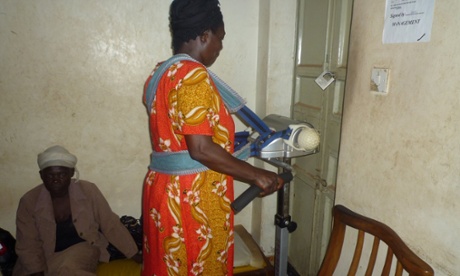
Next, Wasswa points me to the corner where a woman is standing on a small machine and holding onto a pair of handlebars, to which she is harnessed. Her whole body blurs in the dim light as the platform beneath her vibrates rapidly, its droning buzz filling the room.
Similar machines can be found in many gyms these days and are meant to help tone muscle, but the uses Wasswa presents are quite different.
“This is a blood circulation massager,” he announces. “You see how she sweats. It opens the vessels and deals with paralysis. It helps people with stroke.”
A woman stands on a machine Wasswa claims ‘deals with paralysis’. Photograph: James Wan
Wasswa then shows me another diagnostics machine, this one connected to a laptop. As the patient holds on to an appliance plugged into the computer, pictures of different organs flash up on the screen for a few seconds each as a dial next to it oscillates erratically. After a minute, a one-page document pops up, detailing how well his organs are functioning.
In the airless room, Wasswa runs through a few more devices − a face pain remover, a blood pressure reducer, a necklace that removes radiation − before squeezing past bodies and chairs to get back to the first patient we met. By now his diagnostic test is complete. The patient tells me that he came to the store because of some mild pain around his mouth. Wasswa breaks the news that there are more serious things about which he ought to be concerned.
“He has a problem with his spleen,” says Wasswa. “At times, he gets constipation and some swelling in the legs and arms. There is also some paralysis in the legs. He gets headaches. At times he feels dizziness. His brain arteries need to be detoxified. He has kidney deficiencies. He has bad chest pain. He has high cholesterol. He has poor circulation. And he has problems with his stomach.”
The man looks young and healthy. Wasswa is not perturbed.
“He needs to improve his circulation by using our machines and he will need to take our products. If he uses them, he will be fine,” he says.
‘Radiation cure’
Back in the waiting-room-cum-pharmacy, Wasswa shows me some of these products. He picks goods off the shelves – capsules, toothpastes, body creams – and stacks them on the counter as he explains what they do.
“This takes away all the radiation in your body. This helps with diabetes. This treats ulcers. This is for slimming. This adds more white blood cells to your system. This is for people who are mentally disturbed,” he says.
“These medicines are good for everything,” he concludes finally, the pile of products on the counter now complete. “If you have cancer, we can help. If you have HIV, we can help. Even if you have a hernia or a tumour or appendicitis, you just take our products and they will disappear.”
Even if you have a hernia or a tumour or appendicitis, you just take our products and they will disappear
This small store in eastern Uganda employs a handful of staff and, according to Wasswa, receives dozens of people each day. Wasswa is also frequently heard on local radio advertising his services and has made quite a name for himself in the area.
Wasswa was previously a school teacher and says his parents were “peasants”, but now, in his 30s, he is anything but. These days, he drives a shiny four-wheel drive, wears sharp suits and travels around the world. All this makes him quite the exception in Iganga, but across Uganda this young man is by no means a solo pioneer and his store is by no means unique.
Similar stores can found all across the country, from Kasese in the west to Soroti in the east, and from Gulu in the north to Entebbe in the south. There are four outlets in the capital Kampala. All the stores offer the same diagnostic tests, stock the same range of products, and above their doors, there hangs the same innocuous green and orange sign which reads: “Tiens: Together We Share Health And Wealth.”
Tiens − also known as Tianshi − is a multinational company based 10,000 miles away in the Chinese metropolis of Tianjin. It was founded in 1995 by Li Jinyuan, who has since become a billionaire from the venture. The company has established branches in 110 countries, including 16 in Africa, employs over 10,000 staff globally, and reportedly enjoys net profits worth hundreds of millions of dollars each year.
Tiens in Uganda
Tiens first began tapping into the Ugandan market in 2003 and it has grown steadily ever since. There are now around 30 stores across the country. Its distributors regularly engage in outreach programmes to rural communities, and according to the company’s national chairperson, Kibuuka Mazinga Ambrose, Tiens-Uganda has an annual turnover of around $ 6m.
The company has even bought the most prominent advertising spot on the Health Ministry’s official calendar, despite no Tiens outlet being explicitly registered as a health facility.
People who come to the stores seek help for a whole range of conditions, but they tend to tell similar stories of how they arrived. Typically, they say that they first went to public health facilities (some told me they had even visited two or three), but were either not seen or found the treatment ineffective. Tiens is almost always a last resort. But in a country whose healthcare infrastructure is struggling and which, by some measures, ranks as one of the worst in the world, the last resort is often one that needs to be taken.
In many areas of Uganda public health facilities are virtually inaccessible, and those who do manage to reach them may find their walls crumbling, clinics under-staffed, and shelves empty of drugs. Although the government has promised to invest more in healthcare, much of the infrastructure is in decay. Doctors and nurses are over-worked and underpaid, and although services are meant to be free, in reality patients face many hidden costs.
In this context, stores such as Wasswa’s − with its quick turnaround, attentive staff and fully-stocked shelves − offer an appealing alternative. The conclusive diagnostic tests are highly convenient; attendants’ claims about the healing powers of Tiens products may well be reassuring; many patients say the fact the medicines travelled thousands of miles from China suggest they must work.
Satisfied customers
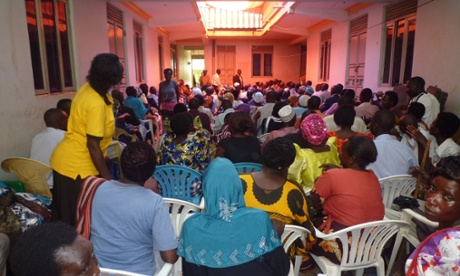
On the Friday morning after my tour of Wasswa’s clinic, the courtyard next to the outlet is packed. More than 100 people sit on plastic chairs facing forwards while latecomers lean against the back wall. A red tarpaulin sheet shields the crammed attendees from the sun and gives the whole atmosphere an eerie pink hue.
“Doctor Julius” stands at the front. He has just finished explaining the healing powers of Tiens toothpaste. As well as cleaning teeth, he says, it can be used to treat ulcers, skin problems and even angina, among many other conditions. He invites attendees who have used the product to give testimony. Four hands go up immediately.
“I had terrible problems with my teeth,” says the first speaker. “I went to see doctors but a new tooth had to be uprooted every week. When I started to use Tiens toothpaste, the pain went away.”
The next person tells a similar story. Two mothers relay how the toothpaste cleared up their respective children’s skin rashes and burns.
Every now and then over the next few hours, many more attendees are invited to recount their experiences of using Tien products. We hear how a man with back pain can now walk, how another man was cured of vertigo, and how a woman’s child was once bed-ridden but is now running around. At one point, Wasswa looks particularly pleased as a mother tells of how her young son − who she had taken to three public healthcare facilities before he was cured of cerebral malaria by Tiens − now wants to change his name to Doctor Wasswa.
At hospitals, they will ask you how you feel, but here, we tell you how you feel
“You see, these products work,” Wasswa announces after one of the testimonies. “At hospitals, they will ask you how you feel, but here, we tell you how you feel. At hospitals, they treat signs and symptoms. Here, we treat causes. At hospitals, they give you medicines made from chemicals which are harmful and can give you ulcers. Here, we use herbal medicines which have no side-effects.”
“This is real,” he continues. “This is Chinese herbal medicine based on 5,000 years of traditional medicine and it works.”
Personal experience
In Kampala, I test this out for myself. I visit a couple of the company’s stores, nestled in the city centre’s endless bustling plazas, and in one of them, managed by a man named Frank, I get tested.
Frank, the self-declared “best in the business” at doing diagnostic tests, seems thrilled at my presence and bundles me across to the end of the room. He sits me down and pulls across a thin curtain to give us a modicum of privacy from the handful of waiting patients. He takes out a battered looking hand-held device, pushes a 9-volt battery into its back, and plugs a wire into it that branches into two metal tips. He gives me one of the electrified points to hold in my right hand and says he will use the other to press points on my left palm. With a grave look on his face, Frank instructs me to tell him when I feel a tingling. This seems to be a more basic version of the first test I’d seen in Iganga.
To begin with, I report whenever I feel something, which is every single time the tip touches my hand, completing the basic electric circuit. Frank nods excitedly when I do so and explains that I have a serious problem in whichever part of my body he is testing. After a while, however, I decide to stop reporting every time I feel a tingling. Frank lets me get away with one, but after that he frowns when I stay silent and simply keeps the metal point on my hand until I give in, sometimes rubbing my hand and even licking the metal tip if I am being particularly resistant.
In the end, Frank writes out a list of around 25 health conditions including “liver disorder”, “STROKE”, and “enteric fever [severe typhoid]“, and prescribes a list of products that comes to over USH 1 million ($ 400).
I get tested. Frank writes out a list of around 25 health conditions including ‘liver disorder’, ‘STROKE’, and ‘enteric fever’, and prescribes a list of products that comes to over USH 1 million ($ 400)
Before committing to his costly regimen, I decide to get a second opinion.
In the bright, clean reception of Beijing Clinic, a private health facility in Kampala, I relate my experience to a young Ugandan doctor, who trained and qualified in China, specialising in traditional Chinese medicine. The doctor, who prefers not to be named, laughs as I explain the machines I saw in Iganga and the test I underwent in Kampala. “No machine can test all those things like they claim,” he says.
Next, I show him the Tiens Information Guide, a booklet from which it seems Julius and Wasswa get much of their information. On page three of the booklet, a short disclaimer warns: “Tianshi Company does not make any medical claims whatsoever.” However, the next 60 pages are filled with bold declarations about the powers of its products and instructions on how to treat different diseases.
The Chinese-trained doctor says this is not Chinese medicine as he knows it. He chuckles as he reads how Tiens medicines are supposed to treat about a dozen different conditions each, from preventing cancer to reversing impotence to promoting “the growth of children’s reproductive organs”.
But the doctor’s amusement turns to horror as he reaches the section of the booklet advising distributors on what steps to take when patients are suffering from different diseases.
If patients have already been given a diagnosis, the company guide offers clear and easy instructions on what they should be prescribed. Of the few hundred conditions listed − which span from Aids to Yellow Fever − a handful include the recommendation to “see a doctor”. But the rest just list a few products to be taken.
One of the most repeated claims is that because the products are herbal they have no side-effects. This is used to show their superiority to western medicines, which they say are made from chemicals and so can be harmful, but the claim is also used to suggest that there are no dangers involved in taking them.
“Even if I tell you to swallow one and you swallow four, there will be no problems,” Wasswa had insisted. But when put to the Chinese-trained doctor in Beijing Clinic, he just shakes his head.
At another private clinic in Kampala, Dr Wen, a highly experienced practitioner, is similarly concerned. “This is not medicine,” he says, “but it is still dangerous. Everything has side-effects. Even herbal medicines and herbal supplements used wrongly can kill.”
I contacted Uganda’s health minister, Ruhakana Rugunda, repeatedly for comment, but received no reply.
Supplements
Tiens products are not registered medicines. Some of the company’s goods have been registered with Uganda’s National Drugs Authority as food and dietary supplements.
Stories about the products not fully working are common, even among fans.
Back in Iganga, with the courtyard seminar over and Wasswa busy talking to a small circle of attendees eager to hear more, Sarah*, 25, moves towards the back of the courtyard closer to where I am sitting.
During the seminar, she had given testimony telling of how she’d taken her baby boy, who was suffering from sickle cell anaemia, to several hospitals before she came to Tiens. Many of those who told their stories directed them matter-of-factly at Julius or Wasswa, but Sarah had turned to face the crowd and spoken passionately as she’d explained how the products worked wonders.
The Tiens seminar. Photograph: James Wan
Asked a few more questions after the symposium, however, her story reveals itself to be far less straightforward. Her son is still ill. So ill, in fact, that she recently quit her nursing job to look after him full-time.
Sarah nevertheless insists that the Tiens medicines work and says the reason her son is still suffering is because his treatment is incomplete. She bought half the products the boy needs for a full recovery but is struggling to find the money to purchase the rest.
Sarah and Robert reveal that they have each spent USH 460,000 ($ 180) on products so far, paying in instalments from what they could borrow or scrape together
Robert, 30, tells a similar tale. He too claims to be a firm believer in the healing powers of Tiens, and acted as my translator throughout the seminar, seemingly on Wasswa’s instruction. Robert says he came to Tiens with kidney problems and maintains the products worked where hospital treatments failed. However, he admits that he is still in pain.
Firstly, he attributes this to the fact that his kidney treatment is incomplete; he too has had financial difficulties. Secondly, he explains that the Tiens diagnostic test revealed his kidneys are not his only problem; while his original condition may have improved, he now knows he is suffering from other conditions that need to be cured too.
Sarah and Robert reveal that they have each spent USH 460,000 ($ 180) on products so far, paying in instalments from what they could borrow or scrape together. Sarah says she needs USH 500,000 ($ 200) more to complete her son’s treatment, but doesn’t know where the money will come from given that she is now jobless and that the father of her son is in school. Robert says he needs around USH 200,000 ($ 80) more, but says that as a “peasant”, he too will struggle.
“I haven’t balanced it well,” he says, “but I hope it will balance out soon. I am still feeling pain.”
It is not a coincidence that Robert, Sarah and a few others who spoke to me had all purchased exactly USH 460,000 worth of products. Nor is it an inexplicable peculiarity that people with no reliable source of income had shelled out what little they had, and more, on Tiens products. After all, Tiens is more than just a supplier of health supplements.
Pyramid scheme
In the symposium in Iganga, once Julius had waxed lyrical about various products, it was time for Wasswa to take over the stage to talk about another benefit of Tiens. Though not before Julius had the opportunity to rouse the crowd.
After finishing his demonstration of Tiens’ disease-curing sanitary pads, Julius put down the product and strolled along the front of the courtyard before turning to face the audience. “Tianshi!” he shouted suddenly. “Together we share!” came back the reply on cue, a hundred voices amplified by the concrete walls. “Tianshi!” Julius proclaimed a second time, a little louder. “One dream!” came the soaring response. “Tianshi!” yelled the doctor a third time. “The best of all!!” bellowed the crowd.
Next, Julius taught the audience a new trick. Since all points in ours palms relate to different internal organs, he explained, clapping stimulates the whole body and works as a kind of “first aid”. He held his hands apart and, together with the crowd, clapped out a rhythm that crackled across the courtyard. Julius explained that the louder you clap, the greater the benefits to your internal organs, before holding out his hands and going again. And again.
Finally, looking satisfied, Julius completed his session and handed over to Wasswa.
“Tiens is not just good for your health,” the salesman proclaimed, taking to the stage, “it is also good for your wealth. If you register with Tiens, they will start to pay you. You come here for treatment, but over time, you will start to get a salary.”
Tiens is not just good for your health,” the salesman proclaimed, taking to the stage, “it is also good for your wealth”
Over the next few minutes, Wasswa explained that this is what he had done and that he was not only receiving thousands of dollars every month now, but had been taken on international trips by the company, received huge cash bonuses and been given a brand new car.
“When you reach a certain level, you start earning,” he said. “And it does not matter if you have no qualifications or education. Tiens does not care if you are educated. Tiens only cares how many products you buy and how many people you recruit.”
Wasswa said these words with a weighty earnestness, but they were not news to half the courtyard. Robert, Sarah and many others around them − all recognisable by the golden lion-shaped badges they were wearing − were not just Tiens patients, but members and distributors already. They were here on Wasswa’s instructions to give testimony and help convince others to join too. For these returning members, Tiens is not just a medical supplier, but a livelihood, an investment, and a chance to follow in Wasswa’s jet-setting footsteps.
When you reach a certain level, you start earning. And it does not matter if you have no qualifications or education. Tiens does not care if you are educated. Tiens only cares how many products you buy and how many people you recruit
Joining fee
Sitting behind his desk at the Tiens-Uganda headquarters, located at the top of King Fahd Plaza on a busy street in Kampala, Kibuuka Mazinga Ambrose is delighted to explain how the business model works in more detail.
“Anyone can join,” says the company chairperson, wearing a bright yellow Tiens-branded cap. “All you need to do is pay a small initial fee of $ 20.” Once you have done this, you can buy products at wholesale prices and sell them on at a profit. However, this is just the start, he says. You don’t get rich by selling a few bottles of herbal supplements. Under Tiens’ model, there are eight ranks and you need to move up the levels to really start enjoying the benefits.
The first few levels can be reached simply by buying more products, which essentially brings with it a small discount on goods. However, to get to the bigger rewards, you need to start recruiting others. This way, you receive a commission whenever they make purchases and also get rewarded if they recruit their own followers.
Tiens refers to itself as a “multi-level marketing” scheme. The more people you recruit and the more they recruit in turn, the higher you move up the rankings, and soon you can just sit back and watch as the commissions roll in. Furthermore, once you’ve reached the 8-star level and keep growing your network, you will eventually become a Bronze Lion, then a Silver Lion, then a Gold Lion, and enjoy rewards of cash prizes, international trips, a brand new 4×4 car, a luxury yacht, a private jet, and finally a “Luxurious Villa Palace”.
“It’s all about growing your network; their success is your success,” says Ambrose cheerily. “Tiens does not care who you are. Anyone can do it, and there is no limit on what you can earn.”
As the Tiens guide puts it, joining the company means: “You stop struggling financially,” there is “little risk of losing”, and “if you work for five years you can retire.”
According the company website, over 200,000 Ugandans have joined Tiens, eclipsing the number of government school teachers in the country
According the company website, over 200,000 Ugandans have joined Tiens, eclipsing even the number of government school teachers in the country.
Given Uganda’s high rates of unemployment − youth unemployment is over 80% according to some estimates − the appeal of membership is clear. Decent jobs are scarce and rags-to-riches stories like Wasswa’s are even scarcer.
The company’s image is significantly helped by the Ugandan government. Not only does Tiens advertise on the Health Ministry’s calendar, but according to Wasswa, around 10 MPs are members of the company. At the Iganga seminar, Stephen Wante, the mayor of Bugembe, made a guest appearance. In 2011 meanwhile, vice-president Edward Ssekandi officiated a ceremony in which a distributor was awarded a car and organised for Tiens to donate some of its products to a government health centre. A photograph of the Ssekandi shaking hands with Tiens’ president also has pride of place on the company website.
Given Uganda’s high rates of unemployment − youth unemployment is over 80% according to some estimates − the appeal of membership is clear
However, at the Tiens headquarters, where members can print out their balance sheets, most leave the office holding spreadsheets indicating that they are owed almost nothing, if anything at all. Back in Iganga, several members who had joined several months ago, attended every biweekly seminar, bought lots of products, and gone on recruitment drives, revealed that they had not earned any notable income either. It seems many others have also abandoned the scheme after finding they could not make it work.
According to most Tiens members − both those who are profiting and those who aren’t − the reason for these failures is simple: the individual did not work hard enough. When I asked Sarah why she thought she hadn’t made any money after being a member for five months, for example, she hesitated before Robert chipped in to say “it means she is not performing well”. Yet Robert had barely received any income either, despite having been a member for six months and having recruited nine people. Other members who had yet to make money also suggested their situation was down to bad luck or poor performance.
I asked Wasswa how long it typically takes to break even. “Some people can take a month, but sometimes maybe two months,” he replied.
What if someone has been working hard but hasn’t started getting an income after six months, I followed up. “Six months?” Wasswa exclaimed. “No, it’s rare. Very rare. If someone is serious, they should be on a high level and earning well after six months.”
I looked at the three recruits who all just stared at the floor.
Not only does each distributor have to compete with 200,000 other sellers as well as 30 well-established stores, it doesn’t make economic sense for customers to buy from individual members when they could sign up to Tiens themselves and get much lower prices anyway.
This is perhaps why Wasswa and other recruiters barely even mention selling products and why the emphasis instead is very heavily on “growing your network”. The incentives for signing up new members are higher than those for sales; the training sessions teach recruits how to sell membership rather than goods; and the Tiens guide’s main advice is a six-step plan of how to “make a name list of at least 100 in a shortest time possible”.
A Tiens Uganda booklet. Photograph: James Wan
I later contacted Ambrose, Wasswa and Jamba George, another 8-star recruiter, for their response to the points made in this article, but they all declined to comment. The manager of Tiens-Uganda, a Chinese expatriate, and the company’s global headquarters in Tianjin also declined to comment.
It should also be noted that Tiens is not just in Uganda, nor is it the only scheme of its kind. While Tiens’ presence on the continent seems to be particularly strong in west Africa, Ethiopia and Zimbabwe, the company also has offices in many western countries, though its products are marketed more directly as food supplements and “wellness equipment’”.
Last hope
Back in the courtyard in Iganga, Robert is listing the products he was prescribed six months ago. Like so many others faced with Uganda’s struggling healthcare system, Robert ended up seeking alternatives and eventually ended up at Wasswa’s busy but welcoming clinic.
The products worked, Robert insists. Up to a point. He just wishes, he says, that he could finish the treatment and be fully cured of his kidney problems as well as the other health conditions detected by the diagnostic test he underwent. But he cannot afford it.
Robert has no other work − he says there are hardly any jobs available in the area − and has five children to support. When he joined the company half a year ago, he thought Tiens was the answer to all his prayers, but he is still in pain and deeper in debt.
“Money is a problem, he says. “It is not easy to recruit people and I spend USH12,000 ($ 5) every week on transport to come to these seminars.”
I ask him why he is still part of the company despite losing money each week. He pauses for a moment before answering, “I believe I will balance my accounts soon. And I am close to moving up to the next level when I will be able to earn more.”
He explains that a technical misunderstanding delayed him moving up a rank, but that it should be sorted out soon. I point out that even if he moves up a level and earns slightly more than now, he will still be earning a tiny fraction of what he has invested. He nods in agreement, but adds, with a faint smile, “But with Tiens, time is on your side.”
But what if it still doesn’t work out, I push. What if Wasswa is the exception that proves the rule? What if it never works out?
Robert looks me in the eye for a few seconds before gazing out across the courtyard where a few groups of attendees are still standing around chatting.
“If the money defeats me, ” he says quietly, turning back to me, “I will disappear.”
* some names have been changed to protect interviewees’ identities.
This article was made possible by a grant from the China-Africa Reporting Project managed by the Journalism Department of the University of Witwatersrand
The report discloses that patient details was sold to 178 personal firms on 588 occasions in between 2005 and 2012, with product sales to pharmaceutical firms and at least 5 major insurance companies, who used it to adjust consumer premiums.
Shockingly, in two situations, auditors had been unable to track down in which the NHS data had been passed.
The overview was led by Sir Nick Partridge, a non-executive director of the Wellness and Social Care Information Centre (HSCIC), which is now in charge of NHS information.
The transactions were dealt with by the NHS Details Centre, its predecessor entire body.
Sir Nick stated: “The HSCIC have to discover lessons from the loosely recorded processes of its predecessor organisation. The public simply will not tolerate vagueness about healthcare information that could be intensely private to them. We exist to guard their data and we have to earn their trust by demonstrating scrupulous care with which we deal with their personal information.”
Even though information did not identify sufferers, in some instances it would have been attainable to “deduce” which patients the data referred to, although this is unlawful, the evaluation found.
It concluded that “there had been considerable administrative lapses in recording the release of data. In some circumstances the choice making process was unclear and data of choices incomplete when managing health-related data this is unacceptable.”
Phil Booth, from privacy campaigners MedConfidential, stated: “The government says it will quit the sale of patient records to insurers, but what about the hundreds of thousands that have already been sold? All business reuse contracts need to be shut down instantly and all our information that should never have been given away must be deleted.”
The review calls for a series of changes to tighten controls of information and improved transparency about the use of info.
The report says three insurance coverage businesses – Scor Worldwide Life Uk, RGA Uk Solutions and Milliman – which hold recent patient information have been ordered to delete their information.
At least two a lot more insurance coverage firms, Very first Help and Pacific Existence, previously had accessibility to aggregate data, the HSCIC mentioned.
None had entry to named patient data. Information was utilized to set premiums for types of consumers, not distinct people.
The disclosures in February about the dealing with of hospital information emerged amid growing worries about plans for a nationwide database which will carry together information from GP data.
The programme was due to be launched in Could, but has been put on hold until next year as even more controls had been drawn up, and will comply with a number of neighborhood pilot schemes.
The HSCIC board stated it had accepted Sir Nick’s suggestions in total.
Helen White, Head of Safety at the Association of British Insurers, mentioned the sector supported the findings.
She mentioned: “Insurers do not want or use data that enables them to recognize people.
“They are interested only in information that demonstrates population trends in health, such as trends in how frequent specific illnesses are, and trends in recovery from specific illnesses.”
When an extreme fever overcame 50-12 months-previous Daw Cho Cho final spring, she took the identical measures as when she final had malaria.
Wary of village medication and mindful of the properly-funded clinic across the border, she crossed into Thailand from her Burma village and came to the malaria centre for therapy. 7 years in the past, her malaria was cured inside of a day. This time, it took much longer.
Inside of three days, medication had killed the parasites in her blood and Daw Cho Cho felt regular, her symptoms gone. But a month later, the malaria came back. The medicines have been unable to kill all the parasites in her blood, and they multiplied.
Dr François Nosten has studied malaria on the Thai-Burma border for 30 many years. Photograph: Kathleen E McLaughlin for the Guardian
She is amid the 1000′s who have been contaminated with an insidiously evolving drug-resistant parasite that might account for 80% of the malaria on this segment of the Thai-Burma border. The mosquito-borne illness is becoming resistant to the final anti-malaria drug standing – artemisinin – largely simply because of counterfeit medicines and incorrect usage.
A top researcher at the Shoklo Malaria Research Unit (SMRU), a investigation centre based mostly on the border and funded primarily by the Wellcome Trust, is taking radical measures to stop the spread of the new strain just before it gets uncontrollable. Dr François Nosten, SMRU’s director, has studied malaria in this border area, close to in which the disease very first grew to become drug resistant, for three decades. He believes that in purchase to stop it spreading to India, then Africa, the place the vast vast majority of the world’s malaria situations happen, it’s important to chase the parasite into Burma’s forests and pre-emptively treat even people who might not be ill.
“If we do not do anything at all, we think that we know what is going to come about,” said Nosten, explaining that as malaria charges decline, the strongest and most resistant strains of the parasite survive and spread. “It has constantly happened like this in the previous, there is no cause to believe this time will be any diverse.”
The degree of alarm Nosten and other scientists express more than drug-resistant malaria contrasts with how it manifests in people, in these early phases. It acts just the very same as any malaria, but is more hard to remedy. The variety of cases creeps up slowly, spreads, then explodes.
“The point about resistance to something – medicines, antibacterials – is that it rises exponentially,” said Nick White, a professor with the Oxford Tropical Medication Analysis Programme who functions with Nosten on this problem. “There’s a long time period in which it doesn’t appear to be rising – and then it really is growing.”
Folks who have had the new strain of malaria report that it feels no distinct to the ailment cured in a day by artemisinin combination therapy just a couple of years ago. That might alter, but for now, the malaria itself does not cause new signs or a lot more complications – it’s just turning out to be a lot more challenging to ruin.
Daw Cho Cho, 50, was taken care of for malaria but the parasites returned a month later Photograph: Kathleen E McLaughlin for the Guardian
My Yee Thaung, whose 9-year-previous son not too long ago had malaria thought to be drug-resistant, explained he recovered, gradually, “but he’s even now not consuming extremely effectively.”
These individuals are between 1000′s participating in a 9-week review of their blood. The clinic, one of 5 malaria centres for Burmese refugees in Thailand run by SMRU, pays their transportation charges and a nominal amount to cover lost wages, and the individuals return to give blood samples after a week.
The amount of malaria instances has shrunk in this region dramatically in the previous thirty many years, given that Nosten and his team started to incorporate and eradicate it. When Nosten commenced the very first border clinic, the parasite was a major killer, infecting tens of thousands of people each and every rainy season. Today, there are a number of thousand cases each and every yr. But individuals that remain are a lot more probably to include a wilier parasite, 1 that is evolving to evade what was very first touted as a miracle drug.
The global implications of artemisinin dropping its edge on malaria are alarming. Worldwide, the WHO estimates there were 207 million malaria situations in 2012 and a lot more than 600,000 deaths, and says malaria charges dropped 25% throughout the world in the course of 2000-2012. The Institute for Well being Metrics and Evaluation employs a various methodology for tallying malaria deaths and says the worldwide death toll could be double what the WHO reports.
In both case, malaria numbers have dropped dramatically in the past decade. But what stays is even far more unsafe, and Nosten warns of a potential complacency that could permit drug-resistant malaria to erupt.
Scientists in Mae Sot’s border clinics study malaria parasites and new drugs that might be utilized to destroy them. Photograph: Kathleen E McLaughlin for the Guardian
“It is an emergency. Everybody is investing their time in meetings, providing advice, not acting speedily ample,” he stated. “It looks like this time we are going to get rid of.”
The march of drug-resistant malaria westward has begun. Circumstances are cropping up additional west in Burma, and could have entered Bangladesh. If which is the case, and background repeats itself, this unsafe and possibly deadly parasite could move additional west into India, then drop south to Africa. It has occurred twice before with the world’s very best malaria medicines and researchers such as Nosten worry a third wave is beneath way, negating a frontline treatment method for a killer of millions, with practically nothing new on the shelf to get its area.
Starting up this summer season and backed by the Global Fund and others, Nosten’s staff is going on the offensive against malaria in Burma. His teams will set up 800 village well being stations inside Burma, treating individuals who have the illness and pre-emptively providing medication to entire villages where a higher percentage of folks carry the malaria parasite. He believes containment – the strategy of decision thus far – has been as well limited, however malaria costs have dropped significantly. Elimination is now necessary.
Artemisinin-primarily based malaria drugs have couple of side-results and most folks call for only a 3-day program to get rid of the parasites. Nosten faced early opposition to his prepare, but says time and options have run out, and the downsides are minimum.
“It is already spread from the border into Myanmar [Burma],” he mentioned. “We should have carried out this three or 4 years ago. Now I am afraid it could be a bit also late.”
Malaria is forever outrunning its attackers, shifting its shape to survive the medication invented to eradicate the parasite.
Chloroquine was widely powerful all around the world, but started to get rid of its grip on malaria following mass dosing in endemic locations. Malaria grew resistant to the drug by the 1950s. Sulfadoxine-pyrimethamine, frequently offered as Fansidar, came following and proved efficient until finally the finish of the final century, when resistance proved widespread.
Artemisinin, derived from sweet wormwood, followed. China’s People’s Liberation Army at the behest of the Communist get together leader, Mao Zedong, developed the drug as portion of a secretive venture in the course of the Vietnam war. The hugely effective drug was stored out of the international marketplace by China but also since of international pharmaceutical spats. In 2006, it grew to become the world’s frontline malaria treatment.
These days, artemisinin nonetheless performs inside a combination drug. Since of a worldwide abundance of fake medicines (a lot of produced in China) and undesirable dosing, even so, its days are numbered.
Vicky Mason, 69, cares for her 94-yr-outdated mom, Jane, who was diagnosed with Parkinson’s condition a decade ago. In current many years, Jane has begun to present indications of dementia and delirium. “She has been deteriorating over the previous couple of years. She nonetheless understands who we are, but her memory is fading,” says Mason.
But a project to offer specialist psychiatric assistance to dementia sufferers although they are in hospital has the two stabilised Jane’s cognitive skills and enhanced the way in which her Parkinson’s is taken care of. On noticing a adjust in behaviour, the doctors treating Mason’s mum on the Parkinson’s ward in Heartlands hospital, Birmingham, referred her to the project’s speedy evaluation interface and discharge (Raid) team based in the hospital, for fast expert psychiatric support.
“The mental health teams were capable to give medicine to quit her from hallucinating and also provide assistance to help her deal with dementia – she is now capable to hold a appropriate conversation,” says Mason. The diagnosis of significant delirium also altered the clinical therapy Jane obtained, as some of her medicine for Parkinson’s would induce nightmares.
The undertaking was very first piloted in December 2009 by Birmingham and Solihull Psychological Well being NHS Basis Believe in in Birmingham City hospital. The aim was to assess the effect of on-website psychiatric care in acute hospitals, right after analysis recommended that much more than a quarter of sufferers in common hospitals had a psychological sickness in addition to their physical sickness. Any medical professional or nurse can refer patients to the Raid staff for evaluation.The team aims to assess patients referred by A&E inside of 1 hour, with a 24-hour target for those already admitted to hospital wards. When a diagnosis has been produced, individuals are either transferred to the out-patient clinic in the hospital or linked to neighborhood community psychological well being services.
The project proved so productive, all five acute hospitals in Birmingham and Solihull, as well as acute hospitals in Telford and Shrewsbury also introduced a Raid services, whilst the method has been defined “ideal practice” in the Joint Commissioning Panel for Psychological Health’s 2012 advice on commissioning mental well being companies. And interest in the task is growing, following final year’s report by the Royal University of Doctors, which warned that common hospitals are on the brink of collapsing under the mental well being issues of an more and more ageing population – similar solutions are becoming designed in Manchester and Wigan.
George Tadros, a advisor psychiatrist at Heartlands, which introduced its Raid group in 2012, says the undertaking has enhanced diagnosis and pace of treatment for individuals who have mental health situations. “Most acute hospitals in Britain are not equipped to deal with the vast sum of psychological well being disorders that come by way of their doors,” he says. “Just before we introduced the Raid team in City hospital, the mental well being signs and symptoms shown by numerous sufferers had been either not identified or doctors would have to speak to the liaison psychiatry team outside the hospital and it could get days or even weeks for the patient to be witnessed and by then the issue could have acquired significantly worse.”
The Raid group has expert psychiatrists, social employees and mental wellness nurses with knowledge in previous age, doing work age and postnatal psychological health and substance misuse, and it supplies typical instruction for acute hospital staff in the diagnosis of delirium, depression and dementia.
Tadros says the venture has also had wider positive aspects for the hospital: enhanced waiting times and diminished repeat admissions. “In the past, we have seen patients who repeatedly come to A&E with recurring difficulties, and in a lot of cases instant psychiatric support would have prevented this. 1 typical example is individuals who come with panic attacks, which might be presented as breathing issues. When the bodily problem is handled you do an ECG and then send them away. But the cause has not been addressed and so they come back.”
Analysis by Paul Kingston, director of the Centre for Ageing Studies at the University of Chester, which assessed the effect of the pilot Raid task, supports his view. Kingston’s report, published last year, identified that Birmingham City hospital, which has 600 beds, saved 43-64 beds per day by avoiding readmissions, although a separate 2013 audit by the London School of Economics estimated that the venture saved the hospital £3.5m.
“Occasionally physical issues cause mental overall health situations and other times mental well being situations are manifest by means of bodily signs and symptoms. For this cause psychiatric support is vital in all acute hospitals,” says Kingston. “Most of the diagnostics that take spot with mental overall health do so by means of conversation. You can’t see depression in a blood test or an x-ray. A lot of of the men and women coming into acute hospitals are, for various causes, unable to communicate a psychiatric difficulty to a physician or may possibly not realise they have one particular. So unless there is expert support they usually go unnoticed.”
For Mason, the task has also improved her own situation. “My mother now receives weekly help from local local community groups while continuing her Parkinson’s remedy. She is much less distressed now she has regular support and this has taken a massive burden off me.”
A public vigil is held at Lichfield Cathedral for Stephen Sutton, the 19-12 months-outdated cancer sufferer and fundraiser. Sutton has raised a lot more than £4m for medical analysis given that he was diagnosed with bowel cancer aged 15. He was praised for his work by celebrities this kind of as Russell Brand, Simon Cowell and Ricky Gervais
Sarah Deeley, a care worker from Tamworth in the West Midlands, said she needed to come and say “thank you” to Stephen for his example.
“He was just such a wonderful person, this is the least I could do,” she said.
It comes as record producers announced a charity record is to be released in Stephen’s memory.
The record, called Hope Ain’t A Bad Thing, has been produced by the Neon Brotherhood, as a personal tribute by 40 musicians inspired by the work of the 19-year-old.
It will feature a speech from Stephen that he had intended to use on his own charity single, while he is also heard playing the tambourine.
The record featuring Stephen has been cut at the Neon Sound Studios in his home town of Burntwood in Staffordshire, where he jammed as a drummer with band Nothing Personal.
Mike Wood, who coordinated the single, posted an advert on Facebook back in April when Stephen first brought the cause of the TCT to the fore. The response to his appeal was “overwhelming”, the 29-year-old said.
“We had so many people that in the end I had to turn musicians away,” said Mike, who plays bass on the 5 minute 25 second recording.
Shane Mason, 19, of Brownhills in the West Midlands, plays piano on the record.
“I was never fortunate enough to meet Stephen, but he was an inspiration,” he said.
“We’ve had the blessing from the family, and both Chris (Stephen’s older brother) and Jane (his mother) came to see us in the studio last week, and are behind us 100%.”
He added: “I was playing piano on the track, and there was a picture of Stephen hanging up on the studio wall above me, where he’s smiling and posing.
“I sort of liked to think he was there with us while we were recording.”
All the proceeds from the sale of the record, which will be released on iTunes and Amazon on Monday, will go to the TCT.
A photo of Stephen Sutton stands in Lichfield Cathedral (PA)
Well-wishers have streamed into the 14th-century cathedral, with many unable to enter the packed building, as an organist played Toccata from Symphony V by French composer Charles Marie Widor.
Before the vigil at began at 7pm on Thursday £20,000 was donated to his JustGiving page in an hour.
Donations were being made at a rate of more than £1,000 an hour to his campaign, which rose from £4.23 million at 7.30pm to £4.24 million by 8pm.
Stephen first started raising money for TCT after he was told his cancer was terminal, prompting him to create a bucket list of 46 “weird and wonderful things” he wanted to do before he died.
Another item on Stephen’s bucket list was a lad’s holiday in Ibiza (FILM UNITED)
His initial target was a modest £10,000 but he increased this to £1 million after donations soared and his appeal attracted the attention of celebrities. He reached his £1 million target after posting a ‘final thumbs up’ selfie when his condition worsened and he went into hospital shortly before his death on May 14.
Opening the ceremony, the Dean of Lichfield, the Very Reverend Adrian Dorber, described Stephen as an “extraordinary example and inspiration” for everyone.
He said: “We have gathered because we don’t want to forget how Stephen has touched so many lives, how his positive attitude turned his own cancer into a force for life.
“We need to remember what Stephen has taught us; not to waste time on his illness, but to grab hold of every single thing that enhances life and makes the world a more joyful place.
“In these next few hours we are trying to do what Stephen did brilliantly, and that is to make the unacceptable meaningful and beautiful.”
He then read the poem “Dust” by Elizabeth Jennings before Julia Hayburn, the assistant head of Stephen’s former school, Chase Terrace Technology College, also paid tribute.
She told of how, when he was diagnosed, the “determined” teenager’s immediate reaction was to call a meeting with teachers because he refused to take doctors’ advice to “forget his Year 11 study”.
Instead he would go on to complete his GCSEs and AS-levels, she added.
“Words like awesome, awe-inspiring and inspirational became synonymous with Stephen – but they only touched the surface of what he has become on a national and international scale,” said Mrs Hayburn.
Following the end of the hour long formal part of the service, the Dean invited the congregation to do five things in turn, including signing the books of condolence and giving the “thumbs-up” sign that has become synonymous with the teenager’s campaign.
Scattered around the church were pictures of Stephen, badges printed with the words “thumbs up for Stephen” and cards telling people where to donate.
Stephen Sutton achieved many of his bucket-list wishes and raised millions for cancer research before his death (PA)
Also on the cards were Stephen’s most famous quote: “I don’t see the point in measuring the worthiness of your life in terms of time, but rather you should measure life in terms of what you achieve.”
Among those attending and giving their thumbs-up were Celia Houghton and her 14-year-old daughter Freya, who had gone to school with Stephen.
The teenager remembered a powerful speech Stephen gave to the school’s assembly a year ago, saying “he was one person who stood out”.
“The one thing that spoke to me was when he said ‘don’t measure time by the clock, measure it by what you do’,” added Freya.
“When he died, people cried at school.
“I remember walking along the corridor and people were using Post-It notes to stick goodbye messages on the wall.”
The teenager’s favourite records – including You’ve Got A Friend In Me, by Randy Newman – were played.
Other songs on the 38 minute compilation including Time To Say Goodbye, by Russell Watson; The Circle Of Life from Disney’s The Lion King; Track Five, by Foo Fighters; Do You Realize, by The Flaming Lips; One Day Like This, by Elbow; I’ll Be Missing You, by Puff Daddy and Faith Evans; You’ll Never Walk Alone and I’ve Had The Time Of My Life, by Bill Medley and Jennifer Warnes.
A queue of people waiting to pay their respects to the teenager stretched outside Lichfield cathedral and lasted for more than an hour after the Dean concluded his address.
Pamela Milligan, whose daughter attended the same school as Stephen said: “I just think it’s fantastic what he has achieved. The town has come together to pay its respect, it’s covered in yellow. He was an inspiration.”
Peter Robinson, 70, a chartered surveyor said: “He has done a wonderful thing, raising an amazing amount of money, and we wanted to show our respect for what he has achieved.
“We can’t believe how the boy next door can raise £4 million. It’s so moving. The ceremony was very appropriate and absolutely packed out.”
People laid bunches of yellow flowers outside the Cathedral.
One bouquet left by one of the 19-year-old’s former band members held a tribute that said: “Ste, it was a pleasure to share the stage with you. Keep on drumming buddy.”
Another bunch was left by a woman who met Stephen as he worked to reach his first fundraising goal of £10,000 in 2013 and became friends with him in the last year of his life.
Charlotte Aspley, 24, who also raises money for TCT said: “I’m just very sad. He was the most amazing person, the most jolly person I have ever met. When I first met him he was going for his first target of £10,000 and now it’s £4 million.
“He was incredible. He became more and more determined to raise more and more money with every milestone he reached.
“This service would have meant everything to him. He always wanted to get himself out there, to meet people. We are so proud of him, and now we want to keep his work going.”
The teenager documented his battle with cancer on his Facebook page, Stephen’s Story.
The funeral cortege of Stephen Sutton arrives at Lichfield Cathedral (GETTY IMAGES)
More than £25,000 was donated overnight on Wednesday to reach £4 million by Thursday afternoon for Teenage Cancer Trust (TCT).
Simon Fuller, director of services at TCT said: “Stephen’s approach to cancer, indeed his approach to life has inspired and motivated more people than we could ever count.
“There is never a good time to get cancer but for a teenager the timing seems particularly cruel.
“I never cease to be amazed by the courage and resilience that young people find in response to cancer diagnosis.
“His story was not a story about cancer – it was a story about life and living it to the full.
“When I last saw Stephen I asked him if he had any thoughts on where the funds he helped raise should be spent.
“He told me to carry on doing exactly what we are doing. His wishes will be very much honoured.
“We will make sure Stephen and all young people with cancer are never forgotten.
“Stephen asked us to put the fun into fundraising but he didn’t stop there, he wanted us to put the fun into funeral – so we’ve given it a go.
“Stephen’s positivity and quiet determination to achieve something quite profound has brought a sense of perspective and focus to our lives, showing us that even small gestures can have a huge impact.”
The service was due to end at midnight before the cathedral reopens at 7am on Friday before a private family funeral is held in the afternoon.
Donations continued to be made throughout the service and more than 172,000 had pledged money to his campaign by Thursday evening, which will pay for more nurses and beds for other teenagers with cancer.
Evie wrote on his Justgiving page : “Very touched by your journey, your attitude, your positivity, humour and your big wonderful heart. Massive thumbs up for you.”
Toddlr also posted: “Inspirational young man whose legacy will live on through TCT.”
As the ceremony drew to a close in Lichfield more than £30,000 had been donated in five hours – taking the total to more than £4 million.
When Gift Aid is added to the donations, the campaign has raised more than £4.5 million for the charity.
His coffin, also white, was followed by his mom Jane, 49, brother Chris, 21, and other family members members, all of whom had dressed in vibrant colors to signify the teenager’s good technique and his wish prior to his death ‘to put the fun into funeral.’
Well-wishers streamed into 14th-century cathedral, with many unable to enter the packed creating, as an organist played Toccata from Symphony V by French composer Charles Marie Widor.
A photograph of Stephen Sutton stands in Lichfield Cathedral (PA)
Before the vigil at began at 7pm £20,000 was donated to his JustGiving webpage in an hour.
Donations were being created at a charge of far more than £1,000 an hour to his campaign, which rose from £4.23 million at 7.30pm to £4.24 million by 8pm.
Stephen very first commenced raising cash for Teenage Cancer Believe in (TCT) when he produced a bucket listing of 46 “weird and superb things” he wanted to do prior to he died – right after he was told his cancer was terminal.
An additional item on Stephen’s bucket list was a lad’s holiday in Ibiza (Film UNITED)
His preliminary target was a modest £10,000 but he increased this to £1 million after donations soared and his appeal attracted the attention of celebrities. He reached his £1 million target after posting a ‘final thumbs up’ selfie when his problem worsened and he went into hospital shortly prior to his death on Could 14.
Opening the ceremony, the Dean of Lichfield, the Very Reverend Adrian Dorber, described Stephen as an “extraordinary example and inspiration” for everybody.
He stated: “We have gathered since we really do not want to fail to remember how Stephen has touched so numerous lives, how his good attitude turned his own cancer into a force for existence.
“We require to bear in mind what Stephen has taught us not to waste time on his sickness, but to grab hold of every single thing that enhances life and helps make the globe a far more joyful location.
“In these subsequent handful of hours we are making an attempt to do what Stephen did brilliantly, and that is to make the unacceptable meaningful and beautiful.”
He then read the poem “Dust” by Elizabeth Jennings prior to Julia Hayburn, the Assistant Head of Stephen’s former school, Chase Terrace Technology School also paid tribute.
She told of how, when he was 1st diagnosed, the “established” teenager’s fast reaction was to call a meeting with teachers since he refused to consider doctors’ suggestions to “overlook his Year eleven research”.
Alternatively he would go on to complete his GCSEs and AS-levels, she added.
“Phrases like amazing, awe-inspiring and inspirational grew to become synonymous with Stephen – but they only touched the surface of what he has become on a national and global scale,” said Mrs Hayburn.
Following the end of the hour lengthy formal portion of the service, the Dean invited the congregation to do five items in flip, such as signing the books of condolence and giving the “thumbs-up” signal that has become synonymous with the teenager’s campaign.
Scattered around the church had been photos of Stephen, badges printed with the phrases “thumbs up for Stephen” and cards telling men and women exactly where to donate.
Stephen Sutton attained several of his bucket-record wishes and raised millions for cancer analysis ahead of his death (PA)
Also on the cards were Stephen’s most famous quote: “I will not see the stage in measuring the worthiness of your existence in terms of time, but rather you should measure existence in terms of what you accomplish.”
Among these attending and providing their thumbs-up were Celia Houghton and her 14-12 months-outdated daughter Freya, who had gone to college with Stephen.
The teenager remembered a potent speech Stephen gave to the school’s assembly a year ago, saying “he was 1 man or woman who stood out”.
“The one particular thing that spoke to me was when he stated ‘don’t measure time by the clock, measure it by what you do’,” additional Freya.
“When he died, men and women cried at college.
“I keep in mind walking along the corridor and folks have been using Post-It notes to stick goodbye messages on the wall.”
The teenager’s favourite data – including You have Received A Buddy In Me, by Randy Newman – had been played.
Other songs on the 38 minute compilation such as Time To Say Goodbye, by Russell Watson The Circle Of Life from Disney’s The Lion King Track 5, by Foo Fighters Do You Understand, by The Flaming Lips 1 Day Like This, by Elbow I’ll Be Missing You, by Puff Daddy and Faith Evans You are going to By no means Stroll Alone and I’ve Had The Time Of My Existence, by Bill Medley and Jennifer Warnes.
A queue of men and women waiting to spend their respects to the teenager stretched outdoors Lichfield cathedral and lasted for more than an hour following the Dean concluded his handle.
Pamela Milligan, whose daughter attended the exact same college as Stephen said: “I just think it’s wonderful what he has attained. The town has come with each other to pay its respect, it’s covered in yellow. He was an inspiration.”
Peter Robinson, 70, a chartered surveyor said: “He has done a fantastic issue, raising an remarkable quantity of money, and we needed to show our respect for what he has attained.
“We can not feel how the boy following door can raise £4 million. It is so moving. The ceremony was really appropriate and absolutely packed out.”
Folks laid bunches of yellow flowers outside the Cathedral.
One particular bouquet left by one particular of the 19-12 months-old’s former band members held a tribute that explained: “Ste, it was a pleasure to share the stage with you. Maintain on drumming buddy.”
One more bunch was left by a lady who met Stephen as he worked to attain his very first fundraising goal of £10,000 in 2013 and became friends with him in the final yr of his daily life.
Charlotte Aspley, 24, who also raises money for TCT said: “I’m just really sad. He was the most amazing man or woman, the most jolly individual I have ever met. When I first met him he was going for his very first target of £10,000 and now it’s £4 million.
“He was extraordinary. He grew to become a lot more and far more determined to raise far more and far more cash with every milestone he reached.
“This support would have meant almost everything to him. He often desired to get himself out there, to meet people. We are so proud of him, and now we want to keep his function going.”
The teenager documented his battle with cancer on his Facebook web page, Stephen’s Story.
The funeral cortege of Stephen Sutton arrives at Lichfield Cathedral (GETTY Photographs)
Far more than £25,000 was donated overnight on Wednesday to reach £4 million by Thursday afternoon for Teenage Cancer Believe in (TCT).
Simon Fuller, director of providers at TCT explained: “Stephen’s strategy to cancer, without a doubt his technique to lifestyle has inspired and motivated far more people than we could ever count.
“There is in no way a very good time to get cancer but for a teenager the timing appears specifically cruel.
“I never cease to be amazed by the courage and resilience that younger men and women find in response to cancer diagnosis.
“His story was not a story about cancer – it was a story about existence and residing it to the full.
“When I final noticed Stephen I asked him if he had any thoughts on where the funds he assisted raise ought to be spent.
“He told me to carry on carrying out exactly what we are carrying out. His wishes will be really a lot honoured.
“We will make sure Stephen and all youthful men and women with cancer are in no way forgotten.
“Stephen asked us to put the enjoyable into fundraising but he didn’t stop there, he wanted us to place the exciting into funeral – so we have offered it a go.
“Stephen’s positivity and quiet determination to attain one thing quite profound has brought a sense of standpoint and focus to our lives, displaying us that even tiny gestures can have a massive effect.”
The service was due to finish at midnight just before the cathedral reopens at 7am on Friday just before a private loved ones funeral is held in the afternoon.
Donations continued to be created during the services and a lot more than 172,000 had pledged funds to his campaign by Thursday evening, which will spend for a lot more nurses and beds for other teenagers with cancer.
Evie wrote on his Justgiving webpage : “Very touched by your journey, your mindset, your positivity, humour and your massive great heart. Huge thumbs up for you.”
Toddlr also posted: “Inspirational younger guy whose legacy will reside on by means of TCT.”
As the ceremony drew to a near in Lichfield much more than £30,000 had been donated in five hrs – taking the complete to a lot more than £4 million.
When Gift Assist is extra to the donations, the campaign has raised far more than £4.5 million for the charity.