One Friday afternoon, I decided to check out a pea-sized lump on my neck that was causing me consternation. I started by calling my GP’s surgery in south London. A recorded message informed me there were no appointments that day; after a few minutes, a receptionist came on the line and said that I could have an appointment on Monday. Not too bad, I thought, until I realised she was not talking about the Monday three days hence, but the one 10 days away. Not so good. I could also try for a walk-in slot or a phone consultation from 8am to 10am on weekday mornings.
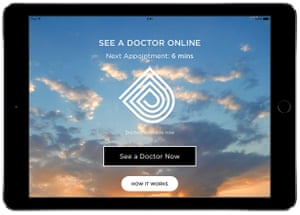
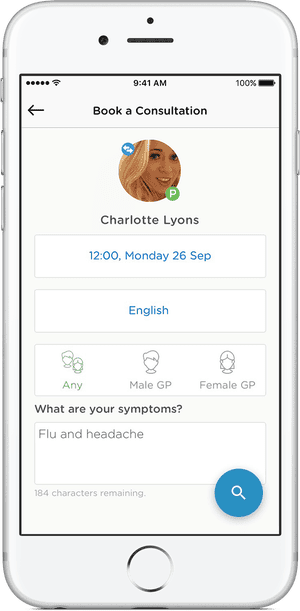
At this point, I downloaded the app from Babylon Health, one of the leaders in online doctor consultations, on to my smartphone. The homepage was purple and teal, the writing welcomingly blobby. I tapped on “check a symptom” and after half-a-dozen questions, it suggested that I “book a consultation”. I was offered a choice between a GP, a specialist or a therapist. The appointment could be on the phone or a video call.
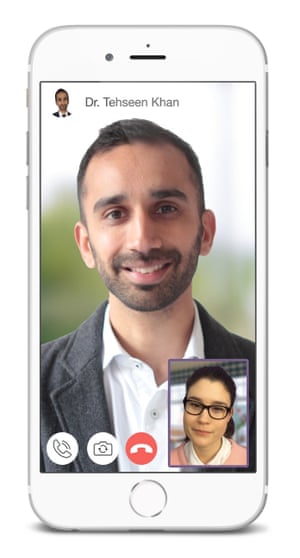
I selected a GP and a video call and was booked in to see Dr Patel 34 minutes later. As I waited to speak to him, I learned from his biographical detail that he was practising in Leeds, that he’d visited five of the seven continents and enjoyed cycling and skiing. At exactly 3.30pm, he materialised on my phone and welcomed me to Babylon. Our appointment was much like a regular exchange with a GP. There were some surreal moments: as I tried to show Dr Patel my neck, I was reminded of an Amy Schumer comedy sketch on the precariousness and indignity of sexting.
But he was engaged and reassuring, calling back when the video feed dropped, and after a few prompts he determined we were probably looking at a sebaceous cyst. They are non-cancerous and can be left alone, as long as they don’t change in size or shape. Soon after the consultation, in case I’d forgotten anything, a video of it was available on my Babylon app and I was sent a short text from Dr Patel that summarised his findings and advice. If I had needed a prescription, it would have been sent within the hour to a local pharmacy. Two days later, my phone beeped with a message to check how I was feeling.
It was a very thorough service, but there was a cost. Babylon offers its triage services, which advise on the urgency of treatment, free, but to speak to a doctor, it’s a rolling monthly payment of £4.99 or a one-off fee of £25. In my case, it provided peace of mind 10 days quicker than if I’d waited to see my GP. But the bigger question is what impact online doctors will have on the provision of healthcare in the UK: are they a valuable tool to reduce the demands on our overloaded doctors and nurses or are they, as one GP I spoke to said, opening “a door to NHS destruction”?
The offices of Babylon in South Kensington have been designed to evoke the hanging gardens, one of the seven wonders of the ancient world. A tough brief, you’d imagine, and the original designers estimated a cost of £1,000 per square foot. Ali Parsa, the founder of Babylon, bristled at such extravagance and decided to oversee the decorations himself. The result is a long, open-plan office with fake trees and hanging plants dotted around. All the accoutrements of the kidult, forward-thinking workplace are present: free toast and cereals, ping-pong tables that double as large desks for team meetings. An adult scooter leans against a desk, although it’s not clear if this is personal transportation or to whizz along the banks of desks.
Why the name Babylon? “First, I was born in Iran,” says Parsa, an energetic, fast-talking 51-year-old with a bald head and statement Cutler & Gross spectacles, “so Babylon was always part of our culture as one of the big Persian cities. And two, there is a story about Babylon that goes really well with healthcare. If you got sick in Babylon about two and a half thousand years ago, you’d stand on the square that was designated as a square of the sick and every resident that passed by would tell you if they’d ever come across that disease and, if they had, how they cured themselves. And with that very simple peer-to-peer health service, they had the longest life expectancy in the world.”
We are going to put an affordable health service into the hands of every person on Earth
Parsa laughs: “But the truth is that all of that is nonsense. We called it Babylon because we were too cheap to pay a design agency or a PR agency to go out and figure out some funky name.”
In the reception area, the mission statement of Babylon is written on a large mirror: “Our purpose is to democratise healthcare. We are going to put an accessible and affordable health service into the hands of every person on Earth.” That’s quite an ambitious goal, I suggest.
“Of course it’s difficult,” he nods. “But actually, if you dissect that, the most difficult part is that you put something in the hands of every human being on Earth. Well, somebody already has. Almost every human being on Earth now has a mobile device. What Elon Musk is doing with SpaceX, creating a ship, sending it to space, that’s difficult! Putting a doctor on your mobile phone, relatively speaking, is not difficult.”
A number of progressive tech entrepreneurs appear to agree with Parsa. Push Doctor, founded by Eren Ozagir, claims to be the largest service of its kind in Europe, with about 7,000 NHS doctors in its network. It came about, apparently, after Ozagir fell sick on a trip to the US and bemoaned the fact that you could organise a taxi, a boat, even a helicopter through your phone, but not a doctor. Push Doctor does not attempt to triage or diagnose patients, but instead puts them straight in touch with GPs doing consultations during the time they could otherwise be doing private practice. An appointment costs at least £20 and a premium membership is the same price per month.
Other players in this market include Now GP and GPDQ (GP delivered quick). GPDQ can arrange for a doctor to come in person to a home, office or hotel in central London between 8am and 11pm, 365 days a year. The average wait is about 90 minutes.
The core message of all of these services is that they are not threatening the NHS, but working alongside it to reduce the burdens it faces coping with a growing and ageing population. Babylon, for example, has started a trial scheme with two GP surgeries in Essex where all patients can use the service free of charge. Early reports apparently found that the average waiting time for appointments came down by a week, to two weeks.
The development also fits with the idea that millennials now expect all their services to be streamlined and efficient: from getting the new ramen joint to deliver via Uber to having your dry cleaning picked up from your desk. David Mott from Oxford Capital, which raised £8.2m in funding for Push Doctor, even suggested the NHS should be left to the elderly and infirm, while time-poor 18-40-year-olds use the new app-based services.
Where Babylon seems to be taking the lead – and, Parsa believes, reducing the crisis of the global shortfall of doctors – is with its use of artificial intelligence. When I tried its “check a symptom” feature for the lump on my neck, I was actually being quizzed by what they consider the world’s first accurate AI triage service. In June, an in-house “live challenge” pitted Babylon’s AI against a senior A&E nurse and an Oxford-educated junior doctor. UCL professor Irwin Nazareth compared the results. According to Nazareth, “check a symptom” was consistently faster and more accurate in triaging patients than its human rivals: it scored 92% accuracy compared to the doctor’s 82% and the nurse’s 77%.
This experiment was not the most rigorous of scientific evaluations, but it has shown enough promise for some heavyweight backers to get behind Babylon. In January 2016, the company raised £19m to further develop its artificial-intelligence platform. Demis Hassabis and Mustafa Suleyman, co-founders of DeepMind, the AI startup bought by Google for $ 500m, who had already been advising Babylon, invested, as did Richard Reed, Adam Balon and Jon Wright, the men behind Innocent Drinks. For Parsa, the next stage, probably as soon as next year, is that the Babylon app will be able to diagnose patients without a doctor ever needing to be involved.
“I’d trust a machine over a human any day of the week – and I already do,” says Parsa, whose background is in engineering, not medicine. He arrived in Britain as a refugee in his late teens and has been, among other things, an investment banker and co-founder of Circle, the private healthcare company that runs hospitals in Bath and Reading and in 2011 took over the struggling Hinchingbrooke hospital in Cambridgeshire. Parsa stood down as Circle’s chief executive in 2012, before launching Babylon in 2014.
“The machine doesn’t get worked up, it doesn’t get angry, it doesn’t get pushed because there are 20 people outside in the queue,” says Parsa. “A machine learns every time a diagnosis happens. A doctor might do 7,000 consultations. The machine will do thousands of times more. Therefore the speed at which it learns and everything it sees increases. So we believe in time we will do this more accurately than a human.
“Even the specialists. How many papers were published last year on dermatology? It was 11,000; 11,000 pieces of research that were worthy of being written down for somebody to take note. Which dermatologist reads this? They say, ‘Oh yeah, I spend my weekends catching up.’ How many can they read? So the idea that a human brain can keep in touch – ha!”
Parsa does not think that artificial intelligence will replace humans – at least not in the foreseeable future. But the potential is clearly there. He cites the example of DeepMind’s AlphaGo program, which inflicted a stunning 4-1 defeat on the 18-time Go world champion Lee Sedol earlier this year. The 3,000-year-old Chinese boardgame had been considered one of the “grand challenges” of AI because of its almost infinite number of possible moves. DeepMind puts the success of AlphaGo down to the fact that the program almost mirrored a human brain: it used trial and error, allied to a dense historical database of games from the past, to play both creatively and minimise mistakes.
“The one game AlphaGo lost was because the guy [Lee] did something that the machine had never imagined can be done,” says Parsa. “He used his intuition to say, ‘You know what? I’m going to do something very human here.’ As opposed to something very machine. And the machine got confused. So the methodology we employ is very similar to the way a human brain works, whereby we teach a human how to become a doctor and the same way we teach a machine how to become a doctor. We don’t just use ginormous amounts of data, we give them rules and functions.”
It takes around seven years to train a human to become a doctor – how long then for a machine? “Well, we’ve been at it for three years,” says Parsa, “so maybe it will take us seven years too.”
Not everyone is excited about the boom in online doctors. While there has been a rush by GPs to supplement their incomes with shifts at places such as Babylon – it has about 100 doctors on call – others are concerned about the impact that paid-for services will have on the NHS.
“General practitioners are a resource in short supply and in great need,” says Margaret McCartney, a GP in Glasgow, Radio 4 regular and author of the forthcoming The State of Medicine: Keeping the Promise of the NHS. “We as a profession are under huge strain and enormous pressure. These companies are essentially using market forces to determine access to GPs rather than need. GPs working in these companies will probably make more money and have a less stressful career. However, patients are far less likely to benefit. This might work in your favour if you are basically healthy, need a one-off appointment and have the money to pay to put yourself in the front of the queue. But if you have an ongoing condition, or multiple or complex needs, the research shows that your care will be better if you have continuity and are looked after by a team that can care for you holistically.”
The idea of “a GP in your pocket” emphasises speed and convenience, but McCartney fears that it may ultimately derail our health service. “These schemes may mean that you end up having to wait even longer to see your NHS GP, as the workforce becomes more depleted,” she says. “Some of these companies won’t see people with chronic diseases or mental illness. This kind of cherry-picking is rife in the private sector and I see these companies as the thin end of the wedge of sleepwalking us into an insurance-based model of healthcare. It needs to be resisted by everyone who cares about the values of the NHS.”
Parsa is aware that not everyone will approve of services such as Babylon. “Listen, there will be many comments from your readers that say, ‘That is brilliant.’ And there will be many that say, ‘That is awful.’ That’s OK. Think of anything: Facebook – lots of people say it’s brilliant and lots of people think it’s awful. But the existing model of healthcare we’ve got, guys, is nothing to write home about. One in five of us can’t see a doctor when we need to. One of eight of us gets misdiagnosed. About a thousand of us a month get killed because of avoidable mistakes. So the system we are protecting so much is good but it’s not great.”
There has been much discussion of the failure of Britain’s technology sector to produce a Facebook, Uber or Airbnb. Parsa feels that Babylon has the potential to become a similar, game-changing enterprise. Wired magazine recently named the company as one of Europe’s 100 hottest startups and the FT made a conservative valuation of it “in excess” of £77m. Babylon is certainly thinking globally; although its main operation is in the UK, the service is also launching in Rwanda, a country of 11.75 million people that has only a few hundred doctors.
Parsa insists that Rwanda is not a publicity stunt: it’s a country where mobile phones are commonplace and it has a progressive, if often heavyhanded, government. Besides, if Babylon can work in sub-Saharan Africa, then it should thrive anywhere. “In Rwanda or in many countries in the world, people are dying from things that a doctor can fix in no time,” he says. “So this is not populist. If you’re not doing it, it’s stupid. If you’re waiting two weeks to see a doctor and you can press a button and see it on Babylon, it’s not right.” A shake of the head: “That’s not right.”
Parsa is a convincing pitchman and my first experience with Babylon for my neck was a good one. But, until it becomes clearer how online doctors can coexist with our health service without diminishing it, it will remain hard to savour the benefits it can provide.
The doctor will see you now… on your smartphone
