immigrant etiketine sahip kayıtlar gösteriliyor. Tüm kayıtları göster

25 Kasım 2016 Cuma

Doctors see a new condition among immigrant children: fear of Trump

At doctors’ offices across the United States, a new diagnosis has been popping up in the medical files of immigrant children, their friends and their families: fear of Trump.


Since the 8 November election, pediatricians and clinics serving undocumented immigrants and other low-income patients have reported a spike in anxiety and panic attacks, particularly among children who worry that they or their parents might now face deportation.


One little boy in North Carolina has been suffering crippling stomach aches in class because he’s afraid he might return home to find his parents gone. In California, many families are reporting that their children are leaving school in tears because their classmates have told them they are going to be thrown out of the country.


Children are showing up in emergency rooms alone because their parents are afraid of being picked up by Immigration and Customs Enforcement if they show their faces. Even American-born children are suffering – one boy in the south-east asked a doctor for Prozac because he was worried about his undocumented friend.


“It’s as though a volcano erupted. It’s been awful,” said Mimi Lind, director of behavioral health at the Venice Family Clinic, one of the largest providers of healthcare to low-income families in southern California. “People who don’t have a history of anxiety and depression are coming forward with symptoms they’ve never had before. And people who had those symptoms already are getting much worse.”


It’s too soon to put precise figures on the wave of Trump-related anxiety, but health professionals and immigrant rights groups say it is unmistakable. “People worry their families will be broken up, that parents will be deported and children will end up in foster care, on a scale that we’ve never seen before. The feeling out there is one of great fear,” said Marielena Hincapié of the National Immigration Law Center.


People who don’t have a history of anxiety and depression are coming forward with symptoms they’ve never had before


Mimi Lind, Venice Family Clinic


Some of the Trump-related anxiety was evident even before the election, especially in states where Republican-dominated legislatures have pushed through measures to make it harder for immigrants to access education, healthcare and other basic services. Trump’s election, however, turned the abiding worry into a full-blown crisis – not least because his victory was unexpected.


Julie Linton, a pediatrician from Winston-Salem, North Carolina, who also serves on the American Academy of Pediatrics’ immigrant child health special interest group, started receiving panicked calls from patients at 6.30am on the morning of 9 November, and she has been deluged since.


Many undocumented parents with sick children born in the United States are now making contingency plans in case they are deported, she says, and in so doing have to face an agonizing choice: whether to leave their children behind, or to risk losing access to the care they need in their home countries. She sees Syrian refugees as well as patients from Mexico and Central America, where it may be difficult or impossible, for example, to find devices to enable children with neuromuscular disorders to walk.


“Parents are asking me: ‘What do I do? How do I set up a power of attorney in case I’m deported?’” Linton said. “It’s hard enough to care for a child with special healthcare needs without having to worry about the threat of deportation.”
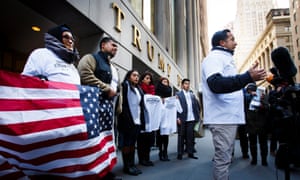


A group of immigrants and attorneys gather outside Trump Tower on 22 November to draw attention to Donald Trump’s proposed immigration policies.


A group of immigrants and attorneys gather outside Trump Tower on 22 November to draw attention to Donald Trump’s proposed immigration policies. Photograph: Justin Lane/EPA

It is not just families and children that have felt the impact. Many patients who are vulnerable anyway – alcoholics, drug addicts, those with degenerative diseases or mental health struggles – have been knocked backwards. “To them, it feels that another part of their power has been taken away when they’ve just started to build themselves up again,” said Eileen Garcia, a therapist who looks after HIV and Aids patients at the Venice Family Clinic.


One of her patients, a middle-aged undocumented immigrant who wanted to be called Maria (not her real name), said that while she had been shocked when she received her initial HIV diagnosis she took it in stride because she knew help was available. “But this,” she said, “feels like a death sentence.”


As Maria sees it, she may lose access to treatment if the Trump administration scraps President Obama’s Affordable Care Act, and she may lose it, too, if she is deported and cannot find similar services back in her home country (which she did not want to name). “It’s a double worry,” she said.


The fear felt by many patients is reflected in the protective instincts of their caregivers. For this story, doctors and therapists were extremely careful not to give away patients’ names, or more than the most basic details of their medical profiles, or even in some cases the state where they live for fear of providing clues to authorities pursing an anti-immigrant crackdown.


They also struggle to know what to say to address their patients’ concerns, especially at this early stage.


“Many of us feel pretty helpless right now,” Linton, the North Carolina pediatrician, agreed. “We try to remain nonpartisan but we’re unabashedly pro-child and that’s a hard place to sit right now. For me, as a pediatrician and as a mom, it’s heart-breaking to think that a child is worth less based on conversations happening at the local, regional or national level.”


“This waiting time is the most anxiety-provoking,” Lind, the behavioral health specialist said. “No one can say anything. We have no way of allaying people’s anxiety with concrete facts.”


Doctors see a new condition among immigrant children: fear of Trump

1 Ağustos 2016 Pazartesi

I’m an immigrant and a Muslim. And I’m here to cure cancer | Azra Raza

This article originally appeared on STAT


It’s a long way from where I grew up in Karachi, Pakistan, to the dining room in Vice-President Joe Biden’s home at the Naval Observatory in Washington DC. Yet that’s where I found myself one day last December, along with a handful of other cancer specialists. We had been invited to offer our perspectives on the current cancer landscape, which contributed to shaping the “cancer moonshot”. I’m convinced that my perspective on medicine as an immigrant is what ultimately got me to the table.


Early in my career as an oncologist at Roswell Park Cancer Institute in Buffalo, New York, I treated a woman who was terminally ill with acute myeloid leukemia (AML). As her disease progressed, I watched her struggle to write letters for her two-year-old twin daughters. She wanted them to read a letter from her on each of their birthdays until they turned 21. She died before she got to the ones for their 13th birthday.


That experience nearly broke my heart. It also suddenly clarified the purpose of my career. I realized that we needed a more comprehensive understanding of her disease. I needed to learn how pre-leukemia develops into leukemia, how it continues to evolve, and how it can be treated.


Had I received my scientific training in the United States, my immediate instinct probably would have been to develop a sophisticated mouse model to work on each of those steps. But because I was educated in Pakistan, I thought about taking a simpler approach – examining the cells of patients with myelodysplastic syndromes (MDS), an early-stage version of leukemia.


So I began banking the blood and bone marrow cells of MDS patients at every encounter and following them as they progressed to leukemia. I also saved their normal cells to serve as germ-line controls. Thus began the MDS-AML Tissue Repository. Since 1984, it has banked some 60,000 samples from thousands of patients. The repository is backed by a state-of-the-art computerized data bank that is the ultimate in one-click efficiency. I can safely say that no more than a handful of patients in all those years turned down my request to donate their cells for research purposes.


This repository has helped my colleagues and me define the molecular and genetic milestones that must be covered for pre-leukemia cells to cross over into leukemia cells. It will also help us define potential therapeutic targets that could be used to intercept the disease before it is too late. This work will likely apply to the evolution of other cancers as well.


Cancer is slated to become the leading cause of death in the coming decade, with 1 in 2 men and 1 in 3 women suffering from the disease at some point in their lives. Over the next 10 years, the number of new cancer cases in the United States will increase by 42%, and the number of cancer survivors will rise from 15.5 million to 20.3 million. During the same period, the number of oncologists will increase by only 28%. Many of the new doctors will be immigrants.


The leader of the group gathered at Vice-President Biden’s home that day was another immigrant, Dr Patrick Soon Shiong, a South African-born, Chinese-American surgical oncologist. He developed a way to transplant human islet cells to treat type 1 diabetes, performed the world’s first encapsulated human-to-human and pig-to-human islet transplants, and the first full pancreas transplant on the west coast. Thanks to this immigrant’s development of the drug Abraxane, the first FDA-approved chemotherapy agent based on nanotechnology, the lives of thousands of patients with breast, pancreatic, and lung cancers are being prolonged.


Many immigrants have brought their unique talents to serve their new country by fighting cancer as healers and researchers. A 2013 study by the National Foundation for American Policy found that 42% of the researchers at the top seven cancer research centers across the country were foreign born. According to a recent study published by George Mason University, immigrants make up 28% of all physicians and surgeons in this country.


My parents chose to live in Pakistan but encouraged all seven of their children to emigrate to the United States in search of higher education. We were brought up to believe that it would equip us with the means of contributing to the knowledge of this world. My parents were deeply moved by the welcome their children received in their new homeland, a place where merit was recognized and rewarded regardless of race or color or religion.


My older brother is a cardiac surgeon, my older sister trained as a pediatric oncologist, and my younger sister is a radiologist and breast imaging expert. Another sister has a PhD in international relations, a brother is a professor of aerospace engineering, and my youngest brother is an electrical engineer.


We are Muslims, we are immigrants, and we are enriching, prolonging, and saving American lives. We are just seven of the many immigrants, from many lands, of many faiths, who are – and have always been – an essential part of America’s strength. We are hard workers, people with big ideas and big dreams, believers in this great country and our shared responsibility to make it even better for all of us.


Closing America’s door to immigrants will never be the answer to the challenges we face. Instead, America needs to bring in the best minds – and the most minds – to fight cancer and solve other seminal issues of our times.


I’m an immigrant and a Muslim. And I’m here to cure cancer | Azra Raza