couple etiketine sahip kayıtlar gösteriliyor. Tüm kayıtları göster

13 Şubat 2017 Pazartesi

£115,000 raised for children of couple who died of cancer

The children of a terminally ill couple who died of cancer within days of each other have said they are “overwhelmed” after more than £100,000 was raised for them.


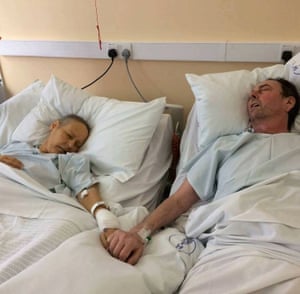
The money flooded in after the children of Julie and Mike Bennet, from Wirral, released a photograph of their parents holding hands on their deathbeds.


The picture was taken hours before Mike Bennet died last Monday from a brain tumour. His wife, Julie, died on Saturday night at the same Merseyside hospice.


More than £115,000 had been raised on Monday morning for the couple’s three children – Oliver, 13, Hannah, 18, and Luke, 21 – by 5,370 members of the public on a JustGiving page set up to help them “continue to live at home and sustain their activities and studies”.


Donations flooded in after the children of Julie and Mike Bennet released a photograph of their parents holding hands on their deathbeds.


Donations flooded in after the children of Julie and Mike Bennet released a photograph of their parents holding hands on their deathbeds. Photograph: Family handout

In a statement, Luke Bennet said: “My brother, sister and I are overwhelmed by the enormous support and generosity we have received from so many friends and well-wishers.


“Mum has appreciated all the help from close friends in supporting the family over the last three years through difficult times and it would be a huge relief to her to know this support will continue.”


Mike Bennet was diagnosed with a brain tumour in 2013 and had been nursed at home by Julie and the children.


The 57-year-old was a self-employed cabinetmaker who had served his apprenticeship with Baldock’s Furniture Manufacturers in Liverpool.


Julie, 50, who was a primary schoolteacher at Somerville school in Wallasey, was diagnosed with liver and kidney cancer in May 2016.


Family friend Heather Heaton Gallagher described the couple as “the most supportive parents”. She said: “Facing a double terminal cancer diagnosis is beyond belief and as a community we are working hard to support the family so that they can stay together and ensure that they can continue their education as planned.


“The biggest challenge is that the family car, a Motorbility car has to be returned, meaning that the kids can’t get around to manage practical and personal activities.


“Julie and Mike have been the most supportive parents, encouraging their children’s interest in dance and acting from a very early age.


“All three children thrive on the stage and I know that Julie and Mike would not want this to stop their children from dancing and performing. To help them do this, we need to make them mobile again and help cover the costs that this brings.”


The fundraising page, set up only six days ago, raised more than £15,000 in the first 24 hours. A family friend, Sue Wright, said of Julie: “I told her the community would come together to help look after her kids – and she opened her eyes and smiled.”


£115,000 raised for children of couple who died of cancer

18 Aralık 2016 Pazar

Chemo, clinical trials and a couple of ill-advised cocktails

Tuesday 29 November


Well, this second-line chemotherapy treatment is proving trickier than anyone expected. Although my blood levels – platelets, critical to blood clotting – and white cells, the ones that fight infection, do appear to return to normal between doses, every new chemo infusion really batters them. So today, I’m back at the Royal Marsden hospital for blood tests before what I hope will be more treatment on Thursday. And whoopee! Blood levels are all good. Mind you, after all the help they’ve been given – a platelet infusion and another string of self-injectable “growth factor” syringes to stimulate white blood-cell production in the bone marrow – they should be!


This being the third dose in the four-week cycle, I should be in line for my second visit to “club class” to get the extra drug ramucirumab the NHS won’t fund and which I have to pay privately for – you remember the £12,000-a-month job? But no. Consultant Dr Starling is still trying to get to the bottom of whether it’s the paclitaxel (that’s the standard chemotherapy drug the NHS does pay for) that’s really attacking my internal systems, or what. So she recommends – given that we’re weeks away from the effects of the previous radiotherapy, there’s been no sign of the dreaded kidney stones and I’m not dehydrated – going for paclitaxel only to get the clearest view possible of its effects.


She also suggests a slightly lower dose than normal so as to reduce the risk of more serious side effects. What’s more, as this is the third dose in the cycle – it should have taken three weeks so far but it’s been more like six with all the extra recovery time added – next week should be a week off treatment, which should be a relief but in the circumstances doesn’t really feel like that. I’m left with a nagging worry – which I’m sure the medical team shares – about what we do next if I really can’t tolerate paclitaxel…


Saturday 3 December


I got a call a couple of weeks back from the chairman of my local rugby club – Harpenden – asking me whether I’d like to join him for the club’s Christmas lunch, which happily coincided with the England v Australia game. I said I had a very old friend visiting from Canada – but no problem, he was invited too. Then it was suggested that any money raised on the traditional raffle could go to any charity I’d care to nominate. I suggested Macmillan Cancer Support and the Maggie’s drop-in centres and offered to say a few words of thanks to the assembled at some point.


Come the day, to be honest I was feeling OK but not great. A bit fatigued and feeling the cold – something I almost never used to do – not even running around those pitches refereeing rugby matches in the sleet and snow! But that was then. Now, many kilos lighter – which leads almost everyone I meet to tell me how well I’m looking! – I feel the cold intensely and, for reasons I hope are obvious, have an almost fatal attraction to padded chairs. Anyhow I arrive at the club – my Canadian friend is en route from Heathrow – to discover its not just a few words of thanks they want but that I’m the after-lunch guest speaker! And all I’ll say is that if you try Googling “cancer” and “jokes” you don’t get a great selection!


I did find a couple of cancer quips which, somewhat unexpectedly as I’d really no idea how a more light-hearted take on cancer would go down, produced huge waves of laughter, and although it was a rugby club Christmas lunch people seemed really keen to share the cancer story I told them – jokes and all. So much so that afterwards I was approached by lots of people talking about their experience of cancer or that of their families but also saying how much they’d enjoyed a good collective laugh about the subject – to go with the concern and the tears. What’s more they gave plenty, which will be passed on to the charities in due course.


Thursday 8 December


Back at hospital for blood tests and a chat – it’s the middle of my “week off”, remember. Well, it really couldn’t be much better. Blood pressure up and stable, no sign of wretched kidney stones and blood tests all good – actually excellent. So full speed ahead for treatment next week? Well, maybe not. Dr Dan the senior registrar produced a 32-page document about a clinical trial that I might be eligible for. It involves two immunotherapy drugs, nivolumab – of which more later – and another drug called “anti-LAG-3”. In a nutshell, cancers appear capable of escaping attack by your body’s own immune system by persuading (chemically, that is) key parts of the system to switch off. These drugs are designed to switch key elements of the system back on and therefore enable the immune system to attack the cancer.


And it would appear I am ideally suited to this trial, which is looking to recruit “gastric” participants. But here’s the thing. As Dr Dan readily acknowledges, the good blood results after the last lot of chemo might indicate that we’ve turned the corner and that the chemo isn’t perhaps as toxic as feared. Trouble is we’ll need at least one more cycle to know that for sure and it’s just as likely that the chemo remains fairly toxic and that in four weeks’ time the trial will have stopped recruiting and we’ll be left with reduced doses of chemo which might hold the cancer in check if we’re lucky. In other words, in chemo terms we might be left hobbling when we should be sprinting.


The trial, by contrast, sounds really interesting and even, dare I say it, exciting. So, decisions, decisions. And when you think about it – pretty big ones!


Saturday 10 December


Decided to go away to Devon and Dorset for the weekend to relax and ponder. Succumbed last night to glorious log fires and good food and, critically, two cocktails. Big mistake! As my liver has plenty of active cancer in it, it can produce an ache under my right ribs if provoked. And while a pint or a couple of glasses of wine seems to be OK – a negroni and an old-fashioned weren’t.


By late morning, news comes through that the Sunday Times writer AA Gill has died. I knew him to say hello to but not well, but had felt a sort of kindred spirit – as we both had to come to terms with you know what. We’d also both had to deal with situations where the NHS wouldn’t fund drugs that might do us good – in his case the immunotherapy drug nivolumab. And although I knew his position was in many ways more difficult that mine, with more advanced spread of cancer to more difficult parts of the body, news of his passing came as a real shock. Actually it reduced me to tears.


Tuesday 13 December


Back at the Marsden: decision day on clinical trial. Blood tests all good. With one exception. All the usual suspects are fine but my albumin level is slightly low. Dr Starling says this could be a sign of poor nutrition or infection or a slightly misbehaving liver. But the critical point is that to get on to the nivolumab/anti-LAG-3 trial my albumin level had to be 28, whereas on Tuesday – the last time I could realistically be consented for the trial – my albumin was 26. So no trial. All more than slightly frustrating and, if I’m honest, disappointing.


But the rollercoaster moves on and another clinical trial is produced also involving nivolumab – the drug that might have helped AA Gill had he got it soon enough. What’s more, the rules of this trial mean I can have another round of chemo in the meantime. So suddenly we might be in a win/win situation? More chemo to keep control and check toxicity and a very promising new trial in the wings?


Decisions, decisions and all in a week! Oh, and happy Christmas – it’s one I shall treasure.


Chemo, clinical trials and a couple of ill-advised cocktails

7 Haziran 2014 Cumartesi

How would you cope if you only have a couple of months to live?

I stopped currently being invited to items, and buddies do not tell me as considerably about their lives any more – they think I have sufficient on my plate. But it is good to hear about every day difficulties. And in a strange way, it’s great to see their tears, too. I want to share their emotions.


After the initial shock I commenced to believe, what am I going to do about this? I felt like it wasn’t my time. Was I going to waste my final six months hunting desperately for more possibilities? I was ready to take the danger. I study up and researched as a lot as I could, and buddies printed items off the internet for me. I contacted the charity Target Ovarian Cancer, who have been amazing. They advised me about Prof Stan Kaye at the Royal Marsden Hospital, and I asked my GP if I could be referred to him for a 2nd opinion. Following some tests, which uncovered a gene mutation had brought on my cancer, I embarked on a series of medicines trials.


I’m on my third drug trial at the moment. The tumour in my lung has gone, and the one in my pelvic area is displaying some shrinkage. But the medication have side results. I feel tired a great deal of the time, and the one particular I’m on at the moment tends to make me delicate to sunlight. But I’ve defied my 6-month prognosis, by a prolonged way. I was in New York with close friends the day that it came about. I’m constantly undertaking something when I can – abseiling, jumping out of planes, raising funds for Target Ovarian Cancer… really just pushing myself to do items I didn’t consider I could do.


In the meantime, life goes on and I make new buddies, although most of the individuals I meet are at the Royal Marsden so are in the exact same boat. Elsewhere, I have a tendency not to inform people for a while about my predicament – I don’t like ruining their day. When I do inform them they can not believe it because I really do not look sick.


I have to think I’m even now right here for a cause, no matter whether that is to raise awareness and money for ovarian cancer or for one thing else I’m not sure of nevertheless. I really don’t know what my recent prognosis is: I may possibly have lived beyond the 6 months but the truth is I have incurable cancer, even though I really don’t come to feel terminally unwell. For now the medicines I am on are retaining me going. But this will not final for ever. Becoming given 6 months produced me realise that we all say, ‘That can wait’, ‘I’ll do that up coming year’, ‘I’ll save up for that’. I really do not have a bucket list, I just have a list of things that I want to do: I maintain including to it, and ticking items off. For me, now, none of it can wait.


Photograph: Lydia Goldblatt


Andrew Culliford (over)36, is married to Donna and has a 4-yr-previous daughter, Isla. They dwell in Poole, Dorset. He was diagnosed with motor neurone illness in 2011


I employed to be a genuine fitness fanatic. I’d had a handful of investigations due to the fact I played tennis and my backhand had grow to be weak. If I’d been significantly less energetic, I most likely wouldn’t have even spotted the changes but I worked as a firefighter so these things have been a lot more noticeable.


‘It’s bad news,’ the physician mentioned when I went to get my test results. He advised me I had ALS, the most widespread sort of motor neurone ailment, and that there was absolutely nothing they could do. More than time almost everything with muscle involvement would cease functioning. So I asked them a query I didn’t want the answer to, ‘How long do I have?’ They informed me that about thirty per cent of individuals survive longer than two years.


I had my household with me in that horrible room. Looking all around at them, the men and women I adore, seeing tears rolling down their faces, I felt an overpowering require to be robust. So I did not break down. It felt like I was viewing a movie about a person else.


Following my diagnosis, I just felt numb. The worst issue at that level was that I was still quite fit. There was no background of this in the household they don’t know what brings about it. It was hard to think about what was going to take place to me. I keep in mind going out for a run about 4 weeks soon after my diagnosis. A lorry passed me, and just for a second I looked at those large wheels and imagined about throwing myself beneath them.


I’m glad I didn’t. Because in a way, the three many years because my diagnosis have been the worst component of my daily life – and the ideal. I utilized to wonder if I died whether or not anyone would come to my funeral. Now I know they will. I feel really loved, and if it hadn’t been for this sickness, I don’t know if I would have ever felt like that. My family members, my buddies, they’ve all been there for me, supporting me, telling me how a lot I mean to them. If I’d just gone under the wheels of that lorry, I never would have felt so wished.


Right after the diagnosis, I stopped doing sport and I consider my health deteriorated, but when I commenced education again I felt greater. The illness has slowly gathered power, affecting my limbs over the very first yr. I’ve been ready to carry on operating for the fire service – my employers have been excellent. I’m even now completely employed and assist out with instruction.


I have trouble swallowing and talking, and I’ve lost the use of the two arms and the power in 1 leg. I try out to keep good, but it is tough. I can see my Donna feeling helpless. I know it’s challenging for her. And I know it is challenging for my friends, as well, but they’ve been incredible. They deal with me precisely the same, taking the mickey – and that’s what I want. I really do not want men and women tip-toeing all around me.


A terminal diagnosis has manufactured me realise what’s crucial. I wouldn’t say to any individual, dwell each day as if it’s your final, that does not make sense. But what I would say is, if you are satisfied, you are undertaking some thing appropriate.


Photo: courtesy of Laura Walker


Laura Walker 39, lives in London. Her father, David, was given a life expectancy of 6 months in late 2012, and died aged 70 in April 2013


My dad was sick for about a yr just before he was diagnosed. He was losing excess weight and the medical professional didn’t feel it was critical, but we felt something was actually wrong. We acquired a second opinion and were appropriate: he had cancer – leukaemia – and was offered between 6 months and a yr to dwell. We have been angry because if the authentic GP had picked it up, it may have been treatable.


The physicians advised my mum initial, and she broke the news to my dad. He said to her that he needed to be on his very own and have time to feel. He wasn’t genuinely the kind of person to display feelings – it was just the way he’d been brought up. My mum and I agreed that we would preserve as optimistic about it in front of him as we could. She put on a brave face, but beneath I knew she was frightened.


They lived in Spain, and had carried out for about ten years, so I flew over to check out as usually as I could. Apart from the missed diagnosis, we imagined the wellness care in Spain was great. The only problem was the language barrier. There were occasions when we wished we have been back in the Uk as issues can get misplaced in translation.


A terminal diagnosis is so difficult for relations. You want to know how long you have left with your loved one particular. But as the doctors explained to us, cancer has an effect on every single person in a different way, which is why it is so challenging for them to be precise in terms of a prognosis. It’s tough to comprehend how you can go from ‘six months to a year’, to ‘a matter of weeks’, but that is what took place in early 2013.


My dad wasn’t responding to the treatment method, and the cancer was aggressive. At 1st, we did not want to tell him that he did not have long left. We thought he may just give up, so we left it as late as feasible. Then my mum informed him. He was really quiet for a number of days: I think he essential to get his head about the fact that he was going to die.


He did not want to, he mentioned he wasn’t prepared. Then he appeared to enter one more stage, wanting to make the most of the time he had left. He made a decision he wished to die at home, in his own bedroom, with the blinds and windows open, and the sunlight streaming in. He wanted a glass of wine, and he wanted to go along the seaside in his wheelchair.


I arrived in Spain the day before he died. It was April, just above 4 months right after his terminal diagnosis. The consultant had mentioned on his final property check out a number of days ahead of that there wasn’t prolonged left. I’ll by no means forget strolling into the bedroom and seeing him. He was drugged up but I know he recognised me. He looked like a tiny bird, so fragile. My mum and I sat on the bed hunting at previous photos and speaking to him. We just wanted him to hear our voices, and know we had been there.


The following evening, we each took it in turns to examine up on him. I checked, and then for some cause a minute later on believed I’d examine again. When I went into the bedroom I knew he wasn’t with us any much more. About five minutes later in the backyard, we saw a large butterfly. It was with us, and then it had gone, flown away.


Photo: Lydia Goldblatt


Tim Oliver is a consultant oncologist and professor emeritus of health-related oncology, St Bart’s and the London School of Medication, QMUL, and a trustee of the male cancer charity Orchid Cancer Appeal


When it comes to terminal diagnoses it’s usually not until finally late in the day that I’m certain about the timescale. And even though I’m always honest about the circumstance from the commence, I never ever consider to place an precise amount of weeks or months on factors, due to the fact I’m not God.


I attempt to make confident that the patient understands the idea of the median, rather than typical. The current median expectation, when 50 per cent of us may die, is at least 82 in males and 85 in women. If you’ve got cancer that can’t be treated, it’s clearly less – but the very same principles apply. Offered a three- or 6-months existence expectancy, you could die inside of the week but there is a 50/50 chance you will dwell longer than 3 or six months. It’s greater to travel hopefully than worry that every single day may possibly be the last.


The first conversation I have with a patient about a terminal diagnosis is by no means effortless. I consider to get an notion of what they would be organizing if it weren’t for their diagnosis – and how significantly of this will even now be achievable. Then I go into specifics of medians and targets, verify that they have acquired their existence in order, and aid them set some achievable goals. I try to uncover anything about the predicament that can raise a smile or a laugh, as a way of diffusing tension. Last but not least, I recommend they go home and observe their favourite comedy movie.


I’ve come across 3 distinct attitudes to an incurable diagnosis. Some individuals go into a state of anxiety, worrying and striving to solve the issue. Others flip into ‘fighters’, receiving out there and doing as a lot as their bodies can do, to try and minimise interference in their lives from the cancer. Each these states of mind are associated with far better survival odds.


The third variety of patient, nonetheless, the passive ‘punchbags’, feel that they are constantly unlucky and are less very likely to exceed expectations when it comes to survival. These sufferers may possibly benefit from expert mental health input, medication or psychotherapy – although often it may be that discovering and getting rid of a reversible anxiety, this kind of as work or marriage problems, can lead to dramatic enhancements.


There may come a time when far more intensive care from a hospice or home care group is necessary. I feel it helps to make positive the patient understands this will be accessible. But, even at the end, it’s critical to try out to engage in positive planning, such as household events. There is strong proof that death ‘takes a holiday’ for specific occasions such as birthdays and Christmas – men and women often ‘hold on’ when there is something like that to appear forward to.


Offering out bad news is a tough portion of the task, and every single person patient is a challenge. But the key to getting a excellent death is guaranteeing it is a two-way procedure, made better by great communication amongst every person concerned.


How would you cope if you only have a couple of months to live?
25 Mayıs 2014 Pazar

Racist couple "demanded white doctor"

Dr Nadeem Moghal, from George Eliot Hospital in Warwickshire, was creating in the BMJ about how the Macpherson report, that looked into institutional racism in the police following the murder of Stephen Lawrence, could be applied to the NHS.


He explained: “The report defined institutional racism as the collective failure of an organisation to provide an appropriate and expert service to people since of their colour, culture, or ethnic origin.


“This report is appropriate to every organisation, private and public yet this was not sufficient in a situation which took place in a former workplace where mothers and fathers of a child patient refused to have care delivered by black or other minority ethnic medical doctors.


“The story is that the mother and father of a youngster patient refused to have care delivered by black or other minority ethnic physicians though the request was phrased a touch a lot more colourfully.


“The patient necessary the specialist skills accessible in tertiary hospitals. The clinical director concluded that simply because of the nature of the illness and the clinical need of the patient, the parents’ decision would be enabled.


“Attendance at the clinic was planned to guarantee that the patient saw 1 specific white British medical professional.


“The clinical crew, which included physicians of South Asian origin, knew of this arrangement.


“On 1 occasion the patient seemed to be acutely sick, forcing the white medical doctor to check who was operating in the evaluation unit ahead of choosing to see the patient simply because of the diversity of workers on the unit at the time.


“The arrangement continued for more than a year. There was an assumption that the rest of the clinical team accepted this arrangement on the grounds of clinical need.


“Even so, when the arrangement was unveiled to other folks outside the particular service in question, as a supposed instance of very good determination generating in a tough circumstance, the reactions ranged from ‘this is no different from a female patient requesting a female doctor’ to ‘this is the first time in my specialist job I have felt defined and judged by my ethnic origin rather than my skilled capability’.


“Following a challenging approach, like requests for a reversal of the decision (such as from me), which unexpectedly led to a board degree inquiry, the healthcare director told the family that care would be provided by staff irrespective of their ethnicity and the loved ones relented.”


He added: “Is institutional racism occurring in our hospitals?


“The determination to enable racist mothers and fathers to determine who was to deliver their child’s care based mostly on ethnicity was to effectuate the racist views of a racist.


“But there are limits to patient option and when racists are confronted they might ultimately relent.


“Any organisation may uncover it challenging to accept that it had behaved in an institutionally racist way but that Macpherson’s definition makes it possible for comprehending and the strengthening of institutions’ policies.


“It was a difficult journey but the right final result was ultimately reached and that the key lesson is right away confronting and standing up to racists.”


Racist couple "demanded white doctor"

14 Mayıs 2014 Çarşamba

Joe Hockey tells Australians $7 physician charge is more affordable than "a couple of beers"

Joe Hockey has taken aim at Australians who are “screaming” about the end of cost-free visits to the physician, declaring the new $ 7 charge was the value of “only a couple of beers or 1 third of a packet of cigarettes”.


And in a blunt response to a question about how a youthful man or woman who had misplaced unemployment benefits would be capable to afford it, the treasurer said: “I would count on you’d be in a work.”


Hockey made the remarks for the duration of a radio interview on Thursday as he continued to push the case for the hard measures outlined in the Abbott government’s first price range, including a new $ seven co-payment to check out a GP or accessibility out-of-hospital pathology and diagnostic imaging companies from July following 12 months.


The doctor will be allowed to pocket $ 2 of the charge, while $ five goes to the government, raising $ 3.5bn more than four many years. For sufferers with concession cards and kids aged underneath sixteen the fee will apply for only the first ten services in each and every yr.


The opposition leader, Bill Shorten, who will provide his price range reply speech on Thursday night, has indicated Labor will vote towards the measure, as will the Greens and Palmer United party, making certain it can’t pass the Senate.


Hockey told the ABC’s AM plan he was stunned about criticism of the measure, with the income paid to go to a new health-related analysis fund.


“One of the issues that really astounds me is some men and women are screaming about [the] $ 7 co-payment,” the treasurer mentioned.


“One packet of cigarettes costs $ 22 that gives you 3 visits to the medical professional. You can invest just in excess of $ 3 on a middy of beer so that’s two middies of beer to go to the medical professional. Let’s have some point of view about the fees of taking care of our health, and is a mother or father really going to deny their sick child a check out to the physician which would be the equivalent payment of a couple of beers or a single third of a packet of cigarettes?”


The interviewer, Chris Uhlmann, replied that a 27-yr-old who had misplaced his or her task and could not accessibility unemployment rewards may not have the selection of a middy of beer, a packet of cigarettes or a go to to the medical professional. The budget outlined changes to Newstart and Youth Allowance for unemployed people beneath 30 that would see them get no revenue help for six months at a time.


Hockey stated: “I would anticipate you’d be in a occupation. That would be the starting level, you’d be in a task, and we require you to work … Almost everything we are performing is about lifting the tide so that we can get much more folks into jobs.”


Pressed on the plight of folks on fixed incomes, such as pensioners, Hockey explained: “Well we do have to make selections and undoubtedly our health care [has] received to be our primary consideration. The point is we make selections each and every day. I think people require to target on their wellness over the medium and prolonged phrase and to do so we’ve got to invest a little bit and a co-payment is going to support to do that.”


Hockey stated he and Abbott have been ready to talk to senators about the budget measures.


“Senators are human beings and they do have their own special way of passing legislation. We’re often prepared to speak to them,” Hockey stated.


Joe Hockey tells Australians $7 physician charge is more affordable than "a couple of beers"

28 Mart 2014 Cuma

A Couple of Things To Keep In Thoughts About The CDC"s New Report On Autism

Yesterday, the CDC released its newest information on the quantity of young children impacted by autism in the nation. The health and education data of eight-year-old kids in eleven states – Alabama, Arizona, Arkansas, Colorado, Georgia, Maryland, Missouri, New Jersey, North Carolina, Utah, and Wisconsin – have been combed to arrive at the new numbers. The finding that many individuals have expressed concern about is that now 1 in 68 young children now seems to have autism spectrum disorder (ASD). The variety is up markedly from two many years in the past when it was 1 in 88, and seven years in the past when it was one in 150. But the factor to preserve in thoughts is that these are just rates at which children are currently being recognized – so the data could not indicate that autism prevalence has truly jumped that much.


The definitions of ASD are also much more encompassing than they had been in the past, with people getting diagnosed today who may not have been diagnosed a decade or two in the past. And because awareness has enhanced so significantly in latest years, a lot of a lot more healthcare pros are acquainted with the disorder, and diagnosis is much a lot more very likely. The CDC itself is cautious about the most current final results, and says to maintain in mind several important aspects of the review:


1. 14.seven youngsters in 1000 had been recognized with ASD in the recent study, which is about 1 in 68. But bear in mind that the information come from only in eleven regions of the country: “It does not represent the whole population of youngsters in the United States,” says the CDC.


two. There is a clear rise in the rate of diagnosis, but we don’t specifically know why. “Some of it may possibly be due to the way children are recognized, diagnosed, and served in their local communities, but precisely how much is unknown,” says the CDC. In other words, the capacity of the communities to determine autism may possibly be improving, rather than the real cases of autism rising.


three. There was a enormous variation in the number of kids with ASD in diverse locations of the country: for illustration, one in 175 children in Alabama vs. 1 in 45 in New Jersey was identified with ASD. This may possibly have partly to do with the resources the communities have to recognize and offer services to kids with autism, rather than an real difference in autism prevalence across these states.


English: A boy with autism.

(Photo credit score: Wikipedia)


4. Almost half of the little ones with an ASD diagnosis (46%) had over-common intelligence (IQ in excess of 85), an exciting finding in itself. In 2002, only about a third of youngsters with ASD were believed to have above-average intelligence.


5. Equivalent to trends in the past, boys had been five instances as likely as ladies to be diagnosed with ASD: “About one in 42 boys and one in 189 ladies had been identified with ASD,” says the CDC.


6. The rates of ASD diagnosis differed among ethnicities of children: Amongst white kids, the fee was about 1 in 63 amongst black children, it was 1 in 81 and amongst Hispanic young children, one in 93.


seven. Only 44% of youngsters with an ASD diagnosis have been diagnosed by age 3.


eight. This means that the vast majority weren’t diagnosed till age 4, which is reasonably late, in terms of early intervention. The CDC says that diagnosis is in a lot of circumstances possible as younger as two many years outdated, which can make educational and behavioral interventions the most productive.


9. There was a higher probability among black and Hispanic young children to have co-happening intellectual disability.


ten.  Only 80% of children who have been identified by the present research as obtaining ASD had been diagnosed by a doctor or had been obtaining providers through their colleges. In other words, 20% of young children who very likely had ASD in these eleven communities have been not in fact diagnosed as getting it by their communities.


On the bright side, this final point signifies that more kids are truly getting diagnosed with ASD than in earlier reports, when this number was only 70%.


Colleen Doyle, the director of the National Center on Birth Defects and Developmental Disabilities at the CDC, says that increasing awareness on the community level is what’s important. “Communities across the nation can use this info to encourage early identification and to prepare for education and service requirements.” She adds that early identification is “the most powerful device we have right now to make a big difference in the lives of younger young children with autism.”


Acquiring companies early can make a enormous variation in advancement of the youngsters, and in the every day experience of the kids and their families, supplied that the services are obtainable – and that funding is inside of reach of the family. This could not usually be the case for numerous in the country. The CDC says it will continue marketing study to realize the brings about and chance aspects for ASD, as effectively as its early indications, and helping make companies accessible for individuals who would advantage from them.


A Couple of Things To Keep In Thoughts About The CDC"s New Report On Autism

19 Ocak 2014 Pazar

Deaf couple angry with hospital in excess of lack of interpreter for the duration of birth of son

Deaf couple angry with hospital over lack of interpreter during birth of son

Hulusi Bati, Nadia Hassan and their five-week-old little one Yusuf. Photograph: Graham Turner for the Guardian


A deaf couple have criticised a hospital for failing to give them with a indicator language interpreter for the duration of the traumatic birth of their son, which they say left them uninformed and additional to the ordeal.


Hulusi Bati, 32, and Nadia Hassan, 28, declare the lack of communication, the two during the birth and Hassan’s ten-day stay at University College hospital, London, publish-birth, amounted to discrimination, as they had been not offered the information that a hearing patient would have received. The British Deaf Association (BDA) stated the case displays the expertise of several deaf men and women inside of the NHS, two out of 3 of whom have asked for an interpreter at a hospital appointment and not acquired a single, according to a 2012 survey.


The couple from Camden, north London, initial went to hospital on seven December when Hassan was experiencing stomach pains. There was no interpreter offered, forcing them to rely on Bati’s 12-12 months-old daughter to interpret sensitive conversations.


When they returned the up coming day, a British Sign Language interpreter had been booked but left ahead of 8pm and Hassan went into labour shortly before 9.30pm. There had been issues and their son was ultimately helped out with forceps.


“There was a lot of panic and they brought in my wife’s sister-in-law to interpret but she’s not an interpreter at all,” mentioned Bati. “She only is aware of the essentials so there was no exact health care information. I felt completely at a loss. I was not element of it. After the birth they took the baby away straight away and started out placing injections in his foot. I wanted to hold my infant but the medical doctor stated no. When I followed him and asked if the child was Okay he just gave me the thumbs-up indicator.” He mentioned that the specifics of injections given to his wife and son had been not communicated.


Hassan remained in hospital until finally 16 December. For the huge bulk of the time, such as doctor’s rounds and breastfeeding instruction, no interpreter was offered, Bati explained. “For the duration of breastfeeding, the midwife was making an attempt to move my wife’s head all around,” he stated. “The midwife was basically manhandling my wife. I kept asking where’s the interpreter and they explained they stored saying ‘he’s coming’ but he never came.”


Bati mentioned staff lacked awareness, making small effort to speak gradually to facilitate lip reading through and occasionally poking them to get their attention in a manner he deemed rude. He mentioned the midwives’ manager had apologised for the couple’s expertise but it was not enough.


“I would like them to offer a 24-hour services for accessibility to interpreters,” he mentioned. “For example, if there was an emergency how would they talk with them? Folks need to be ready to access the overall health services on a par with hearing men and women.” He explained he is taking legal tips. The Equality Act 2010 says that if somebody is at a substantial disadvantage of accessing services since of a disability, reasonable changes should be produced to allow access.


A spokesman for UCLH basis believe in mentioned it aimed to give the most thorough help attainable to sufferers who need to have BSL interpreting companies and functions with a services provider to supply encounter-to-encounter interpreters but that this is not always possible in emergency or obstetric cases that arise at short notice.


He added: “In spite of each work, our spouse had restricted availability and was unable to meet all of our requests for an interpreter on this event. Nevertheless, they have been able to offer some interpreting services often during the couple’s keep.”


He stated that the couple’s complaint was currently being investigated as part of a formal complaints service but the hospital had presently taken steps to complement its existing face-to-encounter interpreting service with a 24-hour electronic interpreting services.


Last 12 months, a variety of organisations launched the Our Health in Your Hands campaign, which asserts that deaf folks have a correct below equalities legislation to an interpreter in healthcare settings.


Paul Redfern, enterprise improvement manager at the BDA and its representative on the campaign, mentioned: “It truly is extremely worrying that, in this day and age when so several of us consider accessibility for granted, there is nevertheless a minority community in this country that’s struggling to get the full details about their very own overall health.


“Lack of appropriate access provision prospects to misdiagnosis, delays in appointments and wrongly prescribed medication, and all of this is an extra burden on the NHS in terms of true costs so it would make a lot more sense if we had excellent access provision.”


Deaf couple angry with hospital in excess of lack of interpreter for the duration of birth of son