Travelling etiketine sahip kayıtlar gösteriliyor. Tüm kayıtları göster

28 Kasım 2016 Pazartesi

How to Stay Healthy While Travelling the World: A Vegetarian Survival Guide

For backpackers, long-term travelers, or anyone who travels widely for work, sampling new local cuisines is one of the things to look forward to most. Who wouldn’t be enthusiastic about to trying traditional tacos in Mexico, sampling steaming-hot street food in Southeast Asia, or digging into a bowl of fresh spaghetti in Italy?


But if you don’t eat meat or fish, things can be trickier. Though the vegetarian movement is growing across the world, in many places meals still center on meat, and even the concept of vegetarianism can be met with a blank look. It isn’t easy for vegetarians to stay healthy on the road, particularly if you’re on a backpacker’s budget. Often, veggie-friendly restaurants hike their prices up, because they know vegetarian tourists will pay for a good meal.


But it doesn’t have to be so difficult. If you’re a committed vegetarian and avid traveler, here’s how to stay healthy while traveling the world.


CHOOSE YOUR DESTINATIONS WISELY


Admittedly, this isn’t always something you can control – if you travel for work you often don’t get a say where you’re sent. But if you’re traveling independently, you have the luxury of choosing destinations where Vegetarians are spoilt for choice – and sometimes these aren’t the countries you expect.


Take Belgium, for example. While it’s not exactly known for being a veggie-friendly country, it’s also home to the city with the largest number of vegetarians per capita: Ghent. This trailblazing town is also home to ‘Donderdag Veggiedag’ – Meat Free Thursdays, an initiative created to tackle growing obesity and greenhouse gas emissions. This soon spread throughout the city, and vegetarian street maps are handed out to visitors to Ghent.


Away from Europe, there are vegetarian hotspots across the globe. India is quite simply a vegetarian’s dream: around a third of people here are vegetarian, and most restaurants have clearly marked meat-free meals. In Southeast Asia, the Buddhist culture that pervades Thailand means vegetarian meals are plentiful, and because dairy is rarely used vegans will also be in their element. In the Middle East, Israel offers a mouth-watering array of vegetarian treats, from pita bread and hummus to falafel to baba ganoush.


Do your research before you go and consider what meat-free food options will be easily available. Bear in mind that some South American countries are notoriously bad for vegetarians.


DON’T BE SCARED TO SAMPLE STREET FOOD


Many vegetarians I’ve spoken to shun street food, believing that it’s usually meat-orientated and unhealthy. While this is often the case (particularly in the U.S.), in many countries the majority of street-food is in fact vegetarian by default. Meat is universally expensive, and the point of street food is usually that it’s quick and cheap.


Take Guatemala, for example. This country is the darling of backpackers across the globe and offers a wide-array of healthy and delicious vegetarian street food. This is starkly contrasted against its meat-loving neighbors – Mexican street food is infrequently vegetarian and in other Central American countries, meat makes an appearance at most street food stalls. In Guatemala, you can enjoy a whole array of vegetarian street food, from empanadas to rellenitos to salads and soups.


IF IN DOUBT, ASK


Though even the idea of vegetarian food is still alien in some cultures, most people will be happy to help you out if you ask.


The local diet in much of Central America is known to revolve around simple meals of meat or fish with rice, beans, and vegetables. Take Costa Rica, for example, where the traditional meal of ‘casado’ consists of rice, beans, plantains, salad and some meat. One vegetarian traveler described how, on explaining she was vegetarian (“soy vegetarian” in Spanish), the restaurant staff happily replaced the customary meat with grilled cheese. This is a great way to stay healthy in Central and South America, as due to their reliance on beans these meals provide vegetarians with enough protein.


Bear in mind that ‘vegetarian’ can mean something else in other countries: it can refer to someone who doesn’t eat red meat but does eat chicken and fish. In Thailand, the term “vegetarian food” often isn’t understood unless you’re in touristy hubs, and asking for just vegetables – “pak” – is sometimes inferred as asking for pork. If you’re unsure, refer to yourself as a Buddhist, and it’ll be instantly understood that you don’t eat any meat.


WHEN ALL ELSE FAILS, COOK


Cooking for yourself rather than eating out in a foreign country can seem like an admission of failure for vegetarians, especially if you’re someone who excitedly looks forward to trying new food. But it doesn’t have to be that way. Head to a local market and pick up some of the oft-used ingredients there, and make a vegetarian version of one of the national dishes.


For example, you don’t have to buy fish to make a delicious ceviche; vegetarian ceviche is becoming a thing, and the blend of fresh vegetables with citrus makes an exceptionally healthy as well as a delicious meal. If you’re in Asia, replace the meat or fish in dishes with extra veg or tofu; a few tweaks to the traditional Tom Yum recipe will result in a wonderful vegetarian alternative that’s packed with vitamins.


In addition to helping you find healthy, delicious and varied vegetarian meals, traversing vibrant and bustling local markets is one of the best ways to understand a new culture. Buying fresh fruit and vegetables will always be cheap and healthy, and whether you’re on a budget or not, is a great way of ensuring you’re getting your five-a-day.


Be brave and imaginative, and you may find yourself with a new understanding of a country’s culture – as well as a lasting appreciation of their cuisine.


How to Stay Healthy While Travelling the World: A Vegetarian Survival Guide

29 Temmuz 2016 Cuma

"My baby in a box": Irish GP tells of trauma of travelling to UK for abortion

A Dublin doctor has spoken of the trauma of returning the foetal remains of her baby from England after Ireland’s near total ban on abortions forced her to travel to Liverpool to terminate her pregnancy.


Dr Lara Kelly is one of the first members of the Irish medical profession to speak publicly about travelling to the UK for an abortion. The 35-year-old GP said her decision to speak out was motivated by the blocking of a bill in the Irish parliament earlier this month that would have allowed for abortions in Irish hospitals in cases of fatal foetal abnormalities.


Kelly and her husband, Mark, learned in March that their baby’s brain had not developed properly, that it only had half of a heart, and that it would die shortly after birth.


After receiving confirmation from their consultant around Easter, they travelled to a Liverpool clinic, where the termination took place a fortnight before their first wedding anniversary.


Kelly wanted to take the foetal remains home to be cremated, a process she described as traumatic and unfair.


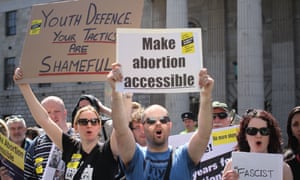
Pro-choice activists protest against a pro-life march on Dublin’s O’Connell Street.


Pro-choice activists protest against a pro-life march on Dublin’s O’Connell Street. Photograph: Alamy

“The Tottenham Hotspur football team were staying at our hotel [in Liverpool],” Kelly said. “I remember carrying the remains past the entire Spurs squad. It was the weirdest thing, walking past them and some of their fans in the packed lobby.


“There was me with my little plastic bag and the baby’s remains in a cardboard box. It was just so bizarre passing by the players with the remains of our baby under my arm.”


At Liverpool airport, Kelly and her husband decided to carry the remains on to the plane, rather than have them placed in the hold, in case the luggage went missing. Passing through security brought on further trauma, she said.


“We were queuing at security for ages and I wasn’t feeling physically great after the procedure the day before,” she said. “When we got to the top we said to the security guy that we had to declare foetal remains. The guy said, ‘What?’ He didn’t seem to understand and so we said it out loud again. He didn’t know what foetal remains meant so Mark said, ‘It’s a baby in the box’, and the man said out loud, ‘A baby in the box?’ Half the queue heard that, probably some of those who were getting on our flight to Dublin heard that.”


Related: UN calls on Ireland to reform abortion laws after landmark ruling


The whole experience was an ordeal, she said. “People – from the hotel clerk to the taxi man taking us to the clinic – kept asking us what we were doing over in Liverpool. Having to avoid those questions was the start of it all feeling so unfair.


“I didn’t even let the taxi drop us right outside the clinic and instead got out before the entrance further down the road. It was all about keeping it secret and to ourselves. I wasn’t questioning what I was going to do, I just didn’t want people to know. We had to lie to people about why we were really over in Liverpool, a series of lies and I couldn’t stop. You lied because you were supposed to lie.”


Kelly and her husband said they had not taken the decision to have an abortion lightly. “We discussed the termination and we felt it was absolutely the best decision for us,” she said. “This was very much a wanted baby. It was an enormous decision that we took very seriously.”


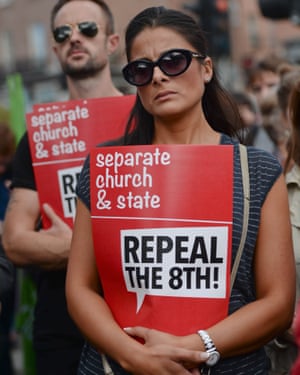
Protesters demand the abolition of the eighth amendment in Dublin in 2014.


Protesters demand the abolition of the eighth amendment in Dublin in 2014. Photograph: NurPhoto/Rex Shutterstock

According to statistics compiled by the UK’s Department of Health between 1980 and 2015, at least 165,438 Irish women and girls accessed UK abortion services. Last year, the figure was 3,451.


However, the Irish Family Planning Association pointed out that these figures underestimate the real numbers, as not all women will provide Irish addresses for reasons of confidentiality. Thousands of other Irish women access abortion through pills bought online, the IFPA adds.


Two incidents from Kelly’s experience bore out the high numbers. When Kelly found the website for the clinic in Liverpool that dealt with fatal foetal causes, she noticed there was a specific section called Travelling from Ireland.


“Bizarrely, the terminations are cheaper for women coming from Ireland because they are mindful about the costs of going over to England,” Kelly said. “It shows how many Irish women use their services.”


On her way back to Dublin, Kelly approached a member of staff at Liverpool airport to ask for advice about travelling with foetal remains. “The girl was Irish as it happened and she said something astonishing to me. ‘It’s fine,’ she said. ‘You need to go over to the gentleman at customs and declare the remains at security. It’s fine, I did it a few weeks ago.’ That’s what she said to me. It was said with such normality because she had done it herself.”


After landing in Dublin the couple drove straight to a funeral home. Once home, Kelly was upfront about her termination within her wider family, who she said supported her decision fully.


However, she said she would have preferred to have had the termination in her home city, adding: “I could have gone to my local hospital that morning, I could have been with my mum and dad recovering that night after it; in my own bed under supervision of my own doctor. I was made to get on a plane to go to a different country because I was not allowed to be here.”


Related: ‘I’ve seen horrible things’: photographer Laia Abril on her history of misogyny


Kelly supports demands by pro-choice campaigners for a referendum aimed at abolishing the eighth amendment to the Irish constitution. It was passed in a previous plebiscite in 1983, under pressure from powerful anti-abortion groups, and effectively makes the embryo an Irish citizen with full constitutional rights from the moment of conception.


Pro-choice reformers believe that there can be no liberalisation of Ireland’s strict anti-abortion laws until the amendment is abolished, as it generates a climate of fear among Irish medical teams even considering terminations allowed under current legislation. Abortions are only legal in Irish hospitals if there is a direct threat to a mother’s life or the woman is suicidal.


Kelly said her experience underlined the need to abolish the amendment. “I would like the people of this country to have the right to vote on this. Give us our referendum. None of the people of my generation got to speak in 1983. I was 18 months old the last time this was voted on,” she said.


“As for politicians, I would say to them that I have a story and they should speak to the women who have gone through it instead of just exporting the problem.”


"My baby in a box": Irish GP tells of trauma of travelling to UK for abortion

21 Temmuz 2014 Pazartesi

Amount of females travelling to America to pick sex of kid rises twenty%

Dr Potter who runs the HRC clinic in Newport Beach in California, said 80 per cent of couples from Britain are choosing to have a girl.


It had been feared that allowing sex selection would lead to an imbalance between the genders with fewer girls born for cultural reasons.


However Dr Potter said the women he sees are desperate for a girl having grown up playing with dolls and always imagined they would have daughter.


He told the Telegraph: “Some have only one child but most have two or three of the same gender. The process is driven by the mother who has identified with little girls since her own childhood and has always had a place for a daughter. When they do not have one, it is like a death and they grieve for their little girl.”


Dr Potter’s patients often do not need fertility treatment in order to conceive but go through the process so that the resulting embryos can be screened and the chosen sex transferred to the womb.


The whole process costs around US$ 15,000 and requires a 12 day stay near the clinic.


Dr Potter said: “I think that pregnancy termination as a method of gender selection is not acceptable but I also believe that is it not for me to impose my values on other people.


“I believe women should have reproductive freedom and that should include selecting the gender of their child if they wish. But in countries like the UK where the government pays for some IVF, taxpayers’ money should not be used to people can have a boy or a girl because that is what they want. That is inappropriate.


“I have had patients come to me from the other side of the world who have never been on a plane before and have saved up for a long time, it is really very important to them.”


He said the arguments against sex selection using IVF were mostly ‘absurd’ and focus on it ‘interfering with God’s will’ or somehow sexually discriminating against the embryo.


One in ten of Dr Potter’s patients are now seen for gender selection with the largest numbers of couples from outside America coming from Australia, the UK and Canada. In these countries, most couples want a girl, he said.


Some patients travel from China wanting to have a boy but many also want twins, with one of each sex.


One British patient who asked to be known only as Hayley said: “I’d always wanted a little girl but logistically, we didn’t want lots of children, we only wanted three, so we though we’d go down this route.


“My husband said “you can have one more baby” at which point I said, if I’m having one more I’ll make sure it’s a girl.


“I just think I’ve always wanted a mother daughter relationship. Not to take away from what I have with my sons which is lovely.”


Hayley and her husband Greg already had two boys, Bobby, six and Christopher, four. After searching the Internet, Hayley found lots of couples were looking for the same, and had coined the phrase, ‘gender dreaming’.


She said: “It took a lot of soul searching to go to the US to be honest – it took us a long time and we had to do lots of talking before we decided.


“Dr Potter was fantastic right from the care you receive in the UK. He was reassuring, really professional and everything you could want.”


“Of the eggs we created, we had 6 healthy embryos, 3 girls, 3 boys.”


Hayley chose to have one female implanted, which led to a successful pregnancy.


“I still can’t quite believe it, I’ll believe it when she’s here.


“The remaining embryos are frozen, they’ll probably remain frozen for a while. At some point we’ll make a decision, and I’m not sure what they decision will be.”


“We spent £22,000 on treatment but we never think about the cost, it was worth every penny.”


The Human Fertilisation and Embryology Authority which regulates fertility treatment in Britain carried out a review of sex selection in 1993 and again in 2002. Sex selection for social or family balancing reasons is illegal under the amended HFE Act which came into force in 2009.


Amount of females travelling to America to pick sex of kid rises twenty%

Quantity of women travelling to America to choose intercourse of youngster rises twenty%

Dr Potter who runs the HRC clinic in Newport Beach in California, said 80 per cent of couples from Britain are choosing to have a girl.


It had been feared that allowing sex selection would lead to an imbalance between the genders with fewer girls born for cultural reasons.


However Dr Potter said the women he sees are desperate for a girl having grown up playing with dolls and always imagined they would have daughter.


He told the Telegraph: “Some have only one child but most have two or three of the same gender. The process is driven by the mother who has identified with little girls since her own childhood and has always had a place for a daughter. When they do not have one, it is like a death and they grieve for their little girl.”


Dr Potter’s patients often do not need fertility treatment in order to conceive but go through the process so that the resulting embryos can be screened and the chosen sex transferred to the womb.


The whole process costs around US$ 15,000 and requires a 12 day stay near the clinic.


Dr Potter said: “I think that pregnancy termination as a method of gender selection is not acceptable but I also believe that is it not for me to impose my values on other people.


“I believe women should have reproductive freedom and that should include selecting the gender of their child if they wish. But in countries like the UK where the government pays for some IVF, taxpayers’ money should not be used to people can have a boy or a girl because that is what they want. That is inappropriate.


“I have had patients come to me from the other side of the world who have never been on a plane before and have saved up for a long time, it is really very important to them.”


He said the arguments against sex selection using IVF were mostly ‘absurd’ and focus on it ‘interfering with God’s will’ or somehow sexually discriminating against the embryo.


One in ten of Dr Potter’s patients are now seen for gender selection with the largest numbers of couples from outside America coming from Australia, the UK and Canada. In these countries, most couples want a girl, he said.


Some patients travel from China wanting to have a boy but many also want twins, with one of each sex.


One British patient who asked to be known only as Hayley said: “I’d always wanted a little girl but logistically, we didn’t want lots of children, we only wanted three, so we though we’d go down this route.


“My husband said “you can have one more baby” at which point I said, if I’m having one more I’ll make sure it’s a girl.


“I just think I’ve always wanted a mother daughter relationship. Not to take away from what I have with my sons which is lovely.”


Hayley and her husband Greg already had two boys, Bobby, six and Christopher, four. After searching the Internet, Hayley found lots of couples were looking for the same, and had coined the phrase, ‘gender dreaming’.


She said: “It took a lot of soul searching to go to the US to be honest – it took us a long time and we had to do lots of talking before we decided.


“Dr Potter was fantastic right from the care you receive in the UK. He was reassuring, really professional and everything you could want.”


“Of the eggs we created, we had 6 healthy embryos, 3 girls, 3 boys.”


Hayley chose to have one female implanted, which led to a successful pregnancy.


“I still can’t quite believe it, I’ll believe it when she’s here.


“The remaining embryos are frozen, they’ll probably remain frozen for a while. At some point we’ll make a decision, and I’m not sure what they decision will be.”


“We spent £22,000 on treatment but we never think about the cost, it was worth every penny.”


The Human Fertilisation and Embryology Authority which regulates fertility treatment in Britain carried out a review of sex selection in 1993 and again in 2002. Sex selection for social or family balancing reasons is illegal under the amended HFE Act which came into force in 2009.


Quantity of women travelling to America to choose intercourse of youngster rises twenty%

6 Mayıs 2014 Salı

Travelling at high altitude: what are the hazards?


June Muxworthy writes
My husband and I are contemplating a trip to South America to include Machu Picchu and other large-altitude places in the Andes. I am 72 and suffer from angina pectoris but I take into account myself really lively. Ought to I be taking into consideration visiting these substantial-altitude areas? I would welcome tips from your health care skilled.


Dr Richard Dawood, travel wellness professional, replies
Angina is ache resulting from lowered oxygenation of heart muscle, so a sudden reduction in oxygen strain could perhaps make it worse. Ahead of travelling to large altitude, you should talk about your strategies very carefully with your cardiologist, to verify that you are in a sufficiently secure condition, capable to tolerate the two the decreased oxygen strain and the improved physical exercise that goes with this kind of a trip. You would also need to think about that – as with other remote destinations – there might be no simple accessibility to first-globe medical care in a crisis, and that great health care insurance coverage cover requirements to be in area.


The major difficulty with brief trips to substantial altitude is that they do not enable enough time for acclimatisation. Most men and women are capable of adapting effectively to higher altitude – in the finish. The challenge is to locate an itinerary that enables you to ascend progressively adequate, spending a few days at two or three intermediate altitudes along the way till you are really prepared to carry on. At an altitude of ten,925ft, Cuzco is the staging level for receiving to Machu Picchu: many travelers fly in straight from sea level, in a misguided work to conserve time or cash. Machu Picchu itself is reduced, at 8,000ft, but other common and desirable destinations in South America are considerably larger: La Paz twelve,562ft, Lake Titicaca twelve,507ft. Without arranging items cautiously and allowing enough time, travelling to these remarkable spots will be stressful and unenjoyable.


Dr Richard Dawood is a expert in travel medication at the Fleet Street Clinic (020 7353 5678) and editor of Travellers’ Overall health (OUP)


Ask the professionals


Our Q&ampA services makes it possible for you can choose the brains of our specialists at residence and abroad. Electronic mail your query to asktheexperts@telegraph.co.united kingdom. We will not be able to answer them all, but we will do our ideal.


About Dr Richard Dawood


Richard is the healthcare director of the Fleet Street Clinic in London and has travelled in more than 100 countries. The fifth edition of his guide Travellers’ Well being: How to Remain Healthy Abroad is due out in autumn.


Click here to locate out about our other experts


Travelling at high altitude: what are the hazards?