Park etiketine sahip kayıtlar gösteriliyor. Tüm kayıtları göster

14 Nisan 2017 Cuma

Harare"s park bench grandmas: "I speak to them and feel a load is lifted off my heart"

The therapy room is a patch of waste ground, and the therapist’s couch a wooden bench under a tree. The therapist is an elderly Zimbabwean woman, in a long brown dress and headscarf.


Her patients call her “Grandmother” when they come along to sit on her bench and discuss their feelings, their depression or other mental health issues.


Outside a clinic in Highfield, a poor suburb just south of Zimbabwe’s capital Harare, there are lots of grandmothers – trained but unqualified health workers – who take turns on the park bench to hear stories. They listen to the battered wife who has attempted suicide twice, the man who hates women after he became infected with HIV, the unemployed single mother driven to despair by the struggle of raising four children.


The benches are a safe place for people struggling with depression, which in the Shona language is called kufungisisa, “thinking too much”.


It is a world away from conventional approaches to mental healthcare, but the Friendship Bench project has changed the lives of an estimated 27,000 Zimbabweans suffering from depression and other mental disorders.


The grandmothers, all of whom are trained to improve a patient’s ability to cope with mental stress, listen and nod, offering only an occasional word of encouragement.


One in four Zimbabweans suffers from some form of mental illness, but there are only 13 psychiatrists in a country of about 15.6 million. A solution had to be found, and it came in the way of a bench and the tradition of respect for African matriarchs.


Clinics screen their visitors for mental illness through a locally developed tool called the Shona Symptom Questionnaire. It has 14 questions, such as “Have you been struggling to sleep?” and “Have you been worrying too much?”


Patients scoring above the cut-off level are referred to the friendship bench. Those who go to the grandmothers are five times less likely to have suicidal thoughts, according to Dr Dixon Chibanda, co-founder of the scheme.


“When they first get to the bench, we use an intervention which we call kuvhura pfungwa [opening of the mind]. They sit and talk about their problems. Through that process, the grandmothers enable that patient to select a specific problem to focus on, and they help them through it,” he says.


Through at least six one-on-one sessions with the health workers, the patients are encouraged to speak about their problems and their mental illness.


Traditionally, elderly women play the role of counsellor for younger members of the community. On the bench, however, the grandmothers listen more, and lecture less.


“We used to talk a lot, ‘Do this, do that’. But now we ask them to open up, open their minds and hearts,” says Sheba Khumalo, a grandmother.


Chibanda says it is mostly women that visit the bench. “From our recent study, we found that 40% of those coming to the bench who show depression are victims of domestic violence. Whether that violence is caused by the economic situation is something that we have not looked at.”


In conservative Zimbabwe, just getting people to open up about their mental health is a victory in itself, says Joyce Ncube, another of the grandmothers.


“Many died just because they had nobody to tell their problems to,” she says, settling on to the wooden seat for a session with one of her patients. “When people keep things inside, their problems start.”


Maria Makoni is a 49-year-old unemployed mother of three who began therapy earlier this year.


“In our culture, you are ridiculed for speaking about your mental health,” says Makoni.


She is tense, but lights up when she speaks about the grandmothers. “I was desperate to find someone to talk to about my problems. When I speak to them, I feel like a load is lifted off my heart.”


When Makoni first found her way to the friendship bench, she was surprised to find she was one of many with similar problems. Now she is volunteering to bring more to the bench. “I am ready to speak to as many people as I can.”
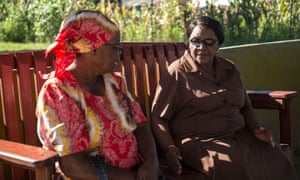


Grandmothers working with the Friendship Bench project


Grandmothers working with the Friendship Bench project chat before counselling sessions begin. Photograph: Cynthia R Matonhodze

For many Zimbabweans, poverty – more than 70% of people live below the poverty line – and unemployment are a source of despair. In such a deeply superstitious and religious society, mentally ill people are sometimes seen as possessed; many are dragged to exorcism sessions at charismatic churches or traditional healers.


Chibanda says such beliefs need not be a hurdle, provided the intervention is packaged well.


“The term ‘opening of the mind’ does not sound medical at all. We have used those words to package a scientific intervention, and this is why it’s acceptable.”


The programme has had to pick its words carefully, as the grandmothers are meant to be more friends than doctors. The scheme was initially called “mental health bench” but nobody came. “The minute we changed it to friendship bench, it became acceptable, even though we are essentially providing the same thing,” says Chibanda.


Researchers say the friendship bench may be a blueprint for mental healthcare in developing countries. In Zimbabwe, the programme will now be rolled out to 60 other clinics across the country.


“This bench is filling that gap we have in providing affordable care,” says Prosper Chonzi, director of health for the City of Harare. “We are glad to see it is being applied to other cities in the country.”


Harare"s park bench grandmas: "I speak to them and feel a load is lifted off my heart"

30 Ocak 2017 Pazartesi

Wife and son "dumped American man with dementia in UK car park"

An American man with dementia was flown to Britain and left in a car park by his wife and son, according to US court documents.


Roger Curry was allegedly abandoned in the car park of Hereford bus station on 7 November 2015 after travelling from his home in Los Angeles with his family.


Legal documents seen by the BBC’s Panorama programme and filed in Los Angeles state: “In late 2015 Mr Curry was taken surreptitiously to England by his wife Mary Curry and his son Kevin Curry and abandoned there.”


The 76-year-old, who did not know his name or where he was, was found in the company of two men who flagged down a passing ambulance. One of the men – described as having an American accent, but younger than Curry – allegedly vanished from the scene.


Curry was taken into the care of a nursing home while police and social services spent months trying to find out who he was. He was finally flown back to America eight months later and is in the care of authorities in Los Angeles.


At the time of his discovery, police appealed for help to identify the “vulnerable” man.


West Mercia police said they also wanted to trace a man, described as being in his 40s, who was seen to be walking with Curry towards Hereford county Hospital on the day he was discovered.


As part of the investigation, a 50-year-old man from Taunton in Somerset was arrested on suspicion of kidnap and bailed. He has not been charged.


Kevin Curry, who was interviewed by Panorama, said he had nothing to do with the abandonment of his father.


Wife and son "dumped American man with dementia in UK car park"

10 Mart 2014 Pazartesi

A scream of solidarity to my fellow ladies everywhere | Cara Park

Is mise Cara Park.


I am used to speaking publicly but I am a little nervous about this speech as it is so essential to me.


I have constantly desired to do this and I am not sure if I will get the opportunity once again so if you could humour me, I want to let out a scream.


A scream of disappointment.


A scream of solidarity to my fellow lady who are not able to express themselves in this kind of a vogue, who are suffering injustice and discrimination.


If you would join in a cry/a keen for other women who are suffering.


Thank you.


I stand ahead of you today as a female unfree, in spite of the area of my birth here in the European Union, a colony of the British empire, the island of Ireland, Eire.


This is since I do not have the identical rights as my sisters in other elements of these conglomerate nations. I am officially a citizen of the United Kingdom but the same freedom of reproductive decision is not awarded to me.


An bhfuil sin cothrom? [Is this fair?]


I was going to put on a chastity belt right now as a symbol of sexual slavery but I do not want to use a gimmicky prop to signify a severe act of oppression towards the female population of this island.


I am wearing quite little clothing.


By dressing like this, does that right away make me a “slut”, a “slag”, a “dolly bird”, a “whore”, a “loose” woman?


Am I letting the side down by sporting lipstick, fake tan, dyeing my hair, exhibiting my nipples?


I am expressing my femininity.


My sexuality.


My youth.


My body.


Does that make me superficial?


Need to I be in a position to dress how I like and not face discrimination?


This could seem like a superficial, trivial matter, but it is not.


Men and females have fought and some have died in the suffragist struggle to award me this kind of freedom of expression.


Other women in the planet are not so lucky.


Some men in this society are not so lucky.


This is a symptom of a really severe difficulty.


Branding individuals.


Putting them in boxes.


Identifying with symbols.


Flags, groups, teams, sides.


What side are you on?


I am a solution of the two the Protestant and Catholic communities.


I relate to the two and belong to neither.


I am not a republican. I am not a unionist. I am a humanist.


I feel we are so distracted by tribal rituals that we overlook to address the genuine inequalities, oppression, racism, gender discrimination that some of our laws uphold.


For instance, the gay blood ban.


Discriminatory.


The fact that I can not talk my native language in a court area.


Discriminatory.


An bhfuil sin cothrom?


The truth that I am objectified, vilified if I appear overtly sexual.


Sex is a dirty word, we do not speak about sex right here. Hush, hush.


Well possibly we need to.


Intercourse.


I have intercourse.


I am a attractive girl.


I explained it.


I am not ashamed.


We all are born of intercourse.


Hiding the reality helps no a single.


Probably if we have been much more open about sex, if it was not deemed a mortal sin and young children have been offered suitable, informative sex education, then so numerous rapists would not have gotten away with sexually abusing our ladies, males and young children more than the years.


It is the shame that has guarded rapists and sadists who have carried out hideous sexual acts against victims.


The shame of confessing, the dirty strategies, the lifetimes ruined by abuse.


We need to educate our children and remove the associated guilt of the victims.


End the tyranny of sexual shaming.


The primary point I wished to raise is about a woman’s right to select.


The Offences Towards the Particular person Act which criminalises females for taking their fertility in their very own hands.


The patriarchal laws and the predominantly male enforcers of mentioned archaic acts of parliaments condemn us criminals if we terminate our pregnancies.


We are forced to break the law, go to other components of the Uk on illicit journeys, incorporating secrecy and criminality to presently traumatic scenarios.


We are forced to lie to medical doctors.


Conceal our shame.


An bhfuil sin cothrom?


We can argue that this is because we are in Ireland, an outstanding place historically, a Christian country. If we are to attribute the suppression of female autonomy as a upholding of fundamentalist Christian values, let me inform or remind you that abortion is not pointed out in the Bible.


It is a social construction, a lot like the compulsory hair covering in Muslim countries. Burqas, hijabs, gloves are not talked about in the Qur’an either.


One more act of suppression on the female type.


Conceal sexuality.


But the oppression of girls by refusal to apply the Abortion Act 1967 is probably the 1 level that the opposing conservative events can agree on.


An bhfuil sin cothrom?


I am calling for the patriarchal laws to be transformed and affirmative action taken. We are in a lucky place here in Ireland in contrast with other regimes, in spite of dealing with a lifetime in prison for having an abortion. We need to use the relative freedom we possess, like the freedom of speech, to vocalise our struggle and help other individuals much less lucky.


We must not grow to be complacent! The struggle is not in excess of! Carry on the fight for equality in the encounter of informal misogyny, bodily misogyny and, most importantly, resist and revolt against misogyny by the state.


Equal rights for girls means equal rights for all! Continue the suffrage, assistance other ladies, do not be complicit in the commodification of the female kind, do not judge other ladies in how they dress, who they have sex with, their sense of humour, the books they have read through etc. We have to unite as collective force and fight the patriarchal powers as an alternative of dividing ourselves into feminist sub-groups.


Do not let the superficial age we live in divide and conquer us, unify, organise, protest, demonstrate, enjoy your neighbours, celebrate distinctions. We owe it to our suffragist brothers and sisters who have fought for the rights we have right now.


Make abortion cost-free, protected and legal.


Corp s’agam, Ré s’agam. My body, my option.


Equal rights for all.


• This is the text of a speech provided at an International Women’s Day event at the Stormont assembly


A scream of solidarity to my fellow ladies everywhere | Cara Park