surgery etiketine sahip kayıtlar gösteriliyor. Tüm kayıtları göster

21 Nisan 2017 Cuma

Bariatric surgery and early death

Weight loss surgeries have witnessed huge popularity in recent times. The number of stomach-shrinking operations, a type of bariatric surgery meant for severely obese people has skyrocketed in recent years. Few celebrities of Hollywood have also opted for this form of surgery to curtail obesity.


But there are various risks associated with these surgeries especially for elderly people and those suffering from heart disease (1, 2, 3). At times, it can result in early death.  Patients aged 65 or older face a nearly threefold increase in the risk of early mortality according to latest findings. It has been found that men are nearly twice as likely to die following such procedures as opposed to women. According to the Journal of the American Medical Association, more than 5% of men and nearly 3% of women aged 35 to 44 years were dead within a year of having the surgery and a slightly higher rate was found in patients aged between 45 to 54.


Bariatric surgery is a complicated procedure therefore a surgeon requires prior experience to perform it properly. Patients whose surgeons had performed fewer than 20 procedures were nearly five times as likely to die within 30 days after the operation as compared to others. Despite the greater risk associated with it, bariatric surgery can be a safe and effective tool for morbidly obese people, who face serious health problems if they don’t lose weight.


Things you need to know about bariatric surgery
1.Bariatric surgery is not an easy option for obesity sufferers as it carries the usual pain and risks of any major gastrointestinal surgical operation.
2.Bariatric surgery requires changes in eating habits therefore after having bariatric surgery; patients remain at a lifelong risk of nutritional deficiencies.
3.Bariatric Surgery is best suited for morbidly obese people.
4.High amount of motivation is required to make the surgery a success.
5.This procedure is costly as compared to other weight loss techniques.
Therefore, be well informed about the surgery you want to opt for as it can make weight loss an easy and safe affair for you.


1. http://www.mayoclinic.org/tests-procedures/bariatric-surgery/basics/risks/prc-20019138


2. http://www.medicalnewstoday.com/articles/269487.php


3. http://www.bariatric-surgery-source.com/complications-of-gastric-bypass-surgery.html


Dr. Serge Gregoire

Dr. Serge is a clinical nutritionist. He owns a doctorate degree in nutrition from McGill University in Canada. In addition, he completed a 7-year postdoctoral training at Harvard Medical School in Massachusetts where he studied the impact of fat as it relates to heart disease.

He has authored a book on this topic that is awaiting publication with Edition Berger publishers in Canada. He holds an advance certification in Nutrition Response Testing (SM) from Ulan Nutritional Systems in Florida and he is a certified herbalist through the Australian College of Phytotherapy.


His personalized nutritional programs allow to help individuals with a wide variety of health concerns such as hormonal imbalance, digestive issues, heart-related conditions, detoxes/cleanses, weight loss, fatigue, migraines, allergies, among others.



Bariatric surgery and early death

12 Nisan 2017 Çarşamba

Why axeing 18-week surgery target won"t create more capacity in A&E

Press coverage of the recent Next steps on the NHS Five Year Forward View [pdf] concentrated heavily on the argument that a lower 18-week elective surgery target in 2017/18 will make it easier to recover performance against the four-hour accident and emergency target. But false linkages between the two targets are hiding the real risk for the NHS.


While the lower elective surgery target is a welcome, but painful, acceptance of reality, the linkage between the two targets is neither direct nor strong. And overemphasising that linkage underplays the serious risks the NHS faces next winter.


NHS performance between December 2016 and March 2017 showed the service is running a higher risk in the provision of urgent care than at any point over the past decade.


The 95% four-hour A&E target isn’t a particularly good measure of that risk – the Royal College of Emergency Medicine argues that 75% performance against the four-hour standard is the “magic mark for safety … when it becomes very overcrowded and … unsafe”. Better measures of patient safety risk are the levels of hospital bed occupancy, ambulance handover delays and the number and frequency of long hospital trolley waits.


All of these took a significant turn for the worse last winter. A third of hospitals had bed occupancy rates of 100% on at least one day. Many reported trying to manage bed occupancy levels well over the recommended 85%-90% level for weeks on end. This required continual, difficult, “one in, one out” admission/discharge decisions that usually led to worse care for the patients concerned. Ambulance diversions – hospitals turning away ambulances because they were full – were up 85% compared with the previous year.


While the NHS as a whole just about coped with record levels of demand, a number of local systems were overwhelmed for periods of time, putting patients at unacceptable risk.


Hospital and ambulance trust leaders are now concerned about their ability to manage this growing risk and that the number of systems in danger of failing over next winter is rising. Their colleagues in community and mental health report similar pressures, risks and concerns though, frustratingly, we either don’t have the public data to show this or the data is too new to be robust.


Aiming for a lower 18-week elective surgery target will, in many instances, make little difference, for three reasons.


First, many hospitals are now undertaking such relatively low levels of elective activity that they are, in the words of a recent Health Foundation Report, “becoming more of an emergency service” (pdf). Relaxing elective surgery performance targets won’t help them much.


Second, most hospitals have already scaled back their elective work over the crucial winter period. Indeed, they were formally instructed to do so by NHS Improvement. Relaxing the elective surgery target won’t create much extra winter capacity as it has already largely been freed up anyway.


Third, urgent and emergency care performance is not just about hospitals. While concentrating more hospital capacity on emergency, as opposed to elective, care may help a little, it does nothing to address the problem of capacity constraints in primary and social care, and the ambulance, community and mental health sectors.


The NHS can no longer do everything. Trying to hit the elective surgery target would have required the service to abandon proposed increases in cancer, mental health and primary care funding. But relaxing the target does have unwelcome side effects. As the £300m deterioration in last year’s trust finances in the third quarter showed, reducing elective surgery seriously hits trust financial performance just when we are trying to recover it. Delaying surgery also risks turning some cases into emergencies, adding to the urgent care burden.


Good urgent care largely depends on supply and demand across a local geography. The NHS struggles with winter pressures because we don’t have enough capacity. If we want to manage growing risk, we have to increase capacity to match growing demand.


We need to boost capacity in primary care, where the number of GPs is falling, not rising. We need to increase capacity in out-of-hospital care, not reduce the number of out-of-hospital beds by 8% as happened between winter 2016 and winter 2017. We need to grow capacity in social care, not cut the number of care packages available, to reduce delayed transfers and enable hospitals to properly manage their patient flow. And we need to increase temporary capacity in both acute hospitals and ambulance services too, if that’s what’s needed. It’s important to note that we added eight extra hospitals’ worth of temporary acute bed capacity last winter and still struggled.


What we shouldn’t do is kid ourselves that relaxing the 92% 18-week elective surgery target is any real substitute for that extra urgent and emergency care capacity. It isn’t.


Join the Healthcare Professionals Network to read more pieces like this. And follow us on Twitter (@GdnHealthcare) to keep up with the latest healthcare news and views.


Why axeing 18-week surgery target won"t create more capacity in A&E

31 Mart 2017 Cuma

There is no quick fix in cosmetic surgery | Letters

Saturday 1 April marks the fourth anniversary of NHS’s medical director Bruce Keogh’s scathing report on the regulation of cosmetic procedures. It concluded that dermal fillers are a crisis waiting to happen – and said they should be classified as a prescription-only medical device.


Yet today little has changed. As an NHS reconstructive surgeon, I am frequently called on to fix the mistakes of unqualified beauty consultants.


Understanding the intricacies of facial anatomy and physiology has taken me half a lifetime of rigorous medical training to master. Yet flimsy regulation means an individual can jump on to YouTube, watch a couple of “how-to” clips, order supplies online and set up as a bona fide consultant.


The dangers are clear. I have seen around 50 women in the past few years, some with allergies to filler, others with filler pouring out of their faces – many in need of multiple, complex procedures to restore their features. And it is clear numbers are increasing.


Health minister Philip Dunne recently said that the majority of these products were intended to be used in reconstructive surgery, and regulated medical professionals are bound by professional standards and terms of registration. But what of the budding hairdresser turned beauty consultant? Who is there to regulate these rogue practitioners?


The non-surgical cosmetic procedures market is worth £3.6bn. And non-surgical procedures account for 90% of all cosmetic interventions. Individual filler sessions can cost £300. Such clear financial incentives are unlikely to dissuade the let’s-give-it-a-go brigade. Regulation is key. The General Medical Council has compiled a guide for physicians to establish standards. But binding regulation is needed. Other non-medical organisations such as Save Face have also tried to direct the public to practitioners with appropriate training.


As a plastic surgeon who works in the NHS, I have a team of colleagues who reconstruct the faces of children and adults with facial deformities.


Sadly, a new group of patients are emerging whose features have been changed, sometimes irreversibly, by non-surgical cosmetic procedures. It is essential that anyone receiving these treatments has confidence in their practitioner, and we must encourage patients not to be lured by quick fixes and unbelievable deals.
Simon Eccles
Member, British Association of Plastic, Reconstructive and Aesthetic Surgeons


Join the debate – email guardian.letters@theguardian.com


Read more Guardian letters – click here to visit gu.com/letters


There is no quick fix in cosmetic surgery | Letters

27 Mart 2017 Pazartesi

Stem cells help some men with erectile dysfunction after prostate surgery

Men unable to have an erection after prostate surgery enjoyed normal intercourse thanks to stem cell therapy, scientists are to report on Saturday at a medical conference in London.


In first-phase clinical trials, eight out of 15 continent men suffering from erectile dysfunction had sex six months after the one-time treatment, without recourse to drugs or penile implants.


The positive result showed no signs of flagging during a subsequent year-long monitoring period. “As far as we know, this is the first time that a human study with a 12-month follow up shows that the treatment is lasting and safe,” said Lars Lund, a professor at Odense University hospital in Denmark, who took part in the trials.


“That is much better than taking a pill every time you want to have intercourse,” he said.


The results were promising enough to convince Danish health authorities to authorise so-called phase III “double-blind” randomised trials in which one group of men is given stem cell therapy and another placebos.


Only men recovering from prostate cancer and able to control their bladders will be enrolled in the new experiments, Lund explained.


To perform the procedure, doctors remove fat cells from a patient’s abdomen via liposuction. The cells undergo a brief treatment and emerge as all-purpose stem cells, meaning they can mutate into almost any specialised cell in the body.


“We do not cultivate the cells or change them in any way,” said Lund’s colleague Martha Haahr, head researcher and lead author of a study detailing preliminary results, published last year in EBioMedicine.


The stem cells are then injected with a syringe into the penis, where they spontaneously begin to change in to nerve and muscle cells, as well as the endothelial cells that line blood vessels. Men are under general anaesthesia while all of this happens, and are discharged from hospital the same day.


Prostate surgery is responsible for about 13% of erectile dysfunction cases. Up to 80% of men experience difficulty having sex immediately after an operation, previous research has shown.


Diabetes accounts for 40% of erectile dysfunction cases, and vascular disease another 30%. Men with diabetes would be the next target group for clinical trials, Lund said.


The results reported at the European Association of Urology conference could be an effective “therapeutic option for patients suffering erectile dysfunction from other causes,” Haahr said.


It is estimated that nearly half of men between the ages of 40 and 70 experience erectile dysfunction to some degree.


The global market for drugs treating the disorder is expected to top $ 3.4 billion by 2019.


Failure to perform sexually can also, in some men, result from relationship problems, performance anxiety or repressed homosexuality, Haahr said.


Stem cells help some men with erectile dysfunction after prostate surgery

12 Mart 2017 Pazar

The art of surgery: life drawing and leprosy

‘Life drawing”, “still life” and “life class” are all fairly mundane terms I thought only applied to nude figures or fruit bowls in an art studio. However, in November, I stood and drew in the corner of a plastic surgeon’s theatre in Lalgadh hospital, near Janakpur in Nepal. The theatre was set up to operate on the paralysed hands of leprosy patients. “Life drawing” became very appropriate very quickly.


Like many infectious diseases that predominantly affect those in poverty, leprosy is alive and well; there were more than 200,000 new cases were reported in 2015. The sad fact is that the disease is difficult to contract and relatively straightforward to treat. Many patients present late, when paralysis sets in. Although medication can make patients non-infective, the paralysis requires surgery to correct.


Ram being cleaned with iodine before his operation.


A patient being cleaned with iodine before his operation.

Each year, Working Hands – a Bristol-based charity run by hand surgeon Donald Sammut – spends two weeks, pro bono, operating on the backlog of patients in Lalgadh, training staff and providing hundreds of kilos of medical equipment and consumables. The work is highly skilled, but in many cases the objective is simple: to generate enough movement and power in a hand for the patient to go back to work, or to eat, or to look after themselves in a society where stigma is attached to those with the disease. Most of these patients are illiterate farmers whose only means of support depends on how much they can dig, or carry.


Raj is 60 and undergoing an opponensplasty to give more strength and movement to his right thumb.


Raj undergoing an opponensplasty to give more strength and movement to his right thumb.

As I was drawing Raj, a 60-year-old man having an opponensplasty (an operation to restore strength and movement to a paralysed thumb), it occurred to me that there have been many crossovers between surgery and art. Leonardo da Vinci and Henry Tonks were two of them, both using drawing as a way of comprehending the human body.


Leprosy surgery in Nepal surgery


The team amputating a lower limb under local anaesthetic.

Watching Sammut, I could see why surgeons often make great artists. The value of being bold, with highly tuned hand-eye coordination, an obsessive understanding of what looks beautiful and a consideration for symmetry were all tips from the drawing books. But it doesn’t end there. Surgery is also performed under great time pressure; these procedures are all done under local anaesthetic, including the amputations, with a tourniquet to stem blood flow. The shorter the tourniquet time, the less damage to the tissue.


Gulshan, a 21-year-old, was having the gangrenous and mummified fingers removed from both of her hands – a procedure done under local anaesthetic.


Gulshan, a 21-year-old, was having the gangrenous and mummified fingers removed from both of her hands – a procedure done under local anaesthetic.

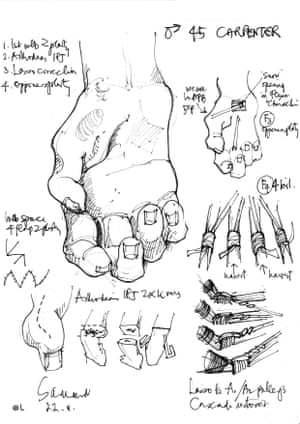
Before each surgery, Sammut spends several minutes drawing the patient’s hand; scar tissue shown with cross-hatching, deformity by weight of line, cut lines with dotted lines. “Those few minutes of examining and drawing the hand are invaluable,” he says. “While drawing, one is obliged to examine every millimetre, the texture and suppleness of the tissues one is about to rearrange. And it also gives one a few moments to plan the surgery, running it through one’s head like choreography steps.” The drawing is the beginning of a relationship built on trust, and a life-changing procedure.


Surgery notes for a 45-year-old male carpenter needing Lasso correction and opponensplasty. Drawing by Donald Sammut, Working Hands charity.


Surgery notes for a 45-year-old male carpenter needing Lasso correction and opponensplasty. Drawing by Donald Sammut, Working Hands charity.


Leprosy surgery in Nepal lalgadh hospital

Leprosy patients here are treated at Lalgadh hospital for free, supported by the 400 paying outpatients the hospital treats each day.


Leprosy surgery in Nepal haycollecting

An entire family collecting hay, typical of the sort of agricultural society that many of the leprosy patients work in.


Leprosy surgery in Nepal physio

Two patients waiting in line for physiotherapy after corrective surgery on their hands.


Leprosy surgery in Nepal funeral

A Hindu funeral pyre for 55-year-old Krishna Bikram Chauhan on the bed of the river Sundari near Janatpur. The names of those watching the pyre are taken and they are invited to a celebration 10 days later.


Leprosy surgery in Nepal mother and child

A mother comforts her child after his operation.


Leprosy surgery in Nepal theatre

Working Hands team and local doctors in the middle of a procedure in Lalgadh hospital.


The art of surgery: life drawing and leprosy

17 Şubat 2017 Cuma

Antibiotics, not surgery, could treat appendicitis in children, study suggests

Antibiotics could be an effective alternative to surgery for treating children with appendicitis, research suggests.


According to the NHS, appendicitis affects an estimated one in 13 people at some point in their life, with appendix removal the most common reason for emergency surgery in children.


But researchers say using antibiotics alone might offer a less invasive alternative – an approach that has already had some success in adult patients.


“It has become clear in recent years that in adults there are some patients with appendicitis who can recover from the disease without an operation, and we are frequently asked by parents of children with an appendicitis whether their child really needs an operation to get better,” said Nigel Hall, associate professor of paediatric surgery at the University of Southampton and co-author of the study.


While surgery remains the “gold standard” tried and tested treatment, often with some antibiotics, said Hall, “we are keen to explore the role of non-operative treatment for these children.”


Published in the journal Pediatrics by a team of scientists from the UK and Canada, the research involved a review of 10 existing studies published within the last decade. In total the studies involved 766 children from countries around the world – but not including the UK – of whom 413 were treated for uncomplicated, acute appendicitis with antibiotics alone rather than surgery.


Six of the studies compared the use of antibiotics alone with surgery, while the other four looked only at results for children treated with antibiotics. Different antibiotics and course durations were used in the studies, with both intravenous and oral regimes employed.


Overall, the authors found that the use of antibiotics alone was effective for 97% of children undergoing non-surgical treatment, while none of the studies reported any adverse effects of treating appendicitis with antibiotics.


However, appendicitis recurred in 14% of the children who did not have surgery. Overall, 82% of children who were treated with antibiotics alone avoided having surgery by the end of the various studies, a period that ranged from eight weeks to four years, depending on the research.


“While the benefit of non-operative treatment might be that you can avoid an operation, if you get a recurrence of your appendicitis it is likely that you will then be recommended to have an operation to remove the appendix in the long run,” said Hall. “So the benefit of avoiding an operation in the short term is gone.”


With only one of the ten studies considered in the review a randomised control trial, further rigorous research is needed to compare the effectiveness of antibiotics alone versus surgery for appendicitis, as well as to evaluate costs and quality of life for the different treatments.


“We really do need to do the prospective, comparative, randomised studies in order to be able to find out which is the better treatment option,” said Hall, adding that initial steps towards such studies are already underway in the UK by a team including Hall.


Furthermore, he noted, the review only covers simple, acute appendicitis and does not include children with complicated appendicitis, such as those with a perforated appendix or an appendix mass.


“We would very much not recommend that all children with appendicitis are treated with antibiotics and also very much that treatment of appendicitis remains a condition that needs to be treated by a specialist surgeon in a hospital,” said Hall.


Anthony Lander, a consultant surgeon at Birmingham Women’s and Children’s Hospital who was not involved in the study, acknowledged that both surgery and antibiotics alone have their benefits and drawbacks.


“Operations are expensive and have complications but there is no recurrent appendicitis. Antibiotics are cheap and very safe but may fail to treat the illness and surgery may still be required,” he said.


While Lander agreed with the need for large, rigorous studies to compare which approach might be best for treating early acute appendicitis, he added that the condition differs from person to person.


“A more valuable question would be “ What is the nature of the appendicitis which can be treated by antibiotics alone, safely and without a high recurrence rate?” and “Which cases should have an operation?”,” he said “The challenge is to design a study to answer this question.”.


John Abercrombie, a consultant colorectal surgeon and spokesperson for emergency general surgery at the Royal College of Surgeons, welcomed the study. “What this shows is quite similar to similar publications looking at appendicitis in adults where antibiotic treatments are being shown to be safe for selected cases,” he said.


“It is an important treatment option that needs to be discussed and for suitable children it seems like a very reasonable thing to do and may offer the chance to avoid an operation,” he added.


Antibiotics, not surgery, could treat appendicitis in children, study suggests

14 Şubat 2017 Salı

Is Brexit really to blame for the decline in plastic surgery? | Tim Dowling

Almost exactly a year ago I visited a Harley Street address, notebook in hand, to interview a plastic surgeon, a number of his staff and a few of his satisfied clients. The story was simple: business was good. The place was high-ceilinged and expensively decorated. In the UK the number of cosmetic surgical procedures had increased to record levels, by a whopping 13% year on year, in line with a decade-long upward trend.


What a difference a year makes. Figures just released by the British Association of Aesthetic Plastic Surgeons (Baaps) show that procedures actually dropped by 40% in 2016. A total of 31,000 cosmetic surgeries were performed in the UK last year, fewer than in 2007. It’s one of those statistics that seems to indicate – in contrast to all the other evidence – that sometime last year people started to see sense.


In a press statement Baaps cited several possible explanations for the decline, from uncertainty surrounding the EU referendum to “global fragility”. It’s also been suggested that larger cultural forces – mainly Instagram – have left us with less rigid ideas about beauty.


The thing about such a surprising reversal is that no one knows exactly what’s behind it. It makes sense that in times of upheaval people are reluctant to make life-changing decisions or commit to big purchases, but there was no corresponding drop in first-time mortgages or foreign holidays. It’s true that more people are opting for non-surgical cosmetic procedures, which are cheaper and less invasive, but that’s been the case for some time.


I’d love to believe that the public has begun to seen the light regarding the often illusory benefits of cosmetic surgery, but if I had to guess I’d say it was plastic surgeons themselves who are driving this shift. Non-surgical procedures are cheaper for them too, and they can do lots more of them. The practice I visited last year had already thoroughly diversified into Botox, thread-lifting, and proprietorial anti-ageing ointments.


Non-surgical clients require no hospital stay, and they have to keep coming back because the treatments wear off. Plastic surgery remains risky, and comes with tiresome ethical obligations on the part of the surgeon. It’s estimated that about half of plastic surgeons turn away 10% of all patients, and that one in five surgeons turns away a third. You don’t have to tell a patient they may be having Botox for the wrong reasons.


Newspapers are displayed on a stand outside a newsagent on November 28, 2012 in London, England


‘I arrived to find that two freezer cabinets had been moved to the spot where the newspapers used to be.’ Photograph: Dan Kitwood/Getty Images

Corner shop chaos


The other day I went to buy milk and a newspaper from the corner shop. I’ve done the same thing every day, at roughly the same time, for about 15 years, more or less on autopilot.. On this occasion I arrived to find that two freezer cabinets had been moved to the spot where the newspapers used to be. I like to think of myself as a rational and perceptive being, quick to adapt to small adjustments in my immediate surroundings, but that doesn’t quite square with my behaviour in this instance: I stared at the freezers in total incomprehension for about 20 seconds, my jaw hanging open.


The first conclusion I drew was that I’d walked into the wrong shop, or maybe a different universe. It wasn’t until another customer came in and experienced the same bafflement alongside me that I figured out what was going on. I found the newspapers on another shelf, bought one and left, forgetting the milk.


Dumb and dumberer


I spent the rest of that day appraising the world around me with renewed suspicion, which made me realise how important it is to have one’s environment disrupted from time to time; if you don’t notice something is amiss, chances are you won’t notice anything. I wish I could say this heightened sense of awareness stayed with me, but I went back to the shop the next day and performed the whole dumbshow of stupidity all over again, although I did at least remember the milk. It’s amazing we’re allowed to drive.


Is Brexit really to blame for the decline in plastic surgery? | Tim Dowling

13 Şubat 2017 Pazartesi

Do you have any cosmetic surgery regrets? | Sarah Marsh

The cosmetic surgery industry has seen relatively consistent growth over the years, but in 2016 the number of people going under the knife fell to a near-decade low. So what’s going on?


The British Association of Aesthetic Plastic Surgeons, which compiles the annual audit, put the decline down to financial constraints in a climate of global fragility. But industry observers think social media-savvy presenters and models have been shifting the focus away from appearances to “relatability”.


The news comes as some celebrities are turning their backs on cosmetic surgery. Take Katie Price, for example, who has had earlier work reversed.


We want to hear from people who have had cosmetic surgery about how they feel now. Do you have regrets about going under the knife? Or do you feel happy with what you had done? Do you think the landscape has now changed? Why do you think cosmetic surgery numbers are down? Please tell us your thoughts and share your experiences.


Do you have any cosmetic surgery regrets? | Sarah Marsh

2 Şubat 2017 Perşembe

NHS cash crisis in Kent halts non-urgent surgery until April

An NHS body has run so short of money that it has banned patients in its area from having non-urgent surgery for up to 102 days in an unprecedented move that doctors have condemned as unfair and damaging.


Around 1,700 patients will be affected by West Kent clinical commissioning group’s (CCG) attempt to save £3.2m by delaying non-urgent operations from 20 December last year until the new financial year starts in April.


The CCG has introduced what the Royal College of Surgeons says is the longest ban in health service history on patients undergoing surgery to relieve pain, immobility, disability and other problems. The 1,700 patients include those waiting to have a new hip or knee fitted.


It is the latest example of cash-strapped CCGs implementing controversial restrictions on patients’ access to treatment which doctors have agreed they need. It follows a series of rows over the growing number of England’s 209 CCGs rationing care, including to smokers and those who are obese.


West Kent CCG has decided to suspend non-urgent surgery to help ensure that it does not bust its £472m annual budget. It pays for and supervises the care received by 463,000 people in Maidstone, Tunbridge Wells and surrounding areas.


Clare Marx, the president of the Royal College of Surgeons, warned that the move would prolong patients’ suffering. “West Kent CCG’s suspension of non-urgent surgery until April is unprecedented and unfair. Patients, some of whom may be in severe discomfort or pain, should not be made to wait longer for treatment because the CCG has run out of money and surgical patients are perceived as easily postponed,” said Marx.


The policy could mean that patients’ health worsens further while they wait for a date for their procedure, and would waste valuable NHS resources and cost the CCG more in the long run, she added.


“The CCG is trying to make short-term savings, which may have major consequences for patients. While patients wait for treatment, their conditions could deteriorate, sometimes making treatment more complex and costly in the long term. In addition, standing down surgeons and their teams is inefficient and a waste of scarce resource. Clinical decisions must not be made purely on a financial basis,” Marx said.


Recent CCG board papers show that it agreed and began the policy in December because so many more patients than expected were seeking care that it was at risk of overshooting its budget.


Hospitals are being “asked to reduce non-urgent elective care until the end of the financial year. This will inevitably mean delays in treatment for some patients,” it said. It hopes to save £2.1m by not sending patients for surgery at Maidstone and Tunbridge Wells NHS trust and another £1.1m by limiting the number of patients sent to private health firms.


The CCG is also limiting patients’ access to cataract removals and in-vitro fertilisation as part of a raft of measures designed to shore up its rocky financial position. In addition, it is following a lead set by other CCGs and making smokers and obese patients wait for a wide range of surgery until they have quit smoking or lost weight.


“For a hip or a knee replacement, some individuals, although suffering continued discomfort, would be able to wait longer for their operation without there being an adverse outcome for their health,” said Dr Ian Ayres, the CCG’s accountable officer.


“We are working with our providers to identify exactly which patients will be affected, but estimate the number of patients affected to be in the order of 1,700. We have not prescribed in advance a list of procedures or patients to be delayed. Anyone who has had a procedure booked will be treated. No one will have their operation or procedure cancelled as a result of this policy.


“Patients will continue to be referred by their GP outpatient appointment and be seen by a consultant. A judgment will then be made as to whether the required procedure is urgent, or non-urgent and could wait. Therefore, no one with an urgent healthcare need will be made to wait.”


The move comes against a backdrop of fast-deteriorating CCG finances. The 209 CCGs were meant to end 2016-17 with an £800m surplus, which was then going to be used to prop up the ailing finances of NHS hospital trusts. But NHS England recently disclosed that CCGs had overspent by £300m in the first six months of the year, casting serious doubt over their ability to meet that target.


Sally Gainsbury, an NHS finances expert at the Nuffield Trust health thinktank, said the NHS’s overall finances for this year would be put at risk if CCGs did not deliver the requested £800m surplus. “If they don’t underspend by £800m then the NHS system is bust,” she said, because that sum has been earmarked to help ensure hospitals’ collective deficit in 2016-17 is much less than last year’s record £2.45bn.”


NHS cash crisis in Kent halts non-urgent surgery until April