In a noisy community hall in London, mothers and toddlers sit in a circle shaking tambourines and singing. At first glance it’s just another infant music session, but looking around, a different picture emerges. Nearby a mother, a sleeping baby in her arms, chats quietly to an attentive volunteer known as a maternity champion, while another cheerfully hands out cups of tea to a couple of exhausted-looking women, that tell-tale sign of new motherhood.
The maternity champions project, run by Paddington Development Trust in partnership with the NCT, the UK’s largest parent charity, launched as a two-year pilot in 2014, funded by Westminster council’s public health team. Funding has recently been extended for a further two years and the aim is to roll out the concept nationally. The pilot is part of a wider programme of NCT peer support projects across the country, to provide support, link parents to antenatal and postnatal services, and reduce the social isolation many new mothers feel.
In London’s Queen’s Park, which crosses the boroughs of Brent and Westminster, where the project takes place, wealth and poverty sit side by side. Despite being in central London, a third of the households in Queen’s Park earn less than £20,000 a year and parts of it fall within the top 10% most deprived in England. The volunteers, recruited from the local estates, have been trained through NCT’s Birth and Beyond community peer supporter scheme and run twice weekly drop-in sessions, open to all mothers in the area.
The maternity champions project aims to provide support to new mothers in Queen’s Park, London. Photograph: Oliver Edwards
When Anne Watson, a new mother in her 30s, first came to the drop in, she was sleep-deprived and emotional. Her baby, Oscar, was nearly six months old and having problems sleeping. “I hadn’t slept properly for weeks and I was beyond exhausted,” she says. “I turned up and said I’d like some advice, and promptly burst into tears. He got scooped off me and cuddled, I got taken off and cuddled too. I was given a cup of tea and someone to talk to. It just made me feel not alone to speak to the maternity champion as she had been through it. I got some support and advice. It was just wonderful.”
NCT research has found that 80% of participating parents reported that the project helped them to access local services (including health-visiting services and support groups for new and pregnant parents) and three quarters said they felt more confident about their pregnancy or being a parent.
Sarah McMullen, head of knowledge for the NCT, was involved in the design of the project. She says: “Women often have very specific and personal needs; in some cases it might be around domestic violence or mental health, it’s very individual.” The maternity champions are trained to deal with vulnerable situations and have a good knowledge of local services, which means they are often the first person women choose to talk to, especially as GP appointments are so short. McMullen says: “They are building the trust and the relationship, and they’ve got time for women to open up about things. They can then signpost to different services.”
Not only the mothers have benefited. Most of the volunteers have accessed further education courses since becoming maternity champions; three have won places on midwifery courses and four have gone on to train as NCT breastfeeding peer supporters.
The project makes new mothers feel welcome right away and encourages them to mix with others in a similar situation. Photograph: Oliver Edwards
One is Lina, 33, who has four children of her own. She is originally from Syria and came to the UK aged 16. She married an Iraqi man soon after arriving and had her first child not long after that. “I didn’t have much support. I had problems breastfeeding but I didn’t speak much English so it was really difficult for me to get the information to help. Volunteering and doing all the training has changed my life as a parent and helped me change the lives of my children. I like to share what I’ve learnt with parents like me. That’s why I do it.”
There is a large migrant community in the area – 53% of Queen’s Park residents are from non-white ethnic groups. “Most speak Arabic so I can help and translate for them,” Lina says. “I help them if they are shy or just need advice. I used to be like some of the mums I now help, like a pregnant Moroccan woman I met recently who was really struggling. She doesn’t speak English yet and I helped her access a translation service for all her appointments.”
Caroline Adebayo, 34, from Nigeria, attends drop-ins on the Mozart estate and sums up why the pilot has been so successful. She says: “I was made to feel welcome right away. I met other mothers and the maternity champion told me about other services. I got to learn how to relate to my baby, how to talk to her, songs to sing her.
“I was a little down from staying at home too much but the love they showed me helped. It was like a family.”
Join the Healthcare Professionals Network to read more pieces like this. And follow us on Twitter (@GdnHealthcare) to keep up with the latest healthcare news and views.
A healthy diet is not about Instagrammed asparagus, glowing skin or a feeling of wellbeing – it’s about eating foods that help you to avoid disease. That simple message has been muddied by pseudoscience nutritionists and celebrity health gurus, clambering over each other to persuade you to buy their products.
With a healthy diet you can avoid risk factors such as being overweight, having high blood pressure and developing diabetes, which lead to serious cardiovascular diseases such as heart attacks and strokes. It’s concerning, then, with the burden of obesity and disease falling on the poor, that health is being packaged and sold through a soft-focus lens as an aspirational product beyond many people’s means.
Nothing could be further from the truth. The much-vaunted Mediterranean diet, for instance, is one of peasants. Born of a needs-must school of eating, it emphasises varied, seasonal, humble and largely plant-based ingredients: fruit and veg, fibrous carbs, legumes, nuts, a bit of meat, and healthy fats such as olive oil. Doesn’t sound too expensive, does it?
Most nutritionists and health gurus agree with doctors and scientists on the fundamentals of a healthy diet – the idea is to eat more protective foods and fewer damaging ones. Anything else is a selling point people use to stand out in the marketplace.
Here we look at the basic pillars of a healthy diet with ingredients and recipes that follow three guiding principles: they are accessible, inexpensive and simple to cook.
Fruit and veg
Fruit and veg are good for you, but even this message has been spun to make money.
They’re not good for you because of magical detoxifying properties. Whether it’s goji or acai berries or concentrated vegetable gloop, these things often come with scientific-sounding words, such as flavonoids and antioxidants, attached, usually just to sell you something.
Catherine Collins, dietitian at St George’s hospital, London, says that pseudoscientists latch onto the fact that there are chemicals in all fruit and veg which affect our health. “But they cherrypick scientific concepts and make simplistic, unproven associations with human health and specific outcomes to justify their viewpoint,” she says.
What we do know is that by eating fruit and veg you can lower the risk of disease. Because they contain artery-relaxing nitrates, familiar vegetables such as spinach, lettuce and radishes, can lower blood pressure. The potassium in green leafy veg, squash and mushrooms does the same. These vegetables might not be glamorous, but given that high blood pressure has overtaken smoking as the leading risk for disease and death you’d be foolish to push them to the side of your plate.
Fats
That saturated fats aren’t as bad as once thought has led to PR spin that has only confused matters. A prime example is coconut oil. With no good evidence that eating coconut oil regularly will keep you healthy, inaccurate marketing has used interesting theoretical health properties to make it more desirable.
Saturated fats such as butter, if enjoyed sensibly, are neutral to your health: they are not protective like olive oil but are not damaging like trans fats or excess sugars. It’s unsaturated ones from whole food sources such as oily fish, nuts, seeds and olive oil that should be your fats of choice.
Where evidence is strongest is with boring olive oil. There’s no need to fork out for the expensive stuff, the economical extra-virgin type will do fine. Watch out for processed spreads and fats branded as omega-3 fortified and mayonnaise with 5% added olive oil. If you’re eating it in a bid to be extra healthy, you’re wasting your time.
Oily fish can be a little trickier – its shelf life can make it difficult to squeeze into a busy family’s schedule Its expense, too, can be prohibitive. Unless you’re Richard Branson or a grizzly bear with a fishing rod, you’re unlikely to be able to eat as much salmon as you’d like, but there are options that aren’t so hard on the wallet.
Grilled mackerel in the summer is always a winner. Cornish sardines are increasingly popular since their rebranding (they were once the more drab-sounding pilchards). Canned fish such as traditional sardines can be store-cupboard superstars but tuna, although classified as oily when fresh, loses much of its omega-3 when canned.
Avocados, nuts and seeds are another good supplementary source to top up your intake. Know where to buy them and they don’t have to be expensive. Ignore them altogether and they can cost you a healthy heart.
Carbs
It seems we have a limited capacity for understanding what bad foods are. As fats have benefited from a PR makeover, carbs have been put in the stocks. Restricting your carb intake is an effective way to lose weight, but to vilify a whole food group by banishing them forever would be to make the same mistakes all over again.
Good carbohydrate sources are unrefined, fibre-rich ones such as oats, wholegrains, quinoa, sweet potatoes, squash and legumes, all of which release their sugars slowly. Bad carbs are refined ones such as the white flour used to make white bread and pasta: the refining process takes out all the fibre and leaves you with easily digestible sugar.
There’s only one problem: refined carbohydrates are delicious. We’ve evolved to crave energy-dense foods so don’t deny yourself – just manage how much refined carbohydrate you eat. You can do this by eating a cauliflower crust pizza but, if you’re anything like us, you’ll end up wanting to throw that pizza in the bin after a few bites. If you want pizza eat a proper one, just don’t make it a habit.
Brown pasta, too, is about as fun as eating cardboard. Italians don’t eat it so why should you? You can have regular pasta, but limit it to about a quarter of your plate and balance it with other fibre-rich elements such as vegetables that will slow down your digestion and limit the spikes in sugar your liver turns into harmful fats.
An obvious way to avoid sugar spikes is to avoid sugar. But there’s no point splashing out on apparently healthy alternatives such as agave nectar, honey or date molasses. These alternatives, says Nita Forouhi, a diabetes clinician-scientist at the MRC Epidemiology Unit, University of Cambridge, are marketed as “having antioxidants or a lower GI [glycemic index] value, but there’s no convincing evidence to support swapping table sugar for any of them for health benefits – they are all ‘free sugars’ which as a rule we should limit”.
Protein
The apparent health benefits of protein have been thrust into our faces one Instagrammed workout at a time. This link between protein and health, though, is the embodiment of the misunderstanding of what health is: it’s not about six packs and bubble butts, it’s about the avoidance of disease and premature death, admittedly unsexy but undeniably important factors that eating more protein will not improve.
That’s not to say proteins aren’t important. They’re the building blocks of what makes you (muscles and bones), what holds you together (skin and cartilage) and what keeps everything ticking along (enzymes and hormones).
Eating meat is an easy way to get your protein – the animal does all the hard work and concentrates the nutrients for you – but it can be expensive, you can’t eat it if you’re a vegetarian, and if you eat too much of it you won’t have space left for more protective foods.
Although meat is not essential for health, for many it’s a key part of any meal. The good news is that we can get those satisfying umami flavours we crave as often as we want without breaking the bank or eating too much. As with many peasant dishes of the Mediterranean diet, cooking techniques such as stewing and braising stretch the flavour to other ingredients, such as fibre-rich vegetables. You can also use cheaper cuts such as shin and skirt steak: just go for quality over quantity.
Vegetarians, fear not: fibre-rich beans and pulses (legumes), while being a great source of protein, are associated with long-term health protection and so should also be a go-to food for meat eaters. Nuts and seeds, too, can bulk out a salad and their protective fats will leave you fuller for longer.
Other than low-quality processed meats there are no bad proteins. Try to trade up excess meat for more protective foods whenever you can – a healthy diet will protect you from disease more than a six-pack ever will.
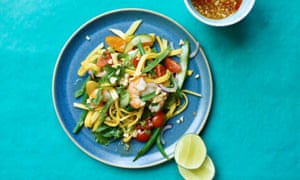
Green mango salad (som tum mamuang)
Green mango salad (som tum mamuang). Photograph: Tara Fisher for the Observer
South-east Asian cooking transforms a salad from a side dish to the main event, giving a perfect opportunity to eat more fruit, veg, healthy proteins and nuts. These textures together with the taste explosion of sweet, savoury, spicy and sour dressing mean you won’t miss unrefined, fibreless carbs.
Mangoes are also rich in a protective, soluble fibre that will slow down the digestion of the entire meal. Add chicken left over from a roast for extra thrift.
Serves 2 as a main course fine green beans a handful peanuts a handful, toasted and crushed red onion ½ (or whole shallot), finely sliced cucumber a handful, finely sliced at an angle red chilli 1, with seeds tomatoes a handful, quartered mint and coriander 1 tbsp of each, chopped, stalks included, leftover roast chicken torn strips (other good options are prawns, griddled and sliced, or chicken breast) mango 1 large, under-ripe
For the dressing (the important bit) chilli 1-2 garlic 1 large clove palm sugar 1 tbsp (you can substitute honey or normal sugar) fish sauce 2 tbsp lime 1, juiced extra-virgin olive oil
This salad is easiest to make with a Japanese mandoline, but there are other options if you don’t have one: you could use a combination of a knife and a potato peeler or a cheap julienne peeler.
The beans will need blanching in salted boiling water for around 3-4 minutes until they are tender but retain a little bite. Drain and “refresh” by cooling with cold water – it’s nice if they are warm but not hot in the salad.
Toast the unsalted peanuts in a dry non-stick pan until they have a golden colour. Roughly crush – best done by bashing in a mortar and pestle.
Slice the onion, cucumber and chilli and quarter the tomatoes. Finely chop the herbs and include the fragrant coriander stalks as well as the leaves. Add the chicken (or prawns) and incorporate all together in a large bowl with the sliced mango, green beans and crushed, toasted peanuts.
The dressing is best made in a mortar and pestle, although you can pulse the ingredients in a blender.
Add together the dry ingredients and bash into a smooth paste – the sugar helps with abrasion. Now add the wet ingredients and stir them together.
Dress the salad and allow it to sit for 2-3 minutes for the flavours to marinate. Then pile high on a large serving plate and enjoy.
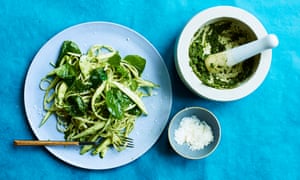
Mortar and pestle pesto pasta, courgette tagliatelle and baby spinach
Mortar And Pestle Pesto Pasta, courgette tagliatelli. Photograph: Tara Fisher for the Observer
Ready in 20 minutes. The simple, fresh flavours and textures complement each other perfectly: hot peppery notes (raw garlic and olive oil), mellow comforting richness (pasta, parmesan and pine nuts) and clean perfumed bite (basil, spinach and courgette). A mixture of pasta and courgette “tagliatelle” keeps the comfort and satisfaction of pasta but packs in more veg alongside other protective ingredients such as garlic, nuts, extra-virgin olive oil and dark green leafy spinach. With the fat from the cheese giving additional satiety, you won’t miss that extra pasta, especially if you pair with a simple sliced tomato and onion salad dressed with a little olive oil and balsamic vinegar.
Serves 2 courgettes 2, medium linguine pasta 100g (50g per person) baby spinach 2 large handfuls garlic 1 large clove basil leaves a big bunch pine nuts 2 small handfuls (dry toasted) fresh parmesan a handful, grated extra-virgin olive oil salt and black pepper
Make the courgette tagliatelle by taking long length slices of the courgette with a mandoline (largest tooth setting) or a potato peeler until you get to the soft water centre. Keep the soft cores, you can finely chop and add them as they are with the tagliatelle.
Boil the pasta in plenty of salted water. Wash the spinach, drain and place in a large bowl.
Make the pesto while the pasta is cooking. We like to make the pesto in a mortar and pestle for that chunky, fresh-made texture but you can add all the ingredients straight into a blender or food processor.
Bash a whole peeled garlic clove with a pinch of salt for extra abrasion until a paste. Add the basil leaves and do the same. Add the toasted pine nuts and parmesan. Drizzle in olive oil to loosen the mixture. Bash and stir away until you have a chunky mixture that’s loose enough to stir into your pasta.
The pasta should nearly be ready. Throw in the courgette tagliatelle for the final 2 minutes or just enough to soften but retain a slight bite.
Drain and immediately add the hot pasta into the bowl with the spinach and stir. The heat of the pasta will wilt and soften the spinach. Now add your pesto and mix thoroughly. Season with black pepper and a final fresh sprinkle of parmesan. You don’t need to add any additional salt as the cheese and other elements have enough.
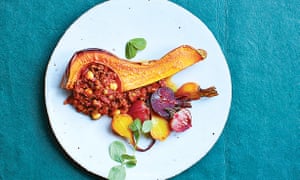
Stuffed coquina squash and sweet roasted beets
Stuffed coquina squash and sweet roasted beets. Photograph: Tara Fisher for the Observer
The soft coquina squash with chewy, candied edges, the concentrated sweetness of roasted beetroot, and the warming, meaty filling make this dish one of our favourites. The squash and legumes, being high in fibre, are the good type of carbs that prevent spikes in blood sugar and subsequent fat storage, the slow-cooked meat stretches that umami satisfaction through the filling, allowing you to use less meat and pack in more protective veg. The roasted beets, too, are rich in artery-relaxing nitrates that can lower blood pressure (it’s why athletes drink beetroot juice to improve their endurance).
Serves 4 (makes enough sauce for 8-10, freeze leftovers for another meal) minced beef 500g extra-virgin olive oil onion 1 large celery 2 sticks carrot 2 large, skin on courgette, sweet pepper, aubergine 1 each garlic 4 large cloves large chillies 2 (leave seeds in if you like it hot or add more) salt and pepper tomato puree 2 large tbsp tomatoes 2 x 400g tins bay leaves 3 ground cinnamon 1 tsp green lentils 100g chickpeas 1 tin beetroot 12 small, uncooked large coquina squash 1
Use a large heavy cast-iron casserole dish that can be placed in the oven. Preheat the oven to 160C/gas mark 3.
Over a moderate high heat brown the minced beef in a little splash of olive oil until the edges are crispy and golden brown. While the beef is cooking chop the onions, celery, carrot, and other vegetables along with the garlic and chilli – use a food processor if you have one.
Remove the browned beef with a slotted spoon and add the chopped vegetables to the pan to soften in the same oil. When the veg looks softened and the onions are translucent add back the beef.
Season the mix now with salt and black pepper. Add the tomato puree and cook out together for another 2 minutes
Now add the tinned tomatoes and equal amount of water (by rinsing out and filling the tomato tin). Add the bay leaves and bring back to simmer.
Transfer to the oven to slowly cook for 3 hours to develop a beautiful melting texture and deep umami flavours. Portion out around half to cool and freeze for an easy meal another day.
Add a teaspoon of cinnamon and the green lentils (rinsed, boiled for 10 minutes, drained) and chickpeas (rinsed and crushed to a pulse) for the final 30 minutes of cooking.
Now to the squash and beetroot. Individually wrap in foil and bake the beetroots, leaving the skin on, for an hour at 180C/gas mark 4 or until a knife passes through the flesh easily. (It’s fine to turn up the heat on the base sauce for the last hour if you’re cooking both at the same time.) Cut and deseed the squash, leaving skin on, season and drizzle with olive oil and roast for an hour or until the flesh is deep orange and the edges are darkened. The tip of a knife should pass easily through the thickest bit of the squash. When cooked and cooled, the skin of the beet will slide off easily; dress with a splash of balsamic if you like. Scoop some flesh out of the squash, mix with the filling, pile high and enjoy.
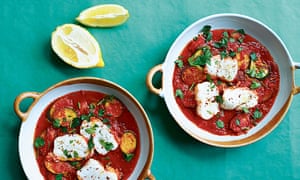
Mediterranean fisherman’s stew: leek, courgette and cod with chilli and lemon seasoning
Mediterranean Fisherman’s stew: leek, courgette and cod with chilli and lemon seasoning. Photograph: Tara Fisher for the Observer
Humble and sweet courgette and leek, a rich tomato sofrito sauce and subtle white fish highlighted with lemon, parsley and chilli. The plentiful courgettes and leeks become the base of a genuinely healthy meal. The combination of olive oil, tomato, garlic and onion forms the base of the sofrito sauce, a mainstay of Mediterranean cooking. When combined, these ingredients might have a synergistic, protective effect but, most importantly, they give that delicious flavour that transports you to the Italian Riviera. We’ve gone for cod because it’s the nation’s favourite, but experiment with your choice of oily fish.
Serves 4 courgettes 4 large leeks 2 large garlic 4 chunky cloves extra-virgin olive oil salt and black pepper tomato passata 500g dried chilli flakes cod loin skinned and filleted, three nice chunks each parsley a handful, including stalks lemon wedges
Cut the washed courgettes and leeks into rounds (approx 2cm thick). Slice the garlic.
Heat a good glug of olive oil in a non-stick pan and add the sliced veg. Season with salt and pepper.
Turn the temperature down so that the veg sweat without colouring. Make a cartouche with some greaseproof paper (YouTube it for a quick tutorial) and pop on top. This slow-cooking process accentuates the natural sweetness of the veg. Check on them in 10 minutes and add a splash of water if drying out.
After about 20 minutes when the veg have softened add the passata. Sprinkle a pinch of dry chilli. Re-cover and cook until meltingly soft (around 40 minutes).
Cut the chunky fish fillet across the length with a sharp knife into scallops. Taste the sauce – grind some extra pepper and if required add more salt. Pop the fish scallops around the dish on top of the sofrito sauce. Re-cover and cook for 10 minutes.
Finely chop the parsley and sprinkle over the dish with extra chilli and a squeeze of lemon to finish.
Enjoy scarpetta style with a sensible mop of crusty wholemeal bread, eat light with green side salad or throw in some borlotti beans and cook as a stew.
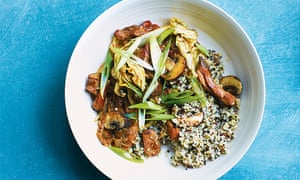
Aromatic braised chicken, hidden veg and quinoa hot pot
Aromatic braised chicken, hidden veg and quinoa hot pot. Photograph: Tara Fisher for the Observer
One pot and you’re good to go. The braised, browned and caramelised meat intensifies and spreads the meaty flavour allowing you to sneak in plenty of protective fibre and veg. Quinoa? Because it’s not that fancy any more and with its low glycaemic index it’s better than eating refined carbs.
Serves 4–6 (good to make a big batch, you’ll want the extra)
chicken 8 skinless, boneless thighs extra-virgin olive oil onions 2 large leek 1 large (or add a third onion) garlic 6 cloves ginger a thumb-sized piece chillies 4 red or green (seeds out for a milder version) tomato puree 2 large tbsp honey 1 tbsp soy sauce 6 tbsp star anise 1 chestnut mushrooms 2 handfuls Chinese leaf cabbage ½ a head quinoa 50g per person spring onions 4, chopped
Use a heavy cast-iron dish in an oven (preheated to 160C/ gas mark 3) for the best, slow-cooked meltiness. You can also just simmer on the hob.
Roughly chop the chicken into large strips and brown over a high heat with a splash of olive oil. Don’t overcrowd the pan and if necessary brown the chicken in two batches. Stir occasionally but you are aiming to get some crispy caramelised bits on the edges and bottom of the pan to add umami intensity to the dish.
Peel, half and roughly chop the onions into large strips. Do the same with the leek and wash thoroughly to get rid of any muddy bits in the layers. Add to the pan with the browned chicken and start to soften.
Peel and roughly chop the garlic and ginger together with the chillies. Leave the seeds in if you like spice or remove if you prefer perfumed warmth. Add to the pan with the tomato puree. Cook together for another couple of minutes.
Now add the honey, soy sauce, star anise and enough cold water to barely cover (around 2 glasses usually). Bring to a simmer and scrape around the bottom of the pan to dislodge any crispy bits. Place in your preheated oven to slow cook and braise for the next 2 hours.
After 2 hours remove, stir and check the hot pot. You should have a reduced, intensely umami-flavoured sauce. You want this to be strong because it will become diluted by the water in the additional veg. Now add your washed and sliced mushrooms and Chinese cabbage. Return to the oven for another hour.
Towards the end, boil the quinoa separately until the seeds open. Drain and then add straight into the hot pot and stir together. Fish out the star anise and taste for final seasoning – add a final splash of soy sauce if you like. Garnish with finely chopped spring onion for a fresh finish.
Ali Khavandi is a consultant cardiologist. alikhavandi.com; daramohammadi.com