In a time of austerity and strained budgets, it has never been more essential for the NHS to get partnerships and collaboration right. Every day, clinical teams save lives – and if the NHS is to survive and thrive, it must draw on this collective strength. Yet collaboration can be patchy among the higher echelons of the NHS, with many potential partners complaining of the health service’s seeming inability to work effectively and courteously with others.
Would the NHS be in a different place if health leaders had, over the past 20 years, facilitated collaboration in the same way they had done for competition? That was one of the questions from the floor at a seminar hosted by the Guardian and supported by business solutions and technology company Brother.
In front of an audience of invited healthcare professionals, an expert panel, chaired by the Guardian’s public services editor David Brindle, discussed and debated the gaps in healthcare provision in the UK, as well as if – and how – they could be solved by more effective partnerships. Could the health, social care and voluntary sectors work more closely together, how might this be achieved and what would it mean for patients?
Fragmentation means duplication and duplication costs money; we can’t afford that
“We too often dish out lazy cliches about different sectors and different parts of the system, whether it be the private sector describing the public sector as inefficient or the public sector [describing the private sector] as ethically questionable,” said David Hare, chief executive of NHS Partners Network, which represents independent sector providers of NHS clinical services. “For the patients, some of those divides are false. Even within the NHS we’ve had divides between primary care and secondary care, physical health and mental health. The future has to look at how to integrate and bring all that together for the service user. If you have that fragmentation, you have an element of duplication; duplication costs money and we can’t afford that in the current climate. We have to work our way through this.”
Integration, or joined-up working, has long been the buzzword of choice among professionals in both health and social care. But years of talking have brought few benefits for the social care and voluntary sectors, which continue to be the “poor relations” of the NHS, according to Grainne Siggins, policy lead at the Association of Directors of Adult Social Services (Adass) and director of adult social services for the London borough of Newham. “There are different cultures across health and care and we shouldn’t underestimate the impact of that in terms of trying to work collaboratively and as partners across a whole system,” she said. Asked if the picture was improving, she replied that it wasn’t, adding: “You’ve only got to look at the approach to sustainability and transformation plans [five-year plans for the future of health and care services in local areas] to see that equality wasn’t important in that partnership.”
There are chinks of light in the gloom, however – areas where improved collaboration is beginning to happen. Take Manchester, where powers and responsibilities for health and social care, among others, have been devolved from national government. John Patterson, a GP and clinical director of of Hope Citadel Healthcare, says people now understand that wellbeing is about a range of factors, including health, housing, friends and diet and that healthcare and social care must reflect that. “A housing officer with 30 years of experience can’t be replaced by an app,” he said. “We need to find out how to get that experience and compassion into the health system. How do we get the experience of a community matron into the social care system? The thing I love most about Manchester is that here we’re trying to do that with and through people.”
Another positive associated with “Devo Manc”, he added, is that people are brave enough to try new things. “We were one of the first organisations in the country to get double-badged workers. We had a care navigator that had a council badge and an NHS badge – somebody who would walk between worlds, find the sickest people and help them the most.”
It’s not so much an austerity issue as about doing the right thing for people
Anu Singh, director of patient and public participation at NHS England, pointed out that the challenge she faces is that people see partnerships as an accounting trick or something that is about saving money. Instead, she said, people needed to realise that traditional models of healthcare hadn’t worked and hadn’t met the needs in the community. “We’re trying to work differently with localities because we know that if we don’t get housing right – if we don’t have people helping with social isolation – this will add to the pressure on care and things will continue to spiral out of control,” she said. “It’s not so much an austerity issue as about doing the right thing for people.”
She recalled how one GP had told her that when a patient came to him in the past with mental health problems, they would prescribe prozac; now, they can help that patient get a job. She believes this example highlights how the NHS can work differently and more effectively. “As always with health, you have innovators and policy people trying to pull strings in different directions,” she said. “People know we’ve not quite got it right so far – I don’t think all the parts have come together before – but the time is now.”
This was a point that Dr Mahiben Maruthappu, a London-based doctor and social entrepreneur, agreed with. He said that the challenges were social, demographic and economic – and that the frontline and national decision-making bodies were not aligned. “I think the vision in the Five Year Forward View still stands – we need a radical upgrade in prevention, better integration of services, and to overcome fractures between primary and secondary services.”
He also explained how technology could save cash while enforcing a better quality of service by being “an enabler” of healthcare that can support doctors, nurses and patients. “We always ask how the health and care system can be more sustainable – if we allow patients to identify and manage their conditions better, that’s going to relieve a tremendous amount of pressure.”
The panellists agreed that the patient or service user must be at the centre of all decisions and Singh admitted that patients could get “pushed around clinical pathways” in the current system. “If the health service is going to be more sustainable, we need to shift that paradigm,” she said.
A question from an audience member about whether there was too much focus on external partnerships and not enough on bringing a “highly disillusioned” workforce into decisions then prompted the panel to discuss healthcare staff.
Singh said she learned the difference between how those on the frontline and policymakers think when she was trying to introduce a scheme to help clinicians empower patients: “What seemed obvious to the policymakers seemed alien to a lot of the clinicians we were talking to.” Talking initially to those involved in care, to see if they had a solution, is key, she said.
Maruthappu, a doctor himself, pointed out that clinicians work in partnership every day – in multidisciplinary teams made up of doctors, nurses, occupational therapists, physiotherapists and more. He suggested that the model be amplified and replicated higher up.
Siggins, meanwhile, highlighted the importance of getting clinicians involved in social care. Now that local authorities have taken over responsibility for commissioning a range of public health services, GPs need to be involved in conversations, she said: “It’s our job to support GPs so we can support people coming into the system.”
All panellists recognised that the current work climate is a difficult one for everyone – but will this strain drive people working in the health, social and voluntary sectors apart? Hare acknowledged the danger, but pointed out that this has only made collaboration more necessary. “We’ve got no alternative. We’re going to have to do things differently. There isn’t going to be a magic pot of money.”
Maruthappu agreed: “Healthcare is a team sport and we need to embrace that far better than we do at the moment.”
At the table
David Brindle (chair), public services editor, the Guardian
Dr Mahiben Maruthappu, co-founder, NHS Innovation Accelerator
Anu Singh, director of patient and public voice and insight, NHS England
David Hare, chief executive, NHS Partners Network
Grainne Siggins, policy lead, Adass, and director of adult social services, London borough of Newham
Dr John Patterson, co-founder, Focused Care scheme
Nearly 33 million Americans – more than 10% of the country’s population – have no health insurance. While the very poorest are entitled to Medicaid coverage, millions more narrowly fail to qualify, but remain too poor to pay for private health insurance. Among those who do qualify for subsidised plans or manage to pay insurance contributions, paying for minor treatments such as fillings and eye tests is often a problem, as they may not be covered by basic healthcare plans. Even finding local doctors who accept Medicaid can be so challenging that it can seem easier just to work through the pain or to self-medicate.
Virginia is one of 19 states refusing federal dollars to close the healthcare “coverage gap” for people not poor enough for Medicaid, but too poor for anything else. Yet at the Wise County Fairgrounds in Southwest Virginia, for one late-July weekend each year, there is a small glimmer of hope. For three days, a non-profit organisation known as Remote Area Medical (RAM) builds a pop-up clinic – the largest of its kind in the US – from the ground up, and serves more than 2,000 patients from more than 15 different states. These patients come in the hope of getting cavities filled, lungs x-rayed and new pairs of glasses made – for free.
RAM was founded in 1985 by Stan Brock, a British philanthropist, actor, author, naturalist, cowboy and former TV host. The organisation is funded entirely via private donations and – except for a small, paid staff – completely dependent upon thousands of volunteers for everything from performing oral surgery to making up bags of Cheerios to hand out to patients’ toddlers. In addition to international and disaster-relief missions, the group has held more than 800 general health-clinic events across 12 states throughout the southern and south-western United States. In the past five or six years, it has added urban stops such as Los Angeles and Chicago to its regular locations.
As I pull up to the Wise County Fairgrounds clinic this summer, dozens of rows of cars glint in the sun – patients’ vehicles in one field, volunteers’ in another. Those seeking care are given entry numbers based on the order in which they arrive, and cannot leave without forfeiting their place. Many make plans to camp out for up to two days before the gates even open – sleeping in their cars, in tents, or on the ground, to make sure they snag a low number.
By 3.30am on Friday,volunteers with torches are moving from car to tent to car in the patient lot, handing out admission numbers for the day. By the time the sun rises at 6am, they have given out 1,600 tickets to the clinic. On Saturday morning, they will give out about 600 more.
I meet Sheila Harris, a 58-year-old former paralegal, in the early hours of the opening day. Sheila has worked her whole life, but after the birth of the last two of her six children, steady legal work dried up, and she now earns only a small income taking care of children in her home. She is one of the first hundred people allowed through the gates. Hundreds more are packed outside the fairgrounds’ fences, waiting to hear their numbers announced via megaphone.
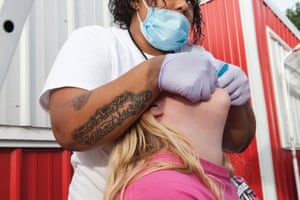
A woman receives dental care at the Wise County RAM clinic. Photograph: Dawn Whitmore
Sheila, her daughter Amy, her sister Cindy, Cindy’s daughter Elizabeth, and four other family members have travelled for three hours to arrive at Wise two days early. These eight adults and one toddler would end up sleeping in their two cars for four days. During the first couple of nights, they would drape blankets over the windows for privacy, but would take them down after it made the cars too hot to sit in, much less sleep.
It is everyone’s first time at the clinic, except for Cindy, who has been twice before and led the group on this trip. Once, she says, she arrived early enough to be the very first patient served. “It was still a long couple days, though,” she says.
Cindy is here this year to get new glasses and to support her 29-year-old daughter Elizabeth, who also needs glasses, as well as the extraction of two molars. Elizabeth also hopes to get a partial denture plate. She had a bad fall a couple of years ago and broke her top front teeth, most of which have been completely missing for years. At the time of her fall, she had decent health insurance, but still had to pay $ 1,000 from her own pocket, to rebuild just one tooth, which later cracked again anyway. Cindy and Elizabeth now both receive disability benefits – essentially their only source of income. Without RAM, a new pair of glasses with a current prescription would be a luxury item.
Sheila needs glasses, too, but is first set to have six teeth removed – a couple of which are already in pieces – and upper dentures made and fitted. Neither Sheila nor Elizabeth will smile open-mouthed. They haven’t smiled that way for years, out of embarrassment. “I guess I’ve kind of withdrawn from people because of it,” Sheila says. “I used to talk to anyone, anywhere, about anything – real outgoing – but I haven’t been like that in a long time.”
Sheila pulls a roll of Tums antacid tablets from her shorts pocket and says it’s the only thing she’s been able to eat since the day before, on account of her nerves. She’s brought the broken dental crown with her “in case they can use it or something”, and holds it tightly.
It is cool outside before sunrise,but the temperature will reach a humid 35C by late morning, and get even hotter by Saturday. The site has no air-conditioned spaces, apart from the mammogram and radiology trucks. Volunteers drive back and forth across the grounds all day, handing out cold water and chilled neck wraps.
Though traffic through the medical stations is steady, the main attractions of every RAM clinic are the dental and eye-care services. At the Wise County Fairgrounds, the organisation sets up about 80 mobile dental stations under large tents – one section of tents reserved for cleanings by hygienists, a second block for fillings, and, in the back tent, four or five long rows of stations for extractions. The vision and medical services are each delivered in two large barns. The makeshift examination rooms are livestock stalls, with bedsheets hung for privacy.
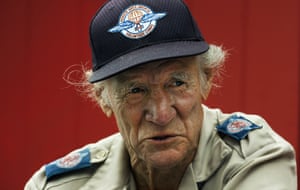
Stan Brock. founder of the RAM clinic, watching the operation in Wise County. Photograph: Paul J. Richards/AFP/Getty Images
The full Wise County clinic footprint is immense: one general-support volunteer working as a patient escort could easily walk 15 miles or more in a day. Specialised services such as x-rays, mammograms, and orthopaedics are provided in converted lorries or large camper vans. Other tents, offering treatment for substance abuse, counselling to help smokers quit, and mental healthcare, as well as clothing and book donations and a pharmacy, are scattered wide across the grounds. The only bathrooms – for patients and volunteers – are several dozen portaloos.
Other such RAM clinics may be smaller, but they operate under similar conditions. One in Smyth County, Virginia, is set up on the asphalt and in the emptied hangars of the local airport. Services there must shut down at a particular time so that planes can be moved back inside. One Tennessee clinic is held right on the Bristol Motor Speedway infield, a famous Nascar racing track; Stan Brock can often be seen on the track on his bicycle, vigorously pedalling angled laps.
“Poor teeth, I knew, beget not just shamebut more poorness,” writes Sarah Smarsh in her 2014 Aeon essay on class and dental hygiene. One woman sitting near Sheila and her family in Extraction Row says she has recently been fired from a waitressing job after losing a couple of her front teeth. Her manager didn’t want her in front of customers. Food service has made up the entirety of her employment history, and she is having trouble getting hired permanently elsewhere for similar reasons. Even when she was working, she says, she couldn’t afford the cost or time off necessary to treat her teeth – or anything else, for that matter. The RAM clinic, once a year, is her sole source of healthcare. She now works as a temp in one of the many call centres planted in Southwest Virginia.
Dr Joe Smiddy, one of the long-time volunteer doctors on site, has seen similar scenarios play out for patients here, time and again: “Once they lose their teeth, or they have unsightly teeth, they lose part of their own marketability. They have trouble finding a job,” he says. “Course, when they lose their job, they lose any healthcare they might have had. And then you can have substance issues where people are self‑medicating with tobacco and street drugs for what is real pain and real anxiety.”
Poverty also begets limited choices. Sugar provides a cheap and legal high and caffeine does the same. Both can be used to self-medicate and as an easy way to make your kids happy when you can’t afford much else.
Nearly 100,000 people in Southwest Virginia receive Supplemental Nutrition Assistance Program benefits (formerly known as “food stamps”). A family of four receives $ 115 per week on average for food, or just about $ 16 per day. “The economics of this community,” says Terry Dickinson, executive director of the Virginia Dental Association, “are such that when they go to the grocery store and buy food, it so happens they get a lot more food when they buy highly processed, high-carbohydrate foods, and, instead of water, they pick soda pop or sports drinks, or any of that stuff that’s just as cheap.”
Unhealthy processed foods are not just cheaper: they do not spoil as quickly, and they can take less time and fewer ingredients to prepare. “What you want for everyone is personal responsibility,” says Dickinson, “but you’ve got to give people the education and tools they need to make those decisions.” And, he says, for people living in poverty, “we just haven’t done a good job of that. These are people in survival mode.”
Living in survival mode means prioritising where you spend your limited income. A 2015 survey conducted by the Federal Reserve Board to determine what practical effects, if any, the economic recovery was having on families, found that 46% of Americans did not have enough money on hand to cover an unexpected $ 400 expense. When that expense is a medical emergency, it often leaves only two options: use a credit card if you have one, or forgo care until the pain goes well past emergency and becomes unbearable.
Putting stock in a long-term investment such as one’s health requires hope. Embedded in preventative and rehabilitative care is the presumption of a long, fulfilling life. Health insurance is an invisible protection – it does not fill a hungry stomach, or power a refrigerator, or fill a petrol tank.
Sheila is in Dr Dan Laskin’s dental chair and is about to have her extractions done. There are picks, forceps, syringes and what looks like a hammer and small chisel on the tray beside her. Even when you’re having six teeth pulled, if your dental care is happening under a tent at a fairground, you are given some numbing lidocaine, a few large, well-placed shots of novocaine, and not much more of an anaesthetic cushion than that.
The procedure is probably as smooth as it could be, though Sheila often moans and wriggles from the pressure. The dental assistant gets her to close her eyes and talks her through some visualisation strategies involving her favourite place: the beach. It takes about 30 to 45 minutes before the procedure is finished, and the experts are ready for whoever is next in line. Numbed and frazzled, Sheila says to Laskin through the packed gauze, “You are freaking amazing!” and hugs him.
Elizabeth has already had her two extractions done, and is now at the dentures station, where another dentist has inserted a tray of paste into her mouth that will become the mould used to make her partial plate. The dentist has to keep the tray pressed tight against Elizabeth’s swollen, sore jaw for about a minute. Afterwards, she says she didn’t mind it too much: “It was easier than getting my teeth yanked out!” She heads over to the vision section to get in the long line for glasses.
Observing the makeshift clinic, it sometimes feels more like a carnival than a hospital. Occasionally, in between seeing patients, you can catch Joe Smiddy picking a banjo in the clinic bluegrass band he has pulled together with a few regular volunteers. Smiddy is a 74-year-old retired pulmonary specialist, now a full-time medical volunteer, who grew up in Wise County, the grandson of a coal miner. He got his commercial driver’s licence in order to drive the 18-wheeler that holds his mobile x-ray office to RAM clinics. Smiddy has seen it all: most of what he has to share with me begins with “And I can say this because I’m from here.”
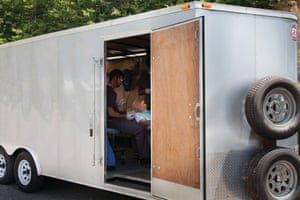
Many of the facilities at RAM clinics are housed in specially adapted trailers, lorries and vans. Photograph: Dawn Whitmore
“The people of Southwest Virginia,” he advises me, “are self-reliant, and their self-reliance and their love for their people and their land is such a wonderful thing, but it’s also what holds them here. There’s a social importance to people who are from here being really glued here. So why would we move to another part of Virginia? Why wouldn’t we move to where the jobs are? But we’re totally averse to doing that, and so we have a large population who live in an economically deprived area. The schools are struggling. The churches are struggling. Every time they build a Walmart, it puts several mom-and-pop stores out of business. Your barbershop’s gone because you get your hair cut at Walmart, your beauty salon, your auto-repair – everything Walmart. And then you’ve got people working at Walmart who don’t have health insurance, either.”
People not in poverty often ask those who are to move in various ways – off street corners when they’re homeless, away from their depressed hometowns when they’re unemployed. They are asked to move couches, off front porches and cars, off blocks.Politically, they are usually asked to move out of their own way.
All of the qualities that Smiddy describes, though, are what most people would probably say they want in a healthy community. We want people to love and care about their land and neighbourhoods and to know one another. We want a shared history, vibrant cooperation. These are all characteristics we celebrate, it seems, everywhere but communities of poverty. In places like Southwest Virginia, we do not honour these relationships, or underwrite them – socially or financially – in the same way we do in middle-class or affluent regions. Instead, what we reinforce, as a matter of policy and entertainment, are the rural stereotypes.
In his mobile rig, Smiddy will x-ray “just about anything you can put in front of the machine”. He mostly looks at lungs, though. “We’re a belt of lung disease,” he says. “Southwest Virginia is a belt of asthma, COPD [chronic obstructive pulmonary disease], emphysema, and, of course, heart attacks, strokes, and diabetes. Part of that is smoking – we in Southwest Virginia have a tradition of starting smoking at an early age. There are towns where the average age of starting smoking for current lung patients was age 10.”
But part of it, he says, is the coal dust and environmental allergens. When business was booming, coal workers were paid well and offered decent health insurance, but layoffs and closures have left many in the region with poor health, and poorer prospects for work and the healthcare coverage that used to come with it.
“All of the politicians are singing this little fairytale that coal is coming back,” Smiddy says. “They’re living in that fairytale, and so what they’re not doing is accepting the reality that we could plan, we could think ahead. We could reach broadly to incorporate everybody – schools, churches, civic organisations, mayors, community leaders – that we all pull back together and say, ‘We have a goal, and our goal is that we’re going to try to predict as best as we can the jobs of the future, and we’re going to start now.’ I don’t mean to be ugly when I say that there may be some people who will miss that curve, but we could build for their children.”
Coal is complicated in Appalachia, the mountainous region within which Southwest Virginia sits. The coal industry has torn up pieces of Southwest Virginia and the bodies of those who have mined it, but as it has declined here, the men and women it employed – many of whom have at most graduated high-school – have slipped from relying on steady middle- and upper-income salaries to prospecting for minimum wage. The classified ads in places such as Wise and Coeburn, Virginia, are thin and advertise for such positions as “Customer Service Representative 1” and “Cashier (Part Time)”. We may be able to replace coal with other comparable energy sources, but we have not yet prioritised how to comparably replace coal jobs.
“I mean, how many call centres can you put down here?” Dickinson says. All people want here, he repeats, is a good-paying job.
By Saturday, all eight of Sheila Harris’s family have spent four days and three nights living in two cars. They have had to stay this long to wait for their glasses and partial dentures to be finished.
Cindy and Amy walk over to a large tent where a few thousand brand-new frames – all donated – are set out on long folding tables so that patients can select the styles they like. A few regular volunteers consult on shape and fit.
The barn where the sight tests are given is a touch cooler than outside, mostly because the room has to be kept dark for the testing. The majority of patients here are getting basic checkups and prescriptions written or updated, but occasionally – as with the dentists – the optometrists diagnose more serious health issues: glaucoma, cataracts, macular degeneration, diabetes. Prior to their eye tests, some patients don’t even realise they need glasses.
Dr Victoria Molnar Weiss is the optometrist who runs all the Virginia RAM vision clinics. Weiss and the other eight or nine volunteer optometrists and ophthalmologists will see one third of the 2,200 patients coming through the Wise clinic over the weekend. She explains that the possibility of getting new glasses can be the lure that first brings patients to the clinics, and then, over time, their trust grows. “The patients see us up at 3am too, so it kind of helps them feel like we’re all in this together,” she says.
What also helps is the ability to use the money they might otherwise have spent on frames, lenses, and an eye test on other necessities. People living in poverty are often playing a losing game with whatever limited income they have: skipping a power bill to pay for a visit to the optician might work for a month, but it could put them behind for a year. Much easier to keep using old lenses, squint a little harder, and live through the migraines.
Elizabeth’s partial plate is finally ready. The dental technician is fitting it for her, taking it in and out of her mouth in between filing her teeth down to eventually arrive at the best fit. After a few revisions, they are both satisfied. The technician does not have a mirror, but holds up her iPhone with a forward-facing camera so Elizabeth can see herself. She has front teeth for the first time in years. She smiles and tries not to at the same time. She is now crying. Her mother, Cindy, is crying. The dental technician and I are both crying as we watch mother and daughter cry and hug each other. Elizabeth even hugs me. “It doesn’t feel normal to smile. It feels weird,” she says.
By Saturday evening, the whole family has got just about everything they came for: glasses, extractions, dentures, and even a few bags of clothes and shoes from the donations tent. They are nearly packed up when Sheila discovers her van will not start. She seems much less worried than I would be. This has happened multiple times before – she knows how to fix it herself, she says. She crawls underneath the van and reattaches a loose wire, and when she tries it, the engine turns over.
Late on Sunday morning, I catch up with Sister Bernie Kenny of the Medical Missionaries of Mary just as the clinic is closing down. Sister Bernie is a nurse-practitioner who first persuaded Stan Brock to bring RAM to Virginia back in 1999. “Today we had a young woman, 27 years old, who had all her teeth out,” she says straight away, before I can say a word past “Hello”. “And her hope for dentures is 2018. How can she live? How can her self-esteem, or her nutrition, or her hope of ever getting a job? It saddens me. But the wonder of being here is all these volunteers with one purpose: to help one another. All denominations, all faiths, all colours, everybody together, and we get energy one from another.”
Clients wait their turn to see dentists and medics. Photograph: Dawn Whitmore
I ask her what she would do if I gave her a magic wand that she could wave and change one thing for the patients here at RAM. She gives a version of the same answer that all the nurses and doctors and most of the patients give when I ask them: “Everybody has the right to healthcare – it’s not a privilege,” she says. “Your neighbour’s health affects you, so you want the best for your neighbour as well as yourself.”
Sister Bernie, like all the nurses and doctors and patients, says that dental and vision coverage need to be included in basic healthcare policies. Consider this: someone living in poverty with no health insurance gets a toothache, but swallows the pain for months. She finally goes to ER when it gets too bad to eat, sleep, or work. She sees a nurse or a doctor, but not a dentist, so the actual cause of the pain stays untreated. The ER doctor gives her some antibiotics and maybe some prescription pain medications. She uses up the prescription and then maybe looks for something cheaper on the street to dull the pain, because the tooth is never fixed. No one I speak to mentions heroin or methamphetamine by name – it’s always just “street drugs”. In the meantime, the abscessed tooth could go septic and turn just as deadly as an overdose.
Sister Bernie sees this repeatedly, across generations of families. “But the people who come to RAM want to be healthy,” she says. “A lot of them don’t take vacations, or can’t. They come here.” One patient I met started off from her house two days before the clinic opened. She had walked 27 miles to Wise just to have a couple teeth pulled. Then walked 27 miles back.
Access to healthcare is about more than just reducing the travel time between patients and doctors – it’s about bringing down those intangible barriers that make a distance seem impossible to cross. The stereotypes that teach that people living in poverty get what they deserve, the employment barriers that leave medical and dental students with a mortgage worth of school debt, such that they cannot afford to treat people who cannot afford to come to them for care. RAM does not solve and will not solve the US healthcare crisis – or poverty, for that matter – but it clears a path. One that starts right in our own backyards.
This article is adapted from an essay published in the autumn 2016 issue of the Virginia Quarterly Review.
• Follow the Long Read on Twitter at @gdnlongread, or sign up to the long read weekly email here.
People living in affluent areas of England are just as likely to end up in hospital because of inadequate healthcare as those living in impoverished areas, statistics have shown.
Data compiled by the University of York for NHS England revealed that the wealth or poverty of an area makes little difference to how well the local NHS treats its patients.
Liverpool clinical commissioning group, which appears on the worst performers list, and Tower Hamlets and Portsmouth CCGs, which appear on the best performers list, each serve some of the most deprived neighbourhoods in the country.
At the wealthy end of the scale, South Cheshire performs badly on inequalities, while East Surrey CCG performs well, appearing in the top 10.
Prof Richard Cookson, of the Centre for Health Economics (CHE) at York, led the team that helped devise the indicators for NHS England. “For the first time, you can now find out how fair your local NHS is, compared with similar local areas, in terms of tackling health inequalities between rich and poor,” he said.
“It’s not simply that Brexit-voting deprived areas do badly, and posh southern suburbs do well. Some deprived areas do well at tackling local health inequalities – such as Tower Hamlets, Stoke-on-Trent, Portsmouth – and some affluent areas do badly – such as South Cheshire and Windsor.” The information is available on a CCG website.
The indicators show how well a CCG is doing in reducing the inequalities that exist between the rich and poor in an area. Although poorer people are likely to have worse health than richer ones, local NHS efforts can reduce this.
The indicators measure the proportion of people from rich and poor backgrounds who have long-term conditions, from dementia to diabetes and heart disease, which are not properly managed at the GP level or in out-patient departments. These are people who end up being admitted to hospital as an emergency because their condition has unnecessarily worsened.
“These emergency admissions are not just a barometer of wider social ills, but also an indicator of how well the NHS is succeeding in delivering out-of-hospital services to deprived patients with complex long-term conditions,” Cookson said. “This is important for NHS managers to know, because social inequalities in potentially avoidable emergency hospitalisation impose large and rising costs on the NHS, as well as raising important concerns about social justice.”
The work was funded by the National Institute of Health Research. Between April 2015 and April 2016, the York team found there were 264,000 preventable hospital admissions in England associated with socioeconomic inequality.
The best performing CCG was City and Hackney in London, followed by Fareham and Gosport, East Surrey, Crawley and the Isle of Wight. Tower Hamlets in London was seventh.
The worst performer was Central Manchester. North Manchester and South Manchester CCGs were also in the bottom five, as were Blackburn,Darwen and Islington.
Miqdad Asaria, the CHE’s lead analyst, said: “There is a social gradient in preventable emergencies meaning everyone, not just the poorest, is affected. The further down the gradient a person is, the greater the chances of suffering a preventable emergency hospitalisation.
“The NHS can now start producing our equity indicators on an up-to-date, annual basis to help improve the coordination of care and reduce preventable hospitalisation and mortality arising from social inequality.”
Ruth Passman, the deputy director for equality and heath inequalities for NHS England, said being able to compare the performance of the NHS around the country on the issue was of major importance.
“For the first time, NHS managers can now find out how well their local CCG area is doing in tackling these inequalities, compared with similar CCG areas, and see how these inequalities are responding to local healthcare initiatives,” she said. “This will help NHS managers learn about the best ways of reducing costly health emergencies associated with social deprivation.”
Islington CCG, which was the fifth most deprived borough in London, said: “There are areas of great and increasing affluence next door to neighbourhoods experiencing some of the most significant deprivation in the capital.”
It said it was working to improve the diagnosis and management of long-term conditions, keeping people in or close to their homes, and had set up programmes to identify people with complex needs who were at risk of ending up in A&E. It had made “significant and sustained progress on reducing inequalities in cardiovascular disease in recent years”, it said in a statement.
A statement from Manchester’s CCGs said: “Manchester has a lot of high-intensity pockets of deprivation. Other ‘norm’ areas, for example Trafford, will have extremes, ie, areas of affluence against areas of deprivation, which is normally shown in findings like this. “The NHS results are not performance indicators – and the rankings are based on values. Manchester CCGs see that the tool is useful in highlighting inequality and will see it as an indicator of variables of the current picture – and will continue with their work, especially via the neighbourhood teams, to reduce health inequalities across Manchester.”
Even before excess fat was a feminist concern, society was seared by culinary divides on class lines – and the query of who could afford what substances was only ever element of the story. “A millionaire”, Orwell wrote in the 1930s, “may enjoy breakfasting on Ryvita biscuits and orange juice an unemployed guy doesn’t.” Wholesome living has usually been connected to self-confidence and status. At the top of the scale, there is ample scope to cultivate the virtue of deferring gratification at the bottom, there is a pressing require for low-cost palliatives for challenging lives lived, in Jarvis Cocker’s line, “with no that means or control”. Epidemiologists observe the consequences all over the place, from the class gradient in the data on who continues to smoke, to the tendency of the greater-off to do much more shopping in the fruit and veg aisle.
The spread of fitness across society used to be less skewed than the distribution of super-food items. Heaving, hauling and even standing had been, right after all, characteristics of manual and not desk-bound trades. And from the college playground on, the functioning class could compete on degree terms, as they could in few places, in sports activities this kind of as football: they dominated them as a result. Much more lately there have been depressing signs of physical exercise going the same way as smoking cessation and raw-meals diets. Exercising is becoming an echelon situation.
In 2010, Sir Michael Marmot’s evaluation for the government pointed to academic evidence that the less-educated and, specially, the workless exercised less adequately, and new information from diverse sources factors to a hardening of class lines. On the standard – and most medically critical – query of acquiring moving at least when a week, Sport England’s Active People Survey has now been working for a decade, and it registers a statistically substantial rise for the higher occupational grades above this time, and a substantial fall at the bottom end of the scale.
Even among these who are resolved to maintain match, new schisms are opening up. The fitness center industry is following the bifurcating trends of the supermarket sector. Cardlytics examination of bank accounts suggests that subs paid to the exercising equivalents of cut-price tag retailers Aldi and Lidl are increasing notably quick, with month-to-month investing up 66% in the previous year. Meanwhile, earlier in the British summertime, Fitness Very first announced that it could quickly bring the invitation-only, “gated” gyms for executives that it is creating in Singapore penthouses to London. In parallel, men and women with income to commit get pleasure from a burgeoning range of choices to attain the all-important spur to get themselves a lot more energetic – from a Fitbit on the wrist, to a former sergeant major yelling in the ear, courtesy of the boom in military-design fitness courses.
So how to tackle the physical exercise gap? 1st, stay away from the sort of vehicle-over-pedestrian preparing that ends up with America’s Centers for Condition Management obtaining to advocate “mall walking” as an affordable way to maintain fit. Second, get behind initiatives that can motivate the demotivated with no requiring them to shell out – the NHS’s Couch to 5K podcasts, and the Parkrun motion becoming two exceptional examples. Third and lastly, give some imagined to the great gulf in living situations itself. Until life gets more secure and much less penurious for Britain’s poor, edicts to start exercising will carry on to carry the dry taste of Ryvita biscuits.
‘Because there are wealthy folks in Cheshire and poor people in Kent does not mean there is no measurable variation among people in related situations.’ Photograph: Don McPhee/theguardian.com
Odd to see Owen Jones (The north-south divide is a myth and a distraction, five Might) following Tony Blair in dismissing the actuality of the north-south divide.
Due to the fact there are wealthy folks in Cheshire and poor people in Kent does not indicate there is no measurable distinction among individuals in comparable situations. The 1980 Black report on inequalities in wellness (which the Conservative government tried to bury) showed that the mortality and morbidity charges for folks in the same class and occupation have been much better for individuals in London and the south-east than in other areas.
More than 90% of non-university scientific investigation is spent in the so-named golden triangle among London, Cambridge and Oxford. The government spends twice as a lot on capital and revenue expenditure on transport in London in contrast with Greater Manchester and Merseyside or certainly any of our key regional centres. Astonishingly, 94% of capital expenditure on transport is spent on London. This is unjustifiable and unfair.
I have no disagreement with Owen Jones that electrical power and wealth resides in as well handful of hands and that this is our best issue, but this does not imply we need to pretend that other inequities do not exist. He and John Denham are mistaken attempting to bury this problem, and I and other folks will make confident it stays alive. Graham Stringer MP Labour, Blackley and Broughton
• The north-south disparity is undoubtedly not a myth. Appear at regional per-head figures for the government’s capital projects spending, and for arts paying. But calling it a divide perpetuates the erroneous notion that it could be bridged by some link such as HS2. For the north, HS2 will be a substantial waste of funds. Northern railways, and the north in common, definitely need to have £50bn of investment – but not on a single line that will just make it less difficult to run almost everything everywhere from London headquarters. Brian Hatton London
• While pleased to see you give front-page area (three May) to Britain’s poor functionality in stopping deaths amid children underneath five, and that inequality was mentioned in passing, we had been disappointed that both the report and the accompanying examination focused on poverty and deprivation as explanations. As lengthy in the past as 1992, study showed that even for households in the extremely leading social class, babies had been more probably to die in infancy in England and Wales than in far more equal Sweden. Individuals deaths have little to do with poverty, deprivation or access to medical care.
Inequality damages health across the social spectrum because of its psychosocial influence. The lately published little one mortality figures are drastically correlated with income inequality in wealthy, developed nations.
Investigation continues to demonstrate that in a far more unequal society we are all, even at the best of the social ladder, affected by higher ranges of stress and status anxiety. We must steer clear of conflating the results of materials poverty with individuals of inequality – the two are undesirable for population health but they need different answers. Kate Pickett Professor of epidemiology, University of York Nigel Simpson Senior lecturer in obstetrics and gynaecology, University of Leeds Richard Wilkinson Emeritus professor of social epidemiology, University of York