boom etiketine sahip kayıtlar gösteriliyor. Tüm kayıtları göster

16 Mayıs 2017 Salı

Cybersecurity stocks boom in wake of ransomware attack

The ransomware attack that disrupted the NHS and businesses around the world has led to a boom in share prices of cybersecurity companies – including the firm used by the health service to protect it against hackers.


With governments and companies expected to increase spending on IT security after being caught out by the attack, cybersecurity firms have seen their stock market values climb sharply over the past two days.


Sophos, a cloud network security specialist which counts the NHS among its clients, has seen its shares jump 8%. Over the weekend, a claim on the company’s website that “the NHS is totally protected with Sophos” was changed to “Sophos understands the security needs of the NHS”. Last week, Sophos tweeted its “top five tips for securing NHS organisations”. But its shares have been performing well over recent months because of the increased need for cyber defences.


Meanwhile, NCC group added 5% to its share valuation and cyber consultancy group ECSC surged 42%. ISE, a fund invested in cybersecurity businesses, added nearly 4%.


The surge has been put down to the attacks refocusing businesses on the need for adequate cybersecurity. “Significant increases in public sector cyber defence spending [are] now looking inevitable,” said Nicholas Hyett, equity analyst at Hargreaves Lansdown. “[Sophos] already provides services to the healthcare industry and will be looking to increase selling to the sector in the aftermath of the attack.”


US firms have also benefited, with FireEye’s prices rising 7%, Symantec up more than 3% and Palo Alto Networks 2.7% better. Neil Campling, head of technology research at financial services firm Northern Trust, told Reuters: “These attacks help focus the minds of chief technology officers across corporations to make sure security protocols are up to date, and you often see bookings growth at cybersecurity companies as a result.”


It was also suggested that the success of the WannaCry hack could make other attacks more likely in the future amid doubts over governments’ ability to secure “cyberweapons” from theft.


“The attacks raise significant questions about whether or not countries that are developing and stockpiling cyberweapons can do more to protect those tools from being stolen and turned against their own population,” said Thomas Fitzgerald, associate fund manager at EdenTree Investment Management. “The WannaCry attack is likely to be a catalyst for more of these types of cyber-attacks from copycat criminal organisations.”


The effects of the attack continued to be felt on Tuesday, although one of the seven NHS trusts which had still been experiencing serious problems on Monday, James Paget university hospitals trust in Norfolk, said that all of its operations and appointments were going ahead as scheduled.


Elsewhere the disruption continued. East and North Hertfordshire trust advised people to only go to A&E if absolutely essential.


Southport and Ormskirk hospital said it was continuing to experience difficulties with its clinical information systems but insisted that patient safety was being maintained. It advised all patients scheduled for surgery on Tuesday not to attend unless contacted and said all outpatients and endoscopy appointments were cancelled.


Barts health NHS trust said it was no longer diverting ambulances from its hospitals but was still experiencing delays and disruption. York teaching hospital NHS trust said bone scans at Scarborough hospital were not going ahead on Tuesday and that breast screening clinics in some areas had been cancelled. A number of affected trusts asked patients not to contact them by email because of ongoing IT problems.


NHS Digital said none of its services had been affected by the attack.


Cybersecurity stocks boom in wake of ransomware attack

3 Mart 2017 Cuma

UK"s appetite for gourmet takeaway fuels restaurant delivery boom

“You don’t need a silver fork to eat good food,” the late celebrity chef Paul Prudhomme once said. But these days, you don’t even need to leave the comfort of your living room, as more and more restaurants offer take-out options to cash in on the growing market for fine dining at home.


The demand for home deliveries of ready-to-eat food grew 10 times faster than for dining out last year, according to figures released on Thursday, and food delivery apps specialising in restaurant-quality meals have seen a huge jump in popularity.


According to analysts NPD Group, the delivery sector rose almost 10% to 599m visits in the UK last year, while total visits to restaurants and other dining venues rose by just 1%. The delivery channel was worth £3.6bn last year, a 6% increase on 2015 and 50% more than in 2008.


NPD noted that even pubs were part of the home-delivery revolution by partnering with brands such as Deliveroo, Just Eat, Hungry House and UberEats. While British pubs only accounted for 4% of the delivery market, they increased their delivery visits by 59% over the previous year.


Deliveroo, which was founded by William Shu and Greg Orlowski in 2013 and now operates in 120 cities in 12 countries, said its orders grew by 650% in 2016. This included 20% more lunch orders, 20% more deliveries on a Monday, 10% more deliveries on Monday to Wednesday, and a 34% increase in people ordering healthy dishes, suggesting restaurant-style deliveries were seen less and less as an indulgent weekend treat.


The company is partnering with new restaurants every week and employs more than 1,000 people. Popular chains that have joined Deliveroo in the last 12 months include Five Guys, Cafe Rouge, Franco Manca, Ottolenghi, Farmacy, Sticks’n’Sushi and Pizza Pilgrims.


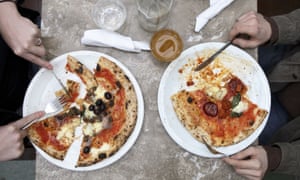
Restaurant chains such as Franco Manca are taking advantage of the surge in demand for food delivery.


Restaurant chains such as Franco Manca are taking advantage of the surge in demand for food delivery. Photograph: Michelle Grant/Rex/Shutterstock

The latter’s management say they joined Deliveroo to try new technology and make customers happier. “For some people pizza is the ultimate takeaway, while others see it as a casual dining out option, so working with Deliveroo just allowed us to please as many people as possible,” said Michael Dench, the chain’s operations director.


One restaurant group, London rotisserie Clockjack, opened a delivery-only kitchen last year to cater solely for Deliveroo orders.


The NPD study found the average bill for delivered food was just £1 lower than for a meal eaten on the premises. However, the difference was bigger for some operators such as local Indian, Thai, Chinese, Japanese, Greek, Italian or Mexican restaurants at £12 for a meal on the premises versus £6.90 for delivery.


Cyril Lavenant, NPD’s UK food service director, said: “Ordering ready-to-eat food for delivery via an app or by phone is growing so fast that eating in is becoming the new eating out. It goes beyond getting delivery of conventional takeaway food because full-service restaurants are offering delivery too.”


A spokesman for Deliveroo said it was not replacing the dine-in experience, rather complementing it by bringing a new breadth of choice to the delivery market. “We work with thousands of restaurants that traditionally did not offer food delivery, creating £200m in added revenue for the restaurant industry in 2016,” he said.


But it’s not all good news. Cancer Research UK has warned of the risks of weight gain and obesity linked to the consumption of fast food and ready meals, which tend to have a high calorie content and higher levels of fat and sugar.


Figures released on Friday by the charity show that at least 79m ready meals and 22m fast-food and takeaway meals are eaten weekly by adults in the UK. Young adults aged 18-24 are more likely to rely on convenience meals, and are seven times more likely to indulge in fast food and takeaways at least once a week compared with the over-65s.


Alison Cox, Cancer Research UK’s director of prevention, said the figures showed that “grab and go” foods and a growing appetite for takeaways and ready meals were helping to propel people towards an epidemic of larger waistlines.


“The whole food industry needs to step up and commit to working with government to cut the amount of fat and sugar in our food. This would make it that bit easier for all of us to become healthier and reduce our cancer risks,” she said.


UK"s appetite for gourmet takeaway fuels restaurant delivery boom

30 Mayıs 2014 Cuma

Iran"s baby boom decree prompts fears for women"s rights

MDG : An Iranian girl stands among a group of women

Iran’s infant boom purchase replaces the ‘fewer youngsters, much better life’ motto adopted in the 1980s. Photograph: Behrouz Mehri/AFP/Getty Photographs


Iran’s supreme leader has known as for a population enhance in an edict likely to restrict accessibility to contraception that critics fear could harm women’s rights and public health.


In his 14-stage decree, Ayatollah Ali Khamenei mentioned increasing Iran’s 76 million-robust population would strengthen national identity and counter undesirable elements of western lifestyles. “Provided the significance of population size in sovereign may and economic progress … firm, rapid and efficient measures must be taken to offset the steep fall in birth charge of current years,” he wrote on his website.


Khamenei’s buy, which need to be utilized by all three branches of government, replaces the “fewer children, greater daily life” motto adopted in the late 1980s when contraception was manufactured extensively offered.


Since then the birth charge has fallen from three.2% in 1986 to one.2%, in accordance to the CIA Planet Factbook. At recent fertility prices, Iran’s median age is expected to boost from 28 in 2013 to forty by 2030, according to UN data.


But several Iranians are concerned about policy shifts to enhance the population, one thing proposed for years by conservatives, including the former president Mahmoud Ahmadinejad, who favoured practically doubling the population to 120 million, encouraging girls to remain house and dedicate their time to youngster-rearing.


Reformist Iranians worry the fertility campaign could undermine the position of girls in a nation in which 60% of university college students are female but only 12.four% of the workforce is, according to the Statistical Centre of Iran.


There are also fears about sexual overall health. “In order to fight Aids, our only route is to distribute and teach people to use condoms,” Dr Minoo Moharez, head of the Aids study centre at Tehran University advised Shargh every day. “If, based mostly on some policies, the distribution of condoms in the country is faced with limitations, it will lead to horrible occasions, the boost of Aids sufferers from unprotected intercourse will be compounded.”


Fertility is a single of numerous troubles that divides conservatives and reformists in Iran, where President Hassan Rouhani has named for as easing of social restrictions. He has said minor on birth control, focusing his attention on negotiating a deal with globe powers on Iran’s nuclear programme in order to escape economic sanctions.


Farzaneh Roudi of the Population Reference Bureau, a Washington-based thinktank, said if Tehran was concerned about an aging workforce, it would make use of much more females. “The government could tap the women labour force, several of whom do not work in the formal economic climate,” she said.


Roudi added that the political push for a little one boom was unlikely to succeed. “It’s difficult for me to think about that individuals will have much more children simply because Khamenei needs them to.”


Iran"s baby boom decree prompts fears for women"s rights

7 Mart 2014 Cuma

China"s pollution amounts spark boom in sale of air purifiers and encounter masks

Customers shop for air purifier at an appliance store in Beijing, China

Clients decide on air purifier at an appliance shop in Beijing, China. Photograph: Gong Lei/Corbis


Sales of air purifiers and encounter masks are booming in China as citizens try to protect themselves from the lung-choking smog that plagues many of the country’s cities.


Total revenue of air purifiers hit three.5bn RMB (£293m) in 2013, according to Daxue Consulting who have carried out marketplace research. “There is 80-100% development yr-on-12 months compared to 2012,” said Matthieu David-Experton, CEO of Daxue Consulting, which has offices in Shanghai and Beijing. Far more than 40% of these revenue in 2013 were recorded in November and December when air pollution ranges have been notably large, according to their figures.


Revenue of face masks have also risen dramatically with many retailers in Beijing reporting that they had sold out stock throughout the city’s most recent bout of smog. Chinese state media reported that 217,000 individuals purchased masks in seven days on the on the internet retail platform Tmall.com. 1 manufacturer, 3M, which sells its goods on Tmall, offered out of 26 of its 29 products.


Louie Cheng, president of PureLiving China, an indoor environmental consulting company based in Shanghai mentioned his company’s income of encounter masks and air purifiers surged when air pollution levels reached off index ranges in the city final December.


“Right after that specifically bad week at the beginning of December, over a two day period we probably had 300 consumers pass although our workplace to acquire filters and masks,” Cheng stated. “We had been offered out of issues. There was a clearing of the shelves type of response.”


This is echoed by Thomas Talhelm, founder of Intelligent Air, a organization that sells price range air purifiers. “It truly is quite clear that items get type of crazy every time the air pollution gets undesirable,” said Talhelm. “Our revenue doubled every single day for three days when the air was genuinely negative in Shanghai.”


Even so, there have been considerations raised at the lack of regulation in this lucrative market place. “There is no business regular,” stated David-Experton. The Shanghai Municipal Bureau of Good quality and Technical Supervision (SMBQTS) has previously stated some businesses that make air purifiers are inaccurately describing the abilities of their items.


Recently there had been calls for a nationwide common for anti-pollution face masks as some on the industry declare to filter out PM2.five, small particulate pollution which is deemed unsafe, but are not powerful.


The anti-pollution industry is expanding swiftly, explained Cheng. “As a whole the tide is rising, every person is jumping in. It’s variety of like green washing ten years in the past in which almost everything was ‘eco friendly’,” he explained. “It was a lot of advertising and marketing but there was not a lot of labelling manage.


Chinese commuters wear face masks as heavy air pollution continues to shroud Beijing Commuters put on encounter masks in Beijing to keep away from inhaling smog. Photograph: Mark Ralston/AFP/Getty Images


“There is regulation but there is not a lot of enforcement all around the regulation. Individuals will place their trust and cash into anything and it might not be justified.” It is not just at the lower end of the industry, mentioned Cheng. “We see some extremely pricey programs and they are either employed incorrectly or they are just flat out ineffective.”


As Talhelm identified, the technologies behind air purifiers is not challenging and some of the price tags of up to 16,000 RMB (£1,565) are not justified. He set up his business final September right after he had discovered it difficult to get a fairly priced yet productive air purifier to protect himself from the smog in Beijing. “I set out to get a advised 1 and realised it was $ 1,000. I couldn’t justify the expense,” he said.


Soon after carrying out analysis, Talhelm found that a HEPA filter attached to a fan is as productive as some of the more pricey designs he could not afford. “HEPA filters are not some crazy thing, in reality if you have a vacuum cleaner at property, it almost certainly has a HEPA filter and you did not pay $ 1,000 for it.”


This week the Chinese premier Li Keqiang stated China is “declaring war” on pollution, an indication of how serious the issue has turn out to be. Whilst there have been blue skies in excess of Beijing as Li created his declaration, air pollution has turn out to be a persistant issue and final 12 months the Chinese capital, Beijing, skilled a complete of 189 polluted air days.


This declaration was substantial, explained Ma Jun, director of the Institute of Public and Environmental Affairs and one particular of China’s most wellknown environmentalists. “There is excellent political will now to try and deal with the problem,” he mentioned. But economic development “nevertheless trumps every thing,” he extra. “Pollution is not just an environmental issue, it is an concern of livliehood and if unchecked it could turn out to be a political issue,” Ma said. “There is an comprehending that this is not just about public well being and assets but also about social stability.”


China"s pollution amounts spark boom in sale of air purifiers and encounter masks