Gill etiketine sahip kayıtlar gösteriliyor. Tüm kayıtları göster

11 Aralık 2016 Pazar

AA Gill said NHS could not give him new cancer treatment

AA Gill, the revered critic who died on Saturday aged 62, described in his final article how the NHS could not give him a cutting-edge, potentially life-extending cancer treatment but triumphed on a human level where private healthcare does not.


Described as “a giant among journalists”, the Sunday Times columnist died three weeks after revealing he had the “full English” of cancers.


In a final piece published in the Sunday Times, Gill said he had been denied an expensive therapy – costing up to 100,000 a year – that may have helped him live “considerably” longer and was the weapon of choice for “every oncologist in the first world”.


The former smoker was diagnosed with lung cancer that had spread to his neck and pancreas, with tumours that were inoperable and unsuitable for radiotherapy, after noticing his health was failing in the autumn.
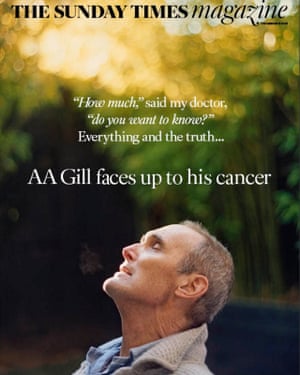


AA Gill on the front of Sunday Times magazine


AA Gill on the front of Sunday Times magazine. Photograph: Sunday Times

He described how he was told by a consultant oncologist that a pioneering new treatment for cancer, immunotherapy, would give him his best chance at fighting the disease, but it was not available on the NHS.


“The National Institute for Health and Care Excellence (Nice), the quango that acts as the quartermaster for the health service, won’t pay,” he wrote.


The consultant told Gill the treatment would be “particularly successful” with his kind of cancer, but told his wife Nicola Formby: “If he had insurance, I’d put him on immunotherapy – specifically, nivolumab. As would every oncologist in the first world. But I can’t do it on the National Health.”


Gill said that the prohibitive cost of nivolumab was £60,000 to £100,000 a year for a lung cancer patient, about four times the cost of chemotherapy.


However, he said that “old men who think they’re going to die anyway aren’t very effective activists” and do not see the “public or press pressure that young mothers’ cancers and kids’ diseases get”.


He added: “As yet, immunotherapy isn’t a cure, it’s a stretch more life, a considerable bit of life. More life with your kids, more life with your friends, more life holding hands, more life shared, more life spent on earth – but only if you can pay.”


Gill, who previously said he wanted to have his treatment on the NHS due to a sense of “human connection”, drew attention to the health service’s performance in international oncology rankings.
He wrote: “It was the first question I asked my oncologist, Dr Conrad Lewanski. ‘Why is this such a bad place to get cancer, when we have lots of hospitals, when we teach doctors from all over the world, when we’ve won more Nobel prizes than the French?’. ‘It’s the nature of the health service,’ he says.”


AA Gill, journalist and restaurant critic, dies aged 62

Gill eventually underwent a course of platinum chemotherapy at the Charing Cross hospital in London.


He told how, in the weeks before he died, he was rushed to hospital in pain “by miles and miles the worst thing I have ever lived through”. After doctors discovered his pancreatic tumour had grown to the size of a fist they offered more chemotherapy.


Gill finished the article, which was printed before he died and published in the Sunday Times, with a conversation he had with a cancer nurse. “(She said) ‘You’re supposed to be with me down in chemotherapy. I saw your name. Why are you up here?’,” he wrote. “’Well, it turns out the chemo isn’t working’. Her shoulders sag and her hand goes to her head. ‘F***, f***, that’s dreadful.’ I think she might be crying. “I look away, so might I. You don’t get that with private healthcare.”


AA Gill said NHS could not give him new cancer treatment

20 Kasım 2016 Pazar

AA Gill opens restaurant review with cancer diagnosis

Restaurant critic AA Gill has been diagnosed with “an embarrassment of cancer, the full English”, breaking the news in his regular “Table Talk” dining column.


The 62-year-old Sunday Times writer said he was alerting readers who follow his restaurant recommendations and who ought to know if there were “any fundamental, gastro, epicurean personal changes that would affect my judgment”.


Gill, a father of four, also announced he is to marry his long-term partner, Nicola Formby, after 23 years together.


Describing how the disease, diagnosed in the summer, had spread, he wrote: “There is barely a morsel of offal that is not included. I have a trucker’s gut-buster, gimpy, malevolent, meaty, malignancy”.


Gill, who was married to home secretary Amber Rudd during the 1990s, is the latest of a number of high-profile journalists and celebrities to have chosen to go public about cancer and chronicle their journeys.


Early pioneers to have written newspaper diaries about their cancer include Ruth Picardie, journalist and mother of two, whose Observer column was published as the memoir Before I Say Goodbye after her death in 1997 aged 33 from breast cancer. Broadcaster and journalist John Diamond, husband of Nigella Lawson, who died after being diagnosed with throat cancer in 2001 aged 47, won a What the Papers Say award for his weekly column.


The Vanity Fair columns written by author, essayist and journalist Christopher Hitchens, who died aged 62 in 2011 from esophageal cancer, were published at book length entitled Mortality after his death.


Sun columnist Jane Moore, a friend of Gill, told the Andrew Marr show she had urged him to write about his illness “because I thought it would be the definitive article on having cancer”.


Experts have long applauded those who share their experiences publicly for helping break the taboo of talking openly about the disease. Martin Ledwick, Cancer Research UK’s head nurse, said: Although over recent years attitudes have begun to change, cancer is still a subject that people find difficult to discuss. When people in the public eye are open about their cancer diagnosis it can be extremely helpful in demonstrating that it is OK to talk about it”.


Broadcaster and journalist Steve Hewlett, 58, who earlier this year was diagnosed with cancer of the oesophagus, charts his journey through broadcast interviews and an Observer column. He said his decision to go public came after deciding to be entirely open with his family, especially his children. By doing so, he allowed them to find support networks they might not otherwise have found, he said.


Writing about it also helped him stay in control, and not mired in a negative mindset. “I have something of a public profile anyway. I am naturally drawn to storytelling,” he said. “I didn’t go into it expecting to generate any reaction. I just thought it really interested me. My own case began to interest me as a story very early on.”


In his quest for information about his illness and treatment, he stumbled across things he thought others might need to know and wanted to share. “There remains for some people, and it is not irrational, a significant taboo about discussing cancer.


“The reaction has been absolutely extraordinary,” he said. “I honestly had no idea what to expect, but I certainly didn’t expect what happened. I have been contacted by well over 3,000 people, offering help, or support, people sharing their own stories, and a lot just saying ‘thank goodness someone is doing this’,” he said.


“I have come to the conclusion that it is helping people. It is extraordinary that it has touched.”


In an interview in the Sunday Times, Gill, said he had no regrets about his diagnosis. “I realise I don’t have a bucket list; I don’t feel I’ve been cheated of anything. I’d like to have gone to Timbuktu, and there are places I will be sorry not to see again,” he said.


Gill, who gave up alcohol when he was 30, added: “But actually, because of the nature of my life and the nature of what happened to me in my early life – my [alcohol] addiction, I know I have been very lucky.”


AA Gill opens restaurant review with cancer diagnosis