exciting etiketine sahip kayıtlar gösteriliyor. Tüm kayıtları göster

30 Ağustos 2016 Salı

Care firm criticised for promoting "exciting" prison self-harm incidents

The UK’s largest private healthcare provider has been criticised after one of its senior executives spoke of the “exciting life of prison medical staff” in reference to life-threatening injuries and self-harm.


Dr Sarah Bromley, Care UK’s national medical director for health in justice, said in a staff recruitment video: “If you like life to be exciting, there are always alarm bells going off, resuscitations, self-harming incidents, a lot of chaos that goes on in our prisons.”


The remarks, which have been criticised as ill-judged and offensive, come at a time when suicides and self-harm rates are at a record high in prisons in England and Wales.


Care UK is the UK’s largest independent provider of health and social care services. Its health and justice arm provides healthcare in 30 prisons in England and Wales, including some of the biggest.


It provides healthcare in HMP Leeds, which has seen five apparently self-inflicted deaths in the last year. At Chelmsford prison, where it also operates, an inspection report published this week said health provision was inadequate. Inspectors said self-harm levels were “very high, far higher than at comparator prisons.”


This month a coroner said “significant failures” by Care UK had contributed to the death of a prisoner at Pentonville jail in London. Terence Adams, 43, killed himself at the prison last November. Mary Hassell, the senior coroner for inner north London, found medical staff did not take immediate action after Adams’ admission to the jail despite recording a “high risk of self-harm”.


Adams had been deemed at risk on a mental health assessment, which should have triggered an immediate admission to in-patient care at the jail. Instead he was placed in a normal cell. He killed himself three days later.


The coroner also said a report compiled by Care UK after the death was not shared with the coroner’s office until it was accidentally discovered by lawyers during the inquest.


Also this month, the Ministry of Justice published a bulletin on deaths, self-harm and assaults in prisons. In the 12 months from June 2015 there were 105 apparently self-inflicted deaths, a 28% increase on the previous year, and 34,586 reported incidents of self-harm, up 27%.


Deborah Coles, the director of Inquest, which supports relatives of people who die in custody, said Bromley’s remarks were offensive to the hundreds of families the charity had represented over the years.


Coles expressed concern that the comments demonstrated a lack of understanding of the vulnerability of prisoners and the staff who work with them.


“If this is the premise in which staff are recruited to work in some of the most challenging prisons, it is not hard to imagine the quality of training Care UK staff receive,” she said.


“The evidence from prison inspectors and the coroner earlier this month is alarming. When will the government stop prioritising profit over quality of service and look at how these private providers are operating on the ground?”


A Care UK spokesman said: “The video seeks to explain to healthcare professionals the difficulties, but also the opportunity, of providing complex multi-disciplinary care to vulnerable people, who often have had limited access to healthcare in the past, within what is inevitably a challenging environment.


“Whilst seeking to describe the nature of the role and environment appropriately, we are of course sensitive to the perceptions of everyone connected to prison healthcare and we will review our recruitment material accordingly.”


After the Guardian contacted Care UK about the recruitment video, the company edited the film, removing Bromley’s reference to excitement, resuscitations, and self-harm.


Care firm criticised for promoting "exciting" prison self-harm incidents

27 Mayıs 2014 Salı

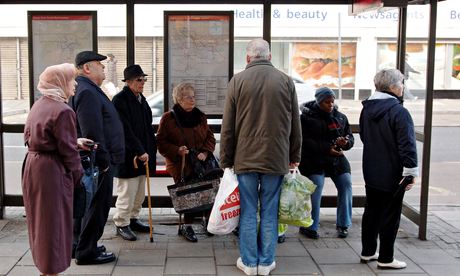
Making outdated age exciting: much more buses, perform locations and loos | Malcolm Dean

busses for pensioners

Getting out an about can contribute to health and wellbeing, but numerous older men and women are constrained by bad bus companies. Photograph: Martin Godwin for the Guardian


Bang on time for the start of a new council cycle, a in depth 58-page report will up coming month set out the degree to which neighborhood neighbourhoods must adapt if they are to meet the requirements of an ageing society. In between 2010 and 2018 an additional two million folks will have turn into 65. Two many years after that, the little one boomers of the 1960s start retiring.


For 6 months, two major charities on ageing issues, ILC-United kingdom and Age Uk, have worked with academics, researchers and professionals seeking solutions to the challenges raised by this seismic demographic shift. The report, Making our Communities Prepared for Ageing, focuses on three primary themes: at house obtaining out and about and guaranteeing communities offer what older folks want.


But it goes on to declare: “If communities are to perform for today’s and tomorrow’s older population, planners must emphasis on how we ensure that they supply a lot much more than the essentials. There is not sufficient emphasis on exciting and playfulness for older individuals. Communities require to work for all ages and can not segregate the wants of various groups.”


The bulk of older people (90%) are living in mainstream housing. Of the other 10%, six% are in sheltered or retirement housing, and 4% in residential or nursing homes. There is a mismatch simply because 40% of houses had been constructed just before 1945 and twenty% just before 1919 when residences had been filled with far much more young children – and far fewer older individuals. Equally tough, there have been far as well couple of homes – with significantly less room – created in the final two decades, making adaptations for older individuals much more hard.


These days there are 7 million older householders occupying thirty% of all houses. Currently one.4 million of them have a health care situation that requires specially adapted accommodation. Government projections propose 60% of family development by means of to 2033 will involve someone over 65. But social care, which plays a crucial position in maintaining men and women at property, is in problems. Given that 2010 local authorities have been forced to reduce £1.2bn from the support, cutting off 250,000 older individuals from assist.


The report calls for a greater push on housing enhancements and suggests a tax-incentivised voucher scheme may support. It desires to see improved insulation to decrease the 31,000 extra deaths for the duration of the winter of 2013, and new homes with far more room.


One particular of the ideal approaches of bettering physical and psychological overall health is receiving out and about. Above 3.4 million of the over-65s reside alone. Many truly feel isolated and alone. Three barriers to getting out are: cuts to bus solutions, the squeeze on neighborhood transport, and the closure of public toilets, raising concern amid older men and women of getting “caught out”.


A lengthy checklist of solutions incorporate auto sharing schemes for folks wanting to cease driving neighborhood transport, such as school or university buses, getting open to other folks and far more use of bicycles. Only 1% of journeys created by over-65s in England and Wales involve a bicycle, in contrast to 9% in Germany, 15% in Denmark, and 23% in the Netherlands.


The report calls on wellness and welfare boards to push for a lot more cycling schemes. It also asks the exact same boards to make the availability of public toilets – 40% of which have been shut in the last decade – a public health problem.


There are a number of easy techniques communities could be created far more friendly for an ageing society. More seats at bus stops, in retailers, parks, and public squares. Regional public overall health campaigns on loneliness, involving GPs and encouraging less difficult accessibility to neighborhood groups. And, far more enjoyable by way of a lot more entry to playgrounds for older people.


Making outdated age exciting: much more buses, perform locations and loos | Malcolm Dean

16 Ocak 2014 Perşembe

Moshi Monsters are not just harmless exciting

“What pains us is that a company that wants to thrill and excite children in the imaginary world is not admitting that this is going to have an effect on the real lives of children they meet in the playground, school bus or classroom,” says


Changing Faces founder and chief executive James Partridge, who was himself disfigured after being severely burned in a fire at the age of 18.


Bullying because of his appearance is something that 17-year-old Lucas Hayward has experienced at first hand. He was born with frontal-nasal, craniofacial dysplasia (a congenital condition, where the nose has a wide flat appearance and the eyes are wideset) and was bullied so badly at his primary school he had to leave. “I was called freak and Elephant man,” he recalls. “The boys would punch me and stand on my head….Most of the time I was too scared to go into the playground.”


With support from Changing Faces, Lucas moved to a new school where there was zero tolerance for bullying. But he is supporting the charity’s campaign because it chimes with his experience. “I know that Moshi Monsters are extremely popular – my mum’s a child-minder and all her kids have Moshi Monster lunch bags. But I’ve seen how the kids connect how ugly the characters are with how evil they are. “


The charity first contacted Mind Candy in May but the company has declined to take on its suggestions to either remove the Freakface, Bruiser and Fishlips characters, change their names, or remove the descriptions putting value judgements on their disfigurements (A similar campaign by Changing Faces in the summer saw Lego swiftly alter a value-laden description of a badly scarred Lone Ranger character).


Changing Faces has now launched a petition, which has more than 1,500 signatures so far and is being backed by senior maxillofacial surgeon Alistair Cobb, whose practice covers the south west.


“I have three kids who love Moshi Monsters” he says. “But the choices of names for their monsters are shocking. I work with children and adults with facial differences and the problems they face are bad enough without equating disfigurement with something sinister.”


A spokesperson for Mind Candy said the company was sorry for any offence given, although it stood by the decision not to change the monsters’ names. “We have met with the charity and discussed the possibility of including a storyline within one of our narratives to support their work in the coming months,” she said.


“Many other children’s entertainment characters, from Disney to Marvel have featured quirky and unusual looking visual characteristics,” she added. “These are the essence of good, visual storytelling. Our ‘monsters’ have a range of characteristics and include some of our most popular and well loved characters, Zommer, Big Bad Bill and Gingersnap.”


Changing Faces is currently taking legal advice over the issue. “We are not against Moshi Monsters – it’s a fantastic game,” says Partridge. “But to associate facial disfigurement with nastiness legitimises prejudice.”


Moshi Monsters are not just harmless exciting