Psychological thrillers are a great way of understanding the skewed perception of first-person consciousness
With the hotly anticipated Into The Water by Paula Hawkins out next month, the interest in psychological thrillers isn’t going away. The genre’s preoccupations are shared with neuroscience – in particular, how we process memory. But it’s not recent breakthroughs within neuroscience and psychology that make it such a rich seam for novelists.
In fact, there haven’t really been any, although much new data about the brain is available, thanks to imaging techniques, neuroscience projects and interest from venture capitalists into artificial intelligence, our basic view of it is not that different to what it was 20 years ago. Now novels offer the most realistic accounts of first-person consciousness, particularly psychological thrillers that rely on skewed perception and unreliable narrators. This style, suggesting that what we experience isn’t objective reality but rather a story we tell ourselves, is closer to the truth than most psychological theories. When we can finally explain how the brain works, perhaps scientific representations will be more accurate. But for now, the novel is the real story.
Scientists have reversed memory and learning problems in aged mice with infusions of a protein found in human umbilical cord blood.
The striking results have raised hopes for a treatment that staves off mental decline in old age, but researchers stressed that more studies, including human trials, are needed before the therapy can be considered for clinical use.
Tests on frail rodents found that the protein therapy rejuvenated an area of the brain called the hippocampus, which is crucial for memory formation, and one of the first and most important regions to deteriorate in old age.
Older mice that received the treatment reacted like younger animals in a series of behavioural tests, according to researchers at Stanford University in California. They escaped from a maze faster than before, had better memories, and started building nests again, a skill the animals tend to lose in old age.
Researchers led by Tony Wyss-Coray made the discovery after they noticed that human umbilical cord blood had unusually high levels of a protein called TIMP2 when compared with blood from older people. When injected into mice, the protein ramped up the activity of a group of genes that revitalised the hippocampus, and made it more able to adapt to new information. Details of the study are reported in Nature.
The work is the latest in a string of studies that suggest molecules found in young blood may be able to rejuvenate old brains and other tissues. If the therapies are effective in humans, they could become a potent weapon against the cognitive decline that comes with old age, and also neurodegenerative diseases such as Alzheimer’s.
But until the treatment has proved itself in humans, scientists are roundly cautious of the work. The lesson from Alzheimer’s research on mice is that almost everything works in the animals, and so far nothing works in humans, said Rob Howard, professor of old age psychiatry at University College London. “Having taken that on on board, this is a really interesting way to understand how we might help people who are aged or in the early stages of the disease,” he said. The protein therapy might not reverse brain ageing, or halt Alzheimer’s, but it might boost what remains of the healthy brain to at least offset some of the decline that accompanies old age.
Jennifer Wild, a clinical psychologist at Oxford University, said that while the results were interesting, it was too early to consider it as a therapy for humans. “It’s exciting for mice who have cognitive ageing, but it’s way too early to start extrapolating that to say we can help humans,”, she said.
After the incredulity, the despair, and then the cautious return to optimism, the presidential campaign has entered a phase of almost intolerable anxiety. National polls that don’t signify much are instantly interpreted as omens of the apocalypse; tiny anecdotes about early voting figures induce heart-stopping panic, or get clung to like life-rafts, depending on the direction in which they point. Until Tuesday, no new information is likely to bring any sense of closure, only more stress, but that doesn’t stop us from seeking it compulsively.
Never mind that a victory for Donald Trump, at this point, would still require him to have executed a turnaround unknown in living memory, or that the nervous comparisons with Brexit have been so overblown. (Plenty of polls predicted a victory for Brexit – and there are many reasons to assume the tapestry of state and national US polls is less error-prone than for a simple majority referendum.) In the closing days of an election that has kept Americans and non-Americans alike in a state of clenched-stomach tension for months, allowing yourself any confidence in a victory for Hillary Clinton feels like mocking the gods.
Even assuming Trump loses, the relief will be superficial: Trumpism will remain, and the world will have to contend with the fact that about 40% of the US electorate saw little wrong with his racism and misogyny, alleged sexual assaults, business scandals, lies, misrepresentations of his wealth and charitable giving, probable failure to pay taxes, lack of impulse control, profound ignorance and tiny attention span.
But the relief will still be real.
In a way that feels unprecedented in modern politics, Trump has burrowed deep into our psyches, stimulating anxiety that isn’t confined to the borders of the US, or to those who are the direct targets of his bigotry.
A survey for the American Psychological Association published in October found that the election was a source of stress for 52% of American adults; during the summer, 70% of registered voters – that is, including Trump supporters – said the prospect of a Trump presidency made them anxious, according to a Washington Post poll. (The figure for Clinton was 50%.) There have been multiple reports of election-related fears arising on therapists’ couches as never before, along with anecdotes of relationships damaged by political disagreement.
“I think what’s been so uniquely distressing isn’t just that there’s one person out there who thinks like that, but that there are clearly so many people who agree,” says Joan Cook, an associate professor of psychiatry at Yale University and an expert in traumatic stress. (She thinks Trump’s hardcore supporters, meanwhile, are in the grip of “traumatic bonding”, as with Stockholm syndrome – an emotional dependence forged through abuse.)
This is a kind of psychological entanglement with national and international news that most of us, most of the time, are spared; but the Trump candidacy has removed the possibility of such distance. The Rape, Abuse and Incest National Network reported a 33% increase in calls to its support hotline during the weekend following the release of Trump’s notorious Access Hollywood tape.
Armchair diagnosis: dos and don’ts
Alongside its psychological impact on the rest of us, the campaign has also felt distinctive – and distinctively disturbing – in the ways that Trump’s own psychology has come to dominate it.
While Hillary Clinton’s inner life remains largely mysterious, information about Trump’s insecurities leaks from his every public statement – even before the New York Times obtained tapes of interviews with a biographer in which Trump’s morbid fear of public humiliation was made plain. His former ghostwriter, Tony Schwartz, has pointed out how Trump’s attacks on others aren’t random, but constitute a precise inventory of his own faults: “unstable”, “reckless”, “bigoted”, “trigger-happy”, exhausted and prone to lying.
As Sheena Monnin, the former Miss Pennsylvania sued by Trump after she criticized his Miss USA pageant, put it in an interview with CNN: “I have a degree in psychology, and I understand that underneath the bullying tactics, there’s usually a lot of emptiness, and a strong need to feed the ego.”
Trump told his biographer Michael D’Antonio: “I don’t like to analyse myself, because I might not like what I see.” But the rest of us haven’t had much choice. Like a traffic pile-up, the candidate’s involuntary self-exposure has been impossible not to gawp at. (On that note, the October APA survey found that the election was having a significant negative impact on productivity.)
Yet throughout this intensely psychological election, psychology professionals have been restrained by a widespread, though fragmenting, consensus that Trump’s mental health ought not to be discussed at all.
This stance is most clearly expressed in the American Psychiatric Association’s so-called Goldwater rule – the prohibition on diagnosis-at-a-distance introduced following the incident in 1964 when 1,100 psychiatrists told a news magazine they believed that Barry Goldwater, the Republican candidate for president, was unfit for office.
In a finger-wagging statement released in August (“The Goldwater rule: why breaking it is unethical and irresponsible”), the APA’s president, Maria Oquendo, reaffirmed the ban. But while there are certainly strong arguments in favour of it – it risks undermining public confidence in psychiatrists, and stigmatising people with mental illness – it’s been far from obvious, in 2016, that these outweigh the ethical arguments for flouting it.
Writing in Vox, the psychologist Cedar Riener compared psychiatrists disregarding the rule to a doctor diagnosing cancer “just by looking at my behaviour or public statements”. But in the case of psychological disorders, unlike physical illnesses, behaviour and speech are always the primary sources of diagnostic data. And it has often seemed as if we might have more direct access to the darkest recesses of Trump’s mind than to some of our closest friends.
“Like many Americans, I was more amused than alarmed by Trump at the beginning,” says Bill Doherty, a marriage and family therapist from Minnesota. But as the Trump movement picked up steam, Doherty happened to be travelling in Austria, where he encountered a neo-fascist political demonstration and visited a concentration camp. “So I did some reading about the responses of mental health professionals in Germany and Austria in the 1930s, and they were largely silent, and some were complicit.”
Upon his return, he wrote a manifesto – Citizen Therapists Against Trumpism – which more than 3,300 of his colleagues have now signed. Doherty insists this doesn’t violate the Goldwater rule – he’s condemning Trumpism as a threat to public health, not diagnosing Trump as, say, a narcissist or sociopath, the disorders most frequently attributed to him.
As “citizen therapists”, Doherty says, “we must be willing to speak out on issues that affect the mental health of our clients, instead of just sitting in our offices and dealing with the fallout.”
Trump-induced distress is especially acute, he says, for anyone who has been exposed to a personality style like his – focused on bullying, scapegoating and the kneejerk demeaning of critics – earlier in their personal lives. His status as a presidential candidate “brings legitimacy to his way of relating to other people. There have always been personalities like Trump, but his power and the hundreds of people at his rallies say to anyone who has any psychological vulnerability that, yes, their fears were legitimate, and that there’s no accountability for anyone who says and does these things. And that’s exactly what’s happened in their lives: there’s been no accountability for the people who harmed them.”
Daddy issues: ‘a fantasy of being rescued by a powerful father figure’
Beyond the confines of therapy, the rise of Trump has demonstrated more broadly how bad we are at understanding politics in psychological terms. For months, an almost entirely futile debate between pundits has sought to establish whether Trump’s supporters are motivated by economic anxiety or by racism, as if the two could be neatly distinguished and measured.
For Jonathan Shedler, professor of psychiatry at the University of Colorado school of medicine, his appeal is better understood through the lens of “transference”: in times of stress, whatever the complex blend of causes for that stress, people revert to a childhood desire for an omnipotent protector – an understandable need in young children, but dysfunctional in adulthood.
“Trump is benefiting from a childlike fantasy of being rescued by an all-powerful, larger-than-life father figure, so all of these qualities get attributed to Trump,” he says. If the candidate’s serially outrageous behaviour fails to alienate them, that’s at least partly because the appealing qualities they’re seeing aren’t really in him; instead, “they’re in the minds of the people who are doing the attributing, expressing their not-quite-conscious yearnings.”
Meanwhile, the question of whether Trump himself is suffering from a personality disorder is beside the point, Shedler argues – the consequence of trying to force our thinking about personality into a “medical model” in which narcissism or antisocial attitudes, like cancer, are discrete diseases, invading an otherwise healthy body. But Trump’s narcissism, insecurities and viciousness are intrinsic components of who he is, and they’ve already damaged the world’s wellbeing – whether or not they’re best thought of as formal disorders.
At a rally in Henderson, Nevada, earlier this month, Trump told supporters: “If I don’t win, this will be the greatest waste of time, money and energy in my lifetime, by a factor of 100.”
It was a fairly typical statement from Trump, in its profound self-absorption and total lack of interest in the impact of his victory or defeat on the country he proposes to lead. But it was also an especially infuriating one, given the extraordinary quantities of attention and emotional energy Trump has already squandered – not his, but ours.
If he loses on 8 November, that won’t mark the end of the problem he represents. But it may nonetheless be a rich source of delight to savor the departure of the toxic uninvited guest who has spent the last year so stubbornly resident in our brains.
You have to get used to being invisible as an anaesthetist. A large percentage of the public has no idea that we’re medically qualified. I’ve been asked how many GCSEs you need to be an anaesthetist. In fact our training is as long as that of a surgeon. It takes seven years of specialist studies after you’ve already completed two years of basic general training; and that’s after five or six years at medical school.
Patients always remember the name of their surgeon, never that of their anaesthetist. But it’s still a hugely rewarding job. We’re everywhere in the hospital. In theatre obviously, but also in intensive care, on the wards, in the emergency department, and in the pain clinic, with those who are really suffering. We assess people’s fitness for surgery, how likely they are to suffer complications, and support them through the operation itself and into the postoperative period.
If there’s an emergency during an operation the team looks to the anaesthetist for leadership. If you panic, it spreads
When you first start anaesthetising patients early on in your career it’s terrifying. You know that if you get it wrong you might kill someone. Our drugs stop people breathing and it’s our job to take over that function. Even after nine years I still get a frisson of nerves in some situations. I hide it though; it’s an important part of the job to stay calm at all times. If there’s an emergency during an operation the team looks to the anaesthetist for leadership, as the surgeon is often too focused on fixing the immediate problem. If you panic, it spreads and the team loses the ability to function efficiently.
Anaesthesia is a very safety-oriented speciality; we’ve led the way in reducing patient harm by looking at human factors, using simulation training and reporting “near misses”. By sharing episodes where a patient has nearly come to harm, we hope to address the causes and prevent actual harm from occurring in the future. We’ve embraced ideas from aviation and other high-reliability industries about how a team functions effectively. We try to flatten the hierarchy in theatre so that the least qualified individual can raise concerns without feeling intimidated. This makes it especially frustrating when patients come to harm after they leave your care because the rest of the system is struggling to cope.
There are so many gaps in rotas of doctors, nurses and the wider healthcare team, and the proposed junior doctor contract changes will only make this worse. The outlook for patients who suffer complications after surgery is determined not by the presence of the complication, but by how quickly it is picked up and dealt with. This simply can’t happen when workloads are too high.
I look after one patient at a time. This ability to offer a premium level of care is one of the reasons I became an anaesthetist in the first place. On the wards each doctor will be responsible for up to 30 people a day, and even more at night. I can see with each heartbeat what the patient’s blood pressure is in the operating theatre; on the wards, it might only be checked once every four hours.
The speciality is a broad church, so there is room for all personality types. But given the precision involved there is perhaps a tendency to obsessive traits. I’ve worked with colleagues who have a 10-minute ritual for putting in an intravenous cannula that had to be completed in the correct sequence. Our postgraduate exams are renowned for being tricky but they are really a test of commitment. We’re experts in physiology, pharmacology, and physics; we have to know about everything from cellular respiration to how our drugs work, to the internal workings of a defibrillator.
Patients are usually nervous when they arrive in my anaesthetic room. It’s an exercise in trust to place your whole life in the hands of others. Every anaesthetist will have their spiel, some small talk to distract the patient from their imminent surgery. I ask them about family, talk about their favourite place to visit, what they do for a living. I modify my “going to sleep” talk depending on the small talk that’s gone before. If they love travelling, I’ll talk about a white sandy beach, with crystal clear waters, a gentle breeze. The more nervous they are, the longer they take to go to sleep. Many young, usually male, patients have commented as the drugs take effect that it feels just like a Saturday night. I’ve also been asked if I liked to have sex in a vest – I decided not to pursue what he meant by that when he woke up.
Every anaesthetist has a secret weapon when working in the operating theatre. We always work with an assistant, who might be a nurse or an operating department practitioner (ODP). The very best of them could do my job without thinking twice, but they choose even greater anonymity than the anaesthetist enjoys. Many a time I’ve had my bacon saved by an astute ODP. Some appear to have powers of extrasensory perception; I turn to ask for something and there it is in my hand.
I’ve also worked with many theatre colleagues with a wicked sense of humour. Before my first unsupervised operating shift, I confessed to the ODP that I’d never worked alone before. He paused and stuttered that neither had he, it was his first day at work, being newly qualified. I spent the entire day terrified that some disaster would befall us, and we wouldn’t be up to the challenge. At the end of the day he came clean – he’d been doing the job for 20 years.
Frustrations creep in to the job when the system fails. I often arrive at 7.30am (30 minutes before my shift begins), so I can find space on the pre-op ward to see my patients in private, find out their history and take the time to address any concerns. It’s then immensely distressing when operations are cancelled due to lack of beds, or lack of notes, or the surgeon’s been double booked, or you are moved to another job at short notice. Anaesthesia can also become routine; it’s a far cry from the early days of the speciality when unpredictable drugs were used without monitoring. If the patient is fit, it’s rare for them to come to harm from a general anaesthetic.
It is important to have other interests to distract from the stresses, strains and occasional boredom of the job. In my spare time I’m a volunteer doctor for the ambulance service. Being under a car in a ditch in the rain at 2am is very different from the bright lights of the operating theatre. Some of my colleagues are real polymaths. There are painters, musicians, novelists, as well as some quite serious sports people. The coffee room in the morning is the preserve of the middle-aged man in lycra. We see every day the damaging effects of too little aerobic fitness, so we’re staving off our own mortality.
The best bits? Reassuring nervous patients, rendering labouring women pain-free with the magic of epidural analgesia and, of course, merciless surgeon baiting. I’ll ask if they need me to Google instructions for the operation, or if they’ll be finished before new year. We say there’s a blood-brain barrier between the surgeon and the anaesthetist: they’re the blood, and we’re the brains.
• Are you a private tutor, a plumber or a mental health nurse? We want to hear your candid accounts of what work is really like. Find full details on submitting your story anonymously here
Toxic nanoparticles from air pollution have been discovered in human brains in “abundant” quantities, a newly published study reveals.
The detection of the particles, in brain tissue from 37 people, raises concerns because recent research has suggested links between these magnetite particles and Alzheimer’s disease, while air pollution has been shown to significantly increase the risk of the disease. However, the new work is still a long way from proving that the air pollution particles cause or exacerbate Alzheimer’s.
“This is a discovery finding, and now what should start is a whole new examination of this as a potentially very important environmental risk factor for Alzheimer’s disease,” said Prof Barbara Maher, at Lancaster University, who led the new research. “Now there is a reason to go on and do the epidemiology and the toxicity testing, because these particles are so prolific and people are exposed to them.”
Air pollution is a global health crisis that kills more people than malaria and HIV/Aids combined and it has long been linked to lung and heart disease and strokes. But research is uncovering new impacts on health, including degenerative brain diseases such as Alzheimer’s, mental illness and reduced intelligence.
The new work, published in the Proceedings of the National Academy of Sciences, examined brain tissue from 37 people in Manchester, in the UK, and Mexico, aged between three and 92.
It found abundant particles of magnetite, an iron oxide. “You are talking about millions of magnetite particles per gram of freeze-dried brain tissue – it is extraordinary,” said Maher.
“Magnetite in the brain is not something you want to have because it is particularly toxic there,” she said, explaining that the substance can create reactive oxygen species called free radicals. “Oxidative cell damage is one of the hallmark features of Alzheimer’s disease, and this is why the presence of magnetite is so potentially significant, because it is so bioreactive.”
Abnormal accumulation of brain metals is a key feature of Alzheimer’s disease and a recent study showed that magnetite was directly associated with the damage seen in Alzheimer’s brains. Magnetite particles are known to form biologically in human brains, but these are small and crystal-shaped, unlike the larger, spherical particles that dominated the samples in the new study.
“Many of the magnetite particles we have found in the brain are very distinctive,” said Maher. “They are very rounded nanospheres, because they were formed as molten droplets of material from combustion sources, such as car exhausts, industrial processes and power stations, anywhere you are burning fuel.”
“They are abundant,” she said. “For every one of [the crystal shaped particles] we saw about 100 of the pollution particles. The thing about magnetite is it is everywhere.” An analysis of roadside air in Lancaster found 200m magnetite particles per cubic metre.
Furthermore, said Maher: “We also observed other metal-bearing particles in the brain, such as platinum, cobalt and nickel. Things like platinum are very unlikely to come from a source within the brain. It is a bit of an indicator of a [vehicle] catalytic converter source.”
Other scientists told the Guardian the new work provided strong evidence that most of the magnetite in the brain samples come from air pollution but that the link to Alzheimer’s disease remained speculative.
“This is a very intriguing finding and it raises a lot of important questions,” said Prof Jon Dobson, at the University of Florida and not part of the research team. But he said further investigation was needed: “One thing that puzzles me is that the [particle] concentrations are somewhat higher than those previously reported for the human brain. Further studies [are needed] to determine whether this due to regional variations within the brain, the fact that these samples are from subjects who lived in industrial areas, or whether it is possibly due to [lab] contamination.” The researchers said they had gone to great lengths to avoid contamination.
Air pollution was linked to a significant increase in the risk of Alzheimer’s disease by a major study published in 2015, while other research showed brain damage related to Alzheimer’s disease in children and young adults exposed to air pollution. Air pollution has also been linked to dementia in older men and women.
“We have not demonstrated a causal link between these particles and Alzheimer’s disease but when you consider that magnetite has been found in higher concentrations in Alzheimer’s brains and you know that magnetite is pernicious in its effect on the brain, then having a direct [air pollution] source of magnetite right up your olfactory bulb and into your frontal cortex is not a great idea,” said Maher.
Prof David Allsop, an Alzheimer’s disease expert at Lancaster University and part of the research team, said: “There is no blood-brain barrier with nasal delivery. Once nanoparticles directly enter olfactory areas of the brain through the nose, they can spread to other areas of the brain, including hippocampus and cerebral cortex – regions affected in Alzheimer’s disease.” He said it was worth noting that an impaired sense of smell is an early indicator of Alzheimer’s disease.
“Knowledge is power,” Maher said. “So if there’s at least a possibility that exposure to traffic pollution is having even worse health impacts than were previously known, then take the steps you can to reduce your dose as far as you can.”
“What this is pointing towards perhaps is there needs to be a major shift in policy and an attempt to reduce the particulate matter burden on human health.” Maher said. “The more you realise the impact this is having, the more urgent and important it is to reduce the concentrations in the atmosphere.”
Dr Clare Walton, research communications manager at the Alzheimer’s Society, said: “This study offers convincing evidence that magnetite from air pollution can get into the brain, but it doesn’t tell us what effect this has on brain health or conditions such as Alzheimer’s disease. Further work in this area is important, but until we have more information people should not be unduly worried. There are more practical ways to lower your chances of developing dementia such as regular exercise, eating a healthy diet and avoiding smoking.”
The smell in the autopsy room is indescribable. It lingers on your clothes and in your hair long after you leave. Staff are constantly cleaning the linoleum floors and wiping down every surface with harsh disinfectants. But if anything, it adds to the uniquely acrid odor.
You never get used to the smell, says Jennifer Hammers, deputy chief medical examiner for Kings County, New York – but you do get beyond it.
I’ve been allowed a privileged glimpse at a regular Wednesday in the Brooklyn office of the Chief Medical Examiner of New York City. The office is one of the busiest of its kind in the country.
Around 70,000 people die in New York City each year, and about 8,000-9,000 of them end up at the medical examiner, requiring further investigation. Of those, 5,000 are autopsied.
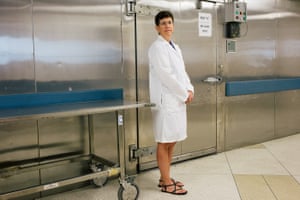
Barbara Sampson, Chief Medical Examiner of New York City Photograph: Ben Zucker for the Guardian
Only the lonely
In the basement, the staff are hard at work in the autopsy suite, carefully examining the bodies and photographing relevant organs for their reports.
Most cases brought to the medical examiner are not crime related. In a city of over 8 million people, with many immigrants and transplants from other parts of the country, there is no shortage of the lonely.
Of the seven bodies brought in today, three have died alone in their apartments. In the summer, without air conditioning, it can take as little as two days before the smell of a body causes neighbors to make a call.
One gentleman found alone in his home is now lying before me on a steel gurney. James Daniels, a lead forensic mortuary technician, is carefully removing the scalp before cutting the skull with a bone saw so the brain can be examined for any signs of aneurysm, stroke or other potential causes of death.
An examination table in the “decomposition room” Photograph: Ben Zucker for the Guardian
Over 60 forensic mortuary technicians like Daniels work in New York City. While the 31 medical examiners in New York City are all highly trained physicians who completed special fellowships, technicians don’t have any educational requirements.
Typically, technicians join when they are young and only have a high school education. They learn the intricacies of their job on site. Without them, the office would cease to function. They are the ones dispatched to collect the bodies for autopsy. They are often the first people from the office a family encounters when grieving.
Being the doctor’s doctor
In addition to the medical examiners, there are x-ray technicians who scan for bullets and broken bones; DNA and toxicology laboratory staff; consulting dentists for matching dental records for identification; anthropologists who specialize in discovering the race, age and height of skeletal remains and figuring out what tools caused blunt force traumas; mortuary technicians who assist with autopsies; a variety of administrators; death scene investigators; and professional photographers who take careful photos of every autopsy for detailed record keeping.
One of the photographers on staff also takes professional photos of food, Hammers tells me with a smile.
While the doctors examine the body and determine the cause of death, the technicians do a lot of careful and very skilled cutting to assist them. They also clean the bodies after the autopsy is completed, making sure that it is in a pristine state when handed over to a funeral director.
For Daniels, who started with the Office of the Chief Medical Examiner as a young man in 1989, it was an unexpected career choice, as he hated the idea of being around dead bodies and avoided funerals entirely.
Most of the medical examiners, on the other hand, said they always loved the idea of solving a mystery, of being “the doctor’s doctor”. They wanted to be the ones to determine the real cause of a death or diagnose a pathology.
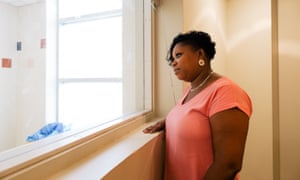
Nadia Bissette-Dolor, who works in the Office of the Chief Medical Examiner of New York City, stands by a window used by families to identify bodies of the deceased. She says family members rarely ask to view the body, but a small number do. Photograph: Ben Zucker for the Guardian
Daniels had a more pragmatic reason for joining the office: he needed a job, and working for the city meant stable employment. When he first started, he dreaded touching bodies and entering strangers’ homes. It was fear of the unknown, he explains. But these days, working as a lead technician, there is little left unknown when it comes to the dead.
Daniels was on the job during 9/11. He also responded to Flight 587, which crashed in Queens in November 2011, killing everyone on board. That time created his worst memories of the job. But it also gave him the greatest sense of the work’s importance: none of those families would otherwise have had closure. He now “loves the job”, he says.
The case that hits home
No matter how long they have been working at the Office of the Chief Medical Examiner, and how many bodies they have seen, everyone has a case that hits home.
For Barbara Sampson, the chief medical examiner for New York City, it was a 9/11 case. The terror attack on 9/11, which Sampson refers to as the biggest homicide in US history, was a difficult time for all of the staff at the office. They worked round the clock to identify bodies, and the images they saw still haunt most of them fifteen years later.
Identification often had to be done from DNA analysis of fragments of remains and is still ongoing as new DNA techniques are discovered.
One particular case sticks out for Sampson: a Belgian man who died during the collapse of the World Trade Center towers. His parents were elderly, and while they knew that he had died, without official scientific confirmation, they could not get closure. His remains had not been identified. They were afraid they would pass away never having his death confirmed.
Two years ago, Sampson’s office was able to identify the Belgian man’s remains through DNA analysis. “I had the honor of telling them we had found their son. That was one of the most incredible experiences of my life,” she says. Thirteen years after 9/11, the parents could finally put their son to rest.
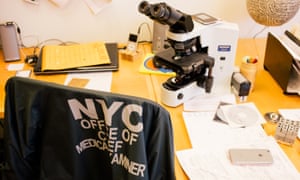
The desk of the Deputy Chief Medical Examiner Photograph: Ben Zucker for the Guardian
For Aglae Charlot, an elegant senior medical examiner with a pronounced French accent who has worked at the office since 1987, it was a teenage girl who came in a few years back. The girl died in the hospital of an unusual illness, from which her mother also suffered. The illness can be idiopathic or caused by Aids. The hospital had assumed it was idiopathic since the mother had the same illness.
When Charlot investigated, she found the teenager did actually have Aids, which she must have been suffering from for five or six years.
Upon further investigation, she discovered the mother’s boyfriend had died of Aids.
Infecting a child and causing her death is murder, she explains to me, her jaw tensing. Charlot knew she could probably trace the particular strain of Aids back to the boyfriend, but what would it change? He was dead, so could not be charged, and it would only cause more pain for the living. She put Aids as the cause of death on the certificate, and left it at that.
Seeing the lighter side
“We all have an odd sense of humor,” says Christopher Brock, a bearded young medical examiner sitting in front of a file cabinet covered by photos of his wife and two young children. “We are often smiling, and I think you have to when you are surrounded by this every day.”
In Hammers’s office, her crooked playfulness is on display in a framed, fake blood-spattered sign above her desk that reads: “Braainns.”
Humor can provide a release in an environment that is fraught with stress. “One of the things a lot of people don’t realize is that we deal with the living just as much as we deal with the dead,” says Brock. “We provide answers to families.”
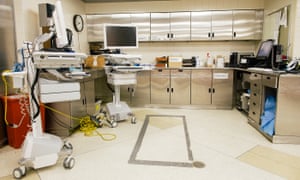
Check out station at the morgue Photograph: Ben Zucker for the Guardian
Much of the week is spent performing autopsies, and the rest of it filling out paperwork, testifying in court and speaking with the families of the dead.
At a time when primary care physicians rarely have more than two minutes to speak with a living patient, it’s strange somehow that the medical examiners can spend hours explaining their findings to the families, comforting them and helping them deal with their grief.
“Every family really wants to know what happened to their loved one and have their questions answered in order to have closure,” says Hammers. “Even if it is a hard answer like in the case of a suicide, it wouldn’t be what they prefer to hear but it allows them to have an answer and then work their grief around that and move through it.”
As Brock puts it, when it comes to the deceased: “We are their last physicians.”
The human brain can be compared to one thing like a large, bustling city. It has staff, the neurons and glial cells which co-operate with every single other to process details it has offices, the clusters of cells that perform collectively to achieve certain duties it has highways, the fibre bundles that transfer data across lengthy distances and it has centralised hubs, the densely interconnected nodes that integrate info from its distributed networks.
Like any large city, the brain also generates large amounts of waste products, which have to be cleared away so that they do not clog up its delicate moving parts. Right up until really just lately, although, we knew extremely small about how this happens. The brain’s waste disposal program has now been identified. We now know that it operates although we rest at night, just like the waste collectors in most big cities, and the most recent analysis suggests that specific sleeping positions may well make it more efficient.
Related: Newly identified vessels beneath skull could link brain and immune system
Waste from the rest of the physique is cleared away by the lymphatic method, which tends to make and transports a fluid referred to as lymph. The lymphatic program is an critical part of the immune system. Lymph consists of white blood cells that can kill microbes and mop up their remains and other cellular debris. It is carried in branching vessels to every organ and physique element, and passes by means of them, via the spaces between their cells, picking up waste materials. It is then drained, filtered, and recirculated.
The brain was considered to lack lymphatic vessels altogether, and so its waste disposal system proved to be far more elusive. A number of years in the past, nevertheless, Maiken Nedergaard of the University of Rochester Health-related Center and colleagues identified a technique of hydraulic “pipes” working alongside blood vessels in the mouse brain. Employing in vivo two-photon imaging to trace the movements of fluorescent markers, they showed that these vessels carry cerebrospinal fluid close to the brain, and that the fluid enters inter-cellular spaces in the brain tissue, choosing up waste on its way.
Nedergaard and her colleagues also found that suitable perform of these vessels depends on movements of water close to the brain, which are carried out by glial cells known as astrocytes, and for that reason named them the glymphatic system. They went on to show that inter-cellular spaces broaden by up to 60% in the brains of naturally sleeping and anaesthetised mice, and that this growth drives the clearance of waste from the brain by facilitating the movements of lymph and water.
Last month, researchers from the University of Virginia reported the identification of lymphatic vessels in the central nervous system. They demonstrated that the lymphatic program extends into the dura mater, the thickest and outer-most of the three meningeal membranes that envelope the brain and spinal cord. These vessels run parallel to the major veins and arteries, and split to send branches deep into the brain’s crevices. The researchers think that these vessels could be linked to the glymphatic method, and could make up the second stage of the disposal mechanism, which would transport waste out of the brain and spinal cord altogether.
The most current research from Nedergaard’s group, published in the Journal of Neuroscience earlier this month, shows that physique posture has an effect on the efficiency of the glymphatic system’s waste clearance. Utilizing fluorescence microscopy and radioactive tracing as soon as again, they showed that it worked greatest in mice lying on their sides in contrast to individuals lying on their back or standing up.
Connected: The neuroprotective way of life | Mo Costandi
The function of sleep was when deeply mysterious, but there is lots of evidence that it is crucial for memory consolidation, and it would now look to be essential for the effective elimination of waste from the brain, too. Though these scientific studies have been performed in mice, preliminary results suggest that lymphatic vessels are also current in the human brain and spinal cord, but further study will be necessary to verify that they truly constitute a doing work waste disposal system.
Eventually, the website link to sleep could have important implications for the therapy of neurodegenerative illnesses such as Alzheimer’s and Parkinson’s, all of which involve the develop-up of misfolded proteins inside and around nerve cells, simply because of a defective waste disposal method. Without a doubt, it is now appears clear that very good rest hygiene has a neuroprotective result and, in line with this, other investigation demonstrates that rest disturbances predict the onset of neurodegeneration.
Sleeping on the side just takes place to be the most popular sleeping posture for each mice and people, and so this preference might have evolved to optimise the waste disposal method and thus make sure that the metropolis of the brain runs as efficiently as feasible.
References
Lee, H. et al. (2015). The Result of Body Posture on Brain Glymphatic Transport. J. Neurosci, 35: 11034-44. DOI: ten.1523/JNEUROSCI.1625-15.2015.
Louveau, A., et al. (2015). Structural and practical attributes of central nervous system lymphatic vessels. Nature, 523: 337-41. DOI: 10.1038/nature14432.
Xu, L., et al. (2014). Rest Drives Metabolite Clearance from the Adult Brain. Science, 342: 373-7. DOI: ten.1126/science.1241224. [Full text]
Iliff, J., et al. (2013). A Paravascular Pathway Facilitates CSF Flow Via the Brain Parenchyma and the Clearance of Interstitial Solutes, Including Amyloid β. Sci. Trans. Med., 4: 147ra111. DOI: ten.1126/scitranslmed.3003748. [Full text]
Published in Proceedings of the National Academy of Sciences, the review performed by Eyal Abraham of Bar-Ilan University, Israel, builds on previous work which mapped the alterations in the brains of new mothers.
It was not clear if that pattern is a outcome of the hormonal and other changes that accompany pregnancy or a response to the knowledge of motherhood.
To find out, Mr Abraham, doing work with Ruth Feldman of Bar Ilan and Professor Talma Hendler of the Tel-Aviv Sourasky Center, filmed 89 new mothers and fathers interacting with their infants at house.
They then measured the parents’ brain activity even though watching these videos in an MRI tube, as properly as viewing movies their young children did not star in.
For the twenty mothers in the research watching their infants triggered heightened exercise in the brain’s emotion-processing areas, especially in a framework known as the amygdala, which was 5 instances a lot more active than when watching other video clips.
“These are areas that react unconsciously to indications of an infants’ wants, and that derive deep emotional reward from seeing the baby,” research co-writer Ms Feldman said.
For the 21 heterosexual fathers, who have been really involved in raising their infant but whose wives took the parenting lead, viewing their infant enhanced activation of cognitive circuits, notably a construction that interprets a baby’s cries and non-verbal cues.
The 48 gay fathers raising youngsters with their husbands mirrored each mothers and fathers in terms of the modifications to brain activity.
Their emotional circuits have been as energetic as these of the mothers and the interpretive circuits showed the same additional action as that of heterosexual fathers.
The far more time a guy invested as principal caregiver to a child, the greater the connectivity suggesting playing the two parental roles brought on the brain to integrate the structures essential for every single.
Ms Feldman stated: “In all fathers, the overlap, or connectivity, amongst the two brain systems – emotional processing and mentalizing or amygdala and STS – is higher the much more the father is involved in childrearing responsibilities. That is, the mentalizing network recruits the emotional network.”
She extra: “Fathers’ brains are very plastic.
“When there are two fathers, their brains should recruit each networks, the emotional and cognitive, for optimum parenting.”
The following stage will be for scientists to execute neuroimaging on males and ladies just before and then right after they became mothers and fathers, to check that any heightened activity followed junior’s arrival and was not current before.
But Feldman is assured that the brain action benefits from parenting.
Gay guys appear to show the two maternal and paternal modifications in their brain activity as they execute the dual function of mother and father.
The findings could fuel the debate over whether gay guys must be permitted to adopt youngsters, especially in the US where numerous adoption companies will not perform with identical-sex couples and some states have banned them from adopting.
Published in Proceedings of the National Academy of Sciences, the research builds on earlier work which mapped the adjustments in the brains of new mothers.
It was not clear if that pattern is a result of the hormonal and other adjustments that accompany pregnancy or a response to the expertise of motherhood.
To locate out, neuropsychologist Ruth Feldman of Bar-Ilan University, Israel, and her colleagues filmed 89 new mothers and fathers interacting with their infants at house.
They then measured the parents’ brain activity even though watching these movies in an MRI tube, as nicely as viewing videos their youngsters did not star in.
For the 20 mothers in the examine viewing their babies triggered heightened exercise in the brain’s emotion-processing areas, specifically in a structure known as the amygdala, which was 5 occasions more lively than when watching other movies.
“These are areas that react unconsciously to signs of an infants’ needs, and that derive deep emotional reward from seeing the little one,” Ms Feldman explained.
For the 21 heterosexual fathers, who have been quite involved in raising their little one but whose wives took the parenting lead, viewing their infant increased activation of cognitive circuits, particularly a construction that interprets a baby’s cries and non-verbal cues.
The 48 gay fathers raising children with their husbands seemed to be each mom and father in terms of the modifications to brain exercise.
Their emotional circuits had been as energetic as people of the mothers and the interpretive circuits showed the very same extra action as that of heterosexual fathers’.
The following stage will be for scientists to complete neuroimaging on guys and females before and then right after they became parents, to verify that any heightened exercise followed junior’s arrival and was not current before.
But Feldman is assured that the brain action final results from parenting.
She points out that in gay fathers, but not heterosexual ones, the brain also had added communication lines in between emotional and cognitive structures.
The more time a man invested as major caregiver to a little one, the greater the connectivity. It was as if enjoying the two parental roles triggered the brain to integrate the structures essential for every.
“Fathers’ brains are very plastic,” Feldman said.
“When there are two fathers, their brains must recruit both networks, the emotional and cognitive, for optimal parenting.”
The Department of Health has commissioned the world’s largest review into the results of mobile phones’ radio waves on childrens’ brains, 9 years after a government examine mentioned youngsters need to only use mobile phones when “definitely needed”.
The Study of Cognition, Adolescents and Mobile Phones (Scamp) will examine about 2,500 schoolchildren at the ages of eleven and twelve, gather information about how they use the phones and how a lot time they spend on them, and assess them two years later on on mental functions this kind of as memory and interest, which carry on to develop into the teenage many years.
Whilst no research has ever proven harmful effects from the lower-energy radio waves, recognized as “non-ionizing radiation”, created by mobile phones, nearly all have targeted on grownups.
The last tips on childrens’ use of mobile phones came in the Stewart report in January 2005, in which Sir William Stewart advised that as a precaution youngsters under eight should not use mobile phones at all, and that older kids ought to use it for texting rather than voice calls.
Considering that then ownership of mobile phones has continued to rise: an estimated 70% of 11- to 12-12 months-olds in the United kingdom now personal a mobile telephone, increasing to 90% by age 14.
The Scamp study will be led by Dr Mireille Toledano, of the faculty of medicine at Imperial College, who has written papers on investigations into claims of cancer hyperlinks between reduced-energy emissions from mobile phones and from power lines.
The Scamp research was commissioned by the Department of Health by means of the Investigation Initiative on Well being and Mobile Telecommunications, which is funded jointly by the government and mobile telephone operators.
Toledano stated: “This suggestions to mother and father is based on the precautionary principle, offered in the absence of offered evidence, and not simply because we have proof of any hazardous effects.
“As mobile phones are a new and widespread technological innovation central to our lives, carrying out the Scamp study is important in buy to offer the proof base with which to inform policy and via which parents and their kids can make informed life selections.
“By assessing the young children in yr seven and once again in year nine we will be able to see how their cognitive capabilities produce in relation to altering use of mobile phones and other wireless technologies.”
The study will by its nature contain some examination of the impact of Wi-Fi capability, given that a lot of children now use smartphones – which have a tendency to have higher SAR (distinct absorption charge) values, a measure of how considerably electromagnetic radiation is absorbed by the entire body for the duration of use, than older mobile phones.
But even that image is complex simply because older phones tend only to use GSM technological innovation, which emits far more radiation than the 3G technological innovation of newer phones.
Current Uk overall health guidelines, based mostly on the 2005 Stewart report, say young children underneath 16 should be encouraged only to use mobile phones for crucial calls, and in which possible to use a hands-cost-free kit or to send text messages. When they do have to make calls, they are advised to maintain them brief.
Regardless of there currently being no convincing evidence that mobile phones impact adult wellness, authorities have hypothesized that youngsters could be much more vulnerable to any results due to their developing nervous methods and thinner skulls, which absorb greater levels of radio energy.
Professor Patrick Haggard, deputy director of the Institute of Cognitive Neuroscience at University College London and chairman of the Scamp steering committee, said it was crucial to have a properly-funded, huge-scale review. “It has taken a long time to get to this. A longitudinal examine, which seems to be at a lot folks, is much better but a lot more expensive and tough to set up.”
A whole lot of earlier scientific studies had been too tiny to rule out chance effects, he stated. “It truly is good that the Uk is major in this. I hope that the public, dad and mom and little ones are prepared to give generously of their time.”
The World Well being Organisation (WHO) has ranked forward-hunting scientific studies of the results of mobile phones on children and adolescents as a “highest priority research want”, but to date there are only two scientific studies, both in Europe, focusing on childhood cancers and mobile phone use. One particular has reported no association and the other is ongoing.
Co-investigator Professor Paul Elliott, director of the MRC-PHE Centre for Setting and Wellness at Imperial University, stated: “Scientific proof accessible to date is reassuring and displays no association in between exposure to radio frequency waves from mobile mobile phone use and brain cancer in grownups in the brief phrase (much less than 10 many years of use). But the proof obtainable regarding lengthy term heavy use and children’s use is restricted and significantly less clear.”
Another study, named Cosmos, which has a United kingdom arm funded by the Department of Health, is currently investigating the attainable lengthy-term wellness results of mobile phones on 290,000 adult users over a time period of twenty to 30 many years. The most recent examine on this topic was carried out in Australia from 2006-7 with 250 participants, and published in 2010. It found no statistical impact.
Toledano said: “Scamp will complement this other research by focusing on the ongoing advancement of cognitive functions in the brain for the duration of adolescence.
“Cognition is primarily how we feel how we make selections and how we approach and recall information. It is linked to intelligence and educational achievement and kinds the building blocks of the modern and creative potential of each personal and consequently society as a complete.”
Youngsters volunteering for the review will undertake classroom-based mostly computerised tasks developed to measure cognitive abilities that underpin functions this kind of as memory and attention. Collectively with their dad and mom, they will also response concerns about their use of mobile phones and other gadgets, wellbeing and life style.
Toledano additional: “Taking element in Scamp is a wonderful chance for colleges to bring ‘live’ science into their classrooms, display young children how we conduct wellness investigation and, above all, for colleges, pupils and dad and mom to make a real contribution to the well being of present and long term generations.”
The Department of Well being has commissioned the world’s biggest study into the effects of mobile phones’ radio waves on childrens’ brains, nine many years following a government study said children must only use mobile phones when “totally essential”.
The Review of Cognition, Adolescents and Mobile Phones (Scamp) will examine about 2,500 schoolchildren at the ages of 11 and 12, acquire data about how they use the phones and how a lot time they invest on them, and assess them two many years later on on psychological functions such as memory and consideration, which carry on to produce into the teenage years.
Even though no review has ever shown damaging effects from the minimal-power radio waves, known as “non-ionizing radiation”, produced by mobile phones, almost all have targeted on grownups.
The final suggestions on childrens’ use of mobile phones came in the Stewart report in January 2005, in which Sir William Stewart suggested that as a precaution kids under eight ought to not use mobile phones at all, and that older youngsters must use it for texting rather than voice calls.
Since then ownership of mobile phones has continued to rise: an estimated 70% of eleven- to 12-12 months-olds in the Uk now own a mobile phone, increasing to 90% by age 14.
The Scamp examine will be led by Dr Mireille Toledano, of the faculty of medication at Imperial College, who has written papers on investigations into claims of cancer back links among minimal-energy emissions from mobile phones and from power lines.
The Scamp review was commissioned by the Department of Overall health through the Analysis Initiative on Well being and Mobile Telecommunications, which is funded jointly by the government and mobile mobile phone operators.
Toledano stated: “This guidance to mother and father is based mostly on the precautionary principle, provided in the absence of obtainable evidence, and not simply because we have proof of any damaging results.
“As mobile phones are a new and widespread technological innovation central to our lives, carrying out the Scamp examine is important in order to offer the evidence base with which to inform policy and by way of which parents and their kids can make informed lifestyle options.
“By assessing the youngsters in yr 7 and yet again in 12 months 9 we will be in a position to see how their cognitive abilities create in relation to changing use of mobile phones and other wireless technologies.”
The study will by its nature include some examination of the impact of Wi-Fi capability, offered that several young children now use smartphones – which have a tendency to have larger SAR (specific absorption charge) values, a measure of how a lot electromagnetic radiation is absorbed by the body during use, than older mobile phones.
But even that picture is challenging since older phones have a tendency only to use GSM technologies, which emits a lot more radiation than the 3G engineering of newer phones.
Recent Uk health tips, based on the 2005 Stewart report, say kids beneath 16 ought to be encouraged only to use mobile phones for vital calls, and the place attainable to use a hands-free of charge kit or to send text messages. When they do have to make calls, they are suggested to maintain them brief.
Regardless of there becoming no convincing proof that mobile phones impact grownup well being, authorities have hypothesized that young children could be far more vulnerable to any results due to their developing nervous techniques and thinner skulls, which soak up larger ranges of radio power.
Professor Patrick Haggard, deputy director of the Institute of Cognitive Neuroscience at University University London and chairman of the Scamp steering committee, explained it was crucial to have a properly-funded, large-scale review. “It has taken a extended time to get to this. A longitudinal research, which seems to be at a whole lot men and women, is far better but a lot more high-priced and difficult to set up.”
A great deal of earlier scientific studies were also modest to rule out likelihood effects, he mentioned. “It truly is great that the Uk is leading in this. I hope that the public, parents and kids are ready to give generously of their time.”
The Globe Well being Organisation (WHO) has ranked forward-hunting studies of the effects of mobile phones on children and adolescents as a “highest priority analysis want”, but to date there are only two research, each in Europe, focusing on childhood cancers and mobile mobile phone use. 1 has reported no association and the other is ongoing.
Co-investigator Professor Paul Elliott, director of the MRC-PHE Centre for Atmosphere and Health at Imperial School, explained: “Scientific proof offered to date is reassuring and shows no association amongst publicity to radio frequency waves from mobile phone use and brain cancer in grownups in the quick term (significantly less than 10 years of use). But the evidence obtainable concerning lengthy term heavy use and children’s use is constrained and less clear.”
Another examine, called Cosmos, which has a United kingdom arm funded by the Department of Health, is at present investigating the attainable extended-phrase health results of mobile phones on 290,000 adult users in excess of a period of twenty to 30 years. The most current research on this topic was carried out in Australia from 2006-7 with 250 participants, and published in 2010. It found no statistical result.
Toledano said: “Scamp will complement this other investigation by focusing on the ongoing growth of cognitive functions in the brain for the duration of adolescence.
“Cognition is essentially how we believe how we make selections and how we method and recall data. It is linked to intelligence and educational achievement and kinds the constructing blocks of the progressive and imaginative likely of each and every personal and for that reason society as a whole.”
Youngsters volunteering for the review will undertake classroom-primarily based computerised tasks made to measure cognitive skills that underpin functions this kind of as memory and consideration. Collectively with their parents, they will also reply concerns about their use of mobile phones and other devices, wellbeing and way of life.
Toledano additional: “Taking part in Scamp is a amazing possibility for schools to deliver ‘live’ science into their classrooms, demonstrate youngsters how we perform overall health research and, over all, for colleges, pupils and mothers and fathers to make a real contribution to the wellness of recent and future generations.”
A single of the biggest scientific studies ever performed on the extended-phrase results of alcohol consumption suggests that heavy drinking is linked to considerable cognitive decline in middle-aged guys. The brains of girls, nonetheless, look to be protected towards the identical effects for motives that are not clear.
Cognitive decline in the examine was defined in two techniques: a decrease in executive function (the brain’s processing pace and efficiency), and deterioration in memory.
Researchers analyzed information from the Whitehall II cohort research, which began in the mid-1980s with roughly 10,000 British civil servants who agreed to full lifestyle questionnaires and undergo a physical exam at specified instances in the course of a almost 20-yr span. The research design and style allowed researchers to track results of way of life selections, including drinking alcohol, more than extended intervals of time.
The examine identified that middle-aged males (average age 56) who drank 36 grams, the equivalent of about 1.two fluid ounces, or more of alcohol a day for 10 years knowledgeable greater memory reduction and slowing of executive function as compared to “occasional” or “moderate” drinkers who consumed in between .03 and 1.one ounces a day.
To put this in point of view, a standard shot of 80-proof whiskey is 1.5 fluid ounces, only .6 fluid ounces of which is pure alcohol. So a heavy drinker, as defined in this research, drank at least two shots of their booze of option a day. If the review participants were wine or beer drinkers, they drank at least ten fluid ounces of wine or 24 fluid ounces of beer a day to attain the identical alcohol degree.
The kind of alcohol manufactured no big difference in the research benefits drinking the equivalent of one.two or far more fluid ounces of alcohol in beer, wine or challenging liquor had the same outcome.
Heavy consuming for women was defined in a different way due to the distinctions in how the sexes metabolize alcohol. To qualify as a heavy drinker in this research, a girl had to drink at least 19 grams (.6 fluid ounces) of alcohol a day—about half of the male degree.
Oddly, heavy drinkers amongst female participants didn’t demonstrate almost the exact same degree of cognitive decline as males.
The examine authors didn’t speculate as to why this big difference exists, but it is feasible that the hormone, estrogen, plays a part. A research conducted in 2001 by University of California-Davis researchers showed that estrogen acts as a guardian of brain cell health, and increased amounts of the hormone are linked to a reduced threat of creating Alzheimer’s disease. Estrogen may possibly also act as a hormonal shield against alcohol toxicity.
It is worth mentioning that even however this examine did not demonstrate the same toxic results of alcohol in women’s brains, there are plenty of other factors to drink in moderation, not the least of which is liver well being.
As with any cohort examine, this one has a handful of drawbacks—chief amongst them that so numerous elements have an effect on brain health more than extended intervals, it is difficult to isolate particular aspects, like alcohol consumption, as the real culprit of cognitive decline.
On the other hand, this study’s strength is in the numbers. About 10% of guys in the examine experienced as hefty drinkers—more than 700 participants—and the signs of cognitive decline across this group have been consistently significant.
The brains of drinkers in the occasional and moderate classes seemed to climate the many years fairly properly, about the identical as people who either quit drinking or chose to not drink at all.
The examine was published in the journal Neurology.
US researchers’ declare is the newest in a developing list of advantages that reasonable caffeine consumption appears to offer Photograph: Alamy
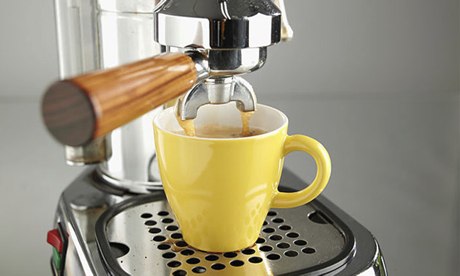
A cup or two of coffee could improve the brain’s capability to store extended-term memories, researchers in the US claim. Folks who had a shot of caffeine after hunting at a series of photographs were greater at distinguishing them from related photographs in tests the next day, the scientists discovered.
The process offers a measure of how exactly details is stored in the brain, which aids with a procedure known as pattern separation which can be critical in each day scenarios.
If the impact is real, and some scientists are doubtful, then it would add memory enhancement to the expanding record of positive aspects that moderate caffeine consumption would seem to offer.
Michael Yassa, a neuroscientist who led the examine at Johns Hopkins University in Baltimore, said the potential to separate patterns was crucial for discriminating among similar scenarios and experiences in daily life.
“If you park in the same parking lot every single day, the spot you pick can search the same as a lot of other people. But when you go and appear for your car, you want to look for exactly where you parked it today, not in which you parked it yesterday,” he said.
Writing in the journal Nature Neuroscience, Yassa described how 44 volunteers who were not hefty caffeine customers and had abstained for at least a day have been proven a quick sequence of images on a personal computer screen. The photos included a large variety of objects, this kind of as a hammer, a chair, an apple, a seahorse, a rubber duck and a auto.
When every single image flashed up on the display, the particular person viewing had to say whether the object was generally identified indoors or outdoors, but they have been not asked to memorise the images. At the end of the process, each volunteer was randomly assigned both a 200mg caffeine pill or a placebo. A standard cup of coffee contains about 150mg of caffeine.
The subsequent day, the scientists brought the volunteers back and sat them down at the laptop once again. This time, the sequence of images integrated a lot of they had noticed the day ahead of, but some have been new and others had been equivalent. The related images varied in how close to the originals they had been. Some showed the identical object from a different angle, even though others had been a equivalent variety of object, this kind of as a various design of hammer from the a single they had observed just before.
For this component of the study, the volunteers had to say regardless of whether each and every image was either new, outdated or similar to 1 they had noticed the day ahead of. In accordance to Yassa, the caffeine and placebo groups scored the same except when it came to spotting the similar pictures. In this task, the caffeine group scored all around ten% greater, he stated.
“What I’ve taken from this is that I ought to preserve drinking my coffee,” Yassa advised the Guardian. “Our examine suggests there’s a real finding out and memory advantage, but other studies recommend caffeine is connected with increased longevity, and a resistance to Alzheimer’s illness. In moderate amounts, it could have helpful effects for wellness.”
Yassa said it was unclear how caffeine might help the storage of memories, but 1 concept is that it leads to greater levels of a stress hormone known as norepinephrine in the brain, which assists recollections to be laid down.
Some scientists, nonetheless, say they want a lot more evidence to feel the impact. George Kemenes, a neuroscientist who studies memory at Sussex University, explained the statistical methods utilised in the paper were not excellent adequate to show the effect was genuine. “I have reservations. If the statistics are not proper the whole story, lovely as it is, unravels,” he explained.
“Even if this was solidly true, which in my see it isn’t, it would not show that caffeine has a memory-improving house. It would not get in touch with this an improvement in prolonged-phrase memory.”
Jon Simons, who functions on memory at Cambridge University, mentioned the examine was intriguing and meticulously developed, but the result necessary to be proven in a bigger quantity of individuals. “The claim that caffeine affects the consolidation of memories is primarily based on quite a little impact that would actually benefit from replication in a greater sample to be convincing,” he explained.