welcome etiketine sahip kayıtlar gösteriliyor. Tüm kayıtları göster

13 Şubat 2017 Pazartesi

Welcome to Onitsha: the city with the world’s worst air

Approaching Okpoko market through thick smog on the back of an okada (motorcycle taxi), the natural reaction is to cover your nose to protect yourself from the dust storm – but the effort is futile.


When a lorry zooms past, kicking up yet another red cloud of dirt, a trader turns the head of a sleeping toddler away from the road, a protective act that is as poignant as it is pointless.


This is a typical day in the southern Nigerian port city of Onitsha – which last year gained notoriety when it was ranked the worst city in the world for the staggering levels of PM10 particulate matter in its air.


Onitsha’s mean annual concentration was recorded at 594 micrograms per cubic metre by the World Health Organization – massively exceeding the WHO’s annual guideline limit for PM10s of 20μg/m3.


PM10 refers to coarse dust particles between 10 and 2.5 micrometres in diameter, while PM2.5s are even finer and more dangerous when inhaled, settling deep in a person’s lungs. Sources of both include dust storms, gases emitted by vehicles, all types of combustion, and industrial activities such as cement manufacturing, construction, mining and smelting. Onitsha scores highly on most of the above – as do other rapidly growing Nigerian cities such as Kaduna, Aba and Umuahia, all of which also featured in the WHO’s 20 worst offenders for PM10s.


In Onitsha’s very busy Okpoko market, my air quality monitor registers 140 for PM10s and 70 for PM2.5s – all way over recommended healthy levels, but still nothing compared to the readings triggered in other parts of this densely populated commercial and industrial hub.


The entire vicinity of the market is perpetually dusty, as wood-sellers saw lumber into different shapes and sizes. The air here is made worse by all the fine sand particles that fly off the back of trucks as they visit one of the many dredging companies on the bank of the River Niger, just behind the wood market.
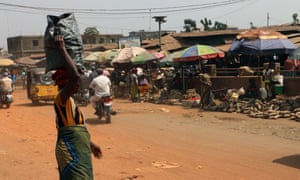


Onitsha, Nigeria, the world’s most polluted city according to the World Health Organisation. For cities: air pollution


Some residents of Onitsha are unaware of the dangerous levels of pollution. Photograph: Hadassah Egbedi for the Guardian

One female traffic warden has been working in the same spot here for two days. How does she cope with the dust? “I am just doing my job,” she replies reluctantly. “Dust does not kill people.”


But she is mistaken. According to the United Nations Environment Programme (Unep), around 600,000 deaths throughout Africa every year are associated with air pollution, while an October 2016 report by the Organisation for Economic Co-operation and Development (OECD) suggested that polluted air could be killing 712,000 people prematurely every year across the continent.


The warden’s attitude towards this invisible but deadly threat is widespread among Onitsha’s residents – but not necessarily because they are nonchalant about their health. Most are simply unaware of the issue.


Some say they have more pressing concerns, such as how to feed their family. Others have simply become accustomed to living in a dirty and polluted environment.


Onitsha is grossly polluted – not just in terms of the air quality, but also the solid waste that litters the streets, blocking drainages and canals. With not a single waste bin in sight, heaps of unregulated rubbish dumps occupy roadsides and street corners.
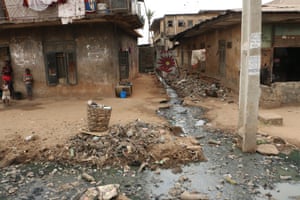


Onitsha, Nigeria, the world’s most polluted city according to the World Health Organisation. For cities: air pollution


Rubbish clogs Onitsha’s streets, drainages and canals. Photograph: Hadassah Egbedi for the Guardian

Ikechukwu Obizue, a businessman in the neighbourhood of Nwangene, says residents can only do so much when there is little corresponding effort by the city’s government.


“Onitsha is quite dirty, but the government is not doing anything about it. We do environmental sanitation monthly, but then the city returns to being dirty,” Obizue says. “It is the government’s responsibility to keep the city clean, not the work of the residents – people in this city are too busy hustling to make an income.”


‘We don’t take air pollution seriously’


In Nwangene, my air monitor shows 667μg/m3 for PM10s – a reading in excess of the 594 annual figure that gave Onitsha its title of the world’s most polluted city. What’s more, the smaller and even more dangerous particulate (PM2.5) reading of 290 is far in excess of the WHO’s annual figure of 66.


We are in deep trouble. People will keep dying as stakeholders remain nonchalant


Nelson Aluya


The air quality proves just as bad at Ochanja market, with PM10s registered at 586 micrograms and PM2.5s at 266. Yet in these highly polluted areas, few people show any sign of trying to protect themselves from the threat.


There are only a few air masks in sight. A good number of aluminium and copper recyclers are not wearing masks, even while smelting metal scraps. Worse still, most smelting activities are done in the open, releasing monstrous clouds of smoke into the core of the city.


At one of the few state-approved dump sites on Creek Road, Ikechuckwu works at a smelting workshop. He is sweating profusely as he sits on a pile of ash, taking a break from work. He explains he has been smelting iron for a little over five years – but says not to worry about his health.


“I know how to take care of myself,” he brags. “I am not wearing a nose mask because I don’t need it. I take medicine to cater for my health.”
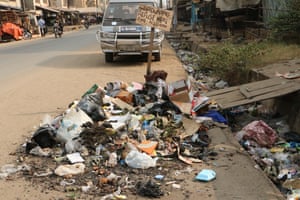


Rubbish in Onitsha


Residents conduct a monthly cleanup, but the city quickly fills with waste again. Many locals blame government inaction for the problem. Photograph: Hadassah Egbedi for the Guardian

It is hard to determine to what extent these high concentrations of particles are affecting the residents of Onitsha, since there is no official data – but the health effects attributed to sustained exposure to PMs, especially PM2.5s, are well proven.


For a state government that can barely manage its waste disposal system, however, regulating its air quality appears a far-fetched aspiration. The now defunct Anambra State Environmental Protection Agency was widely criticised for failing in its responsibility to effectively tackle environmental pollution, and in its place, the Anambra State Waste Management Agency was created – with little effect.


The state’s Ministry of Environment, Beautification and Ecology did not respond to the Guardian’s questions regarding air pollution in Onitsha.


“The major problem is that we don’t take air pollution seriously in Nigeria,” says medical practitioner Dr Nelson Aluya. “As the population increases and we become more industrialised, we ought to have active air-monitoring agencies and a federal environmental protection agency. We say they are there – but are they active?”


In truth, air quality monitoring and control is not on the radar of many African governments. Nigeria has a long list of environmental protection laws and regulations that are barely enforced.


“Even in the healthcare sector,” Aluya continues, “there is no standardised care to monitor those who have chronic obstructive pulmonary diseases resulting from exposure to bad air, and no standard procedure in hospitals to check for oxygen levels.


“So you see, we are in deep trouble. If we have not recognised the fact there’s a problem, then how do we solve it? Unfortunately, people will keep dying as stakeholders remain nonchalant.”


Guardian Cities is dedicating a week to investigating one of the worst preventable causes of death around the world: air pollution. Explore our coverage at The Air We Breathe and follow Guardian Cities on Twitter and Facebook to join the discussion


Welcome to Onitsha: the city with the world’s worst air

27 Kasım 2016 Pazar

Welcome to skyr, the Viking ‘superfood’ waking up Britain

One of Iceland’s top dairy experts will arrive in Britain this week to help an adventurous Yorkshire farmer increase production of skyr, a Viking food that was barely known beyond the north Atlantic for a thousand years but is now being marketed as a “superfood”.


Ten years ago skyr – prounced skeer with a trill on the r – barely registered in the world’s yoghurt market. Now, according to global business consultants Future Market Insights, the market for skyr is worth nearly $ 8bn (£6.4bn) a year and growing fast.


The skyr boom first took off in the US and Scandinavia and could sweep into Asia after a recent visit to Japan and China by Icelandic dairy farmers. Skyr first went on sale in British supermarkets in 2015 and is still relatively unknown here – but that could be about to change.


Yorkshireman Sam Moorhouse, 23, the only British farmer making skyr, already has a deal with Booths supermarket, known as “the Waitrose of the north”. He will welcome Icelandic dairy expert Thorarinn Egill Sveinsson to Hesper Farm, near Skipton, on Thursday to help him install new equipment.


“I need to scale up to meet demand,” said Moorhouse, who started production in 2015. “The bank was sceptical about funding at first and nobody had heard of skyr, but it has been very popular. I was looking at diversification two and a half years ago and I read an article about skyr. I flew to Iceland to try it, worked at a skyr producer, met Thorarinn and he has helped me since I started.”


Skyr’s popularity in the UK could also be about to be boosted by Arla, one of the world’s biggest dairy companies, which will advertise skyr on TV in January, the month when yoghurt sales are highest.


The biggest producer of “authentic” skyr, MS Dairies, has also identified the UK as its largest growth market. It is owned by 700 Icelandic farmers and has tried for two years to have the skyr trademark protected, like Parma ham or Stilton cheese. It failed and this has allowed big dairy companies such as Arla and other smaller entrepreneurs to cash in on the boom.


So why has something that has been around for a thousand years taken off at the breakfast table?


Iceland’s tourism boom has helped to spread the word, so has a big push from Starbucks and the fact that skyr is thick enough to be eaten “on the go”. But the main reason is what Arla calls skyr’s “three credentials” – low sugar, no fat, and high protein content.


Although it is marketed as a yoghurt, skyr is technically a soft cheese made from skimmed milk. After the whey has been removed by ultra-filtration it is so thick that a spoon will stand up in it. A culture of lactic acid bacteria is added, and the process from cow to supermarket shelf takes three to four days.


The “skyr is good for you” message is broadcast in Scandinavia by Eidur Gudjohnsen, the footballer who scored more than 70 Premier League goals for Chelsea and Bolton, and won the Champions League with Barcelona. He and his father both played for Iceland, and both have eaten skyr all their life.


Arla started selling skyr in Asda last year, and when it launched last year with an advert filmed in Iceland it irked MS Dairies. Like the skyr sold in the US, Arla’s product was not made in Iceland, and the media in Reykjavik wrote of “skyr wars”.


“We own the recipe, they don’t have our culture, so it’s real skyr v copycats,” said Jon Axel Petersson, head of marketing at MS. “Arla is a Danish-Swedish company that makes its skyr in Germany, and they said that they were located in Iceland.”


Viking cows are smaller than European cows, and produce only 60-70% of their milk yield


Jon Axel Petersson, MS Dairies


But Iceland cannot meet demand. It takes 3.5 litres of milk to make one litre of skyr and there are only about 30,000 milk-producing cows in Iceland. “Viking cows are smaller than European cows, and produce only 60-70% of their milk yield,” said Petersson.“They would not be used in other countries because they cannot compete. But they are protected and have been here for a thousand years.”


There has been talk of importing bigger cows, but it seems unlikely.


MS, which produces under licence in Denmark and Norway with local milk and will have to do the same in Britain, started selling its skyr.is brand in Waitrose earlier this year and has just shifted its two millionth pot. Arla has had a good year in Asda, Tesco and Sainsbury’s. Lidl recently joined in with its own brand which, at 49p, is far cheaper than the “authentic” skyr, which sells for £1.25 in Britain and £2.50 in Norway.


UK sales are dwarfed by those in Scandinavia and the US. In Norway and Finland, where the courts allowed MS to protect its skyr by trademark. In Iceland annual consumption is measured in kilos per person.


Iceland’s farmers are making good money – from zero to €70m (£60m) in exports in five years and a 23-fold increase in production. And so are the dairy giants. But not as much as Siggi Hilmarsson, an Icelandic entrepreneur who gave up his job at Deloitte in New York after he started making skyr in his own kitchen.


His mother sent him a recipe from a 1960 women’s magazine she had found at the national library in Reykjavik, and Siggi’s is now the fastest-growing brand in a US yoghurt market worth $ 9bn a year, selling in Starbucks and Whole Foods shops. Hilmarsson had two outlets in 2006 when he started; now he has 25,000.


“After graduating I had a corporate job that I didn’t really like and I started making yogurt as a hobby because I missed eating skyr from home,” said Hilmarsson, who has lived in the US for 14 years. “I asked my mum to find me some recipes.


“I realised there was a market for healthy food with lower sugar content, and especially lower sugar yoghurt. Greek yoghurt is similar in texture but has much more sugar. We have no additives, low sugar, high protein. It’s all clean ingredients.


“When I started I hoped there was a future selling a high-end product that could sustain me and maybe a couple of employees. I thought I could make a living but didn’t foresee this.”


Moorhouse sees Hilmarsson as a role model. “How big will it become? It’s hard to say, but I hope to use all the milk we produce in skyr.”


Welcome to skyr, the Viking ‘superfood’ waking up Britain

21 Ağustos 2015 Cuma

Welcome to the complicated world of 3D-printed drugs

The prospect of tailor-made drugs that are customised to your individual wants has moved a phase closer with the latest announcement of the first 3D-printed (3DP) drug to achieve approval from the US meals and drug administration (FDA).


Relevant: Smile! Meet the 3D printer churning out teeth, nerves and gums for dentists


A visit to the pharmacy may soon involve currently being questioned on your bodyweight, or possessing your percentage of entire body unwanted fat measured so that the medicine can be printed to match your dimension. Younger young children, typically resistant to taking medicine, might be ready to choose the colour, form and layout of a tablet that could be developed to dissolve effortlessly. Imagine antibiotics that search like Peppa Pig or superhero characters.


But as entry to the engineering expands, what are the potential downsides? Will 3DP be risk-free? Could it lead to a proliferation of illegal drugs and how will regulation adapt?


Personalised medication


The vision behind 3DP is that medication will be customised to individuals in approaches that make it safer and far more effective. The dimension, dose, appearance and price of delivery of a drug can be developed to suit an individual. FDA accredited Spritam, for illustration, uses 3DP technology to generate a a lot more porous pill that is simpler to swallow.


“Now that this approval has gone via, a lot more medicines are most likely to come to marketplace,” says Dr Stephen Hilton, of University School London (UCL) School of Pharmacy. The possibilities are that higher street pharmacists will be able to tailor and print out customised drugs inside the subsequent decade.


The choices seem endless. For illustration, some sufferers have to have their stomach removed as component of their treatment method for stomach cancer. Medication could be created to be absorbed from the intestine rather than from the stomach for these folks. The opportunities to fit the drug to the patient will boost as people get their own gene profile.


Obese patients could swallow parts that assemble in the stomach to produce a structure that requires up a great deal of area as an substitute to a gastric band. Yet another thought could link the release of a drug that kills cancer cells with blood ranges of a tumour marker. As the cancer grows, blood amounts of the tumour marker rise and this would set off release of the drug into the cancer.


Lee Cronin, professor of chemistry at Glasgow University, says that current technological innovation enables prepared-produced medication to be adapted and made by 3DP. “Like taking a strong bar of chocolate and including air bubbles to make an Aero,” he says. The 3DP acts as a proxy robot, mixing person constituents like an automated cocktail maker, he explains.


But the actual challenge is to digitise the chemistry so you have a blueprint for molecules and can construct medication from scratch. The blueprint could be encrypted to make certain that medication are only created according to a validated blueprint and, the hope is, counterfeit medication would turn into a point of the past.


In a TED speak, Cronin explained how it could be completed. “It requires application, it requires hardware and it calls for chemical inks. And so the really awesome bit is the thought that we want to have a universal set of inks that we place out with the printer and you download the blueprint, the natural chemistry for that molecule, and you make it in the gadget. And so you can make your molecule in the printer employing this computer software.”


If Cronin’s vision turns into a actuality, the blueprints could be downloaded for a modest charge. The medication themselves could be produced in nearby pharmacies, which are probably to see their position change radically above the up coming five many years.


Alternatively of storing packets of tablets, pharmacists will have reels of filaments of the base solution (our prescribed drug) and will customise the dose and shape of tablet to our person needs. There would be an onus on the pharmacists to verify the customised pills, just as they do now, says Hilton.


Pharmaceutical organizations must not shed out substantially as pharmacists will even now have to acquire the base goods and sell only patented formulations of medication. But Cronin predicts that if 3DP requires off as predicted, they will have to undergo “an unprecedented time period of innovation” to adapt to the new challenges.


The implications


As with any new engineering, it can be a race against time to anticipate and deal with the downsides.


Critics, such as the journalist Mike Energy, have raised worries about the likely for blueprints to be mislabelled, filed below the wrong description or to have a greater strength than advertised.


In accordance to Hilton, any errors are very likely to be due to human error (this kind of as putting the wrong spool of base materials into the printer) but the final product will have to pass a validation check out – which compares the chemical formulation of the tablet to a standard – as they do now. There’s a four-five% failure fee in regular manufacturing, says Hilton and he thinks this is unlikely to alter when 3DP technology is employed.


There is also concern about blueprint hacking. For his element, Cronin accepts that encrypted codes can be hacked but says that the 3DP will have an inbuilt validation technique to permit medicines to be checked towards identified specifications.


Relevant: How 3D printing is set to shake up manufacturing provide chains


And for individuals who envisage crowds of partygoers waiting for sheets of ecstasy to come off the printer, this may not be routed in actuality. The scope for manufacturing illegal medication presently exists and employing a 3DP to customise drugs will not support the illegal drug trade.


1 major issue is how to regulate this brave new planet. David Hodgson, companion in Deloitte’s healthcare and existence sciences team, says that the new technology poses numerous concerns that have nevertheless to be resolved: “The present international, regional and local regulatory atmosphere is incapable of accommodating the ambiguity of a 3D printing method. The query is are we regulating the printer as a health-related gadget, the substances, or the individual or organisation carrying out the printing as the manufacturer and distributor?” In other phrases, where will the liability lie when a drug brings about an adverse response?


The worldwide nature of the technology also poses problems, in accordance to Hodgson. How would drug organizations make sure that the right packaging and consumer instructions had been accessible? And is printing of a drug in a country the place it is not authorized by the regulators acceptable?


The complexity of these problems indicates “it may consider time to embrace 3D printing as a technologies,” Hodgson predicts.


The long term


3DP engineering is presently up and working in many locations. It enables orthopaedic surgeons to print artificial bone, making use of scans to mould surgical supplies into precisely the needed dimension and shaped piece to change broken or missing bone. They’ve designed skull implants for men and women with head trauma and titanium heels to exchange a bone eroded by cancer.


But these customised surgical implants and grafts, like the new drug Spritam, are fairly crude adaptations of existing supplies. The actually interesting innovation is however to come: the capacity to generate bespoke materials. Let’s hope regulation can keep up.


Welcome to the complicated world of 3D-printed drugs

10 Mayıs 2014 Cumartesi

Nursing union welcome new suggestions


Getting hospital nurses care for a lot more than eight patients every for the duration of the day generates an “improved chance of harm”, an NHS watchdog has warned.


The Nationwide Institute for Overall health and Care Excellence (Good) has drawn up draft recommendations to deal with ranges of nursing employees following the Francis Inquiry into the catastrophic care failings at Mid Staffordshire NHS Trust.


The watchdog explained there is more threat of harm if there is a decrease ratio of nurses to individuals, but stopped quick of stipulating 1 to eight was an absolute minimum, stating flexibility was necessary on a day-to-day basis.


Dr Peter Carter from the Royal School of Nursing has welcomed guidelines advising that nurses must not have to appear soon after much more than eight individuals, but has also warned that in some units, nurses must only be seeking after one or two people at a time.


Dr Peter Carter, chief executive of the Royal University of Nursing (RCN), mentioned: “We are encouraged that these suggestions have been developed – following substantial and steady evidence from the RCN of the danger to patients exactly where there are too couple of workers.


“They underline what we presently know – that a registered nurse caring for a lot more than eight individuals under these conditions is a result in for concern – in several cases, substantially far more nurses will be necessary.


Nursing union welcome new suggestions