inside etiketine sahip kayıtlar gösteriliyor. Tüm kayıtları göster

17 Nisan 2017 Pazartesi

Tea, biscuits and classical music: inside an ECT clinic

Electroconvulsive therapy is such a serious treatment that there is something almost prosaic about the place where it happens. There is a sense that the therapy is no more dramatic – or time-consuming – than visiting a blood bank. There is even a tea and biscuit station at the end.


Within a suite of five rooms at the Barnet, Enfield and Haringey Mental Health NHS trust, classical music floats across the airwaves casting an uplifting atmosphere over the standard hospital decor of blue lino, magnolia walls and no-nonsense chairs.


Robert Tobiansky, the lead ECT consultant, talks us through a typical procedure.


“We treat anywhere between 30 and 50 patients per year and it has been like that for as long as I have been around,” he says, adding that numbers for the clinic, held twice a week, vary throughout the year. “Our list today was five – we have been very busy lately.”
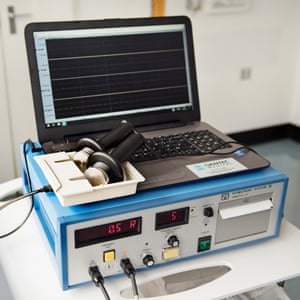


The ECT machine.


The ECT machine. Photograph: Linda Nylind for the Guardian

We pass through a small waiting room and then an office-like space where each patient is talked through the process of ECT and asked for their consent.


Next is the treatment room, a clinical space with one trolley bearing anaesthetic equipment and another carrying the ECT machine.


“It might not look like much, but that blue box cost 25 grand,” says Tobianksy. He picks up the electrodes, or paddles – each about the size of a coffee jar – and demonstrates how they are placed on a patient’s head.


The machine is also connected to what appears to be a jumble of cables. These, says Tobiansky, are for monitoring the patient’s brain activity throughout the procedure. “As well as being able to give an electric stimulus, in such a way that it is giving minimal amounts of electricity but sufficient to induce a seizure, it also monitors the duration of the seizure,” he explains.


After lying down on a trolley the patient is given an anaesthetic and muscle relaxant, with blood oxygen and heart rate monitored. The paddles are then placed on their head and a current applied for just a few seconds – inducing a short seizure.


A stint in the recovery room follows – an airy space with four beds each bearing a green mattress and yellow pillow. On the walls are paintings, while blue blinds are half drawn at the window.
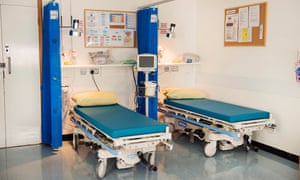


The ECT recovery room at Chase Farm hospital.


The recovery room. Photograph: Linda Nylind for the Guardian

Typically, says Tobiansky, patients are a little groggy, perhaps with a headache or nausea as they come round. “We check how quickly people become re-oriented by asking: ‘Do you know where you are? Do you know the date?’ etc, and we are documenting how long that takes.” Within 15 minutes most patients are back on their feet.


The final room contains a kettle – patients are offered tea or coffee and a biscuit before they leave the suite, an important step since the general anaesthetic means they have had to fast for six hours prior to the treatment.


Typically, says Tobiansky, ECT is used to treat patients with severe depression, often accompanied by psychotic symptoms, a high risk of suicide or a refusal to eat or drink.


“This is somebody who through their depression feels that they are not worthy of eating or drinking, who through their illness is starving – that is a life-threatening condition,” says Tobiansky. “You have not got time to wait for other things not to work. Likely things have been tried and failed.”


But, he adds, negative, dramatic depictions of the treatment in film and other media have left their mark. “Although it is small numbers of people who have the treatment we usually have a big battle against the stigmas and the very negative press ECT has,” he says.


While Tobiansky admits ECT can cause memory problems, and it is difficult to predict to what degree that will affect each patient, he says there is no evidence that it causes brain damage or dementia.


“I have seen it help so many people over so many years where nothing else has helped them,” said Tobiansky.


“In my opinion, ECT is underused. [But] it is not a panacea.”


Tea, biscuits and classical music: inside an ECT clinic

10 Nisan 2017 Pazartesi

Should you take your shoes off inside the house?

My brother is a fastidious shoes-off-er. I visited him recently and, within a couple of minutes, he gestured at my feet in horror. “What are those?” he asked. “These?” I replied, pointing to my trainers. “I bought them onli–” “No!” he yelled. “What are they doing on in my house?”


This is the best way to divide people. There are those who despise the thought of rubber on carpet, who lie awake panicking because wearing outdoors shoes indoors upsets the natural order of things. Then there are normal people like me, who don’t really care because they understand the purpose of doormats.


However, as much as I hate to admit it, the shoes-off-ers might be on to something. A recent study led by researchers at the University of Houston has shown that 26.4% of shoes carry Clostridium difficile, while a 2015 study claimed that 40% of shoes carry Listeria monocytogenes. Work on a farm? A 2014 study concluded that your boots are almost certainly covered in E coli. These are not the things that should be traipsed through living rooms.


But I’m not going out without a fight. Sure, it might be more hygienic to remove your shoes at the door, but only infinitesimally so. By all accounts, you’re unlikely to get ill just because someone is wearing shoes in your living room. And if you have got young kids, who bolt in and out of the house without warning at the first sign of sun, it’s much more practical to keep your shoes on. Not to mention dignified; fewer things inspire more pity than the sight of adults flamingoing themselves into knots as they attempt to do up their shoelaces in a narrow hallway at the end of a night.

True, the answer to both of these problems is loafers. But given the choice of loafers or E Coli, I’ll take the latter every time.


Should you take your shoes off inside the house?

2 Mart 2017 Perşembe

Inside Royal Brompton hospital"s paediatric unit – photo essay

The Royal Brompton in Chelsea is one of three hospitals in London with the facilities and staff to treat children with heart defects. An estimated 5,500 to 6,300 babies are born with congenital heart disease in the UK each year, all of whom require specialised care. Some will need many operations throughout their life.


On Friday, the Guardian will be live blogging from the Brompton, where congenital heart disease services are under threat of closure. Advocates of the change say concentrating services in fewer locations makes for better care; the hospital and its supporters say it is the best at what it does in the country. The Brompton treats children with heart and lung diseases aged from just days old to 16 years. It has a paediatric intensive care unit (PICU) for children after surgery with at least one dedicated nurse per child, the Rose ward for 30 inpatients, and four beds in a high-dependency care unit (HCU).


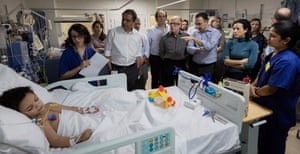
The morning ward-around


The morning ward-around Photograph: David Levene for the Guardian

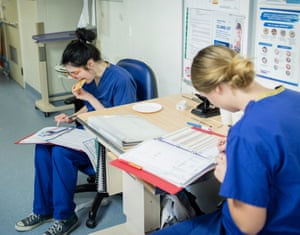
  • Morning routines: the ward-around meeting, and breakfast on the fly for the nurses


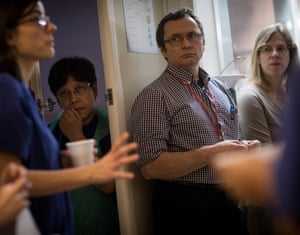
The morning ward-around meeting


The morning ward-around meeting Photograph: David Levene for the Guardian


Nurses eat breakfast while doing paperwork


Nurses eat breakfast while doing paperwork at about 8am Photograph: David Levene for the Guardian

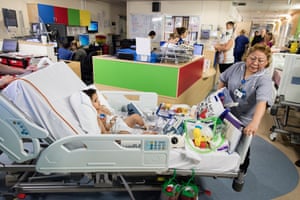
Doctors, consultants and nurses tour the paediatrics department in the morning ward-around. It is a crucial opportunity to discuss the various cases and what to expect for the day ahead.


Young patients


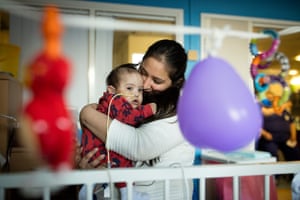
Kawaljit Kaur and her baby Ekam, inside Rose ward


Kawaljit Kaur and her baby Ekam, inside Rose ward Photograph: David Levene for the Guardian

Kawaljit Kaur spends all day, every day, at the bedside of her first and only child, Ekam, who is five months and 19 days old, she says, and was born with a hole in his heart. “I play with him. He holds my hand. We talk to each other and he gives me a smile,” she says. Ekam, sleeping flat on his back with his face hidden by tubes, flails his limbs in the air. “He is very lively,” says a nurse.


After work, Kaur’s husband joins her before they go home for the night. And in the morning she is back. “On Saturday and Sunday we are both sitting here, watching what he is doing,” she says.


Autumn Russell with her mother Keri


Autumn Russell with her mother Keri Photograph: David Levene for the Guardian

  • Autumn Russell with her mother Keri

Fifteen-month-old Autumn Russell from Essex was transferred to the Brompton for specialist treatment for a case of empyema, a bacterial infection that develops in the slim space between the outside of the lungs and the inside of the chest cavity.


Time may pass slowly on the ward in the paediatric heart and lung unit, but for children like Ekam and their parents, the hospital becomes part of their life – a second home and a place of hope. Ekam’s veins are still too narrow for the heart operation he needs, so he has a succession of stents fitted – tubes inserted into blood vessels to increase the flow.


Marciee Barnes-Palmer


Marciee Barnes-Palmer, who has respiratory problems and a congenital heart defect Photograph: David Levene for the Guardian

Marciee Barnes-Palmer has respiratory problems as well as a congenital heart defect. She underwent a microlaryngoscopy and bronchoscopy procedure to look at her upper airways, and doctors will need to close the hole in her heart.


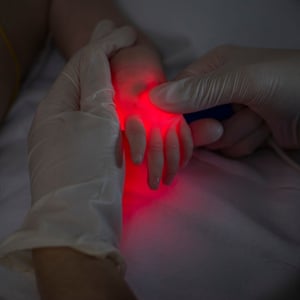
Dr Jana Kossaibati uses a torch to locate a vein in Marciee Barnes-Palmer’s hand


Dr Jana Kossaibati uses a torch to locate a vein for a cannula in Marciee Barnes-Palmer’s hand Photograph: David Levene for the Guardian


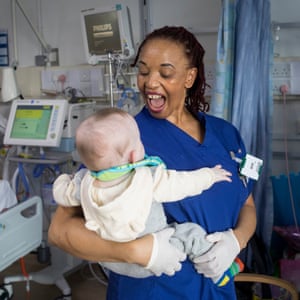
Paediatric nurse Patience Makuyana holds Marciee’s brother Freddie


Paediatric nurse Patience Makuyana holds Marciee’s brother Freddie Photograph: David Levene for the Guardian

  • Dr Jana Kossaibati uses a torch to locate a vein to insert a cannula in Marciee’s hand. Nurse Patience Makuyana holds Marciee’s brother Freddie


Consultant clinical psychologist Michele Puckey


Consultant clinical psychologist Michele Puckey supports the families, patients and their siblings Photograph: David Levene for the Guardian

Consultant clinical psychologist Michele Puckey supports the families, patients older than about three, and their siblings. “Brothers and sisters have to be reassured that they have not caused it,” she says. “And the child in hospital must not be treated like a princess – or they will not fit in at school when they get back to real life.”


Between four and seven they have this extreme feeling of being in control of everything around them. Children feel responsible for parents arguing and separation
Michele Puckey


Staff need support too and Puckey herself is not immune. “I remember once a boy going down to theatre in the same pyjamas as my son and I just caught my breath.”


Ellarna and mother Rachel speaking with Dr Cathy O’Donoghue, anaesthetic and critical care consultant


Mother Rachel speaking with Dr Cathy O’Donoghue Photograph: David Levene for the Guardian

  • Rachel, the mother of Ellarna, speaking with Dr Cathy O’Donoghue

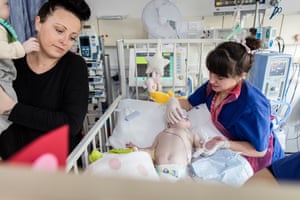
Ellarna is 32 weeks old and has had a catheter procedure today to close a hole in her aorta. Anaesthetic and critical care consultant Cathy O’Donoghue visits to discuss the operation.


Ellarna recovering from her operation


Ellarna recovering from her operation Photograph: David Levene for the Guardian


Ellarna


Ellarna Photograph: David Levene for the Guardian

For premature babies, the Brompton is the only centre in the UK using this method as an alternative to surgery.


Teenage patients


Sarah Bartram with daughter Ellie Bartram


Sarah Bartram with daughter Ellie Bartram Photograph: David Levene for the Guardian

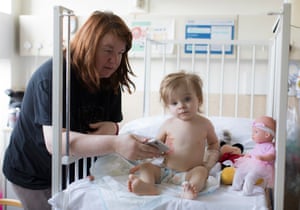
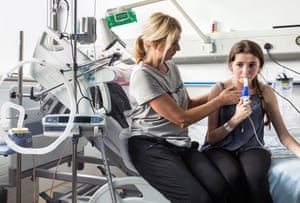
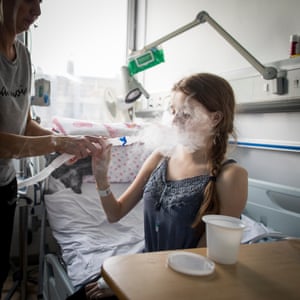
Ellie Bartram, 16, has been coming to the Brompton since she was diagnosed at four months old with cystic fibrosis, a lifelong condition that clogs up the lungs with mucus. She is admitted for two weeks every three months for an intravenous course of antibiotics.


Ellie Bartram in her school class in the paediatric ward


Ellie Bartram in her school class in the paediatric ward Photograph: David Levene for the Guardian


Ellie Bartram


Ellie Bartram Photograph: David Levene for the Guardian

  • Ellie Bartram in her school class in the paediatric ward, and undergoing lung treatment

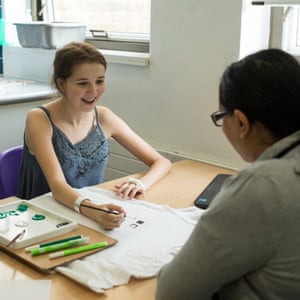
There is a schoolroom on the ward, where Ellie has lessons. The teaching is good – she and her mum Sarah credit a tutor at the Brompton for getting Ellie through her French GCSE with a C grade.


I can’t run around. I can’t go out much or go out with friends often. But my friends come and buy me McDonald’s because it’s my favourite thing
Ellie Bartram


In her solitary room, where visitors must wear aprons and gloves for fear of giving her an infection, she talks to her friends via FaceTime. “I’m used to it,” she says. She doesn’t like being different, but she is matter of fact about life at home in Romford, Essex.


Riley Jenkins, 13, grimaces in pain


Riley Jenkins, 13, grimaces in pain as his mother helps him put on a shirt Photograph: David Levene for the Guardian

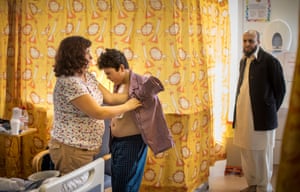
  • Riley Jenkins , 13, grimaces in pain as his mother helps him put on a shirt. Riley had cardiac surgery three days ago

Riley Jenkins, 13, is feeling very sick. He can’t eat the meatballs for lunch. His mother Sally rubs his back to try to make him feel better. It is the after-effects of the anaesthetic and the operation to replace a calcified heart valve that was inserted in his chest when he was just seven months old. “He’s been coming for a checkup once a year since he was a day old,” says his mother, Sally.


Riley was born with a back-to-front heart. “He loves Scouts and being on his computer but he’s been too tired to do a lot of running about. He used to love climbing trees. We’re hoping for more tree-climbing now,” Sally says.


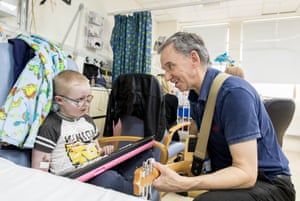
Ben Eccleston-Barnes, from Devon, is visited by volunteer music therapist Brian in Rose ward


Luke Eccleston-Barnes, from Devon, is visited by volunteer music therapist Brian in Rose ward Photograph: David Levene for the Guardian

  • Luke with volunteer music therapist Brian

Luke Eccleston-Barnes, nine, has a needle phobia, perhaps because of the huge number of injections and blood tests he has endured in his life so far. But he is calm now – music therapist Brian Spears has arrived with his guitar to distract him while more blood was taken. He is playing softly to Luke, who tries to accompany him on an electronic keyboard Spears has brought along.


The nurses


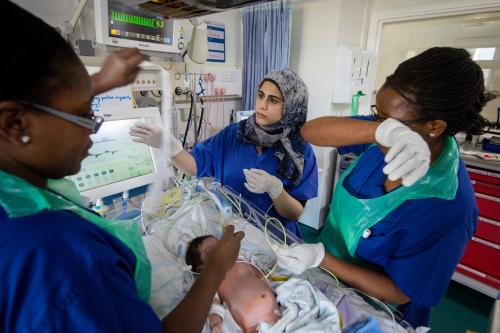
Nurse Angeline Guzha, right, and Dr Jana Kossaibati, centre, help a young girl called Sanaya


Paediatric nurse Angeline Guzha, right, and Dr Jana Kossaibati, centre, help a young girl called Sanaya in the paediatric intensive care unit Photograph: David Levene for the Guardian

Paediatric nurse Angeline Guzha and Dr Jana Kossaibati help a young girl called Sanaya in the paediatric intensive care unit.


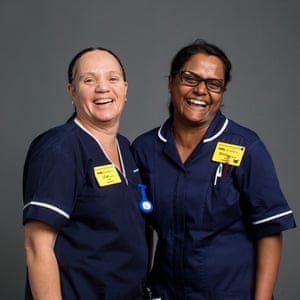
Lilian Leite and Nimla Pentayya are two of the three sisters managing Rose ward, where they have both been for six years. Leite is from South Africa and Pentayya from Mauritius. “We wanted to travel and we stayed – we are getting job satisfaction here,” Pentayya says with a grin. Both always wanted to work with children.


We know that parents are upset and the young nurses are upset but we have to be strong, the three of us will support each other
Lilian Leite


Lilian Leite and Nimla Pentayya


Lilian Leite and Nimla Pentayya are two of the three sisters managing Rose ward Photograph: David Levene for the Guardian

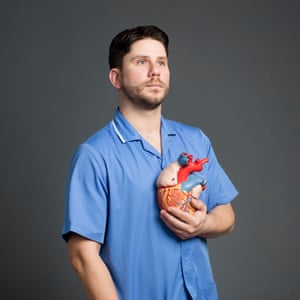
Dan Fossey is a practice educator, a nurse who trains other nurses. He also teaches parents basic life-support techniques in case they need them at home. Often parents are anxious and worry their child is too fragile. “Especially when they have had cardiac surgery they have questions about the scar and can you still do compressions,” he says. He teaches them to overcome their fears if a child has something stuck in his throat.


The last thing a parent wants to do is strike the child on the back
Dan Fossey


Practice educator Dan Fossey


Practice educator Dan Fossey Photograph: David Levene for the Guardian

Fossey runs a graduate programme for newly qualified nurses, to teach them about caring for children with heart defects. “I came here as a brand new nurse 10 years ago. I know what it’s like to come out of university and be looking after children with quite complex conditions,” he says.


Surgery


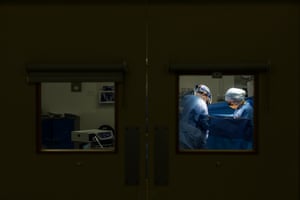
Surgery under way on a young patient


Surgery under way on a young patient Photograph: David Levene for the Guardian

Abdula is being wheeled along a corridor to the operating theatre by robed staff, his mother trailing slightly – out of place and desperately anxious. By far the majority of the complex operations for congenital heart conditions carried out here are a success. Inevitably, sometimes they are not. In some cases, where there is a risk but the baby will die without an operation, surgeons as well as families have to be brave.


Patient Abdula Allanoud on his way to his third heart operation


Patient Abdula Allanoud on his way to his third heart operation Photograph: David Levene for the Guardian

  • Abdula Allanoud, four, on his way to his third heart operation

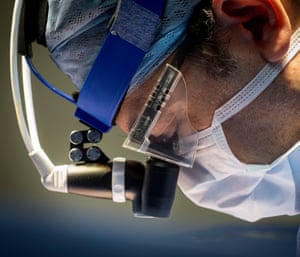
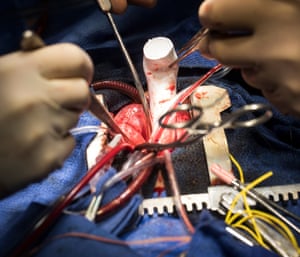
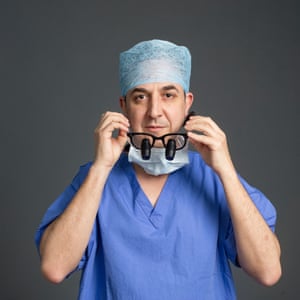
Consultant paediatric heart surgeon Olivier Ghez specialises in neonates – the tiniest babies, less than a month old, with a heart the size of a nut. He operates wearing binocular-style glasses that enlarge the miniature veins he has to stitch.


I have relatively small hands but it is the instruments, not the fingers
Olivier Ghez


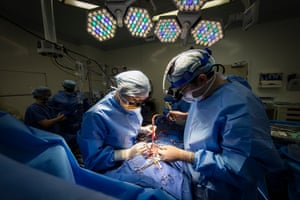
A four-hour surgical procedure conducted by Olivier Ghez


A four-hour surgical procedure to treat Abdula, conducted by Olivier Ghez Photograph: David Levene for the Guardian

  • Abdula is undergoing a four-hour Fontan procedure to correct a complex heart malformation, conducted by Ghez


Olivier Ghez


Olivier Ghez Photograph: David Levene for the Guardian


Olivier Ghez at work during an operation


Olivier Ghez at work during an operation Photograph: David Levene for the Guardian

Ghez’s job is exhausting – an operation can last three to five hours and a complex transplant could take 24 hours. But it is challenging and rewarding, he says. Sometimes he saves babies’ lives. Other times he gives them “the best possible future” with their heart condition. He can never be sure how it will go.


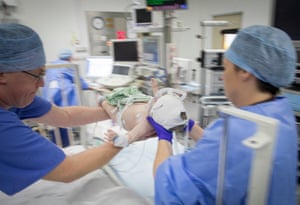
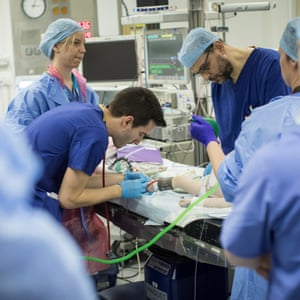
A 14-month-old girl, diagnosed after birth with a hole between the two chambers of the heart, comes into theatre for a relatively routine procedure and suffers a cardiac arrest. Suddenly the theatre is flooded with people, calm but purposeful, and the team restarts her heart.


A 14-month-old girl undergoes a procedure


A 14-month-old girl undergoes a procedure Photograph: David Levene for the Guardian

  • The girl arrested for four minutes during the procedure and was eventually revived by the team after a doctor performed CPR


A young girl goes into arrest during a surgical procedure.


A young girl goes into arrest during a surgical procedure. Photograph: David Levene for the Guardian


CPR is performed on the 14-month-old girl


CPR is performed on the 14-month-old girl Photograph: David Levene for the Guardian

When a child dies, says Ghez, “it is terrible, terrible – very sad and discouraging sometimes”. It may be a child who has had several successful previous operations at the Brompton. “When the baby dies after all this, it is really difficult,” he says. He worries about the accusations that can fly in the media over child deaths during or after surgery.


There is a danger of producing defensive medicine. That is a really perverse effect of the scrutiny. You can’t treat risky patients and have perfect results
Olivier Ghez


Consultant paediatric heart surgeon Olivier Ghez specialises in neonates, the tiniest babies


Consultant paediatric heart surgeon Olivier Ghez specialises in neonates, the tiniest babies Photograph: David Levene for the Guardian

Deaths are rare at the Brompton, but everyone is aware of the risks to the lives of these vulnerable children.


The support staff


A cleaner prepares to clear and disinfect a bay


A cleaner prepares to clear and disinfect a bay where an infection was recently present Photograph: David Levene for the Guardian

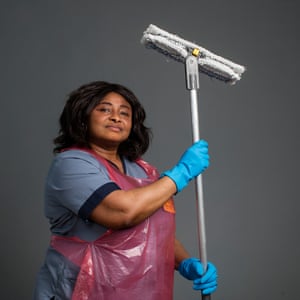
A cleaner prepares to clear and disinfect a bay where an infection was recently present. Everybody is supportive. Theresa Dzade, one of the cleaning staff, says she likes the children and the parents.


It is not easy for someone to leave their house and come here with a small baby. They are sometimes sad because their baby is ill. They talk to me all the time. I tell them I am here to help – anything they want
Theresa Dzade


Theresa Dzade, one of the cleaning staff


Theresa Dzade, one of the cleaning staff Photograph: David Levene for the Guardian

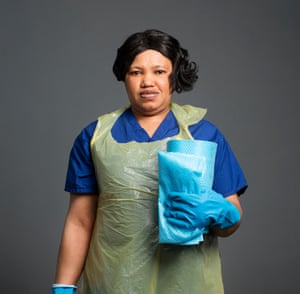
Her friend Sidratu Kargbo feels the same.


We have to do a good job to make them happy
Sidratu Kargbo


Cleaner Sidratu Kargbo


Cleaner Sidratu Kargbo Photograph: David Levene for the Guardian

Night falls


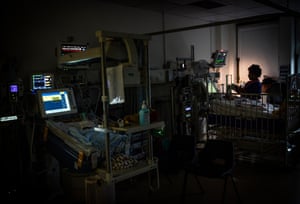
Night falls in the paediatrics department at the Brompton


Night falls in the paediatrics department at the Brompton Photograph: David Levene for the Guardian

Nursing and other medical staff work through the night as many patients require round-the-clock care. Parents usually leave the ward at night as they are encouraged by staff to rest.


Sandra Gala-Peralta, a PICU consultant, says: “If they don’t have a good rest, especially the mother, the following day they are exhausted. And if they are exhausted they don’t take the information in the same way. If something happens they are extremely fragile. So that is why we encourage them to go to sleep and have a good rest. If they don’t want to then we just let them be in the bed space. Especially if they are teenagers or children, five years old, then they have enough understanding to be be very afraid, so we let the parent in..”


Abdula Allanoud recovers after his operation


Abdula Allanoud recovers after his operation Photograph: David Levene for the Guardian

  • Abdula Allanoud recovers in intensive care after his heart operation

Gala-Peralta adds: “The evening tends to be a bit calmer. But everything depends on how the patients are. If the activity is high, the consultant stays around until … well, this is a personal choice. I’m more OCD, I like to make sure that if I go for a rest everything is in order and that I’m not going to have surprises in the night. We have an on-call room in one of the upstairs floors. I have been called in the middle of the night because a child has had a cardiac arrest. I was so stressed when they called me that I went down barefoot! I was doing cardiac massage in my socks! Now I’m more careful.”


I like to work on nights – it gives a lot of space to the doctor and nurses to focus on the patient, and because the night shifts tend to be a bit longer there is enough time to see how a patient can deteriorate, or improve during that time
Sandra Gala-Peralta


PICU consultant Sandra Gala-Peralta


PICU consultant Sandra Gala-Peralta, photographed at 8am at the end of a 24-hour shift Photograph: David Levene for the Guardian

  • Gala-Peralta photographed at 8am at the end of a 24-hour shift

“There are nights when we sleep one hour … and there are nights when we are able to sleep four or five hours. At least we can put our head down and we can have a bit of rest every night. And then in the morning at 7.30 we need to be sharp, back on the unit,” says Gala-Peralta.


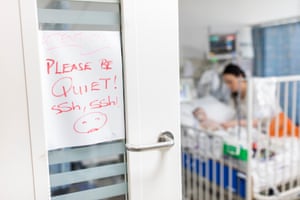
A sign in the paediatrics department


A sign in the paediatrics department Photograph: David Levene for the Guardian


Inside Royal Brompton hospital"s paediatric unit – photo essay