earlystage etiketine sahip kayıtlar gösteriliyor. Tüm kayıtları göster

31 Ağustos 2016 Çarşamba

Trial shows tantalising signs that new Alzheimer"s drug could benefit early-stage patients

A trial of a new Alzheimer’s drug has shown it could benefit patients in the earliest stages of the disease, raising hopes that a treatment for the devastating condition may finally be on the horizon.


While the trial was designed to assess the safety of the treatment and not whether patients fared better on the drug, an “exploratory analysis” of the data revealed that the treatment appeared to slow the mental decline of patients who responded to the therapy.


The small study of only 165 people with mild symptoms of the disorder found that a dozen monthly injections of the antibody aducanumab removed clumps of protein that build up in the Alzheimer’s brain.


A leading theory of the disease holds that the steady accumulation of a protein called amyloid-beta in the ageing brain kills off healthy neurons and brings about the memory and cognitive impairments experienced by Alzheimer’s patients.


In the trial, the strongest glimpse of mental improvement was seen in patients who had the highest dose of drug and who showed the greatest reduction in amyloid plaque proteins in follow-up brain scans. These patients did not worsen at all after six months of treatment. But the small number of patients enrolled in the study means that two much larger trials, which are now recruiting 2,700 patients in 20 countries, are needed to confirm whether the tantalising signs of benefit are real.


Alzheimer’s experts welcomed the results, but cautioned that it is too early to know whether the drug will be a help for patients. Other antibody treatments have looked impressive in early studies only to fail later on in larger trials.
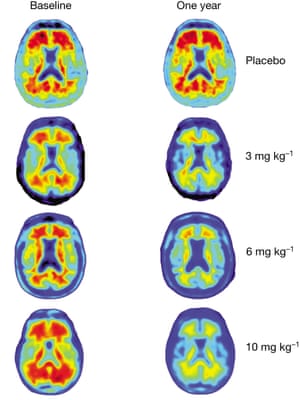


Comparison brain scans, with amyloid beta protein shown in red. The different dosages of aducanumab being tested are shown on the right.


Comparison brain scans, with amyloid beta protein shown in red. The different dosages of aducanumab being tested are shown on the right. Photograph: Ayres, Michael/Sevigny et al/Nature

John Hardy, a neuroscientist at UCL who first proposed that amyloid was a driver of Alzheimer’s disease, said: “It’s very interesting and nice to see all these positive data, and it has caused genuine excitement in the field, but it’s a very small number of patients and too small to draw any definitive conclusions from.”


The results from the trial led by the US biotech firm, Biogen, and a Swiss company called Neurimmune, are reported in the journal Nature. The data were first released at a scientific conference in March last year.


Aducanumab was hailed as a potential treatment for Alzheimer’s when scientists found the antibody in people who aged without suffering the sort of mental decline that goes hand in hand with old age. It appeared that the antibody prevented the build-up of amyloid plaques and staved off dementia.


When injected into Alzheimer’s patients, one or two in every thousand of the antibodies enter the brain where they latch on to wayward amyloid-beta proteins. Researchers at Biogen believe that other cells called microglia then arrive and clear the aberrant proteins from the brain. The drug appears to be most effective if the accumulation of amyloid protein is blocked before it causes too much damage. The process may start 15 years before people show symptoms.


In the latest trial, some patients experienced side effects. MRI scans showed a shift in the brain fluid that was more common at high doses and in people who carry the APOE type-4 gene, which is a major risk factor for Alzheimer’s disease. The scientists are now working on ways to avoid the side effect or diminish the problems by reducing the doses patients receive.


David Allsop, professor of neuroscience at Lancaster University, said the side effects will have to be overcome if the therapy is to find widespread clinical use. “Nevertheless, these findings could be a gamechanger if the effects on memory decline can be confirmed in more extensive follow-on studies.”


There are 850,000 people with dementia in Britain, a number that is expected to reach one million by 2025. Alzheimer’s is the most common form of the condition. “If this drug works, we’ll have a treatment for patients suffering from this devastating disease,” said Biogen’s Alfred Sandrock.


“These results provide tantalising evidence that a new class of drug to treat the disease may be on the horizon, said David Reynolds at Alzheimer’s Research UK.


James Pickett at the Alzheimer’s Society was similarly optimistic: “These results are the most detailed and promising that we’ve seen for a drug that aims to modify the underlying causes of Alzheimer’s disease.”


Trial shows tantalising signs that new Alzheimer"s drug could benefit early-stage patients

1 Mayıs 2014 Perşembe

Research turns skin tissue from infertile males into early-stage sperm cells

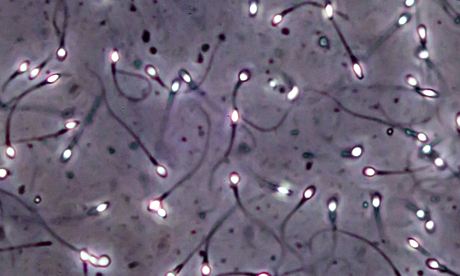
Live sperm seen through a microscope.

Live sperm by means of a microscope. The research suggests infertile men may possibly have misplaced the stem cells in their testes that typically produce into sperm. Photo: Mads Nissen/Panos


Scientists have turned skin tissue from infertile males into early-stage sperm cells in a groundbreaking study that raises hopes for new therapies for the situation.


The unexpected achievement of the method has stunned some scientists, because it was believed to be not possible for the men to make any sperm.


The men who took part in the study had significant genetic defects on their Y sex chromosomes, which meant they could not create healthy adult sperm on their own.


About one% of males cannot make any sperm, a problem acknowledged as azoospermia, while a fifth of men have reduced sperm counts. Male fertility is a concern for approximately half of couples who seek IVF therapy.


In the most current study, researchers took skin cells from three infertile men and converted them into stem cells, which can expand into practically any tissue in the entire body. When these cells have been transplanted into the testes of mice, they designed into early-stage human sperm cells.


“What we located was that cells from guys who did not possess sperm at the time of clinical observation were capable to generate the precursors for sperm,” said Cyril Ramathal, of Stanford University.


Skin cells from infertile males grew into fewer early-stage sperm cells than cells taken from usually fertile men, the research found.


The investigation is at an early stage, but scientists suspect that the converted skin cells might have grown into mature sperm cells if they had been transplanted into the infertile men’s testes.


If additional operate confirms the suspicion, it may be possible to restore male fertility by taking men’s skin cells, turning them into stem cells, and injecting these into their testes. The identical might be accomplished for men who are left infertile soon after getting chemotherapy for cancer.


“Currently being able to efficiently convert skin cells into sperm would let this group to become biologic fathers,” explained Michael Eisenberg, director of male reproduction and surgical procedure at Stanford, who was not involved in the study. “Infertility is one particular of the most widespread and devastating problems of cancer treatment options, specially for young boys and males.”


The examine, published in the journal Cell Reports, suggests that rather than becoming unable to make healthier sperm, the men may just have misplaced the population of stem cells in their testes that typically increase into sperm.


The scientists took skin cells from the guys and produced batches of one.5m induced pluripotent stem (iPS) cells to transplant into the mice. Every single batch was injected into the seminiferous tubules in mouse testes, in which sperm usually develop. The cells that lodged in the tubules created into early-stage sperm cells, but others turned into little tumours. The danger of leading to cancer in the guys is one of the major hazards that scientists need to overcome.


“It is remarkable that you can make iPS cells flip into early sperm cells in males with these genetic deletions,” explained Allan Pacey, senior lecturer in andrology at Sheffield University. “By the time we see them in clinic, they are not creating sperm and don’t have any stem cells to make them from, but that isn’t going to imply they did not have them when.


“This function suggests these infertile guys might have had testicular stem cells at some stage, and the issue is that they are not able to sustain them. So if you can make iPS cells and put them back into the guy, you may possibly be ready to keep ample in the testes for them to create some sperm. You are going to in no way restore them back to normal, but they may have a number of months or many years of producing sperm which is adequate to give them fertility back,” Pacey mentioned.


In the United kingdom, the use of artificially produced sperm to make babies is banned. But sperm created via this strategy – in which converted skin cells are grown into sperm in the men’s testes – may be legal to use as they are produced within the body.


Research turns skin tissue from infertile males into early-stage sperm cells