Severe etiketine sahip kayıtlar gösteriliyor. Tüm kayıtları göster

7 Mart 2017 Salı

Fragrance Sensitivities Can Actually Be Very Severe, Study Finds

You may not love the scent of your coworker’s hand cream, or the perfume wafting across the aisle on the train. But for some people, fragrances like those can trigger a range of very real symptoms, according to a new Australian study, from migraines to difficulties with breathing.


For her research, Anne Steinemann, PhD, a professor of civil engineering at the University of Melbourne School of Engineering, asked nearly 1,100 people to complete questionnaires about their exposure to fragranced products—such as personal care products, air fresheners, cleaning solutions, and laundry supplies—and any reactions those products may have triggered.


The findings, published in the journal Preventive Medicine Reports, suggest that fragrance sensitivity is not only a common issue, but can be quite severe. One-third of the study participants reported experiencing one or more health issues from scented products (whether they used the items themselves, or were exposed to them in public places).


The most common reaction was respiratory difficulties, including coughing and shortness of breath. Almost 17% of participants reported this effect.


Fourteen percent reported mucosal symptoms (such as congestion and watery eyes); 10% had experienced migraines; and 9.5% said they developed skin problems (like rashes, hives, tingling skin, and dermatitis).


RELATED: 20 Ways to Stop Allergies


Other reactions reported included asthma attacks (7.6%) and gastrointestinal problems (3.3%). Almost 5% of people said they suffered neurological symptoms (dizziness or fainting, for example); and 4.1% reported cognitive problems, such as trouble with their memory and difficulty concentrating.


What’s more, nearly 8% of the respondents said they had missed work or lost a job(!) in the past year as a result of feeling ill from exposure to fragrances in the workplace.


“Based on my findings, it’s clear that the health effects of fragrance sensitivities can be immediate, severe, and potentially disabling,” says Steinemann. Her previous research in the United States found that 19% of Americans experience adverse reactions to air fresheners. 


“Some people feel like they can’t enter public restrooms or walk inside shops because they don’t want to risk an asthma attack,” says Steinemann. “This loss of functionality makes a fragrance sensitivity not just a health issue, but a societal and economic one too.”


For anyone who reacts to fragrances, there are a few simple things you can do to protect yourself, she says. First, get rid of air fresheners, which don’t actually improve air quality; and open windows for ventilation instead. You can also try to go old school with your cleaning supplies, she suggests, using products like vinegar or baking soda to wipe down your kitchen and bathroom.


Finally, don’t be afraid to let colleagues know a second-hand scent (from a candle, for example, or an odor-eliminating spray) is making you sick. “Speak up!” urges Steinemann. “It’s a health hazard and workplace liability that doesn’t help productivity.”


Fragrance Sensitivities Can Actually Be Very Severe, Study Finds

3 Mart 2017 Cuma

College Student with Severe Allergy Allegedly Hazed with Peanut Butter: "He Could Have Been Killed"

This article originally appeared on People.com. 


Central Michigan University is investigating an allegation that a student with a severe peanut allergy was covered with peanut butter while passed out during a hazing incident at the Alpha Chi Rho fraternity last fall, the school’s spokeswoman confirmed to PEOPLE.


Heather Smith said alleged victim Andrew Seely spent the fall 2016 semester as a student at the university.


“We take these types of things very seriously,” Smith tells PEOPLE. “So the CMU Police Department and CMU’s Office of Student Conduct responded immediately and started looking into it. The alleged incident would have taken place off-campus, so we involved the Mt. Pleasant Police Department because that would have been their jurisdiction. To my knowledge, there still has not been a police report filed with them, but it’s a potentially criminal matter.”


Mt. Pleasant Police Department spokesman Jeff Brown tells PEOPLE that, as of mid-day Thursday, they “do not have any open investigations into this information that’s been put out on social media, and we have not had any complaints filed.”


On Facebook on Tuesday, Seely’s mother — Teresa Seely — posted a photo of her son’s face that was allegedly taken after the incident.


She wrote, “Last night, we found out that our son was a victim of a hazing incident at Alpha Chi Rho Fraternity at Central Michigan University in the fall. This is a picture of what they did to him. He has a deadly peanut allergy and they rubbed peanut butter on his face while he was passed out.”


She said that “he could have been killed,” saying he was treated at the campus health clinic and “luckily he is still alive.” She also said that Seely carries Benadryl tablets and an Epi-pen at all times, adding that she had notified the school as well as campus and local police.


A spokesman for Central Michigan University’s Campus Police tells PEOPLE they are aware of the allegations but will not be conducting an investigation because the site of the alleged incident was off-campus.


RELATED:  6 Surprising New Places Nuts Are Hiding


Both Smith and the campus police confirmed that the school spoke with the student’s mother on Wednesday and informed her of next steps.


“The university — both campus police and the administration — reached out to the involved parent, and she has been directed on how to make a formal complaint and report with both the university and the Mt. Pleasant Police Department,” the campus police spokesman says.


The spokesman says the campus police and university were originally alerted to the alleged incident because of the Facebook post.


Theresa further spoke to the Detroit Free Press, explaining that her son has since transferred from Central Michigan University. She said that although the alleged incident happened in October, he only revealed it to them this week.


“We thought we were sending our child off to school in a safe environment, and obviously that wasn’t the case,”she told the paper. “He could have died from this. He has a deadly peanut allergy.”


Smith tells PEOPLE that Alpha Chi Rho has not been a recognized fraternity at Central Michigan University since 2011, when they were removed for hazing. She added that they appealed the decision last year, but were denied.


RELATED:  Peanut Allergy Treatment: The Earlier in Childhood, the Better


She says that, pending the conduction of and results from a police investigation, any CMU students involved would potentially be subject to conduct charges.


Alpha Chi Rho National Fraternity did not immediately respond to PEOPLE’s requests for comment.


Teresa Seely also did not immediately respond to requests for comment, but the family’s attorney, Dan Damman, says the Seelys “want to bring awareness to the fact that this could still be happening on college campuses.”


The family wants to “bring awareness to parents to spark a conversation with their kids who are away at college and really bring to light through universities that this is still something that is a problem,” Damman says.


He tells PEOPLE, “This young man really put his trust and his faith into these people that were supposed to be his friends.”


College Student with Severe Allergy Allegedly Hazed with Peanut Butter: "He Could Have Been Killed"

College Student with Severe Allergy Allegedly Hazed with Peanut Butter: "He Could Have Been Killed"

This article originally appeared on People.com. 


Central Michigan University is investigating an allegation that a student with a severe peanut allergy was covered with peanut butter while passed out during a hazing incident at the Alpha Chi Rho fraternity last fall, the school’s spokeswoman confirmed to PEOPLE.


Heather Smith said alleged victim Andrew Seely spent the fall 2016 semester as a student at the university.


“We take these types of things very seriously,” Smith tells PEOPLE. “So the CMU Police Department and CMU’s Office of Student Conduct responded immediately and started looking into it. The alleged incident would have taken place off-campus, so we involved the Mt. Pleasant Police Department because that would have been their jurisdiction. To my knowledge, there still has not been a police report filed with them, but it’s a potentially criminal matter.”


Mt. Pleasant Police Department spokesman Jeff Brown tells PEOPLE that, as of mid-day Thursday, they “do not have any open investigations into this information that’s been put out on social media, and we have not had any complaints filed.”


On Facebook on Tuesday, Seely’s mother — Teresa Seely — posted a photo of her son’s face that was allegedly taken after the incident.


She wrote, “Last night, we found out that our son was a victim of a hazing incident at Alpha Chi Rho Fraternity at Central Michigan University in the fall. This is a picture of what they did to him. He has a deadly peanut allergy and they rubbed peanut butter on his face while he was passed out.”


She said that “he could have been killed,” saying he was treated at the campus health clinic and “luckily he is still alive.” She also said that Seely carries Benadryl tablets and an Epi-pen at all times, adding that she had notified the school as well as campus and local police.


A spokesman for Central Michigan University’s Campus Police tells PEOPLE they are aware of the allegations but will not be conducting an investigation because the site of the alleged incident was off-campus.


RELATED:  6 Surprising New Places Nuts Are Hiding


Both Smith and the campus police confirmed that the school spoke with the student’s mother on Wednesday and informed her of next steps.


“The university — both campus police and the administration — reached out to the involved parent, and she has been directed on how to make a formal complaint and report with both the university and the Mt. Pleasant Police Department,” the campus police spokesman says.


The spokesman says the campus police and university were originally alerted to the alleged incident because of the Facebook post.


Theresa further spoke to the Detroit Free Press, explaining that her son has since transferred from Central Michigan University. She said that although the alleged incident happened in October, he only revealed it to them this week.


“We thought we were sending our child off to school in a safe environment, and obviously that wasn’t the case,”she told the paper. “He could have died from this. He has a deadly peanut allergy.”


Smith tells PEOPLE that Alpha Chi Rho has not been a recognized fraternity at Central Michigan University since 2011, when they were removed for hazing. She added that they appealed the decision last year, but were denied.


RELATED:  Peanut Allergy Treatment: The Earlier in Childhood, the Better


She says that, pending the conduction of and results from a police investigation, any CMU students involved would potentially be subject to conduct charges.


Alpha Chi Rho National Fraternity did not immediately respond to PEOPLE’s requests for comment.


Teresa Seely also did not immediately respond to requests for comment, but the family’s attorney, Dan Damman, says the Seelys “want to bring awareness to the fact that this could still be happening on college campuses.”


The family wants to “bring awareness to parents to spark a conversation with their kids who are away at college and really bring to light through universities that this is still something that is a problem,” Damman says.


He tells PEOPLE, “This young man really put his trust and his faith into these people that were supposed to be his friends.”


College Student with Severe Allergy Allegedly Hazed with Peanut Butter: "He Could Have Been Killed"

21 Ekim 2016 Cuma

Fracking Linked to Migraine Headaches, Severe Fatigue, Chronic Sinus and Nasal Symptoms, Study Finds

Fracking has expanded — outpacing scientific understanding of its potential health risks and impacts.  Nevertheless, there’s a lack of studies relating to health outcomes for people living in close proximity of hydraulic fracturing, or fracking well sites.


John Hopkins researchers recently initiated a study to find out more about the impact of fracking on human health.  As a result, their research adds to the growing evidence of a link between fracking and health problems.


Fracking Industry Linked to Health Problems


Hydraulic fracturing involves injecting millions of liters of water into deep rock formations to free up natural gas or petroleum. Energy companies moved toward fracking in the early 2000s when natural gas prices were high and supplies were low.


In addition, hydraulic fracturing represents an increasing share of energy production worldwide. Currently, shale gas extraction equate to 40 percent of U.S. domestic natural gas production.


According to John Hopkins researchers, unconventional natural gas development — like fracking — produces environmental contaminants and psychosocial stressors.  Even so, a rapid increase in fracking has occurred in Pennsylvania.  More than 8,800 fracking wells have been drilled in Pennsylvania in the past ten years.


In recent years, fracking has expanded rapidly in other states, as well — including Ohio, Wyoming, North Dakota, Colorado, and West Virginia.


A team of researchers from Johns Hopkins Bloomberg School of Public Health initiated a study to look further into the impact of fracking on Pennsylvania residents’ health.  Their findings suggest that Pennsylvania residents with the highest exposure to active natural gas are almost twice as likely to suffer from a combination of health problems.  These health problems include: severe fatigue, migraine headaches, and chronic sinus and nasal symptoms.


The study’s first author, Aaron W. Tustin, a resident physician in the Department of Environmental Health Sciences at the Bloomberg School, comments on their findings.


“These three health conditions can have debilitating impacts on people’s lives.  In addition, they cost the health care system a lot of money. Our data suggest these symptoms are associated with proximity to the fracking industry.”


Study Results


In this study, Tustin and his colleagues created a questionnaire and received responses from 7,785 adult primary care patients of the Geisinger Health System.  Geisinger Health System is a health care provider that covers 40 counties in north and central Pennsylvania.


Between April and October 2014, participants returned the questionnaires to the researchers for analysis. The team of researchers found that 1,765 respondents suffered from migraines; 1,930 people experienced severe fatigue.  In addition, 1,850 had current symptoms of chronic rhinosinusitis — three or more months of nasal and sinus symptoms.


Health Conditions and Exposure to Wells


The researchers used publicly available well data to estimate the study participants’ exposure to the fracking industry. Their models accounted for the size and number of wells, as well as the distance between wells and people’s homes.


No single health condition was associated with proximity to active wells.  However, participants who met criteria for two or more of the health conditions were about twice as likely to live closer to more, or larger wells.


Previous research conducted by the study’s senior author, Brian S. Schwartz, a professor in the Department of Environmental Health Sciences at the Bloomberg School, has linked the fracking industry to increases in indoor radon concentrations, asthma attacks, and premature births.


Schwartz notes the need for more research and protection.


“We don’t know specifically why people in close proximity to these larger wells are more likely to be sick.  We need to find a way to better understand the correlation and, hopefully, do something to protect the health of these people.”


This study titled, “Associations between Unconventional Natural Gas Development and Nasal and Sinus, Migraine Headache, and Fatigue Symptoms in Pennsylvania,” is in the journal Environmental Health Perspectives.


Fracking Linked to Migraine Headaches, Severe Fatigue, Chronic Sinus and Nasal Symptoms, Study Finds

17 Temmuz 2014 Perşembe

How severe is England"s heatwave very likely to be?

Individuals are becoming urged to stay out of the sun after the Met Workplace issued a heatwave warning. Temperatures in the south-east of the nation are very likely to hit up to 32C this weekend with the rest of the country in the mid to large 20s.


A heatwave by its nature is an intense event (it relies on the temperature exceeding the common for a steady time period). But how does this stack up in the context of heatwaves previous? And where will the south-east be hotter than tomorrow?


What is a heatwave? And will there be 1 in the United kingdom?


A heatwave is defined by the Met Office as when the scorching climate meets set thresholds for every day highest and nightly minimum temperatures for two consecutive days. These thresholds generally sit around the 30C mark for the greatest and 15C for the minimal.


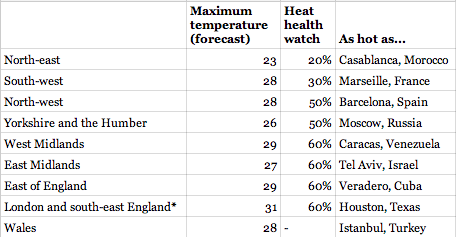
A yellow level two alert has been issued for the whole nation, which happens when there is a 60% danger of a heatwave in one particular or much more regions – this time the East Midlands, West Midlands, east England, the south-east and London are judged to be a lot more very likely than not to encounter heatwave circumstances over the course of Friday and Saturday.


Data on heatwave
*London and the south-east is not aggregated for the Heat-well being view prediction but is for the regional forecast. Photograph: /Met Workplace

London and south-east England are probably to attain temperatures on par with Houston in Texas although the east of England and the West Midlands will be as hot as Caracas. However, London will nevertheless fall beneath Madrid (34C), Beijing (36C), Las Vegas (38C) and Baghdad (43C).


How does this examine to past heatwaves?


The Heat-wellness watch, which is the supply of the warning, was launched in the wake of the 2003 heatwave exactly where a scorching 10 days in August brought on an estimated two,000 deaths.


Throughout that 12 months Faversham was topic to the hottest day on Uk record when temperatures in the Kent town reached 38.5C. The record for July is the 36.5C reached in Wisley, Surrey in the course of 2006.


The benchmark for the 2003 heatwave was the summer time of 1976 when temperatures exceeded 30C somewhere in the United kingdom for 15 days in a row following June 23.


In contrast, 2003 noticed 30C being exceeded for 3 consecutive days amongst August 4 and 6 followed by five consecutive days in between August eight and 12.


Temperatures in London and the south-east are not expected to attain anything at all near that substantial this yr and the potential heatwave would only likely final for two days (Friday and Saturday) with showers expected this weekend.


Could this be the hottest July ever?


Probably not. The hottest July the Uk has ever expertise was 2006 with a indicate optimum temperature of 26.1C (the regular of all the hottest factors throughout each and every day of the month) and an typical temperature of 17.8C.


Last year’s July fared rather nicely as nicely, with a suggest maximum temperature of 24.6C – the sixth hottest because 1910.


This July has not been remarkably scorching so far but could the remaining days do anything towards pushing it up the rankings? Here is what the Met Office have to say about the forecast for July 21 to 31


Monday will deliver a drier day with sunny spells for a lot of and it will stay warm for most with southeastern parts possibly scorching at first. There will be a couple of showers with a lot more basic rain and breezy conditions arriving in the northwest later on and into Tuesday. Even so, this rain will most likely not attain southern and eastern components. This northwest-southeast split in the climate is expected to proceed, with Atlantic frontal techniques bringing intervals of more prolonged rain at occasions in the northwest, with the very best of the drier and sunnier weather in the southeast, even though here some hefty showers are possible, particularly later in the period. Temperatures probably to continue to be on the warm side, maybe turning out to be hot again in the southeast. In the northwest temperatures will be about common.


As we stated at the start off however: if this heatwave occurs it will still be an extreme climate event, which is why Public Overall health England have issued their warning for individuals to remain out of the sun in the course of the hottest intervals – put together for Venezuelan-degree weather in London.


How severe is England"s heatwave very likely to be?

27 Mayıs 2014 Salı

Dear Washington: consider severe mental sickness significantly. It"s a matter of lifestyle and death | Rep Tim Murphy

In the practically 12 months and a half since I have been investigating America’s broken psychological wellness technique – even with my 30-year background in clinical psychology – I have been shocked to discover just how considerably our country has failed these with significant psychological sickness.


Get Elliot Rodger, a 22-yr-old whose instability was known, but went overlooked ahead of he killed 6 school college students and himself in California more than the weekend. Or get Gus Deeds, yet another younger man who was in mental wellness crisis but was denied extended inpatient care before he killed himself and stabbed his father, a Virginia state senator. There was Adam Lanza in Connecticut, Jared Loughner in Tucson, James Holmes in Aurora, Aaron Alexis at the Washington Navy Yard, and on and on.


All had untreated or undertreated severe mental sickness. All spiraled out of manage inside a method that lacked the simple mechanisms to help.


mental well being beds above time

Whilst these are severe cases, they highlight how our broken technique does not respond until finally right after a crisis when we could be carrying out some thing to quit it from taking place. But even in the face of tragedy, we are also uncomfortable to acknowledge the information because the final bastion of stigma in mental overall health considerations these with critical mental illness.


The information are that psychological sickness is a brain ailment, and of the 9.6m individuals in this country with a severe psychological illness – like schizophrenia, bipolar disorder or key clinical depression – approximately 40% will not even get treatment this 12 months.


We have identified it less complicated to focus the two the discussion and public sources on gauzy packages for “behavioral wellness” and “emotional nicely-being” than to confront the agonizing actuality that these with schizophrenia or serious psychosis are a lot more probably to up with no care (four.4m), homeless (250,000), in prison or on parole (1.3m), or dead by or trying suicide (1.38m) than in appropriate psychiatric remedy (roughly 4m).


federal funding mental health

The time has come that we approach critical mental illness as a healthcare emergency demanding an method ideal described as “crisis psychiatry”. Which is the basis for a bill I very first introduced six months ago, the Assisting Households in Mental Health Crisis Act. My legislation fixes the shortage of psychiatric hospital beds, clarifies HIPAA privacy laws so families are portion of frontline care delivery crew, and aids sufferers get treatment method effectively prior to their sickness spirals into crisis.


In contrast to newer, more restricted legislation that lacks bipartisan help, my bill represents a extensive and broad-ranging overhaul, delivering acute psychiatric care to the most vulnerable. None of the difficult concerns surrounding significant mental sickness are taken up in a competing measure offered by Rep Ron Barber of Arizona.


Placing a lot more funds into the current failed technique will do absolutely nothing to avert the following Elliot Rodger, nor will it support the millions of households caring for a loved one particular with an acute untreated psychiatric sickness who refuses treatment and lacks insight into their problem.


And most assuredly, preserving the standing quo will only serve the monetary interests of legal advocates and anti-psychiatry activists who get federal taxpayer dollars to in fact stop patients from obtaining treatment and direct them into the criminal justice method or homelessness.


The status quo is not just uncompassionate it is inhumane.


Now is the time for courage just before yet another tragedy unfolds. For the hundreds of thousands of families in psychological well being crisis, we should have the courage to reject the failed status quo and provide true answers to aid SMI patients get life-saving therapy and recover. When it comes to conserving lives, there can be no compromise.


Rep Tim Murphy is a Republican US Representative from Pennsylvania and a training psychologist.


Interactive report: America’s psychological wellness care crisis, part a single – households left to fill the void of a broken technique


Dear Washington: consider severe mental sickness significantly. It"s a matter of lifestyle and death | Rep Tim Murphy

7 Nisan 2014 Pazartesi

Train driver in deadly New York crash had "severe" rest disorder, NTSB says

The driver of a New York commuter train that derailed at substantial pace final 12 months, killing 4 men and women, had a serious rest disorder that interrupted his rest dozens of occasions each evening, federal investigators disclosed on Monday.


The Nationwide Transportation Security Board’s (NTSB) healthcare examination of engineer William Rockefeller uncovered “serious obstructive rest apnea”, in accordance to documents released by the agency.


The paperwork did not say no matter whether the disorder contributed to the one December crash on the Metro-North railroad. The NTSB explained its examination of the details and any determination of the cause would come in a later report.


Rockefeller’s attorney and union leader have suggested the engineer nodded off on the morning of 1 December as his train raced toward a sharp curve in the Bronx, exactly where it derailed. The curve had a 30 mph speed restrict the train was going 82 mph.


Lawyer Jeffrey Chartier stated a number of days soon after the accident that Rockefeller experienced a nod or “a daze”, nearly like street fatigue or the phenomenon often called highway hypnosis. Anthony Bottalico, leader of the rail staff union, said Rockefeller “essentially nodded”.


The NTSB report explained a rest research was ordered simply because Rockefeller “did not specifically recall events foremost up to the accident”.


The test found that whilst Rockefeller slept, he had about 65 “rest arousals” per hour. Scientists say as handful of as five interruptions an hour can make a person chronically sleepy. The report stated Rockefeller’s apnea apparently was undiagnosed prior to the accident.


The NTSB mentioned that sleep apnea is not described in Metro-North’s healthcare suggestions.


Metro-North spokesman Aaron Donovan explained the railroad was reviewing the paperwork. Chartier did not right away return messages in search of comment on Monday.


The report said Rockefeller’s blood and urine tests right after the accident unveiled small amounts of aspirin and an more than-the-counter antihistamine that carries a warning that it could impair the capacity to drive.


The report notes that Rockefeller’s work routine had recently modified from late evening to early morning shifts.


Apnea is far more frequent in individuals who are overweight, and the health-related report describes Rockefeller, who is five feet eleven inches tall, as obese. Data in the report indicate he was 204 pounds in 2008, 246 pounds in 2011 and 274 pounds in 2013 but down to 261 pounds after the accident.


The report says a rest medication expert prescribed an apnea treatment identified as CPAP, or steady good airway stress, which utilizes a mask and hose to push a regular movement of air pressure into a person’s airway in the course of rest.


Train driver in deadly New York crash had "severe" rest disorder, NTSB says

12 Mart 2014 Çarşamba

NHS believe in apologises for care failings in excess of youngsters with severe heart defects

The families of sixteen young children born with severe heart defects did not acquire the compassion, empathy and assistance they needed from personnel at Leeds educating hospitals believe in and in some instances felt pressured to have terminations, an NHS investigation has found.


Leeds, exactly where children’s heart surgical procedure was temporarily suspended last yr in excess of fears that death rates had been too large, was provided a clean bill of health for its clinical efficiency.


But the damning report into paediatric cardiology at Leeds standard infirmary outlining the experiences of sixteen families who complained of poor care at the unit has prompted apologies from the two NHS England and the Leeds educating hospitals NHS trust, which runs the hospital.


Dad and mom felt they were currently being pressured to have terminations when the heart defect was detected in pregnancy, and had been left alone and in distress soon after the diagnosis.


After the births, some say they were not told that doctors believed the little one would die. One particular couple waited 3 many years for an operation only to uncover that their little one was not on the waiting record. Of the youngsters concerned, six are identified to have died.


The evaluation of the families’ complaints about Leeds was carried out by the independent case reviewer, Professor Pat Cantrill. The complaints associated to care among 2009 and 2013.


The mom of a child called Tom informed Cantrill: “They did the scan and then I went into a space exactly where there was a medical professional and a nurse. I was told my child had half a heart.


“There was no compassion. I cried. The medical doctor explained that the recommendation was to have a termination. I asked if there have been other options and I was informed I could go to complete term and have the baby and then it would die or have the little one and then have surgical treatment but that was not advisable. I was given a booklet and two days to make a selection.


“I was advised not to search items up on the world wide web. I was sent to the antenatal clinic and waited from 2 o’clock until finally five o’clock. I was exhausted. My father went and asked for somebody to see me. The personnel had not been informed about me.


“Then a doctor rang me at home on the Friday for my decision. I said I did not want a termination. I was told it was the largest mistake of my daily life.”


The households had been occasionally provided leaflets to take house but felt they did not have ample info to make a selection. “Some have been left waiting in a distressed state, or in rooms on their personal, and in 1 case left in a corridor,” the report explained.


The mother of yet another baby, Aziz, was urged to consider about termination. “They seemed against me continuing with the pregnancy. As a Muslim I feel that abortion is incorrect. They did not seem to understand,” she advised Cantrill.


Soon after the birth, some mentioned there was no program for the care of the kid.


John, who was breathless, sweaty, blue and slept most of the time, “was on the ‘wait-and-see/as-and-when-required’ path. Alarm bells commencing ringing when a consultant at our local hospital questioned why no care prepare was in spot when John was so poorly,” said on of his mothers and fathers.


Several had been distressed by the lack of distraction when essential tests were carried out. The mom of Sally mentioned: “When they took blood it was awful. They would hold her down. They had 12 attempts to get blood by 4 various doctors. She was so distressed and so were we.


“At the other hospital it could not have been far more various. They have a distraction space and they perform videos while they are taking blood. She can cope with it now.”


Some dad and mom said they have been not advised that the heart could not be repaired and any treatment was only palliative – to relieve symptoms.


“We have been waiting to get a letter for Shona to go into hospital for her heart surgical procedure. I was a nervous wreck,” mentioned a mom. “She commenced to deteriorate. I contacted the hospital. They created me feel as though it was me and that I was becoming above protective and that I would just have to wait.


I stated that we necessary to see someone and eventually we saw the cardiologist. The scan did not demonstrate anything distinct. We had waited for three many years for her surgery but when we saw the physician she told us that Shona was inoperable and that she was not on the waiting list.”


A single mother was known as by the children’s hospice with out understanding the hospital had referred the little one. Families told of delays to their children’s treatment method, which they believed produced it significantly less very likely to be productive.


Some talked of a lack of support after their little one had died. “After Tim died the shutters appeared to come down. There need to be counselling offered for mother and father who have misplaced their child,” mentioned a parent.


Not all the experiences have been negative, the families acknowledged, but some said care from the cardiology support that had been excellent had deteriorated in excess of the years.


The stories she heard, mentioned Cantrill, “were all heartfelt, moving and sincere. All the households have been saddened to locate themselves in a position in which they had lost self confidence in the care supplied for their young children and for them as a family. They want the services for kids with congenital heart conditions each nationally and locally to learn from their encounter. They want companies for children and their households to increase.”


She created a series of suggestions for the believe in, other heart units and NHS England.


The trust apologised to the households and explained it had currently made adjustments, but the deputy director of NHS England, Mike Bewick, warned that lessons have to be realized by all people concerned in the care of this kind of vulnerable youngsters.


“This kind of experiences are not able to be defended,” he stated.


Julian Hartley, chief executive, and Yvette Oade, chief medical officer at Leeds educating hospitals believe in said they have been glad the children’s heart unit had been discovered to be risk-free and running effectively. “We are very sorry however, that the sixteen households who shared their stories with [the evaluation] felt we did not give the care they had a appropriate to anticipate … we sincerely apologise to individuals households and will of course, make sure we understand from what they had to say and enhance our providers as a outcome of this.”


The report was published by NHS England on the day that Sir Ian Kennedy – who chaired the inquiry into failures in babies’ heart surgical procedure at the Bristol royal infirmary more than a decade ago – met families whose young children with heart defects died at one more hospital in the city, the Bristol Royal Hospital for Kids. Kennedy is assisting to set up an inquiry into their concerns, at the request of Sir Bruce Keogh, NHS England’s health care director.


“I have to say that I really feel a wonderful sense of sadness that I discover myself right here in Bristol – 13 years after my first report – hearing after once more the anger and distress of mothers and fathers,” stated Kennedy. “The families want a robust independent procedure. We have made very good progress in obtaining the way forward and there is still more work to do. We hope to get issues moving with some urgency.”


Four inquests on children who have died following heart operations in Bristol have exposed failings in care, breakdowns in communication and, at times, an apparent lack of empathy with mother and father when they flagged up considerations about remedy.


The parents of two of the youngsters, Luke Jenkins, seven, and Sean Turner, 4, who died in 2012 within a month of each and every other at the Bristol royal hospital for Youngsters, have strongly expressed the belief that employees did not consider their concerns seriously.


Faye Valentine, the mother of Luke, stated she and her companion, Stephen, had been manufactured to really feel as if they have been a nuisance when they flagged up fears about their son’s recovery.


“We weren’t currently being listened to,” she stated. “They considered we had been currently being above-anxious and asking too a lot of concerns. They ignored us. We weren’t asking stuff for the exciting of it. We had significant issues and they ignored us.”


The mother and father of 4-12 months-old Sean Turner, who like Luke was taken care of in ward 32, the children’s cardiac ward, said there had identified a “lack of leadership, accountability and communication” at the hospital.


The believe in insists that it has produced basic modifications to the way both kids and their parents are cared for on ward 32. Dad and mom are now asked frequently if they have considerations – and any worries are noted and what actions taken to address them recorded. In addition mother and father can write their views into the official patient information. Up coming to each child’s bed is data about how they can increase concerns formally.


NHS believe in apologises for care failings in excess of youngsters with severe heart defects

22 Ocak 2014 Çarşamba

Drug Developers Look for Severe Clinical Phenotypes To Ignite Medical Discovery


Drug Discovery: Empiricism vs Insight


How do you go about discovering new medicines?


You may well get started empirically, and look all around for one thing that appears to work — willow bark for soreness, for instance, or an anti-tuberculosis pill for depression.  This method relies on what writer Morton Meyers calls “happy accidents,” and accounts for a remarkable number of existing therapeutics (most of them, Nassim Taleb asserts).   Supporting this seemingly radical conjecture, a  2011 paper in Nature Evaluations Drug Discovery reported that among 1999 and 2008, much more FDA-approved very first-in-class tiny molecules have been derived from phenotypic screening (an empiric strategy) than from insight-oriented, target-based drug discovery.


In this age of Large Data, there is substantial curiosity in making an attempt to industrialize serendipity in silico, and use huge datasets and wise algorithms to create empirically-derived novel insights and new therapies.    While this nut hasn’t yet been cracked, a lot of clever data scientists are busily doing work on this challenge.


The second way to technique drug discovery is mechanistically: figure out the trigger of a illness, and use this understanding to form remedy.  This represents the promise of molecular medication, although realizing this dream has proved considerably a lot more difficult than a lot of anticipated, due to the sheer complexity of biology, and the challenge of moving amongst DNA and ailment.  Nevertheless, when this approach operates, the good results can be so compelling, so logical, so validating that it motivates researchers to carry on trying.


The sophisticated triumph of the cancer drug Gleevec, for instance, inspired cancer researchers to seek out other mechanistically-informed treatments — even though for years, Gleevec remained one of molecular medicine’s number of uncontested good results stories.


Captivated by PCSK9


Much more lately, the protagonist function in the molecular medicine narrative has been assumed by the family of lipid-decreasing drugs now in development that target PCSK9.  Amgen and Regeneron/Sanofi lead this race, with numerous other folks not also far behind.


What can make PCSK9 so captivating is that the discovery and improvement process really worked the way it is supposed to, but in practice rarely does.  The examine of two French households with unusually higher cholesterol amounts and a strong historical past of heart illness led to the identification of a issue referred to as PCSK9, which was subsequently shown to increase cholesterol when overactive.  Extra study – nicely described by Gina Kolata in The New York Times — demonstrated that people with a reduced exercise of PCSK9 had minimal cholesterol levels and a markedly decrease cardiac risk.  Extensive animal research strongly reinforced these findings.  Collectively, these data suggested that a medication that could minimize PCSK9 action or function would signify a potent therapeutic.  The final results of clinical trials carried out to date appear to support this optimism.


The PCSK9 knowledge – particularly its elegance and relative ease — looks to have transfixed every drug developer who’s touched it, at after reaffirming their belief in the promise of molecular medicine and stimulating their drive to re-produce this obvious good results.


Extreme Phenotypes


The important beginning level – not remarkably – is phenotype, ideally, an excessive phenotype of obvious health-related interest.  As the mentioned clinical researcher Stephen O’Rahilly has eloquently observed, “The study of rare folks with extreme disturbances of their physiology has long had an effect in terms of scientific comprehending grossly disproportionate to the infrequency of the distinct condition getting investigated.”


Studying these sufferers, O’Rahilly writes, can assist both these distinct patients even though possibly offering insight into broader physiological concerns.


Archibald Garrod’s traditional study of a patient with black urine in 1901 led to the “inborn error in metabolism” idea, anticipating by forty many years the “one gene, one particular enzyme” notion, as Brown and Goldstein level out in their Nobel tackle.


Brown and Goldstein’s personal transformative function on cholesterol transport was similarly rooted in a small population of sufferers – homozygous familial hypercholesterolemia [FH]–  with an intense phenotype — extraordinarily substantial lipid levels.  Their discoveries contributed to the advancement of the statins, medicines now taken by hundreds of thousands of men and women with elevated cholesterol to decrease lipids and lessen cardiac chance.   (Sadly, the individuals with homozygous FH  not only have the highest amounts of lipids, but these lipid ranges are only minimally impacted by statins even so, there is hope these sufferers could derive added lipid-lowering advantage from the new medicines targeting PCSK9.)


New Economics of Drug Development


Drug Developers Look for Severe Clinical Phenotypes To Ignite Medical Discovery