North etiketine sahip kayıtlar gösteriliyor. Tüm kayıtları göster

14 Nisan 2017 Cuma

Antidepressants prescribed far more in deprived coastal towns of north and east

Doctors in deprived coastal towns in the north and east of England are prescribing 50% more antidepressants than those in the rest of the country, analysis of prescription data shows.


Blackpool, Sunderland and East Lindsey, in Skegness, fill the top three spots for the most prescriptions out of England’s 326 districts.


Psychologists said the findings were consistent with links between deprivation and depression, anxiety and other mental health problems. But they added that seaside towns faced a particular set of difficulties that could give rise to mental health issues.


The trends in NHS prescription data were discovered by Exasol, a database analysis company. It found that in Blackpool, the area with the highest rate of antidepressant prescriptions, 2.11 per person in 2016, compared with a national average of 1.16 over the course of the year.


Sunderland and East Lindsey were in second and third place, with about 1.99 prescriptions per person.


Dr Jay Watts, a consultant clinical psychologist, said there were established problems with seaside towns that could affect the mental health of their residents. Blackpool, for example, has the lowest life expectancy for men in the country, and last year topped the list for alcohol-related hospital admissions, she said.


“You’ve got high deprivation, high crime, low life expectancy, loads of alcohol problems,” she said. “Also all of these places tend to be, to a certain extent, ghost towns.


“Because of the destruction of local economies by the cheapening of foreign travel, that we’ve known has been happening since the 1960s onwards, one tends to be environmentally surrounded with the ghosts of a better time.”


Peter Kinderman, president of the British Psychological Society and professor of clinical psychology at the University of Liverpool, said the findings were consistent with established theories on what causes depression, anxiety and other mental health problems.


“You’ve got lack of opportunity, lack of a sense of meaning and purpose in life,” he said. “You’ve got the financial consequences on families, consequent pressure on relationships; a toxic mix of how social and economic factors can put pressure on our mental health and psychological wellbeing.”


Pressure on local authorities and civic organisations trying to operate without a well-functioning economy meant there was a lack of services that could help people with mental health problems, he said.


“Incidentally, I don’t blame the GPs or the psychiatrists. What the hell else have they got to offer people?”


Data published last year by the Health and Social Care Information Centre, now renamed NHS Digital, showed that there were 61m NHS prescriptions for antidepressants in England. This was double the number prescribed a decade earlier and had a net cost to the health service of nearly £285m.


Gillian Connor, head of policy at the charity Rethink Mental Illness, said at the time that antidepressants were often the only treatment available to patients accessing “overstretched and underfunded” mental health services.


“What we want to see is people experiencing depression offered the full range of treatments available, including talking therapies,” she said. “People have to be able to access the treatment that is right for them, whether it’s antidepressants, therapy or a combination of the two.”


Antidepressants prescribed far more in deprived coastal towns of north and east

8 Ocak 2017 Pazar

Bird flu found in North Yorkshire back yard

Bird flu has been found in a small flock in a back yard in North Yorkshire, the UK’s chief veterinary officer said, warning that people who kept chickens and ducks in their gardens needed to be vigilant.


A 3km protection zone and a 10km surveillance zone have been put in place around the infected premises, near Settle, to limit the risk of the disease spreading. The remaining live birds in the small flock of chickens and ducks are being humanely culled, the department for Environment, Food and Rural Affairs (Defra) said.


The same H5N8 strain of avian flu has been confirmed at a poultry farm in Lincolnshire and at a premises in Carmarthenshire, Wales. It has also been found in wild birds in England, Scotland and Wales.


The advice from Public Health England is that the risk to public health from the virus is very low. The Food Standards Agency has made clear that bird flu does not pose a food safety risk for UK consumers.


The chief veterinary officer, Nigel Gibbens, said: “We have taken swift action to limit the risk of the disease spreading. Restrictions are now in place around the affected premises and a full investigation is under way to determine the source of the infection.


“This finding in a back yard flock shows how essential it is for all poultry owners, even those who just keep a few birds as pets, to do everything they can to keep them separate from wild birds and minimise the risk of them catching avian flu via the environment.


“This means keeping birds in a suitable building where possible, and taking precautions such as putting up netting, keeping food and water inside and disinfecting footwear and equipment after contact with birds.”


An avian influenza prevention zone that has been in place since 6 December will be extended until 28 February to help protect poultry and captive birds from avian flu, Gibbens said.


The zone requires keepers of poultry and other captive birds to continue to keep their birds indoors, or take appropriate practical steps to keep them separate from wild birds.


It covers England and similar declarations have been made in Scotland and Wales. There is also a Britain-wide ban on poultry shows and gatherings.


Bird flu found in North Yorkshire back yard

24 Kasım 2016 Perşembe

We are divided by more than north and south | Letters

At the heart of Mike Harding’s letter (23 November) is a call for greater understanding of the needs and desires of diverse communities in our country. I am all for that. What a pity he boiled it down to a north-south divide. I too am a lifelong guardian reader (64 years) and I have a day job as a children’s author. Over the past 20 years I have visited hundreds of schools and communities up and down the country. My list of communities where I saw need and neglect would include Western-super-Mare, Trowbridge, Southampton and many more, all geographically south of Watford. I have also seen the managed decline he refers to in the industrial cities and smaller towns mentioned in his letter. However, in my visits to Edinburgh, Leeds, Glasgow and Manchester, I didn’t see neglect in the Morningside, Harrogate, Bearsden or Didsbury areas of these great cities.


I wonder if Mr Harding has been to Haringey, Lambeth or Dagenham. They are all in London. Our diverse country has wonderful regional differences which we should all cherish. To improve things we need to pull together. John Harris’s excellent piece about Lincolnshire elsewhere in the Guardian (For Labour too Brexit means Brexit) demonstrates how difficult this will be. Please can we focus on what needs to be done, not point scoring.
Adrian Townsend
Garsington, Oxfordshire


Aditya Chakrabortty could have stayed on the English side of Offa’s Dyke and got a close up of the same issues he came across in Pontypool (Just about managing? In these towns that’s a dream, 22 November). Pontypool’s problems can be mirrored in many, if not most, small rural towns, positioned outside the more affluent areas of the country. The issues facing such communities have been continuously ignored. In the Forest of Dean our towns have an industrial history to be proud of, but they are now shadows of their former selves. The main issues are always the same: transport, health, law and order and education.


Perhaps developing our existing railway infrastructure or resuscitating some redundant lines, would be far more beneficial and cheaper than HS2? Maybe some decentralisation could benefit the NHS. Rural communities are punished a second time when suffering ill health or injury, with round trips of 60 miles for basic medical care that could be offered by enhanced local cottage hospitals. Rural police resources are so stretched they only appear able to record crime, not solve or prevent it. Education? Despite the efforts of parents, governors and staff alike, too many of our local schools have been in special measures. Political debate is far too city-centric.
Mark Sargent
Aylburton, Gloucestershire


Why should the inhabitants of Pontypool and similar ones right across these blighted isles have to pay tax direct to the Treasury in London? Wouldn’t the tax be better kept at a local level to revitalise the local economy?


This is where a local currency comes in. A local bank could be established to issue electronic Pontypool pounds to be circulated locally, nourishing those parts that the chancellor fails to reach. Employees would elect to receive a proportion of their income in tax-free e-pounds that could only be spent at local businesses and services, thereby continuously benefiting the local community.
Geoff Naylor
Winchester, Hampshire


Having just completed a road trip round Britain with some visiting Australian relatives how I agree with Aditya Chakrabortty. We visited the usual suspects – Oxford, the Cotswolds and Stratford, but also, because we have northern roots, we visited Liverpool, Oldham, Newcastle and Sunderland. My thoughts are exactly as Aditya suggests – that Theresa May should visit these areas. The thing that did stand out was the amazing and resilient people we met along the way, always with a friendly smile, particularly the lady in the National Glass Centre in Sunderland – an amazing place we did not know existed and which we found by accident. The people of these areas deserve better.
Joan Procter
Worthing, West Sussex


Simon Jenkins is right to criticise the government’s infrastructure schemes (To the capital go all the spoils, 24 November), but the problem is not just the north-south divide. The arguments for infrastructure are that these projects are an investment in our future. But the most crucial element of our future lies with our children and money spent on HS2, for example, would be more wisely spent on improving the education we give to the young (and I mean proper education, not Govean).


A future generation equipped both to serve the economy directly, but also well educated in the round, able to assess arguments and organise their thinking on rational grounds, will be essential if we are to have a well-functioning democracy, and would reap far more dividends than trimming an hour off the journey from London to Manchester (or, as Simon Jenkins points out, more likely from Manchester to London). But no mention in the autumn statement of how our hard-pressed schools could be given any help.
Professor Norman Gowar
London


Join the debate – email guardian.letters@theguardian.com


Read more Guardian letters – click here to visit gu.com/letters


We are divided by more than north and south | Letters

11 Eylül 2016 Pazar

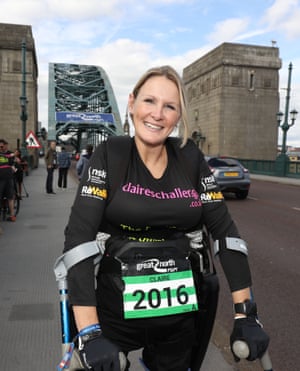
Paralysed, pregnant Claire Lomas finishes Great North Run in five days

A paralysed pregnant woman wearing a bionic suit has completed the Great North Run five days after she started it.


Claire Lomas, from Leicestershire, was paralysed from the chest down in a riding accident in 2007, which left her with a fractured neck, dislocated back, fractured ribs, a punctured lung and pneumonia.


The 36-year-old, who is 16 weeks pregnant, began the half-marathon, which runs from Newcastle to South Shields, on Wednesday and crossed the finish line at about 10am on Sunday.


Lomas told the Guardian that she had suffered from morning sickness during much of her training and had had to seek medical attention for sores caused by the straps of her suit. “I haven’t had much sleep. I spent the first two nights worrying that I wouldn’t be able to make it,” she said.


The former event rider was offered a place in the Great North Run after being refused an official place in the London Vitality 10k. Wearing a ReWalk robotic exoskeleton, which she raised around £50,000 to buy, Claire walked around three miles each day assisted by her husband Dan, visiting schools en route to talk to children about her battle to overcome her injuries.


Claire Lomas on the Tyne bridge during the Great North Run.


Claire Lomas on the Tyne bridge during the Great North Run. Photograph: Owen Humphreys/PA

The ReWalk exoskeleton was developed by ReWalk Robotics in Israel to enable paraplegic people to stand upright, walk and climb stairs. Powered by a backpack battery, it relies on motion sensors to help the wearer lift their legs.


“I’ve always liked personal challenges,” she said. “I wanted to raise money because I saw a lot of people worse off than me in hospital with neck injures, who weren’t getting as much support.” To date, Lomas has raised around £560,000 for the Nicholls Spinal Injury Foundation.


Lomas, who gave birth to her first child, Maisie, in March 2011, says that staying as active as possible is good for people who have suffered spinal injuries. “It’s good for your health, anyway, whether you are [an active person] or not and then there are the mental [health] benefits to it, too,” she said.


In April 2012, she completed the London Marathon in 17 days using the robotic suit. The organisers usually require participants to finish the marathon within 24 hours, but they allowed Lomas to walk two miles a day for 17 days.


“[The Great North Run] has been the toughest by a long way,” said Lomas. “The London marathon took me 17 days and I did this in five, and it’s hilly.” Although she hasn’t calculated the total amount she has raised from the run, she estimates that it will be around £20,000.


Olympic distance-running champion Mo Farah, who finished the run in first place for the third year running, congratulated Lomas, describing her as an inspiration.


“It’s pretty amazing,” he said. “What she went through and then to finish the Great North Run. I want to congratulate her, this is what the Great North Run needs. To have the courage to be able to compete is amazing.”


Paralysed, pregnant Claire Lomas finishes Great North Run in five days

18 Ağustos 2015 Salı

Exotic, possibly deadly Asian tiger mosquito detected in north Queensland

An exotic mosquito that has the prospective to spread deadly diseases has been detected in north Queensland.


The grownup Asian tiger mosquito was collected in a schedule monitoring trap at Cairns port late last week and is believed to have arrived on an worldwide vessel.


The Asian tiger mosquito can bite dozens of instances a minute. It is capable of spreading conditions such as chikungunya virus, Ross River virus, dengue and yellow fever.


Associated: Vicious mosquito heads to Australia, its bite loaded with dengue fever


Although it is nevertheless to create itself on the mainland, populations have existed in the Torres Strait Islands for about a decade.


Mosquito researcher Nigel Beebe stated the tiger mosquito was generating a “world domination” move.


“We really do not want that thing right here, we are attempting quite difficult to hold it out,” he said on Tuesday.


“Modelling has suggested it will go as far as Melbourne and Adelaide. We contact it the barbecue buster and individuals will truly dislike it since it will hammer them.”


Authorities acted swiftly to destroy any other grownup mosquitoes that might have entered Cairns port.


A Division of Agriculture spokeswoman said prospective breeding and resting internet sites had been treated with a residual insecticide and fogging had been undertaken.


Added mosquito traps had been deployed and have been becoming monitored everyday.


“There have been no further Asian tiger mosquitoes detected,” the spokeswoman explained.


Exotic, possibly deadly Asian tiger mosquito detected in north Queensland

Exotic, probably deadly Asian tiger mosquito detected in north Queensland

An exotic mosquito that has the potential to spread deadly ailments has been detected in north Queensland.


The adult Asian tiger mosquito was collected in a schedule monitoring trap at Cairns port late last week and is believed to have arrived on an global vessel.


The Asian tiger mosquito can bite dozens of times a minute. It is capable of spreading conditions this kind of as chikungunya virus, Ross River virus, dengue and yellow fever.


Related: Vicious mosquito heads to Australia, its bite loaded with dengue fever


Even though it is yet to set up itself on the mainland, populations have existed in the Torres Strait Islands for about a decade.


Mosquito researcher Nigel Beebe said the tiger mosquito was making a “world domination” move.


“We really don’t want that point here, we are attempting quite difficult to preserve it out,” he said on Tuesday.


“Modelling has recommended it will go as far as Melbourne and Adelaide. We call it the barbecue buster and folks will truly dislike it because it will hammer them.”


Authorities acted swiftly to destroy any other adult mosquitoes that may have entered Cairns port.


A Department of Agriculture spokeswoman explained possible breeding and resting internet sites had been treated with a residual insecticide and fogging had been undertaken.


Added mosquito traps had been deployed and had been becoming monitored daily.


“There have been no further Asian tiger mosquitoes detected,” the spokeswoman said.


Exotic, probably deadly Asian tiger mosquito detected in north Queensland

10 Temmuz 2014 Perşembe

Intervention: Will North Carolina Clean Up its Medicaid Plan?

By Josh ArchambaultJonathan Ingram and Christie Herrera—Mr. Archambault and Ms. Herrera are Senior Fellows, and Mr. Ingram Director of Analysis, at the Foundation for Government Accountability.


Most state legislative sessions have come to a near, but this hasn’t stopped Medicaid debates across the country from raging on.


In 2014, just 1 state, New Hampshire, has implemented ObamaCare’s Medicaid expansion.  The failure of ObamaCare advocates to persuade a lot more states may possibly explain the dearth of reporting on this situation from a mainstream media that frequently looks solidly supportive of Medicaid growth.


What might be even significantly less covered, however, are the numerous states that are examining approaches to resolve a broken Medicaid system that costs also considerably and delivers overall health outcomes that, at ideal, are inconsistent for the sufferers relying on the security net.


North Carolina is one state exploring reform, although concurrently exposing the many fault lines that create in the course of reform efforts.


What began out as a professional forma session to pass North Carolina’s price range has turned into an intervention in excess of the state Medicaid program’s huge-investing, poor-performing techniques. And it’s about time—North Carolina spends much more than $ 14 billion per year on its Medicaid plan, has run in excess of price range the final 4 many years, and, possibly most surprising, the Medicaid company doesn’t even know how several people are at present enrolled.


Image and video hosting by TinyPic

Gov. Pat McCrory (R) could decide the future course of Medicaid reform in North Carolina. Will he help the concepts included in his original reform proposal or support the status quo? (Photograph credit score: camelcitydispatch.com)


With the state’s Department of Well being and Human Companies (DHHS) in disarray, and even lacking a functional personal computer system to track the Medicaid program, legislators are currently being told to guesstimate the sum taxpayers should allocate in the direction of next 12 months.  Suffice it to say that appropriating based mostly on a hunch is rarely successful.


Battle Lines Drawn


Not possessing a baseline spending budget projection is a huge issue, although cost overruns are absolutely nothing new. Amongst fiscal many years 2009 and 2012, North Carolina’s Medicaid plan exceeded its accepted spending budget by $ 5.four billion.


Tired from continually bailing out the Medicaid plan, leaders in the North Carolina Senate have proposed significant reforms to end Medicaid’s open-ended funding scheme with an method that gives greater price range certainty.


Years of Medicaid shortfalls have left the Standard Assembly weary of discovering locations to reduce, and eager for extensive reform,” wrote Sen. Louis Pate, deputy president professional tem in the North Carolina Senate, to the Medicaid Reform Advisory Group in March.


The Senate proposal makes it possible for for privately-run Medicaid-reform overall health programs to serve Medicaid individuals, with individuals strategies paid a fixed month-to-month rate for all well being care expenses. This new funding structure shifts fiscal danger off of North Carolina taxpayers and on to the health plans themselves.  The reform also provides plans with economic rewards to manage patient care much more successfully and improve patient overall health outcomes. The Senate is also looking for to create a new state entity to control Medicaid and oversee the reform so it can distance itself from the bureaucratic disarray at DHHS.


On the other side of the Capitol in Raleigh, it appears the Home needs to depart Medicaid largely as-is—at least right up until a new decade starts. A House proposal keeps DHHS intact and provides the agency until finally July one, 2020 to construct accountable care organizations (ACOs) that assume economic threat. In contrast to the fixed-funding construction of the Senate’s program, the Home program still leaves North Carolina taxpayers on the hook if ACOs can not deal with Medicaid funds effectively.


The clock is ticking to finish the North Carolina price range, and the battle above Medicaid will be a essential portion of getting the deal completed. Here’s a watch list for all of us as lawmakers in Raleigh battle it out more than Medicaid this month.


Troubles to Observe in NC Medicaid Reform Debate


Who Governor McCrory Sides With


Early last 12 months, newly-elected GOP Gov. Pat McCrory stunned some by putting Medicaid front and center in his policy agenda. It was a wise move, as lengthy-term spending budget stability generally demands getting Medicaid’s fiscal property in buy initial. Other Republican governors, such as Louisiana’s Bobby Jindal and Kansas’ Sam Brownback also implemented comprehensive Medicaid reforms soon right after taking office.


Intervention: Will North Carolina Clean Up its Medicaid Plan?

14 Mayıs 2014 Çarşamba

North Dakota appeals judge"s ruling on abortion ban

North Dakota on Wednesday appealed a federal judge’s ruling that overturned a state law banning abortions as soon as a fetal heartbeat can be detected.


US district judge Daniel Hovland ruled final month that the law is “invalid and unconstitutional” and that it “can’t stand up to a constitutional challenge.”


Attorney common Wayne Stenehjem said in a statement that Hovland’s ruling was not sudden.


“The legislature passed the law in hopes that a larger court would revisit the issue,” Stenehjem explained. “It seems prudent that an appellate court ought to have an chance to consider the concern rather than have one judge overturn the judgment of the legislative assembly.”


The ban was 1 of 4 measures that the Republican-managed state legislature and GOP governor Jack Dalrymple passed final yr that make it a lot more challenging to get an abortion in North Dakota than in any other state.


The most restrictive measure banned the procedure when a fetal heartbeat can be detected, which could be as early as six weeks into a pregnancy — and prior to some females even know they are pregnant.


The state’s only abortion clinic, in Fargo, filed a lawsuit in July towards the measure. Hovland issued a short-term injunction a month later on barring the law from taking influence.


More than 60 North Dakota lawmakers not too long ago wrote a letter to Stenehjem urging him to appeal the federal judge’s selection.


The Center for Reproductive Rights, which is assisting the Red River Women’s Clinic, has stated it is committed to challenging the fetal heartbeat bill on behalf of the clinic.


North Dakota appeals judge"s ruling on abortion ban

30 Nisan 2014 Çarşamba

No Longer King Of The North, Pfizer Seems to be To Recapture Crown

Company is war and practically nothing is much more illustrative of that level than a healthful cycle of M&ampA activity.  Amid a wave of healthcare transactions, Pfizer Pfizer, one of the world’s biggest pharmaceutical companies, announced a $ one hundred billion bid for the British pharmaceutical company AstraZeneca AstraZeneca.


What if this have been the least negative selection for Pfizer in an increasingly challenging organization atmosphere?  Pfizer, like other big pharmaceutical businesses, is struggling. The blockbuster patent cliff has left the firm with greatly diminished income and has endangered earnings per share. In 2010, Pfizer revenue was much more than $ 65 billion while in 2013 income declined to $ 51.6 billion, a lower of far more than 20% in 3 years.


Rather of tactically obtaining vibrant biotech firms with actually mission-oriented cultures or even innovating through good old-fashioned lab function, Pfizer is trying to turn into the world’s greatest pharmaceutical enterprise by means of a complex financial initiative.


So why is Pfizer performing this?  As a $ 200 billion healthcare business, Pfizer can show its relevance in a way that only a key deal can command. This deal also allows Pfizer to compensate for lost income and merchandise exclusivity by acquiring AstraZeneca’s merchandise lines and investigation abilities. Lastly, as most great CPAs will inform you, keeping away from taxes is the subsequent ideal issue to rising income and this acquisition could considerably reduce the company’s tax liability.


But this wouldn’t be the 1st time Pfizer has executed this sort of financial maneuvering.  If background repeats itself, the following precedents must be noted. On January one, 2010, after acquiring Wyeth for $ 68 billion, Pfizer had 116,500 workers. By the finish of 2013, the firm had 77,700 employees, a reduction of more than 38,000 men and women. Also, in 2013 the organization initiated a $ ten billion stock repurchase prepare. In the course of the exact same time period Pfizer increased its earnings per share from $ one.94 to $ three.19.  The result of this kind of tactics had been quick lived, nevertheless, as Pfizer was weakened by a violent downturn in the economy and the realities of the great patent cliff.


AstraZeneca’s R&ampD Web site in Mölndal, Sweden: primary gate (Photo credit: Wikipedia)


By acquiring AstraZeneca, Pfizer could increase its earnings by turning into a British-based mostly corporation with a significantly reduce tax burden than a U.S. firm. Furthermore, for the income portion of any deal, considerably of the income Pfizer would use to acquire AstraZeneca would come from Pfizer’s huge offshore accounts. So Pfizer could obtain a significant asset by making use of money that would have been taxed at a increased fee if they had been ever brought back to the U.S., and Pfizer would conserve substantial taxes on product product sales going forward by getting to be a British-based business and enjoying a significantly reduced tax charge.


All this tends to make ample economic sense for Pfizer, a firm that has lost large amounts of income on its most profitable goods – drugs like Lipitor, Norvasc, Celebrex and Lyrica that now face competition from minimal-value generic brands.  But the proposed acquisition of AstraZeneca would not bolster the combined company’s blockbuster holdings for long. AstraZeneca has and will continue to lose exclusivity of many of its own blockbusters. In 2013, AstraZeneca misplaced exclusivity of Seroquel IR. It will lose exclusivity of Nexium in 2014 and Crestor in 2016. At the exact same time, income of Brilinta/Brilique, which had been anticipated to compensate for losses from other drugs have been disappointing.


As the previous blockbuster cohort declines, there is a new generation of blockbuster medicines, but a lot of have not come from classic huge pharmaceutical businesses. They are now the legacy of the big gamers in biotechnology like Amgen Amgen, Celgene Celgene and Gilead Sciences Gilead Sciences. The irony is that these had been all tiny biotechnology organizations not also long ago. That they are market common-bearers these days demonstrates that mission-oriented R&ampD organizations driven by dynamic cultures can make scientific breakthroughs and accomplish development.


For now the stakes are higher for all the gamers in the healthcare kingdom as an “acquire or be acquired” frenzy reigns.  After this round of mergers and acquisitions comes to an finish, which invariably it have to, it is very likely big pharma will return to business as normal, even though the subsequent logical move ought to be to obtain greater biotechnology organizations ahead of the biotechs grow to be the rulers of the land.


No Longer King Of The North, Pfizer Seems to be To Recapture Crown

14 Nisan 2014 Pazartesi

North Korea stages its very first worldwide marathon


The event was held to commemorate the birthday of its founder, Kim Il Sung, and was open to foreign athletes for the 1st time.


The country’s state-run television reported that about 400 foreigners, including amateurs, from 15 distinct nations took component.


North Korean Pak Chol won the men’s class, with Rwandan Mvuyekure Jean Pierre finishing second and Ukrainian Babaryka Ivan third.


North Koreans took all the medals for the women’s race, with Kim Hye Gyong finishing first.


North Korea stages its very first worldwide marathon