Janet etiketine sahip kayıtlar gösteriliyor. Tüm kayıtları göster

2 Şubat 2017 Perşembe

Tackling loneliness cannot rest with volunteers alone | Janet Morrison

Barely a day goes by without one story or another highlighting the crisis in social care, and flagging the contribution failures in the health service are making to the problem. Added to this are the pressures of an ageing population in which many of the people living for longer are doing so with complex conditions.


The government argues it has taken short term steps to address the crisis, but as yet has offered no suggestion of how it might solve the problem long term.


Independent Age, along with many other charities in the care sector, have long been calling for a cross-party solution to address the crisis in health and social care. We can’t kick this issue into the long grass yet again. As a society we need to ask ourselves, what kind of care we want in later life and how much we are we prepared to pay for it. But the costs involved also beg the question of what role volunteers should have in helping to tackle these issues.


Through our network of volunteers across the UK we offer friendship services to older people who are lonely. Our volunteers provide regular phone calls and visits, enabling older people to feel more connected to their local community and, crucially, helping to reduce loneliness.


A great example of how our work can help is Ron, who is nearly 90. Ron’s wife died a number of years ago, and following a fall at home in which he broke his hip, he very rarely gets out. Ron would go for days on end without speaking to anyone. He now has regular visits from one of our volunteers, Alison, whose employers so value the work she does with Ron that they let her work flexibly so she can visit him.


Crucially, we understand that volunteering is not a one-way street: our volunteers tell us they get as much out of the relationship as the person they visit or call. That might be through the pleasure of a joint interest, or through sharing life stories and experiences. There is evidence that volunteering can bring health benefits for the volunteer too.


Volunteers from across the health and social care sectors are already providing essential services.


There are, however, firm boundaries to the volunteer relationship. We’re clear that it is not the role of our friendship volunteers to offer advice on issues like benefits or accessing care and support (we have an expert helpline for that). And their role mustn’t be confused with the provision of statutory services that are the legal duties of bodies like councils and the NHS.


It’s essential that the boundaries of any volunteering role are clearly understood by the organisation arranging the service, the volunteer providing it and the person receiving it.


That doesn’t mean that volunteers have no role in health and social care though. Many volunteers from across the sector are already providing other essential services: from volunteer-delivered “home from hospital” schemes to lunch clubs and shopping services, driving people to GP and hospital visits, or acting as quality assessors for their local Healthwatch. And let’s not forget the 1.3 million older people who are providing unpaid care [pdf] for their loved ones – recent estimates put the value of informal care provided by older people at £11.4bn a year [pdf].


Up and down the UK, local people are volunteering to provide essential support for health and social care provision. Their contribution must be applauded and recognised as they continue to assist those who need it, now and in the future.


Talk to us on Twitter via @Gdnvoluntary and join our community for your free fortnightly Guardian Voluntary Sector newsletter, with analysis and opinion sent direct to you on the first and third Thursday of the month.


Tackling loneliness cannot rest with volunteers alone | Janet Morrison

11 Şubat 2014 Salı

AOL"s Tim Armstrong couldn"t be more wrong about "distressed babies" | Janet Sheaffer Pickel

cade1

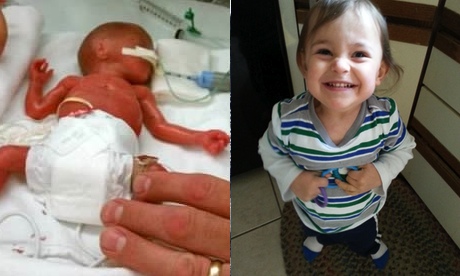
Cade, son of Janet Pickel when he was born (left) and now (right). Photograph: The Guardian.


On the day my twins were born, they racked up health-related expenses of $ 29,000 apiece.


They were delivered by way of emergency caesarean segment at 24 weeks’ gestation, meaning I was approximately five months along. Our daughter, Jaina, weighed just below a pound her brother, Cade, weighed 1 pound, five ounces.


They could not breathe on their personal. Their skin was so thin, their bodies so little, we could watch their hearts beat. They hadn’t developed cartilage yet their ears and noses have been flaps of skin. We didn’t inquire how a lot it was going to expense to deal with them we just wanted our infants to live.


Our several physicians talked about day-to-day survival, not lengthy-term payment strategies.


My employer – a newspaper not far previous a round of buyouts and price-cuts – did not inquire me how significantly it was going to cost to deal with them. My co-workers pooled money and bought us present cards so we didn’t have to cook as we drove back and forth to the hospital for months.


When I study AOL chief Tim Armstrong’s remarks blaming his company’s improved well being-care expenses on two “distressed” infants with million-dollar healthcare expenses, I wondered if that’s what every person imagined about our twins. Did we invest as well considerably of an individual else’s money to consider to conserve them?


I know my unplanned initial pregnancy (at 41) value a total great deal of money, a lot of which did not come out of my pocket. Insurance coverage and Medicaid picked up all but a handful of thousand bucks of the $ 2m we “invested” at the Harrisburg Hospital neonatal intensive care unit in four months.


Our Jaina lived only 49 hrs. In that time, she had x-rays, blood transfusions, IVs, a ventilator, an incubator, a devoted nurse. I never even know what else. All I know is she was quite sick and she died, and I would’ve paid $ 10m – any amount – to save her if I could have.


Cade appeared healthier at 1st, but had his initial (of 10) surgeries when he was two weeks previous. When he was 3 weeks outdated, struggling through his umpteenth infection, a doctor asked us if we needed hold making an attempt to hold him alive.


We did, no matter the cost.


Thanks to talented doctors and nurses who found the supply of the infection and fixed it, Cade turned the corner following that day. He was not out of the woods, however. He could not breathe on his personal right up until he was two months previous. He had sight-conserving eye surgical procedure at 3 months.


At one stage, we have been advised he likely had cerebral palsy and would be disabled in some way, perhaps mentally, maybe physically, possibly the two. Was a disabled youngster also expensive to maintain? No 1 asked that query. My husband and I in no way deemed it.


Cade was launched from the NICU when he was four months outdated. His very first week home, he had 7 physician appointments. He did not have cerebral palsy soon after all, but received government-paid early intervention companies to help him find out to stroll and talk and catch up with his non-preemie peers.


Today, Cade is a content, wholesome two-yr-outdated. He has mild asthma, but has not been hospitalized unexpectedly for a lot more than 18 months, which is trigger for celebration. He still sees a good deal of medical professionals, but not really frequently. His final surgery was only a month in the past, but his scars on his back, his belly and his arm never seem to bother him. Largely, he giggles and skips and asks to watch “Hi Elmo” (Sesame Street) all the time.


I wonder if AOL’s Tim Armstrong, who has apologized for his statements, understands how dehumanizing they were. Some have even advised his remarks violated America’s healthcare privacy laws. Remember when Obamacare opponents were speaking about grandma being subjected to death panels as an alternative of expensive care? It is the very same thing. It’s as if he wished price-benefit analyses to be done just before our daughter’s IV was place in or our son’s cardiac surgeon referred to as.


Thankfully, in our situation, my husband and I were capable to determine what was very best for our child with no worrying about the price. We have usually paid our insurance coverage premiums and taxes without complaint, believing that the frequent very good is well worth sharing the ache. We have tried to give back what we’ve been provided by means of perform and volunteerism.


Must I really feel guilty for possessing medically fragile babies? Was it worth it? Was it fair for other people to aid pay out for them? Must my son truly feel pressured to have a much better-than-common existence due to the fact his start price a lot far more than every person else’s?


Unanswerable concerns. I cannot put a cost on a priceless existence, and neither can any individual else.


AOL"s Tim Armstrong couldn"t be more wrong about "distressed babies" | Janet Sheaffer Pickel