Beveridge etiketine sahip kayıtlar gösteriliyor. Tüm kayıtları göster

18 Eylül 2016 Pazar

Letters: my prescription for the NHS is a new Beveridge report…

My prescription for the NHS? A new Beveridge report…


With parents who were scared if we children became ill because of the “doctor’s bills”, we welcomed the 1942 Beveridge report, which led to the NHS (“Our hospitals are on brink of collapse”, News, last week).


I spent 40 years as a GP, conducting home births, looking after families, caring for the elderly. Twenty years after retirement, the picture seems very different. We have an ageing population with expanding health and social needs and the expectation that public funds should continue largely to provide this.


But the birth of the NHS was a very different time from the present, and I believe we need an up-to-date, apolitical review, akin to Beveridge, to guide us on the provision of medical and social care today. This might help the NHS to avoid being the political football it is.
Godfrey Fowler
Emeritus professor of general practice, Oxford University


The NHS is disintegrating and, as you quoted last week, a government spokesman blames “the aging population” again. Well, we’ve all been here for at least 70-plus years, so why the surprise! And what colossal mismanagement to slash funding to councils for social care while at the same time diverting millions of pounds from patient care to PFI companies. Then to alienate the hardworking and dedicated workforce of which there is already a shortfall. 


It is a frightening prospect for us seniors, who have paid in all our lives, to find that the care may not be there now that we need it. There must be an urgent public inquiry – and it must not ignore this leeching of funds to companies, many of which have MPs and peers on their boards, who are making money at our expense. There is no point putting further money in if it just goes to these people.
Carol Terry
London SW18 


Brexit was built on fraud


Andrew Tampion argues “the time has come to accept the result” of the EU referendum (“Take Brexit on the chin”, Letters, last week). I and others have considerable difficulty in accepting such reasoning. The outcome of the referendum was a debacle, if not an out-and-out fraud.


We know that lies were told regarding such matters as the amount of money Britain actually gives to the EU and the supposed benefits of an exit to organisations like the NHS. It has become clear that many people did not vote on the substantive issue of the referendum but rather sought to show their contempt for the political ruling class, thus the senseless result.


To have a referendum in a democracy, there must be a well-educated electorate; that, all too evidently, was not the case. Many people simply had no clue how laws are invoked within the EU structure. It was a simple matter of making the argument that laws are enacted by an unelected “commission”, a fiction gainfully employed by those politicians reliant on a large measure of ignorance.


In no way am I, along with many other people, prepared to accept the Brexit result. We want justice with the truth at centre stage. I appreciate that there is little chance of any real reckoning with those who so casually sought to mislead many people, given that they now hold high government positions, but the argument that we must move on simply will not wash.
Francis Durham
Rickmansworth, Herts


The centre cannot hold…


Your paper quotes a poll (News, last week) that asks people where they see themselves on the political spectrum. The proportions were as follows: leftwing 10%; centre left 15%; centre 45%; centre right 17% and rightwing 13%. From these numbers is derived the figure that 77% consider themselves centrist or right of centre, a figure that includes those who are left of centre. On that basis, one could argue that the same 77% consider themselves centrist or left of centre. One could emphasise that nearly half (45%) are in the centre, or that most (55%), identify in some way as left or right. Or one could just print the numbers and stop messing around.
Jeremy Hardy
London SW16


Heartbreaking comedy


It’s great to read that the National Theatre has the courage to stage a musical about a woman with cancer (“I hate musicals. I thought I could do them better”, Observer New Review, last week). But the powers-that-be might also like to a take  a look at Britney, the quite brilliant work of playwright Charly Clive and ex-Cambridge Footlighter Ellen Robertson, in which they tell the story of Charly’s experience with brain cancer. I saw it at the Edinburgh fringe last month. It was one of the best things I’ve seen in years. Achingly funny and desperately moving.
Vivien Graveson
St Albans


Put your shirt on it…


In  an edition with various features on poverty, the NHS  and inequality, I was amused to find the following copy adjacent to an image of a female fashion model (Observer Magazine, last week): “For clothes that look super posh but aren’t super expensive try Modern Rarity John Lewis Palmer/Harding shirt £150”. Since when was £150 not expensive for a shirt?
Stephen Brain
London SE10


Letters: my prescription for the NHS is a new Beveridge report…

20 Nisan 2014 Pazar

What would a 2014 Beveridge report say? | Larry Elliott

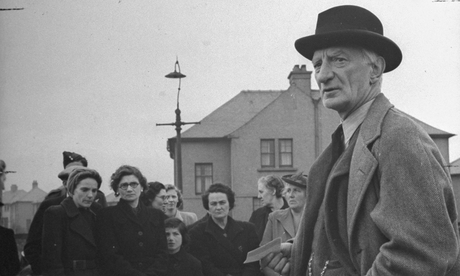
William Beveridge

William Beveridge. Confronting the ‘five giants’ he identified remains the meat and drink of politics. Photograph: Hans Wild/Time &amp Existence Pictures/Getty Photographs


5 giants bar the street to progress: want, ignorance, idleness, ailment and squalor. So stated William Beveridge in the report commissioned by the wartime coalition published in 1942 that shaped the politics of postwar Britain, most especially the Attlee administration of 1945-51 but also the Conservative governments that followed.


Want was tackled by way of a cradle-to-grave welfare state ignorance via the tripartite schooling system (grammar schools, secondary moderns and technical colleges) idleness through the dedication to total employment condition by means of the creation of the NHS and squalor by means of a programme of mass property-creating and increased standards of provision.


Confronting the 5 giants stays the meat and drink of politics, as a fast flick via the Observer demonstrates. “Labour considers raising national insurance to repair £30bn NHS ‘black hole’”, says one headline. “Christian charity hits back over Tory attacks on food banks,” says another. A third referring to the psychological well being troubles induced by versatile work patterns is headlined: “Supermarket shifts ’cause nervousness and insecurity’”.


So let’s presume that a far-sighted government took the view that a new Beveridge report was essential in response to the troubles thrown up by the Great Recession of 2008-09, just as the unique was a response to the poverty and financial stagnation of the period amongst the 1st and 2nd world wars. What would it say?


It would start by recognising that fantastic progress that has been produced. Britain is a richer, healthier, far better educated and a lot more tolerant country than it was 70-odd many years in the past. Daily life expectancy has risen by well in excess of a decade university training is no longer for a tiny elite incomes adjusted for inflation are four times higher than they were at the finish of the 2nd planet war the variety of individuals in owner-occupation has a lot more than doubled men and women no longer reside in sub-regular homes with out baths and within toilets.


But a new Beveridge would also say that there is even now much incorrect with Britain that needs to be put right. The daily life expectancy of a person born in Glasgow is 10 many years decrease than a person born in East Dorset the Uk is sliding down the league table of educational attainment nearly a million men and women are making use of food banks almost four million families could not spend their lease or home loan for much more than a single month if they misplaced their job.


Subsequent, it would inquire which of the 5 giants continue to be the most formidable barriers. Two are nevertheless alive and kicking, a third when assumed to have been slain could come back to daily life.


The dormant giant is illness. Investing on the NHS is ten instances increased than it was when it was founded in excess of the past 60 years the common increase in the spending budget for well being has been just under four%. So whilst the ringfencing of the NHS because 2010 looks generous against the deep cuts in, say, the House Office or the Ministry of Justice, it represents the greatest squeeze on assets given that 1948. This is against the backdrop of a population that is living longer and the place technological advance implies that rates in healthcare rise far more swiftly than the cost of residing typically. Britain loves the NHS and has no want to move away from a free-at-the-level-of-use system. But unless of course the public is ready to pay a lot more, the good quality of care will deteriorate. Labour’s proposed solution is an enhance in national insurance contributions specially designated for overall health and care fees.


That leaves the two giants that already loom large. The very first of these is want, as is clear from the vigorous debate about residing requirements in the Uk. Are they going up? Is there a price-of-living crisis or not? Who is benefiting from a expanding economic system?


What’s happened is this. In the previous decade, shell out prices have been historically low. Actual spend was struggling to maintain up with inflation even ahead of the economic crisis of 2007, and has fallen sharply considering that. Wages buy 10% significantly less now than they did at their pre-economic downturn peak.


Even now, it is questionable no matter whether they are in fact increasing. The government’s measure of regular earnings is a mean. If spend increases are skewed to those on the far better-paid jobs, the mean can boost even though most workers’ shell out increases significantly less rapidly than inflation. Common earnings excluding bonuses (which tend to go to people on higher incomes) are growing by 1.three% a year, which is nevertheless under the official inflation fee of 1.six%.


Some boost in earnings is to be anticipated as the economy grows and unemployment comes down. But the framework of the labour marketplace indicates that the select-up in genuine pay growth will be slow and it is most likely to get till the end of the decade – and probably longer – to get back to pre-recession amounts.


It would not get a new Beveridge report prolonged to discover the reason for the squeeze on living specifications: the imbalance of energy in the workplace. In excess of the past 25 years, the trend has been in direction of an atomised and casualised workforce that has small or no bargaining energy. The Britain of right now is a land of safe workers on excellent incomes but also of gangmasters, zero-hrs contracts, domestic servants and the self-employed scratching a living. Under the Labour government of 1997-2010, tax credits were utilized to top up lower pay out, but austerity implies they have grow to be significantly less generous. There are now more individuals in poverty who are in perform than there are who are workless.


Unless of course the state is ready to act as the guarantor of a living wage by way of the tax and benefit method, there are only two attainable outcomes. One is that the labour share of nationwide earnings will carry on to fall, top either to a reduction in aggregate demand and/or greater indebtedness. The other is that the bargaining power of labour is elevated via total employment, stronger trade unions and collective bargaining.


The other giant is housing. Owner-occupation, which rose steadily in the 20th century, is in decline. Home price tag inflation coupled with lower earnings development implies that a quarter of youthful people aged between twenty and 34 dwell with their mother and father. In the far more prosperous components of Britain, there is a mismatch between housing supply and demand.


This is not a new issue. A decade in the past, the report ready by Kate Barker for Gordon Brown mentioned 210,000 new houses a yr were required in England to avert a housing crisis. Since then 115,000 houses a year have been built.


Outcome? A housing crisis, for which the only answers are a effective regional policy that moves folks to the place the empty homes are, or builds plenty far more homes exactly where the jobs are.


The ultimate point the new Beveridge would say is this: cracks can only be papered in excess of for so long. In all the important places – the NHS, residing standards and housing – it is time for action.


What would a 2014 Beveridge report say? | Larry Elliott