students etiketine sahip kayıtlar gösteriliyor. Tüm kayıtları göster

28 Nisan 2017 Cuma

Surrey students offered meningitis B jab after undergraduate"s death

Students living on campus at the University of Surrey are being offered the meningitis B vaccine after a student died and two others were taken to hospital with the bug.


John Igboanugo, a first-year physics undergraduate, died earlier this month following a sports trip to Rimini in Italy.


Two other Surrey students also fell ill with meningitis but have now been discharged from hospital.


Public Health England (PHE) said laboratory reports had confirmed two of the students had meningitis B while the third was thought to have contracted the B strain of the bug as well.


About 4,200 full-time students living in halls on the Guildford campus – around a third of the total student population – are now being offered the jab to protect against meningitis B.


The vaccine is normally only routinely given on the NHS to young babies.


Prof Max Lu, vice-chancellor of the University of Surrey, said: “We are greatly saddened by the death of our student, and our hearts go out to his family and friends during what continues to be a very difficult time.


“The health and wellbeing of everyone on campus is of the utmost importance.


“We are working closely with PHE on a targeted vaccination programme and are reassured that the risk to staff, students and visitors is still very low.”


Prof Kamila Hawthorne, associate dean for medicine at the University of Surrey, added: “We appreciate that when cases of meningitis B occur there is increased concern about the potential spread, but evidence shows that meningococcal infection is not highly contagious, comparatively rare and the risk to the wider community remains very low.


“Only people who have prolonged, close contact with an ill person are at a slightly increased risk of becoming unwell.


“If anyone is in any doubt or concerned about their health, or the health of others, please call NHS 111 urgently.”


The university said there was no direct link between the three cases.


The two students who were taken to hospital had not been on the sports trip to Italy.


PHE said passengers on the coach trip had been offered antibiotics as a precaution.


It said the wider population in the town and non-students who visited but did not live on the university campus were not considered to be within the at-risk group.


Dr Peter English, consultant in communicable disease control from PHE in the south-east of England, said: “Meningococcal infection is comparatively rare and the risk of transmission is relatively low.


“People who have prolonged, close contact with an ill person are at a slightly increased risk of becoming unwell in the following days.


“This is why immediate contacts of the cases have already been offered antibiotics as a precautionary measure.


“After considering the medical evidence, we have decided to offer vaccination to around 4,200 students living in halls of residence at the university to reduce risk of further cases next term.


“I would like to reassure other students, teachers, their families and the local community that the risk of catching this infection remains very low, and any higher risk is confined to those being offered the vaccine.”


Students are regularly offered a vaccine against other strains of meningitis, known as the Men ACWY jab.


Meningitis can develop rapidly and is sometimes mistaken for flu. Those who survive can be left with life-changing disabilities.


Symptoms include a high temperature, feeling or being sick, exhaustion and irritability, a headache and aching joints, stiff neck and dislike of bright lights, confusion and a rash.


Surrey students offered meningitis B jab after undergraduate"s death

24 Kasım 2016 Perşembe

Three Bristol University students die within weeks of term starting

A coroner is investigating the circumstances surrounding the sudden deaths of three students, all believed to be first years, at one of Britain’s top universities within weeks of the new academic year beginning.


Though the causes of the deaths will have to be established by the Avon coroner, online tribute and fundraising pages for two of the three suggested they had taken their own lives.


The University of Bristol said the deaths were not being treated as suspicious and were not connected but it would carry out its own investigations to find out if lessons could be learned.


According to a survey by the National Union of Students (NUS) published last year, eight out of 10 students said they had experienced mental health issues in the previous year and a third said they had had suicidal thoughts.


One of the students who died has been named as Miranda Williams, 19, from Chichester, who was just three weeks into her first term.


An online fundraising page set up to raise money for the charity Papyrus, which works to prevent young people from killing themselves, said Miranda had died three days after she “decided to take her own life”.


A message on the page said: “Miranda suffered with depression and anxiety a lot of her teenage life … We blame the stigma of her illness for her death. It restricted the help she got, the support and the understanding.”


She was studying philosophy and was a member of the Jazz Funk Soul Bristol society, according to an email to students from the students’ union announcing her death.


It said support was available for students and added: “Shock, grief and understanding what has happened will affect us all differently.


“It is important to let this happen in its own time. Talk to each other, to your school, to your residence pastoral team and to your friends.”


The second first year student who died was the law student Kim Long, 18, from Penzance in Cornwall.


On an online tribute page his family wrote: “We have lost our dearest, loveliest and only son. Kim took his own life last week. He was considerate to the end by leaving us a loving letter which helps us to respect and accept his choice. May he rest in peace.”


A university spokesperson said: “Sadly we can confirm there have been three unrelated student deaths this term. These events are always extremely upsetting and our thoughts are with the students’ families and friends.


“Our student welfare services are offering support to anyone affected. It would be inappropriate for us to comment on the cause of these deaths until the coroner has undertaken independent inquests, although we understand that there are no suspicious circumstances surrounding them.


“The University of Bristol has around 22,000 students. We will, of course, be investigating if there is anything we need to do to learn from these sad events but we have no reason to believe they represent a wider issue.”


Bristol University students’ union’s student living officer, Stephen LeFanu, said the organisation was working hard to improve pastoral care.


He said: “Starting university can be extremely difficult. Some new students are without their support networks from home for the first time, and will be experiencing new academic and social pressures.


“Rising fees mean that students are also increasingly under a great deal of financial pressure, with many taking on part-time work alongside their studies. Many people will also experience complex mental health difficulties, regardless of their environment.”


In the UK, the Samaritans can be contacted on 116 123. In the US, the National Suicide Prevention Hotline is 1-800-273-8255. In Australia, the crisis support service Lifeline is on 13 11 14. Hotlines in other countries can be found here.


Three Bristol University students die within weeks of term starting

22 Kasım 2016 Salı

‘Stark choice’ as schools struggle to foot bill for poorer students

Kevin Prunty is executive head teacher at Cranford community college, a high-achieving school in Hounslow, west London. His pupils are ambitious and successful, but many come from disadvantaged backgrounds.


Like other schools serving deprived areas, Cranford find itself increasingly playing a sophisticated welfare role in its community. It is also footing the bill for uniforms, PE kits, shoes, lunches and educational trips from a diminishing budget, to subsidise parents who cannot afford to meet the costs.


But with school budgets under pressure and further cuts expected there are fears they will not be able to continue to fill the gap.


“Schools know already that there are sizeable further cuts to funding on the way – and whilst we are currently able to fund these additional needs – it will soon become more difficult and perhaps impossible to justify doing so,” says Prunty.


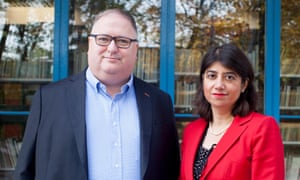
Kevin Prunty and Seema Malhotra


Kevin Prunty, head of Cranford community college in west London, with Seema Malhotra MP. Photograph: Alicia Canter for the Guardian

He says it’s not possible to measure the additional cost in the sense of how many uniforms, how many trips, how many meals. Instead he describes the kind of scenarios his staff deal with on a daily basis to illustrate the level of need.


A year 7 boy needs additional support but his symptoms don’t meet the threshold to qualify for child and adolescent mental health services (Camhs).


An educational welfare officer helps a family where the father is suffering from a mental illness and keeps telling his children they are terminally ill. Another colleague intervenes to help a child with impaired hearing.


Someone else takes a pupil out to buy a suit for a job interview for a traineeship. It’s not just the money – they coach them for the interview and make sure the suit fits properly. “There’s nobody to say whether the arms are too long, so some of our staff take the responsibility,” says Prunty.


And things are getting worse. Since pupils returned to school in September, staff have noticed an increase in the number of children who are not eligible for free school meals who come in without any money for lunch. Inevitably the school provides – it all costs and meanwhile budgets are shrinking.


The Institute for Fiscal Studies has estimated that increasing costs and growing pupil numbers will result in an 8% cut in funding per student by 2020 and an inquiry has been begun by the public accounts committee to examine the financial sustainability of schools.


The sector would like to hear there is more money for schools in the autumn statement later this week – the reality is that schools like Prunty’s are likely to lose out in the long-awaited redrafting of the national funding formula (NFF) in which money from well-funded urban schools working with disadvantaged families is expected to move to less well-funded schools in less needy areas.


He has already had to address a £1m shortfall in the budget caused by a cut in grant funding from the government and rises in pension costs, national insurance costs and below-inflationary salary rises. He has managed to balance the budget but twelve jobs had to be cut – four teachers and the rest support staff.


At another school in the area, a principal who asks not to be named says he increasingly feels like a debt collector, having to chase up parents who owe the school money. As families at his school struggle to make ends meet, many are building up large debts. Some owe hundreds of pounds for school lunches and he estimates that parental debt is costing the school £10,000 a year.


Last year the school handed out 45 uniform grants worth £100 each to parents in need. Then there are equipment grants for things like scientific calculators. He feels for the parents, many of whom are in low paid jobs and are surprised to find they are not entitled to free school meals for their children. “There’s a lot that’s adding to pressure on parents. It’s uncomfortable to be talking to them about the money they owe the school. But that money is money we are not spending on teachers,” he says. “Schools are not in the debt management business. It’s not sustainable to be running this level of debt.”


The issue has been raised by Seema Malhotra, Labour MP for Feltham and Heston, who has become increasingly concerned about the hidden burden on schools’ budgets. “Schools are being faced with a stark choice,” she said. “Let children from poorer backgrounds miss out on educational opportunities and experiences, or pick up the costs and take on financial debt. Budgets are already under pressure and with further cuts to school funding, helping families in need is set to get harder.”


At Springwest Academy in nearby Feltham, which also serves a community with high levels of disadvantage, there are similar concerns. Pastoral mentors deal with calls day in and day out from families with worries about housing and finances; school uniforms and shoes are being paid for more frequently out of the school’s hardship fund and almost four out of ten pupils (38.3%) are referred for counselling or other mental-health support.


Victoria Eadie is chief executive of the Tudor Park Education Trust which includes Springwest. “It does worry me what’s going to happen. I don’t know a school in Hounslow that is not having to go though some form of restructuring and quite severe cuts.” Until now her school, like others, has been able to step in to support the neediest. With further cuts, she says, “schools will not be able fill the gap”.


‘Stark choice’ as schools struggle to foot bill for poorer students

28 Ekim 2016 Cuma

DIY doctors: New Zealand medical students "operating on themselves at home"

A number of medical students at New Zealand’s oldest university are practising invasive medical procedures on their own bodies, and the bodies of their fellow students.


A study published today in the New Zealand Medical Journal found 5% of medical students surveyed by researchers at Otago University medical school in Dunedin are practising in what is believed to give the aspiring medics stress-free conditions in which to hone their skills.


Procedures include inserting IVs, withdrawing blood and removing cysts on their own or other students bodies, some in their own homes using pilfered equipment.


The survey’s sample size was 284 students from a cohort of 800 in their fourth, fifth and sixth year of medical study.


Five percent – or 15 students – described practising on themselves or fellow students.


Co-author and deputy vice-chancellor Helen Nicholson said the findings were “very concerning” and warranted immediate further investigation.
“At the moment we don’t really know why the students are doing this, but anecdotally we have been told it is to practice their skills in a private and stress-free environment,” said Nicholson.


“It is pretty strange behaviour. We know some students were doing these procedures at home, with equipment they had taken from the hospital. So we do have serious concerns that this sort of behaviour is not displaying self-care or a professional attitude.”


Nicholson said while there were plenty of reports of doctors self-diagnosing and self-prescribing, to her knowledge this was the first study to identify students practicing medical procedures on themselves.


The most common practice the medical students tested on themselves was the insertion of an IV line into a vein, and the most common procedure students tested on each other was taking blood.


Nicholson said taking blood, removing a cyst or mole and inserting an IV were all particularly difficult procedures to perform on your own body, and all of them involved some degree of pain.


Professor Barry Taylor, dean of the Dunedin School of Medicine, said it was “pretty common” for students to practice a range of medical procedures on themselves such as using an ultrasound, examining inside each others ears or taking blood pressure.


But Prof Taylor said he drew the line at students practicing any surgical procedures on themselves or each other, and doing so in their own homes with no clinical supervision was dangerous.


“There is a broad philosophy in medicine that doctors shouldn’t promote what they haven’t experienced,” said Prof Taylor.


“And if you are practising on yourself you could argue that you are certainly getting informed consent. But the risks of something going wrong are similar to if you are treating a family member, which we discourage because you are not in a position to make unbiased or objective decisions.


“Taking blood and removing cysts are definitely on the margins of acceptable and could potentially be dangerous procedures if something goes wrong.”


DIY doctors: New Zealand medical students "operating on themselves at home"

22 Eylül 2016 Perşembe

Mental health at university: "Students shouldn"t have to suffer like I did"

As a student, I used to have a ritual. I would wake up and immediately jump up and down 100 times. Then I would start work at 9.21am precisely. I would eat dinner at 5pm on the dot, and I’d finish work at 10pm. Before going to bed, I would touch wood five times. Whenever the cycle was broken, I would break down.


I would tell myself that this was normal, that this was how you make a success of yourself. I wouldn’t be doing my academic work any justice if I wasn’t constantly on the verge of a breakdown, right?


My OCD routine was damaging. I didn’t feel I could seek help because my problems seemed so trivial compared to others’.


It is often said that when it comes to mental health, ignoring your problem – if it is even recognised in the first place – is not the solution. But dealing with it alone isn’t either, since certain neuroses will intensify in solitude. Mine certainly did. I never ate with people, and in a way it helped to lower my anxiety levels in the short term. I was “managing”.


But over time I became more and more anxious, until one day I had a panic attack while walking to university. I didn’t want to face this alone anymore; I had to be brave and get help without feeling I was merely attention-seeking.


But going to the doctors didn’t help much. It was an impersonal experience, where I was told to fill out forms on how to “rate” my level of anxiety. I knew full well that I’d been suffering from OCD, a borderline eating disorder and depression for around four years. I was at breaking point, I was suicidal, I couldn’t face the day anymore without becoming overwhelmed with emotion.


That is where the role of university counselling comes in, or at least it should have. The value of speaking to someone external about your problems is often overlooked – but I wasn’t even aware of this service as an undergraduate student.


The large number of students on campus can make it difficult for individuals to form their own support networks, to fit in and to feel like they are part of a wider whole. The prevalence of mental illness in students will likely become worse without adequate funding for support. A new report that came out today recommends that some universities increase their spending in this area threefold.


There needs to be a more open and inclusive dialogue on campus about mental health, and where students can get support – whether that is through formal counselling services or peer-support networks. This would work to break down the stigma I found myself trapped by when I was at my lowest ebb.


Support should not come as the last resort when students are at breaking point. Problems need to be tackled as early as possible, no matter how small the students – or their peers – believe them to be.


Only 13% of the NHS budget is currently committed to mental health services, despite the fact that mental ill-health accounts for 28% of the total burden of disease. The problem in many universities across the UK is the same: the underfunding of support services doesn’t accurately reflect today’s reality. We need to debate this openly, and more often so that students don’t suffer in silence like I did.


Keep up with the latest on Guardian Students: follow us on Twitter at @GdnStudents – and become a member to receive exclusive benefits and our weekly newsletter.


Mental health at university: "Students shouldn"t have to suffer like I did"

20 Ağustos 2016 Cumartesi

Struggling students are not "lacking resilience" – they need more support

Resilience has been a buzzword in education for years now. Advocates say that young people need to develop the ability to cope with difficulties themselves, rather than expect others to solve their problems. But critics argue that it is used as a catch-all term that removes responsibility from institutions and fails to address the problem of worsening mental health in students.


Related: Tuition fees ‘have led to surge in students seeking counselling’


I have been working as a welfare officer for the past year, and I have rarely seen the term used to encourage self-improvement in an effective way. I have seen students told by their tutors, counsellors and other support staff that they just need to become more resilient. Yet there is little advice on how to do this, or why it will help.


Students often see the word as a synonym for strength, and therefore feel that lacking resilience is a sign of weakness. A professor could be saying “be more resilient” and mean that a student shouldn’t take critical comments on their work personally. But what a student hears is something like, you aren’t strong enough, or you need to man-up, or you lack backbone.


It’s too ambiguous


The word resilience is used too frequently and applied to vastly different situations.


A first-year student at the University of Edinburgh told me she would always ask her professors for feedback about a bad grade, wanting to know how to improve for the future. In response she was told to become more resilient and stop asking for feedback after every assignment. Surely it takes resilience to embrace negative feedback and address mistakes?


Students need to be equipped to bounce back from tough situations or those where they didn’t achieve perfection.


I’ve heard an employer complain that they were being asked for feedback about applications more often, because students “weren’t resilient”.


Times have changed


Problems are often discussed with an “it was different back in my day” attitude. So if students are accessing university counselling services more, it’s because the entire student population is losing its resilience. If disability services are overstretched, the same reason is given. And when tutors are asked to provide pastoral support – historically always a part of the personal tutor role – they feel it’s because these “modern students” need extra help.


Students might be asking for help earlier and for problems that they once might have kept to themselves. But to dismiss an entire generation isn’t fair.


Students are coping with all sorts of factors that make their lives a challenge: the worry about tuition fee debt, an intensely competitive graduate jobs market and the pressure of social media. By recognising this, university staff can start to support their students to become more resilient.


Impact on mental health


The most worrying aspect of this trend is the frequency with which resilience is referenced in discussions about mental health. It is not appropriate to tell anyone suffering with mental illness – be it anxiety, depression, an eating disorder or something else – that you can recover by becoming more resilient.


Doing so strengthens the notion that mental ill-health equals weakness, and can make people feel that they would not be ill if they had only been tougher. A runner with a severe ankle sprain would not be told to fight through the pain and continue training, so why would we tell someone who has panic attacks the same thing?


Related: No one sees how hard it is for students with an invisible illness


How to make it work


Resilience is a great concept. Learning not to be discouraged by past failings and recognising shortcomings is an extremely useful skill. Students need to be equipped to spring back from tough situations, or times when they didn’t achieve perfection – this is vitally important in universities.


As support staff we need to enable students to learn the skills of resilience. We need to standardise what we mean by it. And we should never use the term when discussing mental health.


Being resilient doesn’t mean never asking for help or never being affected by difficult situations. We need to focus our discussion on boosting wellbeing, and teaching a set of skills that help students bounce back from setbacks in life and academia.


Join the higher education network for more comment, analysis and job opportunities, direct to your inbox. Follow us on Twitter @gdnhighered. And if you have an idea for a story, please read our guidelines and email your pitch to us at highereducationnetwork@theguardian.com


Struggling students are not "lacking resilience" – they need more support

9 Ağustos 2016 Salı

Here’s Help For Your College Student’s Depression

According to Psychology Today, the medication most prescribed on college campuses isn’t the pill. It’s Prozac.


Depression is among the top mental health challenges facing college students today. With 36.4% of college students experiencing some level of depression while at school.


It’s the number one reason students drop out of school.


College should be one of the best experiences of your child’s life. It should be incredible, not just endured.


The pressures and anxieties students face can be overwhelming. As a parent, it’s difficult to send them off knowing you’re not there to guide them. You feel like you have no control.


But imagine if you could give your child something to help ward off depression. Or, help play a role in helping if they were already struggling. A natural alternative that had no serious side effects. Wouldn’t you sleep better at night?


Turmeric vs. Prozac


This 2013 study comparing Turmeric to Prozac for treating depression could be the answer. The randomized six-week study consisted of 60 patients diagnosed with Major Depressive Disorder (MDD).


Evidence that Curcumin may be used as an effective, safe method to help treat patients. Without other psychotic side effects or concurrent suicidal thoughts.


A Happy Pill In A Glass


My daughter was born with severe heart defects. I turned to natural remedies to help heal her. Maybe this powerful herb can help your child with depression.


This smoothie helps boost their immune system while warding off anxiety and depression.


Begin by sharing this Turmeric Smoothie recipe. But if your child is like mine, they will never go out and get the ingredients to make it. So make it easy for them! Pack up your depression solution and have it ready for them when they leave.


Be sure to provide them with a blender. 


Forgot to include it in their suitcase? Send them a care package. Pack up the ingredients and the blender.  You can even send canned Pineapple to replace the frozen.


Smoothies are a convenient way to get a variety of powerful healing ingredients into one meal. It’s a quick and easy way to eat healthy every morning. With their busy schedules, what college student wouldn’t love that?


Emotions play a major role in staying healthy. This smoothie may not only help reduce depression but get rid of it all together.


In truth, love, and healing,
Carolyn Harrington


Turmeric Smoothie Recipe
A delicious, comforting smoothie that is reminiscent of Thanksgiving with a hint of cinnamon and ginger. Thank you to PreventDisease.com for this wonderful recipe!


Ingredients:
1 Cup Hemp or Coconut Milk
½ Cup Frozen Pineapple or Mango Chunks
1 Fresh Banana
1 Tablespoon Coconut Oil
½ Teaspoon Turmeric (can be increased to 1 Tsp)
½ Teaspoon Cinnamon
½ Teaspoon Ginger
1 Teaspoon Chia Seeds
1 Teaspoon Maca (optional)
Black Pepper*


Directions:
Combine all ingredients in a blender and process until smooth. Best consumed on an empty stomach to reap the full benefits of the powerful antioxidants.


*Black pepper aids in the absorption of curcumin. Even just a little pinch of pepper—1/20th of a teaspoon—can significantly boost levels.


Use organic ingredients as much as possible. You can substitute almond milk for hemp or coconut milk. Try to avoid using cow’s milk.


Visit my blog: The Art of Healing


Let’s get social: Facebook / Twitter / Pinterest / YouTube / LinkedIn


This post is for educational purposes only and does not provide medical advice. It is meant to motivate, educate and inspire you to live a healthier lifestyle.


The content is not intended to be a substitute for professional medical advice, diagnosis or treatment. Always consult your physician or a qualified health care provider with questions regarding any medical conditions. Reliance on any of the information provided by this post is solely at your own risk.


Resources:


College Level Coping


The Top Mental Health Challenges Facing Students


Efficacy and safety of curcumin in major depressive disorder: a randomized controlled trial.


Why Pepper Boosts Turmeric Blood Levels


Here’s Help For Your College Student’s Depression

28 Temmuz 2016 Perşembe

Survey: 25% of UK architecture students treated for mental health problems

More than a quarter of architecture students in the UK are receiving or have received medical help for mental health problems related to their course. Another quarter feel they may have to seek help in future.


Anxiety over the student debts accrued during the seven-year course, and workloads that frequently require all-nighters, were the primary sources of stress identified by undergraduates.


Poor-value university courses, architectural practices demanding they work for free and sexual and racial discrimination were the other issues highlighted by respondents to the survey carried out by the Architect’s Journal.


More female students reported seeking medical advice for mental health than male students. Nearly one in three women in the survey, 29%, reported receiving mental health treatment over issues directly related to their course, compared with 23% of men.


Nearly 90% of the 447 respondents said they had had to work through the night at some point. Almost one-third said they have to do it regularly.


Related: Six things students can do to boost their mental health


Two-thirds of undergraduates said their debt at the end of their course would be £30,000 or above. Despite that, almost a third said they had been asked to work in practice for free.


Students taking part in the survey reported seeing friends suffering from hair loss as a result of stress. One respondent reported that two course mates had committed suicide, though the Architectural Journal was unable to verify that report. Another student wrote: “I feel so emotionally drained, without any confidence in my ability.” Another said: “A culture of suffering for your art is promoted within education.”


Anthony Seldon, vice-chancellor at the University of Buckingham and a mental-health campaigner, said: “Britain has a near epidemic of mental health problems among its students. Those studying architecture appear to be under added burdens, emanating perhaps from the very length of the course and time taken before earning a proper income.


“Much could be done to rethink the courses so they align with the architectural education needs of the future rather than the dictates of the architectural big cheeses of the past.”


Architect reviewing blueprints on office floor


Almost a third of architecture students in the survey said they had been asked to work in practice for free. Photograph: Alamy

University staff, too, are noticing the emotional strain of architecture education on their students. Timothy Smith, architecture course director at Kingston University, said there has been a rise in the number of students applying for “mitigating circumstances or extensions” in recent years, adding that the requirement for many to work part time means there is a “great deal of pressure” on them.


Nam Kha Tran, a student at the Sheffield School of Architecture, said mental health problems are the “disease of our generation”.


Stephen Buckley, head of information at the mental health charity Mind, says university students are not only burdened with the stress of exams and coursework deadlines but also with high student loans and debt. He reports a surge in calls to the charity’s helpline from those struggling with financial problems in the last few years.


Jane Duncan, president of the Royal Institute of British Architecture, is urging architecture students struggling with mental health problems to seek help, stressing that they “are not alone”. She said that long hours, a heavy workload and intense design scrutiny were embedded in the culture of architecture education.


Duncan added: “I am concerned that the combination of tuition fees, rising student debt and the necessity for many students to take on paid work outside study can trigger or exacerbate mental health problems.”


Survey: 25% of UK architecture students treated for mental health problems

19 Ağustos 2015 Çarşamba

"Smart drug" taken by a single in 4 college students really does improve overall performance


A ‘smart drug’ taken by 1 in four students at Oxford University genuinely does improve brain electrical power and colleges need to take into account whether it need to be banned, scientists have explained.


Modafinil is at the moment offered on NHS as a treatment for narcolepsy but surveys have advised that a fifth of university students use it to improve performance for revising and exams following it was linked to improved cognition.


Oxford University and Harvard Health care School looked at 24 research into modafainil and have concluded that it actually does enhance considering capabilities, particularly in extended complicated tasks. It was also found to assist with planning, decision generating, flexibility, finding out and memory, and creativity.


It is the 1st ‘smart drug’ identified to in fact operate and it appears to have couple of side effects, say researchers.


But the scientists say the final results increase critical ethical inquiries about regardless of whether it need to be ‘classified, condoned or condemned.’


Dr Ruairidh Battleday explained: “Modafinil can and does enhance some cognitive functions.


“For the 1st time, we have a cognitive enhancer that appears not to have considerable detrimental cognitive, emotional, or bodily side effects.


“This implies that it is time for a wider societal debate on how to integrate and regulate cognitive enhancement . The ethical exploration is a large and essential goal for the close to long term: one that the two scientists, politicians, and the public need to be concerned in.”


Modafinil is taken by up to one in 4 college students at British universities  Photo: ALAMY


A survey run by the Oxford University student newspaper The Tab showed that 26 per cent of college students at the university explained they had utilized it. A single quarter of youngsters at Newcastle and Leeds claimed to have attempted the drug and close to a single in 5 at universities like Imperial, Sheffield, Nottingham and Manchester.


Modafinil is normally prescribed to deal with sleeping issues and has been used in the past by the US Air Force to hold pilots alert throughout prolonged distance flights.


But physicians have anecdotally complained that they are currently being forced to give students valium to control withdrawal following exams due to the fact it results rest patterns so badly.


Professor Guy Goodwin, President of the European College of Neuropsychopharmacology (ECNP) said: “it’s the very first real instance of a ‘smart drug’, which can genuinely help, for illustration, with examination planning.


“Previous ethical discussion of this kind of agents has tended to presume extravagant results before it was clear that there were any.


“If appropriate, the current update signifies the ethical debate is genuine: how ought to we classify, condone or condemn a drug that improves human overall performance in the absence of pre-present cognitive impairment? “


The final results were published in the journal European Neuropsychopharmacology.


"Smart drug" taken by a single in 4 college students really does improve overall performance

24 Ocak 2015 Cumartesi

Video urges health-related college students to become family medical professionals

Alongside the video, which demonstrates the varied position a GP plays in health care practice with some even doing work on cruise ships or in prisons, the RCGP will up coming week launch a series of regional recruitment roadshows.


The East Midlands, North West, North East of England and Yorkshire and Humber are some of the areas with the biggest shortage of GPs across the Uk.


Dr Maureen Baker, the RCGP chairman, who final year wrote to health care college students urging them to take into account a job in general practice, explained there is a “media perception” that GPs have a significantly less fascinating job than those who operate in other places this kind of as emergency medicine.


Dr Baker explained: “This video – and the GPs who seem in it – present that nothing at all could be even more from the reality.


“Getting a GP is thrilling, varied and challenging, as properly as currently being the only function in the NHS that delivers care for the entire person over their lifetime.


“GPs are now doing procedures each and every day in our consultation rooms that a decade ago would immediately have been referred to hospital professionals.


“We hope the video will attain out to the medical students and trainee medical professionals who are thinking about the direction of their future careers and demonstrate them what a brilliant occupation basic practice actually is.”


While Dr Baker mentioned the profession has been hit by many years of funding cuts, she added that GPs will play a enormous component in the future of the NHS and a get in touch with has been created to improve its share of the wellness service price range by almost 3 per cent to 11 per cent by 2017.


Dr Baker explained: “After years of under-investment in general practice and the emphasis on hospital care, there is now a actual push for much more resources into standard practice and to create up the GP workforce.


“We are turning the tide on funding for standard practice, with pledges from politicians across the United kingdom that it is time to reinvigorate standard practice, in order to provide large quality and price-efficient care to our patients in the neighborhood.


“The potential of the NHS lies not in hospitals but in general practice. With more investment and far more medical professionals, we can decrease waiting occasions for GP appointments and provide a lot more care for patients closer to home, where they want it most.”


Dr Daniel Poulter, the wellness minister, stated: “We previously have 1,000 a lot more GPs given that September 2010 and growing trainees so that GP numbers carry on to expand more rapidly than the population. We have also set out clear programs to train five,000 more GPs by 2020.”


Dr Clare Taylor from the RCGP mentioned the causes why much more healthcare students are not picking to specialise in general practice are not understood fully, but stated portion of it is to do with the exposure they get at health-related schools to hospital specialities – as effectively as Television displays.


Speaking to Sky News she stated: “I consider some of the dramas on tv can portray hospital medicine perhaps in a slightly much more glamorised light.”


Dr Taylor explained it is a “amazing occupation”, including: “I consider all of us would really, really like far more time with our individuals, and to be capable to supply even a lot more services. And the only way we’re going to do that is to have far more individuals coming in.”


Video urges health-related college students to become family medical professionals

31 Temmuz 2014 Perşembe

More Colleges Expanding Packages For Students On Autism Spectrum

Organizing a route, getting fuel and shifting a flat tire really don’t sound tough to most youthful adults, but for students on the autism spectrum at the University of West Florida in Pensacola, FL, it was a single of the greatest tests of their independence. Autism Spectrum Disorder is a group of developmental disabilities that can cause considerable social, communication and behavioral difficulties, according to the Center for Condition Handle and Prevention. Last year a group of college students efficiently drove by themselves from Pensacola to a conference in New Orleans right after advice from the university’s Autism Inclusion System. And West Florida isn’t the only school integrating these students.


Students with Autism Spectrum Disorder (ASD) have usually been on school campuses, but with the lack of screening technologies just a few many years ago, they struggled by means of schooling almost invisible. These days, nonetheless, the number of kids on the spectrum has risen from 1 in 150 to 1 in 88 in much less than ten many years, and colleges are starting to acknowledge that these younger grownups are keen to acquire their school degrees.


The Harvard Overview of Psychiatry recently launched summaries of the newest findings in ASD research and highlighted that there is a substantial upsurge of individuals with ASD arriving on college campuses.  It is tough to pinpoint just how wonderful this increase is, nevertheless, due to the fact many college students choose not reveal this disorder according to Jane Brown Thierfeld, Ed.D, co-Director of University Autism Spectrum, an organization of pros who assist students with ASD and their households and writer of “The Parent’s Guide to College for Students on the Autism Spectrum.” For each and every pupil receiving unique providers, there are one-two on that identical campus who have not identified themselves to any individual, she says. In accordance to Stephanie Pinder-Amaker, lead writer of the overview, we are only seeing the tip of the ice berg in terms of the number of these students seeking to access increased schooling.


With computers taking more than jobs normally held by men and women on the spectrum, in locations like postal solutions and train operations, it is essential that these completely capable students go on to earn degrees. Colleges and universities across the country have established plans to ensure that they will get enhanced services like academic and executive working tutoring, anxiousness reduction instruction and social talent workshops. Most do not need to have all these assistance companies, nonetheless, and merely signal up for what meets their personal wants. The average plan runs about $ 3,000 per semester on leading of tuition.


How The Schools Are Responding


Rochester Institute of Technological innovation is a co-op college, that means that they need college students to have genuine, paid function experience before they can graduate, and attracts about 20-30 students on the spectrum every single 12 months. The Spectrum Assistance Program there specializes in task planning and provides a 15 week plan involving in-depth seminars on work interviews, networking, resume constructing, behavioral based interview concerns and body language guidelines that bolster students’ self-confidence in the occupation search approach.  RIT caters to the more independent, high-working students. If a child has difficulty waking up in the morning or remembering to get his/her medicine, for example, RIT does not have somebody who lives in the dorm knocking on their door.


“Every system looks very different, and families need to know how significantly time students will commit with plan employees,” says Lurie Ackles, director of the RIT plan. “It’s equally crucial to know what a plan is not going to do.” College students meet with the personnel at most three hours per week—one-hour group meetings and two one particular-hour personal meetings. First 12 months college students shell out up to $ one,600 per phrase at RIT on top of tuition, and upperclassmen with significantly less support can shell out up to $ one,400.


For college students looking for special social providers, Mercyhurst University in Erie, PA delivers an whole residence hall devoted to the Asperger Initiative at Mercyhurst (AIM) plan. It is a Living Finding out Environment that homes twenty-five college students on the spectrum and one graduate student mentor. They give optional meal gatherings, coordinate Asperger assistance group meetings, and group outings to occasions on and off campus. Dr. Brown remembers a pupil telling her that living in the Mercyhurst local community was the initial time she could propose watching a Disney film on a Friday evening without having people laughing at her.


There are, even so, colleges like Rutgers University that aim to absolutely mainstream their students on the spectrum. Rutgers students can be positioned in dorms anyplace on campus and get any lessons. “We want them to perform as Rutgers college students simply because they came right here to be Rutgers students,” says Pam Lubbers, coordinator of University Assistance Program for College students on the Autism Support Spectrum (CAPS) at the university. The charge at Rutgers will be $ 3,000 in January.


Nova Southeastern University, in Fort Lauderdale, FL, will receive its 1st student this coming fall and provides a extremely individualized program. Each and every pupil has a distinctive prepare of help primarily based on what they require support with, which constantly evolves over time. This school will provide ten hour per week peer mentoring, monitored examine hall two hours a day, five days per week, weekly psychoeducational group meetings, physical/occupational therapy sessions and have someone on phone for 24 hours. They also prepare to have students total volunteer or paid perform expertise before they graduate so they can gain experience in the interviewing approach, resume creating, doing work under a supervisor and with co-workers while they have support. The cost for these services is $ eight,000 on prime of tuition.


Obtaining The Right Match


Despite the fact that there is no “one size fits all” plan, every single college provides something exclusive that functions for the pupil in conjunction with the campus culture. “There has to be a genuinely good match in between the pupil and the complete university, not just the plan,” says Susan Kabot, Executive Director at Autism Institute of Nova Southeastern University. “Look at the size of the campus, how easy it is to navigate, the amount of college students, class dimension and that the kind of support offered is what matches what you think your youngster will want in a new, unfamiliar environment.”


In the long term, Pinder hopes to see a lot more colleges supply summertime transition packages. So far the discipline has completed an exceptional job in transitioning college students from pre-school to elementary and so on, but lags when it comes from assisting them make the leap from secondary college to college, according to Pinder’s evaluation.  It’s also a good time to assess whether or not students are prepared to make the jump, and could wind up conserving dad and mom a year’s well worth of tuition. Boston University Summer time Boot Camp already has a related plan in spot that is designed to offer college students with higher working autism spectrum disorder the communication and social capabilities they are going to need to perform most properly on a university campus.


“The reality is, college students on the spectrum are going to be your up coming door neighbor, the individual in the cubicle subsequent to you and the mothers and fathers of your kids’ pals,” says Dr. Brown. “As long as you can realize the possibility of some social awkwardness, then folks on the spectrum are equally as ready and experienced.”


More Colleges Expanding Packages For Students On Autism Spectrum

22 Haziran 2014 Pazar

Sufferers "put at risk" by programs to enable health-related students to deal with individuals


Ideas to let new medical graduates to deal with patients will place lives at risk, health care leaders have warned.


At existing, graduates have to complete a foundation year under the supervision of an knowledgeable physician prior to they can be registered with the General Health-related Council and licensed to practise independently.


Under strategies from the health-related coaching body, Wellness Schooling England, the GMC would register graduates as they leave university following five or 6 many years, freeing them to deal with sufferers without having even more supervision. Health-related leaders will raise issues at the British Health care Association conference in Harrogate this week, saying that the ideas will place patients’ lives at chance and jeopardise graduates’ employment chances.


The program was place forward to fix a crisis in the coaching of medical doctors where there is an oversupply of health-related students graduating and a shortage of basis yr coaching areas.


Harrison Carter, the co-chairman of the BMA’s students committee, explained: “Registering straight from medical college would indicate they are medical doctors in the legal sense and could perform as locums with no further schooling or supervision.


“They would not be on a coaching path in the direction of turning into a advisor or a GP but they could nonetheless operate as a physician here or overseas in a fairly dead-finish place. This compromises patient security as there is no ongoing education or supervision.”


Katherine Murphy, of the Individuals Association, stated safety could not be jeopardised at the expense of “fast-tracking” a doctor’s education.


A spokesman for Health Schooling England explained it had been asked to carry out an options appraisal for “a extremely complex area” and was discussing it with the Department of Health.


Sufferers "put at risk" by programs to enable health-related students to deal with individuals

12 Mayıs 2014 Pazartesi

High College College students Under Attack For Vaccine Documentary

A large-college movie club in Carlsbad, Calif., has made movies centered on emotional, wrenching topics before, like the Holocaust and meals insecurity in the US. But absolutely nothing, not even reaction from white supremacists to their Holocaust movie, ready them for what would take place when they produced a movie about vaccines.


Their documentary, “Invisible Threat,” addresses the topic of vaccine refusal and the repercussions that can comply with. According to the pupil filmmakers, the genesis of the documentary was their original choice to make a brief peer-to-peer film about how the immune method performs. Even though looking into the subject, they became aware of the controversies around vaccines and turned their attention to the results vaccine refusal can have on public health. The film, begun a number of many years in the past, is now full, and a trailer is offered right here. I have not noticed the complete movie.


English: The smallpox vaccine diluent in a syr... Vaccinia (smallpox) vaccine. Photograph credit score: Wikipedia



In accordance to the details disseminated with the trailer, students produced the documentary along with their broadcast journalism instructor and with regional education advocate Lisa Posard. Posard is a documentary producer, former president of the board of the nearby training basis, and the PTA president. She developed the students’ preceding documentaries on the Holocaust and food insecurity, as well, and her daughter, who now attends UCLA, was 1 of the college students who worked on these movies.


So what we have here is large college students creating what has been a remarkably well-reviewed documentary film for film class, with their movie teacher and a producer/mother or father/PTA president who has previously supported them in producing equally compelling, specialist work. You’d feel that this kind of efforts deserve some good interest and praise, offered that their movies have obtained widespread interest and great testimonials from these on the front lines of public health.


But that hasn’t stopped groups who voice vaccine opposition from waging what amounts to a ground campaign against these students. These groups, mainly associated by their insistence on a vaccine-autism link, have issued a news release in which they struggle to imply that the adults–teacher, parent and PTA president–had nefarious intentions in guiding their students in the filmmaking. They allege in the release that the students’ teacher has “joined forces with a vaccine sector front group” and … nicely, it is a little difficult to tell the place 1 goes incorrect advertising one’s film through public health groups when 1 is creating a movie related to public well being.


And they’ve place out a call to followers to get in touch with their congresspersons with this missive, alerting said elected officials to the sheer horror of the existence of a movie about vaccines and public well being produced by higher college college students. It’s adequate to make one really feel sympathy for our elected officials–or their interns, at any fee.


Amid other accusations that activists have produced against these students is the following from the information release:


Barry Segal, philanthropist and founder of Target Autism, stated, “All of the deceptions concerned in the making of this film are a great reminder of how the vaccine business operates.” The film’s “national premier” in January was hosted by The Immunization Task, whose activities incorporate professional-vaccination lobbying efforts. The film is sponsored by a regional Rotary grant Rotary Global receives large grants from the Bill and Melinda Gates Basis, a major investor in vaccines. The film is being promoted for student viewing and is accredited by Common Core.


It pushes all the buttons, does it not? Bill Gates, a lot detested in anti-vaccine circles for his insistence that we eradicate polio “vaccine industry” Widespread Core–which by some means can “approve” things and … the Rotary Club? You know those Rotary individuals. Often up to their elbows in funds-making conspiracies.


The work to intimidate these college students started even before they’d conceived the notion for this film–indeed, it started basically because they’d determined to make their peer-to-peer film about immunity. As Camille Posard, pupil filmmaker and Lisa Posard’s daughter, wrote:


Practically three years ago an post in our small nearby newspaper talked about our broadcast journalism club, Carlsbad Substantial School Television (CHSTV) Films, was going to make a video clip about the immune program like how vaccines work. We hadn’t even commenced filming, nevertheless the blogs prompted hundreds of unsightly feedback and calls. Yes, the anti-vaccine bloggers have been harshly criticizing high school students doing an right after school project sponsored by an unrestricted local Rotary grant.


Not knowing anything about vaccines, I imagined there must be some thing shocking we have been about to uncover about young children becoming harmed and feasible cover up. Now that was well worth studying. Even so, the adult supervisors at CHSTV Films -  the director (our broadcasting instructor) and the volunteer (PTA mom turned producer) - had a various response. They pulled the plug on the venture, citing a concern for us teenagers soon after all the angry comments flooded in. They had no notion that this subject was so explosive. Due to the good results of our prior films, we had other projects being pitched to us and the adults felt it best to avoid this headache.


In the end, they did not back down, in portion at the students’ urging. But according to Michael Kruse, writing at the Canadian Huffington Submit, the vitriol was scary, even in contrast to pushback from white supremacists:


… when the anti-vaccine community acquired wind of the manufacturing via a tiny information write-up in a local paper, the threats and emails started out and nearly stalled their manufacturing. At a media get in touch with for the film, she (Lisa Posard) confirmed that soon after the resistance they received from white-supremacists above their holocaust documentary, they regarded as abandoning the vaccine documentary all with each other.


I recognize the adult reaction of caution simply because threats can be rattling and the initial response to any rattling is to consider to stabilize. But I’m glad that the college students did not back down and made the decision to stand their ground, which is the ethical and courageous response to threats meant to silence and intimidate.


It is unfortunate that substantial-college students exploring a subject and applying actual-world skills to create critically acclaimed work on that topic would become targets in this way, regardless of whether by white supremacists or people who oppose vaccines. But just as making their movie was a “real-world” experience for them, standing their ground against intimidation and alleged threats is about as true-globe as it will get. As well negative they had to be the target of it ahead of they’d officially entered adulthood, just the variety of payback no substantial college student deserves for engaging in fruitful, useful extracurricular projects.


High College College students Under Attack For Vaccine Documentary

10 Mayıs 2014 Cumartesi

Sixth type cancels all morning lessons to assist sleepy college students

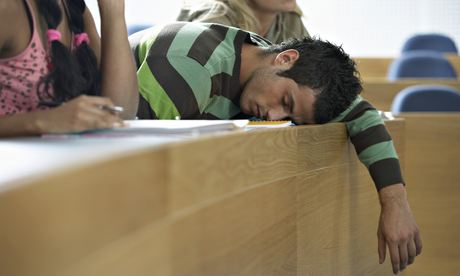
Student Asleep During Lecture

The end of falling asleep throughout courses? A private sixth type in Surrey hopes so. Photograph: Corbis


A personal school is to start lessons for sixth formers at one.30pm simply because teenagers “have a biological disposition to going to bed late and struggling to get up early”.


Hampton Court House in East Molesey, Surrey, believes that the adjust from the typical time of 9am, with courses ending at 7pm, will be far more productive and much less nerve-racking for its students. The staggered begin will also indicate that the pupils can keep away from rush-hour targeted traffic.


Headmaster Man Holloway explained: “There is now a lot more and a lot more scientific evidence to assistance what many parents and teachers have acknowledged for many years.


“The truth is that numerous youngsters do not rest sufficiently for the duration of the week and this can, and usually does, have a considerable effect on teenage cognition and mental and bodily health typically.”


Gabriel Purcell-Davis, 15, at the moment in yr 10 and who will be one particular of the initial to undertake the new regimen, said: “I want to wake up in my bed, not in my maths lesson.”


A school spokesman said: “Dad and mom know it can be a difficult job to preserve regimen in a teenager’s daily life. The independent school, Hampton Court Property, believes that there is a much more productive and anxiety-totally free way to encourage A-level students to concentrate on their educational wants.


“It really is a daring step forward, but a pioneering decision has now been produced by Hampton Court Home to begin lessons for sixth formers at one.30pm rather of the standard time of 9 am.


“The purpose? Current and persuasive research has more reinforced the truth that youngsters have a biological disposition to going to bed late and struggling to get up early.”


Sixth type cancels all morning lessons to assist sleepy college students

8 Mayıs 2014 Perşembe

"I"m depressed and it is frustrating that students will not understand"

A good deal of students are pretty intolerant when it comes to psychological well being concerns, says 22-year-previous John Servante, who suffers from significant depression.


“Most students nonetheless think mental sickness is a myth, that it’s just the result of not enough intercourse, or not having a constructive psychological perspective, or not smoking sufficient weed,” he says.


“They have no notion that psychological problems are genuine neurobiological illnesses. A person confronted me, for instance, about why I so seldom turn up to lectures, and I explained it was since of psychological well being troubles. They just looked at me and explained, ‘Right, so you could actually just go to lectures. It is not like you’re genuinely sick’.”


Servantes, a third-yr English literature pupil at Warwick University, was diagnosed with clinical depression at the starting of his 2nd yr.


In January of that academic year, his university sent him an e mail threatening him with expulsion above bad attendance, even though his private tutor knew about his condition. The university later on put this down to an “admin error”. At the same time, Servante found he was currently being ostracised by other college students.


In March, he set up an anonymous website referred to as A Diary of a Depressed Pupil below the pseudonym Charlie Brown (the anxious tiny boy in the Peanuts comic strip).


“I started the blog since I was getting a miserable time at university and I was threatened with deregistration,” Servante says. “I considered men and women essential to know how folks like me were becoming taken care of, and I wished to vent my frustrations in a way that might increase the social landscape for mentally sick students.”


Servante was overwhelmed by the response from students about the globe, who emailed him their stories of coping with depression at university. A 12 months later on, he made a decision to reveal his identity in the hope that it would give much more students the courage to communicate out.


Servante tells me that throughout bad patches, he suffers from insomnia and often awakens to suicidal ideas: “Your thoughts races with these horrible voices telling you that life’s not worth living – that you have no buddies, no abilities, no well worth.


“By morning, you are exhausted, and you attain this inert phase exactly where your mind’s alive but your body’s dead. With all the will in the world, you can’t do anything at all to get up. If you cry or dribble or something, liquids just run down the side of your face.”


The feelings of worthlessness and despair proceed to haunt him during the day.


“If you make it out of the house, you knowledge this extreme paranoia that absolutely everyone is aware of you’re mentally sick and that they are disgusted with you, that you are so pathetic a mugger would not bother with you,” he says.


“The world gets actually loud with the sounds of your heart beating and your heavy breathing. You may possibly not consume as a form of punishment for being so pathetic, so you’ll starve yourself and not drink.”


At times he sets off in his car, but in no way completes the 20-minute journey to campus: “Even though driving, I go into this state exactly where I really feel that the misery in my head is a bodily issue,” he says. “The up coming point I know, it’s like an hour later, I have missed a seminar, and I am curled up in the foetal position in my auto by the side of the road.”


Servante’s illness has had a significant affect on his relationships with the opposite intercourse. “I’m now going out with a woman who also has depression,” he says. “She’s excellent and we have a lovely relationship, but no way would a non-depressed particular person go out with me.


“I have experimented with it prior to. You begin seeing a woman, you admit that you have a psychological illness and that’s it – they are no longer remotely interested. You are placed firmly in the ‘friend zone’. Or in a worst situation situation, they quit talking to you altogether.”


Servante says there is much more of a stigma about men obtaining depression than women. “I uncover tutors are significantly less sympathetic to male college students with depression, judging by the stories I’ve had through the site and individual knowledge,” he says. “Ladies can speak about becoming depressed and get some sympathy. Guys, even at Warwick, are treated as although they must shut up, guy up, drink much more and have a lot more intercourse.”


He had a “short spell” of counselling at Warwick, but says it was underfunded and of small aid.


“I speedily turned to the NHS and went by means of a lengthy program of cognitive behavioural therapy,” he says. “Undoubtedly – although I’m in no way cured – therapy saved my lifestyle.”


He adds: “I never ever utilized anything like Samaritans since, till my loved ones and friends confronted me about my depression, I was in deep denial. I utilised to put feeling suicidal down to becoming tired or not getting eaten properly. It took me a lengthy time to accept my mental illness.”


Aside from searching for specialist help, he advises college students suffering from psychological sickness to talk to other folks about it.


“If you’re unfortunate ample to locate that individuals you talk to have no empathy, do not give up, simply because you are not alone. No a single must ever come to feel ashamed of an sickness or disability. Talk to people and look for help any way you can.”


You can read through John’s website here.


Depression and Me
Matt Clifton is a 2nd-12 months business management pupil at the University of Essex. In 2012 he commenced a site known as Beat Depression Collectively, that gives assistance for men and women coping with a mental wellness difficulty. Clifton struggled with depression himself as a student, and has now written a guide referred to as Teenage Depression Versus Me.


College students Against Depression
Students Towards Depression (Unhappy) is a resource internet site for college students, but also includes contributions from college students who have selected to share their experiences of depression in order to support others.


If you are going through feelings of depression or have suicidal thoughts, you can ring the Samaritans for free on 08457 90 90 90 or make contact with them on-line.


The pupil counselling support Nightline operates all through the evening for the duration of phrase time – seem at its site to discover a number for your campus branch.


You can also contact psychological overall health charity Thoughts‘s helpline on 0300 123 3393 for guidance – they can advise you on exactly where to seek assist and provide data about medication and kinds of mental wellness problems.


Guardian unique: Perform stress fuels mental overall health troubles in academia


"I"m depressed and it is frustrating that students will not understand"

One particular in 5 college students have taken the study drug modafinil

colourful drugs

A new survey reveals that the use of research drugs is frequent amid students. Photograph: Alamy


One particular in five college students at Uk universities have used the review drug modafinil to examine and remain awake, according to a survey.


The study, carried out by pupil web site the Tab, asked virtually 2000 college students at 41 diverse universities about their use of study drugs.


It found that 1 in five had taken modafinil, a drug which is employed to stop sleepiness and enhance concentration, to help them with their academic operate.


Ally Biring, a latest graduate of the University of the Arts London, says: “Self-medicating is extremely worrying. But students really feel that there is no option. We want to search at what we as a society see as accomplishment.


“College students are investing a good deal of cash into their studies and there is no promise that they will get a occupation. So the competition is fierce. They require to demonstrate that they are the very best and outperform their peers.”


Virtually half of college students who had taken the drug had purchased it online and several reported side effects this kind of as getting a lowered appetite, an inability to sleep and needing to go to the toilet more.


Usually prescribed to treat narcolepsy, the drug is not illegal to purchase but is unlawful to supply. In recent years students have employed the drug to help them focus on their function in the construct-up to exams and deadlines.


An NUS spokeperson explained in the Metro: “With the present labour market, college students may possibly really feel a lot of pressure to do effectively in their research. But taking drugs like these can existing a threat to your wellness, just like something that is not prescribed by a doctor.”


Pupil houses are mouldy and high-priced
Over a third of college students consider their lease is poor worth for money, according to a new survey by Accommodation for College students and Glide. Not only is lease large, but some of you are bailing out your flatmates. Virtually 12% of college students have had to pay out somebody else’s bills, says the survey of one,170 students.


How do you pay for your uni accommodation? Nearly a third said they relied on credit cards or overdrafts to spend their rent, and 65% said they were anxious about funds.


In excess of at the University of York, a survey by Nouse pupil paper this week discovered that 34% of York students feel there is as well significantly mould in their student home.


Poppy ban defeated at Belfast
This week students at the Queen’s University in Belfast proposed a ban on the sale of poppies, saying the poppy appeal is “a politically charged”. Nonetheless, the movement was defeated 40 votes to 15. Final yr the University of London Union brought on a stir when it “boycotted” Remembrance day providers, asking representatives to attend only in a personalized capacity and not to talk for the union.


One particular in 5 college students have taken the study drug modafinil

5 Mayıs 2014 Pazartesi

Does Misuse Of ADHD Medications By Students Constitute Cheating?

College students who are in high stress academic environments usually appear to techniques to help maximize their time for learning and completing school perform. As students really feel much more strain to be successful academically, the notion of gaining an benefit to full numerous tasks and study for exams may possibly appeal to some college students. Aside from the health care risks from using this kind of stimulants for those with no ADHD, the wish to compete and perform has some students taking probabilities in purchase to enhance their academic performance.


So, does casual use of ADHD meds by university college students who study for exams and compose papers constitute cheating?


According to a review presented May three at the Pediatric Academic Societies (PAS) yearly meeting in Vancouver, British Columbia, Canada, near to 20 percent of college students at an Ivy League university reported misusing a prescription stimulant while studying, and one-third of students did not view this kind of misuse as cheating.


imagesStimulants this kind of as Adderrall, Straterra and Ritalin are typically prescribed to treat focus-deficit/hyperactivity disorder (ADHD). However, recent research signifies that college students not diagnosed with ADHD are misusing these medicines in buy to sharpen their concentrate and psychological stamina and enhance their academic performance.



The present study evaluated the prevalence of medicine misuse at a properly regarded ivy league college and no matter whether college students felt that misuse of ADHD prescription drugs constituted cheating.


Investigators evaluated responses from an anonymous online questionnaire in December 2012 from from 616 sophomores, juniors and seniors without ADHD.


Final results indicated that 18 % admitted to misusing a prescription stimulant for an academic reason at least one particular time for the duration of college, and 24 % of these college students utilised these drugs on at least eight occasions. School juniors reported the highest charge of stimulant misuse (24 %).
In accordance to the benefits, 69 % of people who misused stimulants utilised them to publish a paper, 66 % to study for an exam and 27 % to consider an examination.


It turns out that a higher amount who played a varsity sport and were portion of the Greek program reported stimulant misuse compared to college students affiliated with only a single or neither. In addition, a third of college students did not believe that misusing stimulants for academic functions constituted cheating. 41 % thought it was cheating and 25 % were unsure.


“While many colleges tackle alcohol and illicit drug abuse in their wellness and wellness campaigns, most have not addressed prescription stimulant misuse for academic purposes,” said senior investigator Andrew Adesman, MD, FAAP, chief of developmental and behavioral pediatrics at Steven &amp Alexandra Cohen Children’s Healthcare Center of New York. “Because several students are misusing prescription stimulants for academic, not recreational functions, colleges should develop certain plans to tackle this concern.”


Stimulant misuse can also lead to health-related problems which includes resulting nervousness and withdrawal in these who do not have ADHD right after they stop utilizing the medicines, but could also set off cardiac arrhythmias this kind of as SVT, atrial fibrillation or atrial tachyarrhythmias in those at risk– as effectively as trigger harmful complications in those with congenital unknown underlying arrhythmias such as Wolf-Parkinson-White syndrome (WPW). Pediatricians want to be mindful of these underlying risks, discussing this with parents and assessing ADHD sufferers who might match a profile for stimulant abuse.


“To the extent that some substantial school and university college students have reported feigning ADHD symptoms to acquire stimulant medicine, must doctors turn out to be far more cautious or conservative when newly diagnosing ADHD in teenagers? In addition, ought to pediatricians do much more to educate their ADHD patients about the wellness consequences of misuse and the legal consequences that could arise if they promote or give away their stimulant medication?”, explained Adesman.


In accordance to Natalie Colaneri, principal investigator for the research, and study assistant at Cohen Children’s Medical Center, it is crucial to comprehend the moral as well as ethical implications of stimulant misuse not only in university, but also in higher college in which this trend may have its roots.


“It is our hope that this review will improve greater awareness and prompt broader discussion about misuse of medicines like Ritalin or Adderall for academic purposes,” explained Colaneri. “It is crucial that this concern be approached from an interdisciplinary point of view: as an concern relevant to the practice of medication, to larger schooling and to ethics in present day-day society.”


Does Misuse Of ADHD Medications By Students Constitute Cheating?

10 Nisan 2014 Perşembe

GPs" exams disadvantage ethnic minority students, says high court judge

A GP

International health care graduates are nearly 15 occasions more likely to fail the CSA than white Uk graduates. Photograph: Andrew Matthews/PA


A substantial court judge has warned the body responsible for conducting GPs’ exams that it need to adjust its evaluation method after acknowledging that ethnic minority healthcare graduates were place at a disadvantage by the recent method.


At a judicial evaluation in central London, Mr Justice John Mitting rejected a claim by the British Association of Physicians of Indian Origin (Bapio) that the clinical skills assessment (CSA), which includes position-playing assessments, should be declared unlawful.


He stated that the Royal School of Basic Practitioners (RCGP) was neither racially discriminatory nor in breach of its public sector equality duty. But he explained that there was a disparity in outcomes amongst different groups and the RCGP should take action.


“If it does not act and its failure to act is the topic of a more challenge in the future, it may possibly nicely be that it will be held to have breached its duty,” he said. “But, as of now, I am content that it’s not in breach of its duty.”


The court heard that United kingdom graduates from ethnic minority backgrounds were almost four instances much more most likely to fail the CSA, and worldwide healthcare graduates had been practically 15 occasions more very likely to fail than white Uk graduates. The CSA was launched in 2007 and is taken at the finish of three years of vocational instruction.


Mitting mentioned the RCGP had carried out numerous assessments that identified the disparity in performance amongst various groups and that it must now take action, like by picking a lot more representative examiners and role-gamers for the assessment.


He said he was happy that the CSA “place south Asians of both categories [Uk-educated and people who studied overseas] at a disadvantage” but he described the assessment itself as “proportionate” and designed to accomplish “reputable ends”.


Mitting said the relative functionality of worldwide healthcare graduates could be explained, at least in component, by inferior education techniques overseas. He described the number of individuals who failed as quite modest.


Mitting stated the declare had been brought in great faith and in the public curiosity, expressing hope that it would lead to progress. “The bringing of this claim is probably, in the finish, to deliver some thing of advantage to the medical profession,” he explained and concluded by describing the final result for Bapio as “if not a legal victory then a moral accomplishment”.


Bapio president Dr Ramesh Mehta was heartened by the judge’s concluding remarks. “Though we could have lost the battle at this time, we come to feel we have won the war because the judge has also mentioned to the RCGP that they should now take action,” he stated.


Bapio’s attorney, William O’Neill, from Linder Myers solicitors explained it would appeal the verdict.


RCGP chair Dr Maureen Baker welcomed the verdict. “We have often been, and remain, concerned by this situation, and are determined to continue to perform with all other interested stakeholders in both knowing it, and looking to treatment it,” she explained. Baker emphasised that the purpose of the CSA was to ensure “GPs meet the highest standards”.


Mitting also dismissed a declare by Bapio towards the Basic Medical Council for a breach of the public sector equality duty, ordering Bapio to pay out expenses capped at £50,000 to be shared among the RCGP and the GMC.


GPs" exams disadvantage ethnic minority students, says high court judge

18 Şubat 2014 Salı

Students to laugh, tweet and bounce on university mental well being day

student mental health day

Students will get component in pursuits for university psychological overall health day. Photograph: Alamy


College students at universities all around the nation will take portion in pursuits like zumba and singing on Wednesday, to raise awareness of mental overall health concerns for university psychological well being day.


The day, set up in 2012 by the university psychological wellness advisers network and supported by Student Minds, is created to market the mental well being of people who dwell and work in higher training.


Routines on offer on campuses close to the United kingdom include jumping on a bouncy castle in Loughborough, drinking free of charge smoothies in Northampton and “laughter yoga” as effectively as tweeting about whether or not you are getting a #goodday or a #badday in York. Other occasions incorporate “tea and chat” and wearing onesies in Sheffield.


Rosanna Hardwick, communications officer at Pupil Minds, says: “Lots of universities are holding occasions on campus, like movie screenings, speaker occasions, meditation and yoga.


“The aim is to draw attention to the particular needs of students when it comes to psychological well being and to get men and women talking about it.


“Students are specifically vulnerable to mental health issues. The transient nature of pupil daily life can generate issues and items like moving away from home for the initial time, being independent and coping with the academic pressures of university, make it difficult.


“The week is made to let college students know what aid is available, like counselling and peer assistance groups.”


The day comes as the Priory group publishes the findings of its survey of 200 students who have mental wellness troubles and come from 18 diverse universities. The research discovered that a single in four students with psychological overall health concerns surveyed was not comfy talking about their difficulties with their peers.


A lack of comprehending, intimidation and the media have been all provided as causes for the social stigma that a lot of felt remained connected to psychological well being problems in the United kingdom.


Almost half of people surveyed said they had skilled a unfavorable backlash as a result of talking about their problems: sixteen% believed they had misplaced friends as a end result of admitting their psychological well being troubles. The exact same variety also explained that talking about their situation led their peers to “not get them seriously”.


First-12 months students had been the most vulnerable to unfavorable therapy by their fellow peers, with half of those diagnosed saying that they had been taken care of in a different way as a consequence.


Depression, anxiousness, tension, anorexia and bulimia have been the most frequent illnesses found in the survey.


In accordance to investigation by the National Union of Students (NUS), 20% of individuals studying consider themselves to have a psychological wellness dilemma. And the quantity of college students searching for counselling on campus has risen by 33% since 2008.


Dr David Kingsley, advisor adolescent psychiatrist at Priory hospital Cheadle Royal says: “Psychological wellness problems are remarkably common in students, like depression, self-harm, anxiety problems and consuming disorders.


“As this is often the first time that they have been away from property, they can really feel isolated and unable to accessibility help for their difficulties. Universities and schools usually offer you counselling and assistance for this kind of students and it is important that they really feel ready to accessibility this.


“It is also crucial that universities and schools aid other college students to understand psychological wellness troubles better. That way college students can access the help they require from their peers and their problems are not compounded by misunderstanding or prejudice from their close friends.”


A spokesperson from Time to Modify says: “We require to do a lot more in colleges and universities to educate and raise awareness about mental health troubles to show just how frequent they are and to aid men and women to come to feel relaxed talking about them.”


University psychological wellness day aims to draw all students’ attention to psychological sickness. Individuals involved intend to get people talking and to stage out that there is assistance obtainable on campus if it is essential.


• To discover out what is going on at your university click right here.


Students to laugh, tweet and bounce on university mental well being day