privatisation etiketine sahip kayıtlar gösteriliyor. Tüm kayıtları göster

23 Ocak 2017 Pazartesi

NHS pathology labs are ripe for privatisation and cuts

“Every sample is a patient … Every sample is a patient …”


I repeat it like a mantra, so that amid the relentless workload we don’t lose sight of who we work for. We say it as we navigate crumbling floors – in one of our labs, a hole in the lino flooring has been patched up with heavy-duty gaffer tape.


In my work, I see only names, not faces. But every sample is a patient, and every patient has hopes, fears, family and friends. Doctors and nurses get to see their charges in the flesh, whereas I see only the flesh. Paramedics and porters see the blood spilt, I see only the blood. Some names become familiar – a premature baby on the neonatal unit, a 90-year-old with a broken hip – but we never see them recover, never witness the reunions and taxi rides home. Not that my colleagues and I need it, but we never hear their thanks. When we stop receiving their samples, we can but hope for the best.


I work in a pathology laboratory and they are involved in 70% of all diagnoses within the NHS, but very little of what we do is known to the public, or indeed, to many of our healthcare colleagues. We are the definition of behind the scenes, providing doctors with the vital information they need to assess and treat patients.


We are the definition of behind the scenes, providing doctors with the vital information they need to assess and treat


The inner-city microbiology lab where I work as a technician processes thousands of samples a week, from A&E departments, GP surgeries, intensive care, maternity units, and everywhere in-between. We run a full seven-day service (including bank holidays), and with biomedical scientists covering the lab throughout the night, I’m happy to say that we make a mockery of Jeremy Hunt’s calls for a 24/7 NHS.


Sadly, and as with the NHS as a whole, we are short-staffed, under-funded and often ill-equipped. I’m often expected to attempt the workload of two members of staff. What little morale remains is nurtured from the ground up, an esprit de corps forged in a shared adversity, and in taking inspiration from colleagues going about their duties with a quiet efficiency.


Throughout the day porters and couriers deliver a constant stream of samples that are immediately triaged. Urgent specimens are processed within a matter of minutes. What might seem to the untrained eye to be an overwhelming mound of bloods, swabs, tissues and every bodily fluid imaginable is swiftly organised; well-rehearsed procedures are carried out so that every diagnostic test is performed with the minimum of delay.


The sheer amount of equipment and consumables necessary for the lab to function often surprises visitors and those new to the job. The NHS is truly a system, with every part reliant on the other. The labs do not stand alone, and indeed, would be worthless if they did so. Just as the pen is of little use without the paper, so the NHS cannot treat its patients without laboratories. The staff themselves are of course any lab’s greatest asset, a biomedical scientist needs years of education and training to become qualified.


Even though it can be difficult to find a moment in which to draw breath, we are forced to confront our fears about the future. The vital ancillary services of estates, cleaning, security and portering (to name but a few) have been tendered out to the private sector within the trust where I am employed, as they have been across the wider NHS.


Financial pressures are causing more and more laboratories to merge, and it is now the case that many individual trusts no longer directly own their pathology services – instead there are “joint ventures” and “partnerships” forced to bid against one another for customers and business.


While efficiency savings are possible, fewer labs equal longer transport times, and longer transport times equal potentially life-threatening delays. At night, our (private) courier company sometimes has to send a driver from 30 miles away to bring an urgent sample to the lab from a hospital five miles from us.


Given how behind the scenes we are, and how fragmented the NHS is becoming, there is an acute dread that pathology is ripe for the picking in terms of
the work we do being tendered-out to private contractors, or the joint ventures themselves morphing into entities no longer under the control of NHS trusts.


We want to cooperate with our colleagues, not compete against them, even if not many realise what we really do. We want to use the best diagnostic tools, not the cheapest ones. We want the time to treat every sample we receive as a patient, not a commodity. Help us to help you.


If you would like to write a blogpost for Views from the NHS frontline, read our guidelines and get in touch by emailing sarah.johnson@theguardian.com.


Join the Healthcare Professionals Network to read more pieces like this. And follow us on Twitter (@GdnHealthcare) to keep up with the latest healthcare news and views.


NHS pathology labs are ripe for privatisation and cuts

16 Ağustos 2016 Salı

Feet first, our NHS is limping towards privatisation | Polly Toynbee

A fish rots from the head, but the NHS may be rotting from the feet. Podiatry is not up there in the headlines, yet what’s going on in that unglamorous zone is an alarming microcosm of the downward path of the health service. This is a story of the NHS in England in retreat and the private sector filling the vacuum.


Related: How much is the government really privatising the NHS?


You know the big picture from the ever-worsening monthly figures: deteriorating A&E, ambulance and operation waiting times, and a steep rise in bed-blocking. As debts pass £2.5bn, the NHS feels the tightening financial tourniquet.


Now look at it through the prism of just one small corner, as seen from the feet up. Every week 135 people have amputations because diabetes has caused their feet to rot: their circulation goes and then the sensation in their feet, so they don’t notice damage done by rubbing shoes, stubbed toes or stepping on nails. Minor injuries turn into ulcers that if left untreated turn gangrenous, and so the toes, then the foot, then the leg are lost – horrific life-changing damage. Numbers are rising fast, with nearly three million diabetics. The scandal is that 80% of these amputations are preventable – if there were the podiatrists to treat the first signs of foot ulcers. But the numbers employed and in training are falling.


In his surgery, the head of podiatry for Solent NHS Trust, Graham Bowen, is unwrapping the foot of a lifelong diabetic to reveal a large missing chunk of heel, a great red hole nearly through to the bone. This man has already had some toes amputated. He has been having treatment with maggots, bandaged into his wound to eat the dead skin and help healing – and he is slowly improving. Everyone Bowen sees now is at similarly high risk. Small ulcers, incipient ulcers, the ones that need to be caught early (and cheaply) no longer get NHS treatment. “On the NHS we’re essentially firefighting the worst cases now,” says Bowen. “We are going through our lists and discharging all the rest of our patients.”


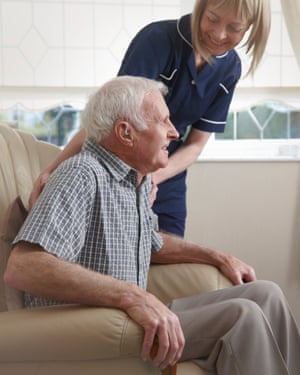
Carer helping elderly man


‘On a 15-minute visit carers can’t check feet.’ Photograph: Andrew Bret Wallis/Getty Images

But not even all these acute patients get the same optimal treatments, due to the vagaries of the 2012 NHS Act. Solent, a community trust that covers mental health and a host of other services, is used by five different clinical commissioning groups (CCGs), including Southampton, Portsmouth and West Hampshire. Each has its own criteria for what it will pay for, and each is toughening those criteria. Depending on their address, some patients get the very best, others only get what their cash-strapped CCG pays for.


You need to know about diabetic feet to understand the difference in treatments: the conventional and cheapest treatment is a dressing and a removable plastic boot, and telling patients to keep their foot up for months. But patients who can’t feel their feet tend to take off the boot and hobble to make a quick cup of tea. “Ten minutes of putting pressure on the ulcer undoes 23 hours of resting it,” Bowen says, so it takes 52 weeks on average to heal ulcers that way. For £500 extra, a new instant fibreglass cast saves any pressure on ulcers and cures them within eight weeks.


Although the National Institute for Health and Care Excellence says this total-contact cast is the gold standard, most of Bowen’s CCGs won’t pay for it. I watched him putting one on a patient in under half an hour: after nine weekly replacements, that ulcer would be completely healed. For every 10 of the new casts, one amputation is prevented – and each amputation costs the NHS £65,000. Such is the madness of NHS fragmentation, divided between multiple commissioners and providers, all in serious financial trouble, that no one spends a bit more now for others to save later, even when the payback is so quick.


This clinic lost four podiatry posts to save money: though diabetic numbers soar, its budget has been static for five years. “Doing more for less,” he says with the same weary sigh you hear echoing through the NHS. As Bowen goes through the clinic’s books removing all but the most acute cases, he turns away diabetics whose problems should be caught early. He turns away others he used to treat: the old and frail who have become immobile due to foot problems; the partially sighted or people with dementia who have poor home care. On a 15-minute visit carers can’t check feet and find out if they are the reason someone doesn’t get out of bed, toes buckled in, leaving them needlessly incapacitated and heading for residential care sooner than necessary.


What happens to those he takes off his books? “They have to go private, if they can afford it. If not, then nothing.” He used to send them to Age UK, but lack of funds shut that service. Only 5% of podiatry is now done by the NHS so Bowen has set up TipToe, a private practice attached to his NHS clinic. It’s not what he wants, but it keeps prices low and all proceeds go to the NHS.


Next year podiatry trainees, like nurses, will no longer get state bursaries, so fewer will apply


Alarm bells should ring here: how silently the NHS slides into the private sector. Labour leadership contender Owen Smith has flagged up his team’s research showing private practice has doubled since 2010. Now that many CCGs only pay for one cataract, how many go private for the second eye? As the Guardian’s health policy editor, Denis Campbell, has asked, how many more vital treatments will go this way?


Podiatry is the ground floor of the NHS hierarchy. The profession reckons the NHS in England needs 12,000 practitioners but only has about 3,000 – and that’s falling, despite so many high-risk diabetics needing weekly appointments. Next year podiatry trainees, like nurses, will no longer receive state bursaries, so fewer will apply. They tend to be older, with families, unable to take on a £45,000 debt for a job paying around £35,000 per year. Already student places have been cut by nearly a quarter in five years. Most of the 7,000 amputations a year are preventable. A shocking statistic: half of those who undergo amputations will die within two years.


Only in the details of what’s happening on the frontline can we understand the daily reality of Britain’s shrinking state. Step back and ask how it can be that a country still growing richer can afford less quality care than when it was poorer? Is that the country’s choice? As the NHS slides into the private sector, here is yet another public service in retreat.


Feet first, our NHS is limping towards privatisation | Polly Toynbee

15 Ağustos 2016 Pazartesi

Creeping privatisation of the NHS is borne out by the facts

The myriad different bodies that make up the NHS in England and their opaqueness, especially in regards to contracts to provide services, makes mapping the true extent of privatisation of public healthcare difficult.


But the available evidence bears out Owen Smith’s claim that NHS privatisation is increasing. However, it is less of an “explosion of privatisation” that the Labour leadership hopeful warns about and more a gradual, though inexorable, rise in the proportion of the NHS budget that is going to firms such as Virgin Care, Care UK and Bupa. It is also noteworthy that the private sector has been making ever bigger inroads into several key areas of NHS care, notably general practice, community services and mental health care.


Department of Health (DH) figures show that the amount of DH funding that has gone to “independent sector providers” more than doubled from £4.1bn in 2009-10, Labour’s last year in power, to £8.7bn in 2015-16.


Slow release privatisation has also seen the percentage of the DH budget finding its way into private hands rising from 4% in 2009-10 to 8% in the last financial year.


A few privatisation contracts involve huge sums. For example, several GP-led NHS clinical commissioning groups (CCGs) in Staffordshire caused controversy in 2014-15 when they sought to hand 10-year contracts for cancer and end of life care worth £1.2bn to a private provider, though those plans have been held up after NHS England became involved. But most contracts are smaller, sometimes for a few million pounds.


In January, though, Richard Branson’s Virgin Care group – which has won growing numbers of NHS contracts – was awarded a £126m contract to provide a range of health services at hospitals in Kent, including home visits, walk-in centres and care in nursing homes. It is unclear what the impact of that tendering decision will be on the failed NHS bidder, Kent Community Health NHS Foundation Trust, which has lost a key source of income.


Similarly, there are serious concerns about the effect on Southport and Ormskirk NHS Trust now that West Lancashire CCG has opted to outsource a range of urgent care services, such as GP out-of-hours services and walk-in centres. Having rejected its local acute trust’s bid the CCG remains in talks with United Healthcare and Virgin Care about the contract.


“This group of people [the CCG] are taking decisions which are destabilising the future of our local hospital and could lead to NHS services being privatised,” local Labour MP Rosie Cooper said recently. Local residents were disgusted, she added. In its response, the CCG said: “This re-procurement of local community health services is standard practice for CCGs. This process is subject to national procurement legislation which requires the CCGs to enable both NGS and independent [private] providers to compete.”


Will this creeping privatisation continue? Almost certainly. The NHS’s financial squeeze, coupled with private firms’ ability to undercut NHS providers, plus the obligation imposed on CCGs by the coalition’s shakeup of the NHS in 2012, together mean that more and more CCGs are likely to feel obliged to outsource more and more contracts, despite concerns about the quality of service that may ensue.


Concern about the quality NHS-funded inpatient care for mental health problems in Priory hospitals is merely the latest reminder that private providers do not always meet the highest standards.


Concern about NHS privatisation has grown since the Conservatives won last year’s general election.


Some in the healthcare profession, such as Dr Kailash Chand, who until recently was the vice-chair of the British Medical Association, see growing outsourcing as part of an unacknowledged Tory plan to deliberately run down the NHS and pave the way for the replacement of its unique funding model with a new setup in which private health insurers and private medical care are central.


Last month the then health minister George Freeman called for an end to the “apartheid” between the NHS and private sector.


“In my party, we have to end the apartheid that suggests the private sector does all the innovation and entrepreneurship and the public sector just treats people … The NHS is the great engine of innovation that can drive that partnership,” he said in a speech to the Reform thinktank. There also needed to be “a debate about how we fund health and care in the 21st century”, he added. Freeman has since acquired a position of much greater significance under Theresa May, as chair of her policy board.


Creeping privatisation of the NHS is borne out by the facts

Owen Smith to target Tories over threat of NHS privatisation

Labour leadership hopeful Owen Smith is to hit out at the threat of creeping privatisation in the NHS, highlighting Department of Health accounts showing that spending on private-sector NHS providers has doubled under the Conservatives.


In a speech on Monday at a campaign trail stop at Trafford General hospital in Manchester, Smith will say that a Labour government led by him would boost health spending by 4% a year, suggesting there is “a secret Tory plan to privatise the NHS”.


Department of Health accounts published on the last day before parliament’s summer recess showed the spend on private-sector NHS providers more than doubled, from more than £4bn in 2009-10 to £8.7bn in 2015-16.


Smith’s early campaign has been dogged by accusations that he lobbied for further private-sector involvement in the NHS during his time as policy chief at the pharmaceuticals companies Pfizer. During his career as a lobbyist for the US firm, Smith had called on ministers to improve incentives for the pharmaceutical industry.


His speech on Monday will attempt to divert attention to his time as shadow health minister, saying that he “fought the Tories’ top-down reorganisation of the NHS line by line”. He will say: “I warned that it would lead to an explosion of privatisation – and that is exactly what has happened.”


Smith, a former shadow work and pensions secretary, has previously claimed it was a gross exaggeration to suggest he had campaigned for more privatisation of NHS services while at Pfizer, and suggested it had been an error for Labour to advocate greater choice over care providers.


He will focus his efforts on health policy a day after Corbyn’s announcement about plans for a national education service based on NHS principles.


Owen Smith to target Tories over threat of NHS privatisation

1 Nisan 2014 Salı

NHS fees strategy is a turning point in privatisation

protest agains the health and social care bill

A protest in 2011 towards the health and social care bill, which ‘opened the floodgates for complete-scale privatisation of the NHS’. Photograph: Demotix / melpressmen/Demotix/Press Association Pictures


The kite flown by a rightwing thinktank that everyone must have to shell out for access to healthcare (£10 each and every can conserve the NHS, 31 March) marks a critical turning point in switching in the direction of a fully paid-for overall health services. This approach has been lengthy planned. 1st Blair encouraged and then pressured NHS hospitals into turning into independent basis trusts, self-standing suppliers within a competitive industry. Cameron took this considerably additional by ruling that all NHS functions would be open to tender by any experienced supplier. The Lansley overall health and social care bill, hatched in deepest secrecy before the 2010 election with not a word about it in the Tory manifesto so that it had no electoral mandate, opened the floodgates for full-scale privatisation of the NHS. But usually the mantra was repeated that the NHS would continue to be “cost-free at the stage of support”. Now that assurance is being kicked away.


The thinktank authors decry the NHS as “an outdated, cosseted and unaffordable healthcare technique”. They do not mention that the Tory government has deliberately imposed a £20bn reduce in NHS funding in excess of the existing five-12 months time period to place it below intolerable strain and perhaps breakdown in purchase to pave the way for a gradual switch to a entirely paid-for personal support, which has often been their secret aim, just like prior to 1948. Nor do they mention that the NHS, at a price of 8% of GDP, is the most expense-productive in the world, half the comparative expense of the private US healthcare technique.


We now see why the Tories have been so keen to demean the NHS on each and every event in excess of the past couple of months. Cue the want to junk the previous, failing NHS and announce the dawn of a brand-new, burnished private healthcare method – and at a bargain price of £10 a month. But keep in mind tuition charges: capped at £3,000, then trebled. If every Uk grownup paid £10 a month, this new tax would increase £5.4bn. Treble that, or a lot more, and we’re speaking significant cash for the healthcare privateers.
Michael Meacher MP
Labour, Oldham West and Royton


• How dare Norman Warner and Jack O’Sullivan denigrate the NHS in such strident terms? I refer them to the meticulously documented report in August 2013 by Dr Don Berwick, who was commissioned to investigate patient security in the NHS. Berwick recognised that healthcare is political and that the existing sustained denigration of the NHS is an ideological campaign which smears “a globe-leading instance of dedication to health and healthcare as a human correct” that should be emulated, and that even though the NHS does have patient safety troubles, so “does each other healthcare technique in the world”. Noting that huge changes are needed, Berwick also says the achievements of the NHS are enormous and suggests that “drama, accusations and overstatement” are ideal avoided.


Reform, which published Warner and O’Sullivan’s report, believes that “by liberalising the public sector, breaking monopoly and extending option”, high-high quality solutions can be made available to absolutely everyone. Current experiences with private companies to the NHS in Cornwall and Suffolk, for instance, indicate otherwise. Reform was set up by a Conservative MP and a Tory strategist. The membership of Reform’s advisory board displays that it is funded by private businesses, with chief executives, chairmen and directors of main pharmaceutical organizations, worldwide investment banking institutions, and accountancy firms constituting the vast majority of board members. Could there be an ideological or probably even some other agenda right here?
Gwen Parr
Pulborough, West Sussex


• It is very misleading to describe the thinktank Reform as “independent”. In 2012, its leading six funders incorporated Prudential Insurance coverage, KMPG (consultants concerned with the NHS), McKesson (a pharmaceutical distributor and healthcare data business), Baxter (a private healthcare company) and BMI (which runs 66 hospitals and treatment centres in the country). These organisations all have a vested curiosity in the tendering out and privatisation (“reform”) of the NHS and in reviews that help the idea of charging for NHS companies.
Sean de Podesta
Brighton


• It would have been excellent if the Guardian had described Norman Warner’s and Reform’s vested interest in criticising the NHS. Warner is an advisory board member of Synlab, a German company involved in NHS privatisation, although Reform is funded by BMI Healthcare, Serco and Sodexo – organisations that have significantly to acquire from the break-up of the heath services (hat-tip to @SolHughesWriter on Twitter for this data).
Ian Sinclair
London


• The suggestion of an NHS membership fee is the newest instance of weird and unsocial reasoning. Folks apparently won’t place up with tax rises to assist the NHS so let us complicate matters by charging charges. How does that help – except if the motive is to exclude these unable to shell out the fee from NHS solutions? The denigration of tax leads to decrease taxes, major to reductions in public services, which leads to the wealthy paying for private medicine, personal education and, one day no doubt, private street lighting and refuse collections, leaving the dispossessed with ever-dwindling providers.
Peter Cave
London


• Alternatively, Warner and O’Sullivan could propose a .05% rise in income tax, to raise approximately the exact same sum, but with no added collection charges, as opposed to their scheme, which, if it is something like road tax, would lose over half the amount collected in administration.
Rod Parfitt
Cleeve, Somerset


• I go through with curiosity your report on a potential £10 per month membership for the NHS. As a surgeon in the NHS, 1 of the key issues I encounter with planned and emergency surgery is weight problems. Most obese patients are aware of the overall health consequences of their weight problems nevertheless, they will not look to know of the hazards they encounter for stomach surgical treatment. Simply moving them on and off an operating tables can be hazardous for the employees alone. The dangers of surgical procedure and submit-operative problems can lead to a prolonged recovery with a threat of main disability. Possibly there need to be an elevated membership fee in line with BMI?
Kathryn McCarthy
Consultant surgeon, Bristol


• Great juxtaposition of headlines on page two on Monday: “Spend £10 a month to use the NHS” and “Poorest properties face £120 council tax rise as security net goes”.
Jeanne Warren
Garsington, Oxfordshire


• The wellness sector regulator Check is committed to parity of esteem for bodily and psychological health providers, and is not recommending that funding for psychological overall health providers need to be cut by twenty% much more than for acute hospitals (Mental health solutions want targeted investment, not even far more cuts, 26 March). Beneath the NHS payment technique, national rates are not set for psychological health services. Pricing choices for psychological wellness companies are manufactured at regional level by commissioners and suppliers, who are anticipated to have regard to the national principles but can make their very own value adjustments where there are very good causes to do so.
Professor Ric Marshall
Director of pricing, Keep track of


NHS fees strategy is a turning point in privatisation