japan etiketine sahip kayıtlar gösteriliyor. Tüm kayıtları göster

8 Şubat 2017 Çarşamba

UK second only to Japan for young people"s poor mental wellbeing

Young people in the UK have the poorest mental wellbeing in the world – with the exception of Japan – and list money, getting on in life and the rise of terrorism among their greatest concerns, according to an international survey of 20,000 youngsters.


The study ranks the UK 19th out of 20 countries in its survey of wellbeing, with young people in the UK aged 15-21 lagging behind comparable cohorts in France and Germany, as well as those in countries such as Israel, Turkey, Russia and China.


Indonesia, India and Nigeria scored highest on the wellbeing scale, with scores of 56.2, 54.4 and 53.9 respectively (the highest possible score being 70), whereas Japan scored the lowest at 41.3, followed by the UK (47.3), New Zealand (47.6), and Australia (47.9).


Mental wellbeing graphic

Just 15% of UK youngsters surveyed felt they had good physical wellbeing, measured by regular exercise, sufficient sleep and time for rest and reflection – which was comparable with France (14%) but lower than most countries including Germany (21%), Italy (21%), and Nigeria which scored highest at 41%.


The report was compiled by the Varkey Foundation education charity and used the Warwick-Edinburgh Mental Wellbeing measure, which asks respondents whether they feel optimistic, confident, loved, and interested in other people. The results found a significantly greater sense of wellbeing among young people in emerging economies compared to those in Europe, North America and Australasia.


Extremism and the rise of global terrorism was the issue which made young people in the UK more fearful for the future than any other factor (83%) – a position shared by young people in 13 of the 20 countries, though young Chinese people who took part in the survey identified climate change as their greatest concern.


Moral outlook graphic

Vikas Pota, chief executive of the Varkey Foundation, said: “At a time of nationalist and populist movements that focus on the differences between people, the evidence shows that young people – whatever their nationality or religion – share a strikingly similar view of the world.


“Teenagers in Nigeria, New Delhi and New York share many of same priorities, fears, ambitions and opinions. There is far more unity among young people than a glance at the headlines would suggest. Young people are passionate believers in the right to live the life that they choose, whatever their background, free of prejudice of all kinds.


“However, they are a generation that is deeply pessimistic about the future of the world. They are not strongly influenced by politicians and think that governments are doing far too little to solve the refugee crisis – one of the greatest challenges of our age.”


On global challenges facing the world, nearly half of young people (48%) in the UK said they thought the government was doing too little to solve the international refugee crisis – compared to 72% in Brazil and 16% in Turkey, which scored the lowest on this measure of any country surveyed.


There were mixed responses to questions about immigration, with 31% of British youngsters in favour of the government making it easier for immigrants to live and work in the UK, while 26% thought it should be more difficult. There was greater support for legal migration in Germany (37%), Italy (38%) and the US (38%), but less in France (27%).


More than half of young people in the UK (54%) said money worries were among their top three causes of anxiety. And asked about their most important value, more UK youngsters chose “working hard and getting on in life”, rather than honesty, tolerance, kindness to others, helping their family, or looking after the world beyond their community.


Fears for the future graphic

Young people in the UK are however noticeably enthusiastic about their country, with more than two-thirds (67%) agreeing it is a good place to live, compared to just 4% who think it is a bad place to live. In France the comparable positive figure was 51%, in Germany 75%, and in Canada 87%.


Nevertheless the report suggests a strong sense of pessimism about the future among young people worldwide with 37% overall convinced that the world is getting worse, compared to 20% who think it is getting better. Young people were at their most pessimistic in France, Italy and Turkey where more than half (53%) feared the world was deteriorating.


In contrast, the most optimistic youngsters are to be found once again in emerging economies – 53% of young people who took part in the survey in China and 49% in India believe that the world is becoming a better place.


And on a positive note, the survey, conducted by Populus, showed widespread support from young people around the world for liberal values of tolerance and equality – 63% support legal same-sex marriage; 89% support equal treatment for men and women and 74% are in favour of equal rights for transgender people.


The report, called What the World’s Young People Think and Feel, compares the experiences of teenagers and adults known as Generation Z, who were born around the turn of the millennium in Argentina, Australia, Brazil, Canada, China, France, Germany, India, Indonesia, Israel, Italy, Japan, New Zealand, Nigeria, Russia, South Africa, South Korea, Turkey and the US, as well as the UK. It is thought to be the first international comparative study of the attitudes of young people on this scale.


UK second only to Japan for young people"s poor mental wellbeing

18 Ekim 2016 Salı

Could Japan Hold The Secret Of Living To 115 Years Old?

[unable to retrieve full-text content]

Japan boasts the highest average life expectancy in the world — with females averaging around 87 years, and males just over 80 years. The recipe for a long life could perhaps be excavated by looking at some of the more distinctive characteristics of the Japanese example.


Could Japan Hold The Secret Of Living To 115 Years Old?

18 Ağustos 2015 Salı

Three Scottish scouts taken care of for meningitis soon after Japan trip

The Scottish well being authorities have contacted about 4,000 British scouts who took part in a jamboree in Japan following 3 from the north of Scotland required therapy for meningitis.


The precautionary letter from Overall health Protection Scotland mentioned whilst the danger of an additional case was very slight, it was sensible to be aware of the signs and symptoms, which incorporate vomiting, serious headache, stiff neck and seizures.


The HPS letter, dated 14 August, mentioned the 3 Scottish scouts were recovering nicely after currently being treated with antibiotics.


Jim McMenamin, a advisor epidemiologist, wrote: “I value this news may possibly lead to some anxiety but please be reassured that as a result far no other cases have been reported from scouts from other elements of the Uk or from other international nations attending the jamboree. The occurrence of this sickness is unusual and the danger of one more case amongst individuals attending the jamboree is quite small.”


Even so, the Associated Press reported that Sweden’s public well being company explained on Monday that one particular Swedish participant was most likely to have contracted the condition at the jamboree, and that two other cases had been below investigation.


An estimated thirty,000 scouts from around the world attended the 12-day event that ended on 8 August in Kirarahama in western Japan, like 4,000 from Britain. The jamboree incorporated a go to to the Hiroshima Peace Memorial Museum as portion of the 70th anniversary of a nuclear bomb being dropped on the city.


In his letter, McMenamin stated not all of indicators and symptoms of meningitis might demonstrate at once, but somebody with the sickness could grow to be really ill. The sickness might progress in excess of one or two days, but can develop really quickly, occasionally in a matter of hrs.


Meningitis, an infection of the meninges (protective membranes that surround the brain and spinal cord), can be caused by bacteria or a virus. It leads to the meninges turning into swollen, which can harm the nerves and brain. The early signs can be like poor flu, but diagnosis in the early phases can be difficult.


McMenamin mentioned laboratory and other data indicated that the chance of infection appeared confined to the little group of scouts in the north of Scotland who attended the jamboree and individuals in households of the 3 confirmed instances.


Three Scottish scouts taken care of for meningitis soon after Japan trip

5 Mart 2014 Çarşamba

World"s oldest man or woman celebrates 116th birthday in Japan

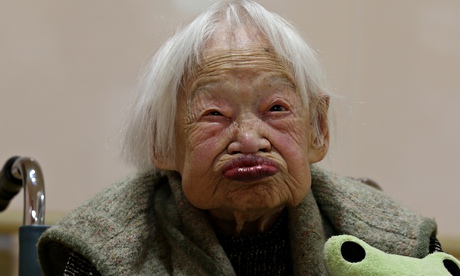
Misao Okawa

Misao Okawa, the world’s oldest girl, celebrates her 116th birthday at her nursing house in Osaka. Photograph: Buddhika Weerasinghe/Getty Pictures


The world’s oldest person, Misao Okawa, has celebrated her 116th birthday – as it was unveiled a lot of rest and a varied diet are the tricks to her lengthy and healthy daily life.


Okawa, who became the world’s oldest person final June following the death at 116 of fellow Japanese Jiroemon Kimura, was provided a cake with just three candles at her nursing property in Osaka – one particular for each and every figure in her age.


Okawa is one of only five men and women alive – all women – confirmed as having been born in the 19th century.


While she has spoken of her really like mackerel sushi, which she eats at least after a month, Okawa is not notably fastidious when it comes to meals.


“She eats sushi, her favourite, and whatever she likes – beef stew, spaghetti, or sashimi – every day,” said an worker of the nursing home in which Okawa has lived for the past 18 years.


“She always says the secret to residing a prolonged time is to consume a very good meal and chill out,” the worker additional. For Okawa, that means an uninterrupted eight hours’ rest each and every evening.


In 1898, the yr Okawa was born, the Spanish-American war was in its infancy and Queen Victoria was still on the British throne. Okawa married in 1919 but her husband died in 1931, much more than eight decades ago. Their marriage produced 3 kids, two of whom are even now alive and in their 90s. Okawa has four grandchildren and six fantastic-grandchildren.


Okawa has dealt with the media interest with incredulity.


When notified that she was in line to become the world’s oldest female last 12 months, she reportedly stated: “Have I genuinely lived that lengthy?”


The centenarian, one particular of about 24 Japanese alive who have passed the 110-12 months milestone, claims she has been unwell, and speedily recovered following breaking her leg in a fall at the age of 102. “She is in excellent form, and is even nonetheless gaining bodyweight,” the nursing home worker explained.


Authorities attribute Japan’s enviable longevity statistics to its traditional lower-excess fat diet, reasonably priced wellness care and good pensions.


Other research stage to the rewards of staying energetic and paying time with family and buddies.


Japan was house to much more than 54,000 centenarians last yr and its elderly population will soar in the coming decades. About a quarter of its 127 million people are currently aged 65 or over, but that is expected to swell to about forty% by the middle of the century.


World"s oldest man or woman celebrates 116th birthday in Japan